

Key Takeaways
Chronic pain drove a man to build a ten-week map back to the present
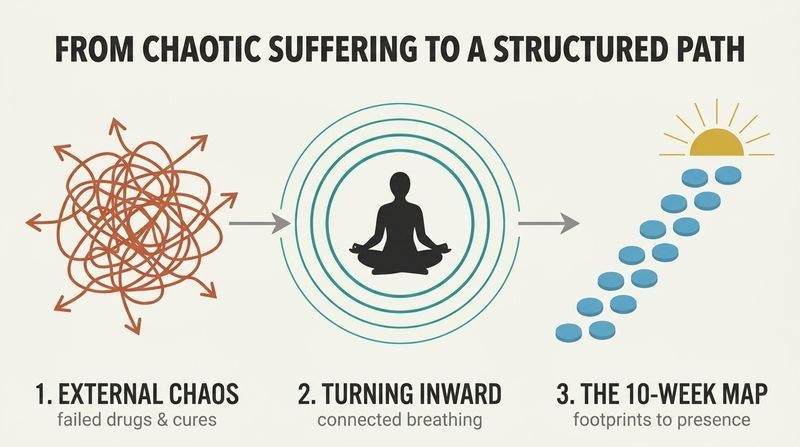
The book grew from suffering. Michael Brown spent nearly a decade tormented by Horton's Syndrome, a neurological condition producing daily agony that doctors called incurable and warned might drive him to addiction or suicide. After failed drugs, cortisone injections, and healers, he turned inward. In an Arizona sweat lodge and through peyote ceremonies, he tasted what he calls Presence: a vibrant, grateful aliveness in which his pain receded.
But substances were signposts, not the road. He sought a method anyone could use without ceremony or drugs, and landed on consciously connected breathing. The Presence Process is the ten-week, self-guided result. Brown insists he is no healer, only a student who charted his own footprints so others could follow more gently.
What's compelling is the origin structure: a wounded practitioner turning affliction into method, echoing figures from Viktor Frankl to countless recovery narratives. The claim that emotional integration resolved a neurological disease is where scientific readers should stay cautious. Conditions like cluster headaches can remit spontaneously, and single-case testimony cannot establish causation. Still, the psychosomatic literature (Gabor Mate, John Sarno) lends partial support to the idea that suppressed emotion amplifies chronic pain. Brown's refusal to franchise trainers or promise cures is unusually disciplined for the genre, sidestepping the guru economy he explicitly criticizes.
You live in "time," a mental prison that skips over the only real moment
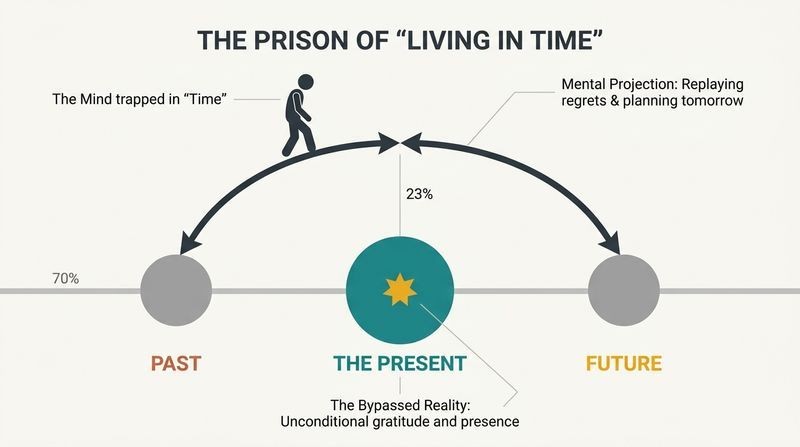
Time is the core diagnosis. Brown argues most of us exist in a chronic mental state he calls living in time: replaying regrets and rehearsing an improved tomorrow, treating right now as a mere means to a future end. The result is that we leapfrog the present, the one place life's vibrancy actually lives. We mistake motion for progress, spinning in circles while believing we advance.
Gratefulness is the gauge. The reliable marker of being present, he says, is unconditional gratitude, not the comparative kind (grateful you have more than someone) but gratitude for existence itself. When you cannot feel grateful simply to be alive, you have drifted into time. Modern automation worsens this: the more life runs itself, the less we participate in the art of living.
This overlaps heavily with Eckhart Tolle, whose publisher released Brown, and with older contemplative traditions naming discursive thought as suffering's root. The novelty is treating time not as a philosophical abstraction but as a diagnosable, addictive perceptual habit. Cognitive science supports the substrate: the default mode network activates during mind-wandering, and Killingsworth and Gilbert's 2010 Harvard study found a wandering mind correlates with unhappiness. Brown's weakness is rhetorical overreach, framing all future planning as illusion, which risks conflating pathological rumination with healthy foresight. His gratitude-as-barometer idea is practically useful and independently validated by positive psychology research.
Breathe without pausing between breaths, twice daily, to anchor attention in now
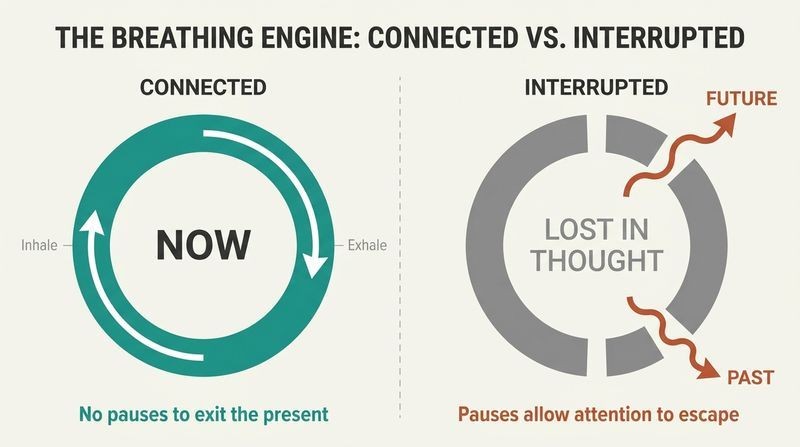
Connected breathing is the engine. For fifteen minutes twice a day across all ten weeks, you breathe rhythmically with no gap between inhale and exhale, effort on the in-breath, letting the out-breath fall like water in a fountain. The point is not oxygen or hyperventilation but accumulating present moment awareness, because you cannot breathe in the past or future, only now.
Pausing reveals absence. Brown observes that humans uniquely insert unconscious gaps between breaths, and these gaps coincide with drifting into thought. Watch a dog or cat: continuous breathing. Sync each breath to the phrase "I am here now in this." Expect resistance in three flavors: physical ("too hard"), mental ("nothing's happening"), emotional ("I feel fine, I can stop"). Falling asleep mid-session is normal; double your tempo to stay conscious.
Connected or circular breathing predates Brown in rebirthing and holotropic breathwork, and he acknowledges the lineage while distinguishing his intent. Physiologically, sustained paced breathing stimulates the vagus nerve and shifts the autonomic system toward parasympathetic dominance, which research links to reduced anxiety and lower cortisol. The insight that breath gaps track mental absence is phenomenologically sharp and testable. One caution: circular breathing can induce tetany and altered states through respiratory alkalosis, so his "no matter what" insistence deserves the medical caveats he sometimes includes. The genius is accessibility, a technique requiring no equipment, belief, or teacher.
Your adult problems are unintegrated childhood emotion repeating on a seven-year loop
Emotional development froze around age seven. Brown's pathway of awareness holds that we enter life emotionally, then mentally (ages 7-14), then physically (14-21). Around seven, formal schooling redirects us from feeling to thinking, effectively halting emotional growth. The charged emotions imprinted before then (received from parents like a baton, what he calls emotional imprinting) never got digested.
So they repeat. Emotionally, he claims, nothing new has happened since childhood; every seven years the same core patterns resurface wearing different circumstances. The adult who asks "why does this keep happening to me?" is feeling a childhood emotional signature, not a new event. Physical and mental symptoms are downstream effects. The cause always sits in the unintegrated emotional body, which is why rearranging your job, partner, or city changes nothing lasting.
The seven-year cycle is Brown's most schematic and least evidenced claim; developmental psychology recognizes rough stages (Piaget, Erikson) but no clean septennial reset, and the notion echoes Rudolf Steiner's anthroposophy more than empirical research. Yet the underlying insight is robust and mainstream: attachment theory, Bowlby, and modern trauma work (van der Kolk's The Body Keeps the Score) confirm that early emotional imprints structure adult reactivity, and that the body stores what the mind suppresses. Freud's repetition compulsion, cited in the foreword, names the same loop. Readers can discard the numerology and keep the causal architecture: treat the root, not the symptom.
Whoever upsets you is a messenger, not the cause of your pain
Upset equals memory recall. Brown reframes every emotional trigger as a messenger sent to reflect your own suppressed charge. The person or event that upsets you is delivering mail; shooting the messenger (reacting, blaming, venting) is futile because the supply is endless. "An upset is a setup." The emotional reaction is a ghost from your past, not a response to what is actually in front of you.
Reflection then projection. When someone reminds you of a parent, that is a reflection; when you start behaving toward them as you did toward that parent, that is projection. The work is to dismiss the messenger gracefully ("I need some time alone"), then turn inward. Family, intimate partners, and coworkers are the chief actors in this staged play precisely because they mirror you most clearly.
This is projection theory (Freud, Jung) repackaged with a memorable delivery-service metaphor. The therapeutic move, disidentifying from the trigger and treating reactivity as information about oneself, aligns closely with cognitive behavioral therapy's cognitive distancing and with Internal Family Systems, which also treats reactions as messengers from wounded parts. The risk of the framework is moral: taken literally, "everyone who hurts you is only your mirror" can excuse genuine abusers and burden victims with total responsibility. Brown partially guards against this by distinguishing discernment from judgment and endorsing boundaries. Used wisely, the reframe transfers locus of control inward, which research consistently links to resilience.
Feel discomfort unconditionally instead of fixing it, because no one can feel for you
Feeling is the integration mechanism. Brown's central practice: when pain or discomfort arises (physical, mental, or emotional), stop running, sedating, or analyzing it. Simply be with it through what he calls felt-perception, with no agenda to fix, heal, understand, or transform. He offers a housesitting analogy: a friend can feed your pets and pass on messages, but cannot "feel on your behalf." Integration, likewise, is non-transferable.
Get better at feeling, don't feel better. The goal is not comfort but capacity. When you place unconditional attention on discomfort, it often amplifies (meaning you are noticing it more), shifts, moves, or dissolves. Any outcome is valid. Deciding in advance what should happen re-binds the energy. This is why he prefers the word integrate over heal: healing assumes something is broken and must be excluded, while integration embraces everything back into wholeness.
This is the operational heart of the book and its most defensible claim. It converges with mindfulness-based approaches, Eugene Gendlin's Focusing (which coined "felt sense"), and acceptance and commitment therapy, all of which show that nonjudgmental contact with sensation reduces suffering more than suppression or reappraisal. Neuroscientifically, affect labeling and interoceptive attention dampen amygdala reactivity. The heal-versus-integrate distinction is philosophically elegant and clinically echoed in trauma therapy's emphasis on titration over catharsis. The main gap: severe trauma often requires a co-regulating other, contradicting Brown's strong solo-work stance. Attachment research suggests presence is often relational, not purely internal.
Recovery covers up the cause; discovery integrates it, so addiction isn't a life sentence
Addiction and affliction are the same effect. Brown treats addictions, chronic illnesses, and even allergies as surface manifestations of one underlying unintegrated emotional charge. Addiction pulls an experience toward you; allergy repels one; affliction expresses it as disease. Self-medication comes in two flavors: sedation (numbing, the alcohol that drowns sorrows) and control (the cigarette that lets you feel in charge).
Attack the cause, not the effect. He is pointedly critical of twelve-step models that, in his view, keep people treading water in "quiet desperation" and simply transfer dependency to the group itself. He calls his alternative a thirteenth step: turning inward rather than outward. He does not demand you quit before starting (forcing abstinence before reducing the charge backfires), but recommends gradually releasing the habit on a second pass through the process, letting the surfacing emotion be felt.
Brown's dismissal of twelve-step programs is his most contentious stance and overreaches. Meta-analyses (including a 2020 Cochrane review) find Alcoholics Anonymous at least as effective as other treatments for sustained abstinence, and its social-support mechanism is a feature, not a bug, given loneliness's role in relapse. That said, his core thesis, that addiction is a solution to unbearable feeling rather than a moral failing or mere chemical hook, is strongly supported by Gabor Mate, Bruce Alexander's Rat Park experiments, and modern trauma-informed addiction science. The transference observation (quitting one habit, gaining another) is clinically real. His medical advisories on not stopping prescriptions unsupervised are responsible.
Chase consequences, not results, because results measure the wrong thing
Results are false idols. Brown draws a sharp line between results (graded, hoped-for outcomes measured against desire) and consequences (inevitable effects of impacting a cause). Entering the process expecting to feel better, make more money, or win someone back is measuring the wrong dashboard. Because the work is causal, its real effects are unexpected and often initially uncomfortable, your experience may seem to worsen as suppressed material surfaces.
Worsening is progress. He reframes discomfort as evidence of authentic impact: "the way out is through, and the way through is in." He also distinguishes abundance from money, health from appearance, and joy from happiness, the former inclusive and unconditional, the latter dependent on "this or that" happening. The mental body, addicted to familiarity, will whisper "better the devil you know" to sabotage change precisely when you near the emotional core (weeks five through eight).
The results-versus-consequences distinction is a useful cousin to James Clear's systems-versus-goals and to process-focused performance psychology, which shows outcome obsession raises anxiety and undermines the very outcomes sought. Brown's insight that healing feels worse before better matches exposure therapy and grief work, where avoidance offers short-term relief at long-term cost. The danger is falsifiability: if feeling better proves progress and feeling worse also proves progress, the framework becomes unfalsifiable and could keep someone in a harmful process indefinitely. His "complete no matter what" instruction needs the counterweight of discernment. The joy-versus-happiness distinction echoes eudaimonic versus hedonic wellbeing research.
You unconsciously recreate childhood's version of love, which is why intimacy keeps souring
Everyone carries one dramatic theme. Brown claims each of us has a single unconscious definition of love, an Achilles heel imprinted in childhood. If love arrived laced with abuse, absence, or conditions, that felt-resonance became your template. So as adults, seeking love, we unconsciously manufacture relationships that recreate the familiar hurt, which is why partners seem to keep "doing this unloving thing."
Relationships reveal it in how they end. Your adult, fairy-tale definition of love (wine, roses, happily ever after) governs how romances begin; your unconscious definition governs how they sour or end. The foreword writer offers his own: "here today, gone tomorrow," choosing partners destined to leave. The exit: stop trying to get love from others and give yourself unconditionally the resonance you crave. Brown's pun for the alternative to grasping is "man-nipple-nation," manipulation, the endless sucking for a source outside yourself.
This is repetition compulsion and attachment-style theory rendered vivid. Research on adult attachment (Hazan and Shaver) confirms that early bonding patterns predict adult relational dynamics, and that people often re-enact insecure templates. The prescription, becoming your own secure base before seeking a partner, aligns with self-compassion research (Kristin Neff) showing internal warmth predicts healthier relationships. The "one primary theme" claim is probably too tidy; most people carry several overlapping wounds. And the giving-to-yourself remedy, while powerful, can shade into spiritual bypassing if used to avoid the genuinely relational repair that ruptures often require. Still, the diagnostic power of examining how relationships end is practically brilliant.
Close the gap: greet the cashier, not the groceries, to end separation
The world lives in the gap between us. Brown's culminating image: because we have separate bodies, we perceive a gap between ourselves and others, and we fill it with "stuff" that we name and assign meaning. That gap is exactly the distance between us and the experience of Presence, which he says is always looking back at us from the other side.
A daily, ordinary choice. Every encounter offers a fork: focus on the items in the gap (the price, the products) or on the Presence across it (the cashier's eyes, a warm hello, "thank you for taking care of me today"). Focusing on stuff widens the gap, a reaction; acknowledging the person closes it, a response. He calls the tool appreciation, noting it means both to value and to increase, whatever you give unconditional attention grows.
Here Brown moves from psychology to nondual metaphysics, and the claim that one shared consciousness gazes through all beings is unprovable, resonating with Advaita Vedanta and perennial philosophy rather than science. Yet the behavioral prescription is grounded and testable: micro-moments of genuine connection with strangers measurably boost wellbeing. Barbara Fredrickson's research on "positivity resonance" and studies by Nicholas Epley showing people underestimate the joy of talking to strangers both support the cashier example directly. The appreciation-as-amplification idea parallels gratitude research and even attention economics. Whether or not one accepts the unified field metaphysics, the practice reliably reduces the felt sense of isolation.
Freedom is responsibility: you constantly correct course like a pilot in wind
Completion is not finishing. Reaching the end of the ten weeks does not mean arrival; it means you have turned your ship out of time-based living and accepted responsibility for the felt quality of your experience. Brown warns against taking your hands off the wheel. He offers a pilot analogy: a plane is rarely exactly on course, buffeted by turbulence, so the pilot continuously compensates. Presence has no autopilot.
Breath is the recovery tool. When life's turbulence knocks you into unconsciousness (confusion, reactivity, projecting fear or anger), the correction is simple: stop and connect your breathing until Presence returns. He redefines free will not as doing whatever you want, but as the capacity to respond consciously to what is required. Reactive behavior, being an emotional photocopy of your parents, is not free at all.
Brown's redefinition of freedom as responsive capacity rather than unconstrained choice is philosophically serious, echoing Viktor Frankl's "space between stimulus and response" and Stoic distinctions between what is and isn't in our control. The pilot metaphor captures a truth that behavior-change research confirms: maintenance, not initial change, is where most efforts fail, and relapse is normal rather than catastrophic. His insistence that unexamined reactivity is inherited and therefore unfree is provocative and largely defensible given how much temperament and conditioning shape behavior. The practical humility here, expecting to drift and simply returning via breath, mirrors the core instruction of every meditation tradition: begin again.
Analysis
The Presence Process sits at the intersection of trauma psychology, contemplative practice, and nondual spirituality, and its distinctiveness lies in packaging profound perceptual work into a structured, self-administered ten-week protocol requiring nothing but breath, attention, and a book. Structurally, it is unusual: a hybrid of instruction manual and initiatory journey, deliberately repetitive because Brown treats repetition as reinforcement for a preverbal "child self" rather than information for the intellect. This makes the book maddening to skim and potent to inhabit, a design choice that is itself an argument against the analytical mind he distrusts.
Intellectually, Brown synthesizes three lineages without always crediting them: Tolle's present-moment teaching (his publisher's flagship), rebirthing breathwork, and shamanic experience. His central causal chain, that suppressed childhood emotion drives adult symptoms, is well supported by contemporary trauma science (van der Kolk, Mate, Levine), even where his packaging (the seven-year cycle, the emotional death at age seven, the unified quantum field) drifts into unfalsifiable or pseudoscientific territory. A discerning reader benefits from separating the durable operational core (feel discomfort without agenda, respond rather than react, treat triggers as self-information, work on cause not effect) from the cosmological scaffolding.
The book's greatest strength is its refusal to commodify: no trainers, no cure promises, no dependency. Its greatest liability is its near-total internalization of responsibility, which risks minimizing genuine external harm, structural injustice, and the relational nature of healing that attachment research emphasizes. Its dismissal of twelve-step programs is empirically weak. The unfalsifiability problem (worse feels like progress, better feels like progress) could trap vulnerable users.
For the right reader, someone stuck in reactive patterns, chronic low-grade suffering, or symptom-chasing, this is a rigorous, humane, and unusually demanding practice. It asks not for belief but for participation, and it delivers its value experientially or not at all.
Review Summary
The Presence Process receives mostly positive reviews for its transformative approach to emotional healing and present moment awareness. Readers praise its practical techniques, particularly the breathing exercises, and report significant personal growth. Many found it life-changing, though some criticized its repetitive writing style. The 10-week process is described as challenging but rewarding, helping individuals integrate past traumas and achieve greater emotional balance. While most reviewers highly recommend it, a few found it too wordy or difficult to follow.
People Also Read

FAQ
What's The Presence Process about?
- Present Moment Awareness: The Presence Process by Michael Brown is a guide to achieving present moment awareness, helping individuals reconnect with their authentic selves.
- Emotional Integration: It emphasizes integrating unprocessed emotional experiences from childhood to achieve emotional balance and clarity.
- Ten-Week Journey: The book outlines a ten-week experiential journey with daily practices like consciously connected breathing to accumulate present moment awareness.
Why should I read The Presence Process?
- Transformative Emotional Integration: The book offers practical tools for integrating suppressed emotions, leading to profound personal transformation and emotional freedom.
- Self-Facilitation: It empowers readers to become their own facilitators in self-discovery and emotional healing, making it a valuable resource for personal growth.
- Holistic Approach: Combining physical, mental, and emotional practices, it provides a balanced and fulfilling life experience.
What are the key takeaways of The Presence Process?
- Emotional Charges: Unintegrated emotional charges from childhood are the root causes of current discomfort, and addressing them can change life experiences.
- Conscious Breathing: Consciously connected breathing is a primary tool for accessing present moment awareness and integrating emotional experiences.
- Response Over Reaction: The book teaches shifting from reactive behaviors to conscious responses for authentic engagement with experiences and relationships.
How does The Presence Process define present moment awareness?
- State of Being: Present moment awareness is being fully aware of the current moment, free from past regrets or future anxieties.
- Gratefulness Indicator: Gratefulness is a reliable indicator of present moment awareness, arising when life is appreciated without conditions.
- Authenticity Connection: Achieving present moment awareness reconnects individuals with their authentic selves, enabling clear and present responses to life.
How does the breathing practice work in The Presence Process?
- Consciously Connected Breathing: This involves breathing in and out without pauses, anchoring awareness in the present moment and facilitating emotional integration.
- Consistency is Key: Practicing for at least 15 minutes twice a day is recommended to accumulate present moment awareness.
- Emotional Integration: The practice allows suppressed emotions to surface, providing an opportunity for integration and healing.
What is emotional imprinting according to The Presence Process?
- Transmission from Caregivers: Emotional imprinting is the unconscious passing of unintegrated emotional conditions from parents or caregivers to children, primarily in the first seven years.
- Influence on Adulthood: These imprints affect current emotional responses and behaviors, often leading to repeated discomfort patterns.
- Integration for Healing: Recognizing and integrating these imprints is crucial for breaking free from past patterns and achieving emotional balance.
How does The Presence Process address addiction and affliction?
- Root Causes: Addiction and affliction are seen as manifestations of unintegrated emotional charges, and addressing these is essential for recovery.
- Self-Medication: The book discusses how individuals use substances or behaviors to cope with discomfort and emphasizes emotional integration instead.
- Empowerment through Integration: By integrating emotional charges, individuals can overcome addictions and afflictions, leading to a more authentic life.
What is the emotional integration procedure in The Presence Process?
- Three-Step Process: It consists of dismissing the messenger, receiving the message, and feeling unconditionally to process emotional responses effectively.
- Felt-Perception Focus: Emphasizes tuning into physical sensations associated with emotions for deeper awareness and integration.
- Transforming Reactions: Helps transform reactive behaviors into conscious responses, fostering emotional maturity and present moment awareness.
What role do "messengers" play in The Presence Process?
- Reflections of Emotions: Messengers are people or situations that trigger emotional responses, reflecting unintegrated emotional states.
- Growth Opportunity: Recognizing messengers provides an opportunity for personal growth and emotional integration.
- Emotional Awareness Key: Understanding messengers helps identify emotional response patterns and guides toward healing.
How can I practice connected breathing as suggested in The Presence Process?
- Daily Routine: Incorporate connected breathing into your daily routine for at least 15 minutes, breathing in and out without pauses.
- Present Focus: Focus on body sensations and breath rhythm to anchor in the present moment and enhance emotional awareness.
- Facilitating Integration: It serves as a tool for emotional integration, allowing effective processing of feelings and experiences.
What changes can I expect after completing The Presence Process?
- Increased Awareness: Expect heightened present moment awareness, leading to a more authentic and fulfilling life.
- Emotional Resilience: Greater emotional resilience and clarity in responding to challenges, improving relationships and well-being.
- Authentic Joy and Peace: Many report feeling authentic joy and peace, enhancing overall life satisfaction and fulfillment.
What are the best quotes from The Presence Process and what do they mean?
- “The way out is through.”: Emphasizes confronting and processing uncomfortable emotions for integration and healing.
- “Presence knows no order of difficulty.”: Highlights that emotional integration is accessible to everyone, regardless of challenges.
- “We are not our body or behavior.”: Reminds that true identity is not defined by appearance or actions, but by presence.
Download PDF
Download EPUB
.epub digital book format is ideal for reading ebooks on phones, tablets, and e-readers.








































