

Key Takeaways
Stop forcing life to happen; let go and it flows
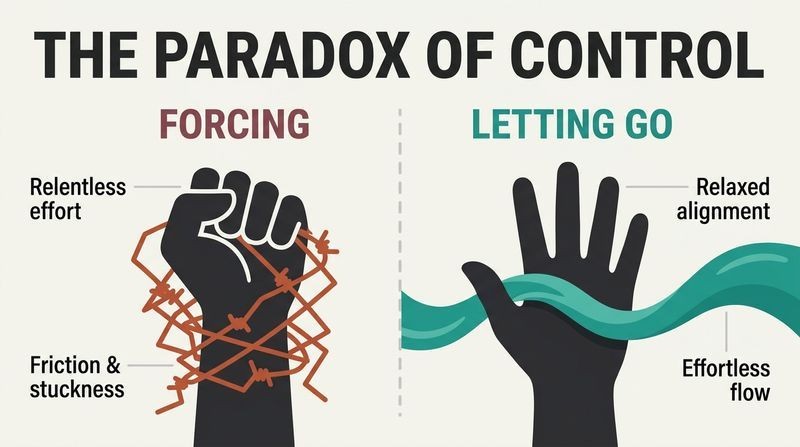
The central paradox. Purkiss, a Cambridge economist turned executive headhunter, argues that the exhausting Western formula (think hard, push relentlessly, control everything) actually keeps us stuck. He describes three categories of desire, and the painful one is what we've chased for years despite huge effort. His claim: the effort itself is the obstacle. When you release your grip, intuition sharpens, useful coincidences multiply, and you take the right action at the right time.
Letting go is not giving up. A common fear is that surrender means passivity. Purkiss insists the opposite happens: once intuition switches on, you often act more, but the action is aligned and stress-free rather than frantic. His own rock-bottom in Paris (failing business, no money, ending relationship, sciatica) resolved only when he stopped trying and asked to be guided.
The thesis echoes the psychology of flow (Csikszentmihalyi) and the paradox of effort in performance research: overtrying activates self-conscious monitoring that degrades skilled action, a phenomenon athletes call choking. Purkiss reframes a genuine cognitive finding through a spiritual lens. The tension worth flagging: survivorship bias. His Paris breakthrough is a compelling single case, and he honestly concedes it isn't statistically significant. Readers should hold the promise loosely. Letting go likely works best not as magic but as a way to reduce the anxiety-driven noise that blocks clear perception and good timing.
Your ego is the illusion that you're separate from everything
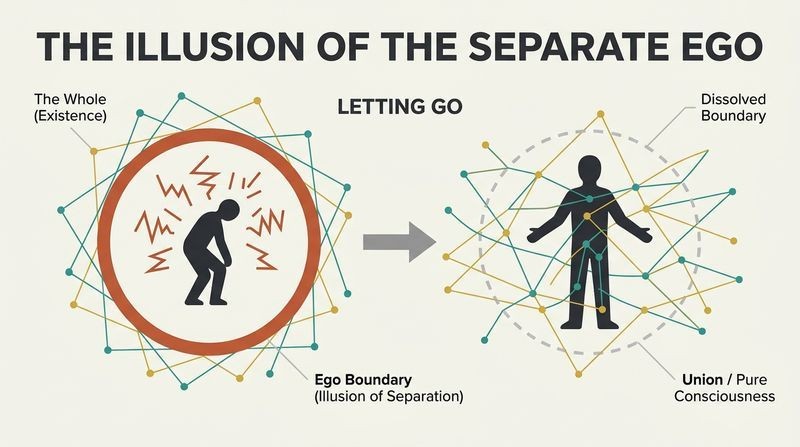
A redefinition, not Freud. Purkiss borrows the Eastern (Vedic, Buddhist, Sufi, Kabbalistic) meaning of ego: the mistaken belief that you are a particular body and mind, cut off from everyone and everything else. This is different from Freud's ego (the realist mediating between instinct and conscience). In Purkiss's usage, the ego is what fights for survival, manufactures dramas, and generates stress.
Existence is the intelligent whole. He calls the vast intelligence running nature (plants, planets, bodies) Existence, a placeholder for what mystics call the Tao, Brahman, the Divine, or the universe. The mistake is imagining we operate outside it. When you drop the sense of separation, life stops being a fight. You discover you are pure consciousness, the screen on which thoughts and feelings are projected, not the flickering film itself.
The screen-and-film metaphor maps neatly onto modern contemplative neuroscience, where practices reducing activity in the default mode network (the brain's self-referential chatter hub) correlate with dissolved boundaries between self and world. What's philosophically interesting is that Purkiss treats the separate self as an error to be corrected rather than a hard-won evolutionary adaptation. A Darwinian would counter that ego-driven boundary-keeping kept ancestors alive. The reconciliation: the felt sense of total separateness may be overactive in modern anxious minds, so loosening it, rather than deleting it, is the practical aim.
Can't stop thinking? Give your restless mind a single job
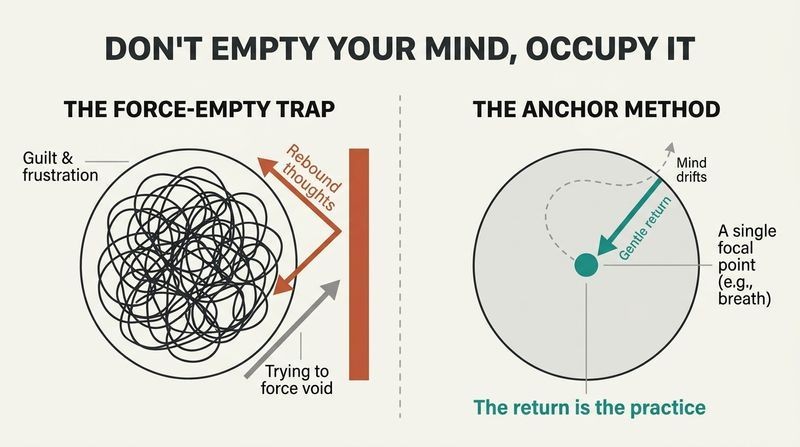
The meditation trick. Most people quit meditation because they try to empty the mind and fail within seconds. Purkiss (who calls the wandering attention the monkey mind, a Buddhist image) says the fix is counterintuitive: don't empty the mind, occupy it. Rest attention on the breath flowing in and out. Every time it drifts, guide it back gently, with no self-judgement. The wandering and returning are the practice, not a failure of it.
Presence as the foundation. He extends this to the five senses and to daily life (pressing thumbnails into fingers to interrupt drift). Being present let him walk calmly into a raging boss's office by feeling the carpet, air, and breath instead of rehearsing catastrophe. The gap between two thoughts, he notes, is a glimpse of pure consciousness.
The insight that concentration needs an anchor rather than a void is well supported. Focused-attention meditation reliably strengthens attentional control, and the non-judgemental return is the actual rep, the mental equivalent of a bicep curl, a point Daniel Goleman and Richard Davidson document in their meta-analyses. Purkiss's boss-corridor story is essentially real-time exposure plus interoception, resembling techniques in dialectical behavior therapy. One caveat: presence dampens reactivity, which is usually good, but the book occasionally implies emotional non-reaction is always superior. Sometimes appropriate anger communicates boundaries. Calm is a tool, not a moral endpoint.
Your stories, labels, and judgements are chatter, not reality
Repetitive thoughts keep you stuck. Purkiss lists the mental habits that block intuition and opportunity: stories, labels, judgements, expectations, comparisons, conclusions, and shoulds. His friend Jacq believed a hidden story (being too successful would make her one of the inequality-creating baddies) that capped her income. Once she saw it and laughed, her business more than doubled in eighteen months.
Even positive labels imprison. Calling yourself a winner or a good father still shrinks you to a temporary bundle of molecules. He uses Shakespeare (nothing is good or bad but thinking makes it so) and the Chinese allegory of the old man who loses a horse, where every good or bad event flips meaning over time, to show judgements are futile. The Latin root of conclude means to shut completely: conclusions slam the door on new possibilities.
This is cognitive defusion, the core skill of Acceptance and Commitment Therapy, dressed in Vedic clothing. ACT research shows that observing a thought as a passing mental event, rather than fusing with it as truth, reliably reduces its behavioral grip. Purkiss's warning about positive labels is the sharper, less obvious point: identity, even flattering identity, becomes something to defend, and defense consumes energy. The horse allegory also anticipates modern affective forecasting research (Gilbert, Wilson), which finds humans are terrible at predicting whether future events will feel good or bad. Suspending the verdict is often simply more accurate.
Re-live old pain until it loses its grip on you
Completion, the book's engine. Beneath repetitive negative thoughts lies stored pain from specific past incidents, often in early childhood, which Purkiss (following the teacher he calls Swamiji) names incompletions or pain patterns. Suppressing them (the British specialty, he jokes) or analysing them (his year of Freudian couch-work solved nothing) both fail. The technique that works is completion: sit before a mirror, look into your own eyes, and re-live the incident aloud at least five times, becoming the age you were, letting every feeling surface. Re-live to relieve.
Why it works. Purkiss traced his own lifelong feeling of being unacceptable to age five, when classmates mocked his accent. His friend Halle dissolved a flying phobia by re-living a childhood rooftop episode; on the fifth pass she felt a weight lift. The memory remains, but the emotional charge drains away, like a book you can reshelve.
Completion strongly resembles evidence-based exposure and memory reconsolidation therapy. Neuroscience shows that recalling a memory briefly makes it labile and rewritable; re-experiencing it in safety can update its emotional tag, the mechanism behind prolonged exposure for PTSD and EMDR. Purkiss's repeat-until-bored instruction mirrors clinical habituation. The mirror element adds self-compassion and self-witnessing. The genuine risk, which the book flags in a note, is that unguided re-living of severe trauma can retraumatize rather than heal. This is powerful for everyday wounds but not a substitute for a trained therapist when the material is heavy.
Whoever annoys you most is holding up a mirror
Your shadow, projected. Borrowing Jung's term, Purkiss argues the traits that infuriate you in others are usually traits you've suppressed and refuse to own in yourself. The proof is the pattern: the same kind of irritating person keeps reappearing across jobs, cities, and relationships because you are the common factor.
His own tells. For years he was surrounded by judgemental colleagues and partners, until he admitted he was intensely judgemental himself. When he finally told an ex she'd been right, she said Finally, and both the friction and the judgemental people faded. Overweight men irritated him until he accepted I can be overweight; soon he noticed them less, and others remarked he'd slimmed. The method: turn each complaint about others (people are so rude) into a question about yourself (when have I been rude?), then embrace the answer.
Projection is one of the few Freudian defense mechanisms with reasonable empirical backing; research by Newman, Baumeister, and colleagues shows people who suppress a trait in themselves are quicker to perceive it in others. Purkiss's recurring-pattern diagnostic is practically useful and testable: keep a list, look for the repeat offender, suspect a projection. The weaker claim is the near-magical bit, that owning the trait makes the annoying people literally disappear or your weight literally drop. The parsimonious reading is perceptual and behavioral: acceptance lowers reactivity and stress-eating, so you notice triggers less and change your own conduct, which shifts how others respond.
Stop trying to be good; aim to be whole instead
Goodness is exhausting. Deciding you must never be judgemental turns you into a constant self-monitor, policing your own thoughts and everyone else's. Purkiss offers a release: accept that you can be anything. Read aloud the paired statements (I can be clever, I can be stupid; I can be generous, I can be mean) until you stop straining to be one thing and reject its opposite.
Wholeness is magnetic. Accepting every facet of yourself makes you feel good, and others feel good around you, which is why relationships form naturally when you stop trying to fix yourself and everyone else. He uses the Marmite principle: the yeast spread people either love or hate. To appeal strongly to some, you must risk repelling others. Hiding your polarizing qualities to please everyone leaves you appealing to no one.
This lands near self-acceptance research and Carl Rogers's paradox: the curious result that accepting yourself as you are is what frees you to change. Suppression is metabolically costly; Wegner's ironic-process work shows that forbidden thoughts rebound harder. The Marmite point is shrewd personal-branding advice grounded in signaling theory: distinctiveness carries information, and universal inoffensiveness is itself a weak, forgettable signal. A useful nuance the reader should add: wholeness means owning your capacity for a trait, not licensing every impulse. Accepting I can be cruel is self-knowledge; acting cruelly is not wholeness. The book means integration of awareness, not abandonment of ethics.
Success loops through surrender, joy, ego, then pain, and back
The four-stage cycle. Surrender, the deepest form of letting go (from the French se rendre, to give oneself up), means releasing goals, memories, and outcomes and following intuition moment by moment. Purkiss maps a recurring loop:
1. Surrender: you let go and immerse in the task.
2. Joy: life takes care of itself, something wonderful happens.
3. Ego: you credit your own effort, feel separate again.
4. Pain: forcing produces patchy results and a setback, which wakes you up to surrender once more.
It speeds up. Early cycles take months or years; with practice, you may run the whole loop in minutes. He warns against mistaking incompletion for intuition: fear-based impulses from unhealed pain masquerade as guidance, so keep completing. Genuine intuition is rooted in love, not fear.
The cycle is a candid, almost confessional model of how insight regresses, and its honesty is its strength: it predicts relapse rather than promising permanent enlightenment, which makes it more usable than tidier frameworks. Stage 3, taking personal credit, is essentially the self-serving attribution bias, well documented in social psychology, and Purkiss cleverly casts it as the seed of the next downfall. The love-versus-fear test for distinguishing intuition from anxiety is intuitively appealing but hard to apply in the moment, since fear is expert at disguising itself as prudence. His safeguard, keep clearing your pain patterns first, is the practical answer to that ambiguity.
Be grateful in the moment; don't hoard your blessings
Gratitude versus counting blessings. Purkiss draws a sharp line. Gratitude happens in the present: you enjoy a cup of tea in the sun and let it go. Counting blessings labels something as yours, so you cling and fear losing it. Genuine appreciation keeps you flowing; ownership makes you anxious.
Practices that shift your baseline. He recommends writing down, last thing at night, everything you appreciated about that specific day (a meal, a laugh, money received), excluding past and future, for at least twenty-one days. He started waking up feeling good instead of low. A Zen exercise: each morning, mentally give away all your possessions one by one, starting with what you value most. He felt lighter and no longer defined by his money. A complaining friend became noticeably more positive within days of trying the gratitude log.
Gratitude journaling is among the most replicated positive-psychology interventions; Emmons and McCullough found regular gratitude lists improve well-being, sleep, and even some health markers, matching Purkiss's anecdotes. His distinction between present-tense gratitude and possessive blessing-counting is subtler than most gratitude advice and aligns with hedonic adaptation research: once we label a good thing as permanently ours, we adapt to it and stop feeling it, then dread its loss. The mental give-away drill resembles Stoic negative visualization (premeditatio malorum), where imagining loss restores appreciation. The convergence of Zen, Stoicism, and modern data on one practice is a strong signal it captures something real.
You manifest your buried beliefs, not your stated desires
Inner determines outer. Purkiss's formula for turning wants into reality: whatever you hold in your inner space is what you create outside. Since most inner space is cluttered with incompletions (all concerning what you don't want), you keep manifesting your fears rather than your goals. Hence the recurring stuckness in one of four areas: health, relationships, career, or money.
The practical sequence. Write down one thing you want that hasn't happened. Sit quietly and let your mind list every reason it can't (I'm too old, not clever enough, not good enough). Those reasons are your incompletions. Complete each one, re-living the original incident until it dissolves. Then surrender and follow intuition. He contrasts this with his old exhausting loop of goal, plan, force, repeat. He also cites how Post-it Notes, the webcam, and Instagram all became something their creators never planned, urging you to stay open about how a desire arrives.
The manifestation framing invites skepticism, and the book distances itself from The Secret's law of attraction by insisting the work is subtractive: clear the blocks rather than visualize the Ferrari. That reframe is more psychologically defensible. Self-limiting beliefs demonstrably shape behavior through self-fulfilling prophecy and reduced effort or opportunity-seeking, documented since Rosenthal's expectancy studies. The honest mechanism is likely mundane: someone who stops broadcasting anxious not-good-enough signals interviews better, negotiates harder, and notices openings. The Post-it and Instagram examples make a genuinely useful point about goal rigidity, echoing effectuation theory in entrepreneurship: fix the destination loosely and stay adaptive about the route.
Admitting you don't know beats pretending you do
Not-knowing as strength. Culture rewards knowing, so people fake certainty. But all knowledge is built from the past, and clinging to it blinds you to what's actually happening now. Purkiss cites an airline analyst whose earnings forecasts were demolished overnight when the oil price halved. The Tao Te Ching line he invokes: presuming to know is a disease.
Escape your bubble. He names confirmation bias (seeking evidence that confirms your beliefs and ignoring the rest) and social media filter bubbles that quietly delete disagreement. His fix is deliberately experiential: read a newspaper aimed at people unlike you, ask genuine questions of those who disagree, visit unfamiliar parts of your city, and put the phone away on public transport. He notes the sharpest fund managers he met read the mass-market tabloids to learn what people outside their bubble were thinking, and spot opportunities first.
Confirmation bias is one of the most robust findings in cognitive science, and Purkiss's remedies are practical versions of what forecasting researchers prescribe. Philip Tetlock's work on superforecasters found the best predictors actively seek disconfirming views and hold beliefs as probabilities rather than identities, exactly the open-minded not-knowing stance advocated here. The tabloid-reading fund managers illustrate epistemic humility as competitive edge, not just virtue. One extension worth noting: bubbles are now algorithmically reinforced far beyond what individual unfriending creates, so deliberate exposure to opposing sources is less a nicety than a necessary counterweight to engineered feeds designed to confirm and enrage.
Analysis
The Power of Letting Go belongs to a crowded genre (spiritual self-help) but distinguishes itself through the unlikely credibility of its author. Purkiss is a Cambridge-trained economist, INSEAD MBA, and working executive headhunter, and he writes as a pragmatist reporting field results rather than a guru issuing decrees. His stated method (test each ancient principle personally, keep what works, explain it plainly) frames the book as applied empiricism, which lowers the reader's defenses against otherwise woo-adjacent claims about yogic body-scanning and desire manifestation.
Structurally, the book is a clean three-stage ladder: let go of thoughts, let go of pain, then surrender completely. This progression maps surprisingly well onto the architecture of modern evidence-based therapy. Stage one is essentially mindfulness and cognitive defusion (ACT). Stage two, the completion technique, functions like exposure therapy and memory reconsolidation. Stage three, surrender, resembles the acceptance and values-driven action that ACT places at its center. The book's real contribution is packaging this therapeutic arc inside an accessible spiritual narrative, with the redefined Eastern ego (illusion of separateness) as the connective tissue.
The intellectual weak points are predictable. Personal anecdote carries most of the evidentiary load, and Purkiss admits his signature Paris-to-dream-job story is statistically insignificant. The body-scanning and manifestation passages strain credibility and may cost him skeptical readers who would benefit from the sturdier core. The reliance on a single controversial teacher (Nithyananda) as the source of the completion technique is a reputational liability the text does not address.
Yet the operational advice is unusually sound: anchor attention rather than empty the mind, re-live rather than suppress or analyze pain, own your projections, practice present-tense gratitude, and clear limiting beliefs before setting goals. Stripped of metaphysics, the book is a lucid manual for reducing the anxious, controlling mental noise that degrades both performance and peace. Its best insight may be the quietest: effort and outcome are not linearly related, and past a point, gripping harder makes things worse.
Review Summary
The Power of Letting Go received mixed reviews, with an average rating of 3.75/5. Many readers found the book helpful for personal growth, stress reduction, and mindfulness practices. Some appreciated the practical exercises and spiritual approach. However, critics felt it was repetitive, lacked scientific evidence, and relied too heavily on anecdotes. The book's focus on spirituality and meditation was polarizing, with some finding it enlightening and others considering it unrealistic or oversimplified. Overall, readers' experiences varied greatly based on their openness to the book's concepts.
People Also Read





Glossary
Existence
The intelligent whole beyond namesPurkiss's placeholder term for the vast intelligence he sees operating throughout nature, from cells to stars. It stands for what various traditions call the Tao, Brahman, God, the universe, or the Absolute. His core claim is that your brain and body are part of Existence, not separate from it, and that surrendering means allowing Existence to act through you.
Ego (Eastern definition)
Illusion of being separateNot Freud's mediating self. Purkiss uses the Vedic and Buddhist meaning: the false belief that you are only a particular body and mind, cut off from everyone and everything else. This ego fights for survival, creates drama, and generates stress. Letting go of it reveals that you are pure consciousness, the unchanging screen behind passing thoughts.
Completion (re-live to relieve)
Re-living memories to release painA technique Purkiss learned from the teacher he calls Swamiji. Sitting before a mirror, you re-live a painful past incident aloud, at least five times, becoming the age you were and letting all feelings surface, until the memory loses its emotional charge. The instruction is to re-live rather than merely recall, and to feel rather than analyze.
Incompletions / pain patterns
Unresolved past wounds ruling youIncidents, memories, and mistaken conclusions from the past that occupy the present and shape the future. Rooted in suppressed emotions from as early as childhood, they run our lives unconsciously, causing recurring stuckness in health, relationships, career, or money. They are cleared through the completion technique. Purkiss says we manifest these buried beliefs rather than our stated desires.
Inner image vs outer image
Hidden self-view versus public maskThe inner image is how you secretly see yourself, often a negative belief formed by early pain (Purkiss's was I'm unacceptable, from being mocked for his accent at age five). The outer image is the persona you project to others (his was I'm clever and friendly). The gap between them causes ongoing problems until completion deactivates the negative inner image.
The shadow
Suppressed traits projected onto othersA term from Carl Jung. It holds everything you refuse to accept about yourself, which you then unconsciously project onto other people. Purkiss's diagnostic: whoever annoys you most reveals a trait you've suppressed. Recurring conflicts with the same type of person signal a projection. Owning and embracing the trait integrates the shadow and makes you whole.
Surrender
Letting go completely of egoThe deepest stage of letting go, from the French se rendre, to give oneself up. You release goals, memories, expectations, and attachment to outcomes, then follow intuition moment by moment. The only thing given up is the ego. Purkiss describes a recurring cycle of surrender, joy, ego, and pain that speeds up with practice until surrender becomes continuous.
Transcendental Meditation (TM)
Effortless mantra meditation techniqueA technique introduced West by Maharishi Mahesh Yogi in 1959, practiced twice daily for twenty minutes using a personal mantra. Purkiss cites research including a study where older people with high blood pressure practicing TM had a 23% reduction in all-cause mortality and 30% fewer cardiovascular deaths versus controls. He reports it removed about 90% of his jet lag.
FAQ
What's "The Power of Letting Go" about?
- Core Concept: The book by John Purkiss is about learning to let go of everything that holds you back in life, such as thoughts, pain, and expectations.
- Purpose: It aims to show readers how to live more intuitively and in sync with the world, leading to a more fulfilling and less stressful life.
- Structure: The book is divided into steps that guide readers through being present, letting go of thoughts and pain, and ultimately surrendering to a higher intelligence.
- Outcome: By following these steps, readers can experience a state of flow where desires are realized more easily and life unfolds naturally.
Why should I read "The Power of Letting Go"?
- Practical Guidance: The book offers practical exercises and techniques to help you let go of mental and emotional baggage.
- Improved Well-being: It promises a reduction in stress and an increase in happiness and fulfillment by aligning with a more natural way of living.
- Universal Relevance: The concepts are applicable to various aspects of life, including health, relationships, career, and finances.
- Spiritual Insight: It draws on ancient spiritual traditions, offering a philosophical perspective that complements its practical advice.
What are the key takeaways of "The Power of Letting Go"?
- Be Present: Focus on the present moment to reduce stress and improve decision-making.
- Let Go of Thoughts: Release repetitive and negative thoughts that keep you stuck.
- Let Go of Pain: Address and release past pain that influences your current life.
- Surrender: Embrace a state of flow by letting go of control and trusting a higher intelligence.
How does John Purkiss suggest we let go of thoughts in "The Power of Letting Go"?
- Observe Thoughts: Stand back and observe your thoughts without judgment or attachment.
- Mindfulness Practice: Use mindfulness techniques to bring your attention back to the present moment.
- Interrupt Stories: Recognize and interrupt the stories you tell yourself that are based on past experiences.
- Release Labels and Judgments: Let go of labels and judgments about yourself and others to see situations more clearly.
What is the "completion technique" in "The Power of Letting Go"?
- Identify Pain Patterns: Recognize incidents from the past that cause current pain and negative thought patterns.
- Re-live to Relieve: Re-live these incidents in a safe environment to release the associated emotions.
- Mirror Exercise: Use a mirror to connect with yourself and talk through these experiences.
- Continuous Practice: Regularly practice this technique to gradually let go of deep-seated pain.
How does "The Power of Letting Go" define surrender?
- Let Go Completely: Surrender involves letting go of all expectations, memories, and thoughts about the present.
- Follow Intuition: Trust your intuition to guide you in the moment without focusing on outcomes.
- Experience Flow: By surrendering, you fall into a state of flow where life unfolds naturally and effortlessly.
- Beyond Ego: Surrendering means giving up the ego, the false self that feels separate from the whole.
What are the benefits of being present according to "The Power of Letting Go"?
- Reduced Stress: Being present helps reduce stress by focusing on the here and now rather than worrying about the past or future.
- Improved Relationships: It enhances relationships by allowing you to listen and engage more fully with others.
- Increased Intuition: A present mind is more open to intuitive insights and creative solutions.
- Safety and Awareness: Being present increases awareness of your surroundings, helping you stay safe and make better decisions.
How does "The Power of Letting Go" address the concept of ego?
- Ego as Illusion: The book describes the ego as the illusion of being separate from Existence.
- Source of Struggle: The ego is responsible for the struggle to control life and the stress that comes with it.
- Letting Go of Ego: By surrendering, you weaken the ego and allow life to flow more naturally.
- Consciousness Over Ego: The book encourages identifying with pure consciousness rather than the ego.
What role does gratitude play in "The Power of Letting Go"?
- Shift Focus: Gratitude shifts focus from what is lacking to what is present and appreciated.
- Daily Practice: The book suggests a daily practice of writing down things you are grateful for to cultivate a positive mindset.
- Improves Relationships: Focusing on what you appreciate in others can transform relationships.
- Aligns with Existence: Gratitude helps align you with the flow of life, making desires easier to realize.
How can "The Power of Letting Go" help with career and financial abundance?
- Identify Resistance: Recognize and complete with any resistance or negative beliefs about career and money.
- Open to Possibilities: Let go of fixed ideas about how success should happen, allowing for unexpected opportunities.
- Follow Intuition: Trust your intuition to guide you toward fulfilling work and financial abundance.
- Align Desires and Beliefs: Ensure your inner beliefs align with your desires for them to manifest in reality.
What are the best quotes from "The Power of Letting Go" and what do they mean?
- "Surrender is allowing Existence to happen through you." This quote emphasizes the power of letting go and trusting the natural flow of life.
- "We manifest our beliefs, not our desires." It highlights the importance of aligning inner beliefs with desires to see them realized.
- "If you judge, you suffer." This underscores the futility of judgment and its role in creating unnecessary suffering.
- "Completion helps to empty the mind of painful thoughts." It points to the effectiveness of the completion technique in releasing past pain.
How does "The Power of Letting Go" integrate spiritual traditions?
- Vedic Tradition: The book draws heavily from the Vedic tradition, which is the source of mindfulness and meditation practices.
- Universal Principles: It incorporates universal spiritual principles that transcend specific religious beliefs.
- Practical Application: Spiritual concepts are presented in a practical way, making them accessible to everyone.
- Focus on Consciousness: The book emphasizes the experience of pure consciousness, a common theme in many spiritual traditions.
Download PDF
Download EPUB
.epub digital book format is ideal for reading ebooks on phones, tablets, and e-readers.








































