Key Takeaways
1. The Demolition of Glory Paved the Way for "Interest"
This astounding transformation of the moral and ideological scene erupts quite suddenly, and the historical and psychological reasons for it are still not wholly understood.
A moral vacuum. For centuries, the striving for honor and glory, particularly in the chivalric and aristocratic ideals, was exalted, despite religious condemnations. However, in the 17th century, thinkers like Hobbes, Pascal, and La Rochefoucauld systematically "demolished the hero," exposing heroic virtues as mere self-preservation, self-love, or vanity. This left a significant void in the prevailing moral and ideological landscape.
No immediate replacement. Crucially, this denunciation of the heroic ideal was not immediately accompanied by the advocacy of a new bourgeois ethos. The demolition simply restored a state of "equality in ignominy" for all human drives, including the love of money, which had long been despised. This intellectual shift created an urgent need for new principles to guide human conduct and statecraft, as traditional moral and religious restraints were deemed insufficient.
A complex genesis. The subsequent rise of the acquisitive drive and commercial activities to a position of honor was not a simple victory of one ideology over another. Instead, it emerged from a complex, roundabout intellectual process, where the initial critique of glory-seeking inadvertently opened the door for a re-evaluation of other human motivations, particularly those that could offer stability in a world perceived as increasingly chaotic.
2. "Man as He Really Is": A Call for Realistic Governance
In the opening paragraph of the Tractatus politicus he attacks the philosophers who "conceive men not as they are but as they would like them to be."
Beyond idealism. Machiavelli initiated a fundamental shift by distinguishing between "the effective truth of things" and "imaginary republics," advocating a scientific, positive approach to statecraft. This demand for realism extended to human nature itself, as moralizing philosophy and religious precepts were increasingly seen as ineffective in restraining destructive human passions.
A scientific quest. Inspired by advances in mathematics and celestial mechanics, thinkers like Hobbes and Spinoza sought to discover "laws of motion" for human actions, just as for physical bodies. Spinoza, in particular, vehemently criticized past philosophers for their utopian views, proposing instead to "consider human actions and appetites just as if I were considering lines, planes, or bodies." This empirical approach was deemed essential for finding new, more effective ways to shape human behavior.
The enduring call. This insistence on observing man "as he really is" continued into the 18th century, echoed by Vico and even Rousseau, despite their differing views on human nature. The underlying conviction was that only a candid dissection of human psychology could reveal practical solutions to the problem of unruly passions, moving beyond mere exhortation or the threat of damnation.
3. The Principle of Countervailing Passions
For as in the government of states it is sometimes necessary to bridle one faction with another, so it is in the government within.
Fighting fire with fire. Faced with the perceived ineffectiveness of moralizing and the difficulties of simple repression, a third solution emerged: discriminating among passions and using one set to counteract another. This "divide et impera" strategy, though hinted at by St. Augustine, was fully articulated by Bacon and Spinoza, who recognized the strength and autonomy of passions.
Bacon's political insight. Francis Bacon, drawing on his experience as a statesman, forcefully argued for "setting affection against affection and to master one by another," likening it to hunting "beast with beast and fly bird with bird." This practical approach sought to manipulate human drives for beneficial outcomes, rather than attempting their impossible eradication.
Hume's radical application. David Hume, even more radically, proclaimed reason to be the "slave of the passions," making the countervailing principle essential for social order. He argued that only a "contrary impulse" could oppose a passion, even suggesting that the "interested affection" (love of gain) could be made to countervail itself through reflection, leading to societal preservation and greater acquisition. This idea became a common intellectual tool for social engineering in the 18th century.
4. "Interest" as the Tamer: A Semantic Transformation
By the word interest I understand not always an interest concerned with wealth (un intérêt de bien), but most frequently one that is concerned with honor or glory.
From statecraft to individual. The concept of "interest" initially arose in the context of statecraft, signifying a sophisticated, rational will guiding princes beyond momentary impulses and passions. The Duke of Rohan's dictum, "Princes order their people around and interest orders princes around," highlighted this new, constraining force. This blend of self-seeking and rationality was then applied to individuals and groups within the state.
The narrowing of meaning. Over time, the broad meaning of "interest" — encompassing all human aspirations pursued with reflection — began to narrow. By the late 17th and early 18th centuries, particularly in England and France, "interest" increasingly became synonymous with material, economic advantage. La Rochefoucauld and Jean de Silhon both noted and, in Silhon's case, deplored this semantic drift, where "interest" became almost exclusively attached to "l'Intérêt du bien ou des richesses."
A new role for avarice. This semantic transformation was crucial. Once money-making wore the label of "interests," it shed much of its traditional stigma as "avarice" or "greed." Re-entering the intellectual arena in this more neutral guise, it was then acclaimed and assigned the task of taming other, more destructive passions like ambition or lust for power. This reversal was facilitated by the positive, curative connotation that "interest" had acquired from its association with enlightened conduct.
5. Economic Predictability and Constancy as Social Assets
Avarice, or the desire of gain, is a universal passion which operates at all times, in all places, and upon all persons.
The allure of predictability. The belief that human behavior could be dominated by "interest" generated considerable intellectual excitement, offering a realistic foundation for a viable social order. Unlike the erratic and fluctuating nature of passions, interest-driven actions were seen as transparent and predictable. This predictability was considered a significant asset, making human affairs more manageable and less prone to chaos.
Constancy as a virtue. The most elementary form of predictability is constancy, a quality highly valued in an age grappling with man's "inconstancy and untrustworthiness." The pursuit of interests was expected to be steadfast, single-minded, and methodical, contrasting sharply with the capricious nature of passions. This aspect helped explain the eventual identification of "interest" with the love of money, a passion perceived as uniquely constant and persistent.
Insatiability re-evaluated. Hume characterized avarice as an "obstinate passion," "perpetual" and "universal," unlike other passions that "operate only by intervals." Dr. Johnson similarly noted, "Avarice is a uniform and tractable vice." The very insatiability of auri sacra fames, traditionally a dangerous vice, was now reinterpreted as a virtue because it implied constancy, offering a stable anchor in a turbulent world.
6. Commerce as a "Doux" and "Innocent" Force
There are few ways in which a man can be more innocently employed than in getting money.
Innocuous pursuits. Dr. Johnson's famous epigram highlights a key aspect of the positive appraisal of money-making: it was considered "innocent" or innocuous, a stark contrast to the wild and dangerous passions. This view stemmed partly from the lingering aristocratic contempt for economic activities, which were deemed too "mean" to cause grand-scale good or evil.
The "douceur" of trade. From the late 17th century, the term "douceur" (sweetness, softness, calm, gentleness) became associated with commerce. Jacques Savary, in Le parfait négociant, claimed commerce "makes for all the gentleness (douceur) of life." Montesquieu famously asserted, "wherever the ways of man are gentle (mœurs douces) there is commerce; and wherever there is commerce, there the ways of men are gentle."
A civilizing influence. This perception of commerce as a softening and polishing force extended to international relations, with Montesquieu proclaiming its "natural effect... is to lead to peace." The term "polished nations" emerged to describe commercial societies, suggesting that trade could wear off prejudices and animosity. This positive image, despite the realities of the slave trade and violent commercial practices, reflected a desire for a "vacation from (disastrous) greatness" and a belief in commerce's capacity to curb human aggression.
7. Montesquieu's Vision: Commerce as a Check on Despotism
And it is fortunate for men to be in a situation in which, though their passions may prompt them to be wicked (méchants), they have nevertheless an interest in not being so.
Eluding violence. Montesquieu, in Esprit des lois, argued that commerce, particularly through the invention of the bill of exchange, allowed wealth to become "invisible" and mobile, enabling it to "elude violence" and arbitrary seizure by rulers. This forced sovereigns to govern with "greater wisdom than they themselves might have intended," as "great and sudden arbitrary actions" became ineffective and counterproductive.
Constraints on power. He extended this argument to the debasement of coinage, noting that foreign exchange operations made such "violent operations" impossible in modern times. For Montesquieu, the mobility of "movable property" (effets mobiliers) acted as a powerful constraint on the sovereign's willfulness, much like his proposed separation of powers. He saw these economic mechanisms as "auxiliaries of the constitutional safeguards" against despotism.
A roundabout road to moderation. Montesquieu's approach was to show rulers the futility of their passionate excesses, rather than directly appealing to morality. He believed that the self-propelling and insatiable desire for gain, when channeled through commerce, could be incorporated into the "disposition des choses" to stop power with power, thereby taming the "passions of the sovereign" and fostering a more moderate and predictable political order.
8. Steuart's "Delicate Watch": The Economy Limits the Sovereign
A modern oeconomy, therefore, is the most effectual bridle ever was invented against the folly of despotism.
The statesman's dilemma. Sir James Steuart, influenced by Montesquieu and his European exile, observed a paradox: while trade and industry were introduced by ambitious princes to gain power, they inadvertently created a "more mild, and a more regular plan of administration." The wealth generated by an "opulent, bold, and spirited people" gave them the power to "shake off his authority" if the prince acted arbitrarily.
The economy as a delicate mechanism. Steuart famously likened the "complicated system of modern oeconomy" to a "delicacy of the watch, which is good for no other purpose than to mark the progression of time, and which is immediately destroyed, if put to any other use, or touched with any but the gentlest hand." This metaphor implied that arbitrary or irregular measures by the sovereign would be exorbitantly costly and disruptive, effectively limiting absolute power.
Beyond arbitrary rule. Steuart distinguished between "arbitrary" abuses of power stemming from a ruler's passions and the "fine tuning" required by an enlightened statesman. Modern economic expansion, he argued, would eliminate the former by imposing severe penalties for such interventions, while simultaneously creating a need for careful, well-intentioned management to keep the delicate economic machine running smoothly.
9. Millar's Mercantile Liberty: Collective Action Against Oppression
The voice of the mercantile interest never fails to command the attention of government, and when firm and unanimous, is even able to control and direct the deliberations of the national councils.
The spirit of liberty. John Millar, a Scottish Enlightenment figure, elaborated on how economic advancement fosters political liberty. He argued that the "advancement of Manufactures, Commerce, and the Arts" leads to greater "personal independence" and "higher notions of general liberty" among the populace, particularly through a more equitable distribution of wealth and a "gradation of opulence."
Collective action facilitated. Crucially, Millar highlighted how trade and manufactures concentrate populations in towns and cities, creating "large bands of labourers or artificers" who, through constant intercourse, can "communicate all their sentiments and passions" and "unite with no less facility in demanding a redress of grievances." This urban density and shared employment made collective action against oppressive governance far more feasible than for dispersed rural populations.
The power of mercantile association. Beyond the populace, Millar noted that "superior orders of mercantile people" become "quick-sighted in discerning their common interest" and "indefatigable in pursuing it." Unlike isolated farmers or landed gentry, merchants are "always ready to join with those of the same profession" to influence government. This "great mercantile association" could "penetrate the inmost recesses of administration" and "control and direct the deliberations of the national councils," acting as a vital feedback mechanism to ensure policies favorable to economic progress.
10. Adam Smith's Ambivalence and the Collapse of the Vision
For the gratification of the most childish, the meanest and the most sordid of all vanities they gradually bartered their whole power and authority.
Feudal decline, not princely restraint. Adam Smith, in The Wealth of Nations, described how commerce and manufactures eroded feudalism, leading to "order and good government." However, his account focused on feudal lords unwittingly relinquishing their power for "trinkets and baubles," rather than kings being constrained by economic interests. This was a victory of consumptionist passions over the lords' long-term power, not a taming of princely passions by economic rationality.
Skepticism about political improvement. Unlike Montesquieu and Steuart, Smith held little hope that economic development would inherently improve the highest levels of government. He famously stated that "the violence and injustice of the rulers of mankind is an ancient evil, for which... the nature of human affairs can scarce admit of a remedy." He believed economic progress could largely proceed despite governmental "folly and injustice," suggesting a separation between economic and political spheres.
The collapse of "passions vs. interests." Smith's most significant departure was his reductionist view of human motivation. In The Theory of Moral Sentiments, he argued that ambition, lust for power, and desire for respect are all ultimately channeled into the "desire of bettering our condition" through economic means. This effectively collapsed the distinction between "passions" and "interests," making them synonyms in The Wealth of Nations and thereby obliterating the intellectual framework that had pitted one against the other.
11. The Unintended Reversal: How the Vision Went Wrong
Liberty is never in greater danger than it is when we measure national felicity . . . by the mere tranquillity which may attend on equitable administration.
The fallacy of composition. Joseph Barnave, a French Revolution orator, introduced a crucial qualification: the "morals of a commercial nation are not completely those of merchants." He argued that while individual merchants might be thrifty, general public morals could become prodigal and dissolute, demonstrating how an aggregation of private virtues might not lead to public virtue. This challenged the optimistic assumption of a direct, positive link between individual economic behavior and societal well-being.
Economic anxiety and despotism. Adam Ferguson and Alexis de Tocqueville further elaborated on the dark side of economic progress. Ferguson noted that the fear of losing wealth, or the resentment from relative deprivation, could predispose people to accept "despotical government" that promised stability. He also warned that the desire for "tranquillity and efficiency" in a commercial state could be "more akin to despotism than we are apt to imagine," as it might justify repressing popular participation for the sake of economic order.
Apathy and tyranny. Tocqueville, observing the July Monarchy, criticized citizens who, absorbed in private economic pursuits, neglected public affairs. He argued that if "the taste for material enjoyments... develops more rapidly than the enlightenments and habits of liberty," a nation demanding "nothing but the maintenance of order is already a slave in the bottom of its heart." This revealed how the very focus on "interests" could inadvertently kill civic spirit and open the door to tyranny, a stark reversal of the earlier hopeful vision.
12. The Irony of Capitalism's Justification
It is better that a man should tyrannize over his bank balance than over his fellow-citizens; and whilst the former is sometimes denounced as being but a means to the latter, sometimes at least it is an alternative.
A repressive intent. The Montesquieu-Steuart vision, which saw capitalism as a means to tame destructive passions, stands in stark contrast to later critiques. Accusations that capitalism inhibits the "full human personality" or leads to alienation ironically target precisely what it was intended to accomplish: to repress certain human drives and foster a more predictable, "one-dimensional" personality, born out of extreme anguish over the destructive forces of unchecked passions.
The romantic critique. Once capitalism achieved dominance and passions seemed indeed restrained, a "Romantic critique" emerged, lamenting the new bourgeois order's lack of nobility, grandeur, and passion. This perspective, evident in thinkers from Fourier to Marx and Weber, often overlooked that the "world of the 'full human personality'" had, to an earlier age, appeared as a menace requiring exorcism.
Repeating forgotten arguments. The historical amnesia surrounding this original justification is striking. Keynes, in his defense of capitalism, echoed Dr. Johnson's 18th-century sentiment that money-making canalizes "dangerous human proclivities into comparatively harmless channels," diverting men from "cruelty, the reckless pursuit of personal power." This demonstrates how, without historical awareness, arguments can be repeated, often without recognizing their past encounters with reality or their inherent complexities.
Review Summary
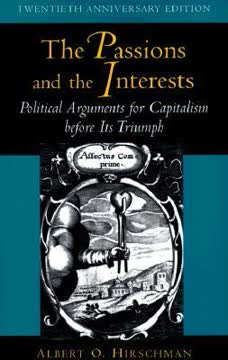
Reviewers broadly praise The Passions and the Interests as a brilliant, concise work of intellectual history tracing how the pursuit of material self-interest transformed from sinful avarice into a celebrated civilizing force. Hirschman's journey through thinkers like Machiavelli, Montesquieu, and Adam Smith is described as lucid, tightly argued, and remarkably accessible. Many highlight his central irony: capitalism was designed to suppress destructive human passions, yet was later criticized for precisely that suppression. Readers consistently commend Hirschman's erudition and his goal of raising, rather than resolving, the debate around capitalism.