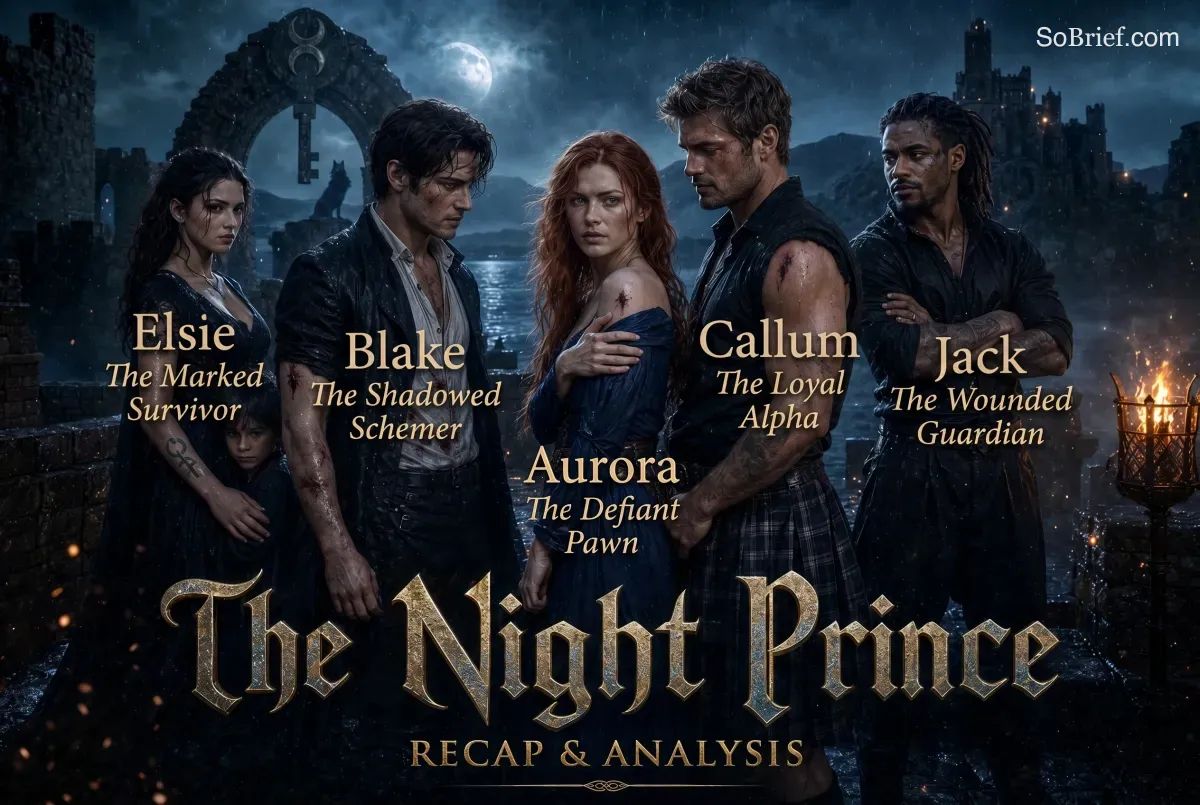


Plot Summary
Prologue
Blake2 walks through Night's prison in a shared dream, finding Aurora1 peering through cell bars. He drags her away from an approaching shadow — the jailer of this otherworld — and pulls her into a cell marked with Night's symbol: a key flanked by crescent moons. When the threat passes, he pushes them into a different dream: his childhood cell beneath a palace, stained with old blood and lit by a single candle.
She asks where they are. He says if she remembers in the morning, he will explain. He shoves her through a wall and they fall into darkness. Blake2 wakes at Lowfell Castle, haunted by the bond's thread of light pulsing inside him — and the knowledge that the God of Night wants the Heart of the Moon to escape his prison.
Three Days of Fever
Aurora1 wakes at Lowfell Castle, sweating in Blake's2 shirt, the wound in her side still raw from James's4 teeth. Callum3 coaches her breathing through the panic. She tells him what Blake2 confessed: he linked their lives so Callum3 could never kill him without killing her, planning to challenge for the throne after James4 is deposed.
Callum3 finds cold comfort in the logic. When their intimacy triggers Aurora's1 emerging wolf nature, her body seizes with fever — three days of hallucinations where dark prisons and Blake's2 laughter bleed together.
She sleepwalks to Blake's2 room with a knife to his throat. When she finally wakes, worse news arrives: James4 holds Callum's3 closest friend Fiona13 hostage and demands Aurora1 in trade. Under wolf law, James's4 bite marks her as his property.
Blake's Bite on Sacred Ground
The Wolves gather at a stone circle atop Dawn's Craig for the sacred ceremony. Lochlan,7 the red-haired alpha of Glas-Cladach, arrives with his clan. The priestess tells how the Moon Goddess tricked Night into imprisoning himself, and candles are raised into the eclipsed sky.
Then James4 strides through the stones with armed men and muskets, demanding Aurora1 under wolf law. She steels herself to go — to prevent bloodshed — when Blake2 hooks an arm around her waist and sinks his teeth into her shoulder. Before the priestess and fifty gathered Wolves, he claims Aurora1 as part of his clan.
James4 leaves satisfied, the fracture between Callum3 and Blake2 already spreading. Aurora1 slaps Blake2 across the face. Callum3 slams him into a rock and squeezes his throat — until Aurora1 starts choking too, the bond transferring the damage.
Broken Birds of Lowfell
Lochlan7 tells Aurora1 privately that Sebastian visited Glas-Cladach seeking the Heart of the Moon, suspecting it traveled from the Snowlands with her mother. A vast crop of moonflower on Lochlan's7 cliffs — said to grow only where the Moon Goddess's power touched earth — supports the theory.
Meanwhile, Aurora1 befriends Elsie,8 who reveals she is Blake's2 half-sister. Their shared father, Bruce, was Lowfell's former alpha — a Night worshipper who meant to sacrifice Elsie.8 Blake2 killed him the night he found her bound in a chapel.
Aurora1 learns that little Alfie was rescued from his murderous father by Elsie;8 Blake2 has tormented the man ever since. Lochlan7 observes that Blake2 collects broken birds — the scarred, the abandoned, the abused — though no one knows whether he means to heal them or pluck their feathers.
The Moon Won't Take Her
Callum3 prepares a candlelit clearing and uses intimate touch to show Aurora1 that shifting feels like release, not destruction. But the fever rises and she collapses. Callum3 carries her to Blake,2 the only healer available. Both alphas shift into wolves and fight over her unconscious body.
Blake2 pins Aurora1 beneath his massive form and guards her through the night — growling whenever Callum3 approaches. She wakes sandwiched against Blake's2 bare chest, both men naked, the room destroyed. The critical fact: she did not shift.
Callum3 is visibly relieved, believing she is human. But Aurora1 senses Blake2 concealing something. Later, alone by the loch, Blake2 tells her the truth — she is a wolf. He could not have shared his lifeforce with a human. Why she didn't shift remains a mystery he cannot explain.
James's Cruelest Test
Ian, a wolf from Lochlan's7 clan whose brother Alexander5 holds prisoner, drugs Aurora1 and delivers her to James4 at a manor house. She is bound to a pillar before James4 and his allied alphas. Blake2 and Callum3 arrive to negotiate.
James4 offers a test: he will release Aurora1 if Blake2 kisses her — he wants Callum3 to witness Blake's2 true reaction. Callum3 tells Blake2 to comply. Aurora1 is chained and helpless while the man she loves sanctions her humiliation before jeering men. Blake2 approaches, whispers an apology, and presses his lips to hers.
Darkness and pine flood her senses. Something visceral vibrates along their bond. Using the kiss as cover, Blake2 tests her bindings. Moments later, he seizes a guard's weapon and slices through her ropes as the room erupts into chaos.
Wolfsbane Bullets and Night's Chapel
Alexander's5 Borderlands soldiers crash through the stained-glass windows as Callum3 charges James.4 Blake2 grabs Aurora1 to flee, but a musketeer fires wolfsbane-dipped bullets that strike his shoulder — he turned his body to shield her. Aurora1 drags the bleeding, poisoned wolf through corridors and onto a horse.
Alexander5 pursues on horseback, whistling an eerily familiar tune. They reach a chapel marked with Night's crescent-moon symbol. Alexander5 halts at the gate — he once tried to trick the God of Night and now fears setting foot on sacred ground.
Inside, Aurora1 washes the poison from her hands, injects the antidote from Blake's2 medical kit, and bandages his wounds. The antidote provokes his wolf into feral aggression. She pushes him back through the bond — discovering a new ability. A messenger arrives: Callum3 won. James4 forfeited and escaped.
Callum's Crown, Blake's Shadow
At Madadh-allaidh, Lochlan's7 army rings the castle walls. Callum3 sits on the throne wearing James's4 royal sash, bruised and regal — but barely able to look at Aurora.1 He assigns her a separate room, claiming he needs space. The forced kiss is a splinter he cannot extract.
Fiona13 is freed and crushes Aurora1 in a fierce embrace. In the infirmary, Kai — Lochlan's7 rescued former beta — bears Night's brand burned into his chest. His eyes flash black and he speaks in a voice not his own, warning that something knows Aurora's1 scent.
Blake2 sedates him. Kai delivered Alexander's5 ultimatum: surrender Aurora,1 or face war unlike anything the north has seen. A creature called the Dark Beast waits at the Grey Keep. Blake2 warns that the rescued prisoners may have been sent as a trap.
The Wastrel Had Claws
Fiona13 hauls a freckle-faced redhead to the floor of the Great Hall during the coronation feast. Philip,6 Aurora's1 brother — the Southlands prince she grew up despising for his drunkenness and cruelty — flirts with every woman and mocks every threat.
Then his eyes shift: pupils dilating, irises threaded with silver. The heir to the human throne is a wolf. He was bitten in the palace dungeons before fleeing to the Snowlands, where he trained as a warrior. He carries a marriage proposal from Ingrid Erickson, the Snowlands queen, offering to unite the wolf kingdoms against Night's rising followers.
Callum3 flatly refuses — he will marry only for love. When Callum3 tests Philip6 in a courtyard swordfight, the supposed wastrel holds his own against five Northlands Wolves simultaneously. The prince6 is far more than he pretends.
The Scars Beneath His Shirt
Aurora1 finds a passage describing a kidney removal, with a diagram that mirrors the long curved scar on Blake's2 abdomen. The horrifying books she assumed he wrote — documenting experiments on Wolves, the melting of eyes, the breaking of bones — were records of what was done to him.
She confronts Blake,2 slamming the book against his chest. He confirms without flinching: her father's Maester of Healing ran a program of systematic torture beneath the palace. Blake2 was one of his subjects. The revelation fractures Aurora's1 understanding of everything.
While she attended dancing lessons upstairs, Blake2 was being dissected below. He is not merely an ambitious alpha scheming for the throne. He has cause to hate humans as deeply as Wolves. Aurora1 fears his endgame reaches further than Callum's3 crown — that perhaps he wants everything to burn.
Anam-Cridech
Aurora1 fights Blake2 for the missing pages from his book, but he burns them in the fireplace — she glimpses only one word before they turn to ash: Anam-Cridech. Moments later, Lochlan7 arrives with armed men on Callum's3 orders.
Blake2 goes to the dungeons peacefully, smiling, warning Aurora1 he has not shown his hand yet. With him imprisoned, Aurora1 traces the unfamiliar word through Elsie's8 romance novels to their author — Mrs. McDonald, the castle cook. The old woman confirms what the fiction describes: the Anam-Cridech is a mate bond, created by the Moon Goddess between two destined souls.
It cannot be broken. Once accepted, it outlasts even death. Aurora1 leaves the kitchen on trembling legs. The bond connecting her to Blake2 was never his weapon. It is sacred, eternal, permanent. They are mates.
The Bathtub Reckoning
Aurora1 storms into Callum's3 chambers, soaking wet with fury, and hurls a candlestick at his head while he sits in the bath. She crashes into the tub on top of him. He admits the truth: he has known since the night James4 forced the kiss.
He scented it, saw Blake's2 reaction, then read the torn pages from Blake's book. He suppressed the knowledge because accepting it meant losing her. They scream at each other, tangled and dripping, until rage transmutes into desperate need. Callum3 finally stops holding himself back.
Afterward, spent and trembling, he tells her what the sacred bond makes inevitable: their relationship cannot continue among Wolves. She vows to find the Heart of the Moon and shatter the bond. Callum3 says he will wait for her. Always.
The Mountain Farewell
On the castle ramparts, Callum3 tells Aurora1 she is not safe at Madadh-allaidh. Alexander5 hunts her, disloyal Wolves would betray her, and Blake2 — once freed — will come for her. He tested Philip6 and saw a warrior worth trusting.
He tasks the prince6 with escorting Aurora1 to Glas-Cladach and onward to the Snowlands. They embrace against the parapet, looking over the mountains one final time. Around a forest campfire, Philip6 shares his history: bitten by Jack9 in the palace dungeons, he fled to the Snowlands and trained as a warrior.
Then Alexander's5 men descend in the night. Philip6 is forced to his knees and obeys — Alexander,5 who also bit Philip6 in that same dungeon, is secretly his alpha. Aurora1 is shackled. They are dragged to the Grey Keep.
Chained in the Amphitheater
In the Grey Keep's dungeons, Aurora1 discovers James,4 Claire,11 and Ryan12 already caged — brought to fight the Dark Beast lurking below. She is dragged to a crumbling amphitheater and chained between two posts before hooded acolytes.
Alexander5 orders her whipped with a silver-tipped lash, insisting that agony will force her hidden power to surface. The whip shreds her back open and Aurora1 retreats into the only refuge she knows — stone. She has stood in this position before, held by nuns in the Church of Light and Sun while the High Priest beat her for sins she never committed.
She goes numb. Her power refuses to emerge. Alexander5 screams. Then Blake2 appears in the entrance corridor, blood-soaked and flanked by Jack9 and Arran,10 and names Aurora1 as his mate before every wolf in the room.
The Heart Was Never Stone
Alexander5 flings open a trapdoor and Night's serpentine prisoner — a shadow-wrapped creature with obsidian eyes — erupts into the amphitheater, swallowing men whole. Blake2 tells Aurora1 to stop suppressing not her wolf but a different power.
She stops fighting the fever and falls into a vision: she shatters her stone skin in the palace garden, breaks the vines in the church, rips free from puppet strings. Then she finds her mother by a moonlit lake. Her mother reveals the truth: their bloodline descends from the Moon Goddess and the Elderwolf.
The Heart of the Moon was never a relic. It is a person, passed through the female line, growing stronger each generation. Her mother took the wolfsbane willingly, let herself be killed, to protect this secret. Aurora1 opens her eyes and unleashes a scream of moonlight that burns the serpent to ash.
The Night Prince's Hand
The Wolves kneel. James4 names Aurora1 Heart of the Moon. Then Alexander,5 bleeding but alive, slits Blake's2 throat from behind. Arran10 decapitates the Borderlands lord5 an instant later, but the bond between Aurora1 and Blake2 begins to fray. She could break it and save herself.
Instead, she dives into his consciousness, finds him drowning in the well from his childhood, and hauls him out — strengthening the bond instead of severing it. Days later, Aurora1 dreams her way into Blake's2 past and witnesses him kneeling before Night's obsidian throne, promising to find the Heart of the Moon.
Blake2 is the Night Prince — a prisoner who died in her father's dungeon and was sent back by Night to find the key to his prison. He did not know the key would be her. Night's forces are coming. Blake2 extends his hand. Aurora1 takes it.
Analysis
The Night Prince interrogates whether freedom is something granted or something seized — and whether the distinction matters when every choice occurs within a cage. Aurora1 begins the story having escaped her father's palace only to find herself claimed, bitten, bonded, and fought over by alphas who frame possession as protection. The book systematically dismantles the possessive-alpha archetype by showing its consequences: Callum's3 gentleness infantilizes Aurora,1 Blake's2 manipulation strips her agency, and James4 treats her as spoils of war.
The revelation that the Heart of the Moon is a female bloodline — not a weapon to wield but a woman trained to suppress herself — transforms the story's entire power structure. Every alpha hunted an object. The object was a person. The whipping scenes create deliberate parallels between religious institutions and alpha hierarchies: both use pain to enforce submission, both frame submission as protection from something worse. Aurora's1 breakthrough comes not from fighting harder but from ceasing to fight herself — the scream she has been entombing since childhood is literally her power.
Blake2 functions as Aurora's1 dark mirror. Both were tortured by institutions that feared what they contained. Both learned masks so convincing they forgot what lay beneath. His confession — that he died and was resurrected by a god who now owns his soul — reframes the love triangle as a cosmic chess match played on the bodies of traumatized children. The mate bond simultaneously represents the story's most romantic element and its most unsettling: a connection neither party chose, imposed by a goddess upon two people already damaged by others choosing for them.
That Aurora1 strengthens the bond rather than breaking it — the one moment she could free herself — is the novel's central argument. It is not capitulation. For the first time in her life, no father, no priest, no alpha, and no goddess demanded this of her. She chooses, and the world cracks open.
Review Summary
The Night Prince receives mostly positive reviews, with readers praising the character development, world-building, and romantic tension. Many appreciate the complexity of the love triangle and the growth of the main character, Aurora. Some criticize pacing issues and find Aurora's decision-making frustrating. The book's ending leaves readers eagerly anticipating the third installment. While opinions on the male leads vary, Blake emerges as a fan favorite. Overall, reviewers find the book an engaging and emotionally charged continuation of the series.
People Also Read
Characters
Aurora
Southlands princess turned fugitiveThe Southlands princess turned fugitive, Aurora is the story's narrator and emotional center. Raised to suppress every feeling, whipped by a priest for unnamed sins, and groomed as a political pawn, she has spent twenty years encasing herself in stone. Her journey is one of excavation—digging through layers of performed composure to find the wildness underneath. She exhibits classic complex-trauma responses: hypervigilance, people-pleasing as survival, difficulty identifying her own desires. She bites her nails bloody—a wolf symptom she cannot control—mirroring how her suppressed nature finds outlet through the body when denied expression. Her relationships with Callum3 and Blake2 represent two modes of healing—gentle safety versus dangerous honesty—and her struggle to choose mirrors a deeper battle to believe she deserves agency at all.
Blake
Alpha of Lowfell, Aurora's rivalThe alpha of Lowfell, Blake operates behind multiple masks—healer, schemer, sadist, protector. His silky provocations disguise a man forged by extraordinary suffering. He collects people society has discarded: his abused half-sister8, a child rescued from violence, soldiers with shattered pasts. His compulsive need for control stems from years of having none. He is drawn to Aurora's1 suppressed rage because he recognizes his own. Every interaction is transactional—truths exchanged for vulnerabilities, comfort traded for leverage. His relationship with his inner wolf is adversarial; he fears the loss of control that shifting represents. He uses humor and cruelty in equal measure to keep others at arm's length, yet the bond with Aurora1 strips away his defenses with an intimacy he neither sought nor can endure.
Callum
Alpha of Highfell, Wolf KingThe alpha of Highfell and new Wolf King, Callum is mountain-solid and emotionally transparent in a way that both strengthens and limits him. He is his father's opposite by conscious choice—gentle where his father was violent, open where his father was possessive. This deliberate gentleness becomes its own cage: Aurora1 craves his full force, but he holds back for fear of becoming the man who hurt his mother. His jealousy is his greatest vulnerability—not because it is irrational but because it forces him to confront the limits of honor and willpower. He loves deeply, leads naturally, and carries the weight of a kingdom on shoulders broad enough to bear it. Whether he can bear losing the woman he loves to a bond he cannot fight remains his defining question.
James
Former Wolf King, Callum's brotherThe former Wolf King who bit Aurora1 and ignited the story's central conflict. Rough, strategic, and more perceptive than his brutish demeanor suggests, James genuinely loves his brother3 but views Aurora1 as an existential threat to wolf sovereignty. His cruelty toward her serves political calculation rather than personal malice—he would rather exile than execute, if it served the kingdom.
Alexander
Borderlands lord, Night's servantSebastian's bastard brother and the new Borderlands lord. He combines aristocratic finery with feral violence—embroidered coats over a body built for brutality. A devotee of the God of Night who seeks to repay a dark debt, he views Aurora1 as the key to his master's favor. His history with Blake2 runs deeper than either initially reveals.
Philip
Southlands prince, Aurora's brotherAurora's1 older brother, the Southlands crown prince. He presents as a dissolute, sharp-tongued dandy—flirting, drinking, deflecting confrontation with practiced wit. His rivalry with Aurora1 masks jealousy born from occupying different cages within the same gilded palace: he was sent to war while she was made to sit still. His arrival in the Northlands reveals dimensions Aurora1 never suspected.
Lochlan
Alpha of Glas-Cladach, kingmakerThe red-haired, kohl-eyed alpha of Glas-Cladach, whose coastal territory borders the Snowlands. Witty and drawn to dangerous men, he plays kingmaker while nursing wounds from betrayal by his former beta and lover, Kai. He provides Aurora1 with crucial information about her mother's journey from the Snowlands and the moonflower that grows where goddess-power touched earth.
Elsie
Blake's half-sister, secret keeperBlake's2 half-sister, rescued from sacrifice to the God of Night when Blake2 killed their shared father. Sharp-tongued and fiercely protective of little Alfie, the orphaned boy she raises as her own, Elsie refuses to let anyone—especially her brother2—fight her battles. Her taste in romance novels becomes an unexpected key to the story's most devastating mystery.
Jack
Blake's loyal second-in-commandBlake's2 second-in-command, a tattooed former prisoner from the King's City docks. Loyal, wry, and pragmatic, he balances Blake's2 intensity with warmth and serves as his moral barometer.
Arran
One-eyed warrior, Blake's guardA massive, one-eyed former soldier from Aurora's1 father's army. Quiet and dependable, he struggles privately with alcohol and pines for a mate who rejected him.
Claire
Female alpha, James's former loverA female alpha and James's4 former lover. Fierce, foul-mouthed, and independent, she refuses to be defined by her connection to either royal brother.
Ryan
Loyal teenage wolf warriorA sixteen-year-old wolf Aurora1 once spared. Devoted to Callum3, reckless in loyalty, and perpetually trying to prove himself worthy of the warriors surrounding him.
Fiona
Callum's oldest friendCallum's3 oldest friend and the first person at Madadh-allaidh to show Aurora1 genuine kindness. Practical, warm, and self-admittedly terrible at hugs.
Plot Devices
The Anam-Cridech (Mate Bond)
Central conflict engineA sacred bond woven by the Moon Goddess between two destined souls. Unlike an alpha's claim or a lover's choice, the Anam-Cridech operates beyond individual will—connecting two Wolves through shared emotions, dreams, and lifeforce. Blake2 inadvertently activated it while saving Aurora's1 life, and its discovery as a mate bond rather than a strategic manipulation reframes the entire love triangle. The bond transmits pain, pleasure, and emotion between Aurora1 and Blake2, making them unable to harm each other without suffering identical injury. It can theoretically be strengthened or broken by the person who possesses it, but its sacred nature among Wolves means Callum3 cannot in good conscience maintain his relationship with another wolf's mate. The bond's permanence drives Aurora's1 quest for the Heart of the Moon.
The Heart of the Moon
MacGuffin turned identity revelationThroughout the story, characters hunt for what they believe is an ancient relic—the heart ripped from the Moon Goddess's chest, said to grant Wolves the power to shift at will. Sebastian sought it at Glas-Cladach. Lochlan7 suspects Aurora's1 mother carried it from the Snowlands. Callum3 hoped it was a white stone in James's4 possession. Aurora1 theorizes it could break the mate bond. The devastating revelation is that the Heart of the Moon is not a stone but a bloodline—a lineage of power passed through females descended from the Moon Goddess and the Elderwolf. Aurora's1 mother suppressed it with wolfsbane, endured years of poisoning, and ultimately died to keep this secret from a king who would have exploited or destroyed their daughter.
The Àithne (Alpha Command)
Power hierarchy testAn alpha's ability to force obedience from clan members through supernatural dominance. When invoked, it slips beneath a wolf's skin like shadow, compelling submission. Blake2 tests it on Aurora1 and discovers she can resist—partially because her nature exceeds any alpha's, though neither understands why. She pretends to yield, gathering intelligence while concealing her immunity. The Àithne becomes a recurring measure of power dynamics: Alexander5 uses it to control wolves bound to his clan, James4 attempts it on Aurora1 without success, and Blake2 eventually deploys it at full strength—revealing he has been restraining himself all along. Aurora's1 resistance foreshadows her true nature before anyone comprehends why an ordinary half-wolf could shrug off an alpha's command.
Night's Prison / Shared Dreams
Supernatural connection portalAurora1 and Blake2 share dreams that transport them into Night's prison—an endless labyrinth of cells where the God of Night keeps his monsters and the Moon Goddess captive. These shared dreams serve multiple narrative functions: they expose Blake's2 traumatic past, allow Aurora1 to witness memories she should not access, and create an intimate space where both characters drop their masks. The prison's key symbol—two crescent moons flanking a key—recurs on chapel walls, tattoos, and brands throughout the story. The dreams escalate from accidental encounters to deliberate explorations, with Aurora1 learning to navigate between her own nightmares and Blake's2 memories. What begins as an unsettling side effect of the bond becomes a critical window into the story's deepest secrets.
Blake's Experiment Books
Misdirection and revelation deviceHandwritten tomes cataloguing horrific experiments on Wolves—eyeball dissolution, organ removal, bone-breaking sequences during full moons. Aurora1 initially assumes Blake2 authored them as a sadistic researcher, shaping her view of him as a monster incapable of empathy. The books serve as slow-burning misdirection: she reads them for information about wolf physiology and the bond, all while misattributing their authorship. When she finally matches the surgical diagrams to Blake's2 own scars, the books transform from evidence of cruelty into testimony of victimization. Her father ordered these experiments. The Maester of Healing performed them. Blake2 endured them. This reversal forces Aurora1 to reconsider every assumption she has made about the most dangerous wolf she knows.
FAQ
Synopsis & Basic Details
What is The Night Prince about?
- A Princess's Perilous Journey: The Night Prince follows Princess Aurora, a Southlands royal, as she navigates the treacherous world of the Northlands after being bitten by the Wolf King, James. Her life becomes inextricably linked to Blake, the enigmatic alpha of Lowfell, through a mysterious magical bond, forcing her into a complex web of alliances, betrayals, and self-discovery.
- Struggle for Autonomy: At its core, the novel explores Aurora's fierce fight for agency against those who would claim her as property or a pawn in their power games, including her father, James, and even Blake. Her journey is a quest to define herself beyond the roles imposed upon her, culminating in the revelation of her true, ancient power.
- Unveiling Dark Secrets: The narrative delves into the hidden histories of its characters and the Northlands, revealing Blake's past as a prisoner of the dark god Night, the true nature of the magical bond (Anam-Cridech), and the shocking truth of Aurora's heritage as the living "Heart of the Moon," a power sought by both allies and enemies.
Why should I read The Night Prince?
- Intricate Character Dynamics: Readers will be captivated by the complex, morally ambiguous relationships, particularly the intense, fraught connection between Aurora and Blake, and the emotional turmoil experienced by Callum. The novel excels at exploring the psychological depths of its characters, revealing their hidden motivations and vulnerabilities.
- Rich World-Building & Lore: Beyond the political intrigue, the book expands on the unique werewolf mythology, introducing ancient gods, sacred rituals, and a detailed history of conflict between humans and wolves. The Northlands itself becomes a character, with its wild landscapes mirroring the untamed nature of its inhabitants.
- Themes of Power & Identity: The Night Prince offers a compelling exploration of agency, trauma, and transformation. Aurora's journey from a seemingly helpless princess to a powerful, self-possessed queen challenges traditional fantasy tropes, making it a resonant read for those who appreciate strong female leads and stories of profound personal growth.
What is the background of The Night Prince?
- Ancient Wolf Lore & Mythology: The story is steeped in the Northlands' rich mythological background, centered on the Moon Goddess Ghealach and the dark God of Night, Oidhche. This includes the Elderwolf origin story, the Moon Goddess's imprisonment, and the existence of Night's acolytes and monstrous prisoners, setting the stage for a looming, ancient conflict.
- Political & Inter-Kingdom Strife: The narrative unfolds against a backdrop of ongoing war between the human Southlands and the wolf-inhabited Northlands. Internal wolf politics, including clan rivalries and challenges for the Wolf Throne, further complicate the landscape, with characters like James and Callum vying for power and influence.
- Trauma and Societal Norms: The world of The Night Prince is shaped by brutal societal norms, particularly wolf law regarding "claimed" individuals and the Southlands' oppressive religious practices (e.g., the High Priest's beatings). This background highlights the pervasive impact of trauma and the characters' struggles to break free from cycles of abuse and control.
What are the most memorable quotes in The Night Prince?
- "You're not a weapon. You're a fucking tornado.": This powerful quote from Blake to Aurora (Chapter 62) encapsulates her transformation from a perceived object of war into a force of nature. It highlights her burgeoning power and agency, shifting the narrative from her being a pawn to a formidable, uncontrollable entity.
- "Ghealach did not rip out her heart so the Elderwolf could be close to her power. She sent him her daughter, so that he would protect her. The power the Wolves seek. . . it was never a rock, or a relic, or a tool to be used. It was a person, and then a bloodline. We are descended from Ghealach and the Elderwolf, little one. You are the Heart of the Moon.": Aurora's mother's revelation (Chapter 60) is the pivotal moment defining Aurora's true identity and the central mystery of the series. It recontextualizes the entire mythology, making Aurora the literal embodiment of the Moon Goddess's power, not just a wolf.
- "I will consume you until there is nothing left of you. I will ruin you. I will coil myself so tightly around you that you will beg me to release you, and still then, I will not let you go.": Aurora's furious declaration to Blake (Chapter 46) showcases her unleashed rage and newfound ferocity. It marks a significant turning point in her character arc, demonstrating her refusal to be manipulated and her willingness to fight back with a primal intensity that mirrors Blake's own darkness.
What writing style, narrative choices, and literary techniques does Lauren Palphreyman use?
- Visceral First-Person Perspective: Palphreyman employs a close first-person perspective, primarily through Aurora's eyes, immersing the reader directly in her emotional and sensory experiences. This allows for a raw, unfiltered portrayal of her trauma, fear, desire, and burgeoning power, making her internal struggles deeply personal and immediate.
- Symbolic Dream Sequences & Foreshadowing: The novel frequently uses vivid dream sequences and fever visions that blur the line between reality and the subconscious. These are not merely plot devices but serve as powerful literary tools for foreshadowing future events, revealing hidden memories, and exploring the characters' psychological states, often laden with symbolic imagery (e.g., Night's prison, the marionette).
- Sensory-Rich & Evocative Language: Palphreyman's prose is highly sensory, utilizing detailed descriptions of scents ("pine and parchment," "blood and dark fairytales"), sounds ("howls permeate the castle walls," "scrape of metal scalpels"), and physical sensations ("ice pumps through my veins," "skin prickles"). This creates an immersive atmosphere, enhancing the gothic and fantastical elements of the narrative.
Hidden Details & Subtle Connections
What are some minor details that add significant meaning?
- Blake's Fear of Storms: A seemingly minor detail, Blake's aversion to storms (Chapter 27) is later revealed to be a profound psychological scar from his childhood torture in a well during a storm (Chapter 37). This detail humanizes him, linking his vulnerability to his traumatic past and explaining his need for control.
- The Lobster Metaphor: Aurora's anecdote about lobsters being slowly boiled alive (Chapter 22) serves as a powerful, subtle metaphor for her own entrapment and gradual realization of her perilous situation. Elsie's subsequent decision to "free the lobsters" directly mirrors Aurora's burgeoning agency and desire for liberation.
- Philip's Missing Finger: Philip's missing fingertip (Chapter 41), initially a curious detail, is later revealed to be frostbite from his journey to the Snowlands, hinting at his own hidden wolf nature and the hardships he endured in his quest for answers, contrasting with his spoiled princely facade.
What are some subtle foreshadowing and callbacks?
- Blake's "Experiments" Books: Early mentions of Blake's medical tomes, filled with gruesome experiments on wolves (Chapter 13), subtly foreshadow the later revelation that these were records of his own torture by the Maester of Healing (Chapter 44). This recontextualizes his character from a sadist to a victim.
- Recurring Night's Mark Symbol: The key with two crescent moons, first seen in Blake's dream prison (Prologue) and later in Night's chapel (Chapter 6), consistently foreshadows the pervasive influence of the God of Night and the true nature of Blake's connection to him as a branded prisoner.
- Callum's "Oral Fixation": Callum's explanation of wolves' "oral fixation" and tendency to bite (Chapter 16) subtly foreshadows Aurora's own primal urges to bite when overwhelmed by emotion, particularly her anger and jealousy, hinting at her latent wolf-like power before her true nature is revealed.
What are some unexpected character connections?
- Blake and Philip's Shared Captivity: It's revealed that Blake and Philip knew each other from their time imprisoned in the Southlands palace dungeons (Chapter 45), where Blake was tortured and Philip was bitten by Jack. This unexpected connection highlights the pervasive reach of the Southlands' cruelty and the shared trauma that binds seemingly disparate characters.
- Mrs. McDonald's Past with Blake: The formidable cook, Mrs. McDonald, is revealed to be from Lowfell and surprisingly familiar with Blake, even wiping blood from his face (Chapter 32). This hints at a deeper, more complex history between them, suggesting Blake's past actions at Lowfell were not universally condemned and that he might have offered refuge to some of Bruce's former clan.
- Alexander's Wolf Nature & Shared Torturer: Alexander, initially presented as a human lord, is revealed to be a wolf and a former prisoner of the Maester of Healing, just like Blake (Chapter 55). This unexpected parallel creates a dark mirror between the antagonist and one of the protagonists, showing how shared trauma can lead to vastly different paths.
Who are the most significant supporting characters?
- Elsie, Blake's Half-Sister: Elsie provides crucial insight into Blake's past and motivations, revealing his act of saving her from their abusive father (Chapter 12). Her own trauma and resilience, marked by Night's symbol, parallel Aurora's journey and highlight the pervasive impact of patriarchal control and religious fanaticism.
- Jack, Blake's Confidant: Jack serves as Blake's loyal right-hand man, offering both comic relief and a grounded perspective on Blake's often-unfathomable actions. His past as a prisoner in the Southlands and the wolf who bit Philip (Chapter 44) deepens his connection to Blake and the overarching conflict, making him a key player in Blake's schemes.
- Philip, Aurora's Brother: Philip's transformation from a spoiled prince to a complex, secretly wolf-bitten individual (Chapter 39) makes him a surprisingly significant character. His journey to the Snowlands and his alliance with Ingrid introduce a new, critical threat (Night's acolytes) and offer a potential path for uniting the wolf kingdoms, directly influencing Aurora's future.
Psychological, Emotional, & Relational Analysis
What are some unspoken motivations of the characters?
- Blake's Quest for Freedom: Beyond his stated ambition for the Wolf Throne, Blake's deepest, unspoken motivation is freedom from Night's eternal torment (Chapter 63). His actions, including seeking the Heart of the Moon and manipulating others, are driven by a desperate desire to escape his fate as Night's prisoner, making him a more sympathetic, albeit still dangerous, figure.
- Callum's Fear of His Father's Legacy: Callum's overprotective nature and struggle with his wolf instincts are subtly motivated by a deep-seated fear of becoming like his abusive father (Chapter 19). He suppresses his more primal urges, including his jealousy and possessiveness, to avoid repeating the cycle of cruelty he witnessed, which sometimes leads to miscommunication with Aurora.
- Aurora's Desire for Unconditional Acceptance: Beneath her fight for agency, Aurora implicitly yearns for unconditional acceptance, particularly after a lifetime of being judged and controlled by her father and the High Priest. Her vulnerability with Blake, despite his manipulations, stems from his ability to see and acknowledge her "wildness" without judgment, a stark contrast to Callum's protective gentleness.
What psychological complexities do the characters exhibit?
- Blake's Duality and Self-Loathing: Blake is a master of masks, projecting nonchalance and amusement while harboring deep-seated trauma and self-loathing from his torture and his soul belonging to Night (Chapter 37). His internal conflict between his forced servitude to Night and his growing connection to Aurora creates a complex psychological landscape, where his actions are driven by a mix of self-preservation and unexpected compassion.
- Callum's Internalized Conflict: Callum grapples with the inherent "wildness" of his wolf nature versus his desire to be an honorable, gentle leader, a conflict exacerbated by his father's abusive legacy (Chapter 19). His psychological complexity lies in his struggle to reconcile these opposing forces, leading to moments of intense jealousy and possessiveness that he actively tries to suppress, often to his own detriment.
- Aurora's Trauma and Identity Fragmentation: Aurora's psychological complexity stems from years of abuse and suppression, leading to a fragmented sense of self. Her fever dreams and visions (Chapter 2) are literal manifestations of her trauma, and her struggle to "unleash" her power is also a journey of integrating her repressed emotions and accepting her true identity as the Heart of the Moon, rather than the "sinner" she was taught to be.
What are the major emotional turning points?
- Blake's Bite at Oidhche Fhada: Blake's public claiming of Aurora with a bite (Chapter 9) is a major emotional turning point, not just for Aurora's physical safety but for the emotional dynamics between the three leads. It ignites Callum's furious jealousy and forces Aurora to confront her lack of autonomy, deepening the bond and setting off a chain reaction of emotional turmoil.
- Aurora's Confrontation with Callum about the Kiss: The heated argument between Aurora and Callum after Blake's forced kiss (Chapter 48) is a critical emotional turning point. It forces Callum to articulate his deep-seated jealousy and fear of losing Aurora, while Aurora confronts his perceived betrayal and the unfairness of his judgment, pushing their relationship to a breaking point.
- Aurora's Unleashing of Power: Aurora's decision to "unleash" her power in the amphitheater (Chapter 60) is the ultimate emotional turning point. It represents her complete acceptance of her identity as the Heart of the Moon and her refusal to be a victim any longer. This act is a cathartic release of years of suppressed rage and fear, transforming her into a formidable force.
How do relationship dynamics evolve?
- Aurora & Callum: From Protector to Partner (and back again): Their relationship evolves from Callum as Aurora's rescuer and protector to a more intimate, passionate partnership. However, Callum's deep-seated need to protect and his struggle with jealousy, particularly regarding Blake, create recurring friction, leading to moments where Aurora feels stifled and unacknowledged as an equal, culminating in their temporary separation.
- Aurora & Blake: From Antagonism to Unbreakable Bond: Their dynamic shifts dramatically from initial loathing and manipulation to a complex, undeniable connection. Blake's initial use of Aurora as a pawn gradually gives way to genuine concern and a shared understanding of trauma, culminating in the revelation of their mate bond (Anam-Cridech). This evolution is fraught with tension, as Aurora struggles to reconcile his past deceptions with his protective actions.
- Callum & James: Brotherly Rivalry to Mortal Enemies: The long-standing rivalry between Callum and James escalates from political maneuvering to a full-blown war for the throne. Their relationship is marked by a complex mix of past affection and present animosity, with James's cruelty and Callum's honor constantly clashing. The conflict over Aurora and the throne ultimately solidifies their roles as mortal enemies, despite their shared blood.
Interpretation & Debate
Which parts of the story remain ambiguous or open-ended?
- The Full Extent of Night's Influence: While Blake is revealed to be Night's prisoner and the Night Prince, the full scope of Night's power and his ultimate plan for the world remains ambiguous. The "Dark Beast" is unleashed, but the true nature of Night's army and the scale of the impending war are left open-ended, setting up future conflict.
- The Future of the Anam-Cridech: Despite Aurora's belief that she can break the bond with the Heart of the Moon's power, Mrs. McDonald states it's "unbreakable" once accepted (Chapter 49). The ending leaves the bond intact, with Blake and Aurora still connected, raising questions about whether it truly can be severed or if they are destined to remain bound, regardless of their desires.
- The Fate of the Kingdoms: The novel concludes with Aurora embracing her power and setting out to claim her birthright as queen of the Southlands, with Blake at her side. However, the political landscape remains volatile, with James still alive, Alexander's army defeated but not fully dispersed, and the looming threat of Night's acolytes. The path to uniting the kingdoms and achieving lasting peace is left uncertain.
What are some debatable, controversial scenes or moments in The Night Prince?
- Callum's Command to Kiss Blake: Callum's decision to order Blake to kiss Aurora (Chapter 29), despite his own jealousy and Aurora's distress, is highly debatable. While he claims it was to free her, it can be interpreted as a moment where Callum prioritizes strategy over Aurora's autonomy and emotional well-being, mirroring the very control she despises.
- Blake's Initial Manipulation of Aurora: Blake's calculated actions to link his life to Aurora's and use her as a pawn in his quest for the throne (Chapter 2) are controversial. His later claims of saving her life and his genuine feelings for her force readers to debate whether his initial deceit can be forgiven or if his manipulative nature is an inherent flaw.
- Aurora's Acceptance of Blake's "Friendship": Aurora's eventual admission that Blake is her "friend" (Chapter 62), despite his repeated deceptions, torture, and plotting against Callum, can be controversial. It challenges traditional notions of trust and loyalty, prompting readers to question the nature of their bond and whether her feelings are a result of Stockholm Syndrome or a deeper, more complex connection forged in shared trauma.
The Night Prince Ending Explained: How It Ends & What It Means
- Aurora's Power Unleashed: The climax sees Aurora fully embracing her identity as the "Heart of the Moon" (Chapter 60), a living embodiment of Ghealach's power. She unleashes a devastating scream that destroys Night's serpentine prisoner, demonstrating her immense, previously suppressed abilities. This signifies her complete transformation from a victim to a powerful, self-actualized queen, no longer defined by others' control.
- Blake's True Nature & Unbreakable Bond: Blake is revealed to be Night's prisoner, his soul belonging to the dark god, and he was branded as such (Chapter 64). He confesses he didn't create the Anam-Cridech bond but activated it to save Aurora, and it cannot be broken. When Alexander mortally wounds Blake, Aurora chooses not to break the bond, instead pulling him from Night's prison in a shared dream, saving his life and solidifying their unbreakable connection. This means their fates are permanently intertwined, for better or worse.
- A New Path Forward: The ending sets up a new trajectory for Aurora. She decides to claim her father's throne as queen of the Southlands, with Blake, now her mate and equal in power, at her side. Callum, though heartbroken by the bond, accepts Aurora's decision and promises to wait for her. The immediate threat of Alexander is neutralized, but the larger war against Night and his acolytes looms, with Aurora and Blake positioned as central figures in the coming conflict, ready to face it together.
Wolf King Series
About the Author
Other books by Lauren Palphreyman

Download PDF
Download EPUB
.epub digital book format is ideal for reading ebooks on phones, tablets, and e-readers.








































