Key Takeaways
1. The Medicalization of Killing: A Core Nazi Principle
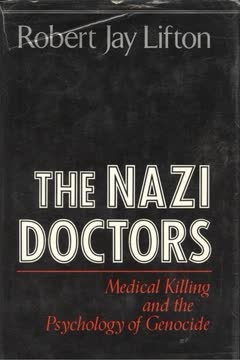
At the heart of the Nazi enterprise, then, is the destruction of the boundary between healing and killing.
Reversal of purpose. The Nazi regime fundamentally inverted the traditional role of the physician, transforming healing into a justification for mass murder. This "medicalization of killing" was central to their genocidal project, framing the extermination of certain groups as a therapeutic imperative for the "health" of the Aryan race. This concept allowed doctors to participate in atrocities under the guise of medical responsibility.
Racial healing. Hitler and Nazi ideologues viewed Germany's post-WWI chaos as an "illness" of the Aryan race, with Jews as the "gangrenous appendix" or "racial tuberculosis." The proposed cure was radical: "cutting out the 'canker of decay'" and "extirpation of all those categories of people considered to be worthless or dangerous." This biomedical vision elevated genocide to a means of national and racial healing.
Biocracy concept. The Nazi state functioned as a "biocracy," where divine prerogative was replaced by the goal of racial purification and revitalization. Doctors, as "biological activists" and "priests of the holy flame of life," were uniquely positioned to implement this vision. They were seen as guardians of the "Volkskörper" (national body), tasked with ensuring its purity and strength, even if it meant orchestrating mass death.
2. Doubling: The Psychological Mechanism of Perpetration
The division of the self into two functioning wholes, so that a part-self acts as an entire self.
Adaptive mechanism. Doubling was the primary psychological vehicle enabling Nazi doctors to participate in atrocities without experiencing themselves as murderers. This process involved creating an "Auschwitz self" that could operate within the camp's murderous reality, while a "prior self" retained connections to humane values, family, and professional identity outside the camp. This allowed for psychological survival in an otherwise intolerable environment.
Holistic function. The "Auschwitz self" was not merely a fragmented part but a coherent, functioning entity that embraced the camp's ethos. It absorbed the demands of the environment, rationalized actions, and provided a framework for daily behavior. This holistic nature distinguished it from simple psychological "splitting," as it actively engaged with and adapted to the extreme conditions.
Guilt avoidance. A key function of doubling was the transfer of conscience. The "Auschwitz self" took on the responsibility for the "dirty work," operating under its own distorted moral criteria (duty, loyalty, efficiency). This allowed the "prior self" to remain largely untouched by guilt, perceiving itself as a decent individual. This disavowal of the meaning of murder was crucial for sustained participation.
3. The "Euthanasia" Program: Prelude to Mass Murder
The state must own death — must kill — in order to keep the social organism alive and healthy.
"Life unworthy of life." The "euthanasia" program, falsely named, was the Nazis' first systematic direct medical killing, targeting individuals deemed "lebensunwertes Leben." This concept, though not new, was pushed to its biological and "therapeutic" extreme. It began with coercive sterilization and escalated to the killing of "impaired" children and adults in specialized centers.
Phased implementation. The program unfolded in distinct steps:
- Coercive sterilization of those with "hereditary diseases" (e.g., congenital feeblemindedness, schizophrenia, epilepsy).
- Killing of "impaired" children in hospitals.
- Killing of "impaired" adults, primarily from mental institutions, using carbon monoxide gas.
- Extension of this killing to "impaired" concentration camp inmates (Action 14f13).
- Culmination in mass killings, predominantly of Jews, in extermination camps.
Medicalized authority. Special "Hereditary Health Courts" were established, composed mainly of physicians, to legitimize sterilization decisions. Doctors were legally mandated to report "hereditarily sick" individuals, overriding patient confidentiality. This legal and medical framework cloaked chaos and arbitrariness, with over 90% of petitions resulting in sterilization, demonstrating the rapid Nazification of the medical profession.
4. Auschwitz: The Apex of Medicalized Genocide
Auschwitz was like a medical operation, and the killing program was led by doctors from beginning to end.
Doctors' central role. In Auschwitz, SS doctors were not merely observers but active orchestrators of mass murder. Their duties extended beyond cruel experiments to supervising the entire killing process, from initial selections on the ramp to declaring victims dead in the gas chambers. This medical involvement lent a perverse legitimacy to the atrocities.
Murderous ecology. SS doctors managed the camp's "murderous ecology," balancing extermination with the need for slave labor. They performed selections to determine who would live (temporarily) for work and who would die immediately. They also conducted "triage-murder" on medical blocks, sending sick or debilitated prisoners to the gas chambers if their recovery would take more than a few weeks.
Systematic killing methods. Doctors were involved in various killing methods:
- Selections: Dividing arriving transports into those for immediate gassing and those for labor.
- Gas chambers: Supervising the gassing process and declaring death.
- Phenol injections: Direct killing of debilitated patients, especially in early phases.
- "Epidemiology": Sending groups with contagious diseases (and often entire blocks) to the gas chambers.
- False death certificates: Fabricating causes of death for victims to maintain medical pretense.
5. Ideology and "Sacred Science": Justifying Annihilation
The unifying principle of the biomedical ideology was that of a deadly racial disease, the sickness of the Aryan race; the cure, the killing of all Jews.
Racial purity. Nazi ideology presented a vision of absolute control over human evolution, aiming to purify and revitalize the "Aryan race." This "biomedical vision" transformed racial prejudice into a "sacred science," where the elimination of "inferior" races, particularly Jews, was deemed a necessary therapeutic act for the national body.
"Scientific racism." Dangerous Jewish characteristics were linked to alleged scientific data, making vicious anti-Semitism appear intellectually respectable. Figures like Fritz Lenz advocated for "racial hygiene," arguing that the state's purpose was to serve the race, not individual rights. This pseudo-scientific framework provided a powerful justification for escalating discriminatory policies.
Total cure. The concept of a "total cure" for Germany's perceived "illness" necessitated the complete annihilation of the "Jewish problem." This totalistic approach, rooted in a blend of romantic nationalism and distorted biological principles, allowed perpetrators to believe they were engaged in a noble, world-saving mission. The "Final Solution" was presented as the ultimate, logical outcome of this "applied biology."
6. The Bureaucracy of Deception: Masking Mass Murder
Every falsification in this 'bloated apparatus' had to be 'covered by two more.'
Elaborate cover-up. The Nazi regime implemented an extensive "bureaucracy of deception" to conceal the true nature of its medicalized killing programs. This involved a complex web of euphemisms, false documents, and secrecy designed to mislead victims, their families, the public, and even some perpetrators.
Euphemistic language. Murder was disguised with innocuous terms:
- "Euthanasia" for direct medical killing.
- "Special treatment" (Sonderbehandlung) for extralegal executions.
- "Resettlement" or "evacuation" for deportations to death camps.
- "Ramp duty" or "medical ramp duty" for selections.
This language allowed perpetrators to engage in killing without explicitly using the word "murder," fostering psychic numbing.
Falsified records. Doctors were central to this deception, signing false death certificates that listed spurious illnesses for victims of gassing or injections. At killing centers, "Special Registry Offices" manipulated death dates to prevent detection of mass killings. Even the ashes of cremated victims were mixed to prevent identification, further obscuring the scale of the atrocities.
7. The Ordeal of the Perpetrator: Adaptation and Numbing
When you see a selection for the first time — I’m not talking only about myself, I'm talking about even the most hardened SS people, ... you see, . . . how children and women are selected. Then you are so shocked ... that it just cannot be described. And after a few weeks one can be accustomed to it [ kann man es gewöhnen ; also suggests becoming inured].
Psychological shift. SS doctors, initially experiencing revulsion at selections, underwent a profound psychological shift from outsider to insider. This adaptation involved suppressing moral aspects of their prior selves in favor of a new "Auschwitz self." This transition was often facilitated by heavy drinking in the officers' club, where doubts were "talked out" and replaced by a shared sense of duty and resignation.
Numbing mechanisms. The "Auschwitz self" relied on radical psychic numbing and derealization to function. The sheer scale of death, the constant exposure to suffering, and the use of euphemistic language allowed doctors to divest themselves of the actuality of their actions. They could perceive mass murder as a "technical process" or a "sewerage project," effectively blocking emotional engagement.
Ordeal and justification. Perpetrators framed their participation as a difficult but necessary "ordeal" or "wartime duty," akin to combat. This concept of "heroic hardness" justified their actions as sacrifices for the greater good of the "Volk." The belief that "Auschwitz was an existing fact" and that "one had to go along with it" provided a powerful rationalization, transforming moral questions into pragmatic concerns about efficiency.
8. The Prisoner Doctor's Dilemma: Healing Amidst Annihilation
We suffered and [acted] within the limits of the possible .... Doctors did provide some comfort, I believe. There was the comfort for the patient and the fact that he was not alone, that someone understood and was trying to help to do something for him — and that was already a lot .... We were a group, not just the [individual] doctors of our block.
Heroic paradox. Prisoner doctors faced an agonizing paradox: to remain healers, they had to navigate a system designed for murder, often depending on the very Nazi doctors who orchestrated the killing. Their efforts to save lives were profoundly heroic, yet often entangled with the camp's destructive logic.
Forced complicity. SS doctors often pressured prisoner doctors to participate in the system, from making lists for selections to falsifying diagnoses. This manipulation aimed to diffuse guilt and blur the lines between victimizer and victim. Prisoner doctors, in turn, sometimes made compromises, such as listing obviously dying patients for selection, to save others who had a chance of survival.
Acts of resistance and healing. Despite immense pressure, many prisoner doctors found ways to resist and heal:
- Falsifying records: Changing numbers or diagnoses to protect inmates from selections.
- Hiding patients: Concealing sick individuals, especially those with contagious diseases, from SS scrutiny.
- Improvising care: Providing what little medical treatment they could with scarce resources.
- Mutual support: Collaborating with colleagues to save lives and maintain morale.
These acts, though often small, were crucial for maintaining their humanity and professional integrity in a dehumanizing environment.
9. Josef Mengele: The Quintessential Physician-Killer-Researcher
He could be friendly but kill.
Omnipresent figure. Mengele embodied the Auschwitz selections process, often perceived as being "everywhere" and responsible for most killings. His elegant demeanor and "graceful and quick movements" on the ramp masked his brutal role, creating a "false front for the crematorium." His detachment could be interrupted by violent outbursts, especially when his authority was challenged.
Fanatical researcher. Mengele's passion for "scientific research," particularly on twins, was a driving force behind his actions. He viewed Auschwitz as an unparalleled opportunity to study genetic abnormalities and hereditary traits, sending specimens and reports to his mentor, Otmar von Verschuer, in Berlin. He saw it as "a sin, a crime... irresponsible [toward science], not to utilize the possibilities that Auschwitz had for twin research."
Duality of character. Mengele exhibited an extreme duality: capable of kindness and affection towards children (who called him "Uncle Pepi") and his research subjects, while simultaneously sending them to the gas chambers or subjecting them to fatal experiments. This "double man" persona, combining schizoid detachment, extreme numbing, and sadistic omnipotence, allowed him to thrive in Auschwitz.
10. Eduard Wirths: The Conflicted Architect of Auschwitz Killing
Can a good man do bad things?
"Good man" persona. Wirths, the chief SS Auschwitz doctor, was widely described by inmates as "kind," "conscientious," and "decent." He was instrumental in improving camp hygiene, combating typhus epidemics, and expanding medical facilities for prisoners. He even protected prisoner doctors from abuse and challenged the Gestapo's unauthorized killings.
Orchestrator of murder. Despite his humane qualities, Wirths was the ultimate medical authority responsible for the camp's system of selections and medicalized killing. He insisted that physicians control selections, thereby legitimizing the murder process. His "moral crusade" to improve conditions inadvertently made the death factory more efficient and psychologically tolerable for perpetrators.
Tragic guilt. Wirths's internal conflict between his medical humanism and his Nazi loyalties was profound. He clung to his family as a source of purity, shielding them from Auschwitz's horrors, yet his duty to the "Volk" compelled him to remain. His suicide after the war, following confrontation with the scale of his responsibility, reflected his "inescapable guilt" and the ultimate breakdown of his doubling mechanism.
11. The Universal Potential for Evil: Lessons from Nazi Doctors
Doubling was the mechanism by which a doctor, in his actions, moved from the ordinary to the demonic.
Atrocity-producing situations. The Nazi doctors' experience reveals how institutional structures can compel individuals, even those with prior humane values, to commit atrocities. Auschwitz was an "atrocity-producing situation" that demanded doubling, transforming ordinary people into perpetrators by creating a psychological climate where evil became the norm.
The "Auschwitz self" as a model. The "Auschwitz self" was a shared psychological process, a group norm that allowed doctors to adapt to killing without feeling like murderers. This collective numbing, facilitated by euphemistic language and diffusion of responsibility, enabled them to perceive their actions as "purely technical" or "humanitarian" within the camp's perverse logic.
Broader implications. The phenomenon of doubling is not unique to Nazi Germany but represents a universal human potential for evil. Professionals, with their specialized skills and inherent authority, may be particularly susceptible to forming a "professional self" that aligns with destructive projects. Understanding this mechanism is crucial for recognizing and resisting the potential for genocide and other forms of mass violence in any society.
Review Summary
Reviewers broadly praise The Nazi Doctors as a harrowing, essential, and meticulously researched work. Many highlight Lifton's concept of "doubling" — the psychological splitting that allowed physicians to function as both healers and killers — as a key insight. Readers appreciate his empathetic yet unflinching approach, including interviews with surviving Nazi and prisoner doctors. Several note the book's relevance to understanding how ordinary people commit atrocities. A minority found it dry or overly dense. Overall, it is considered a landmark study of genocide's psychology.
People Also Read

 Immersive