Key Takeaways
1. The Paradox of Collective Action: Rationality Undermines Group Interests
But it is not in fact true that the idea that groups will act in their self-interest follows logically from the premise of rational and self-interested behavior.
Challenging conventional wisdom. It is commonly assumed that groups with shared interests will naturally act to further those interests, much like individuals pursue personal goals. This belief underpins many theories in economics, political science, and sociology, suggesting that if all members would benefit from a collective objective, they would logically work towards it. However, this assumption is fundamentally flawed.
The core inconsistency. The book argues that for large groups, the premise of rational, self-interested behavior actually contradicts the idea that groups will voluntarily act in their common interest. Unless the group is very small, or there's coercion or a special incentive, rational individuals will not contribute to achieving a common goal. Each individual reasons that their personal contribution won't significantly impact the outcome, and they will still enjoy the benefits if others contribute.
The free-rider dilemma. This leads to a "free-rider" problem where individuals rationally choose to withhold their support, hoping to benefit from the efforts of others without bearing any cost. This behavior, while rational for the individual, leads to the collective failure of the large group to achieve its shared objectives. This paradox is central to understanding why many large groups with clear common interests remain unorganized and ineffective.
2. Group Size Dictates Voluntary Action: Small vs. Large Groups
Small groups will further their common interests better than large groups.
Qualitative difference in groups. The book posits that small groups are not merely quantitatively different from large groups, but qualitatively so, behaving according to fundamentally different principles. In sufficiently small groups, individual contributions are noticeable, and a single member's benefit from a collective good might outweigh the total cost of providing it. This creates a presumption that the collective good will be provided, even through voluntary action.
The "exploitation of the great by the small." In small, unequal groups, the member with the largest interest in the collective good often bears a disproportionate share of the cost. This is because they benefit enough to provide the good even if others free-ride, leading to a surprising tendency for the "exploitation" of larger members by smaller ones. However, even in small groups, the collective good is rarely provided at an optimal level, as individuals still only capture a fraction of the total benefit.
Categorizing group behavior. Olson introduces a taxonomy:
- Privileged groups: Small enough that at least one member benefits enough to provide the collective good alone.
- Intermediate groups: Too large for one member to provide the good alone, but small enough that individual actions are noticeable, leading to indeterminate outcomes (bargaining).
- Latent groups: Very large groups where individual contributions are imperceptible, making voluntary collective action highly unlikely without external mechanisms.
3. Public Goods and the Free-Rider Problem
The very fact that a goal or purpose is common to a group means that no one in the group is excluded from the benefit or satisfaction brought about by its achievement.
Defining public goods. A public or collective good is defined as any good such that if one person consumes it, it cannot feasibly be withheld from others in that group. This non-excludability is the critical feature. Examples include national defense, clean air, or a higher price for an industry's product (if one firm gets it, all do).
The inherent dilemma. Because public goods are non-excludable, individuals in large groups have no incentive to contribute voluntarily to their provision. They can "free-ride" on the contributions of others, enjoying the benefit without bearing the cost. This rational individual behavior leads to a suboptimal supply, or complete absence, of public goods in large groups.
State as a prime example. Even the state, which provides essential public goods like law and order, cannot rely on voluntary contributions (philanthropy) but must resort to compulsory taxation. This demonstrates that even with strong emotional appeals like patriotism, the free-rider problem necessitates coercion for the provision of collective goods in large populations.
4. Selective Incentives: The Key to Large Group Mobilization
Only a separate and “selective” incentive will stimulate a rational individual in a latent group to act in a group-oriented way.
Overcoming the free-rider problem. Since large, latent groups cannot rely on voluntary contributions for collective goods, they must employ "selective incentives" to mobilize their members. These incentives are distinct from the collective good itself and can be either positive (rewards) or negative (punishments). They are "selective" because they can be applied to individuals based on their contribution, unlike the non-excludable collective good.
The "by-product" theory. Large and powerful economic lobbies are often "by-products" of organizations that primarily exist for other purposes. These organizations gain their strength and support because they perform a function in addition to lobbying for collective goods. This other function provides the mechanism for applying selective incentives.
Two main types of selective incentives:
- Coercion: Punishing those who don't contribute (e.g., compulsory membership).
- Positive inducements: Offering private, non-collective benefits to those who do contribute (e.g., insurance, social benefits, specialized information).
This theory explains how large groups, despite the free-rider problem, can still organize and exert influence by linking collective action to individual, excludable benefits or costs.
5. Coercion: A Primary Selective Incentive for Labor Unions
Compulsory membership and picket lines are therefore of the essence of unionism.
Union survival through compulsion. Labor unions, typically large organizations seeking collective goods like higher wages and better working conditions, face a severe free-rider problem. Historically, their ability to survive and grow, especially at the national level, has depended heavily on compulsory membership mechanisms. The "union shop" or "closed shop" ensures that workers must join or pay dues to the union to work in a unionized enterprise.
Historical evidence of coercion. From their earliest days, unions have sought to enforce compulsory membership, often through informal means or, when necessary, through picket lines and even violence. The periods of significant union growth in the U.S. (e.g., 1897-1904, 1935-1945) were strongly correlated with the expansion of compulsory membership provisions, often facilitated by favorable government legislation like the Wagner Act.
Rationality of supporting compulsion. The paradox of low member participation in union meetings alongside overwhelming support for union-shop provisions is explained by individual rationality. Workers understand that a strong union benefits them, but their individual attendance or voluntary dues won't make a perceptible difference. They rationally vote for compulsion because it ensures collective strength, even if they personally free-ride on the internal workings.
6. Non-Collective Benefits: Attracting Members to Professional and Farm Groups
The American Medical Association, then, obtains its membership partly because of subtle forms of coercion, and partly because it provides noncollective benefits.
Beyond direct compulsion. Many large professional and agricultural organizations, while sometimes employing subtle forms of coercion, also rely heavily on providing non-collective, excludable benefits to attract and retain members. These are private goods that can be withheld from non-members, thus serving as positive selective incentives.
Professional associations' strategies:
- Malpractice defense: Essential for doctors, often tied to medical society membership.
- Technical publications: Journals and conferences provide vital information.
- Networking and status: Social and professional connections.
- Licensing and ethical standards: Control over professional practice, making membership advantageous.
These benefits make joining the organization economically rational for individual professionals, even if their primary interest is the collective good of lobbying.
Farm organizations' unique approach. Farm organizations like the Farm Bureau and Farmers Union have leveraged government programs and cooperative businesses to provide selective incentives. The Farm Bureau, initially fostered by government extension services, later developed "Kirkpatrick-type" cooperatives that restricted patronage dividends and other business benefits to members of the political organization. This effectively made membership economically advantageous, even necessary, for many farmers.
7. "Special Interests" Triumph: The Power of Small Business Groups
The smaller groups—the privileged and intermediate groups—can often defeat the large groups—the latent groups—which are normally supposed to prevail in a democracy.
Business's organizational advantage. The business community, while often perceived as a monolithic "special interest," is actually composed of numerous, generally oligopolistic industries. Each industry typically contains a small enough number of firms to constitute a "privileged" or "intermediate" group. This inherent smallness allows them to organize voluntarily and effectively lobby for their specific interests, such as tariffs or tax loopholes.
Disproportionate political power. This organizational advantage explains why small business groups often wield disproportionate political power compared to their numbers. They can overcome the free-rider problem due to their small size, whereas large, latent groups like consumers or white-collar workers struggle to organize. This leads to outcomes where the narrow interests of a few can prevail over the broader interests of the many, despite democratic principles.
Limitations of aggregate business power. While individual industries are highly organized, the "business community as a whole" is a large, latent group. Organizations purporting to represent all business, like the National Association of Manufacturers (NAM) or the U.S. Chamber of Commerce, often rely on contributions from a small subset of very large businesses or federations of smaller local groups. Consequently, their power on broad national issues is not necessarily disproportionate when facing other large, mobilized groups like organized labor.
8. The Flawed Logic of Traditional Group Theories
Both Marxism and liberalism make the same rationalist assumptions that men, given the opportunity, will naturally come to political consciousness of interests, of self or of class [italics mine].
Critiquing pluralism and Marxism. Traditional "group theories" in political science (e.g., Bentley, Truman, Latham) and Marxian class theory share a fundamental inconsistency. They assume that if a group has a common interest, its rational, self-interested members will naturally organize and act to achieve it. This "anarchistic fallacy" ignores the free-rider problem inherent in large groups.
The "anarchistic fallacy." Just as anarchists mistakenly believed that a natural, spontaneous unity would emerge after the state's overthrow, group theorists err in assuming that large groups will voluntarily form pressure groups or unions simply because a need exists. This overlooks the individual's rational incentive to free-ride, which prevents such spontaneous organization in latent groups.
Marx's inconsistency. Marx's theory of class struggle, which posits that self-interested classes will act to further their collective interests, is logically inconsistent with his emphasis on individual selfishness. A rational worker or bourgeois in a large class would not sacrifice for class action, knowing their individual contribution is imperceptible and they would benefit anyway. The absence of widespread class conflict, therefore, doesn't prove a lack of economic motivation, but rather the strength of individual rationality.
9. Government's Role in Fostering Pressure Groups
The Farm Bureau was created by the government.
Government as an organizational catalyst. Governments can inadvertently or intentionally play a significant role in the formation and sustenance of large pressure groups. By providing selective incentives or creating institutional frameworks, the state can overcome the free-rider problem for certain latent groups. The American Farm Bureau Federation serves as a prime example.
The Farm Bureau's origins. The Farm Bureau was initially established through government initiative via the Smith-Lever Act of 1914, which funded "county agents" to provide agricultural education. State governments often required the formation of local "Farm Bureaus" as a condition for receiving these services. Farmers joined these bureaus to access valuable, excludable technical assistance and educational materials, making membership a rational investment.
Sustained government influence. Later, during the New Deal, the Farm Bureau's membership surged again as county agents became administrators of federal agricultural subsidy programs. This direct link between government benefits and organizational affiliation provided a powerful selective incentive. Even after direct ties were loosened, the Farm Bureau continued to thrive by controlling a vast network of cooperative businesses that offered excludable benefits (like patronage dividends or insurance) to members, demonstrating how government actions can create lasting organizational structures.
10. The "Forgotten Groups": Unorganized Interests in Society
For the unorganized groups, the groups that have no lobbies and exert no pressure, are among the largest groups in the nation, and they have some of the most vital common interests.
The silent majority. The most compelling evidence for the theory of latent groups lies in the existence of numerous large groups with vital common interests that remain unorganized and exert no political pressure. These "forgotten groups" illustrate the central point: large groups have no inherent tendency to act voluntarily to further their common interests.
Examples of unorganized latent groups:
- Consumers: A vast group with a common interest in lower prices and higher quality, yet largely unorganized.
- White-collar workers: A large segment of the workforce with shared economic interests, but lacking a unified, powerful lobby.
- Migrant farm laborers: A group with urgent needs and common interests, yet virtually no organized representation.
- Taxpayers: A universal group with a clear common interest in lower taxes or efficient government spending, but notoriously difficult to mobilize for collective action.
The true cost of collective action. The absence of lobbies for these groups is not due to a lack of shared interests or potential benefits, but rather to the insurmountable free-rider problem. Without selective incentives or coercion, the rational individual in these large groups will not contribute, leaving their collective interests unrepresented and often unaddressed in the political arena. This highlights the profound implications of the logic of collective action for understanding power dynamics in society.
Review Summary
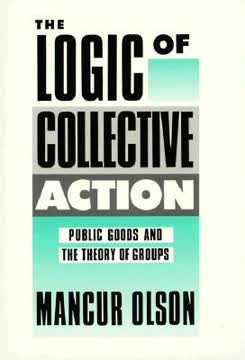
Reviews of The Logic of Collective Action are mixed, averaging 3.98/5. Supporters praise it as a seminal social science text, lauding Olson's insight that small groups more effectively pursue collective interests than large ones, and his "free rider" concept as foundational to public choice theory. Critics argue the work is overly reductionist, relying on neoclassical assumptions of rational self-interest while ignoring human altruism, tribal psychology, and evolutionary behavior. Many acknowledge its historical importance while noting its limitations in explaining real-world collective action across diverse cultural and political contexts.
People Also Read


 Immersive