
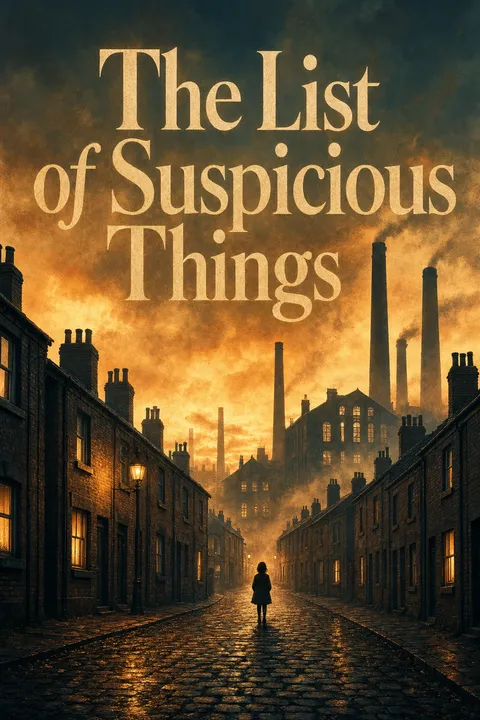


Plot Summary
A Penny in the Well
In late-1970s West Yorkshire, twelve-year-old Miv1 lives in a house gone quiet: her mother5 sits silent in an armchair, her strict Aunty Jean3 has moved in to keep order, and her father Austin4 drifts to the pub each night. When Austin4 muses that a fresh start Down South might help the family escape the Yorkshire Ripper headlines, Miv1 panics at the thought of leaving her only friend, Sharon.2
On a school trip to Mother Shipton's petrifying well, told her wish must stay secret, she drops her penny and privately wishes that she will be the one to catch the Ripper, reasoning that if the murders stop, the family will stay. The wish becomes an obsession she will come to regret.
Godfrey roots a national horror in a child's domestic logic: Miv cannot control her mother's illness or her parents' fraying marriage, so she displaces that helplessness onto a monster she believes she can defeat. The wish is magical thinking as self-protection, converting grief and fear of abandonment into a mission. The period detail (Thatcher, milk-snatching, mill closures) frames a Yorkshire already mourning itself, so the Ripper becomes shorthand for a wider loss of safety. Crucially, the narration signals retrospective guilt, seeding dread. The well's petrified objects foreshadow how good intentions can calcify into damage.
The First Name on the List
Borrowing Aunty Jean's3 habit of listing everything, Miv1 persuades Sharon2 to hunt the Ripper by writing down suspicious people and places. Their first entry is Omar Bashir,6 the gentle corner-shop owner who plays air piano to Elton John, simply because he has dark hair, a moustache, and drives a Ford Corsair, and because their town treats brown skin as inherently suspect.
To investigate, the girls befriend his shy, clever son Ishtiaq,7 playing cricket and chess. They quickly learn Omar6 is a widower who rarely leaves the shop, and cross him off. What began as detective play becomes genuine friendship, even as racist graffiti and a bottle of urine thrown into the shop reveal the daily cruelty the Bashirs endure.
The list dramatizes how prejudice masquerades as deduction: the girls' criteria are lifted straight from adult bigotry, and naming Omar exposes the reader to how communities manufacture outsiders. Yet the investigation subverts itself, because proximity breeds affection. By entering the Bashirs' home and tasting difference as warmth rather than threat, Miv begins dismantling inherited rules about who may befriend whom. Omar's interior chapters deepen this, showing a father negotiating grief and vigilance, honoring a dead wife's wish to let their son choose his own life. The section quietly argues that curiosity, when it becomes relationship, is the antidote to suspicion.
The Teacher Who Frightens
The girls add their intimidating teacher, Mr Ware,8 whose anger and outsider status match newspaper profiles of the killer, plus the town's derelict mills as places to hide a body. Watching him, they discover his marriage is collapsing, his glamorous wife Hazel10 scandalizing the local mothers.
Then, during a swimming lesson, the volatile Reece Carlton15 holds fragile Stephen Crowther underwater until he stops moving. Mr Ware8 hauls the limp boy out and resuscitates him, weeping and apologizing, later admitting to Stephen that he should have protected him.
Reece15 and his sidekick Neil are suspended. The incident complicates everything: the man Miv1 suspected of monstrous rage reveals remorse and tenderness, while a schoolboy15 displays a chilling, controlled cruelty that unsettles her far more.
This turn splits the book's inquiry into violence along two lines. Mr Ware embodies the fear that anger equals guilt, then dissolves it: his own POV reveals a man terrified of becoming his brutal father, cruel out of misguided attempts to toughen a soft son. Reece, by contrast, introduces a cold, performative violence that flicks on and off like a switch, the true menace hiding in plain sight. Godfrey teaches Miv, and us, that visible fury is often the least dangerous force, while the real threat wears composure. The pool scene also foreshadows the novel's tragic physics of water, height, and helpless bodies.
Ghosts of Healy Mill
Chasing the rumor that Reece15 and Neil broke into boarded-up Healy Mill, the girls sneak inside, drawing hopscotch as an alibi. Amid rusted machinery and creaking floors, they hear whistling and heavy footsteps, and a night watchman flushes them out, warning them about John Harris, a twelve-year-old strangled there generations ago while friends played a hanging game inspired by a famous poisoner.
At the library, the young librarian Helen Andrews12 helps them find the grisly history. The mill becomes both a thrilling ghost story and a genuinely dangerous place lodged firmly in Miv's1 imagination. She refuses to cross it off the list, sensing their business there is unfinished, an instinct that will prove devastatingly accurate.
The mill functions as gothic memory, a monument to industrial Yorkshire's dead prosperity and to children destroyed by careless play. The John Harris legend rhymes with the novel's present: kids reenacting adult violence until someone really dies. By planting the mill early and refusing closure, Godfrey obeys the storyteller's law of setup, letting a place of make-believe fear metastasize into real catastrophe. Helen's appearance here also stitches the town's separate lives together, the librarian who will become another thread. The section captures childhood's appetite for haunted spaces, and how the stories we tell to feel brave can rehearse the tragedies we cannot yet imagine.
The Man Among the Wrecks
Investigating Howden's Scrapyard as a body-dumping site during Wakes Week, the girls spy a man washing and undressing, wearing a donkey jacket like one the Ripper reportedly wore. To their relief he turns out to be Arthur,11 the beloved rag-and-bone man with his horse Mungo. He confesses he has been camping there because his wife Doreen recently died and their empty house became unbearable.
Sharon,2 who lost her nana, weeps with him, and the girls adopt Arthur11 as a friend, visiting daily, bringing sweets, helping him move home. When local thugs ransack his camp, the Bashirs6 quietly leave food. Arthur's11 loneliness teaches Miv1 what grief looks like, even as she keeps refusing to see it in her own silent mother.5
Arthur is the novel's tender heart, a figure of vanishing Yorkshire whose sorrow is unmistakable because, unlike Miv's family, he is allowed to voice it. Through him, Godfrey contrasts healthy mourning with the suppressed, unspeakable grief poisoning Miv's home. Sharon's instinctive compassion here marks her as the emotionally fluent counterpart to analytical Miv, deepening their seesaw friendship. The donkey-jacket scare also exposes the investigation's method: fear pattern-matches innocent men into monsters. Kindness, extended across class and race (the Bashirs' anonymous casserole), quietly builds the support network that will later hold the whole grieving town together.
The Geordie in the Lorry
When police release the hoax Wearside Jack tape, the town fixates on any non-Yorkshire voice. Jim Jameson,14 a cheerful Geordie lorry driver who works for Austin,4 is stopped and questioned, then living in his cab after his marriage falters. Miv1 adds him to the list, but finds him too warm to fear.
His workmates, egged on by cruelty and suspicion, beat him and spray Ripper slurs on his lorry. Austin,4 ashamed he failed to stop it, brings Jim14 home for a lively tea that briefly makes the family feel normal, and Aunty Jean3 unexpectedly blossoms. Jim14 is officially cleared when his boots prove too large to match the killer's footprints, earning a letter he treasures like a golden ticket.
Jim's ordeal indicts mob logic and the human need for a recognizable enemy: an accent becomes evidence, and decency is no defense against collective fear. Godfrey uses him to show how the Ripper's shadow corrodes ordinary solidarity, turning coworkers into a jury. Yet Jim's irrepressible good humor and his eventual clearing offer comic relief and a lesson in resilience. The warm family tea is poignant precisely because it is borrowed normality, glimpsed only when the ill mother is absent. Austin's guilt over the beating also quietly foreshadows his own secret shame, a man measuring himself against the monster on television.
Into Chapeltown
Convinced they must go where the Ripper hunts, Miv1 persuades a reluctant Sharon2 to bus to Leeds and find Chapeltown's red-light district. The reality is mundane until dusk, when two leering men outside the Gaiety pub corner them and one grabs Miv's1 arm. A working woman named Mags scares the men off, buys the girls sweets, scolds them fiercely, and phones a policeman who drives them to the station.
There a kind off-duty detective, Guy Lister,16 escorts them home and, against his judgment, agrees not to tell their parents. Shaken, Miv1 finally begins to grasp that these murders are real and that her game has consequences. Sharon,2 meanwhile, starts openly questioning whether the list is right at all.
The Chapeltown expedition is the novel's midpoint reckoning, where play collides with peril and the abstract victims of headlines become a living woman who saves them. Mags punctures the newspapers' moral hierarchy of respectable versus fallen women, a distinction Sharon has already found obscene. The scene marks the friendship's fault line: Sharon, maturing, senses the cruelty in treating suffering as sport, while Miv clings to the list as the glue binding them. Godfrey also plants Guy Lister, whose gentleness contrasts with the distant, posh policemen failing the investigation, and whose later role will bind these threads. Danger has become intimate.
The Librarian's Bruises
After student Barbara Leach becomes the Ripper's latest victim, reigniting the girls' resolve, they notice librarian Helen Andrews12 swinging between warmth and haunted silence, arriving with a black eye she blames on a fall. Sharon2 insists Helen12 is hiding something. They soon learn she is Arthur's11 cherished daughter, and that her charming husband Gary,13 adored by everyone in the pub, is a different man behind closed doors.
Helen's12 own chapters reveal the truth the girls only sense: Gary13 controls, isolates, and beats her, and the community's rules train women to stay silent and men to charm. Omar,6 whose quiet kindness she treasures, is one of the few who seems to understand. Helen12 stays on the list, though for reasons Miv1 cannot yet name.
Here the hunt for a distant killer keeps stumbling onto intimate, domestic violence, the novel's central pivot. Godfrey argues that the Ripper is not an aberration but the extreme of a continuum: a whole culture that polices women's movements, disbelieves their injuries, and worships male charm. Helen's interiority exposes the machinery of coercive control and the social omerta that protects abusers. The girls' childish surveillance becomes accidental witness to real suffering adults refuse to see. That Gary is universally beloved while privately cruel echoes Reece's on-off menace, reinforcing the book's thesis that danger hides behind likeability, not accents or dark eyes.
Fire and a Fatal Mistake
Omar's6 shop is firebombed with a petrol-soaked rag; Ishtiaq7 escapes with smoke inhalation and is sent to family in Bradford. Grasping for a culprit, Miv1 fixates on Brian,18 the silent man in overalls and yellow bobble hat who always lingers near the shop and has been seen with Reece15 and Neil.
Finding a petrol-stained rag in his mother Valerie's shed, Miv1 takes it to the police and names him. Days later Brian,18 a lonely, gentle soul preyed upon by the fascist boys, is found hanged in the woods. Miv's1 guilt is crushing, and Sharon,2 devastated, declares she will no longer play the list, insisting they have been recklessly meddling in real lives. Their friendship fractures.
This is the list's moral nadir, where amateur suspicion produces a body. Godfrey stages the consequence Miv has been courting since the well: her hunger to matter, to be seen as the girl who caught the killer, helps destroy an innocent, vulnerable man. Brian embodies those the town discards, neurodivergent perhaps, friendless, easy to scapegoat, echoing how the community treats anyone different. Sharon's withdrawal crystallizes the book's ethical argument in a child's voice: curiosity without compassion is violence. The rupture between the girls, built on their complementary natures, feels like the loss of innocence itself, and sets the emotional stakes for what follows.
Uncle Raymond Unmasked
At choir, Miv1 registers the wrongness of Uncle Raymond,19 the church helper who plies favorite little girls with extra cordial, tickles them, and gives Miv1 a lingering, predatory smile on a bus. Younger girls confirm he is a known groper. Miv,1 wanting to do genuine good for once, recruits two of his targets to trap him, but the plan is foiled by Mrs Spencer.
Soon after, Raymond19 is arrested for abducting and assaulting nine-year-old Alison. The police, including Guy Lister,16 take Miv's1 account seriously. For the first time her watchfulness protects rather than harms someone, though other mothers blame her, and the girls she helped shun her, punishing the child who named the danger they preferred to ignore.
Raymond makes literal the novel's refrain that predators hide in plain sight, sanctified even, behind respectability and community trust. Godfrey draws a hard line between Miv's reckless targeting of Brian and her vindicated instinct about Raymond: the difference is evidence, pattern, and the corroborated testimony of victims, precisely the methodical, unemotional approach Lister described. Yet the aftermath is bitterly realistic. Adults minimize (just tickling), victims are silenced, and the girl who speaks is branded a bad influence. The section anatomizes how abuse persists through communal denial, and how children who name it pay a social price while the guilty are protected by everyone's reluctance to look.
The Cry Behind the Door
Overwhelmed by home tensions and needing someone who might understand her, Miv1 seeks out Helen12 at the flats and instead hears Gary13 calmly, brutally beating her through the door. She races to a payphone and calls an ambulance, then watches, weeping, as Helen12 is stretchered out. Recovering at Arthur's,11 Helen12 finally admits to Sharon2 and Miv1 that her injuries came from Gary,13 and Arthur11 overhears, embracing his broken daughter.12
More chilling, Helen12 confides to Omar6 that Gary13 boasted of setting the shop fire, jealous of Omar's6 kindness to her. The arsonist who destroyed the Bashirs and helped push events toward Brian's18 death was neither Brian18 nor a stranger, but the town's most charming man,13 hiding cruelty behind a wink.
The revelation reroutes all the novel's misdirected suspicion toward its true target: the beloved abuser next door. Godfrey completes her indictment of a society that reads danger by skin and accent while excusing the white charmer buying rounds at the bar. Miv's phone call is her first act of unambiguous good, a stark redemption after Brian, and it reframes vigilance as courage rather than intrusion when aimed correctly. The fire's authorship also retroactively deepens Miv's guilt-and-relief whiplash: she blamed an innocent for a crime committed by a man everyone trusted. Helen's disclosure to Omar, not the police, underscores how survivors seek safety in genuine kindness.
Following Dad at Night
Miv's own father4 joins the list. His secretive phone calls, night wanderings, and police questioning about his whereabouts on murder dates terrify her into suspecting Austin4 himself. On her thirteenth birthday he reveals the family may finally move away for a new job, reigniting her original dread. Trailing him one night, Miv1 watches him walk to Sharon's2 house and kiss Ruby,17 Sharon's mother, on the doorstep.
The truth is an affair, not murder, relief tangled with betrayal. Aunty Jean,3 who had confronted Austin4 and briefly moved out, has understood all along. Miv1 now carries a secret that could destroy Sharon,2 whose fragile friendship she is only just repairing, and the family she idealized proves as broken as her own.
The suspicion of the father is the book's most intimate turn, collapsing the distance between hunting a monster and fearing one's own kin, literalizing the investigation's warning that the killer is someone's husband, someone's father. Austin's interiority reframes his lie to police as shame over adultery, a man refusing to let cowardice make him the monster. Godfrey complicates the Parkers, Miv's model of the happy family, revealing every household's concealed fractures. The move threat closes a circle back to the wishing well, reminding us the entire quest sprang from a child's terror of loss. Relief and heartbreak arrive fused, the texture of growing up.
The Roof of Healy Mill
Determined to finish the last item, the mill, Miv1 slips inside and finds a bag of fascist leaflets and stolen scrapyard piping. Her friends, Sharon,2 Ishtiaq,7 and Paul Ware,9 track her there, and for a tender moment the four lie in the snow watching stars, agreeing to work the list together. Then Reece15 and Neil appear on the roof, Reece15 wielding a metal pipe, sneering racist threats at Sharon2 for loving Ishtiaq.7
As the boys shove and swing, Sharon2 is knocked backward off the roof. The children find her below, and Miv1 covers her friend's body2 with her own coat, murmuring to her as though she is only cold. At the hospital, Sharon2 is pronounced dead, and Miv's mother,5 roused from silence by fear, finally holds her.
The climax fuses every seeded element: the haunted mill, Reece's cold violence, the stolen piping, the fascist leaflets Paul once carried, and the novel's argument that hatred kills. Sharon, the book's emblem of kindness and loyalty, dies defending love across a color line, murdered by the same ideology that firebombed the shop and scapegoated Brian. Godfrey refuses to let the Ripper be the story's only monster; the true killer here is the everyday bigotry the town nurtured. Miv's tender delusion over the body, echoing childhood dolls, renders grief unbearable. Yet her mother's reawakening at the hospital signals that catastrophe can also crack open long-frozen love.
Epilogue
In the aftermath, Miv1 learns to grieve from Ishtiaq,7 walks the town with him and Paul,9 and starts a new notebook listing everything she loved about Sharon.2 Reece15 is charged with manslaughter. Austin4 confesses the affair is over and admits his shame. Then Peter Sutcliffe is arrested, and Austin4 realizes he worked beside the Ripper daily.
Finally Marian5 breaks her years of silence: she was attacked walking home one night, blamed herself as the papers blamed all victims, and stopped speaking. She assures Miv1 that Sharon's2 death, like her own assault, was the attacker's fault, never the girl's. A grief group forms around Omar6 and Valerie, gathering the town's lost souls, including Aunty Jean.3
Godfrey resolves her braided themes through disclosure and communal healing. Marian's revelation retroactively explains the novel's central silence, binding the domestic and the national: the Ripper's culture of victim-blaming literally muted a mother, and only naming it restores her voice. Her gift to Miv, absolution, releases the girl from the guilt that has driven her since the wishing well. Sutcliffe's banal capture (a routine traffic stop, a coworker unrecognized) confirms the book's insistence that evil is unremarkable and near. The grief group, mixing samosas with potted-meat sandwiches, enacts the reconciliation the town could not manage while afraid, suggesting that shared mourning, not suspicion, is what finally makes a place safe.
Analysis
Godfrey's debut disguises a coming-of-age novel as a murder mystery, then reveals that the real subject is how communities locate danger. Miv's1 list, built from her elders' bigotries, keeps misfiring: it fingers a kind shopkeeper,6 a grieving widower,11 a bullied Geordie,14 a lonely man in a yellow hat,18 while the genuine threats, a charming wife-beater,13 a radicalized schoolboy,15 a sanctified church predator,19 move freely because they look like belonging. The book's central irony is that a nation terrorized by one man ignores the everyday violence, domestic, racist, sexual, woven through its own streets. The Ripper becomes a screen onto which a whole culture projects its fears while excusing the harms it prefers not to see. Structurally, the polyphonic chapters convert suspicion into empathy: every flat figure of gossip is given an interior, arguing that understanding, not surveillance, is what makes people safe. The mother's5 climactic revelation fuses the personal and political, her silence a direct product of the same victim-blaming that lets murderers flourish, and her absolution of Miv1 reframes the novel's guilt: catastrophe is the fault of those who choose cruelty, never of the vulnerable. Godfrey is also elegiac about place, mourning a Yorkshire of dead mills and lost pride, using derelict factories and rag-and-bone men as monuments to disappearance. Yet the ending resists despair. Grief, shared over samosas and potted-meat sandwiches, rebuilds the trust that fear dismantled. The lesson Miv1 extracts is not that she caught the killer, she never does, but that observation without compassion wounds, and that becoming a good person means learning to see people whole. It is a tender, morally serious book about childhood's dangerous games and the ordinary faces of evil.
People Also Read







Characters
Miv (Mavis)
Watchful girl detectiveThe narrator, twelve turning thirteen, a bookish, sharply observant girl who feels invisible beside her prettier friend2 and neglected at home, where her mother's5 silence and her father's4 absences have hollowed the house. Miv copes by noticing everything and by imposing order through lists, a habit inherited from Aunty Jean3. Her hunt for the Ripper is really a bid to feel significant, to keep her family from moving, and to hold onto Sharon2. Loyal, imaginative, and hungry to matter, she confuses being seen with being good, and must learn the difference between curiosity and cruelty. Beneath her detective bravado lies a lonely child aching for her mother's5 lost voice and her father's4 attention.
Sharon
Beloved best friendMiv's1 opposite and anchor: blonde, warm, and effortlessly liked, the Anne to Miv's1 tomboyish George. Sharon makes Miv's1 schemes happen and softens her edges, providing the emotional intelligence Miv1 lacks. Kind to outsiders like Stephen and the Bashirs6, she is braver and more principled than her sweet appearance suggests, increasingly troubled by the ethics of the list. As she matures, she pulls toward real relationships and away from the game, straining a friendship built on shared invention. Her instinctive compassion and moral clarity make her the story's tender conscience, and the person Miv1 most wants to become.
Aunty Jean
Opinionated household rulerAustin's4 spinster sister, who moved in when Marian5 fell silent and governs the home with lists, sniffs, and buttoned-up cardigans. Fiercely judgmental about Thatcher, immigrants, and loose morals, she seems all hard edges, yet she has quietly become the glue holding a fractured family together. Her copperplate notebooks model the ordering impulse Miv1 adopts. Beneath the granite lies old grief for a father broken by the mills and a loneliness she rarely admits. Over time her sternness reveals unexpected tenderness and capacity for change.
Austin
Weary, absent fatherMiv's father1, a delivery-depot supervisor who worked his way up from loader, proud of his job and devoted to Yorkshire cricket. Worn thin by his wife's5 illness, he escapes to the pub and carries a private guilt that makes him evasive and secretive. Cricket is the only language he and Miv1 reliably share. Kind in his goodnight rituals yet emotionally unreachable, he embodies the stoic Yorkshire man who cannot speak his pain, and who fears that his own failures might make him no better than the monster on the news.
Marian
The silent motherMiv's mother1, once a singer with a beautiful voice who filled the house with music, now mostly mute and confined to her armchair or bedroom after a breakdown. Her absence shapes every corner of Miv's1 life, an invisible forcefield of sorrow the family navigates around. Miv1 aches for the melodic, affectionate woman she used to be. The cause and depth of Marian's silence remain a haunting question that governs the emotional undertow of the whole novel.
Omar Bashir
Grieving corner-shop ownerA Pakistani widower who moved from Bradford to run the corner shop, seeking a fresh start away from his late wife Rizwana's cloying family. Warm, witty, and Elton John-obsessed, he masks daily racism and private rage behind an unfailing smile, honoring Rizwana's plea that he never fight back for their son's7 sake. A devoted, anxious father to Ishtiaq7, he becomes an unlikely pillar of the community, extending quiet kindness to the lonely and the abused. His interior chapters reveal grief, dignity, and a fierce protectiveness held always in check.
Ishtiaq
Shy, clever schoolmateOmar's6 sensitive, cricket-loving son, silent and guarded at school where he suffers racist bullying, but funny and animated at home. Bookish and quietly resilient, he becomes a true friend to Miv1 and something more to Sharon2. Having already lost his mother, he understands grief in ways the others do not, and models how to mourn and keep living.
Mr Ware (Mike)
Feared, grieving teacherAn imposing, perpetually angry teacher new to the town, suspected by the girls for his moustache and fury. His chapters reveal a man in a collapsing marriage, terrified of becoming his own brutal military father, cruel to weak boys out of misguided hopes of toughening them, including his own gentle son9. Capable of startling remorse and tenderness beneath the rage.
Paul Ware
Sensitive newcomer boyMike8 and Hazel's10 teenage son, lanky, bookish, and cool in his Blondie shirt and drainpipe jeans, uprooted by his parents' divorce. Reserved and initially prickly, he becomes Miv's1 tentative first crush and a loyal friend, sensible and kind, drawn into the list's final chapters.
Hazel Ware
Glamorous, scandalized motherMike's8 elegant, non-Yorkshire wife whose affair and impending divorce make her the target of the town's gossiping mothers. Warm and unbothered by convention, she dazzles Miv1 as everything she wishes she were, offering the maternal warmth Miv1 craves at home.
Arthur
Grieving rag-and-bone manA beloved old rag-and-bone man with his horse Mungo, a living relic of vanishing Yorkshire. Newly widowed after losing his wife Doreen, he camps in a scrapyard to escape his empty house. Gentle, folksy, and openly sorrowful, he becomes the girls' cherished friend and teaches Miv1 what grief truly looks like. Fiercely loving toward his daughter Helen12.
Helen Andrews
The haunted librarianArthur's11 youngest daughter, a bright young librarian who once dreamed of teaching. Swinging between warmth and frozen distance, she hides bruises beneath scarves and polo necks. Trapped in marriage to a charming, controlling husband13, she has learned the town's rule that women must endure and stay silent. Finds rare understanding in Omar's6 quiet care.
Gary Andrews
Charming, dangerous husbandHelen's12 husband, a plumber universally adored in the pub for his back-slapping generosity and easy charm. Behind closed doors he is a controlling, jealous abuser who isolates and terrorizes his wife12. His public likeability is precisely what shields him, embodying the novel's warning that menace hides behind charisma.
Jim Jameson
Cheerful suspected GeordieA relentlessly good-humored Geordie lorry driver at Austin's4 depot, wrongly suspected because his accent echoes the hoax tape. Beaten by workmates and living in his cab after a marriage split, he bears cruelty with resilience and warmth, eventually cleared and taken in by Arthur11.
Reece Carlton
Cold, cruel schoolboyA once-shy, clever boy turned chillingly menacing, son of the feared Kevin Carlton. Reece dispenses violence with a switch-flick calm that terrifies Miv1 more than open anger. Increasingly radicalized and brutal, he channels the town's hatred into something genuinely dangerous, always shadowed by his follower Neil.
Guy Lister
Kind off-duty detectiveA gentle detective sergeant who lives locally, drives the girls safely home from Chapeltown, and takes Miv's1 observations seriously. Connected to Hazel Ware10, he treats children and teenagers as people worth listening to.
Ruby
Sharon's warm motherSharon's2 kind, sweet-smelling mother, who first invited lonely Miv1 for teas and puddings. A picture of maternal warmth and apparent domestic happiness, she becomes entangled in a secret that complicates Miv's1 idealized view of the perfect family.
Brian
The man in overallsA silent, solitary young man in greasy overalls and a yellow bobble hat who lingers near the shop and lives with his mother Valerie. Gentle and friendless, misunderstood by the town, he is easily preyed upon by the fascist boys.
Uncle Raymond
Church predatorA church helper and photographer who is no one's actual uncle, given to plying and tickling favorite young girls. His unsettling attentions mask a genuine, dangerous predatory nature hidden behind respectability.
Plot Devices
The list
Structuring investigative deviceA spiral-bound notebook in which Miv1 records suspicious people and places, modeled on Aunty Jean's3 obsessive lists and a policeman's talk of rigor and structure. Each numbered entry, from the shopkeeper6 to the mills to her own father4, organizes both the plot and Miv's1 attempt to impose control on a frightening, chaotic world. The list gives her identity, purpose, and a shared mission with Sharon2, but it also weaponizes inherited prejudice, turning innocent neighbors into suspects. As the entries accumulate consequences, the notebook becomes a moral ledger, tracking how curiosity curdles into harm. Its chapter-heading structure lets the reader anticipate each new target and dread where the hunt will lead.
The Yorkshire Ripper
Pervasive historical menaceThe real serial killer stalking 1970s West Yorkshire looms over every scene through newspapers, posters, playground games, and the parroted line that he could be anyone's husband or son. He is the engine of the plot, the reason for Miv's1 wish and list, and the atmosphere of dread that reshapes women's lives, curfews, and the town's trust in strangers. Yet Godfrey uses him thematically as much as literally: the true violence the children uncover is domestic, racist, and predatory, closer to home than any faraway monster. The killer's eventual, banal capture reframes the whole novel's search, insisting that evil is ordinary, unrecognized, and near.
Multiple POV chapters
Reveals hidden adult livesInterspersed among Miv's1 first-person narration are third-person chapters inside the minds of Austin4, Omar6, Mike Ware8, and Helen12. This device lets the reader understand the interior truths the children can only misread from the outside: a father's shame4, a widower's suppressed rage6, a teacher's inherited fear8, a wife's coerced silence12. The technique dramatizes the novel's central lesson, that everyone hides a story, and generates dramatic irony as Miv1 suspects the wrong things for the wrong reasons. By granting dignity and complexity to figures the town flattens into gossip or suspicion, the shifting perspective becomes an argument for empathy over surveillance.
The wishing well
Guilt-laden origin catalystOn a school trip, Miv1 drops a penny into Mother Shipton's petrifying well and secretly wishes to catch the Ripper so the murders will stop and her family will not move. The secret wish, which folklore says must never be told, becomes the novel's engine of guilt and consequence, the moment a frightened child binds her sense of agency to a monstrous quest. Godfrey frames it with retrospective dread, signaling that the wish will ripple destructively through everyone Miv1 loves. The petrified objects hanging in the cave, ordinary things turned to stone, quietly foreshadow how good intentions can harden into damage, and how childhood magic curdles into responsibility.
The Wearside Jack tape
Fear-amplifying red herringThe hoax audio recording sent to police by a man claiming to be the Ripper is played endlessly on television and radio, its flat north-eastern accent absorbed into the town's paranoia. The tape sharpens everyone's distrust of outsiders and any non-Yorkshire voice, directly triggering the persecution of Jim Jameson14. Historically a catastrophic misdirection for the real investigation, within the novel it demonstrates how a single piece of false evidence can reorganize a community's suspicions and harden its xenophobia. For Miv1 it becomes another clue to obsess over, and for the reader a lesson in how the desperate hunger for a recognizable enemy manufactures scapegoats.
Download PDF
Download EPUB
.epub digital book format is ideal for reading ebooks on phones, tablets, and e-readers.








































