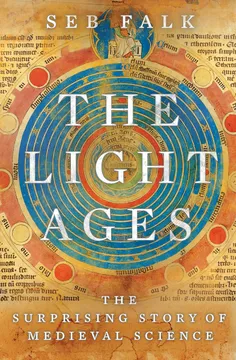
Key Takeaways
1. The "Dark Ages" is a myth; the medieval period was an era of scientific curiosity and light.
The medieval reality, however, is a Light Age of scientific interest and inquiry.
Re-evaluating historical myths. The term "Dark Ages" was actually coined by Renaissance humanists and Protestant reformers to make their own eras look superior by comparison. In reality, the medieval period was characterized by a vibrant, active pursuit of natural philosophy and scientific inquiry.
A continuous evolution. Rather than a sudden explosion of knowledge in the Renaissance, science progressed through a continuous, gradual evolution. Medieval thinkers laid the groundwork for modern physics, astronomy, and mathematics by preserving, translating, and building upon classical knowledge.
- The preservation of Greek and Roman texts in monastic libraries.
- The active translation of advanced scientific works from Arabic and Hebrew.
- The establishment of the first universities as centers of intellectual debate.
Contextualizing past achievements. We must avoid judging the past solely by how much it resembles our present. Medieval science was highly sophisticated and successful when measured on its own terms, addressing the practical and spiritual needs of its time.
2. Medieval science was deeply intertwined with religious faith and daily monastic life.
Belief in God never prevented people from seeking to understand the world around them.
Harmonizing faith and reason. The modern assumption that science and religion are inherently antagonistic is a historical misconception. In the medieval world, studying the cosmos was seen as a way to understand the mind of God and appreciate the perfection of His creation.
Monasteries as intellectual hubs. Monasteries were not just places of prayer; they functioned as the primary scientific and educational institutions of their day. Monks required precise astronomical and mathematical knowledge to manage vast agricultural estates, calculate calendars, and regulate daily prayer schedules.
- Tracking the movements of the stars to determine the hours of nightly prayer.
- Managing agricultural cycles through folk astronomy and seasonal observations.
- Copying, translating, and preserving scientific manuscripts in scriptoriums.
A holistic cosmic view. For medieval thinkers, natural philosophy was a path to moral and spiritual wisdom. They viewed the physical universe as a "book of nature" written by the divine, meant to be read alongside holy scripture.
3. The reckoning of time and the calendar drove the development of medieval mathematics and astronomy.
Computus was the essential science for any medieval monk to learn.
The science of Computus. The need to calculate the movable feast of Easter led to the development of computus, a highly sophisticated discipline of calendrical astronomy. This science required monks to master complex mathematics to align the solar year with the lunar cycle.
Innovative mathematical tools. To solve these calendrical challenges, medieval scholars developed and utilized various mathematical and mnemonic tools. They used finger-counting systems, abacuses, and reference tables to perform calculations that would otherwise be incredibly tedious.
- The nineteen-year Metonic cycle to align solar and lunar calendars.
- Golden Numbers and Sunday letters to predict the dates of new moons and Easter.
- Hand mnemonics to memorize complex musical scales and calendar cycles.
Exposing calendar discrepancies. As the centuries progressed, astronomers realized that the Julian calendar was slightly too long, causing the observed equinox to drift. This discrepancy sparked intense scientific debate and laid the groundwork for the eventual Gregorian calendar reform.
4. Global exchange of knowledge, particularly from Islamic and Jewish scholars, shaped Western science.
Medieval science was an international endeavour, just as science is today.
The great translation movement. In the twelfth and thirteenth centuries, a massive influx of scientific texts translated from Arabic, Greek, and Hebrew transformed European scholarship. Translators working in multicultural hubs like Toledo, Spain, made advanced mathematical and astronomical works accessible to the Latin West.
Cross-cultural scientific collaboration. Devout Christian scholars had no hesitation in adopting and building upon theories developed by thinkers of other faiths. They recognized that scientific truth was universal, regardless of its cultural or religious origin.
- Al-Khwarizmi, whose work introduced Hindu-Arabic numerals and algebra to Europe.
- Al-Zarqali (Arzachel), whose Toledan Tables and universal astrolabe designs revolutionized astronomy.
- Ibn Sina (Avicenna) and Ibn Rushd (Averroës), who shaped medieval medicine and natural philosophy.
A shared global heritage. This global exchange of ideas demonstrates that the history of science is not a purely Western narrative. Modern scientific concepts are built upon a rich, multicultural foundation of shared human curiosity.
5. The mechanical clock was a revolutionary medieval invention that transformed human society.
The mechanical clock was surely the most significant invention of the Middle Ages.
A profound technological shift. The invention of the mechanical clock around 1300 marked a profound shift in how humans measured and experienced time. By dividing the day into twenty-four equal hours, clocks replaced the traditional, variable seasonal hours with a standardized, regular beat.
Wallingford's mechanical masterpiece. The astronomical clock built by Abbot Richard of Wallingford at St Albans was a marvel of medieval engineering. It did not just strike the hours; it displayed the phases of the moon, the movement of the sun, the tides of London Bridge, and even predicted eclipses.
- The "strob" escapement, which regulated the release of energy from falling weights.
- An intricate hour-striking mechanism that chimed the correct number of times.
- An oval gear designed to replicate the sun's variable speed through the zodiac.
Transforming human society. The spread of mechanical clocks from monasteries to civic centers transformed economic and social life. It established a shared, objective framework of time that laid the foundation for the modern, synchronized world.
6. The astrolabe served as a portable, multifunctional analog computer of the medieval world.
When you know the astrolabe well, you will know the universe like a fruit on the palm of your hand.
The ultimate portable computer. The astrolabe was the classic scientific instrument of the Middle Ages, serving as a portable model of the moving heavens. By projecting the three-dimensional celestial sphere onto a flat, two-dimensional plate, it allowed users to perform complex calculations with ease.
Multifunctional astronomical utility. The astrolabe was incredibly versatile, offering dozens of practical applications for astronomers, astrologers, and travelers. It could be used to tell the time by day or night, find the coordinates of stars, and measure the heights of buildings.
- The mater (mother), which held interchangeable plates engraved for specific latitudes.
- The rete (net), a skeletal plate featuring pointers for major stars and the ecliptic ring.
- The alidade, a rotating sighting rule on the back used to measure celestial altitudes.
A powerful cultural symbol. Beyond its practical uses, the astrolabe was a powerful status symbol and educational tool. It represented its owner's education, wealth, and mastery over the mathematical laws that governed the cosmos.
7. Medieval universities established a rigorous, standardized curriculum based on the liberal arts and natural philosophy.
The universities did not appear out of nowhere but evolved after centuries of gradual development in monastic and cathedral schools...
The rise of universities. The rise of universities in the twelfth and thirteenth centuries created a new, highly organized class of professional scholars. Institutions like Oxford and Paris established standardized curricula that shaped intellectual life across Europe.
The liberal arts curriculum. Students began their studies in the Faculty of Arts, mastering the trivium of verbal sciences and the quadrivium of mathematical sciences. This foundational training prepared them for higher studies in theology, law, or medicine.
- The Trivium: Grammar, rhetoric, and logic.
- The Quadrivium: Arithmetic, geometry, music, and astronomy.
- The "three philosophies": Natural philosophy, moral philosophy, and metaphysics.
Rigorous scholastic debate. The university curriculum was heavily based on the newly translated works of Aristotle. Scholars used the scholastic method of structured debate to analyze, criticize, and reconcile classical philosophy with Christian theology.
8. Astrology and medicine were practical, highly mathematical applications of medieval cosmology.
A doctor cannot cure, if he does not know the cause of the disease.
The cosmic human microcosm. Medieval medicine was deeply rooted in the belief that the human body was a microcosm of the universe. Because the elements of the Earth were influenced by the movements of the heavens, physicians had to master astronomy to diagnose and treat illnesses.
The four bodily humours. Health was understood as a balance of four bodily fluids, or humours, which corresponded to the four elements and their qualities. Astrological configurations were used to determine the best times for medical interventions like bloodletting or administering drugs.
- Blood: Hot and wet, corresponding to air and the spring.
- Phlegm: Cold and wet, corresponding to water and the winter.
- Yellow bile (choler): Hot and dry, corresponding to fire and the summer.
- Black bile (melancholy): Cold and dry, corresponding to earth and the autumn.
Predictive natural astrology. While the Church condemned extreme forms of judicial astrology that threatened human free will, natural astrology was widely accepted. It was used to forecast the weather, predict agricultural yields, and guide daily decision-making.
9. The equatorium represented the pinnacle of medieval computational ingenuity, simplifying complex planetary orbits.
The equatorium was a tool for learning astronomical concepts, but its primary purpose was to pinpoint planetary positions.
Simplifying planetary orbits. While the astrolabe modeled the daily rotation of the stars, the equatorium was designed to calculate the complex, irregular paths of the planets. It allowed astronomers to bypass the tedious mathematical calculations required by traditional planetary tables.
Westwyk's innovative design. John Westwyk's equatorium was a highly original, large-scale instrument that combined all the planets' deferent circles onto a single face. By standardizing the sizes of the circles, he created a user-friendly analog computer that could find planetary longitudes to a high level of precision.
- A six-foot wooden disc bound with iron like a cartwheel for maximum precision.
- A combined epicycle plate that stood in for all the planets' individual epicycles.
- A system of parallel silk threads used to transfer angles from the equant to the Earth.
An educational modeling tool. The equatorium was not just a labor-saving calculator; it was a physical manifestation of Ptolemaic planetary theory. Using the instrument helped students visualize and understand the complex geometry of deferents, epicycles, and equants.
10. Science progresses through gradual, collaborative, and incremental steps rather than isolated "Eureka" moments.
A true story of science should not be a parade of famous names but should represent the ideas and achievements of the nameless majority of scientifically minded people.
The collaborative scientific network. The history of science is often written as a series of revolutionary breakthroughs by a few famous "Great Men." In reality, scientific progress is a slow, collaborative effort carried out by a vast, often forgotten network of ordinary scholars like John Westwyk.
Incremental historical progress. Medieval thinkers did not simply accept classical authority blindly; they constantly tested, corrected, and refined the theories they inherited. They built upon each other's work across generations, languages, and continents, making small, incremental improvements that eventually led to the modern scientific revolution.
- The gradual refinement of the Toledan Tables into the more accurate Alfonsine Tables.
- The development of the "Maragha School" planetary models that Copernicus later utilized.
- The evolution of timekeeping from simple sundials to complex astronomical clocks.
A shared human journey. Recognizing the collaborative nature of science helps us appreciate that our own knowledge is part of an ongoing, historical journey. By understanding the science of the past on its own terms, we can better navigate the challenges and uncertainties of the future.
I confirm that I have written detailed takeaways for ALL 10 key takeaways in the format requested.
Review Summary
Reviews of The Light Ages are largely positive, averaging 3.67/5. Many readers praise Falk's engaging storytelling and his effective dismantling of the "Dark Ages" myth, highlighting the surprising sophistication of medieval science. The narrative device of following monk John Westwyk is widely appreciated, as are the book's breadth of topics. However, several reviewers note that the technical sections—particularly around astrolabes and mathematics—can be overwhelming and inaccessible. Some critics feel the book is Eurocentric and doesn't sufficiently acknowledge Islamic and Byzantine contributions.








































