

Key Takeaways
Attraction runs on projected attitude, not your face or your wallet
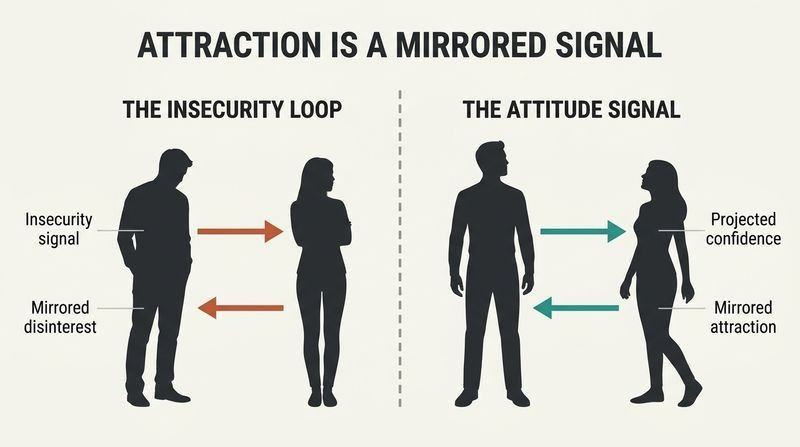
The book's founding premise separates two archetypes: the PUA (pick-up artist), a man who supposedly masters seduction, and the AFC (average frustrated chump), a needy man clueless about female desire. Its central claim is that women judge men not by looks but by how a man makes them feel. Baldness, height, and a thin bank account do not repel women, the argument goes; the low confidence those insecurities produce does.
The prescribed fix is internal. Grooming, posture, and a rehearsed mantra ("I am the perfect experience for her") substitute for wealth or a chiseled jaw. The logic: fake it internally until the projection becomes real, because a woman mirrors back whatever emotional signal you send her.
The reframe has therapeutic value for socially anxious men: obsessing over immutable traits is paralyzing, while attitude is trainable. Yet the totalizing claim that "looks do not matter" contradicts robust findings on the halo effect and physical-attractiveness bias, where attractive people are rated more competent and trustworthy on sight. A fairer synthesis: appearance sets the opening odds, but demeanor, warmth, and status cues genuinely move them. The book overcorrects a real insight into a slogan, which is common in confidence literature that must sell hope to feel useful.
The alpha male is a performance that becomes real when believed
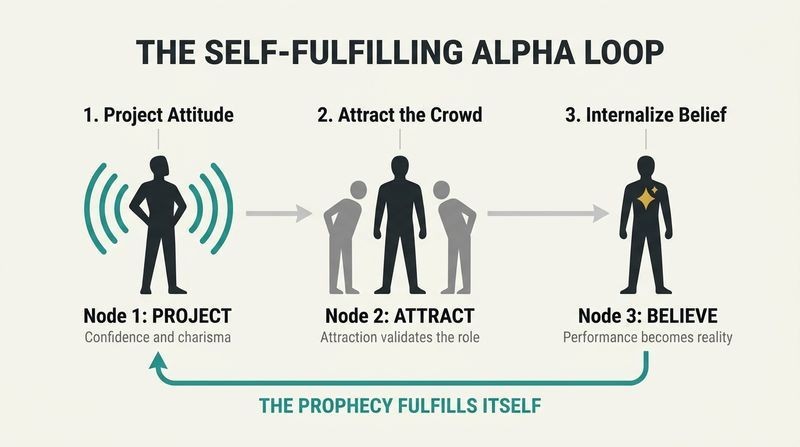
Borrowing from nature-documentary imagery, the book argues the alpha male is not the strongest or best-looking animal but simply the one who mates. Attraction, therefore, is a self-fulfilling prophecy: project dominance and women flock to you, and because women flock to you, you are by definition the alpha.
Crucially, humans are said to escape the zero-sum jungle. Unlike lions fighting over a few females, men face millions of potential partners, so there is no need to physically compete or out-muscle rivals. You need only stand apart from the timid crowd. The recommended traits are attitudinal: confident, outgoing, attentive, authoritative, and fun, none requiring muscles or money.
The pop-ethology is shaky. Primatologist Frans de Waal has shown that durable alpha status among chimps often depends on coalition-building, grooming, and conflict resolution, not raw aggression, which undermines the dominance-only caricature. What survives scrutiny is the psychology of behavioral confirmation: people often elicit the very responses they expect, a cousin of the Pygmalion effect. The performance-becomes-reality mechanism is legitimate. The zoological costume draped over it is decorative pseudoscience that lends unearned scientific authority to a simple self-belief exercise.
Approach within three seconds, before fear invents an excuse
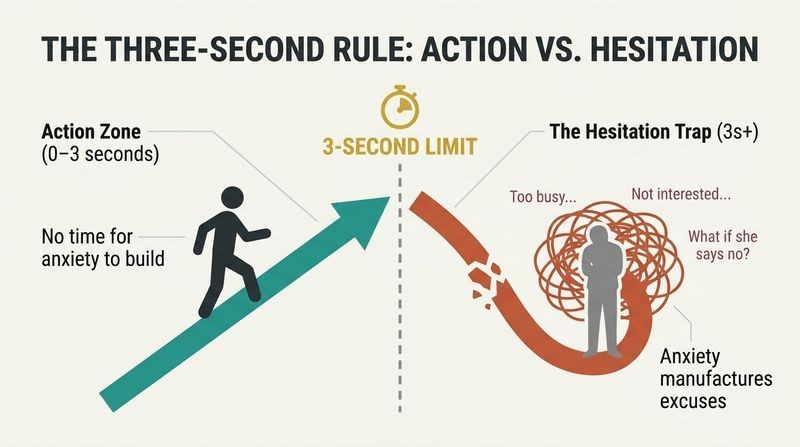
The Three Second Rule (abbreviated 3S) commands you to approach a woman within three seconds of noticing her, even before eye contact. The purpose is not politeness but neurological sabotage: three seconds is too short a window for the brain to manufacture anxiety, sweat, and reasons to retreat.
Hesitation, the book warns, signals weakness and lands men on "death row," the line of paralyzed wallflowers ringing every dance floor. A companion drill called "Crash and Burn" has beginners deliberately use terrible lines to get rejected on purpose, desensitizing themselves to fear until rejection stops stinging.
This is the book's most defensible tactic because it aligns with clinical practice. Crash and Burn is essentially exposure therapy and systematic desensitization, the gold-standard treatment for social anxiety, in which repeated safe exposure extinguishes the fear response. The three-second window also mirrors research on the "action precedes motivation" principle: waiting for courage rarely works, whereas acting quickly bypasses rumination. The framing is crude, but a therapist coaching a phobic client to approach strangers before catastrophizing would recognize the underlying mechanism. Stripped of the conquest metaphor, it is sound behavioral science.
Drop the nice-guy mask and broadcast desire early
The book rejects the idea that women prefer jerks. Instead it argues that so-called nice guys sabotage themselves by switching off their sexuality to seem inoffensive, projecting an asexual, emasculated persona that confuses women about whether attraction even exists. The result is the friend zone, or LJBF ("Let's Just Be Friends").
The supposed jerk wins not through rudeness but through unambiguous sexual confidence. The instruction is to combine warmth with clear intent: be polite, attentive, and romantic, but never hide that you find her attractive and want her. Women, the argument goes, feel safer knowing desire is mutual than being left guessing.
There is a genuine kernel here. Research on the "nice guy paradox" suggests ambiguity about romantic intent, not kindness itself, is what strands men in friendship limbo, and signaling interest reduces uncertainty. The error is the false binary. Kindness and sexual confidence are not opposites; the book conflates timidity with virtue and boldness with sexuality, forcing a choice that does not exist. Emotionally intelligent men are direct AND considerate. The framing also risks teaching men that respect and desire cannot coexist, a distortion that later PUA culture amplified into open contempt.
Treat rejection as data collection, never as a personal verdict
Rejection is reframed as feedback rather than judgment. Even elite practitioners, the book concedes, lose more often than they win; batting .500 is fantasy. PUA Johnny Shack's tidy list claims a woman rejects you for only three reasons: she has a boyfriend, she wants your friend, or she lacks the confidence to say yes, none of which reflect your worth.
The deeper lever is abundance. Fixating on one "dream girl" breeds a desperation the book calls a self-reinforcing downward spiral, where obsession repels her further. The antidote is the mantra that there is always another woman, which keeps you relaxed, non-needy, and paradoxically more attractive.
The abundance mindset is psychologically legitimate. Scarcity thinking spikes anxiety and neediness, while perceived options lower the stakes of any single interaction, reducing rejection sensitivity, a trait linked to anxious attachment. Reframing failure as information also mirrors resilience research and the growth mindset. The shadow side is the self-serving "she is missing out" narrative, which protects the ego by curdling into contempt for the person who declined. Healthy detachment says "we were not a fit"; the book's version too often says "her loss," and that resentment tends to leak into behavior.
Negging deflates a beautiful woman's ego so you stand out
Adopted from the PUA known as Mystery, the neg hit is a backhanded compliment aimed only at "nines and tens." The theory: stunning women are drowning in flattery and desensitized to it, so a mild, ambiguous jab ("Nice nails, are they real?") disrupts their expectation and their sense of power.
The neg is not an insult, the book insists, but a qualification, a signal that she has failed to meet your standard. Robbed of the adoration that anchors her control, she grows curious and starts working to win your approval. The rules: frame it as a compliment, never on women with low self-esteem, and stop before you crush her.
Negging became notorious after Neil Strauss's memoir The Game brought it mainstream. Mechanistically it exploits intermittent reinforcement and the scarcity of approval, both real drivers of compulsive pursuit, which is precisely why it is ethically corrosive: it manufactures self-doubt to create dependency. It is also unreliable, frequently reading as simple hostility and ending interactions. More damning, it treats a woman's insecurity as an exploitable bug rather than a person's vulnerability. Modern critiques rightly classify it as psychological manipulation adjacent to negging in abusive dynamics. Whatever its short-term efficacy, it optimizes for control, not connection.
Speed Seduction uses scripted patterns to plant feelings covertly
Ross Jeffries built Speed Seduction from neuro-linguistic programming (NLP), the 1970s work of Grinder and Bandler. The core tool is the pattern: a scripted story (his famous "Discovery Channel" bit about roller-coaster thrills) laced with embedded commands, trance words, and sexual innuendo designed to make a woman feel arousal and unconsciously link it to you.
Supporting devices include stacking realities and quoting (attributing racy suggestions to a friend to dodge blame), and anchoring, a crude borrowing of Pavlov's dog: touch her in the same spot each time she feels good until the touch alone triggers the feeling. The book claims patterns work about 70 percent of the time.
NLP is one of the most thoroughly discredited frameworks in psychology; controlled studies find no support for "embedded commands" or covert linguistic mind control, and the "weasel phrases" are theater. Yet the practice is not entirely empty. Buried inside are legitimate rapport skills: mirroring, evocative storytelling, and shifting a conversation from facts to feelings genuinely build connection. The likeliest active ingredient is the placebo running on the practitioner: a man armed with a script speaks with fluency and conviction, and that borrowed confidence, not hypnosis, is what occasionally lands. The 70 percent figure is marketing, not data.
Elicit her values, then become the man she already wants
The technique of eliciting values hinges on a distinction. A "means value" is a surface trait she names ("I like tall guys"); an "end value" or desired state is the feeling beneath it (safety, protection). Probe past the means to the end, the book says, and you learn what she actually craves, often rooted in childhood or past wounds.
The payoff is to fill that void and anchor the fulfillment to yourself, becoming not a dream man but her dream man. You feed her language back using her "trance words," the emphasized phrases that carry emotional weight, so she feels uniquely understood, as if you share her wavelength.
This is emotional intelligence, weaponized. The skills involved (deep listening, distinguishing stated wants from underlying needs, reflecting someone's language) are the same ones taught in Rogerian counseling, motivational interviewing, and elite sales. Understanding that "I want tall" means "I want to feel safe" is genuinely sophisticated. The ethical fault line is intent: therapy uses these skills to serve the other person, while the book uses them to fabricate false compatibility for extraction. It is a textbook illustration of how dark-triad manipulation and genuine empathy share a toolkit and diverge entirely in purpose. The same key opens a door or picks a lock.
Manufacture your own value through scarcity and refusing to pay
The book treats value as a function of price and scarcity. Never buy a woman a drink or dinner; doing so signals supplication and hands her power. Gifts and dates are reframed as rewards for sex already given, not investments to earn it. A man who costs nothing, the logic runs, is assumed to be worth nothing.
In relationships the same principle governs behavior: always appear busy, stay a little unavailable, occasionally cancel plans, and make her invest effort and money in you. Passion, the closing chapter insists, requires the constant belief that she could lose you. Non-monogamy is even recommended, provided you disclose it, to keep competitive tension alive.
The underlying psychology is real. Cialdini documented scarcity as a potent persuasion trigger, and reactance theory shows people want what seems restricted. Playing hard to get has mixed empirical support: some studies find selective unavailability raises desirability, others find it simply frustrates. The deeper problem is that treating a relationship as a market with power leverage breeds exactly the mutual distrust that corrodes intimacy. Attachment research is unambiguous that security, responsiveness, and reliability, not engineered scarcity, predict lasting satisfaction. The book optimizes for the chase and is silent on what happens when someone actually wants to be loved.
Close by making her offer the number, then test with a kiss
Closing is the exit move of every encounter. The number close aims to make her offer her number so she concludes "I gave it to him, I must like him," rather than the weaker "he asked, he must like me." Always leave at a conversational high point, the book urges, so she wants more, and always schedule a specific callback.
The kiss close follows: rather than asking permission (framed as weak), you say "Would you like to kiss me?" and treat anything short of a firm no as a yes. Before inviting a woman home, the kiss functions as a calibration test of her intent. The "date" itself is disguised as midweek coffee, never a weekend dinner.
One buried idea has real merit: using escalating physical steps to read whether interest is mutual before proceeding is a form of consent calibration. But the book's execution collides head-on with modern affirmative-consent standards. Treating "anything short of no as negotiation" is precisely the framework that consent education exists to dismantle, since silence, hesitation, or ambiguity are not agreement. The manual does state that a clear no ends everything, yet it simultaneously trains men to reinterpret reluctance as an obstacle to overcome. That contradiction, published in 2004 before the cultural reckoning of the following decade, is the book's most dangerous legacy.
Analysis
The Layguide is less an original work than a 2004 anthology, a curated download of the early internet seduction community (usenet's alt.seduction.fast, Ross Jeffries, Mystery, Maniac High) compiled under a house pseudonym. Its structure follows a funnel: mindset, approach, conversation, close, and relationship management, each stage supplied with named techniques. Understood as a cultural artifact, it captures the pre-Neil-Strauss moment when pickup was migrating from message boards to mass-market paperbacks, and it foreshadows the manosphere that followed.
Stripped of ideology, the book contains a genuine behavioral core worth naming honestly. Approach anxiety yields to exposure. Neediness repels, while abundance and detachment calm the nervous system. Listening for underlying needs beats reciting facts about yourself. Confidence is partly a trainable performance. These map onto real findings in exposure therapy, attachment theory, persuasion science, and clinical rapport-building. A charitable reading is that lonely, socially frozen men extracted from it permission to act.
The problem is the operating system wrapped around those tools. Every interaction is framed as a power contest to be won through control, and women are rendered as obstacles, prizes, and status symbols rather than people. The neg exploits insecurity by design. The value-elicitation weaponizes empathy for deception. Most alarmingly, the consent framing ("anything short of no is negotiation") is exactly what a decade of affirmative-consent scholarship arose to refute. The book insists a clear no is final while simultaneously coaching men to reinterpret reluctance as a hurdle, a contradiction that is not a footnote but a fault line.
The honest verdict: a real skill set encased in a corrosive worldview. The techniques that help (courage, listening, self-possession) are indistinguishable from ordinary social competence, while the techniques unique to the genre (negging, patterns, boyfriend-alienation) are either pseudoscience or manipulation. Read it as a case study in how the toolkit of connection and the toolkit of exploitation share the same instruments and diverge entirely in intent.
Review Summary
The Layguide receives mixed reviews, with an average rating of 3.19 out of 5. Many readers criticize it as sexist, manipulative, and objectifying towards women. Some find it condescending and outdated, comparing it unfavorably to other dating advice books. Critics argue it promotes toxic behavior and treats women as conquests. However, a few readers appreciate its directness and find it helpful for improving their dating skills. Some view it as entertaining, while others consider it a waste of time. Overall, opinions are polarized, with strong negative reactions outnumbering positive ones.
FAQ
What is The Layguide by Tony Clink about?
- Comprehensive seduction manual: The Layguide is a step-by-step guide for men on how to seduce women more beautiful than they ever thought possible, regardless of their looks or income.
- Focus on mindset and attitude: The book emphasizes that success with women is about confidence, control, and the right mindset, not physical appearance or wealth.
- Covers all stages: It provides practical advice on everything from initial approach and conversation to advanced techniques and relationship management.
- Draws from PUA wisdom: Tony Clink shares insights from years of studying master pick-up artists (PUAs) and his own experiences.
Why should I read The Layguide by Tony Clink?
- Unlock confidence and control: The book teaches how to always be in control of yourself, the situation, and the relationship, which is key to seduction.
- Learn proven techniques: It compiles the best advice from top PUAs, including methods like Speed Seduction®, the Three Second Rule, and negging.
- Avoid common mistakes: The Layguide helps readers avoid typical “nice guy” errors, such as being too accommodating or hiding their sexuality.
- Become a high-value man: The goal is to transform readers into confident, sophisticated lovers who can attract and satisfy beautiful women.
What are the key takeaways from The Layguide by Tony Clink?
- Attitude over appearance: Seduction is about mindset, confidence, and control, not looks or money.
- Action beats hesitation: Techniques like the Three Second Rule stress the importance of immediate action to show decisiveness.
- Master conversation and body language: The book details how to use conversation, humor, and body language to create attraction.
- Handle rejection and abundance: Learning to love rejection and maintaining multiple options are crucial for long-term success.
What are the Ten Rules of Seduction in The Layguide by Tony Clink?
- Control is key: Always be in control of yourself, the situation, and the relationship.
- Be the alpha male: Project dominance and confidence through attitude, not just looks.
- Look your best: Grooming and appearance matter for confidence and first impressions.
- Embrace confidence and mindset: Approach women proactively, worship the Three Second Rule, and never be a “nice guy.”
- Love rejection and abundance: Learn from rejection and always remember there’s another woman out there.
What is the Three Second Rule in The Layguide and why is it important?
- Immediate action required: The Three Second Rule means you must approach a woman within three seconds of noticing her.
- Prevents overthinking: Acting quickly stops nervousness and hesitation, which can kill attraction.
- Shows confidence: Quick approaches project fearlessness and decisiveness, traits women find attractive.
- Sacred rule for success: Missing the window means moving on without regret, reinforcing abundance mentality.
What is the difference between a PUA and an AFC according to The Layguide by Tony Clink?
- PUA (Pick-Up Artist): Masters seduction, confidence, and social skills, and leads interactions with women.
- AFC (Average Frustrated Chump): Lacks understanding of what women want, is often desperate, and has low success rates.
- Key distinction: PUAs control and lead, while AFCs follow and react out of insecurity.
- Sexual awareness: PUAs recognize all interactions with attractive women as sexual, while AFCs often suppress this.
What is Speed Seduction® in The Layguide by Tony Clink and how does it work?
- NLP-based technique: Speed Seduction® uses NeuroLinguistic Programming (NLP) and hypnotic language patterns to create attraction.
- Embedded commands: It involves telling stories with subtle sexual suggestions and commands that influence a woman’s subconscious.
- Stacking realities and quoting: Techniques like quoting others or using hypothetical scenarios introduce sexual ideas safely.
- Creates emotional connection: The goal is to guide a woman’s feelings and desires, making her more receptive.
What are “patterns” in The Layguide by Tony Clink and how are they used?
- Pre-set conversational scripts: Patterns are designed to evoke excitement, anticipation, and connection in women.
- Embedded commands and innuendo: They use subtle, double-meaning phrases to influence her subconscious without being overt.
- Not manipulative: The book frames patterns as a way to give women the emotional experiences they crave.
- Enhances attraction: Patterns help create a strong emotional and imaginative bond.
What is negging in The Layguide by Tony Clink and how should it be used?
- Playful backhanded compliments: Negging involves giving mild, playful insults to highly confident women to lower their guard.
- Signals non-neediness: It shows you’re not desperate or overly impressed, making you stand out.
- Use with care: Negs should be sincere, friendly, and never cruel, and are best used on women who expect admiration.
- Breaks the “bitch shield”: Negging helps bypass a woman’s defenses and creates intrigue.
How does The Layguide by Tony Clink recommend handling group situations and using a wingman?
- Wingman’s role: A wingman supports by distracting obstacles and helping you approach women in groups.
- Approach strategies: Engage the most bored group member first or befriend all members, especially obstacles.
- Getting separation: Use your wingman to distract friends so you can get the target alone for intimacy.
- Clear roles: Establish primary and wing roles before approaching to avoid confusion.
What is “eliciting values” in The Layguide by Tony Clink and why is it important?
- Discover her desires: Eliciting values means asking deep questions to find out what feelings and experiences a woman truly wants.
- Focus on end values: The book distinguishes between means values (traits) and end values (feelings), emphasizing the latter.
- Tailor your approach: Use her values and “trance words” to become her ideal man in conversation and behavior.
- Build strong rapport: This technique creates a deep emotional connection and attraction.
What is the “Our World” technique in The Layguide by Tony Clink and how does it work?
- Imaginary safe space: “Our World” is a mental construct where societal rules don’t apply, fostering intimacy and freedom.
- Built from her values: Use elicited values to design this ideal world, emphasizing safety and companionship.
- Overcomes objections: Describing future meetings in vivid, romantic detail builds anticipation and makes invitations natural.
- Facilitates closing: This technique helps move the interaction toward intimacy and a successful close.
Download PDF
Download EPUB
.epub digital book format is ideal for reading ebooks on phones, tablets, and e-readers.








































