

Key Takeaways
Washington's greatest Cold War victory was a mass murder few Americans know
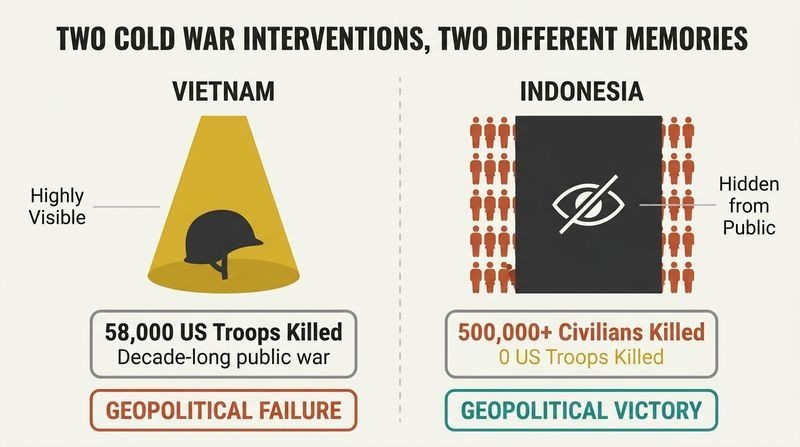
The forgotten pivot of the twentieth century. In 1965-66, the Indonesian military, with US backing, slaughtered between 500,000 and one million unarmed civilians to destroy the Partai Komunis Indonesia (PKI), the largest Communist Party outside China and the Soviet Union. Indonesia, now the world's fourth most-populous nation, flipped overnight from a fierce voice of Third World neutrality into a compliant US ally.
More decisive than Vietnam. US officials privately considered Indonesia a bigger prize than Indochina, and they achieved there in months what ten years of war failed to secure. Robert McNamara later admitted the destruction of the PKI "greatly reduced America's stakes in Vietnam." Yet the episode vanished from Western memory, precisely because it worked so cleanly and no American soldier died.
Bevins forces a reframe of how the Cold War is taught. The standard narrative centers Berlin, Cuba, and Moscow, treating the Global South as a sideshow. Historian Odd Arne Westad, whom Bevins draws on, argues the opposite: the Cold War was primarily fought over how newly decolonized nations would join the world system. What is striking is the asymmetry of memory. Vietnam produced films, novels, and national reckoning; Indonesia produced silence. That silence is itself data, suggesting collective memory tracks not scale of violence but proximity to national self-image and casualties among one's own.
Anticommunism killed people for what they might inspire, not what they did
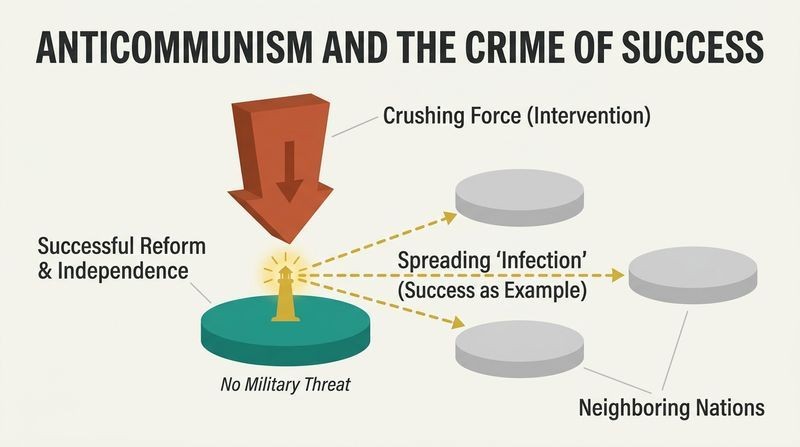
The domino was the real fear. A declassified State Department memo on Guatemala in 1954 admitted the country posed "no present military danger" to the US. The genuine threat was example: that a small nation demonstrating independence and land reform might inspire neighbors. Louis Halle called this the danger of "infection" spreading through nationalism and social reform.
Success, not aggression, was the crime. This logic recurs everywhere in the book. Arbenz in Guatemala, Sukarno in Indonesia, Allende in Chile, and Goulart in Brazil were not Soviet puppets. Most wanted decent relations with Washington. Their offense was proving that a poorer country could pursue redistribution democratically. Nixon told his National Security Council the fear about Allende was that "the picture projected to the world will be his success."
This inverts the official rationale of the entire era. If the danger were Soviet military expansion, Washington would target Soviet strength. Instead it repeatedly targeted weak, popular, reformist governments, which suggests the operative fear was ideological contagion, not conquest. Political scientists call this the demonstration effect. The uncomfortable implication is that US policy often opposed not tyranny but competition, specifically the possibility of a viable non-American development model. Bevins's evidence is strong here, though critics note he underweights genuine Soviet subversion in some theaters. Still, the pattern of striking successful moderates rather than failed radicals is hard to explain away.
The CIA learned that killing lists and propaganda beat parachuting spies
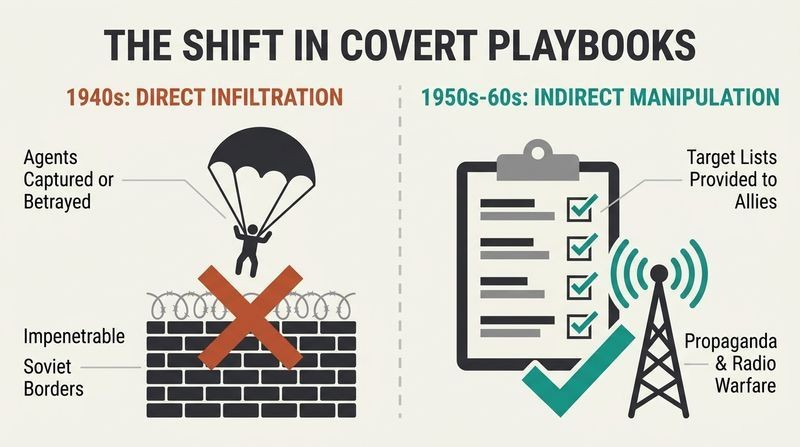
Frank Wisner's early operations were catastrophes. The CIA's covert-action chief sent Ukrainian and Albanian agents to infiltrate Soviet territory in the late 1940s. Nearly all were captured or killed, partly because British double agent Kim Philby had betrayed them. Actual Soviet territory proved impenetrable.
The Third World offered easier targets. Iran (1953) and Guatemala (1954) taught Washington a cheaper playbook: bribe politicians, plant fake evidence, wage radio psychological warfare, and supply local allies. In Guatemala, Iraq (1963), and Indonesia (1965), US officials handed local forces literal lists of communists to be hunted and "checked off." Embassy officer Robert Martens, who prepared Indonesian lists, said, "I probably have a lot of blood on my hands, but that's not all bad."
The evolution here mirrors a grim organizational learning curve. Wisner's team failed against hardened states, so the agency pivoted to softer targets where local proxies did the killing. This delegation is analytically crucial: it let Washington shape outcomes while maintaining deniability, a template that reappears in the phrase "plausible deniability" itself. The kill-list detail connects to later scholarship on how bureaucratized genocide requires information infrastructure more than weaponry. Hannah Arendt's insight about the banality of administrative evil resonates in Martens's chillingly casual confession. What made the method scalable was not firepower but paperwork and radio waves.
State terror works by disappearing victims, not just killing them
Uncertainty paralyzes populations. In Indonesia, the military did not stage public executions. They arrested people, then made them vanish in the night, dumping bodies in rivers until corpses blocked the flow. Families never knew if a detained son or daughter was alive. That not-knowing froze people into silence and compliance, making a quarter of the country (the PKI's affiliated membership) easier to control.
The tactic traveled. Historians believe 1965 Indonesia was the first use of mass forced disappearance as state terror in Asia. In 1966, two US operatives with Indonesian experience arrived in Guatemala; Operación Limpieza began disappearing leftists there, the first such campaign in Latin America. The method spread through Operation Condor across the continent.
Bevins surfaces a counterintuitive truth about political violence: ambiguity can be more controlling than certainty. A visible corpse produces a martyr and a grievance; a disappearance produces a paralyzed family clinging to hope, unwilling to protest lest they endanger the missing. Later human rights scholarship on Argentina's desaparecidos confirms this psychological mechanism, and the Madres de Plaza de Mayo emerged precisely to break the enforced silence. The claim that Indonesia pioneered the tactic in Asia is difficult to verify absolutely, and Bevins acknowledges consulting multiple experts. But the transnational diffusion of technique, personnel moving from Jakarta to Guatemala City, is documented and damning.
Fanatical anticommunism needed a founding myth of demonic betrayal
Manufactured horror justifies real slaughter. Suharto told Indonesia a lurid lie: that communist Gerwani women danced naked while castrating and mutilating the six kidnapped generals before their murder. Autopsies showed the men were simply shot, and Suharto knew this. The story tapped primal fears, night raids, sexual depravity, emasculation, and became national dogma taught via an annual three-hour film.
Brazil built the same myth first. The 1935 Intentona Comunista legend claimed communists knifed sleeping officers in cold blood; autopsies proved no one died of stab wounds. Both regimes erected nearly identical monuments and held annual anticommunist rituals. The parallel is no coincidence: thousands of Brazilian and Indonesian officers trained together at Fort Leavenworth, and a global anticommunist network shared tropes.
The recurrence of a specific narrative, communists secretly stabbing sleeping military men, across continents reveals propaganda as a shared technology, not spontaneous local invention. Folklorists would recognize these as atrocity legends, structurally similar to blood-libel myths that demonize an out-group through fabricated sexual and bodily violation. The gendered dimension is key: portraying leftist women as castrating witches inverts patriarchal order and licenses extreme retaliatory violence against women, which duly followed. Bevins's comparison of the twin monuments is his most original contribution, showing anticommunism operated as a transnational culture with borrowed liturgy, martyrs, and shrines, functioning much like a state religion.
"Jakarta" became a codeword for mass murder across Latin America
A capital city turned into a death threat. In early-1970s Chile, right-wing operatives painted "Yakarta viene" (Jakarta is coming) on walls in wealthy Santiago neighborhoods and mailed postcards bearing the words to leftists. Everyone understood: they would replicate Indonesia's extermination. Navy sailors overheard officers discussing "El Plan Yakarta" to kill ten thousand people.
Brazil coined "Operação Jacarta" too. A general threatened journalism students that he would "neutralize two thousand communists" under Operation Jakarta. Bevins traces the metaphor to at least eleven countries. The word that once signified, under the 1948 "Jakarta Axiom," a tolerable neutral Third World nation, came to mean anticommunist state extermination. Chile's Pinochet killed around 3,000; Operation Condor networked six nations to hunt enemies globally.
This is the book's titular thesis and its most haunting evidence. That perpetrators explicitly named their plans after Indonesia demonstrates a self-conscious lineage of terror, not isolated national tragedies. It refutes the comforting view that each dictatorship was a discrete aberration. The linguistic migration of "Jakarta" functions like a meme in the original Dawkins sense, a replicating unit of cultural transmission carrying operational meaning. One caution: Bevins concedes he lacks a smoking-gun document proving official internal use of the term in every case, relying partly on testimony. But the public graffiti and postcards are undeniable, and the pattern is too consistent to dismiss as coincidence.
Washington tolerated European communists but exterminated Third World ones
Race and power drew the line. When Francisca, the Indonesian exile, reached the Netherlands in 1968, Dutch communists sat in parliament, and French and Italian communist parties won 20-plus percent of votes without US-backed slaughter. Her explanation was blunt: white Europeans were trusted to manage their own democracy; brown colonized peoples were not.
Wealth mattered too. Western Europe was rich, powerful, and already integrated at the top of the world economy, so it posed little risk of rewriting the rules. When Wisner and Jones rebuilt West Germany's finances after the war, Washington simply wiped out all debt to launch the deutsche mark. A Third World leader attempting the same after independence would have been branded a dangerous radical.
The double standard is the book's sharpest moral indictment, and it holds up under scrutiny. The US did fund anticommunist propaganda in Italy in 1948, but it worked within elections rather than organizing massacres. The differential treatment tracks two variables Bevins names: race and structural position in the global economy. Dependency theorists like Andre Gunder Frank argued the world system was designed to keep peripheral nations peripheral, and this violence enforced that hierarchy. A fair challenge: geopolitical proximity to Soviet armies also shaped European restraint. But that does not explain the ferocity unleashed on unarmed, democratically inclined movements far from Moscow's reach.
US-backed regimes built "crony capitalism," not the textbook free market
Anticommunism produced rigged economies. Indonesia and Brazil became capitalist authoritarian states integrated into the Western system, but not the competitive markets economics textbooks describe. Instead, small elites captured the state, corruption exploded, and feudal landlords ran fiefdoms. Suharto's Indonesia and Mobutu's Congo set world records for graft. Because any complaint could be branded communist, unions, land reform, and antimonopoly rules were all crushed.
Survival meant attaching to the corrupt apparatus. As Barack Obama's Indonesian stepfather told his mother, "Guilt is a luxury only foreigners can afford." People either clung to a rapacious top layer or fell into poverty. In these countries, anticommunism functioned as a near-religion that dismissed any reform from below as dangerous subversion.
Bevins makes a subtle economic point often lost in ideological framing: the regimes Washington installed were not free-market exemplars but extractive oligarchies. This aligns with Acemoglu and Robinson's distinction between inclusive and extractive institutions, the latter concentrating power and stunting broad development. The irony is severe: interventions justified as defending free enterprise produced its opposite, economies where political connection trumped competition and innovation. Chile under the Chicago Boys is the partial exception Bevins notes, though even that neoliberal experiment rode atop terror. The takeaway reframes crony capitalism not as a cultural failing of the Global South but as a structural product of Cold War intervention.
The massacres pushed the global left toward armed struggle
Peaceful revolution looked suicidal after 1965. The PKI had three million members and twenty million affiliates, yet no weapons and total faith in democratic engagement through Sukarno. It was annihilated without resistance. Watching this, revolutionaries drew hard lessons. Cambodia's Pol Pot studied the PKI's collapse and vowed his Khmer Rouge would seize and hold power by arms. Filipino communist Jose Maria Sison built a clandestine, armed party for the same reason.
A tragic vindication of the hardliners. When Bevins asked surviving leftists in Indonesia, Chile, and Guatemala who was right in the old debates between peaceful and armed revolution, many admitted, without pleasure, that the militants had been correct. Their nonviolent friends were dead. Che had drawn the same conclusion from Guatemala in 1954.
Here Bevins identifies a devastating feedback loop: violence against peaceful reformers radicalized survivors, which then justified further repression. This is a tragic equilibrium, where moderation is punished and extremism rewarded on both sides. It complicates any triumphalist reading of anticommunism, since the very brutality meant to stop revolution helped produce the paranoid, militarized left that followed, and in Cambodia's case a genocidal one. The insight echoes research on how state repression can escalate rather than deter insurgency. The moral weight is heavy: the people most committed to democratic norms, trusting institutions and elections, were selectively eliminated, arguably degrading the political gene pool of the twentieth century.
The First World won the Cold War and the gap barely narrowed
Bandung's dream went unrealized. In 1955, Sukarno convened leaders representing 1.5 billion people at the Bandung Conference, launching the Third World as a movement to claim equal standing with former colonizers. They expected to catch up. They did not. The US economy today is roughly twenty times Indonesia's; Brazil's GDP per capita is under one-sixth of the American figure.
Structure held firm. With few exceptions, the nations at Bandung remain in the same relative position to former imperial powers. Only South Korea and Taiwan leapt from Third to First World wealth, and both received special exemptions from the rules of the world order because of their Cold War strategic value. China grew, but from poor to merely average, driven by its own path, not US-backed intervention.
Bevins ends on structural sobriety rather than sentiment. The persistence of the global hierarchy across seventy years supports world-systems and dependency arguments that the postwar order locked in inequality. His South Korea and Taiwan caveat is analytically honest and important: their ascent was permitted, even subsidized, for geopolitical reasons, suggesting mobility was available only to strategically useful clients, not as a general rule. Economist Branko Milanovic's data, which Bevins cites, shows most convergence since 1980 comes from China alone. The provocative claim is that Cold War violence did not merely accompany this frozen hierarchy but helped enforce it, foreclosing alternative development paths before they could be tested.
Analysis
The Jakarta Method is a work of narrative journalism doubling as revisionist Cold War history, and its power lies in method as much as argument. Bevins braids intimate biography (Francisca the translator, Benny the economist, Magdalena the factory worker, Sakono the student) with declassified cables and diplomatic history, forcing readers to inhabit the Global South perspective that Anglophone Cold War narratives systematically exclude. The book's central intervention, following Odd Arne Westad, is to redefine the Cold War not as a bipolar superpower standoff but as the violent process by which decolonizing nations were forced into a US-led capitalist order. Within that frame, mass murder of civilians was not incidental tragedy but effective, purposeful statecraft.
The strongest evidence is the documented transnational diffusion of technique and even vocabulary. That perpetrators in Brazil and Chile named operations after Jakarta, that personnel moved from Indonesia to Guatemala, and that kill-lists appear in Guatemala 1954, Iraq 1963, and Indonesia 1965, establishes a lineage that resists the compartmentalization of each atrocity as a national aberration. This is Bevins's genuine scholarly contribution.
The book has limits worth naming. It deliberately minimizes communist atrocities (Stalin, Mao, Pol Pot) on the grounds that those states no longer shape our world, which is defensible framing but leaves the moral ledger one-sided. It sometimes infers coordinated intent from patterns that could reflect a diffuse ideological climate rather than central direction, and Bevins is admirably candid about missing documents. Skeptics will note that genuine Soviet and Chinese subversion existed in some theaters, complicating the innocent-victim framing.
Still, the accumulation is overwhelming and the human cost undeniable: up to a million dead in Indonesia, hundreds of thousands more across at least twenty-two countries. The book's lasting achievement is to make Western readers feel the weight of a history their own institutions worked to erase, and to ask why comfort required forgetting.
Review Summary
The Jakarta Method receives high praise for exposing the US government's role in supporting mass killings of suspected communists during the Cold War, particularly in Indonesia. Readers find the book informative, infuriating, and eye-opening, as it challenges conventional Cold War narratives. Many appreciate Bevins' thorough research and human-centered approach, though some find the writing occasionally disjointed. The book is widely recommended for its exploration of forgotten history and its relevance to understanding modern geopolitics. Some readers express shock at learning about these events for the first time.
People Also Read




Glossary
The Jakarta Method
US-backed anticommunist civilian exterminationBevins's term for the loose, transnational network of US-supported programs that murdered leftists and accused leftists to secure Washington's Cold War goals. Named after Indonesia's capital, where the 1965-66 killings of up to a million people became a model and codeword. Perpetrators in Brazil, Chile, and elsewhere explicitly invoked "Jakarta" as shorthand for planned mass murder of the political left.
Jakarta Axiom
Early US tolerance of neutral nationsHistorian Odd Arne Westad's term, adopted by Bevins, for the late-1940s US position that a Third World nation could be left alone if it suppressed communism enough, as Sukarno's Indonesia initially did. The word "Jakarta" originally signified acceptable neutrality, a meaning that inverted grotesquely after 1965 into a byword for extermination.
September 30th Movement (G30S)
1965 Indonesian officers' coup attemptA group of mid-level Indonesian army officers who, in the night of September 30 to October 1, 1965, kidnapped and killed six top generals, claiming to protect Sukarno from a right-wing plot. Crushed within a day by General Suharto, it became the pretext for blaming and annihilating the Communist Party, though its true authorship remains disputed.
Operation Condor
Cross-border South American terror allianceA coordinated program launched in 1975 among Chile, Argentina, Brazil, Bolivia, Paraguay, and Uruguay to share intelligence and hunt, torture, and assassinate leftist enemies across borders and even abroad. Backed by US-supplied technology, it extended anticommunist extermination throughout South America and reached targets in Washington, Europe, and beyond.
Modernization Theory
Stages-of-development doctrine favoring strong militariesA Cold War academic framework holding that traditional societies progress through fixed stages toward a modern, US-like end state. Increasingly it endorsed strong, US-friendly militaries as the force to drag nations into modernity, even at democracy's expense. It shaped Kennedy-era policy of building alliances with Third World armed forces as anticommunist modernizers.
crony capitalism
Elite-captured, corruption-riddled economic systemThe economic order Bevins says US-backed dictatorships like Suharto's Indonesia and Brazil's junta actually produced: capitalist and pro-Western but dominated by small elites, rampant corruption, feudal landholding, and suppression of unions or reform. It diverges sharply from the competitive free market of economics textbooks, because branding any complaint communist blocked normal market and political checks.
FAQ
What's The Jakarta Method about?
- Focus on Anticommunism: The book examines the U.S. government's anticommunist efforts during the Cold War, focusing on Indonesia and Brazil as key battlegrounds.
- Historical Context: It provides a detailed narrative of the 1965 Indonesian coup and the mass killings that followed, linking these events to broader U.S. interventionism.
- Global Impact: The book argues that these events significantly influenced global politics, shaping U.S. foreign policy and Cold War dynamics.
Why should I read The Jakarta Method?
- Revealing Hidden Histories: Vincent Bevins uncovers lesser-known events that have profoundly impacted modern geopolitics, especially in Southeast Asia and Latin America.
- Critical Analysis: The book offers a critical examination of U.S. foreign policy, challenging the notion of American exceptionalism by highlighting its darker aspects.
- Engaging Narrative: Bevins combines personal stories, interviews, and research to create a compelling and accessible narrative.
What are the key takeaways of The Jakarta Method?
- Systematic Violence: The U.S. supported systematic violence against leftist movements, leading to mass deaths under the guise of fighting communism.
- Global Extermination Network: The events in Indonesia and Brazil contributed to a global network of extermination, with anticommunist regimes collaborating to eliminate threats.
- Power Dynamics: The book emphasizes understanding power dynamics between nations and serves as a cautionary tale about foreign intervention consequences.
What are the best quotes from The Jakarta Method and what do they mean?
- “The violence was effective...”: This quote highlights the calculated nature of the violence as a strategy to achieve political goals.
- “We are gathered here today...”: Sukarno’s speech emphasizes the collective struggle against imperialism and the importance of unity among newly independent nations.
- “Go to hell with your aid!”: Sukarno’s defiance symbolizes the resistance of Global South leaders against neocolonial pressures.
How does The Jakarta Method connect Indonesia and Brazil?
- Shared Strategies: Both countries experienced U.S.-backed coups leading to brutal military regimes, with similar methods used to suppress leftist movements.
- Mass Violence: The systematic extermination of communists in both nations illustrates the global nature of U.S. anticommunist efforts.
- Geopolitical Impact: The outcomes in both countries significantly influenced U.S. foreign policy and Cold War dynamics.
What is the Jakarta Axiom mentioned in The Jakarta Method?
- Definition: The Jakarta Axiom refers to the U.S. policy of tolerating neutral Third World nations as long as they kept communism in check.
- Policy Shift: After the 1958 civil war, the U.S. adopted a more aggressive stance against perceived threats, including Sukarno.
- Consequences: This policy shift contributed to the violent suppression of leftist movements in Indonesia.
How does The Jakarta Method address the role of the CIA?
- Covert Operations: The book details the CIA’s involvement in orchestrating coups and supporting anticommunist regimes in Indonesia and Brazil.
- Support for Extermination: The CIA provided lists of suspected communists, facilitating mass killings and raising ethical questions.
- Long-term Implications: These actions contributed to a legacy of distrust and resentment in the Global South.
What was the September 30th Movement in Indonesia?
- Overview: A failed coup attempt in Indonesia aimed at arresting military officials believed to be plotting against Sukarno.
- Consequences: The movement led to a violent military backlash, resulting in mass murders of communists and leftists.
- Significance: It set the stage for General Suharto's rise and the establishment of a military dictatorship.
How does The Jakarta Method depict the impact of the Cold War on Indonesia?
- Cold War Dynamics: The book shows how the Cold War shaped U.S. foreign policy in Indonesia, leading to interventionist strategies.
- Domestic Influence: The climate of fear justified extreme measures, including mass violence against suspected communists.
- Legacy: The violence left deep scars on Indonesian society, affecting its political landscape today.
What role did Sukarno play in the events described in The Jakarta Method?
- Leadership: Sukarno was Indonesia's first president and a key figure in its independence struggle.
- Balancing Act: He attempted to balance various political factions, crucial in the lead-up to the September 30th Movement.
- Legacy: His downfall came with the military's rise, leaving a complex legacy as both a founding father and an authoritarian.
How does The Jakarta Method explore the theme of imperialism?
- Neocolonialism: The book discusses U.S. neocolonial practices, exerting control over countries like Indonesia and Brazil.
- Local Impact: It highlights the devastating effects of imperialism, including mass violence and repression.
- Resistance: Despite overwhelming power, local movements and leaders fought for independence and justice.
How did the U.S. support the Indonesian military during the 1965 coup?
- Kill Lists: U.S. officials provided lists of suspected communists, facilitating targeted killings.
- Military Aid: The U.S. provided training and resources, enabling the military to carry out the coup.
- Propaganda: The U.S. spread propaganda demonizing leftists, justifying the military's actions.
Download PDF
Download EPUB
.epub digital book format is ideal for reading ebooks on phones, tablets, and e-readers.








































