

Key Takeaways
Leaving your son's manhood to chance guarantees the culture raises him
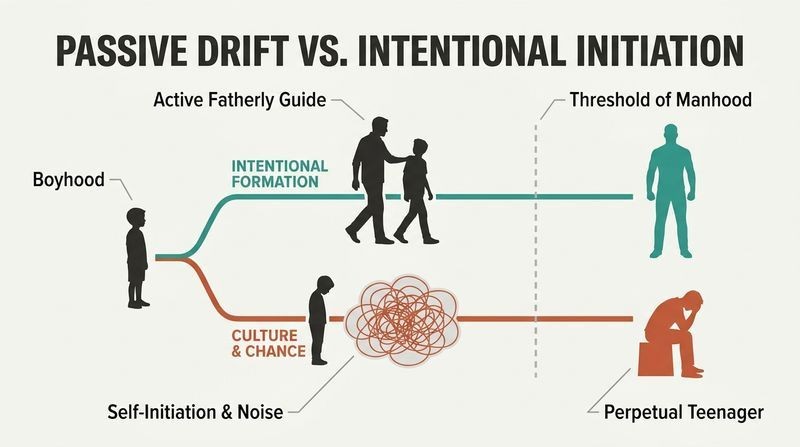
Tyson's central alarm: modern Western society stripped away the initiation rites nearly every other culture used to usher boys into adulthood. Without a father intentionally walking a boy across that threshold, boys attempt "self-initiation," and the wreckage shows up as porn addiction, campus rape culture, self-harm, and adult men who are really just teenagers in grown bodies.
He cites the cost of father absence from fatherhood.org statistics: fatherless children are four times more likely to live in poverty, twice as likely to face infant mortality, and only one in five prison inmates grew up with a present father. Barna research found practicing Christian dads parent much like everyone else: uncertain and overwhelmed. Tyson's answer is not vague encouragement but a deliberate, multiyear formation pathway.
The claim resonates with anthropologist Arnold van Gennep's classic work on rites of passage and Robert Bly's "Iron John," both arguing that unmentored young men stall in perpetual adolescence. What's worth scrutinizing is the correlation-versus-causation trap in father-absence statistics: poverty, incarceration, and family breakdown are deeply entangled, so absent fathers are partly a symptom, not only a cause. Still, the core intuition holds across developmental psychology: adolescents crave structured, meaningful transitions, and in their absence they manufacture crude substitutes (binge drinking, gaming conquests). Tyson's contribution is refusing to merely diagnose, instead building a replicable structure most parenting books never attempt.
Which of the five fathers are you? Choose intentional
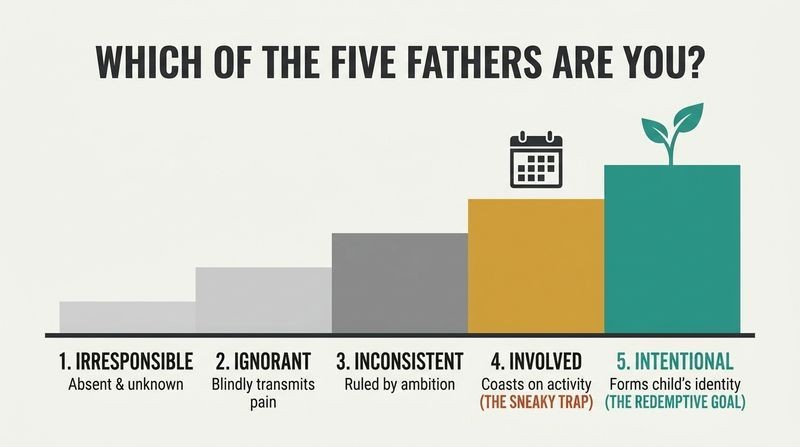
Tyson sorts dads into five types, a diagnostic mirror rather than a compliment.
1. Irresponsible: absent, unknown to his kids.
2. Ignorant: means no harm but transmits his own brokenness blindly.
3. Inconsistent: capable but ruled by ambition, alternating between selfishness and guilt.
4. Involved: shows up at games, installs porn filters, gets much right, yet never asks who his child specifically is.
5. Intentional: invested in discovering who his child is and forming him toward his redemptive potential.
The involved father is the sneaky trap: he looks like a good dad but coasts on activity without deeper inquiry. Tyson's aim is not producing "alpha males" or men who fit a cultural stereotype, but sons formed toward the character of Jesus, whom he calls the best man who ever lived.
The typology's power is that it convicts good dads, not just deadbeats. The gap between "involved" and "intentional" maps neatly onto what psychologists call quality versus quantity of engagement: presence alone does not equal attunement. Diana Baumrind's research on authoritative parenting (high warmth plus high structure) echoes the intentional ideal. One fair critique: the categories are archetypes, not empirical clusters, and most fathers drift among several depending on the season. The framework works best as a self-audit rather than a fixed label. Its motivational sting is real, though, which is precisely the point.
Picture the day he leaves home, then reverse-engineer everything
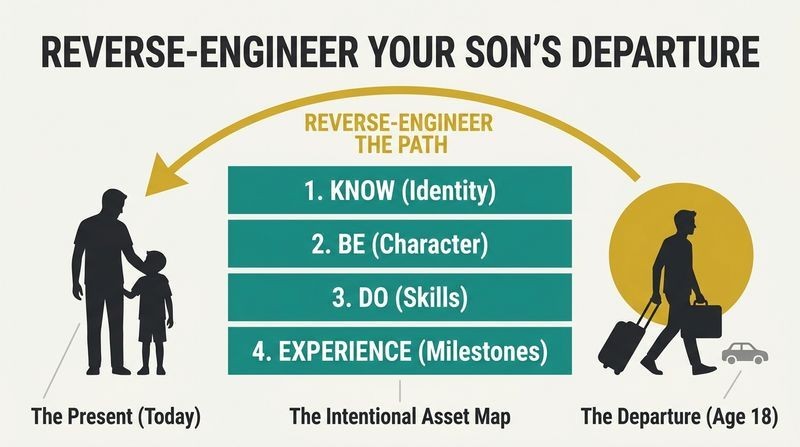
Adapting Stephen Covey's funeral visualization, Tyson proposes the "day your son leaves home" exercise: imagine the goodbye, the two suitcases, the Uber pulling away, and ask what he carries into the world. Then work backward with four questions.
1. What do you want him to KNOW (about God, himself, life)?
2. Who do you want him to BE (character)?
3. What do you want him to be able to DO (practical skills like changing a tire, opening a retirement account)?
4. What EXPERIENCES do you want him to have?
Because character is never built by accident, Tyson urges an "asset map": inventory the people, places, trips, and mentors already available. Most dads outsource this to luck; he insists chance is a lousy teacher.
This is backward design, the same logic instructional designers use with "begin with the end in mind" curriculum planning. Framing fatherhood as a project with defined outcomes is unusually concrete for a genre prone to sentiment. The know-be-do-experience grid mirrors competency models used in leadership development. The asset-map idea quietly dismantles the myth of the self-sufficient dad, invoking what sociologists call social capital: a boy's formation is a village enterprise. A caution worth voicing: outcome-engineering a human being risks treating a son as a product to optimize. Tyson guards against this by centering discovery of who the child already is, not imposition.
Transform your father-wound or you will transmit it downward
Quoting Richard Rohr ("if we do not transform our pain, we will most assuredly transmit it"), Tyson insists fathers heal their own history first. His grandfather, a gifted missionary, dumped Tyson's dad in an Indian boarding school, believing love of family competed with love of Jesus. His dad, never given the tools, struggled to pass them on.
Two exercises follow.
1. Write a tribute letter to your father, listing specifically what he got right (or, if absent, a letter of forgiveness). Tyson's father wept reading his on a plane to Australia.
2. The "mountains and valleys" timeline from Viktor Frankl: map life's highs and lows, name each, and extract the lesson to pass on.
Carl Jung's insight anchors it: we mature when we see parents as fellow strugglers, not just as our parents.
This is intergenerational trauma theory in plain clothes. Attachment research (Main and Hesse's work on "earned secure" attachment) shows adults who coherently narrate painful childhoods parent far better than those who suppress them, which validates the letter and timeline exercises as more than sentiment. The forgiveness letter parallels therapeutic techniques in narrative therapy and forgiveness studies (Robert Enright's forgiveness model). The one tension: Tyson frames reconciliation as near-universally advisable, but for sons of genuinely abusive fathers, clinicians caution that premature forgiveness can retraumatize. The private, unsent letter he permits is the safer, evidence-aligned option.
Mark the threshold with a ceremony a boy cannot ignore
Boys need a definitive break from childhood into what anthropologists call liminal space. Tyson chose age thirteen, the near-universal age cultures recognize something shifting in a boy. The launch began with mom: a "directional dinner" where Nate's mother took him to his favorite restaurant, blessed him, and pointed him toward his father and a community of men, signaling she would cheer from the stands but not run onto the field.
That night, Tyson and three other dads drove their sons to Coney Island, cast a vision of manhood's lost path, and had the boys plunge into the cold ocean as a baptism into the journey. He then gave Nate icons: a heavy bronze pen ("your words have weight"), a leather journal, and a military footlocker to store artifacts from the years ahead.
The instinct is anthropologically sound. Van Gennep identified three phases in rites of passage: separation, liminality, and reincorporation, and Tyson's design hits all three across the multiyear arc. The mother's "directional" role echoes cross-cultural patterns where women ritually release sons to the men's world, a hand-off that prevents what some call mother-enmeshment. What elevates this above gimmickry is the physical, sensory anchor: cold water, weighted objects, a group of peers. Memory research shows emotionally and somatically charged events encode far more durably than verbal instruction. The risk is theatrics without substance, which Tyson addresses by making the ceremony the doorway to years of real work, not a one-off spectacle.
Take your son home so he knows the story he inherited
Drawing on Alasdair MacIntyre ("I can only answer 'what am I to do?' if I can answer 'what story am I part of?'"), Tyson took Nate to Australia on a pilgrimage through his own formative places: Anstey's Hill where he prayed at 4 a.m. as a teenager, the church where he became a Christian, the butcher shop where he learned work ethic, and the airport where he risked everything to emigrate with two suitcases.
He left Nate alone with his grandfather for two days to hear what it means to be a Tyson man, threw a family reunion, and received a cousin's book tracing the lineage to the tenth century. The payoff: a self-focused teenager grasps he is a small part of a long story, breaking the delusion that the world begins and ends with him.
Developmental psychology strongly backs this. Marshall Duke and Robyn Fivush at Emory found that children who know their family narratives (the "Do You Know" scale, including stories of relatives' struggles and triumphs) show higher self-esteem, resilience, and lower anxiety. Tyson intuited empirically validated ground. The pilgrimage also functions as embodied storytelling: standing on the actual hill beats retelling it at the dinner table. One practical limit Tyson concedes indirectly: the Australia trip took months of planning and real money, potentially gatekeeping the practice. His fix, that a home trip can be a few hours' drive, keeps the principle accessible even when the scale shrinks.
Teach the five shifts that turn a boy's world upside down
Adapting Richard Rohr's five hard rules of manhood (life is hard, you are not important, your life is not about you, you are not in control, you are going to die), Tyson reframed them as five shifts a boy makes toward maturity, using contrast rather than blunt bad news.
1. From ease to difficulty.
2. From self to others.
3. From the whole story to part of the story.
4. From control to surrender.
5. From the temporary to the eternal.
Each shift got roughly a month or two: Bible study, biographies, a themed movie (Braveheart for embracing difficulty), and a marking experience. To teach "you are going to die," he had Nate walk a cemetery in silence for twenty minutes, then reflect on the dash between birth and death dates as his one chance to shape eternity.
Rohr's rules are essentially Stoic and monastic wisdom compressed, and they run directly counter to consumer culture's messaging (life should be easy, you are the center, control everything). Terror management theory in psychology confirms that confronting mortality, done constructively, can reorient people toward meaning and away from shallow status-seeking, which validates the cemetery exercise. The genius move is pedagogical: Tyson learned that stating harsh truths to a teenager backfires, so he engineered experiences that let the boy discover them. That mirrors experiential learning theory (David Kolb): concrete experience plus reflection beats lecture. The one caveat is dosage; relentless heaviness could breed anxiety rather than resilience, so the built-in rewards matter.
Don't raise a good man; raise a man good at being one
When Nate lost motivation and asked why every moment needed a lesson, Tyson realized his son thought the goal was becoming a "good man": someone who mainly avoids bad things, insecure and uninspiring. Tyson flipped it: the aim is to be good AT being a man, because confidence comes from competence.
He borrowed a discipleship sequence from Dave Ferguson to transfer any skill:
1. I do, you watch, we talk.
2. I do, you help, we talk.
3. You do, I help, we talk.
4. You do, I watch, we talk.
5. You do, someone else watches.
He taught Nate to host a group conversation this way over successive dinners, using tools from Dale Carnegie. Pep talks from the sidelines ("you can do it!") fail because they name the goal without transferring the skill.
This is one of the book's sharpest insights. The distinction echoes philosopher Jack Donovan's controversial line between being "a good man" (moral) and being "good at being a man" (competent), though Tyson baptizes it toward Christlikeness rather than tribal virtue. The five-step gradient is textbook scaffolding, matching Vygotsky's zone of proximal development and the "gradual release of responsibility" model teachers use. Self-determination theory also supports it: competence is a core psychological need driving intrinsic motivation, which explains why Nate suddenly volunteered to wake early. The reframe is quietly profound: much male dysfunction (anger, apathy, lashing out) may stem less from bad values than from felt incompetence.
Master six roles: disciple, lover, leader, warrior, brother, wise man
Tyson organizes practical manhood into six archetypes (careful, he warns, not stereotypes).
1. Disciple: knowing God, the gospel, the biblical story, and how to read Scripture (culminating in Nate's baptism).
2. Lover: understanding, honoring, and respecting women, plus honest talk about sex, porn as "the new drug," and consent.
3. Leader: accepting responsibility and rejecting passivity, because "passivity leads to pain."
4. Warrior: finding a real-world cause rather than the false conquest of video games; Nate earned a Tae Kwon Do black belt.
5. Brother: building friendship and brotherhood against an epidemic of male loneliness.
6. Wise man: stewarding time and money (he taught compound interest via the daily-latte example).
The parable driving it: a farmer isn't repairing a fence with his sons, he's raising his sons. If you don't teach him about women, porn will.
The archetype framework echoes the Jungian "King, Warrior, Magician, Lover" model popularized by Robert Moore and Douglas Gillette, refracted through Christian discipleship. The warrior-versus-video-games point lands hard amid research on how games hijack dopamine reward systems to simulate mastery and progress that real life withholds. The loneliness emphasis is prescient: surveys consistently show men report fewer close friendships than women, with real health consequences (loneliness rivals smoking as a mortality risk). The obvious tension is that archetypes can slide into gender essentialism; Tyson's repeated "archetype not stereotype" caveat acknowledges the danger without fully resolving whether these roles are universally masculine or simply universally human.
Prepare for defining moments; be unreasonable, not just reasonable
Borrowing from Chip and Dan Heath's "The Power of Moments," Tyson argues that a handful of adolescent moments get remembered for life, so fathers should rehearse for them like a martial art. His own two contrasting memories: his father reading a book instead of watching him drain a three-pointer (a wound), versus his father putting down his tools to hear about Jon's first fistfight (a win).
He lists moments to plan for: first phone, first exposure to porn (respond with grace, not shame or dismissal), first shave, first girlfriend, first breakup, first job, first encounter with death. The Heaths' warning becomes his mantra: "beware the soul-sucking voice of reasonableness." Rather than a mall cheesesteak, drive to Philadelphia for a hundred-dollar one and stay overnight. Twenty years later, which does the son remember?
The Heath brothers' research shows memory is not a faithful recording but a highlight reel dominated by peaks and transitions, so deliberately engineering peaks is a legitimate memory-design strategy. The porn-response counsel is notably wise: shame-based reactions are linked in addiction research to secrecy and escalation, while non-judgmental openness supports disclosure. Neuroscience adds weight to the "remembered moments" claim through the reminiscence bump, the finding that events from roughly ages ten to twenty-five are disproportionately recalled across the lifespan. The "be unreasonable" ethic risks privileging spectacle and wealth, but Tyson's underlying point stands: ordinary, sensible responses rarely become the stories a son tells his own children.
Send him into liminal space: a gap year, then a pilgrimage
Tyson caps the journey with two deliberate departures. First, a gap year between high school and college so a son matures emotionally rather than sprinting onto the "career conveyor belt." Nate spent nine months serving through India, Nepal, Swaziland, and Guatemala (roughly $16,000, partly fundraised), with two goals: encounter the global poor and shed entitlement. Fundraising itself became formative as the community rallied around him.
Second, a father-son pilgrimage: the two hiked the 500-mile Camino de Santiago in a Spanish heat wave, blisters and all, debriefing everything he had learned. Tyson's charge is to save early ($100 a month for five years is $6,000) and refuse the excuses. When Nate emerged from the ocean at the Camino's end, his father called out, "A man emerges from the ocean. Who is this man?"
Gap years enjoy empirical support: studies (and institutions like Harvard) report students return more mature, focused, and less prone to burnout. The service dimension aligns with research on how cross-cultural exposure reduces entitlement and broadens perspective-taking. The pilgrimage taps the same rite-of-passage machinery as the opening ceremony, closing the loop van Gennep called reincorporation. The honest limitation is cost: a $16,000 gap year plus a month abroad is out of reach for most families, and Tyson's "beware the voice of reason" can read as tone-deaf to real financial constraints. His mitigations (start saving at twelve, secular alternatives, hosted stays) partly address this, but access remains the framework's steepest barrier.
Bless your son out loud, or he'll chase blessing forever
Tyson closes on blessing, which he defines through Dallas Willard as projecting good into another's life. His conviction: a son who never receives his father's blessing spends life trying to earn it, chasing women, money, or dominance. He points to Jacob, who deceived his way to a stolen blessing, versus Jesus, who operated from his Father's blessing rather than for it.
For Nate's recognition ceremony, Tyson gathered sixty friends and family on a rooftop, played a video of his whole life, had men of consequence speak affirmation, and sang over him. He gave a Daily Stoic medal and a maxed-out Roth IRA (~$6,000) as a compounding symbol. The distinction is everything: working from blessing produces a fundamentally different life than working for it.
The from-versus-for blessing distinction is theologically rich and psychologically astute. It parallels attachment theory's "secure base": a child who internalizes unconditional acceptance explores the world with confidence, while insecure attachment breeds approval-seeking and striving. It also echoes research on unconditional versus conditional parental regard (Assor and Roth), where conditional approval predicts fragile self-worth and resentment. The public, witnessed nature of the ceremony matters: social psychology shows commitments and affirmations made before a community carry more binding, identity-shaping weight than private ones. The Roth IRA is a clever material sermon on delayed gratification. The deeper claim, that unblessed men become strivers, is hard to test but rings true across clinical and pastoral experience.
Analysis
"The Intentional Father" is a hybrid: part memoir, part how-to manual, part cultural jeremiad, built around one man's five-year experiment raising his son Nate from thirteen to adulthood. Its structure mirrors a rite of passage (preparation, initiation, formation, recognition), which is both its intellectual backbone and its most transferable idea. What distinguishes it from the crowded Christian-parenting shelf is concreteness. Tyson does not merely exhort fathers to be present; he hands over a replicable operating system with ceremonies, morning rituals, reading lists, trips, and a graduation blessing.
The book's great strength is that it takes seriously a problem most parenting literature waves away: the absence of structured transition into adulthood. Tyson borrows liberally and honestly from Rohr, Covey, the Heath brothers, MacIntyre, and Ferguson, functioning less as an original theorist than as a synthesizer and field-tester. That synthesis is the value. He converts scattered wisdom into a lived sequence, and his willingness to expose his own wounds (his distracted father, his boarding-school grandfather, his Instagram addiction) grounds the prescriptions in humility.
Three tensions deserve naming. First, class and access: the Australia pilgrimage, $16,000 gap year, and Camino trek assume resources and flexibility many fathers lack, and the "beware reasonableness" mantra can shade into privilege. Tyson offers scaled-down alternatives but the aspirational default skews affluent. Second, the gender framework rests on assumed essential differences between men and women that he asserts more than defends, and the archetype language, despite his caveats, courts stereotype. Third, the father-absence statistics conflate correlation with causation.
Yet the core insight is durable and increasingly validated by developmental science: adolescents thrive with narrative rootedness, competence-based confidence, marked transitions, and unconditional blessing. Whether or not one shares Tyson's theology, the operating system he documents answers a real and widespread hunger, offering fathers something rarer than inspiration: a plan.
Review Summary
The Intentional Father receives mostly positive reviews, praised for its practical guidance on raising sons intentionally. Readers appreciate Tyson's personal experiences and concrete ideas, though some find it idealistic or impractical. The book's focus on creating a pathway to manhood resonates with many fathers. Critics note a lack of biblical foundation and overemphasis on personal success. Overall, it's seen as a valuable resource for fathers seeking to guide their sons, despite some limitations in applicability and theological depth.
People Also Read

Glossary
Intentional Father
Dad who deliberately forms his sonThe fifth and highest of Tyson's five father types: a dad deeply invested in discovering who his child specifically is and forming him toward his God-given potential. Unlike the merely "involved" father who shows up but never asks deeper questions, the intentional father treats parenting as a central calling and leaves multigenerational blessing rather than inherited brokenness.
Five Shifts
Boy-to-man maturity transitionsTyson's reframing of Richard Rohr's five rules of manhood into positive movements a boy makes toward maturity: from ease to difficulty, from self to others, from the whole story to part of the story, from control to surrender, and from the temporary to the eternal. Each is taught over a month or two through Scripture, biography, film, and a marking experience.
Six Roles
Archetypes of skillful manhoodThe competencies Tyson believes a man must master to be "good at being a man": disciple (knowing God), lover (honoring women), leader (accepting responsibility), warrior (fighting for a real cause), brother (building friendship), and wise man (stewarding time and money). He frames these as archetypes, deliberately warning against reducing them to cultural stereotypes.
Directional dinner
Mother's release ceremonyA ritual meal in which a mother marks her son's entry into the path of manhood by pointing him toward his father and a community of men rather than toward her comfort. Modeled on cross-cultural patterns of mothers releasing sons to the men's world, it signals she will support from a distance rather than shield him from the difficult journey ahead.
Mountains and valleys
Life-highs-and-lows reflection timelineAn exercise Tyson draws from Viktor Frankl in which a father maps the highs and lows of his own life on a timeline, names each moment, owns the feelings, and extracts the lesson. The goal is gaining objective distance from one's story so the resulting wisdom can be passed to a son as cautionary or celebratory tales.
Being good at being a man
Competence over generic goodnessTyson's reframing of the goal of formation. Rather than raising a "good man" (defined narrowly as someone who avoids bad behavior, which he finds uninspiring), the aim is a son competent and confident across the real skills of life, because, in Tyson's phrase, confidence comes from competence.
I do, you watch, we talk
Five-step skill-transfer sequenceA discipleship progression Tyson borrows from Dave Ferguson for transferring any skill: I do while you watch and we discuss; I do while you help; you do while I help; you do while I watch; finally, you do while someone else watches. It scaffolds a son from observer to competent practitioner to teacher.
Gap year
Transitional year before collegeA deliberate year between high school and college spent outside normal routine, which Tyson uses as liminal space for emotional maturing. Nate spent nine months serving the poor across India, Nepal, Swaziland, and Guatemala, with the goals of encountering global poverty and shedding entitlement before stepping onto the career track.
Blessing (from vs. for)
Received affirmation versus earned strivingTyson's central closing distinction, defined via Dallas Willard as projecting good into another's life. A son who receives his father's blessing operates from it with security; a son who never receives it spends life striving for it through women, money, or dominance. He caps the journey with a public ceremony of welcome and blessing.
FAQ
1. What is "The Intentional Father" by Jon Tyson about?
- Field Guide for Fatherhood: The book is a practical guide for fathers (and father figures) who want to intentionally raise sons of courage and character, especially in a culture that often lacks clear pathways to manhood.
- Step-by-Step Framework: Tyson shares a multi-year, customizable process for guiding boys through adolescence into healthy, mature manhood, drawing from his own experience with his son and research from Barna Group.
- Focus on Formation: The book emphasizes the importance of intentional discipleship, rites of passage, and the transmission of values, skills, and identity from father to son.
- Addressing Modern Challenges: It tackles contemporary issues such as fatherlessness, toxic masculinity, digital distractions, and the absence of meaningful initiation into adulthood.
2. Why should I read "The Intentional Father" by Jon Tyson?
- Urgent Cultural Need: The book addresses the crisis of raising boys into men of character and consequence, a challenge that affects families, communities, and society at large.
- Actionable and Practical: Tyson provides concrete steps, exercises, and rituals that fathers can implement, making the book highly actionable rather than just theoretical.
- Applicable to All Father Figures: Whether you are a biological father, stepdad, mentor, or guardian, the book offers guidance for anyone seeking to positively influence a young man’s life.
- Personal and Relatable: Tyson’s honest storytelling, including his own doubts and journey, makes the book relatable and encouraging for fathers who feel overwhelmed or unprepared.
3. What are the key takeaways from "The Intentional Father" by Jon Tyson?
- Intentionality is Essential: Raising sons of consequence requires deliberate planning, not leaving their development to chance or cultural trends.
- Rites of Passage Matter: Boys need clear markers and ceremonies to transition from childhood to manhood, supported by a community of men.
- Values and Skills Transmission: Fathers must intentionally pass on family, personal, and masculine values, as well as practical life skills and wisdom.
- Healing and Legacy: Fathers should address their own wounds and family history to avoid passing on pain, instead leaving a legacy of blessing and healing.
4. What is Jon Tyson’s definition of an "Intentional Father" and how does it differ from other types of fathers?
- Five Types of Fathers: Tyson describes five types: irresponsible, ignorant, inconsistent, involved, and intentional, with the intentional father being the ideal.
- Intentional Father Defined: An intentional father is deeply invested in understanding his children, helping them reach their redemptive potential, and seeing parenting as a central calling.
- Contrast with Others: Unlike the other types, the intentional father is proactive, plans for his child’s development, and leaves a multigenerational legacy.
- Focus on Customization: The intentional father tailors his approach to the unique needs and personality of his son, rather than relying on generic or passive parenting.
5. What is the step-by-step method or framework Jon Tyson recommends in "The Intentional Father"?
- Multi-Part Journey: The book is structured into five parts: Introduction, Preparation, Initiation, Formation, and Recognition, each with specific steps and exercises.
- Preparation: Fathers are encouraged to envision the day their son leaves home, clarify what they want him to know, be, do, and experience, and create an asset map and support cohort.
- Initiation: The process includes a severing dinner (often led by the mother), an initiation ceremony, and the establishment of rituals and artifacts to mark the journey.
- Formation: Tyson outlines five key shifts (ease to difficulty, self to others, etc.), the importance of marking formative moments, and mastering six archetypal roles (disciple, lover, leader, warrior, brother, wise man).
- Recognition: The journey culminates in a gap year, a father-son pilgrimage, and a ceremony of blessing to welcome the son into manhood.
6. What are the "five shifts" Jon Tyson describes for moving boys into manhood in "The Intentional Father"?
- From Ease to Difficulty: Boys must learn to embrace challenges and difficulty rather than seeking comfort and ease.
- From Self to Others: The shift from self-centeredness to caring for and serving others is essential for maturity.
- From Whole Story to Part of the Story: Boys need to see themselves as part of a larger narrative, not the center of the universe.
- From Control to Surrender: Accepting that not everything is within their control and learning to surrender to greater purposes.
- From Temporary to Eternal: Developing an eternal perspective, understanding that life is short and should be lived with meaning and legacy in mind.
7. How does "The Intentional Father" by Jon Tyson recommend fathers handle rites of passage and ceremonies?
- Severing Dinner: The journey begins with a "directional dinner" where the mother releases the son to the father and the community of men.
- Initiation Ceremony: A memorable, meaningful event (often at age thirteen) marks the boy’s entry into the path toward manhood, involving community, symbolic acts, and gifts.
- Artifacts and Rituals: Fathers are encouraged to give their sons physical artifacts (journals, pens, footlockers) and establish regular rituals (morning meetings, man nights).
- Ceremony of Blessing: The journey concludes with a public or private ceremony where the father and community affirm and bless the son as a man.
8. What are the six key roles or archetypes of manhood Jon Tyson teaches in "The Intentional Father"?
- Disciple: Learning to follow Jesus, understand faith, and practice spiritual disciplines.
- Lover: Understanding and honoring women, sexuality, and relationships with respect and integrity.
- Leader: Accepting responsibility, rejecting passivity, and developing leadership skills.
- Warrior: Channeling masculine energy into a cause, developing mental and physical toughness, and fighting for justice.
- Brother: Building community, learning friendship, forgiveness, and how to be a supportive peer.
- Wise Man: Pursuing wisdom, managing time and money, and making sound life decisions.
9. How does Jon Tyson address the importance of values in "The Intentional Father"?
- Three Types of Values: Tyson emphasizes family values (what makes your family unique), personal values (formed through life’s highs and lows), and masculine values (wisdom, self-control, courage, justice).
- Codifying Values: Fathers are encouraged to clarify, write down, and regularly reinforce these values through conversation, rituals, and modeling.
- Passing on Values: The book provides exercises for discussing and embodying values, ensuring sons internalize them rather than absorbing only cultural norms.
- Values in Action: Tyson stresses that values should be lived out and celebrated, not just stated, and that they form the foundation for navigating life’s complexities.
10. What practical exercises and intentional steps does "The Intentional Father" by Jon Tyson provide for fathers?
- Vision and Planning: Exercises include envisioning the day your son leaves home, creating an asset map, and forming a cohort of intentional fathers.
- Story and Legacy: Fathers are guided to write tribute letters to their own fathers, map their life’s mountains and valleys, and take their sons on a "story context trip" to share family history.
- Marking Moments: The book offers checklists and ideas for marking key moments (first phone, first shave, first job, etc.) and making them memorable.
- Self-Discovery Tools: Tyson recommends a series of personality, strengths, and spiritual gifts assessments to help sons understand themselves and their calling.
11. How does "The Intentional Father" by Jon Tyson address healing from past wounds and family history?
- Acknowledging Brokenness: Tyson encourages fathers to reflect on their own upbringing, recognize wounds, and understand how unhealed pain can be transmitted to their children.
- Honoring Fathers: The book suggests writing a tribute letter to one’s own father, whether to express gratitude or forgiveness, as a step toward healing.
- Mountains and Valleys Exercise: Fathers are guided to map out the high and low points of their lives, extract lessons, and consciously choose what to pass on or transform for the next generation.
- Breaking the Cycle: By dealing with their own pain, fathers can intentionally pass on blessing and healing rather than repeating cycles of brokenness.
12. What are the most impactful quotes from "The Intentional Father" by Jon Tyson and what do they mean?
- "Any fool can have a child. That doesn’t make you a father. It’s the courage to raise a child that makes you a father." – Barack Obama: Highlights the difference between biological fatherhood and the intentional, courageous act of raising a child.
- "It is easier to build strong children than to repair broken men." – Frederick Douglass: Emphasizes the importance of proactive, formative parenting over trying to fix problems later in life.
- "If we do not transform our pain, we will most assuredly transmit it." – Richard Rohr: Stresses the necessity of healing personal wounds to avoid passing them on to the next generation.
- "Confidence comes from competence." – Jon Tyson: Underlines the book’s focus on equipping sons with real skills and knowledge, not just moral platitudes.
- "Blessing is the projection of good into the life of another." – Dallas Willard: Captures the heart of the book’s final ceremony, where fathers intentionally speak blessing and affirmation over their sons as they enter adulthood.
Download PDF
Download EPUB
.epub digital book format is ideal for reading ebooks on phones, tablets, and e-readers.








































