Key Takeaways
1. The Korean War: A Pivotal, Misunderstood Conflict
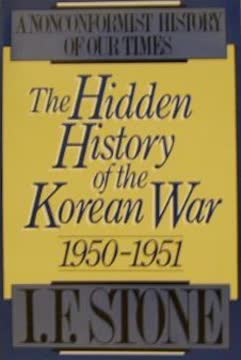
Among the major conflicts that the United States has fought since 1945, the Korean War is the least understood, the most likely to be “forgotten,” and the most important one of all.
Forgotten but foundational. I.F. Stone argues that the Korean War, often dismissed as a "forgotten war," was in fact a critical turning point in American history. It established the "national security state," led to unprecedented Pentagon spending, and created a permanent standing army and a global network of military bases. This conflict, far from being a simple "police action," profoundly reshaped US foreign policy and domestic priorities, setting the stage for future interventions.
Challenging official narratives. Stone, an investigative journalist, meticulously scrutinized official documents and press reports to uncover discrepancies and hidden motives behind the war's origins and conduct. He questioned the simplistic portrayal of unprovoked aggression, suggesting a more complex web of political maneuvering and deliberate actions by various parties. His work aimed to expose the "arcana imperii"—the hidden methods of empire—that often shroud major conflicts from public understanding.
Enduring legacy. The war's unresolved status, with American troops remaining in South Korea decades later, underscores its lasting impact. Stone's analysis reveals how easily nations can be drawn into conflict and how desperately hard it is to disengage, a lesson that continues to resonate in contemporary geopolitical challenges. The conflict stabilized the containment doctrine, but at a profound cost, both human and strategic.
2. Intelligence Warnings Were Deliberately Downplayed
When newspapermen that torrid Washington summer day called at the Pentagon, huge headquarters of the United States Department of Defense, “an aide said privately that the United States expected the attack.”
Pre-war knowledge. Despite official claims of a "surprise attack," evidence suggests that US intelligence agencies, including the CIA, had advance warnings of an impending North Korean invasion. Rear Admiral Roscoe H. Hillenkoetter, CIA director, initially stated that American intelligence was aware of conditions that "could have meant an invasion this week or next," a claim later softened under political pressure. This indicates a deliberate downplaying of intelligence.
MacArthur's oversight. General Douglas MacArthur's headquarters in Tokyo, despite its proximity and extensive intelligence capabilities, also claimed to be "utterly surprised." However, MacArthur's own intelligence chief, Major General Charles A. Willoughby, later admitted that a "reportorial unit" in Korea had "unmistakably traced the North Korean buildup for war" as early as March 1950. This information was, however, dismissed by MacArthur's G-2 as not serious.
Unexplained silence. The puzzling silence from both Washington and Tokyo regarding these warnings, coupled with the rapid deployment of evacuation ships, raises questions about whether the "surprise" was genuine or a convenient narrative. The failure to issue diplomatic warnings or public alerts, despite clear indications of danger, suggests a calculated decision to allow events to unfold.
3. South Korean Leaders Actively Sought Intervention
Could it be that Rhee received advice that it would be wiser to invite or provoke attack, and then trust to the impact on American public opinion to change American policy?
Rhee's bellicose stance. South Korean President Syngman Rhee openly expressed his desire to unify Korea by force, boasting in October 1949 that his forces could take Pyongyang in three days and were only restrained by the US. His Defense Minister echoed this sentiment, stating, "If we had our own way, we would... have started up already." This aggressive posture was well-known to US officials.
Campaign for aid. Rhee actively campaigned for increased military aid, particularly combat planes, warning in May 1950 that "May and June may be the crucial period in the life of our nation" due to imminent invasion danger. However, after May 10, Rhee's government became strangely silent, making no further public appeals despite their stated fears and inadequate equipment.
Political vulnerability. Rhee faced significant internal political challenges, including disastrous election results on May 30, 1950, which saw his party lose control of the National Assembly. A peaceful unification, favored by many Koreans, would have threatened his regime. The outbreak of war, therefore, offered a convenient solution to his domestic problems, potentially securing US intervention and solidifying his power.
4. Dulles and MacArthur Orchestrated Escalation
Fresh from a ninety-minute talk with MacArthur, Dulles told a press conference that his own presence in the Far East “indicated that the principle of bipartisan foreign policy now might be extended for the first time to Asia.”
Strategic alignment. John Foster Dulles, a key Republican foreign policy advisor, visited Korea and then Tokyo to meet with General MacArthur just before the war. Both men were staunch anti-Communists eager to commit the US more strongly against Communism in the Far East, particularly regarding Formosa and Japan. Their discussions, though officially vague, hinted at "positive action" to preserve peace, a phrase that soon preceded major US military intervention.
Formosa's fate. Dulles, a "godfather" of the South Korean Republic, had a strong interest in the region. His public statements and private discussions with MacArthur indicated a shared desire to reverse Truman's "hands-off" policy on Formosa. The outbreak of the Korean War provided the perfect pretext to link Korea's defense with Formosa's, thereby committing the US to Chiang Kai-shek's regime.
Japanese rearmament. The timing of Dulles's visit also coincided with high-level military conferences in Tokyo involving Secretary of Defense Louis Johnson and General Omar Bradley. These meetings focused on the security aspects of a Japanese peace treaty, with MacArthur pushing for continued US military presence and Japanese rearmament. The Korean War would inevitably accelerate these plans, solidifying Japan as a key US base in the Cold War.
5. Truman's Policy Reversal and UN's Acquiescence
The statement of June 27 was in all but one respect the Pacific Pact which Chiang, Rhee, and Quirino, with help from MacArthur, had been advocating.
Sudden shift. On June 26, President Truman's initial response to the invasion was cautious, avoiding direct military intervention. However, a dramatic shift occurred overnight, leading to his June 27 statement. This committed US air and sea forces to support South Korea, ordered the Seventh Fleet to "prevent any attack on Formosa," and pledged more aid to Indochina and the Philippines. This effectively implemented the "Pacific Pact" that MacArthur and Chiang had long advocated.
UN stampede. The United Nations Security Council, meeting on June 27, was presented with a fait accompli. Truman's order for military intervention preceded any UN authorization, forcing the Council to either endorse US actions or oppose them. With the Soviet Union boycotting the Council, the US-backed resolution passed, giving post-facto legality to American intervention and establishing a "unified command" under MacArthur, largely free from UN control.
Blank check. The resolution of July 7, introduced by Britain and France, authorized MacArthur to use the UN flag but did not subject him to UN orders. This "blank check" allowed MacArthur unprecedented autonomy, enabling him to pursue his own agenda of escalating the conflict without direct accountability to the international body whose name he invoked. This set a dangerous precedent for future military actions.
6. MacArthur's Provocative "Blank Check" Command
Henceforth the Korean War becomes not only a military struggle between North and South Korea but a political struggle between MacArthur and Truman, the latter fighting a rearguard action to keep the struggle localized, the former engaging in provocative maneuver whenever peace seemed possible, constantly risking extension of the conflict and more and more openly advocating a course which could hardly end otherwise than in World War III.
Insubordinate escalation. With a "blank check" from the UN, MacArthur consistently pushed for a wider war, often in defiance of Washington's directives. His first major move was to report to the UN that North Koreans were drawing "personnel and equipment" from beyond their borders, implying Russian or Chinese intervention, despite his own intelligence suggesting otherwise. This set the stage for justifying broader actions.
Border provocations. MacArthur's dramatic flight to Formosa in July, issuing a communiqué implying an alliance with Chiang Kai-shek against mainland China, directly contradicted Truman's "neutralization" policy. Subsequent border bombings near the Siberian and Manchurian frontiers, often following presidential attempts to curb him, appeared to be deliberate provocations aimed at drawing China into the conflict.
Unconditional surrender. MacArthur's unilateral proclamation for "unconditional surrender" of North Korean forces, issued without UN consultation, foreclosed any possibility of negotiated peace terms. This, combined with the rapid advance of UN forces across the 38th Parallel, ensured the continuation of the war and increased the risk of direct confrontation with China and Russia.
7. The "Fear of Peace" Drove Continued Conflict
Truman always said he wanted peace. Why was he becoming alarmed over its approach? Was he insincere in his peaceful protestations? I do not think so.
Peace as calamity. As UN forces achieved victory and pushed North Korean troops back across the 38th Parallel, a "sudden chilling fear of peace" gripped Washington. Officials, including Secretary of the Air Force Thomas K. Finletter and General Omar Bradley, warned against "letting down our guard" and emphasized the need for continued rearmament, even if the Korean War ended. Peace was seen as a threat to the momentum of the Cold War mobilization.
Political calculations. President Truman, while professing a desire for peace, was caught between domestic political pressures and the need to maintain a strong anti-Soviet stance. A peaceful settlement in Korea would have undermined the justification for increased military spending, universal military training, and the rearmament of Japan and Germany. It would also have complicated the non-recognition policy towards Communist China.
Unspoken coalition. An "unspoken and unintended coalition" formed between those who actively sought a wider war (like MacArthur and the "preventive war" advocates) and "moderates" who feared the political and economic consequences of peace. This dynamic ensured that opportunities for de-escalation and negotiation were consistently undermined, prolonging the conflict and escalating tensions.
8. Propaganda and Fabricated Narratives Masked Reality
The presentation of the “evidence” was slickly and disingenuously phrased, as if by a clever lawyer trying hard to make much of little.
Inflated enemy numbers. Throughout the war, MacArthur's headquarters consistently issued exaggerated reports of enemy strength and casualties. For example, after declaring the North Korean army "totally destroyed" in November 1950, it was "miraculously reorganized" with vastly inflated numbers weeks later. These "weird statistics" served to justify continued military action and maintain public alarm.
Disinformation tactics. When Chinese intervention began, MacArthur's headquarters initially downplayed it, then dramatically exaggerated it, often contradicting front-line reports. This selective reporting aimed to control the narrative, portraying the Chinese as aggressive "hordes" while obscuring the actual scale of their commitment or their defensive motivations. The "home-by-Christmas" offensive, launched against an "equal" enemy force, was presented as a necessary push, despite intelligence suggesting otherwise.
Atrocity claims. The sudden release of highly questionable atrocity figures by Colonel James M. Hanley in November 1951, claiming thousands of American POWs murdered, served to inflame public opinion and derail peace talks. Despite glaring discrepancies and a lack of concrete evidence, these claims were widely publicized, demonstrating a willingness to use emotionally charged narratives to prolong the conflict and justify harsh measures.
9. The Devastating Human Cost of "Liberation"
The Mongols, to whom Truman compared the Chinese Communists in calling for a “moral mobilization” against them, could not have hoped to match the depredations of Korea’s liberators.
Scorched earth policy. The war inflicted unimaginable suffering on the Korean people, with both North and South Korea being systematically devastated. The "scorched earth" policy, particularly the widespread use of napalm and incendiary bombs by UN forces, obliterated cities and villages, leaving behind "blackened spots where towns once stood." This destruction was often carried out without clear military necessity.
Indiscriminate bombing. Air Force communiqués frequently reported "excellent results" from attacks on "enemy-occupied villages," often with little distinction between military targets and civilian populations. Eyewitness accounts described entire hamlets wiped out, with hundreds of noncombatants killed in single raids, reflecting a "gay moral imbecility" and a profound indifference to human life.
"Combat school" for troops. General James A. Van Fleet, commander of the Eighth Army, openly described Korea as a "combat school" where troops were "working at their trade" and "absorbing new lessons." This perspective reduced the conflict to a training exercise, further dehumanizing the local population and justifying the immense destruction and loss of life as a means to hone military skills.
10. MacArthur's Political Insubordination and Dismissal
It was MacArthur’s intervention in domestic, not world, politics which finally led Truman to remove him.
Challenge to civilian authority. General MacArthur's dismissal on April 11, 1951, was not primarily due to his military strategy or his unauthorized communications with the Chinese commander. The decisive factor was his letter to Republican House leader Joseph W. Martin, Jr., endorsing Martin's proposal to use Chiang Kai-shek's troops against mainland China and openly challenging Truman's foreign policy. This constituted a direct act of insubordination in domestic politics.
Alliance with opposition. MacArthur's letter, appealing to Republicans who favored a stronger focus on Asia over Europe, represented an open alliance with the political opposition. For Truman, this was an intolerable challenge to the constitutional principle of civilian supremacy over the military, especially in an election year. The President, a shrewd politician, would not tolerate such a direct affront to his authority.
Truman's terms for peace. Despite their public disagreements, Truman's own terms for peace in Korea, outlined after MacArthur's dismissal, largely mirrored MacArthur's: a purely military armistice without addressing broader political issues like Formosa or China's UN seat. This suggests that while Truman opposed MacArthur's methods and political grandstanding, he shared a fundamental reluctance to pursue a comprehensive political settlement that might undermine his Cold War objectives.
11. Truce Talks as a Tool for Prolonging Tension
The peace talks were regarded by these leaders as a kind of diabolic plot against rearmament.
Strategic delays. The truce talks, initiated in July 1951, were repeatedly stalled and manipulated by the US military and State Department. Initial demands for a cease-fire line far north of the actual battlefront, coupled with a refusal to halt hostilities during negotiations, created immediate deadlocks. This contrasted sharply with earlier UN proposals for an immediate cease-fire, which the Chinese had rejected.
Manufactured incidents. The talks were frequently interrupted by "incidents," such as alleged bombings or ambushes in the neutral zone, which were often dubious or even admitted by the UN command to be its own errors. These incidents, often accompanied by alarmist press "leaks" from Tokyo and Washington, served to justify breaking off negotiations and maintaining a climate of distrust.
Resistance to peace. Top American officials, including Defense Secretary George C. Marshall and President Truman, consistently warned against a "letdown" in rearmament efforts if peace broke out in Korea. The successful conclusion of a truce was seen as a threat to the broader Cold War mobilization, making it politically expedient to prolong the negotiations and maintain a state of tension.
12. The Soybean Speculation Mystery
If the Korean War was a surprise attack, how is it that Chinese close to Chiang began to speculate in soybeans in the weeks before the fighting broke out?
Insider trading. A peculiar financial anomaly occurred just before the Korean War: a massive speculation in soybean futures on the Chicago market. An investigation by the US Department of Agriculture revealed that "very sizable trading by persons with Chinese names, and in some instances with Hong Kong addresses" had cornered almost half of all open contracts for July futures by June 30, 1950.
Chiang's connections. One of the largest speculators identified was T.L. Soong, younger brother of T.V. Soong, who was Chiang Kai-shek's brother-in-law. This suggests that individuals closely connected to Chiang's Nationalist government had advance knowledge of the impending conflict and profited handsomely from it, reportedly making $30 million.
Unanswered questions. This "ugly inference" of insider knowledge, though never fully investigated by the Senate, raises profound questions about the war's origins. If Chiang's inner circle knew war was coming, it strengthens the possibility that the conflict was not a "surprise" but potentially provoked or at least anticipated by those who stood to gain most from US intervention in the Far East.
Review Summary
Reviews of The Hidden History of the Korean War are largely positive, averaging 4.12 out of 5. Many praise Stone's meticulous use of official documents to challenge mainstream narratives, calling it essential reading on a "forgotten war." Supporters highlight his exposé of MacArthur's conduct and prolonged peace negotiations. Critics argue Stone lacks understanding of military and diplomatic strategy, cherry-picks data, and replaces argument with rhetoric. Several readers note the book's repetitive style but acknowledge its value as a uniquely detailed account of the conflict.