

Key Takeaways
Character, not skills, is the 90% of leadership hiding below the waterline
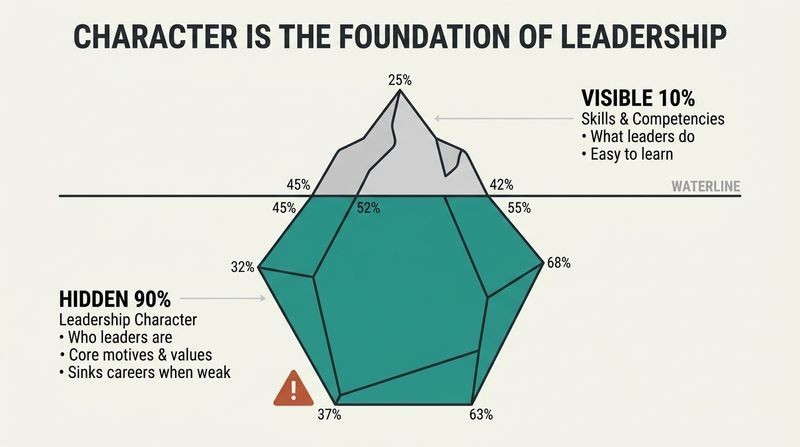
Leadership is an iceberg. Mark Miller's central image splits leadership into two parts. Above the water sits the visible 10%: skills, competencies, the things leaders do. Below the surface lies the 90% that determines success: leadership character, the motives and heart that drive behavior. Blake, a 28-year-old star performer at Dynastar, keeps getting passed over for promotion despite excellent results. His boss can only say, cryptically, "leaders are different," without explaining how.
Skills are easy; character is hard. Miller's contrarian claim is that lack of skills rarely derails leaders because skills are learnable. What sinks careers is underdeveloped character. Blake washes dishes for his wife, but Debbie, his mentor, points out that if he does it grudgingly or to earn credit, she senses it. Same action, opposite result. The heart underneath colors everything.
The iceberg metaphor is old, but Miller's application is sharp: he reframes character not as generic virtue but as the invisible engine of influence. This aligns with decades of leadership research, from Jim Collins's Level 5 humility to Daniel Goleman's emotional intelligence work, which found technical skill matters least at senior levels. One caution: the 90/10 split is rhetorical, not measured. Skills and character are not truly separable, and in some fields (surgery, aviation) competence remains non-negotiable. Still, the core insight holds. People forgive skill gaps far more readily than they forgive a leader whose motives they distrust.
Distinguish leadership character from ordinary good character
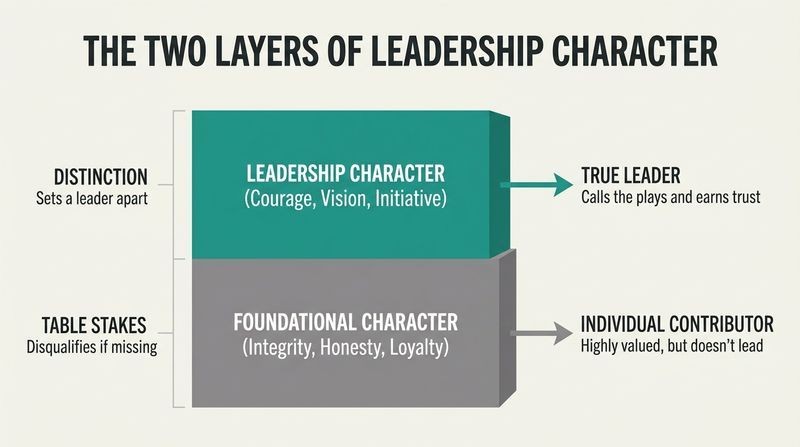
Honesty is table stakes, not distinction. When asked what character traits define leaders, most people name integrity, honesty, and loyalty. Miller argues these are necessary but insufficient. You want every employee to have them, so they cannot be what sets leaders apart. Someone can be impeccably honest, dependable, and loyal and still fail to demonstrate leadership character.
Two layers stacked together. Foundational character (integrity, loyalty) is the ground floor; leaders lacking it are disqualified before they begin. Leadership character sits on top: additional traits displayed in the daily act of leading. Without them, a person remains a talented individual contributor, someone you are glad to have on the team but never let call the plays. Their results get discounted because peers simply do not perceive them as a leader, regardless of output.
This distinction is genuinely useful and underexplored. Most character-in-leadership writing conflates being a good person with being a leader, which leaves high-integrity people baffled when they stall out. Miller separates the two cleanly. The point echoes research on the "competence versus warmth" trade-off in social psychology, and on how followers grant legitimacy. A subtle tension: some traits Miller later files under leadership character (courage, responsibility) arguably belong to strong moral character generally. The boundary is fuzzier than the tidy stacking suggests. But the practical payoff, understanding why flawless work does not translate into followership, resolves a real and common frustration.
Lead now, without waiting for a title to arrive
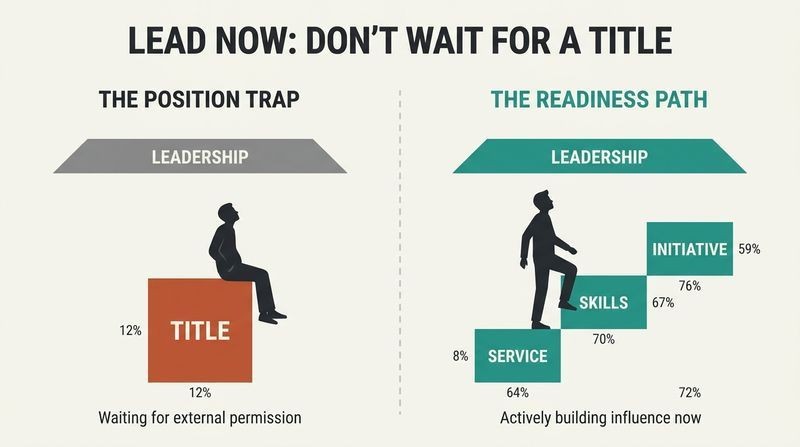
A title is not permission. Blake's fixation on promotion is itself the trap. Debbie tells him bluntly he was never actually qualified for the earlier role he coveted at 28: not seasoned, not proven. But her deeper point is that leadership has nothing to do with position. If you wait for a title to start leading, you may wait forever. Blake had led early in his career without any formal authority, then quietly stopped, without even noticing.
Readiness is the only thing you control. CEO Joe Conrad illustrates with his young son, who begged to play infield, botched his first grounder, and got sent back to the outfield. The boy practiced relentlessly, earned another chance, and played infield for twenty years. Others control opportunity; you control preparation. Get ready, and opportunity follows.
The claim that title-obsession blinds people to daily chances to lead is one of the book's most liberating moves. It shifts agency back to the individual. This resonates with the modern notion of "leading from any chair" and with Robert Greenleaf's servant leadership, where authority is earned through contribution rather than conferred by rank. The baseball parable neatly separates two variables people constantly confuse: opportunity (external, uncontrollable) and readiness (internal, controllable). The mild blind spot: structural barriers are real. Bias, politics, and gatekeeping mean readiness does not always convert to opportunity. Miller nods to this by admitting others control access, but the optimism runs slightly ahead of the evidence.
Become a dealer in hope by choosing to expect the best
Optimism is a leadership tool, not a mood. Joe Conrad, a pharmaceutical CEO, runs a business where only a tiny fraction of drugs tested ever reach market, each costing billions. A pessimist could never sustain that. Leaders see not just what is but what could be, and the future they imagine is always better than the present. Napoleon's line that leaders are dealers in hope captures it: no one wants to follow someone who expects failure.
Expecting the best from people. People tend to rise to the expectations placed on them. Joe's head of marketing for a multibillion-dollar firm started answering phones in the call center; belief in her unlocked her potential. The risk is losing touch with reality or delaying tough calls (Joe admits optimism once made him overspend on a doomed drug and keep a bad hire too long). Optimism must coexist with facts and truth-tellers.
Miller wisely frames optimism as a choice and a discipline rather than a temperament, which makes it trainable. His "expect the best from people" echoes the Pygmalion effect, the well-documented finding that raised expectations measurably improve performance. The candor about downsides is refreshing; too much leadership optimism curdles into denial. This maps onto Jim Collins's Stockdale Paradox: confront the brutal facts while retaining faith in the outcome. The unresolved question is calibration. How does a leader distinguish visionary persistence from stubborn escalation of commitment? Joe's own examples show the line is only visible in hindsight, which limits how actionable the advice can be in the moment.
Don't wait when action is called for; respond with courage
Courage is a response, not a trait in isolation. School superintendent Molly Ortega, responsible for over 100 schools and thousands of children, phrases it precisely: courage is how the best leaders respond to difficulty, while others choose the path of less risk, less conflict, less discomfort. Leaders initiate; they do not wait, because waiting hands your leadership away. She keeps children's thank-you notes framed on her walls as fuel for the courage to act.
Courage shows up in unglamorous moments:
1. Articulating a vision for the future
2. Building relationships with difficult people
3. Challenging people to grow
4. Confronting problems head-on
5. Making unpopular decisions
Molly confesses she once delegated a parent complaint she should have handled, and children failed as a result. Citing Henry Cloud, she notes leaders get what they create and what they allow.
Reframing courage as a response rather than a fixed personality trait is quietly powerful because responses can be practiced. Molly's prescription, take small initiatives daily until action becomes reflexive, treats courage like a muscle, consistent with modern habit science and exposure-based approaches in psychology. The most sobering idea here is the invisibility of the cost. When a leader stays silent in a meeting or defers a hard conversation, nothing dramatic happens immediately, so the failure goes unrecorded. Yet these missed moments compound. This is essentially an argument about opportunity cost applied to character: the damage is cumulative, silent, and only legible in aggregate over years.
Chase wisdom like a hunger that is never satisfied
Wisdom feeds decisions, and decisions define leaders. Judge Victoria Barnett, a former managing partner turned judge, argues that leaders succeed or fail based on their choices, and every choice, on people, strategy, money, or time, demands wisdom. She distinguishes decision-making (a skill) from wisdom (a character trait that informs the skill). Wisdom must be forged over time through friction and effort, like metal in fire.
Three practices to cultivate it:
1. Focus on the pursuit, not arrival; believing you have arrived breeds arrogance.
2. Stay radically open to contrarian views, new ideas, and how little you actually know.
3. Build a network of counselors who tell you the truth.
Victoria's most surprising counselor is her own assistant, who knows her strengths and blind spots intimately and gives her the best performance reviews she has ever received.
Framing wisdom as insatiable hunger rather than a destination is a smart hedge against the Dunning-Kruger trap, where modest competence breeds inflated confidence. Victoria's practice of soliciting truth from an assistant inverts the usual status hierarchy of advice and anticipates the modern emphasis on psychological safety and 360-degree feedback. The distinction between wisdom and mere decision-making skill is philosophically sound; it echoes Aristotle's phronesis, practical wisdom, which cannot be reduced to technique. One gap: the book treats wisdom mostly as receptivity to counsel and learning. It underplays the role of reflection on one's own accumulated experience, arguably the primary forge in which judgment is actually made.
When things go wrong, look in the mirror before pointing fingers
Own outcomes, especially the bad ones. Blake's breakthrough comes from Coach Tom Bradley, who once lost a state playoff and told the press his team was good enough to win and the loss was his fault, a comment Blake found strange years earlier. Reflecting, Blake realizes he has spent his career accepting credit for successes while blaming others for failures. This asymmetry, common and self-flattering, is precisely what disqualified him as a leader.
Accepting responsibility is freedom, not guilt. The insight energizes Blake rather than crushing him: if his response is his to choose, then he can change. He applies it immediately, confessing to his wife that he had misplaced blame at home, and later owning a sales problem in a team meeting. His boss is stunned; she notes he had literally never owned anything before. Ownership, done publicly, rebuilds credibility fast.
The credit-blame asymmetry Miller identifies is textbook self-serving bias, one of the most robust findings in social psychology: we attribute success to ourselves and failure to circumstance. Naming it as the single biggest character gap for aspiring leaders is a shrewd diagnosis. What makes the insight practical is the reframe from shame to agency. Blaming others feels protective but is secretly disempowering, because it locates the cause of your problems outside your control. Ownership, paradoxically, restores power. This connects to Stephen Covey's circle of influence and to Jocko Willink's Extreme Ownership. The public dimension matters too: visible accountability is a fast, if uncomfortable, credibility-builder.
Put others first: the trait that reveals whether your heart has changed
The keystone of the five traits. Chad Culpepper, who runs a soup kitchen called Heaven's Kitchen, teaches Blake that thinking others first is the single most important leadership character trait, because it reveals motive. Blake realizes he enters nearly every interaction focused on what he wants or the idea he is trying to push. He begins asking two questions before conversations: How can I serve this person? What does a win look like for them?
Serving versus self-serving. The ultimate question every leader answers is one of motive: are you a serving leader or a self-serving one? Debbie models this at the soup kitchen, where a steady stream of people interrupt to thank her for a coat, a ride to the doctor, friendship. Her leadership character is not theoretical; it is visible in who she loves and how she serves when no title is at stake.
Positioning "think others first" as the keystone that exposes motive is the book's deepest move, because it makes the other four traits diagnosable. Courage, optimism, and responsibility can all be performed for selfish ends; other-orientation is the tell. This is the Greenleaf servant-leadership tradition distilled, and it converges with research showing that prosocial "givers" (Adam Grant's work) can become top performers when their generosity is strategic rather than self-sacrificing. Blake's two pre-conversation questions are a concrete, portable practice. The honest limit Miller acknowledges is that no technique guarantees a changed heart. You can perform service while resenting it, and people sense the difference.
The five traits spell HEART, and the heart is what must change
A memorable acronym, deliberately reordered. Blake collects five traits from five mentors, then Debbie rearranges them into an acronym: Hunger for wisdom, Expect the best, Accept responsibility, Respond with courage, Think others first. HEART. The wordplay is the point: leadership is fundamentally a matter of the heart, of who you are becoming, not just what you do.
Techniques alone will not save you. Debbie's hardest truth is that you can perform every recommended activity, seek counsel, take initiative, own failures, and still fail as a leader if your heart does not change. Worse, she is not certain a person can change their own heart directly. Her prescription is oblique: do the right things consistently and see what happens. The proof that Blake's heart had shifted was that his answer to "why do you want this?" evolved from earning a promotion to serving others.
The insistence that behavior change alone is insufficient without inner transformation is both the book's most profound and most frustrating claim. Profound, because it resists the mechanistic self-help promise that if you just run the routines, results follow. Frustrating, because "do the right things and hope your heart changes" is deliberately non-instrumental. Yet this may be psychologically accurate: research on self-perception theory (Daryl Bem) suggests we infer our attitudes from our own actions, meaning sustained behavior can gradually reshape identity, which is roughly Debbie's bet. The evolving answer to "why" functions as an elegant, low-cost diagnostic for motive drift, one any reader can apply to themselves.
Three quiet killers stop leaders: title-obsession, fear, and an unchanged heart
Why some people never get it. Debbie has mentored many aspiring leaders through the same journey Blake takes, and reveals that some never transform. Three obstacles explain the failures:
1. Title dependency: they cannot stop believing leadership requires a position, so they miss daily chances to lead.
2. Fear: of failure, of the unknown, of the responsibility leadership carries. Fear has stolen countless leaders' futures.
3. An unchanged heart: the biggest hurdle, revealed last, the self-serving motive that no amount of technique overcomes.
Leadership has a price. Debbie is candid that leadership is a privilege but not free. Even seasoned leaders occasionally surrender to fear; the goal is not perfection but keeping those surrenders rare. Naming these three killers gives readers a diagnostic checklist: which one is quietly limiting you right now?
Ending on a taxonomy of failure is smart pedagogy; it converts an inspirational story into a self-assessment tool. The three obstacles are well chosen because they operate at different levels: cognitive (a false belief about titles), emotional (fear), and moral (motive). Fear as a career-killer deserves emphasis, since it masquerades as prudence, and organizational research consistently finds that avoidance of hard conversations is among the costliest leadership failures. The framing that even good leaders periodically succumb, and that the target is frequency rather than perfection, is both realistic and kind. It inoculates readers against the all-or-nothing thinking that makes people abandon growth after a single lapse.
Analysis
The Heart of Leadership belongs to the business-fable genre popularized by Ken Blanchard, Mark Miller's frequent co-author, and Patrick Lencioni, who wrote the foreword. At roughly 19,000 words, it is a parable, not a treatise: Blake, a stalled young performer at Dynastar, is sent by his late father's protege, Debbie Brewster, on a scavenger hunt to five accomplished leaders, each of whom hands him one trait. The five combine into the HEART acronym. The narrative device is efficient and memorable, though the mentors speak in a uniform, slightly saccharine register, and every character is improbably wise and available. This is the genre's trade-off: emotional accessibility at the cost of texture and counter-evidence.
The book's intellectual spine is its most defensible claim, that character, not competence, gates advancement into leadership, and that ordinary virtue (honesty, loyalty) is distinct from and insufficient for leadership character. This maps cleanly onto serious research: Collins's Level 5 leadership, Goleman's emotional intelligence, and Greenleaf's servant leadership, which is the book's true philosophical home. Miller's thirty-five years at Chick-fil-A under Truett Cathy clearly inform the servant-leadership emphasis, and the soup-kitchen setting where Debbie is beloved makes the abstraction concrete.
The book's honest weakness is its treatment of transformation. Debbie admits she is unsure a person can change their own heart, offering only "do the right things and see what happens." This is intellectually humble but practically thin, and it sits in tension with the surrounding self-help promise. It also underweights structural barriers: readiness does not reliably convert to opportunity in biased systems. Still, the reframes are genuinely useful: courage as a practicable response, the credit-blame asymmetry as the top disqualifier, title-obsession as a self-imposed cage, and the evolving "why" as a motive diagnostic. For an aspiring leader stuck despite strong results, the book offers a precise, actionable explanation and a workable checklist.
Review Summary
The Heart of Leadership receives mostly positive reviews for its engaging narrative format and practical leadership advice. Readers appreciate the focus on character traits like servant leadership, accountability, and lifelong learning. Many find the story approach refreshing and relatable. Some criticize the book as simplistic or cliché, but most agree it offers valuable insights on becoming a leader others want to follow. The HEART acronym (Hunger for wisdom, Expect the best, Accept responsibility, Respond with courage, Think others first) is highlighted as a helpful framework.
People Also Read





FAQ
What's "The Heart of Leadership" about?
- Focus on Leadership Character: The book emphasizes that true leadership begins with self-leadership and character development. It argues that leadership is not just about skills but about who you are as a person.
- Storytelling Approach: Through a narrative about a character named Blake, the book illustrates the journey of discovering and developing leadership character.
- Practical Guidance: It provides actionable insights and advice on how to cultivate the traits that make leaders different and effective.
- Mentorship and Growth: The book highlights the importance of mentorship and continuous personal growth in becoming a leader people want to follow.
Why should I read "The Heart of Leadership"?
- Self-Improvement Focus: If you're looking to improve your leadership abilities by focusing on personal growth and character, this book offers valuable insights.
- Practical Advice: The book provides practical steps and real-world examples that can be applied to both personal and professional life.
- Inspiring Narrative: The story of Blake's journey is relatable and inspiring, making complex leadership concepts accessible and engaging.
- Comprehensive Framework: It offers a comprehensive framework for understanding and developing the core traits of effective leadership.
What are the key takeaways of "The Heart of Leadership"?
- Leadership Character Matters: The book stresses that leadership character is more important than skills in determining a leader's success.
- Five Core Traits: It identifies five core traits of leadership character: Hunger for Wisdom, Expect the Best, Accept Responsibility, Respond with Courage, and Think Others First.
- Heart of Leadership: Leadership is fundamentally about who you are, not just what you do. A leader's heart and motives are crucial.
- Continuous Growth: The journey of developing leadership character is ongoing and requires commitment to personal growth and learning.
What are the best quotes from "The Heart of Leadership" and what do they mean?
- "Without leadership character, no one cares about your skills." This quote emphasizes that skills alone are insufficient for effective leadership; character is what truly matters.
- "Leaders are different." This statement highlights the unique traits and mindset that set leaders apart from others.
- "The heart of leadership is a matter of the heart." It underscores the importance of genuine motives and integrity in leadership.
- "You can lead, with or without, a title." This quote encourages aspiring leaders to focus on influence and character rather than formal positions.
How does Mark Miller define leadership character in "The Heart of Leadership"?
- Beyond Basic Traits: Leadership character goes beyond basic traits like honesty and integrity, which are expected of everyone.
- Five Core Traits: It includes specific traits that set leaders apart: Hunger for Wisdom, Expect the Best, Accept Responsibility, Respond with Courage, and Think Others First.
- Foundation for Skills: Leadership character is the foundation upon which leadership skills are built and determines a leader's effectiveness.
- Reflects True Self: It is a true reflection of who a leader is as a person and drives their actions and decisions.
What is the significance of the iceberg metaphor in "The Heart of Leadership"?
- Visible vs. Invisible: The iceberg metaphor illustrates that the visible part (skills) is only a small portion of what makes a leader; the larger, invisible part (character) is crucial.
- Character Below Waterline: Leadership character, like the submerged part of an iceberg, is foundational and supports the visible skills.
- 90% Below Waterline: The book suggests that 90% of a leader's success is determined by what is below the waterline—character.
- Guides Leadership Actions: The metaphor emphasizes that character drives actions and decisions, much like the unseen part of an iceberg supports the visible part.
What are the five core traits of leadership character according to "The Heart of Leadership"?
- Hunger for Wisdom: A continuous pursuit of knowledge and understanding to make informed decisions.
- Expect the Best: Maintaining an optimistic outlook and believing in positive outcomes and the potential of others.
- Accept Responsibility: Owning one's actions and their consequences, both good and bad.
- Respond with Courage: Taking initiative and making tough decisions, even in the face of fear or uncertainty.
- Think Others First: Prioritizing the needs and well-being of others over personal gain.
How does "The Heart of Leadership" suggest developing leadership character?
- Self-Reflection: Regular self-assessment and reflection on personal motives and actions.
- Mentorship: Seeking guidance and feedback from mentors and experienced leaders.
- Practical Application: Implementing the core traits in daily interactions and decisions.
- Continuous Learning: Committing to lifelong learning and personal development to cultivate wisdom and character.
What role does mentorship play in "The Heart of Leadership"?
- Guidance and Support: Mentors provide valuable guidance and support in the journey of developing leadership character.
- Real-World Insights: They offer real-world insights and experiences that help aspiring leaders understand and apply leadership principles.
- Accountability: Mentors hold individuals accountable for their growth and development, encouraging them to stay on track.
- Inspiration and Motivation: They inspire and motivate individuals to strive for excellence and embrace the challenges of leadership.
How does "The Heart of Leadership" address the concept of self-leadership?
- Foundation of Leadership: Self-leadership is presented as the foundation of effective leadership, emphasizing the need to lead oneself before leading others.
- Personal Responsibility: It involves taking personal responsibility for one's growth, actions, and decisions.
- Character Development: Self-leadership focuses on developing the character traits that define effective leaders.
- Continuous Improvement: It requires a commitment to continuous improvement and self-awareness to align actions with values and goals.
What challenges do leaders face in developing leadership character according to "The Heart of Leadership"?
- Fear of Failure: Leaders often face fear of failure and the unknown, which can hinder their growth and decision-making.
- Misplaced Focus: Some leaders struggle with focusing too much on titles and positions rather than influence and character.
- Resistance to Change: Developing leadership character requires a willingness to change and adapt, which can be challenging for some.
- Balancing Priorities: Leaders must balance personal growth with professional responsibilities, which can be demanding.
How does "The Heart of Leadership" illustrate the impact of leadership character on personal and professional life?
- Improved Relationships: Strong leadership character enhances relationships at home and work by fostering trust and respect.
- Increased Influence: Leaders with strong character have greater influence and are more likely to inspire and motivate others.
- Career Advancement: Leadership character opens up opportunities for career advancement and greater responsibilities.
- Personal Fulfillment: Developing leadership character leads to personal fulfillment and a sense of purpose in serving others.
Download PDF
Download EPUB
.epub digital book format is ideal for reading ebooks on phones, tablets, and e-readers.








































