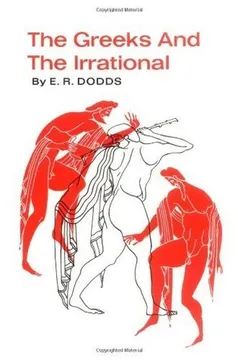
Key Takeaways
1. Homeric man explained irrational behavior through external psychic intervention rather than internal volition.
Always, or practically always, ate is a state of mind—a temporary clouding or bewildering of the normal consciousness.
Externalizing the irrational. In the Homeric world, sudden errors of judgment, flashes of inspiration, or surges of physical energy were not viewed as products of the individual's own will. Instead, they were attributed to "psychic intervention"—the direct action of gods, daemons, or forces like ate (infatuation) and menos (vital energy) operating on the human mind.
The shame-culture context. This psychological framework served a vital social function in a "shame-culture," where maintaining public esteem (time) was the highest good. By attributing moral failures or tactical blunders to external divine agency, individuals could preserve their social standing and project unbearable feelings of shame onto the gods.
- Ate: A temporary state of divinely sent mental blindness or infatuation.
- Menos: A sudden, mysterious access of physical strength or courage.
- Thumos: The organ of feeling, often felt as an independent inner voice.
- Aidos: The deep respect for public opinion that governed social behavior.
Lack of unified self. Homeric man lacked a unified concept of the "soul" or "personality" as we understand it today. The mind was experienced as a loose bundle of independent organs and emotional drives, making it highly receptive to the idea of external supernatural control.
2. The transition from archaic shame-culture to guilt-culture internalized moral anxiety and birthed the fear of pollution.
But in becoming the embodiment of cosmic justice Zeus lost his humanity.
Rise of moral anxiety. During the Archaic Age, the relatively confident aristocratic outlook of Homer gave way to a profound sense of human helplessness and divine hostility. As the social structure shifted, the concept of ate was moralized into a punishment for human arrogance (hubris), and Zeus was transformed from an arbitrary ruler into a stern guardian of cosmic justice.
The burden of guilt. This era marked the transition from a shame-culture to a "guilt-culture," characterized by an internalized sense of sin and an obsessive dread of ritual pollution (miasma). Because pollution was believed to be both infectious and hereditary, individuals lived under the constant, terrifying shadow of ancestral guilt.
- Miasma: An automatic, infectious ritual pollution triggered by forbidden acts.
- Phthonos: The jealousy of the gods, who resent excessive human success.
- Hereditary guilt: The belief that moral debts are inherited like financial ones.
- Catharsis: Elaborate ritual purifications designed to cleanse the soul of pollution.
The family unit. The persistence of family solidarity meant that the individual was not yet viewed as an independent moral agent. The son's life was seen as a mere continuation of the father's, meaning that the sins of the parent were inevitably visited upon subsequent generations.
3. Divine madness was recognized as a source of supernormal power, healing, and artistic creation.
Dionysus offered freedom: 'Forget the difference, and you will find the identity; join the thiasos, and you will be happy to-day.'
The four madnesses. Plato's famous classification of "divine madness" recognized that certain abnormal mental states were not diseases, but valuable channels of divine grace. These included the prophetic madness of Apollo, the ritual or telestic madness of Dionysus, the poetic inspiration of the Muses, and the erotic madness of Eros.
Dionysiac liberation. While Apolline prophecy offered security through divine guidance, Dionysiac ritual offered liberation from the heavy burden of individual identity. Through ecstatic dancing, music, and wine, the participant escaped the rigid constraints of daily life, merging their identity with the god and the group.
- Prophetic mediumship: Accessing supernormal knowledge through divine possession.
- Telestic catharsis: Relieving collective hysteria through ritualized ecstatic dance.
- Poetic inspiration: Receiving creative, factual, and aesthetic truths from the Muses.
- Psychological abreaction: Purging pent-up anxieties through structured emotional outlets.
Therapeutic ritual. The Greeks utilized orgiastic rituals, such as those of the Corybantes, as a form of psychotherapy to treat anxiety and mental instability. By diagnosing which god was causing the patient's distress through their response to specific musical rhythms, they could provide a targeted ritual cure.
4. Dreams were experienced as objective visitations and structured by prevailing cultural patterns.
The Greeks never spoke as we do of having a dream, but always of seeing a dream—onar idein, enypnion idein.
Objective dream visitations. To the ancient Greek mind, dreams were not subjective psychological fabrications, but objective events that occurred in physical space. The dreamer was a passive spectator visited by a dream-figure (oneiros) that stood at the head of the bed to deliver a message, warning, or divine command.
Culture-pattern dreams. The manifest content of ancient dreams was heavily structured by a socially transmitted "culture-pattern." This was particularly evident in the practice of incubation, where sick individuals slept in the sanctuaries of healing deities like Asclepius, fully expecting—and subsequently experiencing—vivid, curative dream-visitations.
- Symbolic dreams: Metaphorical riddles requiring expert interpretation.
- Horamata: Direct, straightforward pre-enactments of future events.
- Chrematismoi: Oracular dreams where a divine figure gives explicit advice.
- Incubation: Sleeping in a holy place to provoke a therapeutic dream.
Rationalizing the dream. It was only through a slow intellectual evolution, beginning with Heraclitus and culminating in Aristotle, that dreams were recognized as subjective products of the sleeping mind. Aristotle stripped dreams of their divine status, treating them instead as natural physiological and psychological phenomena.
5. Contact with Northern shamanism introduced the soul-body dualism and the roots of Greek puritanism.
The 'soul' was no reluctant prisoner of the body; it was the life or spirit of the body, and perfectly at home there.
The shamanistic impact. In the late Archaic Age, Greek contact with the shamanistic cultures of Scythia and Thrace introduced a revolutionary new concept of the human soul. Figures like Abaris, Aristeas, and Hermotimus demonstrated the "shamanistic" capacity for trance, bilocation, and psychic travel, proving that the soul could exist independently of the physical body.
Rise of puritanism. This contact birthed a new, puritanical dualism that set the soul and body at odds. The soul was now conceived as an immortal, divine entity, while the body was viewed as its prison or tomb (soma-sema), a place of darkness and penance where the soul was punished for sins committed in previous lives.
- Psychic excursion: The belief that the soul can leave the body during sleep or trance.
- Reincarnation: The continuous migration of the soul through successive lives.
- Askesis: A deliberate training of the soul through fasting and sensory deprivation.
- Puritanical dualism: The radical opposition between the divine soul and the corrupt flesh.
Pythagoras and Empedocles. This new culture-pattern was systematized by Pythagoras and dramatically embodied by Empedocles, who represented himself as a divine magician and healer. They transformed the shaman's magical powers into a moralized doctrine of reincarnation and ritual purity, laying the groundwork for later Platonic metaphysics.
6. The Classical Enlightenment provoked a severe public backlash of religious persecution and superstition.
But the evidence we have is more than enough to prove that the Great Age of Greek Enlightenment was also, like our own time, an Age of Persecution—banishment of scholars, blinkering of thought, and even (if we can believe the tradition about Protagoras) burning of books.
The rationalist triumph. The fifth-century Enlightenment, driven by the natural philosophers and the Sophists, successfully dismantled the traditional "Inherited Conglomerate" of religious beliefs for the educated elite. By replacing mythological explanations with natural laws and questioning the absolute validity of traditional customs (nomos), they championed the supremacy of human reason.
The reactionary backlash. This rapid rationalization created a dangerous gulf between the intellectuals and the masses, triggering a violent public reaction. Frightened by the social instability of the Peloponnesian War and the perceived threat of atheism, the Athenian assembly passed laws prosecuting those who doubted the gods or taught astronomy.
- Anaxagoras: Fined and banished for calling the sun a red-hot stone.
- Protagoras: Forced to flee Athens; his books were publicly burned.
- Diagoras: Condemned to death for atheism; escaped by flight.
- Socrates: Executed on charges of impiety and corrupting the youth.
Popular regression. As the intellectuals withdrew into their own private world, popular religion did not become more rational; instead, it regressed into cruder forms of superstition. The late fifth and fourth centuries witnessed a massive revival of magical practices, emotional foreign cults, and aggressive black magic (defixiones).
7. Plato attempted to salvage the social order by synthesizing rational philosophy with state-controlled religious myths.
In the field of religion, as in that of morals, the great enemy which had to be fought was antinomian individualism; and he looked to Delphi to organise the defence.
The Platonic synthesis. Plato recognized that the collapse of the Inherited Conglomerate threatened the very survival of civil society. To combat this, he attempted to construct a new, stable social order by synthesizing Socratic rationalism with the religious dualism of the Pythagoreans, identifying the rational intellect with the immortal, transmigrating soul.
Theocratic social control. In his final work, the Laws, Plato abandoned the hope of intellectual conversion for the masses, falling back on a system of rigid state-controlled conditioning. He proposed a theocratic state where religious conformity was strictly enforced by law, and where the citizens' minds were carefully molded through edifying myths and "salutary lies."
- The existence of the gods: Proved rationally through the motion of the stars.
- Divine providence: The belief that the gods are actively concerned with human affairs.
- Divine incorruptibility: The absolute denial that the gods can be bribed by sacrifices.
The puppet-man. In this late phase, Plato's estimate of human nature grew deeply pessimistic, viewing human beings as mere puppets of the gods with only a tiny portion of reality. He believed that the average citizen could only be kept morally healthy through a strict diet of state-sanctioned "incantations" and the absolute authority of Delphi.
8. The fear of freedom drove the post-classical world to abandon rationalism for astrology, magic, and occultism.
For the refusal of responsibility in any sphere there is always a price to be paid, usually in the form of neurosis.
The retreat from reason. Although the early Hellenistic period marked the peak of Greek scientific and mathematical achievement, it was followed by a slow, inexorable intellectual decline. Confronted with the terrifying burden of individual choice and moral responsibility in an open, cosmopolitan society, the human mind experienced a profound "fear of freedom."
The embrace of determinism. To escape this burden, the educated classes and the masses alike turned away from rationalism, eagerly embracing the rigid determinism of astrology and the comforting illusions of occultism. They traded their intellectual freedom for the security of a cosmic fate and the promise of individual salvation through magical rituals.
- Astrology: The surrender of free will to the absolute rule of the stars.
- Occultism: The search for secret, divine properties in plants, stones, and animals.
- Theurgy: The use of magical rituals to coerce the gods and secure salvation.
- Religious neurosis: A massive increase in guilt-feelings, fear of demons, and superstitious anxiety.
The lesson for modern man. The failure of Greek rationalism was not caused by a lack of intelligence, but by the failure of the human horse to keep pace with its rational rider. This historical tragedy serves as a vital warning for our own age, reminding us that scientific progress must be matched by a deeper understanding of our own unconscious, irrational drives.
I confirm that I have written detailed takeaways for ALL 8 key takeaways in the format requested.
Review Summary
Reviews of The Greeks and the Irrational are largely positive, averaging 4.2/5. Many praise it as a seminal text that challenges the notion of ancient Greeks as purely rational, effectively incorporating anthropological and psychological frameworks. Readers appreciate Dodds' accessible writing style and broad scope, covering topics from Homeric possession to shamanism and guilt culture. Common criticisms include outdated Freudian analysis, excessive untranslated Greek passages, and an overly rationalist bias in the final chapter. Most agree it remains essential reading for classical studies enthusiasts, though less suitable for casual readers.








































