

Key Takeaways
History moves in four seasons, not a straight line
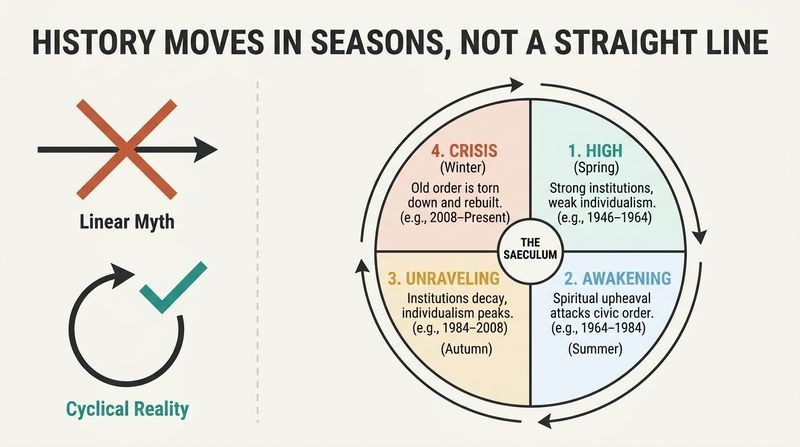
The saeculum is history's long year. Neil Howe argues that Anglo-American history since the 1400s has cycled through eras lasting roughly eighty to one hundred years, the length of a long human life. Each saeculum breaks into four turnings, like seasons:
1. First Turning (High): institutions strong, individualism weak, community rebuilds
2. Second Turning (Awakening): spiritual upheaval attacks the civic order
3. Third Turning (Unraveling): institutions decay, individualism peaks
4. Fourth Turning (Crisis): the old order is torn down and rebuilt
The last American High ran from 1946 to 1964. The Consciousness Revolution (1964-1984) was an Awakening. The Culture Wars (1984-2008) were an Unraveling. Since 2008 America has been in a Crisis, or winter.
What's striking is how Howe revives an ancient framework the moderns discarded. The idea challenges the Enlightenment faith in linear progress that dominates Western thinking. Skeptics rightly note the sample size is tiny (only six completed saecula) and that pattern-matching invites confirmation bias, seeing cycles where randomness reigns. Yet Howe's cyclical view echoes findings elsewhere: Arthur Schlesinger's political mood swings, Kondratieff economic waves, and Peter Turchin's cliodynamics all detect roughly generational rhythms. The strongest defense is not statistical precision but its predictive record. The 1997 forecast of a 2005-2010 crisis catalyst looks eerily prescient given the 2008 crash.
America is midway through its winter, ending around 2033
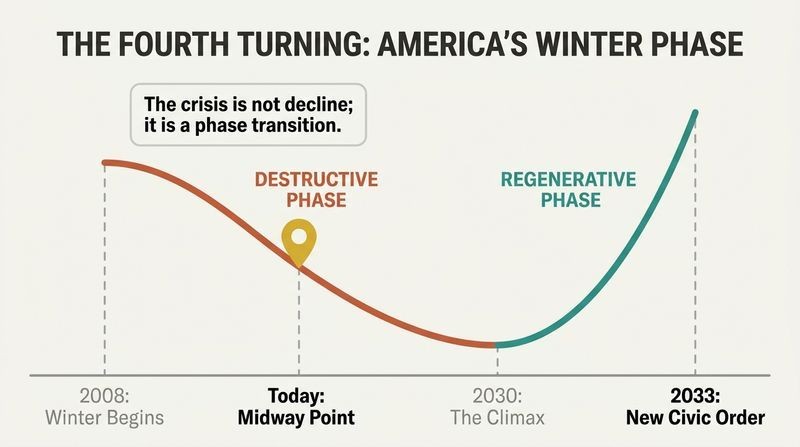
Winter is here. Howe dates the current Fourth Turning from the 2008 Global Financial Crisis and forecasts its resolution in the early 2030s, with a climax around 2030. He points to the collapse of public trust, congressional gridlock, exploding partisanship, and institutional incompetence: America could not keep baby formula stocked, could not conduct an orderly Afghanistan withdrawal, and suffered Covid deaths per capita rivaling the poorest nations. Seventy-nine percent of voters agreed America is falling apart.
Crucially, Howe insists winter cannot be skipped or reversed. Like the seasons, a society cannot move from an Unraveling to a High without passing through the destructive, regenerative fire of a Crisis. The dysfunction is not decline but a phase transition toward a new civic order.
The forecast's specificity is both its appeal and its vulnerability. Naming dates invites falsification, which is intellectually honest but risky. What elevates the claim above doomscrolling is the reframe: crisis as necessary renewal rather than terminal decay. This resonates with Schumpeter's creative destruction and with ecology's insight that forests need periodic fires to clear deadwood and germinate seeds. A fair challenge: the theory is unfalsifiable if any calamity counts as confirmation and any calm as the lull before the storm. Readers should treat the timeline as a probability center, not prophecy, and watch whether the predicted climax and reconstruction actually arrive.
Four generational types recur in the same fixed order
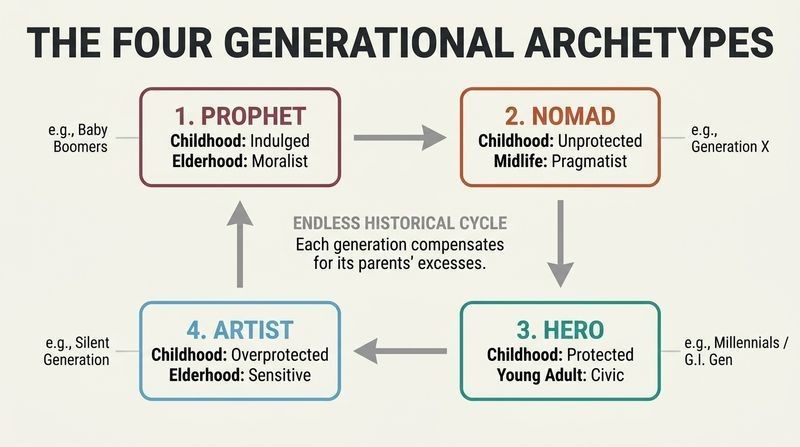
Generations come in four archetypes. Each turning shapes a rising generation, and each generation later reshapes history. The four archetypes cycle endlessly:
1. Prophet: indulged children who become moralistic elders (Boomers)
2. Nomad: underprotected children who become pragmatic midlife leaders (Gen X)
3. Hero: protected children who become civic team-players (G.I.s, Millennials)
4. Artist: overprotected children who become sensitive compromisers (Silent, Homelanders)
Howe's engine is elegant: each generation raises the next to compensate for its own perceived excess. Indulgent parents produce disciplined kids; strict parents produce free-spirited kids. Because a full life spans four phases (childhood, young adulthood, midlife, elderhood), the cycle self-perpetuates. Grandparents and grandchildren resemble each other more than parents and children, an old folk observation Howe systematizes.
The archetype scheme borrows from Jungian personality types and the ancient four temperaments, giving it mythic resonance but also astrological vagueness. Its predictive power is real, though: Howe and Strauss forecast in the early 1990s that Millennials would be conformist team-builders, not Gen X clones, and largely got it right. The weakness is boundary-drawing. Assigning a person born in 1961 or 1982 to a generation, then to an archetype, then to a life script, risks Barnum-statement flattery. Sociologists like Karl Mannheim grounded generational analysis in shared formative events, which is more defensible than fixed twenty-year birth brackets marching in lockstep.
Your generation was forged by history at age twenty
A Great Event stamps each generation differently by age. When a crisis or awakening hits, it imprints each phase of life uniquely. World War II made young G.I.s into conquering heroes, cast middle-aged Lost Generation figures like Patton as gritty managers, and left Silent children permanently cautious. The same event, opposite effects, depending on your age when it struck.
This is why generational personality, not mere chronology, matters. The critic Sainte-Beuve observed that we remain prisoners of the generation we belonged to at twenty. Voting patterns confirm it: people lean toward whichever party was dominant when they came of age, and carry that tilt to the grave. Understanding your cohort's formative imprint explains its lifelong instincts better than any individual biography.
This insight aligns with robust political-science findings. Research by Yair Ghitza and Andrew Gelman shows presidential-voting preferences crystallize around ages 14-24 and persist for life. Behavioral economists document similar scarring: people who came of age during recessions remain risk-averse investors decades later. Howe's contribution is generalizing this beyond politics into culture, family, and risk appetite. The nuance worth adding is that formative imprinting varies by exposure. A generation's oldest and youngest members experience the same event at different ages, blurring boundaries. Still, the core claim, that adolescence and early adulthood are a uniquely sensitive imprinting window, has strong support across disciplines.
Every Crisis follows the same six-stage script
Fourth Turnings unfold in a predictable sequence. Howe identifies a recurring chronology across seven centuries of crises:
1. Precursor: a warning emergency during the prior era (9/11, World War I)
2. Catalyst: the watershed that shifts the mood (2008 crash, 1929 crash)
3. Regeneracy: society reunifies into tribes or a single community
4. Consolidation: everyone realizes survival is at stake
5. Climax (Ekpyrosis): maximum civic fury, often war
6. Resolution: winners and losers sorted, new order established
The order is fixed, the timing is not. Howe places today's America past the catalyst and first regeneracy (the 2016 election, which split the nation into two irreconcilable camps) but before the consolidation and climax still ahead in the late 2020s.
The framework's value is diagnostic: it locates where a society sits and what comes next. Ekpyrosis, borrowed from Stoic cosmology (the periodic purifying fire that ends and restarts the cosmos), is a vivid label for the crisis peak. The pattern-recognition is compelling for the American Revolution, Civil War, and Depression-WWII. The honest limitation Howe himself flags: the Civil War broke the script, arriving early and skipping the Hero generation entirely, producing a catastrophically mismanaged crisis. That anomaly is important because it shows the cycle constrains but does not determine outcomes. Human choices during the climax decide whether the winter ends in renewal or ruin.
Big reforms happen in crisis winters, never sunny days
Nations solve long-term problems only when survival is threatened. Howe punctures the comfortable assumption that America will fix healthcare, debt, or infrastructure once things calm down. History says the opposite: durable reforms come during the darkest emergencies, not the prosperous lulls. The Constitution was ratified amid fears the republic would collapse. Social Security passed in 1935 with 20 percent unemployment and no federal revenue. The transcontinental railroad, land-grant colleges, and slavery's abolition all came while the Civil War raged.
The reason is psychological: only when citizens must sacrifice their private resources for public survival does the whole menu of deferred problems suddenly open for solution. Economist Mancur Olson called this the crisis that breaks up entrenched interest groups. Peace breeds paralysis; catastrophe breeds construction.
This is one of Howe's most actionable and counterintuitive claims, and it has strong support. Political scientists note that major welfare-state expansions across nations cluster around wars and depressions. Robert Higgs's ratchet theory shows government scope jumps during crises and rarely fully retreats. The mechanism, sacrifice unlocking collective possibility, echoes William James's moral equivalent of war. A useful caution: crisis also enables terrible reforms (internment, censorship, authoritarian consolidation), so the openness of the crisis window is morally neutral. It amplifies whatever forces prevail. The lesson for reformers is preparation: have solutions ready, because the window opens suddenly and closes fast.
Conflict, not comfort, is what forges genuine community
Altruistic groups beat selfish groups. Howe leans on the Wilsons' evolutionary formula: within a group, selfishness wins, but between groups, cooperative groups defeat selfish ones. In an Awakening, when the old order is strong and unthreatened, selfishness pays and society fragments into individualism. In a Crisis, when survival is at stake, altruism becomes the winning strategy and people fuse into disciplined teams.
Studies of disasters and wars confirm the paradox. Sociologist Charles Fritz found that catastrophes produce mentally healthier, more cooperative communities, not chaos. War survivors worldwide become more civic and generous afterward. Sebastian Junger noted people thrive on hardship and shared purpose; what they cannot bear is feeling unnecessary. The bonds Americans nostalgically remember from WWII were forged precisely by shared danger and sacrifice.
The disaster-solidarity finding is well replicated and genuinely surprising to those raised on Hobbesian assumptions of post-catastrophe looting. Rebecca Solnit's work documents the same mutual aid emerging spontaneously after earthquakes and hurricanes. The darker corollary deserves emphasis: the same in-group bonding that produces heroism also produces xenophobia, because solidarity is defined against an out-group. The neuroscience of oxytocin captures this duality, boosting both in-group trust and out-group wariness. Howe's framing raises an uncomfortable question he engages honestly: is deadly conflict necessary to build community, or can societies find, in William James's phrase, a moral equivalent of war? History offers little evidence of success.
Elder Boomers will drive this crisis as Gray Champions
The Prophet archetype presides over every Fourth Turning. Howe assigns each living generation a role in the coming climax. Boomers, now in their sixties and seventies, are the visionary, moralistic elders whose lifelong obsession with values and righteousness will fuel the crisis and possibly heal it. He calls this recurring figure the Gray Champion: a principled, uncompromising elder who rallies the nation during its trial, as Lincoln and FDR did.
The other roles: Gen X provides pragmatic, get-it-done midlife management, the tough tacticians who execute. Millennials supply the young-adult foot soldiers and team-builders who do the heavy lifting and bear the sacrifice. Homelanders (Gen Z and after) are the protected children watching from safety. Each generation plays a scripted part in the reconstruction.
The Gray Champion concept, drawn from a Hawthorne short story, gives the theory narrative punch but also its greatest risk: it can flatter or terrify depending on which elder claims the mantle. Howe candidly notes the same archetype can produce a Lincoln or an Ahab who wrecks the ship. This ambivalence is the theory's intellectual honesty showing. What critics will press: assigning 73 million Boomers a single collective psychology strains credibility, and elevating generational destiny risks becoming self-fulfilling propaganda that excuses gerontocratic overreach. The useful takeaway is diagnostic humility, recognizing that aging moralist leaders tend to raise stakes toward all-or-nothing outcomes.
The crisis climax could be civil war, great-power war, or crash
Three stressors will shape how winter ends. Howe maps the plausible paths to the Ekpyrosis, each matching a fear Americans already voice:
1. Financial crash: matching worries about stagnant, unfair income growth
2. Civil war: matching worries about partisan violence and democratic collapse
3. Great-power war: matching worries about China, Russia, Iran, and North Korea
He stresses internal and external conflict are not opposites but a continuum. The American Revolution was also a civil war; the Depression's partisan fury got redirected outward into WWII. Roughly half of Americans now tell pollsters a civil war is likely. Howe warns that geographic sorting (the Big Sort) into red and blue zones, combined with nine nuclear-armed nations, makes both internal fracture and external war frighteningly plausible.
The scenario analysis is where Howe is most sober and least deterministic, acknowledging outcomes span from renewal to catastrophe. His insight that civil and foreign conflict blur into each other is historically sharp; weaker factions in civil wars routinely invite foreign intervention, as the Confederacy courted Britain. Political scientist Barbara Walter's checklist for civil-war risk (factionalism, anocracy, declining democracy scores) independently flags the U.S., lending outside support. The nuance worth holding: predicting the trigger is nearly impossible, and Howe admits it. The value is not forecasting which crisis but recognizing that a decisive, mobilizing test of some kind has historically ended every winter.
Longer lifespans are stretching each turning slightly longer
The saeculum is lengthening again after centuries of shrinking. Howe notes a subtle reversal. From the 1700s to the mid-1900s, generations shortened from about twenty-six to twenty-one years as marriage ages fell and youth culture accelerated maturity. Since roughly 1970, that trend flipped: median first-marriage age climbed from twenty-one to twenty-nine, first childbirth from twenty-one to twenty-seven, and adults increasingly live with parents into their late twenties.
Developmental psychologist Jeffrey Arnett coined emerging adulthood for this delayed transition. Meanwhile, elders stay in power far longer, producing octogenarian leaders across government. Howe argues this means future turnings may run twenty-two or twenty-three years rather than twenty, and dismisses the common claim that life is speeding up. The underlying rhythm of social change may actually be decelerating.
This is a genuinely counterintuitive corrective to the ubiquitous acceleration narrative popularized by figures like Ray Kurzweil. Howe distinguishes the pace of gadgets from the pace of life-cycle transitions, and the demographic data back him. The delayed-adulthood trend is well documented across affluent nations and correlates with rising education, housing costs, and female labor participation. The provocative implication that today's slow-launching youth resemble pre-industrial patterns more than 1960s youth deserves scrutiny; the causes differ (economic precarity versus land scarcity). Still, the reframe is valuable: the felt sense of speed comes from information churn, while the deeper social clock governing generations and turnings may be slowing.
Act like it is winter: prepare community, minimize suffering
Conform your behavior to the season. Howe's practical counsel draws on Navajo and Tibetan sand-painting rituals, which leave the fourth quadrant open because only the gods can complete the circle of death and rebirth. The wisdom: you cannot prevent winter, but you can make it turn out better or worse. First, acknowledge that winter has arrived, so you can see clearly and plan responsibly.
Then ask how your specific role, as parent, leader, teenager, or elder, can help winter end well. Help your community grow strong for the coming spring while reducing suffering during the storms. Howe invokes the Bhagavad Gita: fulfill your dharma, your assigned role, as well as you can, without obsessing over outcomes you cannot foresee or control.
The turn from grand forecasting to personal ethics is the book's most humane move, and its most philosophically ambitious. Grounding agency in role-fulfillment rather than outcome-control echoes Stoicism (focus on what is yours to govern) as much as the Gita. It also offers psychological ballast against the doomism that cyclical theories can breed. The tension worth naming: if the cycle is largely deterministic, how much does individual action matter? Howe's answer, that the season is fixed but its severity and outcome are not, preserves meaningful agency. The advice to prepare community bonds now is sound regardless of whether one buys the full theory.
After winter comes a new golden age, then another cycle
Spring follows winter, but the wheel keeps turning. Howe closes by looking past the crisis to the next First Turning, likely the early 2030s to mid-2050s. If the crisis resolves well, America enters a new High: stronger institutions, higher trust, a rebuilt middle class, a baby boom, ambitious public works, and possibly a new golden age of technological and civic achievement. Community will be strong, individualism weak, conformity heavy.
But the same order that feels triumphant will eventually feel suffocating. The children raised safe and indulged in the new High, the next Prophet generation, will spark another Awakening in the 2060s, attacking the very order their parents built. Howe reminds readers that no season is permanent, and that the saeculum, dormant among the ancients, grows ever stronger in the modern world.
Ending on renewal rather than apocalypse distinguishes Howe from most crisis literature, and it is the theory's most hopeful and falsifiable claim. The predicted post-crisis High mirrors 1946-1964 with uncanny specificity: baby boom, infrastructure surge, conformity, and inequality decline. Historical support is real; inequality did compress dramatically after both the Civil War and WWII. The recursive twist, that every solution breeds the next rebellion, reflects a mature dialectical view reminiscent of Hegel's owl of Minerva flying at dusk. The sobering caveat Howe stresses: only six of six Anglo-American crises resolved well, a small and possibly lucky sample. A failed Fourth Turning remains genuinely possible.
Analysis
The Fourth Turning Is Here is a work of speculative macro-history that revives an idea modernity buried: that time is cyclical, not linear. Its foundational move is philosophically radical. Where the West since the Enlightenment has assumed history is a progressive arrow, Howe argues that Anglo-American society oscillates through an eighty-to-hundred-year seasonal cycle (the saeculum) driven by the interplay of four generational archetypes and four social moods. The theory's engine is genuinely clever: because a human life spans four phases, and because each generation raises the next to compensate for its own excesses, the system self-perpetuates without needing external cause. This endogenous mechanism, borrowed conceptually from Schlesinger and Ibn Khaldun, is what separates Howe from mere pattern-mongering.
The book's greatest strength is its diagnostic and predictive record. The 1997 original forecast a crisis catalyst around 2005-2010 and a Millennial generation unlike Gen X, both largely vindicated. Its greatest weakness is epistemological: with only six completed saecula, the sample is tiny, the archetypes are loosely operationalized, and the theory risks unfalsifiability, since any turmoil confirms crisis and any calm confirms the pre-crisis lull. Howe's intellectual honesty in cataloging the Civil War anomaly (which broke the script) partly disarms this critique by showing the cycle constrains rather than determines.
Situated among peers, the work rhymes with Peter Turchin's cliodynamics (which quantifies similar fifty-year instability waves and elite overproduction), with Kondratieff economic long waves, and with recent civil-war-risk scholarship. What Howe adds is narrative coherence and generational texture. The book is best read not as prophecy but as a mental model: a way to see present dysfunction as phase transition rather than terminal decline, to locate oneself in a longer story, and to prepare. Its closing pivot from forecasting to dharma-inflected personal ethics elevates it from punditry toward wisdom literature, even for readers unconvinced by the underlying determinism.
Review Summary
The Fourth Turning Is Here receives mixed reviews. Many readers find Howe's generational theory and cyclical view of history compelling, praising its insights into current events and potential future outcomes. However, some criticize the book for rehashing content from the original "Fourth Turning" and exhibiting political bias. Readers appreciate the historical analysis but question the accuracy of predictions. Some find the book dense and challenging to read, while others consider it essential for understanding societal patterns and preparing for potential crises.
People Also Read

Glossary
Saeculum
History's long human-life cycleA recurring cycle of roughly eighty to one hundred years, the length of a long human life, that Anglo-American society has moved through since the 1400s. Each saeculum divides into four turnings (High, Awakening, Unraveling, Crisis) corresponding to spring, summer, fall, and winter. The term derives from Etruscan and Roman usage measuring the maximum span of a human lifetime.
Fourth Turning
Crisis era of civic upheavalThe winter season of the saeculum, a decisive era when society tears down its old civic order and builds a new one through conflict and sacrifice. Historical examples include the American Revolution, Civil War, and Great Depression-WWII. Howe dates the current Fourth Turning from 2008 and forecasts resolution in the early 2030s.
Turnings
The four moods of a saeculumThe four successive eras within each saeculum, each about twenty years long: the First Turning or High (strong institutions), Second Turning or Awakening (spiritual and cultural rebellion), Third Turning or Unraveling (institutional decay and individualism), and Fourth Turning or Crisis (destruction and rebuilding). They always occur in the same order, like seasons.
Generational archetypes
Four recurring generational personality typesThe four personality patterns that generations cycle through in fixed order: Prophet (moralistic visionaries), Nomad (pragmatic survivors), Hero (civic team-players), and Artist (sensitive compromisers). Each is shaped by the turning it grows up in and later reshapes history when it reaches midlife and elderhood. Boomers are Prophets, Gen X are Nomads, Millennials are Heroes, Homelanders are Artists.
Ekpyrosis
The climax of a crisisBorrowed from Stoic cosmology (the periodic purifying fire that destroys and regenerates the universe), Howe uses it to name the culminating years of a Fourth Turning when civic action reaches maximum intensity, often through war or revolution. It is the pivotal moment that confirms the death of the old order and the birth of the new.
Gray Champion
Elder leader who rallies the nationA recurring figure, drawn from a Hawthorne story, of a principled, uncompromising elder who emerges during a Fourth Turning to galvanize the nation through its trial. Lincoln and FDR played this role. Howe suggests it typically comes from the Prophet archetype and predicts an aging Boomer may fill it in the current crisis.
Regeneracy
Society reunifies during crisisThe phase after a crisis catalyst when a fragmented society draws back together into stronger communities, tribes, or partisan factions, restoring a sense of collective purpose. Howe identifies the 2016 election as the first regeneracy of the current Fourth Turning, splitting America into two cohesive, opposed camps.
The Big Sort
Geographic clustering by politicsJournalist Bill Bishop's term, adopted by Howe, for Americans increasingly relocating to live among the politically like-minded, producing landslide counties and single-party states. This geographic polarization deepens partisan intensity, breeds conspiracy thinking, and raises the risk of civil conflict during the crisis era.
FAQ
What's The Fourth Turning Is Here about?
- Historical Theory and Cycles: The book presents a theory of history based on generational cycles, suggesting that society moves through four distinct turnings: High, Awakening, Unraveling, and Crisis.
- Generational Archetypes: It introduces four generational archetypes—Prophet, Nomad, Hero, and Artist—that play specific roles during each turning, influencing societal behaviors and attitudes.
- Current Crisis Context: The authors argue that the United States is currently in a Fourth Turning, a period of crisis that will lead to significant societal transformation.
Why should I read The Fourth Turning Is Here?
- Understanding Societal Change: The book provides a framework for understanding the dynamics of societal change and the role of generations in shaping history.
- Predictive Insights: It offers predictions about the future based on historical patterns, which can inform personal and political decision-making.
- Cultural Relevance: The themes discussed are highly relevant in today's context of political polarization and social unrest, making it a timely read.
What are the key takeaways of The Fourth Turning Is Here?
- Cyclical Nature of History: History is cyclical, with societies experiencing predictable phases that influence their development and crises.
- Generational Roles: Each generation has a specific role to play during the turnings, influencing the direction of society.
- Crisis as a Catalyst: Crises are necessary for societal renewal and transformation, leading to a redefinition of values and institutions.
What are the best quotes from The Fourth Turning Is Here and what do they mean?
- “History never looks like history when you are living through it.”: This highlights the difficulty of recognizing historical patterns while experiencing them firsthand.
- “The old American republic is collapsing. And a new American republic, as yet unrecognizable, is under construction.”: This underscores the transformative nature of the current crisis.
- “Every generation revolts against its fathers and makes friends with its grandfathers.”: This reflects the cyclical nature of generational relationships.
How does The Fourth Turning Is Here define the four turnings?
- High: A period of strong institutions and collective confidence, characterized by unity and optimism.
- Awakening: A phase where society questions established norms, leading to cultural renaissance and individualism.
- Unraveling: A decline in social order and trust in institutions, leading to fragmentation and discontent.
- Crisis: A time of upheaval and conflict, where the old order is challenged, leading to renewal.
What generational archetypes does The Fourth Turning Is Here discuss?
- Prophets: Visionaries born during a High, leading during a Crisis with a focus on values.
- Nomads: Pragmatic survivors born during an Awakening, stabilizing forces during a Crisis.
- Heroes: Civic-minded builders coming of age during a Crisis, taking on significant challenges.
- Artists: Sensitive reformers born during a Crisis, emerging as leaders during the following High.
What is the concept of the Fourth Turning in The Fourth Turning Is Here?
- Crisis Phase: Represents a period of crisis following an era of Unraveling, characterized by social upheaval and reevaluation of values.
- Historical Examples: Past Fourth Turnings include the American Civil War and the Great Depression, leading to profound societal changes.
- Future Implications: The current Fourth Turning is expected to culminate in transformative events reshaping the nation.
How does The Fourth Turning Is Here relate to current events?
- Crisis Context: The book connects cyclical patterns to contemporary issues like political polarization and social unrest.
- Generational Response: Each generation must respond to the current crisis in ways that reflect their unique characteristics.
- Historical Lessons: It encourages learning from historical precedents to navigate the current landscape.
What is the significance of the "saeculum" in The Fourth Turning Is Here?
- Definition of Saeculum: A long human life cycle, typically spanning 80-100 years, encompassing multiple generations.
- Cyclical Nature: Divided into four turnings, each lasting about 20-25 years, explaining recurring historical patterns.
- Implications for the Future: Recognizing the saeculum helps anticipate societal shifts and prepare for challenges.
What advice does The Fourth Turning Is Here offer for navigating the Fourth Turning?
- Embrace Change: Accept the inevitability of change during a crisis for personal growth and societal progress.
- Engage with Community: Emphasizes the importance of community and collective action during the Fourth Turning.
- Prepare for Renewal: Focus on the potential for renewal that follows a crisis, contributing positively to society.
How does The Fourth Turning Is Here define the role of leadership during a Fourth Turning?
- Adaptive Leadership: Leaders must be adaptable and responsive to changing societal needs.
- Visionary Guidance: Providing clear vision and direction can inspire collective action and resilience.
- Building Trust: Prioritizing transparency and community engagement is crucial for successful leadership.
What does The Fourth Turning Is Here say about civic duty?
- Collective Responsibility: Civic duty is essential for a functioning society, especially during times of crisis.
- Historical Context: References historical figures to illustrate the importance of civic engagement.
- Future Implications: A renewed sense of civic duty is necessary for emerging successfully from the current crisis.
Download PDF
Download EPUB
.epub digital book format is ideal for reading ebooks on phones, tablets, and e-readers.








































