Key Takeaways
1. The Enduring Tension: Forum vs. Tower
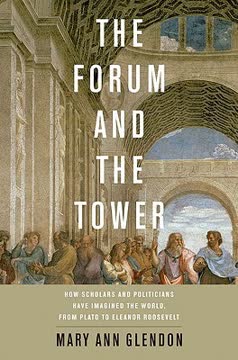
For as long as there have been governments and people to study them, statespersons and scholars have pondered the relative merits of life in the public forum and life in the ivory tower—the different skills required, the temperaments suited for one or the other way of life, and the relationship of the study of politics to its practice.
A perennial debate. The book explores the age-old question of whether a life of political action or philosophical contemplation is more "choiceworthy," as Aristotle put it. Many historical figures, from Plato to Max Weber, found themselves pulled between these two distinct vocations, each demanding different skills and temperaments. This tension highlights the fundamental divide between the urgent demands of practical governance and the pursuit of timeless knowledge.
Different responsibilities. Statespersons must make immediate decisions and bear responsibility for their consequences, often navigating a world of contingencies and partial answers. Scholars, by contrast, can debate endlessly, seeking the "best answer" without the immediate pressure of implementation. Henry Kissinger, a modern scholar-statesman, articulated this difference: "As a professor, I was responsible primarily for coming up with the best answer I could divine. As a policymaker, I was also responsible for the worst that could happen."
Personal struggles. Many individuals profiled, like Plato and Tocqueville, initially sought political careers but found themselves ill-suited or disillusioned, eventually turning to scholarship. Others, like Cicero and Burke, excelled in both, believing that philosophy should illuminate political action. This constant interplay reveals that the ideal confluence of gifts, favorable conditions, and luck is often elusive, making the choice between the forum and the tower a deeply personal and often fraught one.
2. Ideas Shape Reality, But Are Often Distorted
Moreover, ideas taken out of their original contexts can morph into surprising forms.
Unintended consequences. The journey of ideas from the "tower" of political theory to the "forum" of political practice is rarely straightforward. Concepts from thinkers like Machiavelli, Rousseau, Locke, and Marx have profoundly influenced political discourse and movements, but not always in ways their authors intended or expected. Often, only fragments of complex theories migrate, stripped of their nuance and balance, leading to surprising and sometimes dangerous applications.
Simplification and radicalization. Rousseau's nuanced critiques of society, for instance, were often simplified and radicalized by French revolutionaries, becoming slogans that fueled violent upheaval. Similarly, Locke's ideas of natural rights, while foundational for American democracy, were sometimes abstracted from their historical context, leading to interpretations that overlooked other important elements of the American story. This process of selective appropriation highlights the vulnerability of complex thought to political expediency.
The power of language. The emotional resonance and evocative language of certain thinkers, like Rousseau, often had a greater impact on readers' emotions than their intellects. This meant that the "what Rousseau actually said or meant was of less consequence than the emotional responses his writings stirred." This phenomenon underscores how the rhetorical power of ideas can overshadow their philosophical depth, leading to widespread influence even when the original intent is misunderstood.
3. The Statesman's Dilemma: Integrity vs. Effectiveness
What kinds of compromises can one make for the sake of getting and keeping a position from which one might be able to have influence on the course of events?
Navigating moral minefields. Public life often presents individuals with agonizing choices between maintaining personal integrity and achieving political effectiveness. Figures like Cicero and Burke constantly wrestled with how far to compromise their principles to advance cherished causes or simply to survive in a corrupt political landscape. This dilemma is central to the statesman's vocation, where "prudent accommodation" can easily slide into "pandering."
The "economy of truth." Edmund Burke, an Irish outsider in British politics, articulated the concept of an "economy of truth," suggesting that one might "speak truth with measure that he may speak it the longer." This pragmatic approach, while criticized by some like Dr. Samuel Johnson, reflected Burke's understanding that premature or absolute pronouncements could render a statesman ineffective, especially when advocating for unpopular causes like Catholic relief in Ireland.
Personal cost. The pursuit of political influence often comes at a significant personal cost. Plato's dangerous trips to Syracuse, Cicero's eventual execution for his opposition to Antony, and Tocqueville's disillusionment with party politics all illustrate the sacrifices and disappointments inherent in a life devoted to action. Charles Malik, a philosopher reluctantly turned diplomat, viewed politics as "the sphere of compromise and calculation," accepting a "certain degree of untruth and impurity and insincerity" as a "chastening cross."
4. The Scholar's Challenge: Relevance vs. Purity
As a professor, the risk was that the important would drive out the urgent. As a policymaker, the risk was that the urgent would drive out the important.
The ivory tower's isolation. Scholars often face the challenge of ensuring their work remains relevant to the "real world" without sacrificing intellectual rigor or becoming mere ideologues. Plato, after his political failures, retreated to the Academy, concluding that there are times when a wise man should "keep quiet and offer up prayers for his own welfare and for that of his country," rather than engage in futile political action. This highlights the risk of scholars becoming detached from practical affairs.
Disillusionment and self-doubt. Max Weber, despite his immense scholarly achievements, longed for a political role, feeling that "purely scientific work has lost all its excitement" compared to the "practical interests" of law and politics. His "Science as a Vocation" lecture painted a bleak picture of academic life, questioning its ultimate meaning in a "disenchanted world." This reflects the scholar's potential for disillusionment when the pursuit of knowledge feels disconnected from tangible impact.
The lure of the forum. Many scholars, like John Locke, were drawn into the political arena, finding that academic life was "but half life—it is withdrawal from the fight in order to utter smart things that cost you nothing except the thinking them from a cloister." This desire to engage in the "practical struggle of life" underscores a recurring theme: the intellectual's yearning to "make a difference" beyond the confines of theoretical discourse, even if it means confronting the messy realities of power.
5. Law as a Bridge: From Ancient Codes to Modern Rights
The compilation preserved Roman law for succeeding generations and nations. All later Western systems borrowed extensively from it.
A foundation of order. Legal systems, from ancient Rome to modern international declarations, serve as crucial bridges between abstract principles and practical governance. The Romans, uniquely among ancient peoples, developed a sophisticated legal profession and a systematic body of law, culminating in Justinian's Corpus Juris Civilis. This monumental work, a collaboration between Emperor Justinian and his chief legal advisor Tribonian, preserved a thousand years of Roman legal wisdom, becoming the "foundation of the world’s most widely distributed legal systems."
Adaptation and revival. After centuries of obscurity, Roman law was "rescued" by medieval scholars like Irnerius, who lauded it as ratio scripta ("written reason"). This revival in Bologna led to its adaptation and integration into the customary laws of Europe, forming the basis of today's civil law systems. This process demonstrates how legal scholarship can breathe new life into ancient wisdom, making it relevant for evolving societal needs.
Universal principles. In the 20th century, the Universal Declaration of Human Rights emerged as another landmark legal achievement, a "composite synthesis" of diverse cultural and philosophical outlooks. Eleanor Roosevelt, Charles Malik, and their colleagues navigated profound ideological differences to create a document that could serve as a "moral yardstick" for nations worldwide. This collaborative effort highlights law's capacity to articulate universal values and guide international relations, even amidst deep disagreements on foundational principles.
6. The Perils of Abstract Theory Without Practice
What is a merit in the writer may well be a vice in the statesman and the very qualities that make great literature can lead to catastrophic revolutions.
Divorced from reality. Political philosophy, when detached from the practical realities of governance, can lead to abstract theories that are difficult, if not dangerous, to implement. Plato's attempts to advise the tyrants of Syracuse, though well-intentioned, were "spectacular failures" because he underestimated the complexities of real-world power and human wickedness. This illustrates the gap between ideal theory and the messy contingencies of political action.
Revolutionary fervor. Jean-Jacques Rousseau, a self-taught outsider with no practical political experience, profoundly influenced the French Revolution. His evocative ideas, often simplified and radicalized by revolutionaries, became slogans that fueled a "revolution in sentiments, manners and moral opinions." Tocqueville observed that the revolutionaries' "fondness for broad generalizations, cut-and-dried legislative systems, and a pedantic symmetry" led to "catastrophic revolutions," demonstrating the dangers of applying abstract ideals without regard for "hard facts."
Totalitarian implications. Hobbes's "scientific" prescription for absolute sovereignty, while aiming for peace, rationalized a form of government where law was mere command and individual rights were severely curtailed. His rejection of custom and "higher law" struck at the heart of rule-of-law traditions, laying theoretical groundwork for regimes that demand total submission. Such theories, though intellectually rigorous, can have sinister implications when translated into political practice without the tempering influence of practical wisdom and historical experience.
7. The Power of Tradition and Gradual Change
A state without the means of some change is without the means of its conservation.
Building on the past. Many influential figures championed the value of tradition, custom, and gradual change as essential for stable and just governance. Cicero, deeply proud of Rome's unwritten constitution, believed it was "based upon the genius, not of one man, but of many; it was founded, not in one generation, but in a long period of several centuries and many ages of men." This perspective emphasizes the collective wisdom accumulated over time, rather than the singular vision of a revolutionary.
Organic development. Edward Coke, in his defense of English common law, saw it as an "artificial perfection of reason gotten by long study, observation and experience... fined and refined [over the ages] by an infinite number of grave and learned men." This view contrasts sharply with Hobbes's idea of law as mere sovereign command, highlighting the common law's dynamic, self-correcting nature that adapts time-tested principles to new circumstances.
Prudence in reform. Edmund Burke, a staunch opponent of the French Revolution, advocated for an approach to change that builds upon, rather than destroys, existing institutions. He favored "what had proved its value in practice, while leaving behind what had proved harmful." For Burke, tradition was not blind worship but a presumption in favor of practices under which a people had flourished, recognizing that "presumptions can be rebutted" and that "everything in political conduct depends on occasions and opportunities."
8. Leadership in a Disenchanted World
The fate of our times is characterized by rationalization and intellectualization and, above, all by the ‘disenchantment of the world.’
Evolving political landscape. The rise of democracy, industrialization, and bureaucracy profoundly reshaped the nature of statesmanship and scholarship in the 19th and 20th centuries. Tocqueville, observing Jacksonian America, worried that ambitious men were increasingly drawn to commerce rather than public service, and that the quality of political leadership might decline in a democratic age. He noted a shift from a focus on "glory" to a pursuit of "success."
Bureaucracy's double edge. Max Weber analyzed how "rationalization and intellectualization" led to the "disenchantment of the world," impacting both science and politics. He critiqued Germany's Beamtenherrschaft (civil-service rule) for creating outstanding administrators but stifling the development of political leaders with vision and charisma. This system, he argued, left Germany with an "impotent" legislature and a lack of political education, hindering its ability to adapt to modern democratic demands.
The judge as statesman. In the United States, Oliver Wendell Holmes, Jr., found a path to influence as a judge and public intellectual, rather than through electoral politics. He saw the Supreme Court as a "center of great forces" where justices interpreted laws like "statesmen governing an empire." Holmes's career exemplified a new form of leadership, where intellectual prowess and judicial restraint could shape national policy, even as he challenged traditional notions of law, reason, and morality.
9. Collaboration as a Path to Lasting Achievement
Such collaborative enterprises require participants with a somewhat different set of qualities from those possessed by persons like Tocqueville who could not bring himself to be a team player or Weber whose desire for recognition caused him to lament that one’s best work is sure to be superseded in the future.
Synergy of skills. History reveals that some of the most enduring achievements in governance and law have resulted from effective collaboration between statesmen and scholars. The Emperor Justinian, a statesman, and Tribonian, a scholar, combined their talents to produce the Corpus Juris Civilis, a work that continues to influence legal systems worldwide. Centuries later, Napoleon and his jurist Portalis consciously emulated this model in creating the French Civil Code, which Napoleon regarded as his most enduring legacy.
Bridging divides. The creation of the Universal Declaration of Human Rights stands as a powerful modern example of such teamwork. Eleanor Roosevelt, a seasoned political leader, skillfully chaired the UN Human Rights Commission, while Charles Malik, a philosopher turned diplomat, provided intellectual depth and cross-cultural understanding. Despite deep ideological divisions and the escalating Cold War, their leadership fostered a "close identity of views on aims and objectives," allowing a diverse group of delegates to forge a document of universal significance.
Beyond individual genius. This collaborative model contrasts with the struggles of figures like Tocqueville, whose fierce independence hampered his political effectiveness, or Weber, whose individualistic drive made teamwork challenging. The success of the UDHR, in particular, demonstrates that in an increasingly specialized and interconnected world, "it is a diverse community of knowers, rather than any one individual that accomplishes significant advances." This highlights the importance of qualities like diplomacy, empathy, and a willingness to set aside personal ego for a common cause.
Review Summary
Reviews of The Forum and the Tower are generally positive, averaging 3.95/5. Readers appreciate Glendon's well-written mini-biographies of philosophers and statesmen, particularly praising chapters on Burke, Cicero, and the collaboration behind the UN Declaration of Human Rights. Many found the exploration of the tension between academic and political life insightful and inspiring. Some critics felt the essays lacked cohesion as an overarching narrative. A recurring theme readers highlight is that results of one's efforts may only be recognized long after one's lifetime.








































