

Key Takeaways
Empty space is not empty; it is a boiling ocean of energy
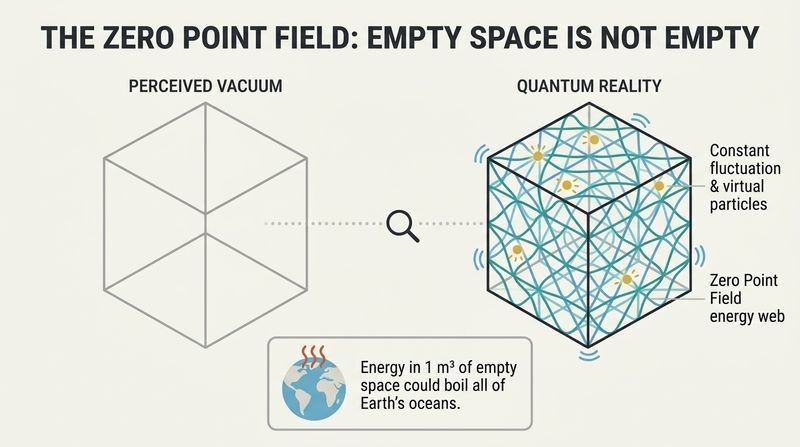
The vacuum is a hive of activity. McTaggart's central claim rests on the Zero Point Field, the residual energy that remains in space even at absolute zero, when all matter and heat have been removed. Quantum theory says particles never fully stop jiggling, and virtual particles constantly pop in and out of existence. Physicists usually subtracted this energy away as an irrelevant constant, a process called renormalization.
The numbers are staggering. McTaggart cites Richard Feynman's estimate that the energy in a single cubic meter of empty space could boil all the oceans of the world. Physicist Hal Puthoff argued this field connects everything to everything else like an invisible web, holding atoms stable and possibly offering a limitless free energy source.
The Zero Point Field is real and uncontroversial physics. What's contested is McTaggart's leap from a well-established quantum phenomenon to a universal information medium underpinning consciousness. Mainstream physics treats zero-point energy as genuine but not extractable in the way she implies, and calculations of its magnitude vary wildly depending on assumptions about cutoff frequencies. The vacuum energy problem is precisely why the cosmological constant remains physics's most embarrassing discrepancy, off by up to 120 orders of magnitude. McTaggart's genius is narrative synthesis; her risk is treating speculative frontier hypotheses as settled. Readers should hold the wonder and the skepticism simultaneously.
You are not separate from the world; you are entangled with it
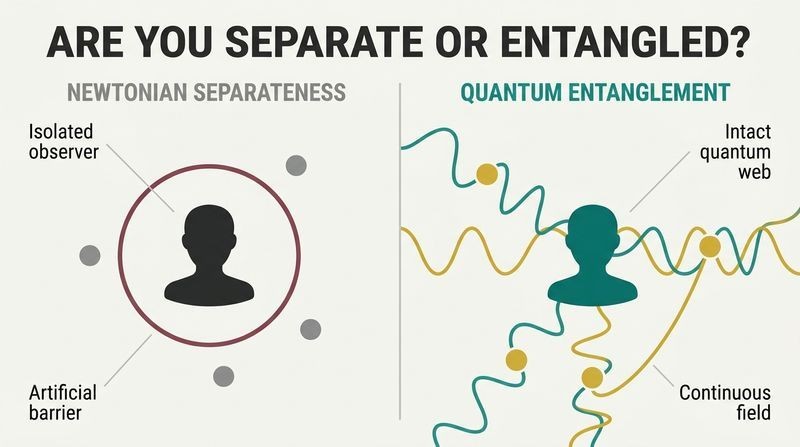
The book's core thesis rejects Newtonian separateness. For 300 years, science described a universe of discrete, self-contained objects moving through empty space, a worldview McTaggart traces to Newton and Descartes, who split mind from matter and pulled humans out of the cosmic fabric. Darwin added the lonely survival machine. She argues quantum discoveries dissolve this: subatomic particles have no meaning in isolation, only in relationship.
Nonlocality proves connection. Once two particles interact, they remain linked instantaneously across any distance, what Einstein dismissed as spooky action at a distance and what experiments verified from 1982 onward. If living beings are ultimately packets of quantum energy exchanging information with this field, the boundary between self and environment blurs. There is no clean line between me and not-me.
This reframing echoes systems biology, ecology, and Buddhist philosophy, all of which reject the atomized self. The scientific weight rests heavily on quantum entanglement, which is genuine but notoriously does not permit faster-than-light communication or macroscopic information transfer, a point physicists stress against overinterpretation. Decoherence theory explains why quantum weirdness rarely survives at the scale of warm, wet biology. Still, the philosophical point lands: our sense of radical individualism is a cultural inheritance, not a physical law. Fields like social epidemiology confirm that isolation genuinely harms health, giving the interconnection thesis empirical footing that does not require quantum mechanics at all.
Your body glows with faint light that orchestrates your cells
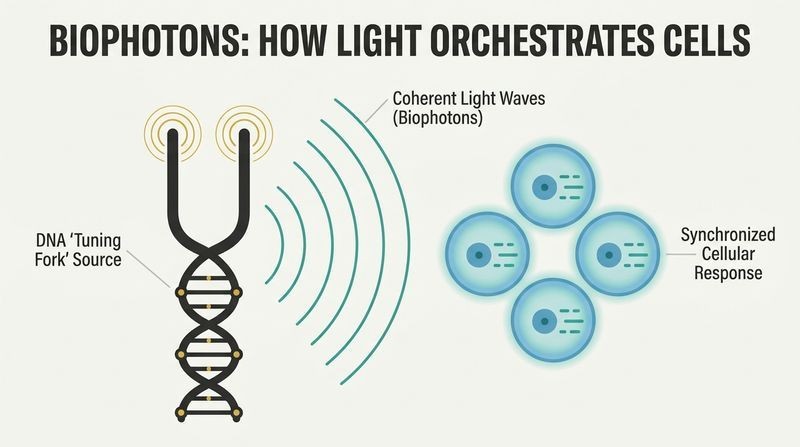
Living things emit biophotons. German biophysicist Fritz-Albert Popp discovered that all living cells radiate a weak, highly coherent stream of light, which he called biophoton emissions. Using a photomultiplier sensitive enough to count individual photons, he found that DNA acts as the body's master tuning fork, storing and emitting light across many frequencies.
This light coordinates the body. Popp argued these emissions solve a mystery chemistry cannot: how billions of molecular reactions synchronize instantly, and how a single cell knows to become an arm rather than a leg. Healthy people showed rhythmic, coherent light; cancer patients had lost their internal rhythms and coherence, their light going out. Multiple sclerosis, by contrast, showed too much light. Health, in this view, is perfect subatomic communication.
Ultra-weak photon emission from organisms is documented and studied in legitimate journals; oxidative metabolism produces measurable light. The controversial step is Popp's claim that this light functions as a coherent, DNA-driven control system rivaling biochemistry. Mainstream biology attributes cellular coordination to signaling cascades, gap junctions, and gene regulatory networks, which are well mapped. Popp's coherence hypothesis remains fringe, and his cancer diagnostics never entered clinical practice. Yet the underlying question he pressed is profound and unresolved: how does morphogenesis achieve such exquisite spatial timing? Developmental biologists still debate morphogen gradients versus bioelectric fields, the latter revived recently by researchers like Michael Levin.
Water may remember molecules long after they are gone
The memory of water experiments. French immunologist Jacques Benveniste found that antibody solutions diluted until not a single original molecule remained still triggered immune cell responses, as if the water retained a molecular imprint. His 1988 Nature paper sparked a firestorm; editor John Maddox arrived with a magician and a fraud investigator to discredit it.
Molecules speak in frequencies. Benveniste's deeper claim was that molecules communicate not by physically colliding like keys in locks, but by broadcasting signature electromagnetic frequencies. His team recorded these signals digitally and replayed them to biological systems, which reacted as if the real substance were present. A 2004 replication led by Madeleine Ennis, a committed skeptic, reportedly confirmed the dilution effect, forcing her to suspend disbelief.
This is the book's most scientifically radioactive material. Benveniste's work failed repeated rigorous replication and became a textbook case in how not to do science, cited by critics as pathological science alongside cold fusion. The lock-and-key model he attacked remains overwhelmingly validated by structural biology and pharmacology. That said, his reframing of molecular recognition as resonance was not baseless; vibrational spectroscopy is real, and modern research on terahertz biomolecular vibrations continues. The lesson many draw is epistemological: the aggressive, theatrical policing of his claims raised legitimate questions about how gatekeeping suppresses anomalies, even when the anomalies turn out to be errors.
Memory is not stored in your brain; it is read from a field
Lashley's rats broke the storage model. Neuropsychologist Karl Lashley spent decades burning out portions of rat brains trying to find where specific memories lived. No matter how much he destroyed, the rats remembered. Karl Pribram concluded memory must be distributed everywhere, like a hologram, where every fragment contains the whole.
The brain as reader, not warehouse. Pribram proposed the brain perceives by converting wave interference patterns using Fourier transforms, the same math behind holography. We do not see images in our heads; we project them outward, resonating with the world. Building on Walter Schempp's work with MRI machines, some argued the brain retrieves information encoded in the Zero Point Field rather than storing it internally, which would explain instant recall and the vastness of human memory.
The holographic brain is an elegant, influential metaphor that captures something real: memory is genuinely distributed and reconstructive, not filed like folders, a point confirmed by modern engram research showing memories spread across neural ensembles. Fourier analysis genuinely describes aspects of visual cortex processing. The overreach is the claim that memory lives outside the skull in a cosmic field, which no neuroscience supports and which strains against clear evidence that lesions, Alzheimer's, and hippocampal damage destroy specific memories. Pribram's insight survives without the field: the brain is more a dynamic pattern-processor than a storage device, echoing predictive-processing models now dominant in cognitive science.
Human intention nudges random machines, proving mind shapes matter
The PEAR experiments. At Princeton, engineering dean Robert Jahn and psychologist Brenda Dunne ran Random Event Generators, machines producing electronic coin flips, and asked ordinary people to will more heads or more tails by intention alone. Over 2.5 million trials across twelve years, participants shifted results in the intended direction about 52 percent of the time against an expected 50.
Tiny effect, staggering odds. The deviation sounds trivial, but combined the odds against chance ran to roughly a trillion to one. The effect size, though small, exceeded that of aspirin in preventing heart attacks. Bonded couples produced effects six times stronger than individuals. Strangely, the effect worked even when people tried to influence machines days before they ran, suggesting intention operates outside ordinary time.
PEAR is the empirical backbone of the book, and it divides serious people. The lab produced enormous datasets under engineering-grade controls, and its meta-analyses are statistically real. Critics counter that vanishingly small deviations across millions of trials are exquisitely vulnerable to subtle biases, optional stopping, and the file-drawer problem, and that replication by independent labs, including the Mind-Machine Consortium, largely failed to confirm the original magnitudes. The deeper philosophical puzzle is the measurement problem in quantum mechanics: whether consciousness plays any causal role in wavefunction collapse remains genuinely unsettled, with most physicists favoring interpretations that need no observer at all.
People can sense a stare and feel a stranger's calm from afar
Remote influence on living systems. Psychologist William Braud tested whether one person's intention could affect another's body. Using electrodermal activity, the sweat-gland response measured in lie detectors, he found that people being stared at through a video link showed heightened arousal 59 percent of the time, though they had no conscious awareness of it.
Need amplifies the effect. When Braud tried to calm agitated people remotely, the effect was strongest in those who most needed calming, and nearly as powerful as calming yourself with biofeedback. His meta-analysis with Marilyn Schlitz found a 37 percent success rate against 5 percent by chance. The influence grew with how much the influencer cared and how disordered the recipient was, hinting that a more coherent mind imposes order on a less organized one.
The staring-detection paradigm has been independently pursued by Rupert Sheldrake and others, producing suggestive but contested results, with skeptics attributing hits to sensory leakage, feedback artifacts, and experimenter effects. What is more solidly grounded is the physiological reality that humans unconsciously register social attention; the amygdala responds to direct gaze, and being watched measurably alters behavior, the observer effect studied in social psychology. Braud's framing of coherence flowing from ordered to disordered systems resembles entrainment in physics, where coupled oscillators synchronize. The claim that this operates at a distance without known signal remains the leap that mainstream science declines to take.
Trained viewers described secret sites they could not possibly see
Remote viewing at Stanford. Physicist Hal Puthoff tested psychic Ingo Swann, who altered a heavily shielded magnetometer buried in concrete and sketched its hidden interior accurately. This launched a 23-year, CIA-funded program. Viewers like Pat Price described classified installations from map coordinates alone, once detailing a Soviet site's giant gantry crane later confirmed by satellite.
Distance and shielding did not matter. Swann accurately described Jupiter's ring before NASA's Pioneer confirmed it existed. Viewing worked from inside submarines under hundreds of feet of seawater, ruling out ordinary electromagnetic signals. Jahn and Dunne's 336 trials, spanning distances up to 6,000 miles, beat chance at odds of a billion to one. A government review by statistician Jessica Utts concluded the results far exceeded chance.
The declassified Star Gate program is historical fact, and Utts genuinely concluded the statistics were significant, while co-reviewer Ray Hyman attributed them to methodological flaws, a split that persists. Remote viewing's problem is not statistics but mechanism and utility; the CIA shut the program down because its intelligence was too vague to act on, as the book itself notes with the Star Wars misfire. Judging free-response transcripts invites subjective matching and post-hoc pattern-fitting. Yet the episode is a fascinating case study in Cold War science, motivated reasoning, and how difficult it is to definitively kill an anomaly that refuses to replicate cleanly or vanish entirely.
Distant healing measurably helped dying AIDS patients in a blind trial
Elisabeth Targ's skeptical experiment. A conventionally trained psychiatrist, Targ designed a rigorous double-blind study of distant healing on advanced AIDS patients. Forty healers from diverse traditions, Christian, Buddhist, kabbalist, and Native American shaman among them, sent intentions to patients they never met, working only from a photo and name.
The treated group did dramatically better. In the second, tightly controlled trial matching patients for age and illness severity, the healing group had significantly fewer AIDS-defining illnesses, fewer hospitalizations, and better moods. The method did not matter; calling on Spider Woman worked as well as praying to Jesus. What healers shared was getting out of the way, surrendering ego, and requesting rather than forcing. A separate cardiac prayer study, MAHI, showed similar benefits.
These studies are the book's most consequential and most cautionary. Targ's early AIDS results were striking, but the field of distant-prayer research has since been battered by failed replications, most notably the large 2006 STEP cardiac study, which found no benefit and even worse outcomes in a prayed-for group told they were being prayed for. Publication bias plagues this literature. The robust, uncontroversial finding underneath is that social connection, belonging, and being cared for genuinely improve health outcomes, as the book's own Roseto example shows: a tight-knit Italian immigrant town had half the heart-attack rate of neighbors until its community frayed.
Groups focused on one moment nudge random machines worldwide
Field consciousness and the Global Consciousness Project. Roger Nelson placed Random Event Generators at gripping collective events and found the machines drifted from randomness precisely during moments of intense shared attention: pagan full-moon rituals, Wagner's most poignant arias, sacred sites in Egypt where effects ran six times normal.
The whole world reacting at once. Dean Radin ran machines during the O.J. Simpson verdict and the Academy Awards, watching order spike at the exact seconds a billion minds concentrated together. This grew into a global network of REGs, an ElectroGaiaGram meant to take the pulse of a collective mind. The machines deviated sharply during Princess Diana's funeral and the September 11 attacks, but not during Mother Teresa's expected death, suggesting shock and emotional intensity drive the effect.
The Global Consciousness Project is ongoing and its aggregate statistics are frequently cited as beating chance, but it suffers acutely from the flexibility of defining events and analysis windows after the fact, which inflates false positives. Critics note that with enough post-hoc event selection, noise inevitably yields patterns. The romance of a planetary mind waking during tragedy is powerful, echoing Teilhard de Chardin's noosphere and Jung's collective unconscious. The Transcendental Meditation crime-reduction studies cited alongside are similarly contested, tangled with the organization's promotional interests. The honest verdict: intriguing, unreplicated by hostile parties, and unresolved, which is precisely why it endures as controversy rather than consensus.
Science is a story we tell, and this chapter is being rewritten
A history, not a prophecy. McTaggart frames the whole enterprise as a narrative revolution. Borrowing Joan Didion's line that we tell ourselves stories in order to live, she argues our most defining stories are scientific ones, and the reigning story of separateness, mechanism, and survival of the fittest is being supplanted. Most of the research she chronicles was done in the 1970s and 1980s by credentialed scientists at Princeton, Stanford, and top European institutions.
The cost of the old story. The Newtonian-Darwinian worldview produced technological mastery but spiritual desolation, a lonely universe of winners and losers. If we are instead nodes in a unified field, we must rethink competition, community, healing, and human potential. To be a revolutionary in science, she notes, is to flirt with professional suicide.
McTaggart's framing borrows from Thomas Kuhn's paradigm-shift thesis, and she is right that scientific consensus is historically contingent and socially enforced. The danger in the story frame is that it can be wielded to immunize any claim against refutation by casting all rejection as dogmatic gatekeeping, when peer review, however flawed, exists precisely because most anomalies really are errors. The strongest version of her argument does not require the Zero Point Field at all: it is that reductive materialism has been culturally overextended into a metaphysics of isolation, and that ecology, network science, and relational psychology already offer a more connected picture without invoking contested paranormal data.
Analysis
The Field is best understood as ambitious science journalism performing an act of synthesis its own sources refused to attempt. McTaggart, an investigative reporter rather than a scientist, gathered a scattered community of credentialed mavericks, Puthoff, Popp, Benveniste, Pribram, Jahn, Braud, the Targs, and wove their disparate anomalies into a single narrative: that a quantum information field underlies matter, life, memory, and mind. The book's power is literary and integrative; its vulnerability is that integration outruns evidence. Individually, each strand ranges from solid (zero-point energy exists, biophotons are real, memory is distributed) to deeply contested (water memory, remote viewing, distant healing, global consciousness). McTaggart binds them with the Zero Point Field as connective tissue, but correlation of intriguing anomalies is not a unified theory. The recurring pattern across her cases is instructive: real phenomena at the edge of measurement, small effect sizes, statistical significance in original studies, and persistent failure of independent hostile replication. This is the signature of what Irving Langmuir called pathological science, though it can also, rarely, be the signature of genuine paradigm shift. The reader's task is to distinguish which is which, and the book does not equip them to, because it advocates rather than adjudicates. Its lasting value lies elsewhere. First, it dramatizes how scientific gatekeeping operates, sometimes protecting truth, sometimes suppressing inquiry, as the theatrical demolition of Benveniste illustrates. Second, it articulates a cultural hunger: the yearning to escape a worldview of atomized isolation, a hunger that ecology, systems biology, network neuroscience, and relational psychology are answering through entirely mainstream channels. The interconnection McTaggart seeks in quantum fields may be more soundly located in social epidemiology's finding that loneliness kills and community heals. Read as provocation and cultural document, the book succeeds; read as established science, it demands the skepticism its subjects earned.
Review Summary
The Field receives mixed reviews, with many praising its thought-provoking exploration of quantum physics and consciousness. Supporters find it scientifically grounded and life-changing, appreciating McTaggart's accessible writing style. Critics argue it misrepresents data and lacks scientific rigor, calling it pseudoscience. The book discusses the Zero Point Field, proposing interconnectedness of all things and the power of human intention. While some readers find it enlightening and validating, others caution against taking its claims at face value, emphasizing the need for critical thinking.
People Also Read





Glossary
The Zero Point Field
Energy sea filling empty spaceThe residual electromagnetic energy that persists throughout all space even at absolute zero, when matter and heat are removed. Arising from quantum fluctuations and virtual particles constantly appearing and vanishing, it is normally subtracted from physics equations as an irrelevant constant. McTaggart proposes it as a vast information medium connecting all matter and underlying consciousness, memory, and life itself.
Biophoton emissions
Faint coherent light from cellsThe ultra-weak stream of photons that Fritz-Albert Popp found all living organisms emit, which he argued is highly coherent and directed by DNA. He proposed this light coordinates cellular processes and bodily functions instantaneously, and that its coherence reflects health while its disruption signals illness such as cancer.
Memory of water
Water retaining molecular imprintsJacques Benveniste's controversial finding that water can retain a biological imprint of a substance even after dilution removes every original molecule, so the solution still triggers responses as if the substance were present. It became the basis for his broader claim that molecules communicate through signature electromagnetic frequencies rather than physical contact.
Random Event Generator (REG)
Machine producing electronic coin flipsAn electronic device, also called an RNG, that produces a random stream of ones and zeros driven by quantum-level noise or radioactive decay. Used in the Princeton PEAR lab and elsewhere to test whether human intention or group attention could shift the output away from pure randomness, serving as a sensitive gauge of mind-matter interaction.
Remote viewing
Perceiving distant unseen locations mentallyThe claimed ability to describe distant or hidden targets, often specified only by map coordinates, without any sensory access. Studied by Puthoff and Targ at Stanford Research Institute under CIA funding, viewers reportedly sketched classified installations and even planetary features, with proponents attributing the ability to information accessed through the Zero Point Field.
Field-REG
Random machine tracking group consciousnessRoger Nelson's application of portable Random Event Generators to real-world group events, testing whether collective focused attention produces order in otherwise random machine output. It gave rise to the Global Consciousness Project, or ElectroGaiaGram, a worldwide network of such devices intended to detect a shared reaction during major global events.
FAQ
What's The Field: The Quest for the Secret Force of the Universe by Lynne McTaggart about?
- Exploration of Quantum Physics: The book explores revolutionary ideas from quantum physics, suggesting a universal interconnectedness through a field of energy.
- Human Consciousness and Influence: It examines how human consciousness might influence the physical world, supported by experiments showing thoughts affecting random events.
- Interdependence of All Beings: The narrative emphasizes unity and interconnectedness with all living things and the universe, challenging traditional views of separateness.
Why should I read The Field by Lynne McTaggart?
- Challenging Conventional Science: The book presents groundbreaking ideas that challenge Newtonian views, essential for those interested in scientific evolution.
- Practical Applications of Theory: It discusses how quantum physics concepts can be applied to everyday life, including healing and personal growth.
- Inspiring New Possibilities: The exploration of consciousness offers a hopeful vision for the future, suggesting individuals can influence their environment through intention.
What are the key takeaways of The Field by Lynne McTaggart?
- Unity and Interconnectedness: All matter is interconnected through a quantum field, suggesting separateness is an illusion.
- Role of Consciousness: Consciousness plays a crucial role in shaping reality, challenging the view of it as merely a brain byproduct.
- Potential for Healing: Directed thoughts and intentions can influence physical health, opening new avenues for understanding medicine.
What is the Zero Point Field as described in The Field by Lynne McTaggart?
- Definition of Zero Point Field: It is an ocean of microscopic vibrations, a vast reservoir of energy in the space between things.
- Implications for Energy and Matter: Tapping into this field could provide an inexhaustible energy source, changing our understanding of physics.
- Connection to Consciousness: The field is linked to consciousness, suggesting thoughts and intentions can interact with it, influencing reality.
How does intention affect reality according to The Field by Lynne McTaggart?
- Intentionality and Coherence: Focused intentions create a coherent state that can influence the Zero Point Field, leading to positive changes.
- Scientific Studies: Various studies show that focused intention can lead to measurable effects, such as improved health outcomes.
- Practical Applications: Understanding intention's power allows individuals to direct thoughts toward desired outcomes, enhancing personal growth and healing.
How does The Field by Lynne McTaggart relate to consciousness and healing?
- Consciousness as a Creative Force: Consciousness is an active participant in shaping reality, influencing health and well-being.
- Experiments Supporting Healing: Experiments demonstrate how directed thoughts can lead to healing outcomes, challenging traditional medical paradigms.
- Practical Applications: Insights into harnessing consciousness for healing emphasize intention and focus, empowering readers to take charge of their health.
What scientific evidence does The Field by Lynne McTaggart present?
- Research Studies: The book cites studies on distant healing and intention effects on random number generators, supporting the Zero Point Field claims.
- Experiments on Coherence: Experiments show coherent consciousness states influencing biological systems, suggesting consciousness affects living systems.
- Interdisciplinary Approach: Evidence from quantum physics, biology, and psychology strengthens the argument for a new understanding of consciousness.
What are the best quotes from The Field by Lynne McTaggart and what do they mean?
- “The field is the only reality.”: This encapsulates the central thesis that the quantum field is the fundamental basis of existence.
- “We are attached and engaged, indivisible from our world.”: Highlights interconnectedness, suggesting our actions and thoughts impact the universe.
- “Science flourishes only in freedom.”: Advocates for open-mindedness in scientific inquiry, emphasizing exploring unconventional ideas.
How does The Field by Lynne McTaggart challenge traditional scientific views?
- Critique of Newtonian Physics: It critiques the mechanistic universe view, arguing it fails to account for interconnectedness.
- Emphasis on Consciousness: Places consciousness at the center of understanding reality, contrasting with views of it as a brain byproduct.
- Invitation for Open-Mindedness: Calls for open-minded scientific inquiry, encouraging exploration of unconventional ideas.
What is the significance of the observer effect in quantum physics as discussed in The Field by Lynne McTaggart?
- Definition of Observer Effect: The phenomenon where observation alters a quantum system's state, suggesting reality is influenced by consciousness.
- Implications for Reality: If consciousness affects the physical world, it challenges the notion of an objective reality independent of observers.
- Connection to Human Experience: Highlights interconnectedness, suggesting perceptions and intentions shape experiences.
How does The Field by Lynne McTaggart redefine our understanding of reality?
- New Scientific Narrative: Reality is redefined as a dynamic interplay of energy and consciousness, encouraging a holistic view of existence.
- Interdependence of All Life: Emphasizes interconnectedness through the quantum field, suggesting actions have far-reaching consequences.
- Potential for Transformation: Understanding reality as interconnected empowers individuals to explore their potential for change and influence.
How does The Field by Lynne McTaggart propose we can harness our consciousness?
- Focus on Intention: By directing intentions, individuals can influence the Zero Point Field and create desired outcomes.
- Meditation and Mindfulness: Practices like meditation enhance the ability to connect with the field, cultivating coherence and clarity.
- Community Involvement: Engaging in shared intentions amplifies individual consciousness effects, emphasizing community efforts in creating change.
About the Author
Download PDF
Download EPUB
.epub digital book format is ideal for reading ebooks on phones, tablets, and e-readers.








































