

Key Takeaways
Cancer isn't a foreign invader; it's your own cells gone rogue
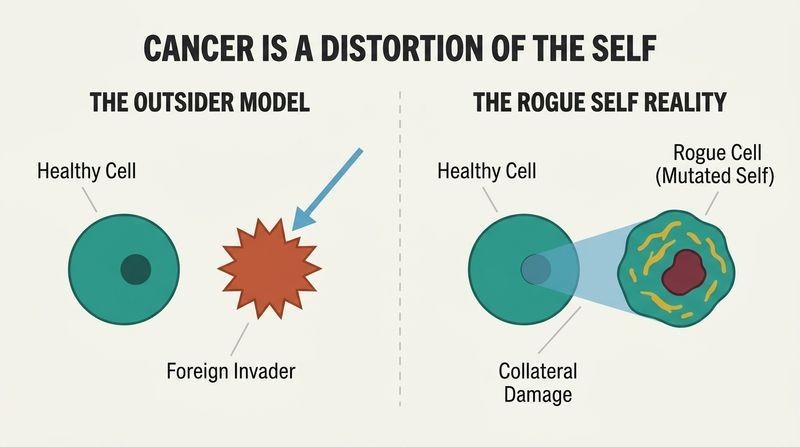
Cancer is a distortion of ourselves. Mukherjee's central thesis dismantles the comforting fiction that cancer is an alien attacker. A cancer cell is a normal cell that has hijacked the very genes governing growth, repair, and reproduction, then refused to stop. The same machinery that lets us heal wounds and grow from embryos, unleashed without brakes, becomes malignancy.
This makes cancer uniquely hard to cure. Because malignant growth borrows directly from normal growth, killing cancer without killing the patient is fiendishly difficult. As one scientist put it, curing cancer is almost as hard as dissolving the left ear while sparing the right. Harold Varmus, accepting his Nobel, called the cancer cell a distorted version of our normal selves, imbued with our own drive to survive and multiply.
What's striking is how this reframing dissolves the war metaphor even as the book uses it. If cancer is us, then total victory may be biologically incoherent, akin to defeating aging itself. This connects to evolutionary biology: cancer exploits Darwinian selection at the cellular level, with fitter mutant clones outcompeting their neighbors inside a single body. The insight also carries a sobering corollary that longevity research now echoes: as we conquer other killers and live longer, we unmask more cancer, because mutations accumulate with every cell division. Cancer may be the price of being a complex, long-lived, self-renewing organism.
A vitamin's evil twin launched modern chemotherapy in 1948
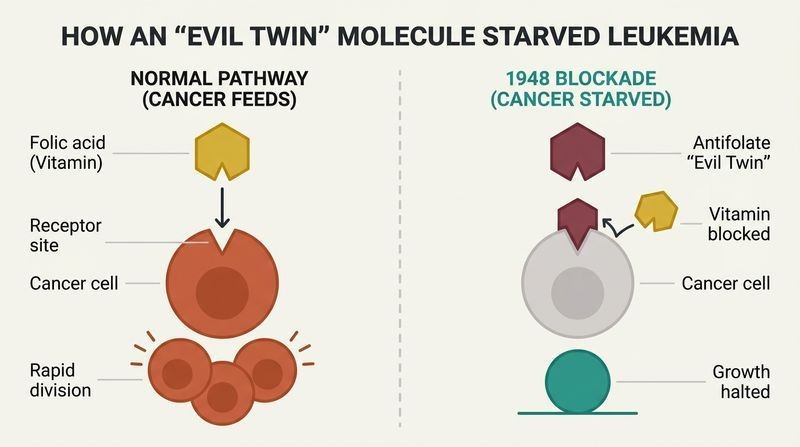
Farber reasoned backward from biology. Sidney Farber, a Boston pathologist tired of examining the dead, knew folic acid stimulated blood cell production. He gambled that a molecule blocking folic acid, an antifolate, might starve leukemia's frenzied cell division. In 1948 he injected aminopterin into children with acute lymphoblastic leukemia and produced the first temporary remissions ever seen in this uniformly fatal disease.
Remissions were fleeting but revolutionary. The cancers roared back within months, and most children died. Yet Farber had proven something unprecedented: a chemical could drive back an aggressive systemic cancer. His seven-page 1948 paper was met with skepticism and outrage, but it threw open a door. He chose leukemia precisely because, floating in blood, it could be counted, measured, and experimented upon.
Farber's leap embodies a recurring theme in drug discovery: therapeutic breakthroughs often precede mechanistic understanding by decades. He had no idea how aminopterin worked at the molecular level, yet it worked. This mirrors how aspirin, lithium, and general anesthesia were used long before their mechanisms were known. There's a cautionary edge too. Farber's earlier instinct had been to give leukemic children folic acid itself, which accelerated their disease and hastened deaths. The line between poison and cure was, and remains, perilously thin, a lesson the entire field would relearn repeatedly through the toxic decades ahead.
Diseases must be marketed politically before they get cured scientifically
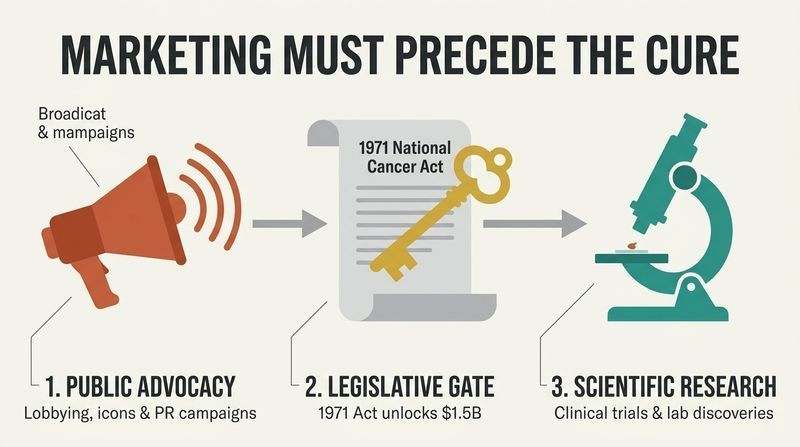
Farber discovered advertising before science. After his antifolate work, Farber teamed with Mary Lasker, a Manhattan socialite and advertising genius, to transform cancer from a whispered-about shame into a national cause. They invented Jimmy, a poster child with lymphoma, and raised money through radio broadcasts and baseball players. A disease needed icons, slogans, and mascots to attract funding.
The Laskerites engineered the War on Cancer. Through relentless lobbying, a full-page 1969 New York Times ad addressed to Nixon, and an Ann Landers column that buried the Senate in a million letters, they pushed the 1971 National Cancer Act through Congress, unlocking roughly 1.5 billion dollars over three years. Cancer research funding, once less than what Americans spent on a football afternoon, became a national priority.
This is one of the book's most transferable insights, extending far beyond oncology. AIDS activists later borrowed the Laskerite playbook wholesale, and modern patient-advocacy groups for rare diseases follow the same template. The uncomfortable underside, which Mukherjee surfaces honestly, is that political momentum outran scientific readiness. Critics like James Watson warned that funding a cure before understanding the cause was like landing on the moon without knowing Newton's laws. The episode illustrates a tension in science policy still unresolved: goal-directed crash programs can mobilize resources brilliantly, yet basic discovery rarely arrives on a congressional timetable.
More radical surgery didn't mean more cures, it meant more mutilation
Halsted's logic seemed unassailable. William Halsted believed cancer spread outward like a pinwheel from a central point, so cutting wider and deeper must cure more. His radical mastectomy removed the breast, chest muscles, lymph nodes, and sometimes ribs and collarbone, leaving women permanently disfigured. Surgeons escalated to superradical and ultraradical operations for nearly a century.
The theory was fatally flawed. If a cancer was truly local, a smaller operation cured it just as well. If it had already spread microscopically, no amount of cutting helped. Halsted's own 1907 data showed survival depended on how far cancer had spread before surgery, not surgical aggressiveness. Yet it took until Bernard Fisher's 1981 randomized trial of 1,765 women to prove statistically that radical mastectomy offered no survival benefit over simpler surgery.
The radical mastectomy is a masterclass in how a seductive theory, combined with institutional power, resists disproof for generations. The word radical carried a double meaning, from the Latin for root but also connoting bold and aggressive, and patients themselves came to demand it. What blocked correction was structural: the eminent surgeons who would need to run a disproving trial were the very ones whose reputations rested on the operation. This is a textbook case of what philosophers of science call theory-ladenness and what economists call incentive capture. It took feminist patient activism, not just data, to finally topple the dogma.
Curing leukemia required poisoning children to the brink of death
Combination chemotherapy was borrowed from tuberculosis. At the National Cancer Institute in the late 1950s, Emil Frei and Emil Freireich reasoned that single drugs failed because cancer grew resistant, just as bacteria did to lone antibiotics. Howard Skipper's mouse studies showed each drug dose killed a fixed percentage of cells, so relentless, repeated, multi-drug assault was needed.
VAMP nearly killed patients before saving them. Their four-drug regimen (vincristine, amethopterin, mercaptopurine, prednisone) was so toxic colleagues called the leukemia ward a butcher shop. Children crashed into near-fatal states, then their marrows regenerated cancer-free. When leukemia relapsed in the brain, a protected sanctuary drugs couldn't reach, Donald Pinkel added spinal injections and skull radiation. His total therapy pushed cure rates for childhood ALL toward 80 percent.
The brutal arithmetic of fractional cell kill, where each cycle eliminates a percentage rather than a fixed number, explains why treatment had to be so punishing and prolonged. This log-kill model remains foundational to oncology dosing today. The brain-sanctuary problem also reveals cancer's exploitation of the body's own defenses: the blood-brain barrier that evolved to keep poisons out also kept chemotherapy out. What's ethically arresting is that these experiments ran before informed consent norms existed. The Nuremberg Code was drafted the very month Farber began his trials, and it's doubtful he had heard of it. Progress and moral hazard were tightly braided.
Cancer's rarity in ancient bodies is a double negative, not good news
Cancer is ancient but was long invisible. A 4,000-year-old Egyptian papyrus describes breast tumors and, under treatment, records only there is none. A Chiribaya mummy from Peru carries a thousand-year-old bone tumor. Yet cancer barely appears in ancient medical texts, which teem with descriptions of plague, tuberculosis, and dropsy.
Longevity unmasked cancer. Cancer becomes common only when all other killers have been killed. In most ancient societies, people died young of infection, childbirth, or famine, long before mutations could accumulate. A woman's breast cancer risk rises from 1 in 400 at thirty to 1 in 9 at seventy. Better detection and the near-elimination of infectious disease didn't cause the cancer epidemic; they revealed one that had always been waiting.
This reframing deflates a common modern anxiety that cancer is purely a product of industrial pollutants, processed food, and modern life. Nineteenth-century doctors made exactly that error, linking cancer to the rush of civilization. Mukherjee shows the correlation was real but the causation inverted: civilization extended lifespans, and long life is cancer's precondition. The insight carries weight for contemporary demographics. As global health improves and populations age, cancer incidence rises not because we are doing something wrong but partly because we are doing something right. It reframes cancer less as a modern curse than as a mirror of our success against everything else.
Cancer genes are corrupted versions of our own growth genes
The hunt started with a chicken virus. Peyton Rous found a virus causing sarcoma in chickens in 1910, suggesting cancer was infectious. Decades later, Harold Varmus and J. Michael Bishop made the pivotal discovery: the cancer-causing gene in the virus, called src, was not foreign at all. It was a corrupted copy of a normal gene present in all animal cells, from birds to humans.
Two gene types drive cancer. Proto-oncogenes are normal growth accelerators; when mutated into oncogenes, they jam the accelerator on. Tumor suppressor genes are the brakes; when both copies are knocked out, as Alfred Knudson deduced for retinoblastoma with his two-hit hypothesis, the brakes fail. Carcinogens like soot, radiation, and tobacco cause cancer precisely by mutating these endogenous genes.
This unified a century of contradictory theories, viral versus chemical versus genetic, into a single elegant framework. The philosophical resonance is profound: the enemy came from within our own genome all along. What's worth flagging is how the false lead of viruses, which consumed hundreds of millions of dollars in the NCI's Special Virus Cancer Program and found essentially no human cancer viruses, nonetheless pointed toward the right answer. Science sometimes reaches truth by traveling a wrong road. Bishop's accelerator-and-brakes metaphor remains the clearest lay explanation of oncogenesis, and it correctly predicts why targeted drugs must attack specific broken components rather than blast all dividing cells.
Tobacco hid in plain sight because nearly everyone smoked
Ubiquity masked the carcinogen. By the 1940s, four out of five men smoked, so linking tobacco to lung cancer was, as epidemiologist Richard Peto quipped, like asking whether sitting causes cancer. Statistical detection works best at the margins, when a rare exposure meets a rare disease, as when Percivall Pott linked chimney soot to scrotal cancer in 1775.
It took new epidemiological tools. Richard Doll and Austin Bradford Hill's case-control and prospective studies, following tens of thousands of British doctors, proved the link definitively. The 1964 Surgeon General's report followed. Yet the tobacco industry fought back with a masterful strategy: manufacture doubt, fund more research to imply the question was open, and shift the fight to a friendlier Congress rather than face regulators.
The tobacco industry's playbook, summarized in an internal memo as doubt is our product, has since been recycled by opponents of climate science, sugar regulation, and more, making this history urgently relevant. Bradford Hill's response was equally consequential: unable to fit smoking into the rigid Koch's postulates designed for infectious disease, he proposed nine flexible criteria for inferring causation from correlation. These still underpin modern epidemiology. The chapter also quietly illustrates a Red Queen dynamic in prevention: smoking spread through social networks like a contagion, and gains reverse the moment vigilance drops. Prevention is never won, only maintained.
Early detection saves lives only if it lowers mortality, not just survival
Screening is riddled with statistical traps. Finding a small tumor feels obviously good, but the book dismantles this intuition. Lead-time bias makes screened patients appear to survive longer simply because their cancer was found earlier, even if they die at the exact same moment. Overdiagnosis catches harmless tumors that would never have killed; underdiagnosis misses lethal ones.
Mammography's benefit is real but modest and age-dependent. After nine trials spanning decades, the pooled Swedish data showed mammography reduced breast cancer mortality by 20 to 30 percent in women aged 55 to 70, but showed little benefit under 55. As statistician Donald Berry put it, screening is a lottery where a minority win and most pay in time, anxiety, and false alarms. Size matters, but a small tumor can be genetically vicious and a large one benign.
This is perhaps the book's most practically useful section for ordinary readers making real decisions. The distinction between survival (time from diagnosis to death, corruptible by early detection) and mortality (whether you actually die of the disease) is one that even physicians muddle. The deeper biological point undercuts the whole premise of size-based screening: metastatic potential is written in a tumor's genes, not its diameter. This foreshadows why modern oncology increasingly favors molecular risk stratification over pure imaging. Berry's helmet analogy, that skipping mammography before 50 is roughly the risk of a short helmetless bike ride, calibrates individual versus population risk beautifully.
Gleevec proved you can kill cancer without poisoning the patient
Targeted therapy fulfilled Ehrlich's dream. Chronic myeloid leukemia is driven by a single fused gene, Bcr-abl, producing a hyperactive kinase that forces cells to divide. Brian Druker and chemists at Ciba-Geigy developed a molecule, Gleevec, that slots precisely into the kinase and shuts it off. In the first trial, 53 of 54 patients achieved remission within days, with minimal side effects.
It broke a psychological barrier. Bruce Chabner compared it to Roger Bannister's four-minute mile: what Gleevec shattered was not a limit but the idea of limits. Herceptin, targeting the Her-2 gene in aggressive breast cancer, followed the same logic. These drugs validated attacking cancer's specific molecular vulnerabilities rather than carpet-bombing all dividing cells. CML went from a fatal disease to one patients live with for thirty years.
Gleevec represents the payoff of the basic-science detour that pragmatists once mocked. It could only be invented after decades of unglamorous work decoding oncogenes and kinases, vindicating Vannevar Bush's argument for open-ended research over crash programs. Yet the triumph carries a Darwinian asterisk, surfaced through patient Jerry Mayfield: cancers mutate their targets and grow resistant, forcing second-generation drugs like dasatinib. This is the Red Queen's race, running to stay in place. It reframes success from cure to control, from eradication to chronic management, a shift now central to oncology. Druker's own joke, that his drug increased cancer's prevalence by keeping patients alive, captures the paradox perfectly.
Every cancer genome is unique, but only about thirteen pathways matter
Sequencing revealed organized chaos. Bert Vogelstein's team mapped the mutations in real tumors. A single breast cancer might carry 50 to 80 mutated genes; one 43-year-old's tumor had 127. No two tumors, even of the same type, share an identical mutation set. Physiological heterogeneity turned out to be genetic heterogeneity.
Beneath the chaos lies order. Most mutations are passengers, along for the ride and inconsequential. A minority are drivers that actually fuel the cancer. When Vogelstein grouped drivers by the biological pathways they disrupt, tumors typically dysregulated only 11 to 15 core pathways, averaging thirteen. Different genes might be broken in different patients, but the same handful of signaling cascades (like the Ras pathway) recur. This finite number offers hope: therapy may need to target pathways, not every individual mutation.
The driver-versus-passenger distinction reframes the daunting complexity of cancer genomes into something tractable, and it explains why simple leukemias, with only five to ten mutations, succumb to chemotherapy while gnarled solid tumors resist. The number thirteen is a Rorschach test: pessimists see thirteen locks to pick simultaneously against a mutating enemy, optimists see a finite, mappable target list. Modern precision oncology, matching drugs to a tumor's molecular profile, flows directly from this work. One caveat worth noting is that the driver-passenger boundary remains genuinely contested, and early estimates of driver counts have been revised. The map is still being drawn.
Redefine victory: preventing death before old age, not defeating death
A cure may be biologically impossible. Because cancer arises from the same genes that drive normal growth, aging, and healing, we cannot fully rid ourselves of it without disabling life itself. Mutations accumulate not just from carcinogens but from random copying errors every time a cell divides. Cancer is, in a sense, the terminus of our own development as organisms.
A humbler goal is achievable. Richard Doll's aphorism, mounted above his Oxford office, reframes the mission: death in old age is inevitable, death before old age is not. The realistic win is stretching the cat-and-mouse game of treatment, resistance, and re-treatment longer and longer, converting fatal cancers into manageable chronic conditions, as happened with CML and multiple myeloma. Mukherjee's thought experiment following Queen Atossa across 4,000 years shows survival gains are real but wildly uneven across cancer types.
This closing reframing is intellectually honest in a way disease narratives rarely permit. It rejects both triumphalist cure-is-coming rhetoric and defeatist nihilism. The parallel to longevity science is direct: just as aging researchers increasingly target healthspan over an impossible immortality, oncology targets productive years saved over total eradication. The Atossa thought experiment is a brilliant pedagogical device, holding the tumor constant while advancing the medicine, isolating exactly what four millennia of progress bought. It also quietly indicts our metrics: whether we are winning depends entirely on what we choose to measure, and measurement, as Lester Breslow argued, is ultimately a measure of our own values.
Analysis
The Emperor of All Maladies is a genre-defying hybrid: part biography of a disease, part history of medicine, part memoir of an oncology fellowship. Its structural triumph is treating cancer as a protagonist with a personality, a shape-shifting adversary tracked across four thousand years. This narrative device solves the summarizer's central problem, that cancer is not one story but hundreds, by imposing a coherent arc: naming, misunderstanding, cutting, poisoning, and finally, molecular comprehension.
The book's deepest intellectual contribution is dissolving three warring theories of cancer causation, viral, chemical, and genetic, into a single genetic synthesis. Varmus and Bishop's discovery that oncogenes are corrupted native genes is the hinge on which the entire history turns. Everything before it (Farber's chemicals, Halsted's knife, Doll's cigarettes) becomes prologue to a mechanistic understanding, and everything after (Gleevec, the Cancer Genome Atlas) becomes its consequence. This gives the sprawling material a genuine spine.
What elevates the work above medical history is Mukherjee's willingness to indict his own profession. Radical mastectomy and megadose chemotherapy with bone marrow transplants are treated as cautionary tales of how theory, ego, and institutional power can sustain harmful practices for decades against accumulating evidence. The bone marrow transplant saga, culminating in Werner Bezwoda's fraud, is a devastating study in how hope corrupts scientific rigor and how patient demand can override the very trials needed to protect patients.
The book's principal limitation, understandable given its 2010 vintage, is that immunotherapy, checkpoint inhibitors and CAR-T cells, barely appears, and these have since transformed prognoses for melanoma and some leukemias in ways the targeted-therapy chapters only gesture toward. Its treatment of prevention is also more descriptive than prescriptive. Yet these are omissions of timing, not of reasoning. The framework Mukherjee builds, cancer as a distorted version of ourselves, governed by finite corrupted pathways, best fought by redefining victory as extended life rather than eradication, remains the definitive lay synthesis. It is science writing that reasons rather than merely reports.
Review Summary
The Emperor of All Maladies is praised as a comprehensive, well-written history of cancer research and treatment. Reviewers appreciate Mukherjee's ability to explain complex scientific concepts in an engaging manner, blending personal stories with medical information. Many find the book emotionally challenging but ultimately informative and hopeful. Some criticize the focus on American research and occasional repetition. Despite its length and dense subject matter, most readers find it compelling and recommend it for anyone interested in understanding cancer's impact on society and medicine.
People Also Read




Glossary
Oncogene
Mutated gene that drives cancerA gene that, when mutated or overactivated, promotes uncontrolled cell division and cancer. Oncogenes arise from proto-oncogenes, which are normal genes controlling cell growth. Bishop's analogy: a mutated proto-oncogene is a jammed accelerator pedal, forcing a cell to divide relentlessly. Examples include ras, myc, and src.
Tumor suppressor gene (anti-oncogene)
Growth brake that fails in cancerA gene that normally halts cell division. When both copies are inactivated by mutation, the cell loses its brakes and can progress toward cancer. Retinoblastoma (Rb) was the first identified. Bishop's analogy: an inactivated tumor suppressor is a missing brake, so stop signals for cell division can no longer register.
Two-hit hypothesis
Both gene copies must failAlfred Knudson's theory that tumor suppressor genes require both inherited copies to be knocked out before cancer develops. Children born with one defective copy need only one more mutation and get cancer faster; those born with two intact copies need two independent hits and get cancer later. Explained the inheritance pattern of retinoblastoma.
Fractional cell kill (log-kill)
Chemo kills fixed percentage each doseHoward Skipper's finding that a given chemotherapy dose kills a constant percentage of cancer cells regardless of total number, not a fixed count. This means repeated, iterative cycles are needed to drive cancer toward zero, explaining why treatment must be relentless, high-dose, and prolonged rather than a single knockout blow.
Lead-time bias
Early detection fakes longer survivalA statistical trap in cancer screening where detecting a cancer earlier makes patients appear to survive longer, simply because the diagnosis clock started sooner, even when the actual time of death is unchanged. This is why screening trials must measure mortality (whether people die of the disease) rather than survival time from diagnosis.
Radical mastectomy
Extensive disfiguring breast cancer surgeryWilliam Halsted's operation removing the breast, underlying chest muscles, and lymph nodes, based on his centrifugal theory that cancer spreads outward from a central point. Practiced for nearly a century, it was proven in Bernard Fisher's 1981 trial to offer no survival advantage over simpler surgery, causing severe disfigurement for no added benefit.
VAMP
Four-drug leukemia chemotherapy regimenA combination chemotherapy regimen of vincristine, amethopterin (methotrexate), mercaptopurine, and prednisone, pioneered by Frei and Freireich at the NCI in the early 1960s. Extraordinarily toxic, it pushed children to near-death but produced durable remissions in childhood leukemia, establishing the principle of high-dose multidrug therapy.
Proto-oncogene theory
Cancer genes are corrupted native genesVarmus and Bishop's discovery that cancer-causing genes like src are not foreign viral imports but mutated versions of normal genes present in all cells. This unified viral, chemical, and genetic theories of cancer: carcinogens and viruses cause cancer by activating these endogenous precursor genes.
Targeted therapy
Drugs attacking specific cancer moleculesCancer drugs designed to inhibit a specific mutated gene or protein driving a tumor, sparing normal cells. Gleevec, which blocks the Bcr-abl kinase in chronic myeloid leukemia, and Herceptin, which targets Her-2 in breast cancer, were the breakthrough examples, fulfilling Paul Ehrlich's century-old dream of a magic bullet with specific affinity for disease.
Driver vs. passenger mutations
Causal versus incidental cancer mutationsBert Vogelstein's distinction from cancer genome sequencing. Driver mutations actively fuel a cancer's growth by hitting key oncogenes or tumor suppressors; passenger mutations are random copying errors carried along without consequence. Though tumors carry dozens of mutations, only a handful are drivers, and they cluster into roughly thirteen core biological pathways.
FAQ
What's The Emperor of All Maladies: A Biography of Cancer about?
- Comprehensive history of cancer: The book provides a detailed exploration of cancer's evolution from an ancient disease to a modern medical challenge, covering its biological, social, and medical aspects.
- Biographical approach: Siddhartha Mukherjee presents cancer as a living entity, intertwining personal stories of patients and researchers with the scientific narrative.
- Interdisciplinary insights: The book integrates perspectives from various fields, including medicine, biology, and sociology, to illustrate the complexity of cancer.
Why should I read The Emperor of All Maladies?
- Engaging storytelling: Mukherjee combines scientific rigor with compelling narratives, making complex medical concepts accessible and engaging for readers.
- Insightful exploration: The book offers a profound understanding of cancer's history, biology, and treatment, essential for anyone interested in medicine or public health.
- Cultural significance: It places cancer within a broader cultural and historical framework, examining how societal attitudes toward the disease have evolved.
What are the key takeaways of The Emperor of All Maladies?
- Cancer is multifaceted: Mukherjee illustrates that cancer is a complex interplay of genetic, environmental, and lifestyle factors, crucial for effective prevention and treatment.
- Importance of research: The book highlights the significance of ongoing research and clinical trials in advancing cancer treatment.
- Patient-centered care: Mukherjee advocates for a compassionate approach to cancer treatment, recognizing the emotional and psychological challenges faced by patients.
What are the best quotes from The Emperor of All Maladies and what do they mean?
- "Illness is the night-side of life": This quote by Susan Sontag encapsulates the duality of human existence, reminding us of the inevitability of suffering and the need for compassion.
- "Cancer is a word, not a sentence": Emphasizes that a cancer diagnosis does not define a person's life or future, serving as a reminder of hope and resilience.
- "Cancer is, in essence, a genetic disease": Highlights the central theme of the book, emphasizing the role of genetic mutations in cancer development.
How does The Emperor of All Maladies address the history of cancer treatment?
- Chronological narrative: Mukherjee traces the history of cancer from ancient times to the present, detailing key discoveries, treatments, and societal attitudes.
- Trial and error: The book emphasizes the trial-and-error nature of cancer treatment development, showcasing both successes and failures.
- Impact of societal factors: Mukherjee discusses how societal attitudes toward cancer have influenced treatment options and research funding.
What role do oncogenes and tumor suppressor genes play in cancer, according to The Emperor of All Maladies?
- Oncogenes drive cancer growth: These are mutated genes that promote uncontrolled cell division, leading to cancer.
- Tumor suppressor genes inhibit growth: Normally function to prevent tumor formation, but when inactivated, they allow cancer to develop.
- Balance of signals: The book emphasizes the delicate balance between these genes in maintaining normal cellular function.
How does Mukherjee describe the evolution of cancer treatment?
- Historical context: Mukherjee traces the history of cancer treatment from ancient surgical practices to modern chemotherapy and targeted therapies.
- Shift from radical surgery: Highlights the transition to more nuanced approaches that consider the genetic makeup of tumors.
- Importance of clinical trials: Emphasizes the role of clinical trials in developing new treatments and improving patient outcomes.
What is the significance of chemotherapy in The Emperor of All Maladies?
- Pioneering treatment: Chemotherapy represents a major breakthrough, allowing for the systemic targeting of cancer cells.
- Combination therapies: Mukherjee emphasizes the importance of using multiple drugs together to enhance effectiveness and reduce resistance.
- Challenges and limitations: The book addresses the challenges of chemotherapy, including toxicity and drug resistance.
How does The Emperor of All Maladies portray the patient experience?
- Personal stories: The book weaves in personal experiences of cancer patients, illustrating the emotional and physical toll of the disease.
- Doctor-patient relationship: Mukherjee reflects on the complexities of this relationship, emphasizing empathy and understanding in cancer care.
- Survivorship: Features experiences of long-term survivors, showcasing resilience and hope.
What role does advocacy play in the fight against cancer, according to The Emperor of All Maladies?
- Mobilizing public support: Advocacy efforts have been instrumental in raising awareness and driving policy changes.
- Influencing research priorities: Advocacy has shaped the direction of cancer research, leading to significant advancements.
- Empowering patients: Emphasizes the importance of patient advocacy in giving a voice to those affected by cancer.
How does The Emperor of All Maladies explore the future of cancer treatment?
- Innovative therapies: Mukherjee discusses emerging therapies, including targeted treatments and immunotherapy.
- Personalized medicine: Highlights the shift toward treatments tailored to individual characteristics of a patient's cancer.
- Ongoing challenges: Acknowledges persistent challenges, including drug resistance and the complexity of cancer biology.
What is the Red Queen syndrome in relation to cancer?
- Constant adaptation required: Refers to the need for treatments to continually evolve to keep pace with cancer's ability to resist therapies.
- Implications for treatment: Illustrates the ongoing battle between cancer cells and treatment strategies.
- Social behavior and prevention: Suggests that societal behaviors can rapidly change and influence cancer rates, highlighting the need for continuous public health initiatives.
About the Author
Download PDF
Download EPUB
.epub digital book format is ideal for reading ebooks on phones, tablets, and e-readers.








































