Plot Summary
Arrival at the Silent House
In late 1970, the narrator arrives in an English village, seeking lodging in a manor shadowed by absence. The house, seemingly uninhabited, emanates an air of ghostliness—windows glint darkly, shrubbery obscures its view, and life is hinted at only by the overgrown garden. Discovery comes in a chance encounter with Dr. Henry Selwyn, the reclusive "hermit" of the estate, who reveals a gentle hospitality amid his detachment from the bustling world. The landscape is both alluring and oppressive, suspended between beauty and loss, mirroring the narrator's own sense of displacement. Unspoken traumas and hidden histories seem embedded in the very walls and grounds, promising revelations and melancholy.
Selwyn's Secret Exile
The narrator forms a growing intimacy with Dr. Selwyn, noticing his deep absorption in the garden and his quiet sadness. Selwyn, an émigré of Jewish descent born in Lithuania, recounts his childhood exodus, fraught with confusion between promise and reality as his family disembarked in London instead of America. He describes a lifetime of adaptation—name changes, professional acculturation, marriage to Elli, and years of comfortable but rootless affluence. Beneath Selwyn's cultivated Englishness persists a homesick longing for a lost world and companions never fully mourned. The painful pull of memory, guilt, and self-effacement underlies his decreasing engagement with life and eventual act of self-erasure.
Ruins of the Past
The house and its grounds, once symbols of prosperity and social order, descend into elegant decline, echoing the loss hidden in Selwyn's and the narrator's lives. Servants vanish into the walls, secret corridors recall vanished social hierarchies, and Elaine, the disturbed kitchen maid, haunts the rooms with broken laughter. The story is punctuated by small acts of kindness—a gift of apples, fragments of conversation. Photographs, maps, and a slide projection evoke youthful vitality that the present cannot recover. The landscape and objects—apples, greenhouses, old photographs—become memento mori, tokens of both survival and oblivion, as the past seeps through cracks in the present.
Losing and Remembering Home
The act of emigrating is a repeated motif; homecomings become impossible amid loss, as if the act of leaving rewrites a person's sense of self. Selwyn's memories resurface—farewells to beloved friends; closeness to the Swiss guide Naegeli, lost without a trace in the Alps; and a sense that the truest connections are fragile or doomed. In the aftermath of Selwyn's suicide, history's buried dead reemerge—old bones found in a glacier, the echo of childhood teachers—and the narrator is left reckoning with how memory, trauma, and longing shape the exiles' fate.
Paul Bereyter: Beloved Outcast
Years after Paul Bereyter's suicide, the narrator searches for understanding of his former primary school teacher's life. Fond memories intertwine with Paul's emotional distance—a man at once sibling-like in openness yet unreachable in his inner depths. Paul's nurturing pedagogy and encouraging methods contrast with the town's silent suspicion and his own alienation. Fragmented stories and recollections by former students reveal a teacher profoundly marked by a sense of not belonging, whose efforts to foster connection only deepen the tragedy of his isolation.
Lessons Beyond the Syllabus
Paul's unconventional methods, excursions, and fondness for music foster an atmosphere of curiosity and empathy among his students. He is both insider and perennial outsider in the conservative town, disdained for his impiety and independence of mind. Outside the classroom, Paul is afflicted by a restlessness—a drive to wander, to seek solace in music and nature, yet haunted by inexplicable tides of sadness. His soul is tuned to absence and displacement, creating a kinship with the narrator and a subtle communion with future "emigrants."
Paul's Eclipsed Calling
Reconstructing Paul's biography, the narrator uncovers the wounds inflicted by exclusion: as a "three-quarters Aryan" in Nazi Germany, Paul is quietly expelled from teaching, sent into exile in France, then conscripted back into the German army. War, persecution, displacement, and unattainable love (for Helen Hollaender, likely deported to a death camp) haunt his postwar return to teaching—a futile effort to reclaim homeland and vocation. Despite his devotion, Paul's homeland remains hostile. His inability to escape his German identity or sever ties with the town ultimately leads to spiritual exhaustion and self-annihilation.
Shadows of Belonging
Through Lucy Landau's recollections, the narrator maps how the postwar culture of silence deepens exile. Paul's family experience the duplicity of neighbors and the bitter fruits of "Aryanization." His postwar efforts to reconstruct and understand the past—archival research, collecting testimonies, and reading the tragic works of other exiles—lead not to closure, but to growing evidence of his own estrangement and kinship with the lost. Even in moments of happiness, the gardened exile in Yverdon, the trauma transmits itself as failing vision, inner deadness, and a mounting sense of doom.
Ambros Adelwarth's Flight
The saga of Ambros Adelwarth, the narrator's great-uncle, unfolds through fragments—photographs, family stories, journeys. Ambros, the youngest in a family marked by early loss, leaves home in adolescence, traveling from German villages to Swiss hotels, London, Japan, and finally the United States. Serving as a major-domo in the Solomon dynasty, Ambros becomes entangled with Cosmo, his employer's troubled son, in a relationship charged with both tenderness and secrecy. Amid luxury and displacement, Ambros's identity is shaped by loyalty, love, and self-denial to the point of personal erasure.
Ceremony and Estrangement
Family gatherings in America, echoes of small-town rituals, and the ceremonies of exile (engagements, burials, auctions) reveal both the persistence and the disintegration of ties. Ambros is revered for his dignity, yet his affect is hollowed by the demands of decorum and the cost of keeping secrets. Inheriting solitude and restraint, his later years are haunted by loss—the breakdown and death of Cosmo, the dispersal of households, and his own mental and physical unraveling. Family survivors, scattered across continents, carry the burden of ambiguous mourning.
Americas of the Mind
The American dream is at once fulfillment and illusion—a landscape of opportunity and perpetual exile. Interviews with Ambros's kin explore how hopes for a new world falter against harsh realities: economic struggles, cultural barriers, and the recurring ache for a vanished homeland. Places lose their identity as families scatter; rituals persist only in memory or through worn family photo albums. The lands that promised renewal transform into settings of melancholy, as the past persists as a ghostly presence beneath modern American surfaces.
The Weight of Inheritance
Descendants and relatives inherit not only stories, but the invisible weight of what has been lost, suppressed, or left unspoken. Diaries, letters, albums, and testimonials become relics, encoding ambivalent legacies—nostalgia and pain, resilience and numbness. The process of remembering blurs with mourning, and survivors struggle to parse their own lives from the inherited ruins of others. The attempt to reconstruct the past is both an act of fidelity and a cause of endless anguish, as meaning always hovers just out of reach.
The Solomons' Unquiet Estate
The narrative delves into the friendship between Ambros and Cosmo, an heir plagued by emotional and psychic crisis. Their partnership traverses the glamorous, disorienting social worlds of early twentieth-century elites—casinos, polo fields, and Mediterranean voyages. Yet splendor is shadowed by Cosmo's downward spiral into mental illness, self-destruction, and detachment. Ambros's unwavering loyalty transforms from salvation to cross; serving in a household of increasing emptiness and anxiety, he becomes a living relic consigned to ceremonial roles. His final years unfold in silence, depression, and self-effacing retreat.
Memories in the Salt Air
The physical journey—returning to Europe, visiting Deauville, wandering cemeteries and seaside ruins—mirrors the crumbling of memory and the impermanence of what was once grand. Places once frequented by the displaced—casinos, hotels, gardens—have become shells, populated by ghosts clinging to routines and dust. The narrator's encounters with surviving landscapes fuse nostalgia with disillusion; the act of climbing galleries, reading gravestones, or watching the sun over the Dead Sea becomes an immersion in the sediment of history, where relics coexist with the pain and beauty of collective amnesia.
Deauville: Ghosts in Summer
The French resort town of Deauville, once the height of cosmopolitan luxury, is a faded echo of pre-war Europe, now haunted by traces of vanished lives. Walking its deserted beaches and shuttered hotels, the narrator glimpses vestiges of the elegant past alongside the trivialities of contemporary tourism. Dreams bleed into reality: gatherings of cosmopolitan elites, lovers observed from a distance, anonymous crowds circumnavigate the corridors of memory. The underlying sense is of civilization in retreat, splendor as an archaeological site, and any search for the lost inevitably resulting in spectral restlessness.
Ferber in the Manchester Dust
The story of Max Ferber, a Jewish émigré painter in postwar Manchester, explores the interplay of place, trauma, and identity. The narrator's young arrival in a desolate industrial city mirrors Ferber's creative exile; both find themselves adrift among derelict architecture, crumbling warehouses, and forgotten histories. Ferber's artistic life—his compulsive, destructive practice of portraiture—becomes a way to record and erase the past, as dust covers the remnants of meaning. The city's immigrant communities, their names still visible on the doors of ruined buildings, echo both the persistence and the loss of memory.
Dust, Art, and Obsession
In Ferber's studio, the process of painting and erasure becomes ritualized—each portrait layered with countless failed attempts, each day's dust a silent index of effort and despair. Art serves as both memorial and shield, an attempt to reclaim meaning from obliteration, yet always haunted by the impossibility of representation. Ferber's isolation mirrors the broader sensation of postwar rootlessness: the city's ruins, vanished families, and fearful silences inscribe themselves into each gesture, each unfinished picture. Art and dust entwine as metaphors for both survival and endless mourning.
Legacies of Loss
The book draws toward a convergence of voices: letters, diaries, and inherited recollections that bear witness to irretrievable worlds. Ferber's mother's memoirs record both the vitality of Jewish village life and its extinction; cemetery walks and fragmented journeys unearth gravestones, artifacts, and the faint echo of the dead. The attempt to piece these stories together—a "final" version, composed of shreds and patches—suggests that the act of remembering cannot redeem but only partially mend the "gash in time" inflicted by historical catastrophe. Loss becomes both the point of departure and the shadow that endures.
Analysis
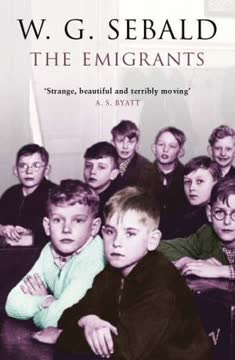
Sebald's The Emigrants is a masterwork of literary mourning—a luminous, deeply unsettling meditation on memory, exile, and the unending aftermath of catastrophe. Through the stories of four lives linked by the experience of forced migration, Sebald explores the intricate relationship between history's wounds and the subjective landscapes of remembrance. The narratives are populated by men and women stranded between worlds, unable to locate a fixed home or self; for them, the act of emigrating is never complete, but an endless oscillation between memory and erasure, nostalgia and guilt. Sebald's genius lies in his refusal to resolve these contradictions: loss is not overcome but lived with, its symptoms surfacing in silence, melancholia, artistic obsession, and the rituals of witness. The book's hybrid form—blending fiction and memoir, image and text—highlights the limits of representation and the ethics of remembering. At its heart, The Emigrants is a warning against forgetfulness, a quiet indictment of the violence inherent not just in destruction, but in the pressure to move on and "let go." Sebald's achievement is to render the unsayable articulate, honoring the shards of lives fractured by history, and inviting the reader to bear witness to the inextinguishable presence of the dead among the living. In a world still marked by displacement, this is a testament to the necessity of mourning, to the fragile dignity of survivors, and to the power of literature to reckon—however inadequately—with the enduring consequences of exile.
Review Summary
Reviews of The Emigrants reveal a deeply moving, elegiac work exploring memory, exile, trauma, and loss across four biographical narratives. Most readers praise Sebald's poetic prose, his blending of fiction and reality through photographs, and his subtle evocation of Holocaust aftermath. The book's melancholic tone, layered narration, and meditation on displacement resonate profoundly with many, though some find it slow and inaccessible. Recurring motifs—Nabokov as the "butterfly man," gardens, and faded photographs—create a haunting tapestry. Most reviewers consider it essential, transformative reading, rating it among the finest literary works they've encountered.
People Also Read



Characters
Dr. Henry Selwyn
Dr. Henry Selwyn embodies the paradox of the assimilated émigré, a man who spends a lifetime cultivating a new identity only to be eternally estranged from both past and present. His surface is one of cultivated Englishness and meticulous quietude, yet beneath lie moments of psychic rupture, memories of forced migration, and an ever-growing homesickness for a world lost to time and violence. Selwyn's reserved nature, half-confessional and half-withdrawn, signals the deep psychic burden of the émigré, unable to settle fully into the present, haunted by impossible returns and unresolved mourning. Through bouts of nostalgia, symbolic acts, and ultimately suicide, he emblematizes the emotional cost of displacement, the dissolution of self under the weight of history.
Paul Bereyter
Paul's contradictions—his warmth, brilliance, eccentricity, and estrangement—make him both beloved and perpetually isolated. Psychoanalytically, Paul's trauma arises from repeated exclusions: as a part-Jew barred from teaching under the Third Reich, as a returned veteran unable to find home in old routines, as a man whose vocation becomes a form of exile. His pedagogical innovations and empathy mask a soul corroded by shame, grief, and a longing for unattainable roots. Kindness cannot save him from recurring depression or from the knowledge of secrets his town would rather forget. Paul's narrative arc—from inspirational teacher to isolated suicide—evinces the tragic impossibility of complete belonging for those marked by inherited or historical wounds.
Ambros Adelwarth
Ambros exudes dignity and loyalty—serving as butler, confidant, and surrogate parent—yet these very virtues condemn him to a life of emotional self-effacement. His emotional core, centered on Cosmo Solomon, is a site of denied longing and ambiguous attachment, underscored by reticence and ritual. Though worldly and accomplished, Ambros is perpetually in motion, incapable of rooting himself or engaging in self-care. He is shaped by inherited melancholia, the trauma of displacement, and a lifelong pattern of avoidance, culminating in voluntary institutionalization and resignation to oblivion. Ambros's story is a microcosm of the émigré experience, blending glamour and loss, devotion and spiritual anemia.
Cosmo Solomon
Cosmo represents both privilege and acute vulnerability—a favored child given to excess, genius, and psychological instability. His relationship with Ambros is marked by tenderness, exclusivity, and a shared sense of belonging nowhere. Cosmo's inability to maintain equilibrium amid the demands of inheritance and the assaults of history leads to breakdown, seclusion, and eventual obsolescence. Cosmo's life and death, seen through Ambros's devotion, become a drama of love and spiritual extinction haunting the exiled family.
Max Ferber
Ferber's life is a study in persistent loss: estranged from homeland, parents, and language, he buries himself in the endless labor of art and self-effacement. His creative process—a cycle of painting, erasure, and dust—enacts the working-through of trauma, a ceaseless memorial to what cannot be restored. Driven by guilt, grief, and a fear of returning to the unredeemed home of his childhood, Ferber forges a way to persist amid ruins, finding in the ashes of the past fleeting traces of connection to the lost. Yet his relationships remain shadowed, his sense of identity fragmentary, his art both a bulwark against forgetting and a testament to the impossibility of healing.
Lucy Landau
Lucy stands as a figure of friendship and insight, connecting the narrator to the interior lives of others damaged by exile. As Paul's later companion and a survivor of her own uprooted childhood, she becomes a repository for the stories others cannot tell: piecing together the arc of Paul's sorrow, keeping alive memories that others repress, and bearing witness to the transmission of pain across generations. Her psychological insight, tireless curiosity, and empathy help bridge the gaps left by silences, making her a mediator between past and present.
Clara
Clara, though less central, provides emotional ballast for the narrator, counterbalancing the mournful tone of the text. Her choices—buying a house, making a life—enable the narrator to attempt (if not achieve) stability. She is a symbol of what might be redeemable in the present, yet even in her presence the weight of the past continually encroaches, underscoring the fragility of rootedness.
Elli Selwyn
Elli, as Selwyn's wife, represents the assimilated émigré who transforms trauma into acumen and practicality. She survives by embracing the logic of business and management, ultimately drifting apart from her husband as mutual secrets and silences pull them into separate orbits. She mirrors the dilemma of survivors forced to choose between pragmatic adaptation and fidelity to a lost origin.
Kasimir
Kasimir is both a link to the old world and an embodiment of the pragmatic strategies required for survival in the new. His stories, tinged with humor and resignation, illustrate the transition from European hardship to American struggle and adjustment. He carries the knowledge that the new world often disappoints, yet persists in the rituals and reminiscences that constitute family memory.
The Narrator
Central to all four narratives, the unnamed narrator is himself a displaced, restless soul drawn to the margins and the mysteries of exile. His psychoanalytic drive is to connect, to reconstruct, to patch up what cannot be made whole—to become in some sense the surrogate mourner for the losses embodied by Selwyn, Paul, Ambros, and Ferber. His detachment, empathy, and melancholia serve as both frame and echo for the vanished worlds he recounts.
Plot Devices
Framed Testimony and Unreliable Witness
Sebald constructs the narrative through layers of embedded recollection: interviews, diaries, letters, photo albums, and oral testimony. Each "emigrant's" story is told through the filter of the narrator's inquiries, colored by the unreliability of memory and the silences imposed by trauma or shame. Photographs, maps, and documentary remnants serve both as evidence and as silent witnesses—evoking what has vanished and what remains unspeakable. The perpetual mediation underscores the impossibility of direct representation; what matters is not simply what happened, but how stories are pieced together or left incomplete.
Interplay of Landscape and Mind
The physical environments described—neglected estates, crumbling town centers, graveyards, train stations—mirror psychological wounds. These landscapes serve as sites of both beauty and despair, emblems of trauma that persists beneath outward tranquility, as well as spaces haunted by invisible presences. Place becomes inseparable from feeling: geography as psyche, travel as shuttling between memory and forgetting.
Nonlinear Chronology, Recursive Structure
Each narrative cycles back on itself, mining episodes from multiple points in the past—childhood, wartime, displacement, postwar years—refusing neat closure. The movement is recursive, memory rising and falling, circling around trauma, each approach provisional. This structure enacts both the persistence of the past and the inability to move "forward," placing the reader in the temporal flux of mourners and survivors.
Symbolism of Objects and Rituals
Sebald invests ordinary objects with immense symbolic weight: apples, letters, gravestones, art supplies, garden plants. These fragments manifest the palpable yet elusive presence of those who are lost. The rituals surrounding such objects—preparing a garden, painting a portrait, reciting the Kaddish, penning diaries for a future reader—become acts of remembrance and resistance against oblivion.
Foreshadowing and Historical Irony
Sebald wields subtle gestures of foreshadowing, with uncanny returns and missed connections—early absences, childhood separations, the persistent image of the "butterfly man," the motif of homesickness that never abates. The tragic fate of exiles is prefigured in the overlooked details of every life: the dangers of silence, the blindness of neighbors, the recurrence of departure and return, the inevitable shattering of illusions. History's ironies bleed through personal stories, as disasters long recorded in archives quietly structure the narratives of survivors.








































