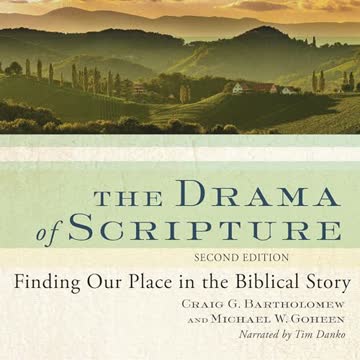
Key Takeaways
1. The Bible is a Unified Grand Story of God's Kingdom.
The Bible narrates the story of God’s journey on that long road of redemption.
Beyond fragments. Many readers approach the Bible as a collection of disconnected stories, moral lessons, or theological bits, rather than a single, coherent narrative. This fragmented reading risks losing the Bible's transformative power and allowing other cultural narratives to shape our lives. The Bible, however, presents itself as the "true story of the world," offering a comprehensive framework for understanding history and our place within it.
A grand metanarrative. This overarching story, or metanarrative, begins with God's creation, moves through human rebellion and Israel's history, culminates in Jesus, and continues through the church towards the completion of God's kingdom. It claims to be public truth, a unique interpretation of universal history that provides meaning for all people, communities, and nations. This perspective challenges pluralistic views that deny the existence of one true story.
Our place in the drama. Understanding the Bible as a unified drama is crucial for believers to find their place within God's ongoing work. It invites us to indwell this story as the foundational truth of our world, shaping our thoughts and actions. The book adopts a six-act structure to tell this drama: Creation, Fall, Israel, Christ, Church, and the Return of the King, emphasizing the covenant and kingdom as central images.
2. God Establishes His Kingdom and Humanity as His Image-Bearers.
By causing the creation to come into being by his word of power, God establishes it as his own vast kingdom.
Divine Creator-King. Genesis 1-2 introduces God as the infinite, eternal, and uncreated person who, by his powerful word, brings the entire creation into existence. This act establishes him as the sovereign King over all, worthy of all glory and worship. His creation is characterized by precision, order, and harmony, reflecting his incomparable goodness, wisdom, and justice.
Humanity's unique vocation. The pinnacle of creation is humankind, made in God's image and likeness. This likeness signifies humanity's unique calling to serve as God's "underkings" or royal stewards, ruling over the nonhuman creation. This "cultural mandate" involves developing the hidden potentials of creation in all areas of life—agriculture, art, science, politics—to reflect God's glory.
Relational and comprehensive. God is portrayed as highly relational, walking and communing intimately with Adam and Eve in the garden, which is depicted as a sanctuary. Humanity is created for intimate relationship with God, with one another (male and female), and with the creation itself. This initial state of creation is described as "very good," a theater of God's glory, intended for flourishing and development within time.
3. Human Rebellion Introduces Sin, but God Initiates Redemption.
Even in the tragic tale of sin’s entrance into the world, God does not give up his purposes for his creation and his kingdom.
The cosmic catastrophe. The entry of sin, described in Genesis 3 as "the fall," is the central conflict of the biblical story, marring God's perfect world and shattering the shalom (peace, wholeness) of creation. Sin is fundamentally a quest for autonomy, a desire to determine right and wrong apart from God's word, as symbolized by eating from the tree of the knowledge of good and evil.
Broken relationships. The immediate consequences of sin are a breakdown in all relationships: between humanity and God (fear, shame, hiding), between humans themselves (Adam blaming Eve), and between humanity and creation (cursed ground, difficult work). Though physical death is not immediate, a deeper spiritual and relational death occurs, distorting human nature and purpose.
God's enduring purpose. Despite human mutiny, God does not abandon his creation or his redemptive purposes. He graciously seeks out Adam and Eve, provides clothing for their shame, and, most significantly, promises future deliverance. Genesis 3:15, the "protoevangelium," foretells that the woman's offspring will crush the serpent's head, initiating the long road of redemption that will ultimately restore the world.
4. God Chooses Israel to Be a Light to the Nations, Forming Them Through Covenant and Law.
God narrows his redemptive focus to one man, one nation. But his ultimate purpose is to bring redemptive blessing to the whole creation.
Abrahamic covenant. In response to the escalating sinfulness culminating in Babel, God initiates a new beginning by calling Abraham. He promises to make Abraham a great nation, bless him, make his name great, and, crucially, make him a blessing through whom "all peoples on earth will be blessed." This election is not for privilege but for service, to channel God's blessing to the entire world.
Formation at Sinai. Through Moses, God delivers Abraham's descendants from Egyptian slavery, demonstrating his faithfulness to his promises. At Mount Sinai, he forms Israel into his covenant people, giving them the Law (Torah) and the Tabernacle. The Law, including the Ten Commandments, provides an ethical framework for their lives, intended to reflect God's character and creational intentions in every sphere—family, politics, economics, and worship.
A royal priesthood. Israel is called to be a "kingdom of priests" and a "holy nation," mediating God's glory to the cosmos. Their life under God's reign is meant to be a "display-people," a showcase of how covenant with Yahweh transforms a nation, drawing other nations to God. The Tabernacle, God's portable residence, symbolizes his permanent presence among them and his ultimate intention to restore his presence within all creation.
5. Israel's Unfaithfulness Leads to Exile, Yet Prophetic Hope for a Messiah Endures.
The history of Israel from this point on is in reality merely a commentary upon the degree of fidelity with which Israel adhered to this Sinai-given vocation.
Cycles of disobedience. Despite God's gracious formation and promises, Israel repeatedly fails to live up to its covenant calling. The book of Judges illustrates a downward spiral of sin, oppression, repentance, and deliverance, as Israel does "what was right in their own eyes." The monarchy, initially a hope for stable leadership, also becomes a source of compromise and idolatry, exemplified by Saul and Solomon's unfaithfulness.
Divided kingdom and prophetic warnings. Solomon's idolatry leads to the kingdom's division into Israel (north) and Judah (south). Both kingdoms largely persist in apostasy, ignoring the warnings of prophets like Elijah, Elisha, Hosea, and Amos. These prophets consistently call Israel back to faithfulness, emphasizing God's justice and his impending judgment if they do not repent.
Exile and enduring hope. Israel's persistent disobedience culminates in the catastrophic exiles to Assyria (northern kingdom) and Babylon (southern kingdom), where the temple is destroyed. This seems like the end of God's promises, yet prophets like Jeremiah and Ezekiel offer hope for a "new covenant" and a "new temple," promising a future return and the advent of a suffering servant Messiah who will truly be a light to the nations.
6. Jesus, the King, Inaugurates God's Kingdom Through His Life, Death, and Resurrection.
In Jesus Christ, that renewal and restoration is revealed in its final shape as the kingdom of God.
The kingdom announced. Jesus's mission centers on the startling announcement that the "kingdom of God has come near," fulfilling Old Testament prophecies of God's return to rule. He redefines Jewish expectations of a political or military messiah, choosing instead the path of humble service, self-giving love, and sacrificial suffering. His call to "repent and believe" demands total allegiance to him, not merely the Torah.
Kingdom revealed in word and deed. Jesus demonstrates the kingdom's arrival through authoritative teaching (e.g., Sermon on the Mount) and mighty works—healing the sick, casting out demons, calming nature, and raising the dead. These "deeds of power" are glimpses of a renewed cosmos, where sin, suffering, and death are overcome. His parables explain the "secret" of the kingdom: it is both present and future, growing humbly, and its final judgment is postponed to allow many to enter.
Victory through the cross and resurrection. The climax of Jesus's mission is his death and resurrection. The cross, a symbol of Roman humiliation and Jewish curse, is reinterpreted by the early church as God's greatest act of redemption—a victory over sin, evil, and death. His bodily resurrection inaugurates the "age to come," the beginning of new creation, and serves as the "firstfruits" and "pioneer" for all who believe, opening the way to God's presence.
7. The Exalted Christ Empowers the Church by His Spirit to Spread the Kingdom Message Globally.
This second part of the gospel story is about the continuing mission of the exalted Christ by the agency of his Spirit to give salvation to the church and through the church to the whole world.
Christ's ongoing mission. After his resurrection, Jesus is "exalted to the right hand of God," enthroned as Lord over all creation. His ascension is not an end but a coronation, from which he continues his mission through the Holy Spirit. The Spirit, promised in the Old Testament, is poured out at Pentecost, empowering the disciples to be witnesses "in Jerusalem, and in all Judea and Samaria, and to the ends of the earth."
The Spirit forms community. The Spirit's first work is to form a community—the church—that embodies the life of the kingdom. This early church, devoted to apostolic teaching, fellowship, breaking bread, and prayer, becomes an attractive "preview" of God's coming kingdom, drawing thousands to faith. This fulfills prophecies of Israel's regathering and its role in drawing the nations to God.
Witness to the ends of the earth. The book of Acts narrates the Spirit-led expansion of the gospel, initially through scattered believers and then through organized missionary efforts, notably by Paul. Paul, a former persecutor, becomes the "chosen instrument" to carry Jesus's name to the Gentiles. His mission involves planting churches, nurturing their growth, and unfolding the gospel's implications for living a new life in Christ, challenging the idolatry of Roman culture.
8. Believers Live in the "Already, Not Yet" Tension, Called to Comprehensive Witness.
The kingdom is real in the present life of the church, but anticipation of its future completion is also the church’s great hope.
Living in overlapping ages. Paul's theology emphasizes that the kingdom of God has "already" dawned in Christ's death and resurrection, yet it is "not yet" fully realized. Believers live in this tension, experiencing the Spirit as a "deposit" or "firstfruits" of the coming kingdom, even while evil and death persist in the world. This in-between time is given for the church's mission to gather the nations.
New life, new obedience. Through Christ's work, believers receive a new identity: declared righteous, reconciled to God, and adopted as his children. This new life, empowered by the Spirit, calls for a new obedience—a life of love, joy, peace, and justice that reflects God's character. This obedience is comprehensive, encompassing all aspects of human life, from eating and drinking to politics and scholarship.
Witness for the world. The church's new life and obedience are not for its own sake but for the sake of the world. By embodying the gospel's transforming power in their daily lives, Christians become a "light in the darkness," attracting outsiders and demonstrating what God's kingdom looks like. This witness extends to all cultural spheres, showing that salvation is cosmic in scope and that God's rule applies to every square inch of creation.
9. God's Redemptive Story Culminates in the Cosmic Restoration of a New Heaven and New Earth.
The goal of biblical history is a renewed creation: healed, redeemed, and restored.
Vision of cosmic restoration. The Bible's story culminates in Revelation's vision of a "new heaven and a new earth," where God's dwelling place descends to earth, signifying a restored unity between Creator and creation. Sin, death, mourning, crying, and pain are no more, as God himself dwells with his people, and all relationships are healed. This is not an escape from earth to a spiritual heaven, but the comprehensive renewal of the physical cosmos.
Continuity and discontinuity. This restoration implies significant continuity with the present world, yet also elements of discontinuity. Just as Jesus's resurrected body was recognizable yet transformed, so too will the new creation be familiar yet transcend our current limitations. Our new lives will be lived in resurrected bodies within this restored creation, where every facet of human life and the nonhuman creation is brought back to God's original intention.
Hope for the future. This vision of a fully redeemed creation provides the ultimate hope that shapes Christian mission today. It assures us that God's restorative work will utterly undo all of sin's "mischief," extending salvation beyond individuals to the entire cosmos. The promise of Jesus, "Look, I am coming soon!", calls believers to live faithfully in the present, eagerly anticipating and straining toward the glorious completion of God's kingdom.
Review Summary
Readers generally find The Drama of Scripture to be a valuable and concise overview of the biblical metanarrative. Many appreciate the cultural and historical context it provides, particularly during the intertestamental period and its Progressive Covenantal Framework. While most readers rate it highly for its accessibility and spiritual depth in under 250 pages, some found it a challenging read. Overall, the book is well-regarded as an educational resource, especially for those seeking a thorough yet digestible survey of Scripture.
People Also Read

 Immersive



 Immersive