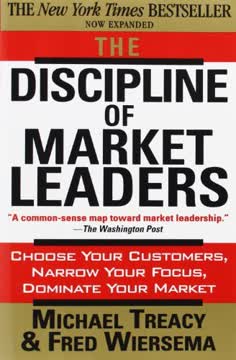
Key Takeaways
1. Market Leadership Demands a Singular Focus
The message of The Discipline of Market Leaders is that no company can succeed today by trying to be all things to all people.
Choose your race. In today's hyper-competitive landscape, companies must stop trying to satisfy every customer need and instead commit to delivering one specific, unmatched type of value to a carefully chosen market segment. This isn't about doing everything well; it's about doing one thing extraordinarily well, making it impossible for others to compete on the old terms. The choice of this singular focus is the foundational strategic decision, defining what work a company should do, rather than just how it should do it.
New competitive rules. The traditional business environment, where companies could raise prices with costs or offer merely "good enough" service, is over. Customers now demand more of what they value, whether it's lower cost, greater convenience, cutting-edge design, or expert advice. Market leaders redefine value by raising customer expectations in their chosen dimension, forcing competitors to either adapt or fail.
Beyond reengineering. While concepts like reengineering and core competencies are powerful tools for improving efficiency, they are insufficient on their own. They are "how-to" guides for running a race, but this book is about "choosing the race to run." A company must first decide its unique value proposition and then align its entire organization to deliver on that promise, continuously improving it year after year.
2. Three Paths to Dominance: Operational Excellence, Product Leadership, or Customer Intimacy
We have identified three distinct value disciplines, so called because each discipline produces a different kind of customer value.
Distinct value propositions. Market leaders don't just offer "value"; they offer a specific kind of value that resonates deeply with a particular customer segment. Our research identified three primary value disciplines, each representing a unique way to combine operating models and value propositions to dominate a market. These disciplines are not industry-specific but rather reflect fundamental choices about how to compete.
The three disciplines are:
- Operational Excellence: Focuses on providing reliable products or services at competitive prices with minimal difficulty or inconvenience.
- Product Leadership: Concentrates on offering products that continually push performance boundaries and redefine the state of the art.
- Customer Intimacy: Aims to sell a total solution, not just a product, by cultivating deep relationships and tailoring offerings to specific customer needs.
Excel in one, maintain others. Choosing one discipline doesn't mean neglecting the others entirely. A company must maintain "threshold standards" in the other two dimensions, ensuring its performance doesn't fall so low that it undermines its primary value proposition. However, the core energy and resources are channeled into mastering the chosen discipline, creating a compelling and unmatched offering.
3. Operational Excellence: Delivering Best Total Cost
Operationally excellent companies provide middle-of-the-market products at the best price with the least inconvenience.
Lowest total cost. This discipline promises customers the lowest overall cost of acquiring and using a product or service. This can manifest as the lowest purchase price, but also includes benefits like exceptional reliability, durability, and hassle-free service that reduce future costs and annoyances. Wal-Mart, for instance, epitomizes this with its "always the low price, always" approach.
Streamlined operations. Operational excellence is built on an operating model characterized by:
- Optimized, streamlined processes for end-to-end product supply and basic service.
- Standardized, simplified, and tightly controlled operations, minimizing employee discretion.
- Management systems focused on integrated, reliable, high-speed transactions and compliance.
- A culture that abhors waste and rewards efficiency.
Variety kills efficiency. These companies reject product or service proliferation, focusing instead on no-frills offerings for the middle of the market where demand is high and cost is paramount. They actively shape customer expectations, making virtues of their limitations (e.g., Southwest Airlines' no-frills flights for low prices). They leverage information technology to automate tasks, coordinate activities, and achieve virtual integration with suppliers, driving down transaction costs and improving service.
4. Product Leadership: Pioneering the Best Products
Their proposition to customers is an offer of the best product, period.
Pushing performance boundaries. Product leaders are relentless innovators, constantly striving to offer products or services that expand existing performance limits or create entirely new categories. They don't just improve; they redefine the state of the art, year after year, product cycle after product cycle. Intel, with its continuous development of faster microprocessors, exemplifies this discipline.
Three challenges for product leaders:
- Creativity: Recognizing and embracing ideas from anywhere, inside or outside the company.
- Speedy Commercialization: Engineering all business and management processes for rapid development and market launch.
- Relentless Self-Obsolescence: Actively seeking to leapfrog their own latest products, rather than waiting for competitors to do so.
Right-to-left thinking. These companies start with a visionary concept of the next breakthrough product and work backward to achieve it, shunning aimless experimentation. Their operating model is fluid, ad hoc, and ever-changing, designed to foster invention and quickly redeploy resources to promising projects. They attract and retain highly talented, curious individuals who thrive on ambitious challenges and are rewarded for new product success, not punished for experimentation.
5. Customer Intimacy: Providing the Best Total Solution
Their proposition to the customer: We have the best solution for you—and we provide all the support you need to achieve optimum results and/or value from whatever products you buy.
Tailored solutions and deep relationships. Customer-intimate companies focus on delivering what specific customers want, not just what the market demands. They cultivate long-term relationships, specializing in satisfying unique needs often recognized only through their close ties and intimate knowledge of the customer. Home Depot, with its knowledgeable staff offering expert advice, and Airborne Express, with its customized logistics services, are prime examples.
Beyond products and services. These companies offer a unique range of superior services, from education and hands-on help to advice on transforming clients' business processes. They often take responsibility for achieving results, even putting themselves at risk to further their clients' success. Historically, IBM excelled at this, providing total solutions and expert guidance to data-processing chiefs.
Client-driven operating model. The operating model for customer intimacy is built on:
- Obsession with solution development, results management, and relationship management.
- A business structure that delegates decision-making to employees close to the customer.
- Management systems geared toward creating results for carefully selected clients.
- A culture that embraces specific solutions and thrives on deep, lasting client relationships. They often use "hollow delivery systems," leveraging networks of co-providers to offer a broad range of capabilities without owning them all.
6. Your Operating Model Must Align with Your Chosen Discipline
The selection of a value discipline is a central act that shapes every subsequent plan and decision a company makes, coloring the entire organization, from its competencies to its culture.
The "machine" for value. A company's operating model is its internal "machine" for delivering value, comprising its operating processes, business structure, management systems, and culture. This model must be meticulously synchronized and dedicated to the chosen value discipline. For instance, the regimented, centrally planned structure of an operationally excellent company like Wal-Mart is vastly different from the loosely knit, ad hoc structure of a product leader like Sony.
Distinct internal workings. Companies excelling in the same value discipline, even across different industries, exhibit remarkably similar operating models. An executive moving from Southwest Airlines to AT&T Universal Card Services would find familiar mechanisms for delivering value. Conversely, companies pursuing different disciplines within the same industry, like Wal-Mart and Nordstrom, appear fundamentally different in their internal operations.
Coherence is key. This alignment ensures that every aspect of the organization, from hiring practices to performance metrics, reinforces the company's core value proposition. Without this coherence, efforts become fragmented, resources are misallocated, and the company struggles to deliver on its promise, leading to internal confusion and competitive disadvantage.
7. The Peril of Not Choosing: Mediocrity and Confusion
Not choosing means ending up in a muddle. It means hybrid operating models that are neither here nor there, and that consequently cause confusion, tension, and loss of energy.
The trap of "doing it all." Many companies mistakenly believe they can excel in all three value disciplines simultaneously. This diffused strategy inevitably leads to mediocrity across the board, as resources and attention are spread too thin. Such firms often become "Kiddievilles"—undistinguished, unable to match competitors on any single dimension of value, and constantly struggling to find a sustainable path.
Internal conflicts and wasted energy. A lack of clear value discipline creates internal confusion and tension. Different departments or executives may operate under conflicting priorities, leading to misaligned efforts and wasted resources. For example, a sales team trying to offer customized solutions (customer intimacy) will clash with a manufacturing unit focused on standardized, low-cost production (operational excellence) if the company hasn't clearly chosen its primary discipline.
Vulnerability to focused competitors. Companies without a chosen discipline are rudderless, easily outmaneuvered by competitors who are laser-focused on delivering unmatched value in their chosen area. They become reactive, constantly playing catch-up, and ultimately lose market share and profitability. The choice of a value discipline is not just about what to do, but crucially, about what not to do, requiring courageous decisions to narrow focus and leave certain opportunities behind.
8. Continuously Elevate Value to Sustain Leadership
Dominate your market by improving value year after year.
No resting on laurels. Market leadership is not a destination but a continuous journey. Companies that achieve the top spot often fall into decline because they become complacent, celebrating past victories and exploiting their advantages rather than relentlessly improving. Competitors are always striving to copy and surpass, making continuous value elevation essential for sustained dominance.
Compete with your own success. True market leaders actively work to make their own operating models and products obsolete. They understand that if they don't innovate and push the boundaries of their chosen value, a competitor eventually will. This means:
- Operational Excellence: Constantly seeking the next generation of efficiency-enhancing assets and processes.
- Product Leadership: Developing successor products that render current offerings obsolete.
- Customer Intimacy: Evolving current solutions and moving clients to new paradigms of value.
Raising the bar. Advances in value are achieved by tightening performance standards, reengineering work processes, and upgrading competencies. This relentless pursuit of improvement ensures that customer expectations continue to rise, further solidifying the leader's position and making it harder for rivals to catch up.
9. Cultivate a "Cult of the Customer" Aligned with Your Discipline
Few market-leading companies—in fact, we know of none—have achieved or retained their position without a palpable culture that aligns precisely with their value commitment to customers.
Beyond strategy, it's culture. A company's chosen value discipline must be deeply embedded in its culture—a "cult of the customer" that shapes every employee's attitude and behavior. This isn't a vague concept; it's a tangible force that drives people to go the extra mile for customers, directly or indirectly. Employees understand that customer value is the ultimate measure of their work and that improving it is the measure of their success.
Credo in action: The customer credo manifests differently for each discipline:
- Operational Excellence: Dedication to total dependability and rock-solid follow-through (e.g., Federal Express driver delivering in a snowstorm).
- Product Leadership: Missionary zeal to dazzle customers with exciting new products and benefits (e.g., Intel engineers pushing chip performance).
- Customer Intimacy: Genuine interest in being a trusted confidant and adviser, helping customers improve their business (e.g., Home Depot staff offering sage advice).
Building the cult. This culture is built through consistent communication of the value proposition, hiring and retaining people who thrive in that environment, rewarding contributions that align with the credo, and removing obstacles to effective work. Senior leaders must act as role models, demonstrating their own devotion to the customer credo in their daily actions.
10. Beware the Pitfalls of Success: Complacency and Myopia
Having attained market leadership, many firms celebrate their victory, admire their own operating model, and exploit their advantages for shareholder gain. They simply rest on their laurels.
The curse of celebrity. Companies that achieve market leadership often fall into decline because success breeds complacency and tempting distractions. They may over-exploit their current advantages, over-invest in outdated assets or ideas, or lose focus on their core value proposition. This "myopia" can lead to a failure to adapt to changing market conditions or rising customer expectations.
Specific pitfalls include:
- Overpricing: Getting greedy and raising prices beyond perceived value (e.g., Kellogg's cereal prices).
- Under-innovation: Failing to develop breakthrough products, relying on minor "improvements" (e.g., old IBM, some soft drink companies).
- Under-servicing: Neglecting customer relationships or failing to evolve solutions (e.g., IBM's later years, American Express's Genesis program).
- Asset becoming liability: Over-investing in assets that become obsolete (e.g., American Airlines' hub infrastructure, Wal-Mart's physical stores in a home-shopping shift).
- Knowledge becoming ignorance: Failing to adapt expertise to new client needs or market shifts (e.g., IBM's ignorance of new PC buyers).
Maintaining balance. Sustained market success requires a delicate balance: aggressively pursuing the chosen value discipline while maintaining threshold performance in others, and constantly innovating to avoid self-inflicted obsolescence. Leaders must resist the temptation to milk short-term gains at the expense of long-term value creation, ensuring a win-win outcome for customers, employees, and shareholders.
People Also Read


 Immersive