


Plot Summary
Prologue
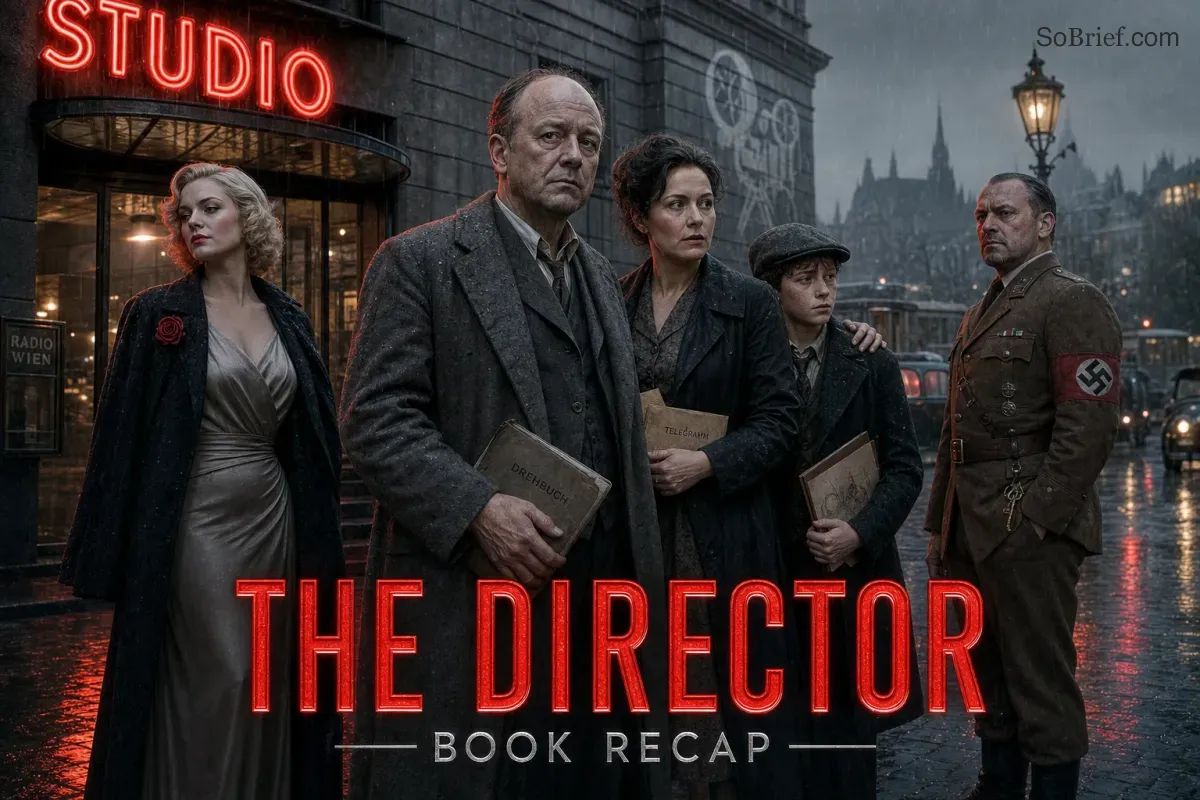
An elderly man named Franz Wilzek4 is fetched from an Austrian nursing home to appear on a Sunday morning television show. He can barely manage the studio's paternoster elevator. His memory gutters like a candle. The host asks about his decades-old work with the legendary film director G. W. Pabst1 — and then raises the subject of a film called The Molander Case.
Wilzek4 erupts: the film was never shot, it doesn't exist, it's a lie. Yet even as he shouts, images assault him — a crystal chandelier seen from a soaring crane, rows of faces forbidden to look up. Backstage, a young editor named Rosenzweig17 quietly tells Wilzek4 that his own father was among those faces. The old man turns away without a word.
The Refugee Nobody Needs
In 1930s Los Angeles, the celebrated Austrian director G. W. Pabst1 arrives in exile with a reputation the size of Europe and English barely adequate for ordering water.
Two studio executives praise him lavishly, compare him to the maker of Metropolis — a film he didn't direct — and insist he shoot A Modern Hero, a melodrama he considers worthless. He pitches his own idea instead: an ocean liner where false news of war strips away civilization's veneer. They smile, agree to nothing, and push the bad script forward.
He visits Greta Garbo,8 the star he discovered a decade earlier, hoping she'll anchor his ship film. She receives him graciously, acknowledges her debt, and declines. The resulting studio film is pulled from theaters after one weekend.
Lulu Says Goodbye Forever
She arrives an hour late to the coffee shop, broke and unapologetic, cataloguing her decline with cheerful precision: the rich men who tired of her, the middling men she bankrupted, the handsome penniless ones who took what remained. Pabst,1 still haunted by a single night together in Paris years ago, pitches his ship film once more. Louise7 demolishes him with surgical tenderness.
She knows he approached her only after Garbo8 refused; she knows he'd leave his wife Trude2 in a heartbeat if she beckoned; she knows working together would be catastrophic. She places her warm hand on his cheek, tells him the pancakes will help, and walks away. For a long time Pabst1 sits motionless. Then he eats. The maple syrup, she was right, tastes excellent.
One Last Night at Alain's
In a grimy Paris bar past midnight, a handful of German refugees — actors, critics, poets — share cheap wine and catalog the scattered and the dead. The playwright Zuckmayer has visas for America. The poet Mehring recites verse. The critic Maria Cornetti16 argues that France is safe.
Pabst1 and his wife Trude2 sit among them and reveal they plan to visit his ailing mother9 in Austria before catching a ship to New York. The table erupts in protest: the country no longer exists, the borders are traps. Trude2 insists they'll be in and out quickly.
No one persuades them. The narrator pauses to enumerate what the future holds for each person at the table: one becomes a Vermont farmer, another shoots himself when his visa expires, another is gassed at Majdanek. They rise together into the pale morning.
Feldkirch's Two-Way Mirror
Young Jakob3 watches telegraph wires bounce outside the window as the family crosses into Austria at Feldkirch. On the opposite platform, a packed train heading out is being emptied — uniformed men check papers and pull passengers off.
A man with a fur collar is rejected, his family forced to follow. A woman collapses on the concrete. In the Pabsts'1 nearly empty compartment, an asthmatic policeman inspects their passports. Pabst1 presents himself as a returning filmmaker who makes thrillers and adventures — never mentioning The Joyless Street or Pandora's Box, his politically charged masterworks.
The policeman accepts this and moves on. Across the platform, the ejected passengers shuffle toward the Pabsts'1 train, the only direction remaining to them. The locomotive lurches forward.
The Caretaker's New Authority
At Dreiturm Castle, the family estate in Tillmitsch, everything has inverted. The caretaker Karl Jerzabek,5 once a deferential servant, greets them in his brown party uniform — he's now the village Nazi group leader.
He rants about Jews on the wagon ride and mentions the nearby concentration camp as casually as the weather. His wife Liesl barely feeds Pabst's confused elderly mother Erika9 and reads all her mail. Their two daughters roam the house, ambushing the old woman from wardrobes, hiding needles in her food.
One afternoon they tie young Jakob3 to a post in the attic, stripped to his underpants, wielding an ax and a kitchen knife in a scalping game that opens a cut across his forehead. Trude2 frees him with the blade and resolves they must flee immediately.
Jerzabek Shakes the Ladder
Determined to retrieve his most treasured possessions before fleeing — a silver cigarette case from the pioneering director D. W. Griffith, letters from Chaplin, annotated scripts — Pabst1 climbs the library's wheeled ladder despite his lifelong terror of heights.
At the top shelf, Jerzabek5 appears below. He releases the wheel lock, grabs the rungs, and rocks the ladder with escalating violence until the hooks jump their track. Then he steps aside and lets go. The room leaps.
When Pabst1 wakes in a strange bed hours later, Trude2 tells him what she saw: the ladder was badly positioned and simply tipped, and Jerzabek5 ran to help but arrived too late. Pabst1 lies immobilized with a fractured hip and a concussion. His wife's expression tells him she knows the truth but cannot speak it.
War Catches Pabst in Bed
Trude2 hears it on the Jerzabeks'5 radio while Pabst1 drifts in and out of consciousness: German troops have crossed into Poland. Trains halt. Borders seal. Their Swiss entry visas, French transit papers, American affidavit, and first-class Atlantic passage are now worthless paper.
Vienna is too dangerous — too many people know Pabst1 there. Berlin is unthinkable. They are marooned in a Styrian village under the authority of the man who just shook the ladder. When Pabst1 surfaces long enough to whisper the word "closed," Trude2 confirms it.
He asks about their visas. She asks what good visas are without trains. He closes his eyes and feels as if he is lying at the bottom of a deep ocean, with black, many-armed shapes moving through the dark. His senses fade again.
The Boy with the Stone
Having attended schools in Paris, Los Angeles, and Basel, Jakob3 understands survival by instinct: you establish dominance or become prey. At the rural Styrian school he memorizes German spelling and Nazi catechism with equal facility.
He chains a teacher's bicycle to a post with an impenetrable lock. He calculates which boy to target and provokes the largest classmate by insulting his village, then kicks his kneecap and strikes his nose three times with a stone hidden in his palm — a tactic borrowed, he reflects, from Genghis Khan's archers, who won by refusing fair combat.
The boy goes down bleeding. Jakob3 pockets the stone using a sleight-of-hand trick a magician once taught him under Fred Zinnemann's California palm trees. The other boys, predictably, side with the winner.
Penance in the Endless Office
Kuno Krämer6 — whom Pabst1 once threatened to hit at a Hollywood pool party — arrives at Dreiturm in a ministerial car, now a functionary of the Propaganda Ministry, and summons Pabst1 to Berlin. There he walks kilometers of identical corridor to reach an office the size of a train station.
The Minister10 demands penance: Pabst1 must repudiate his leftist past aloud. When Pabst1 resists, the Minister10 names the alternatives — a concentration camp, at any time — then pivots to seduction: any budget, any actor, any film.
Telephones shatter against the desk, coffee materializes instantly, the room seems to fold upon itself. Finally, will exhausted, Pabst1 speaks the required words: he is sorry, he has recognized his mistakes. The Minister10 beams, hands him a script, and raises his arm. Pabst1 mirrors the gesture.
The Faces from Maxglan
Dispatched to assist Leni Riefenstahl11 on her stalled vanity project Lowlands — a Spanish drama filmed in Bavaria with plywood villages and thick brown makeup — Pabst1 directs crowd-reaction shots for a dance sequence. He tells the extras to project longing at the camera, to imagine everything life has denied them.
Only afterward does his assistant Franz Wilzek,4 a young Viennese camera operator he's grown close to, tell him where these men were brought from: Maxglan, a camp near Salzburg. Pabst's1 vision goes black.
He sits hunched on a folding chair, unable to rise. Wilzek4 places a hand on his shoulder and says quietly that nothing can be done — they didn't cause it and cannot prevent it. Pabst1 manages to stand. When Riefenstahl11 orders another take, he returns to his position and says nothing.
Jakob Chooses the Reich
During a summer visit to Dreiturm, Jakob3 arrives in Hitler Youth uniform with two boarding-school friends. Werner Krauss,12 Germany's most famous actor, is there for the pre-production of Pabst's1 new film Paracelsus.
At dinner, two Gestapo agents appear and arrest the screenwriter Kurt Heuser;14 Krämer,6 the Ministry representative sitting at the table, says nothing in the man's defense. Afterward, alone with his father, Jakob3 delivers the speech Pabst1 has dreaded: he wants to fight for the Führer and die for something greater than himself.
Movies, he says, are not important. Pabst1 watches his son's face and sees what five years of Nazi schooling have made of the multilingual child who once drew on trains and played rummy in Paris. For the first time, they stand at exactly the same height.
Louise Returns at Midnight
Retreating to Dreiturm with a wretched novel called The Star Violin by the party-approved hack Alfred Karrasch, Pabst1 finds himself creatively paralyzed. The story of a noble violinist and his pure-hearted sister seems unredeemable. He confides his despair to a cow in the meadow.
Then one night Louise7 appears in a dream, close enough to touch. Her words dissolve upon waking, but something cracks open. Standing at the moonlit window, Pabst1 reimagines the entire story: the violinist plays not brilliantly but with desperate effort, each character aches with private unfulfillment, the camera circles them like a gaze from beyond time.
He scribbles on every surface of an old ministry envelope, tears it open, fills the inside. At dawn he wakes Wilzek4 and begins dictating. The film — now called The Molander Case — ignites.
Prisoners in Evening Dress
In Prague's Barrandov Studios, four Wehrmacht companies promised as concert-hall extras are abruptly called to duty. The production manager Hänel,18 ashen-faced, contacts the Reich Protector's office and makes arrangements.
The next morning the hall is filled: gaunt figures in costumes fitted through the night by terrorized Czech tailors, ringed by soldiers just out of frame. Pabst1 commands through a megaphone. Wilzek4 operates the crane camera, sweeping above rows of faces forbidden to look up, and spots his childhood doctor from Vienna sitting in the fifth row.
Dr. Sämann recognizes him and offers a gentle shrug, as if calming a feverish boy. Wilzek's4 consciousness fractures — he loses time, finds himself simultaneously inside and outside the studio. They shoot all day without pause. The extras never ask for water.
Horseshoes for a Masterpiece
As the Prague Uprising erupts, Pabst1 and Wilzek4 edit feverishly for days without sleep, then stuff seven cans of negative into an army rucksack. Gunfire and barricades line their route to the station.
On a bridge, Czech partisans aim rifles at them; in a disoriented fugue, Pabst1 imagines cinematic cuts that somehow carry them past. At the station, Wilzek's4 childhood friend — now a soldier at the gate — waves them through. On the packed train to Vienna, a friendly farrier plays cards with Wilzek;4 beside him rests an identical army rucksack.
At Vienna's South Station, Pabst1 unbuckles the straps and finds neat bundles of horseshoes. The farrier, whose name they never learned, has walked into Brünn with the only copy of The Molander Case. Pabst1 drops the rucksack among the rejoicing crowds.
The Director's Wife Directs
After the war, Pabst1 is barely present. He sits for hours holding Griffith's empty cigarette case, replaying the lost film inside his head, frame by frame, terrified that even his memory of it is fading.
Trude2 steps in: she phones producers, negotiates budgets, writes a cave-exploration script based on her own decades-old play. On set she explains scenes, coaches actors, and makes every decision while Pabst1 offers only occasional murmurs — which, eerily, still prove right.
During the final day of filming inside a real Austrian cave, she leads him deep underground to see prehistoric paintings. Their flashlight dies. In the absolute darkness, seventy meters below the surface, she tells him she stopped loving him long ago. They hold each other and wait for someone to come.
Lulu Kisses Pabst's Son
Decades after the war, Jakob3 — his face scarred, his hands mangled from a tank explosion on the Eastern Front — visits Louise Brooks7 in her cluttered Rochester apartment. She pours gin, asks blunt questions about his wounds, and tells him the truth no one else ever has: his father should never have brought him back to Germany.
She and Jakob3 are both broken, she says — ruined early, bent past repair. She takes his face in her hands and kisses him on the mouth, warm and salty, a gesture that collapses the distance between generations.
He flees down the stairs. Only later does he realize he left behind the Griffith cigarette case, his father's last relic of the Hollywood life, now resting among Louise's7 scattered magazines and dirty glasses, where it belongs.
Epilogue
Back at the Abendruh Sanatorium, Wilzek4 discovers that no one saw his broadcast — the television was broken all morning. Kneeling painfully before his closet, he drags out a battered army rucksack. Inside: seven film cans.
Years earlier, a farrier tracked down Wilzek's4 father's nursery in Vienna and returned the accidentally switched bag. Wilzek4 — Pabst's1 good student, his trusted acolyte — simply never told his mentor. The excuse shifted from embarrassment to paralysis, week after week, year after year, until Pabst1 died believing his masterpiece was lost.
Now the caregiver asks whether someone should come take the heavy thing away. Wilzek4 has no relatives. When he dies, everything will be carried out and discarded. The only surviving copy of the film that consumed Pabst's1 final decades waits in a nursing home closet for nothing.
Analysis
Kehlmann's novel asks what it costs to make art under totalitarianism — and refuses any clean answer. Pabst1 is neither collaborator nor resistor but something more uncomfortable: a man who believes great filmmaking transcends the conditions of its production. When he directs concentration camp prisoners to sit motionless in evening dress while his crane camera sweeps overhead, he has not become evil. He has simply followed his artistic logic to its terminal point, where the distinction between a brilliant tracking shot and a monstrous act collapses entirely.
The novel's architecture mirrors the selective memory that enables such collapse. Its frame narrator, Wilzek,4 insists the film was never shot — then remembers everything. Trude2 tells Pabst1 the ladder simply fell. Pabst1 tells himself the extras were soldiers. Each character constructs the version of reality they can inhabit, and the book traces how these private fictions accumulate into the collective amnesia of postwar Austria.
Jakob's3 transformation is the novel's cruelest exhibit. A cosmopolitan child deposited into a Nazi classroom adapts with the same ruthless intelligence he once used to navigate Parisian schoolyards. His survival mechanism — the ability to read and mirror any social system — becomes the instrument of his ideological capture. When he tells his father that movies are trivial compared to dying for the Führer, we witness not brainwashing but adaptation perfected into self-destruction.
The final revelation — that Wilzek4 possessed the film for decades without telling Pabst1 — retroactively poisons every scene of the mentor mourning his lost work. The trusted acolyte's silence is not betrayal in any dramatic sense; it is the novel's purest example of how moral paralysis operates. Wilzek4 never decides to withhold the film. He simply fails, day after day, to deliver it, until the failure calcifies into fact. Kehlmann suggests that history's worst outcomes often require not villains but bystanders who keep meaning to act tomorrow.
Review Summary
People Also Read







Characters
G. W. Pabst
The director who couldn't leaveGeorg Wilhelm Pabst is a visionary Austrian film director whose genius for editing and guiding actors made him one of cinema's founding masters. Stocky, bespectacled, and chronically afraid of heights, he possesses an almost hypnotic ability to draw performances from others while remaining emotionally opaque himself. He launched Garbo's8 career and created Louise Brooks's7 immortal Lulu, yet remains paralyzed by his desire for Brooks7—a woman he cannot have and cannot forget. Pabst's defining contradiction is his insistence that he is not a political person, even as every circumstance demands political reckoning. Devoted to his craft above all else, he convinces himself that artistic excellence transcends the moral conditions of its production—a belief tested to its breaking point. His relationship with Trude2 is loving but secondary to his obsession with work.
Trude Pabst
His devoted, despairing wifeGertrude Pabst is a multilingual, fiercely intelligent woman who once wrote plays and turned heads on every street she entered. She left a kind, wealthy first husband for Pabst1 after a single electric exchange of glances at a dinner party. Fluent in English from a childhood nanny, she serves as Pabst's1 translator, diplomat, and practical anchor. Trude carries the awareness her husband refuses to hold—she sees the moral reality of their situation with devastating clarity while he loses himself in work. Her jealousy over Louise Brooks7 is the wound she cannot dress. Beneath her composed exterior lies a woman who drinks secretly and watches her influence shrink as her husband's career consumes everything. She is simultaneously Pabst's1 greatest advocate and his most unsparing witness.
Jakob Pabst
The cosmopolitan child remadeBorn into a world of premieres and ocean liners, Jakob attends schools in Paris, Los Angeles, and Basel before being deposited into rural Austria at the worst possible moment. He possesses a painter's eye, a polyglot's ear, and the ruthless adaptability of a child who has learned that each new country requires a new self. This gift—his ability to read social systems and conform—makes him uniquely vulnerable to ideological capture. Jakob studies fairness only to exploit it, learns loyalty only to weaponize it. His intelligence is formidable but entirely instrumental, directed toward survival rather than understanding. The relationship between his artistic sensitivity and his capacity for calculated violence forms the novel's most disturbing through-line. He loves his parents1 but cannot comprehend their hesitation.
Franz Wilzek
Pabst's loyal, haunted acolyteA Viennese gardener's son who becomes Pabst's1 camera assistant, Wilzek is the novel's framing consciousness—the old man on television at the opening, the keeper of secrets at the close. Devoted, technically skilled, and perpetually self-effacing, he treats being called a good student as life's highest aspiration. Wilzek witnesses everything: the camp prisoners directed by Riefenstahl11, the concert hall in Prague, the flight through an uprising. His loyalty to Pabst1 is genuine but ultimately pathological—he is so committed to being the reliable assistant that he cannot act on his own moral authority. His brief relationship with a Czech waitress offers a glimpse of a life beyond servitude. Wilzek's defining trait is not what he does but what he fails to do, making him the novel's most quietly devastating figure.
Karl Jerzabek
Caretaker turned petty tyrantThe gaunt, three-fingered caretaker of Dreiturm Castle who transforms from a servile handyman into the village Nazi group leader. Jerzabek embodies the petty cruelty enabled by authoritarian systems—he torments Pabst's mother9, threatens Trude2 with sexual menace, and terrorizes Jakob3 through his feral daughters. His dialect is so thick it functions as a weapon of intimidation, rendering his words almost incomprehensible while their intent remains unmistakable.
Kuno Krämer
The Ministry's polite handlerA bald, sweating functionary of the Propaganda Ministry who first approaches Pabst1 at a Hollywood pool party posing as an engineer. Krämer embodies bureaucratic evil wrapped in elaborate courtesy—he offers genuine help with nursing homes and doctors while delivering threats through implication. A former mailman who found power through the party, he longs for respect from the educated classes who once dismissed him. His elaborate politeness masks a man who knows exactly what he is doing.
Louise Brooks
Pabst's devastating museThe American actress whose performance in Pandora's Box made her immortal and ruined her director's1 peace of mind. Brilliant, self-destructive, and devastatingly honest, Louise refuses every role Pabst1 offers—romantic partner, artistic collaborator, object of rescue. She lives on her own anarchic terms, cycling through lovers and fortunes with equal abandon. Her brief night with Pabst1 defines his emotional life more profoundly than decades of marriage.
Greta Garbo
The star Pabst discoveredThe most famous woman in the world, whom Pabst1 discovered as a young Swedish actress for The Joyless Street. Garbo receives him with genuine warmth and perfect manners but refuses his ship film absolutely. She dreams of anonymity—of entering a laundry unrecognized—even as her beauty makes ordinary existence impossible. Her rejection represents the emigrant's inability to call in old debts.
Erika Pabst
Pabst's confused, aging motherPabst's1 elderly mother who lives alone at Dreiturm, increasingly confused and mistreated by the Jerzabeks5. She conflates her son with her dead husband, her grandson with her son. Her telegram summoning the family home sets the entire catastrophe in motion. Her insistence on formal address—requiring her son to stress the second syllable of her title—reveals a woman clinging to vanished dignity amid disintegrating cognition.
The Propaganda Minister
Regime's seductive puppeteerThe unnamed Minister who summons Pabst1 to Berlin. Gaunt, strangely youthful, with a Rhenish accent and a pronounced limp, he conducts their meeting as a surreal theatrical performance—alternately threatening concentration camps and offering unlimited artistic resources. He demands not just obedience but genuine contrition, forcing Pabst1 to speak the words of submission aloud. He represents power that insists on being loved.
Leni Riefenstahl
The imperious DirectressGermany's most powerful female filmmaker, playing the lead in her own endlessly delayed Spanish drama. Riefenstahl possesses iron discipline and zero self-awareness—she performs identical takes twenty-one times without variation and considers herself the greatest director and greatest actress alive. Pabst1 once trained her on a glacier, and she still claims him as her teacher while refusing every suggestion he offers on set.
Werner Krauss
Germany's compromised starGermany's most celebrated stage actor, who played multiple Jewish caricatures in the notorious Jud Süss. Grandiloquent and morally vacant, he delivers speeches about divine art while fondling the caretaker's5 teenage daughters at the dinner table.
Paul Wegener
Fearless veteran actorA boisterous seventy-year-old who takes dual roles in The Molander Case. Blunt, cheerful, and openly contemptuous of the regime, he tells Jerzabek5 to put his saluting hand down and declares that dying once hardly justifies a thousand contortions.
Kurt Heuser
The arrested screenwriterPabst's1 screenwriter for Paracelsus who is taken by the Gestapo during a dinner at Dreiturm. He returns changed and unreliable, a man who has been somewhere no one can ask about.
The English writer
Captured British satiristA famous British humorist interned as a prisoner of war and coerced into making radio broadcasts for the Reich. His outsider perspective at Pabst's1 Salzburg premiere provides the novel's sharpest satirical lens.
Maria Cornetti
Exiled Hamburg film criticA bony, cigar-smoking critic stranded in Paris, surviving by inventing facts about Goethe for a French pupil. She argues with ferocious intelligence at the exile bar, insisting that France is safe.
Rosenzweig
TV editor with a secretThe young television editor who books Wilzek4 for the broadcast and reveals afterward that his own father was among the concentration camp extras in The Molander Case.
Hänel
Reluctant Prague facilitatorThe production manager in Prague who arranges for concentration camp prisoners to replace the departed military extras, executing the order with visible horror and a former boxer's grim efficiency.
Plot Devices
The Ship Film (War Has Been Declared)
The unrealized masterpiecePabst's1 recurring pitch—a luxury ocean liner where a false radio alert about war reveals the passengers' capacity for violence, only for the alarm to prove mistaken—appears in nearly every pre-war chapter. He describes it to Hollywood executives, to Garbo8, to Louise7, to exiles in Paris. Each rejection strips another layer of hope. The film represents everything Pabst1 wanted to make and never could: a story about civilization's fragility told with full artistic control. Its never-being-made becomes the novel's first quiet tragedy, preceding the later, greater one. The irony is devastating: Pabst1 spends years trying to make a film about a false alarm of war, only to be trapped by an actual one.
The Army Rucksack
Carrier of art and its lossA standard military rucksack, indistinguishable from millions of others, becomes the vessel for The Molander Case's seven reels of negative. On the train from Prague to Vienna, an identical rucksack belonging to a friendly farrier sits beside it. The switch happens offscreen—noticed only when Pabst1 opens the bag at Vienna's South Station and finds horseshoes. The rucksack's anonymity is the point: the greatest art can be lost through the most mundane accident. Its reappearance decades later, in the most unexpected location, transforms the entire novel retroactively. The weight it carries—too heavy for an old man to lift—operates as both physical burden and moral metaphor.
Griffith's Cigarette Case
Talisman of artistic lineageA silver cigarette case engraved with D. W. Griffith's initials, given to Pabst1 in Paris as a gesture of respect between equals. It represents Pabst's1 claim to cinema's pantheon—proof that he belongs among the masters. He risks his safety climbing a library ladder to retrieve it from a high shelf, precipitating the fall that traps his family in Austria. The case travels from Hollywood to Dreiturm to Munich, eventually passing to his son Jakob3. Its journey traces the dispersal of Pabst's1 legacy across decades and continents, ultimately coming to rest with the woman who embodied his art most completely7.
The Molander Case
Masterpiece and moral stainThe film Pabst1 creates from Karrasch's mediocre novel, reimagined as an expressionist work about unfulfilled longing. Its centerpiece—a concert scene requiring hundreds of extras—forces a moral crisis when military personnel are called away and replaced by concentration camp prisoners. The film thus becomes simultaneously Pabst's1 greatest artistic achievement and his most damning act. Its subsequent loss on a train defines his postwar existence; he replays it endlessly in his memory, terrified of forgetting. The Molander Case functions as the novel's central paradox: a work of art that may be genuinely transcendent but whose creation involved exploiting the most vulnerable people on earth.
The Library Ladder
Weapon of petty authorityA wheeled library ladder on a metal track in Dreiturm Castle's library. When Pabst1 climbs it to retrieve treasured possessions before fleeing, Jerzabek5 releases the wheel lock and shakes the structure until it detaches from the track. The resulting fall fractures Pabst's1 hip and renders him bedridden precisely when Germany invades Poland. Trude2, who witnessed the attack, tells Pabst1 it was an accident—either to protect them from Jerzabek's5 retaliation or because she cannot face the implication. The ladder literalizes the novel's central dynamic: Pabst's1 vulnerability to those with physical power, and the way truth gets rewritten by those who need to survive. His lifelong acrophobia, established during glacier filming decades earlier, makes the scene doubly cruel.
Download PDF
Download EPUB
.epub digital book format is ideal for reading ebooks on phones, tablets, and e-readers.








































