

Key Takeaways
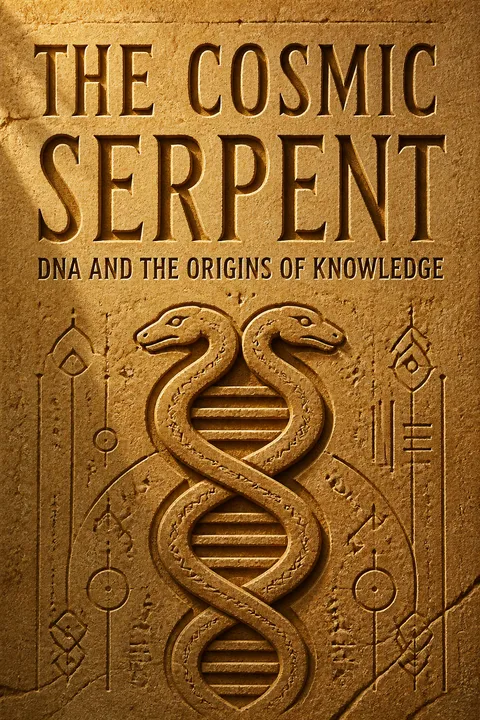
The serpent coiling through humanity's myths may be DNA seen from within
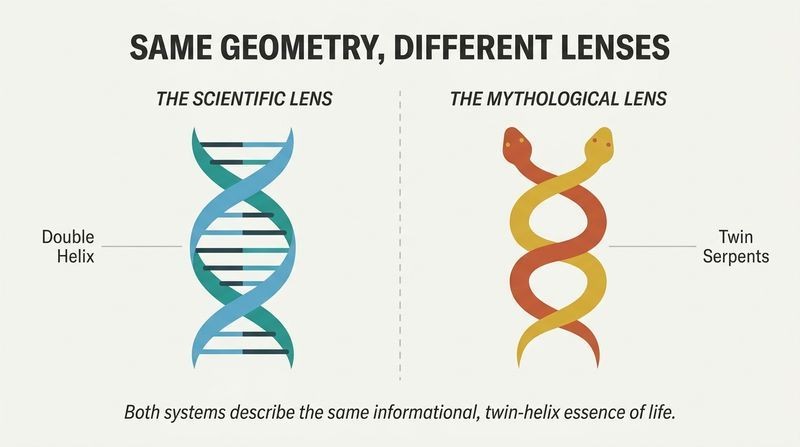
This is the book's audacious thesis. Anthropologist Jeremy Narby argues that Amazonian shamans, in their ayahuasca visions, take their consciousness down to the molecular level and perceive DNA itself, which they describe as twin cosmic serpents. He noticed that creation myths across the planet (Aztec, Egyptian, Australian Aboriginal, Sumerian) center on a double serpent, entwined twins, or a twisted ladder linking heaven and earth.
The visual match is uncanny. DNA is literally two intertwined strands in a twisted-ladder helix. Shamans see fluorescent snakes; biologists draw the double helix as coiled snakes. Narby proposes these are the same reality glimpsed through two different lenses: shamanic trance and the electron microscope, both describing the informational essence common to all life.
What's striking is how Narby weaponizes analogy while knowing it is anthropology's most discredited tool. Nineteenth-century comparativists linked bagpipes in Scotland and Arabia and drew false conclusions, so the discipline retreated into hyper-specificity. Narby gambles that some cross-cultural convergences are real signals, not noise. Critics counter that snakes are cognitively salient to primates and helical forms are geometrically common, so convergence proves little. Yet the thesis remains philosophically fertile: it reframes the origin-of-knowledge question that both anthropology and biology quietly avoid. Read as literal biochemistry it overreaches; read as a provocation about the limits of the rational gaze it is genuinely destabilizing.
How did stone-age chemists find a molecular recipe among 80,000 plants?

Ayahuasca is a chemical puzzle. The brew combines two plants boiled for hours. One contains dimethyltryptamine, a hallucinogen the human brain also secretes; but swallowed alone it does nothing, because a stomach enzyme called monoamine oxidase destroys it. The second plant happens to contain compounds that shut off precisely that enzyme, letting the hallucinogen reach the brain.
Curare tells the same story. This blowgun poison requires combining several plants, boiling them 72 hours while dodging toxic vapors, and it only works injected, not swallowed. The renowned ethnobotanist Richard Evans Schultes doubted pure trial-and-error could explain such recipes. When asked how they knew, indigenous people answer plainly: the plants, or the spirits, told them. That answer, empirically productive yet scientifically unspeakable, is the enigma driving the entire book.
The probability objection is real: with thousands of species and millennia of experimentation, even rare successful combinations can accumulate, and knowledge transmits culturally so each generation does not start from zero. Ethnobotanists note that Amazonian peoples run vast, distributed, multigenerational experiments most Westerners never witness. Still, the specificity of curare (a substance inert unless it enters the bloodstream, a concept alien to hunters preserving meat) genuinely strains the chance hypothesis. The deeper point survives either explanation: pharmaceutical companies have profitably mined this knowledge (74% of plant-based drugs trace to traditional societies) while dismissing its stated origin as superstition.
Anthropologists studying shamans kept describing only their own reflection
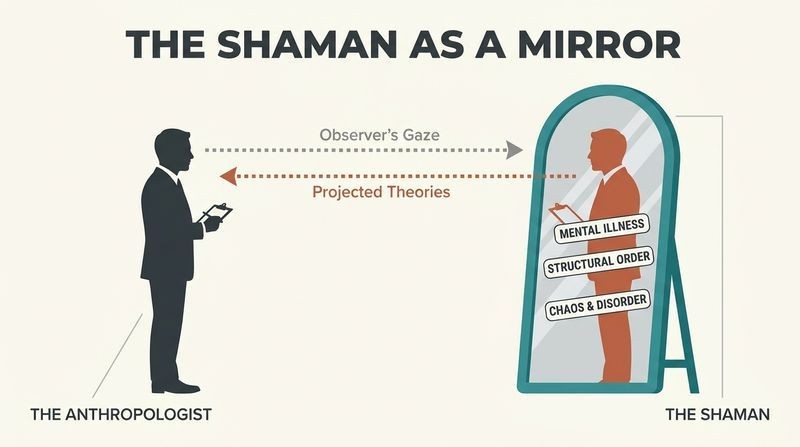
The shaman is a mirror. Narby traces a damning pattern in a century of scholarship. When anthropology was an insecure young science, it called shamans mentally ill. When structuralism sought order everywhere, Levi-Strauss recast the shaman as a creator of order, a psychoanalyst who speaks while the analyst listens. During the discipline's identity crisis, shamans became jacks-of-all-trades; when scholars questioned order itself, shamans became creators of disorder.
Each verdict tracked the observer, not the observed. The academic study of shamanism, Narby argues, is the rational study of the nonrational, a self-contradiction. The sociologist Pierre Bourdieu warned that objectivism fails to objectify its own objectifying relationship: the detached gaze cannot see its own presuppositions. Anthropologists took people's words as metaphor precisely because their framework forbade taking them literally.
This is reflexive critique at its sharpest, echoing Edward Said's argument that Orientalism revealed more about Europe than the East. The insight generalizes far beyond shamanism: peer review, diagnostic categories, and even AI training data encode the observer's priors. What's valuable is the practical warning that a discipline can mistake its own coherence for discovery. The risk in Narby's move is symmetry: if every interpretation merely mirrors its author, his own DNA thesis is equally a projection. He half-concedes this by writing autobiographically, exposing his presuppositions rather than hiding behind false neutrality, which is intellectually honest even when unsettling.
Relax your focus to see patterns a sharp gaze scatters apart
Defocalizing became Narby's method. He borrows the metaphor of the stereogram, those 1990s posters of chaotic dots that reveal a hidden 3D image only when you soften your gaze and stop trying to focus. He argues academic specialists fail to see shamanic phenomena the same way a normal stare fails to see the dolphin in the dots.
So he trained himself to look sideways. Working nights with dissonant violin music like Sherlock Holmes, walking in fog with a tape recorder, he deliberately held one eye on molecular biology and one on shamanism until a coherent image jumped out. His breakthrough came from reading not just the content of texts but their form, following Carlos Perez Shuma's instruction that nature speaks through resemblances in shape. Focused reason, he insists, dissects reality and cannot perceive complementarity.
Narby has rediscovered something cognitive scientists study as the tension between focused and diffuse modes of thought. Guy Claxton's work on slow knowing and studies of incubation in creativity show that insight often arrives when the analytical mind disengages: in the shower, on a walk, half-asleep. Narby lists Descartes dreaming his angel, Einstein daydreaming on a tram, Kekule dreaming the benzene ring as a snake biting its tail. The productive caution is that defocalized pattern-hunting is also how conspiracy theories form. The discipline of noting connections without instantly believing them, which Narby claims to practice, is what separates insight from apophenia.
DNA is a source of information both inside your brain and outside in plants
One molecule spans the divide. Narby's key that unlocked everything was a footnote in anthropologist Michael Harner's ayahuasca account, where giant reptilian creatures showed him they had created all life to hide inside its forms. Harner added: in retrospect they were almost like DNA. Narby realized DNA sits inside the human brain and inside every plant, identical in chemistry, differing only in the order of its four letters.
That resolves a stubborn dichotomy. The scientific view says hallucinations come from inside the brain; shamans say knowledge comes from outside, from the plants. If the information is DNA, it is both at once. This universal molecule is why biotechnology works: a human insulin gene spliced into a bacterium produces human insulin, because all cells read the same four-letter code and use the same 20 amino acids.
The elegance here is philosophical rather than proven: framing DNA as simultaneously internal and external dissolves a false binary the way wave-particle duality did in physics. The unity of the genetic code is genuine and profound, the strongest empirical pillar under Narby's building. The leap is causal: showing DNA is everywhere does not show that a trance can read it. Harner's own footnote is an artifact of hindsight, DNA's structure being famous by the time he wrote. Still, the reframing has heuristic power, nudging readers to see the biosphere as a single informational continuum rather than discrete organisms.
Shamans speak a doubly folded twisted language mirroring DNA's structure
Twisted language is not decoration. Among the Yaminahua of Peru, shamans sing in koshuiti, songs where nothing is named directly: night becomes swift tapirs, anacondas become hammocks, fish become peccaries. They call it tsai yoshtoyoshto, literally language-twisting-twisting. One shaman explained that with ordinary words he would crash into things, but with twisted words he circles them and sees clearly.
DNA is doubly double too. Narby notes the word twist shares a root with two and twin. The genetic message is double (two complementary strands, one a backup), and its content is riddled with redundancy: 97% is non-coding junk full of endless repeats and palindromes, genes are interrupted by meaningless introns, and 64 three-letter words encode only 22 meanings, so synonyms abound like a tongue where jaguar and basket mean the same thing. Form and content both wrap around themselves.
The linguistic parallel is seductive and slightly circular, since almost any complex system can be described as layered and redundant. But it points at a real scientific humility: what Narby calls junk DNA (roughly 97% of the genome) was indeed long dismissed, and subsequent genomics has found regulatory and structural roles in much of it, vindicating his complaint that the pejorative label reflected ignorance rather than evidence. The metaphor idea also resonates with Roman Jakobson, whom Narby cites: the genetic code shares deep structural features with human language, a coincidence biology has never fully explained. Whether that means intention or convergence remains open.
DNA emits a coherent light that could explain luminous visions
Cells glow, faintly and coherently. Narby builds a tentative neurological bridge. Research shows every living cell emits photons, with DNA as the source, at wavelengths spanning exactly the range of visible light. The emission is astonishingly weak, like a candle seen from six miles away, yet highly coherent, regular enough that physicists compare it to an ultraweak laser.
Coherent light looks holographic. A laser produces vivid, saturated color and a sense of three-dimensional depth, which is precisely how ayahuasca visions are described: colors 10 to 100 times more saturated than normal, glowing, dimensional. Narby's proposed mechanism: hallucinogens like DMT or nicotine trigger cascades in neurons that stimulate DNA to emit its photons, which the mind perceives as luminous hallucinatory imagery. He extends this to quartz crystals, used both by shamans and in biophoton labs as receivers and emitters of electromagnetic waves.
This is the book's most speculative and least verifiable stretch, and Narby flags it as hypothesis. Biophoton emission is real and studied by researchers like Fritz-Albert Popp, but its function is contested and the jump from cellular photon emission to structured, information-rich visions has no established pathway. Mainstream neuroscience explains DMT visions through serotonin-receptor activity in visual cortex without invoking DNA at all. The candle-to-laser reframing is a nice intuition pump about coherence versus intensity, but coherence over microscopic distances inside opaque tissue does not obviously reach conscious perception. Fascinating as a research provocation, weak as a proof.
Biology assumes nature is mindless because its rulebook forbids the alternative
The postulate of objectivity is a choice, not a finding. Narby exposes molecular biology's founding commitment, stated bluntly by Nobel laureate Jacques Monod: science must systematically deny that nature has any purpose or intention. Monod admitted this postulate is impossible to prove, yet called it inseparable from science. Francis Crick's central dogma similarly declared chance the only source of novelty.
Yet biologists describe life in the language of design. Their own texts call proteins miniature robots, ribosomes molecular computers, cells factories, and DNA a text, program, or language. Enzymes proofread with one error per ten billion letters; chromosomes perform a stately choreographed dance during cell division. Narby asks how nature can be presumed mindless when our own consciousness is produced by nature, and when the natural world teems with apparent forethought: crows crafting hooked tools, ants farming fungus for 50 million years.
Narby is channeling a live debate. The postulate of objectivity is methodological naturalism, which most philosophers of science defend as a working rule rather than a metaphysical truth: assume no purpose so you actually search for mechanisms. Thomas Nagel's Mind and Cosmos later argued, controversially, that materialism cannot explain consciousness, echoing Narby's discomfort. The strong counterpoint is that mechanistic assumptions have been spectacularly productive, and metaphors like machine or program are heuristics, not confessions of belief. Narby's sharpest hit lands on the honesty point: a field should say we cannot discuss intention without ceasing to be science, rather than asserting nature has none.
Life's origin remains an admitted mystery no theory has cracked
Chance strains under the math. Narby leans on Crick's own calculation: a single average protein of 200 amino acids has about one chance in 20 to the 200th power of assembling randomly, a number vastly larger than the atoms in the observable universe. The earliest cells appeared startlingly fast, within a few hundred million years of Earth cooling, already equipped with DNA's alphabet, proteins' alphabet, and a translation mechanism between them.
The fossil record jumps rather than crawls. In the Cambrian explosion 543 million years ago, nearly every animal phylum appeared within 5 to 10 million years, worldwide, seemingly at once. Species tend to arrive fully formed with specialized organs, then stay stable; there is no intermediate between land ancestor and the first whale. Narby cites Karl Popper's verdict that Darwinism, being a circular survival-of-the-survivors argument, is not falsifiable and functions as a metaphysical research program.
Here caution is essential, because Narby brushes against intelligent-design talking points, and mainstream evolutionary biology has answers he underplays. Popper later partly retracted his non-falsifiability remark. Punctuated equilibrium, developmental gene regulation, and molecular clocks address rapid Cambrian diversification without abandoning natural selection. The protein-probability argument ignores stepwise selection and vast parallel chemistry. That said, the honest core stands: origin-of-life research remains genuinely unsolved, and biologist Robert Shapiro's admission that we lack the slightest idea how life began is real. Narby's fair point is that certainty here is faith, whether the believer wears a lab coat or a feathered headdress.
You see what you believe, so change belief to change perception
Belief precedes sight. Narby's hardest-won lesson reverses common sense. In Quirishari, whenever he doubted his hosts' explanations, his understanding of their reality froze; on the rare occasions he silenced his skepticism, comprehension opened up. Sometimes, he concludes, you must believe in order to see, not the reverse.
Take people literally first. When an elder said the maninkari, the hidden spirits, taught his people to weave, Narby dismissed it, until he grasped that DNA's two ribbons wrap around each other hundreds of millions of times per cell. Maninkari means those who are hidden; DNA is invisible, narrower than a wavelength of light. His cure for chronic back pain by a plant tea at the new moon worked when European cortisone had failed. Reuniting with his old teacher after nine years to announce his findings, Narby got the perfect reply: What took you so long?
This flips the empiricist creed that seeing is believing, aligning instead with modern predictive-processing neuroscience, which holds that the brain does not passively receive reality but actively generates a model and corrects it against sensory input. In that framework Narby is literally correct: perception is belief, constantly updated. The danger is obvious and he knows it: believing in order to see is also how delusions and cults sustain themselves. The safeguard he offers is empirical feedback, his back pain actually vanished, the plant recipes actually work. Suspending disbelief as a temporary investigative posture, then checking results, is more defensible than permanent credulity.
Analysis
The Cosmic Serpent is best read not as proven science but as a philosophical detective story about the boundaries of knowledge. Narby, a Stanford-trained anthropologist doing fieldwork on Ashaninca land rights, stumbles onto an enigma he cannot dismiss: practical forest people credit their pharmacological genius to hallucinations, and their results demonstrably work. His genius is methodological rather than empirical. By refusing to translate indigenous claims into safe metaphor, and by holding molecular biology and shamanism in stereoscopic double vision, he produces a genuinely novel hypothesis: that the worldwide cosmic-serpent motif encodes a perception of DNA. The DNA-vision claim itself is unfalsifiable and probably false in any literal sense; the biophoton mechanism is thin, the probability arguments against evolution are shopworn, and cross-cultural pattern-matching is exactly the trap anthropology learned to fear. Yet the book's lasting value lies elsewhere. It is a devastating meditation on how disciplines encode their presuppositions as reality: anthropology projecting its insecurities onto shamans, biology legislating nature's mindlessness by fiat while describing cells as factories and texts. Narby's real target is the fragmentation of Western knowledge, the specialist's narrow gaze that dissects reality and then cannot reassemble it. His concept of defocalizing anticipates current understanding of diffuse-mode cognition and incubation in creativity. His critique of the postulate of objectivity parallels serious philosophy of mind. And his reflexive honesty, writing autobiographically to expose his own biases rather than hiding behind neutrality, models intellectual integrity even when the conclusions overreach. The book also carries an ethical charge: biopiracy exploits indigenous knowledge while denying its dignity, and Narby argues that recognizing shamanism as a rigorous, accumulated science, comparable to the world's oldest universities, is a matter of justice. Ultimately he lands on humility: origin questions may exceed human grasp, and wisdom requires contemplating mystery, not conquering it.
Review Summary
The Cosmic Serpent receives mixed reviews, with some praising its thought-provoking ideas on DNA, shamanism, and indigenous knowledge, while others criticize its scientific accuracy and logical leaps. Readers appreciate Narby's exploration of Amazonian ayahuasca experiences and his challenge to Western scientific paradigms. However, many find his theories about DNA consciousness and communication far-fetched. The book's interdisciplinary approach and accessibility are commended, but its scientific claims are often questioned. Overall, it's seen as an intriguing, if controversial, work that sparks debate about the nature of knowledge and reality.
People Also Read


FAQ
What's "The Cosmic Serpent: DNA and the Origins of Knowledge" about?
- Exploration of Knowledge: The book explores the intersection of shamanic knowledge and modern science, particularly focusing on how indigenous Amazonian shamans claim to gain knowledge from plant-induced hallucinations.
- DNA and Shamanism: Author Jeremy Narby investigates the possibility that shamans access information about DNA through their visions, suggesting a link between ancient shamanic practices and modern molecular biology.
- Cultural and Scientific Inquiry: Narby combines anthropology, biology, and mythology to question the boundaries of scientific understanding and the potential for indigenous knowledge to inform scientific inquiry.
- Personal Journey: The narrative is also a personal journey of Narby as he navigates his own skepticism and the academic challenges of reconciling these two seemingly disparate worlds.
Why should I read "The Cosmic Serpent: DNA and the Origins of Knowledge"?
- Unique Perspective: The book offers a unique perspective on the relationship between ancient shamanic practices and modern science, challenging conventional scientific views.
- Interdisciplinary Approach: It combines anthropology, biology, and mythology, providing a rich, interdisciplinary approach to understanding knowledge and consciousness.
- Thought-Provoking: Narby's exploration raises thought-provoking questions about the nature of knowledge, consciousness, and the limitations of scientific inquiry.
- Personal and Engaging: The narrative is engaging and personal, as Narby shares his own journey and discoveries, making complex ideas accessible and relatable.
What are the key takeaways of "The Cosmic Serpent: DNA and the Origins of Knowledge"?
- Shamanic Knowledge: Indigenous shamans claim to access knowledge through plant-induced hallucinations, which Narby suggests may relate to DNA.
- DNA as a Source of Knowledge: The book proposes that DNA might be a source of knowledge, accessible through altered states of consciousness.
- Interconnectedness of Life: Narby highlights the interconnectedness of all life forms through DNA, suggesting a universal language of life.
- Challenge to Scientific Orthodoxy: The book challenges the scientific orthodoxy that dismisses non-rational sources of knowledge, advocating for a broader understanding of consciousness.
How does Jeremy Narby connect DNA and shamanism in "The Cosmic Serpent"?
- Hallucinatory Visions: Narby suggests that shamans, through their visions, might access information about the molecular structure of DNA.
- Symbolism of Serpents: He draws parallels between the double helix structure of DNA and the serpent imagery prevalent in shamanic visions and myths.
- Biophotons and Consciousness: The book explores the idea that DNA emits photons, which could be perceived in altered states of consciousness, linking biological processes to shamanic experiences.
- Cultural and Scientific Overlap: Narby argues for a potential overlap between shamanic knowledge and scientific understanding, suggesting that both can inform each other.
What is the significance of serpents in "The Cosmic Serpent"?
- Symbol of Knowledge: Serpents are a recurring symbol in shamanic visions and myths, representing knowledge and the life force.
- Connection to DNA: Narby draws a connection between the serpent imagery and the double helix structure of DNA, suggesting a deeper symbolic meaning.
- Cultural Universality: The serpent motif is found in various cultures worldwide, indicating a universal archetype that transcends cultural boundaries.
- Metaphor for Life: In the book, serpents symbolize the interconnectedness and transformation inherent in life, mirroring the properties of DNA.
How does Jeremy Narby challenge scientific orthodoxy in "The Cosmic Serpent"?
- Questioning Materialism: Narby questions the materialist view that dismisses non-rational sources of knowledge, advocating for a more inclusive understanding of consciousness.
- Interdisciplinary Approach: He combines anthropology, biology, and mythology to challenge the boundaries of scientific inquiry and explore alternative sources of knowledge.
- Critique of Reductionism: The book critiques the reductionist approach of science, which often overlooks the complexity and interconnectedness of life.
- Proposal of New Paradigms: Narby suggests that integrating shamanic knowledge with scientific inquiry could lead to new paradigms in understanding life and consciousness.
What are the best quotes from "The Cosmic Serpent" and what do they mean?
- "We see what we believe, and not just the contrary." This quote highlights the influence of belief systems on perception, suggesting that our understanding of reality is shaped by our preconceptions.
- "The microscopic world of DNA, and its proteins and enzymes, is enough to make us marvel." Narby emphasizes the complexity and wonder of the molecular world, challenging the notion that life is merely a physicochemical phenomenon.
- "The rational approach starts from the idea that everything is explainable and that mystery is in some sense the enemy." This quote critiques the scientific tendency to dismiss the unknown, advocating for a more open-minded approach to mystery and knowledge.
- "In the end, it is up to the readers to draw the spiritual conclusions they see fit." Narby invites readers to engage with the material personally, encouraging them to form their own interpretations and insights.
How does Jeremy Narby use his personal journey to explore the themes in "The Cosmic Serpent"?
- Fieldwork Experience: Narby shares his experiences living with the Ashaninca people, providing a firsthand account of shamanic practices and their cultural context.
- Skepticism and Discovery: The narrative follows Narby's journey from skepticism to discovery, as he grapples with the implications of shamanic knowledge and its potential connection to DNA.
- Interdisciplinary Exploration: His personal journey serves as a framework for exploring interdisciplinary themes, blending anthropology, biology, and mythology.
- Engaging Narrative: By sharing his personal story, Narby makes complex ideas accessible and relatable, inviting readers to join him on his quest for understanding.
What role do hallucinogenic plants play in "The Cosmic Serpent"?
- Source of Knowledge: Hallucinogenic plants are central to shamanic practices, serving as a means to access knowledge and communicate with the spirits.
- Altered States of Consciousness: The book explores how these plants induce altered states of consciousness, allowing shamans to perceive information beyond ordinary reality.
- Connection to DNA: Narby suggests that the visions induced by these plants may provide insights into the molecular structure of DNA, linking shamanic experiences to biological processes.
- Cultural Significance: Hallucinogenic plants hold cultural and spiritual significance for indigenous peoples, representing a bridge between the material and spiritual worlds.
How does "The Cosmic Serpent" address the limitations of scientific inquiry?
- Blind Spots of Science: Narby highlights the blind spots of scientific inquiry, particularly its dismissal of non-rational sources of knowledge and its reductionist approach.
- Interdisciplinary Insights: The book advocates for an interdisciplinary approach, suggesting that integrating shamanic knowledge with scientific inquiry could lead to new insights.
- Challenge to Objectivity: Narby questions the scientific postulate of objectivity, arguing that it limits the scope of inquiry and overlooks the complexity of life.
- Call for Open-Mindedness: The book calls for a more open-minded approach to scientific inquiry, encouraging researchers to consider alternative perspectives and sources of knowledge.
What is the relationship between mythology and molecular biology in "The Cosmic Serpent"?
- Symbolic Connections: Narby draws symbolic connections between mythology and molecular biology, suggesting that ancient myths may contain insights into the nature of life.
- Universal Archetypes: The book explores universal archetypes, such as the cosmic serpent, that appear in both mythology and the structure of DNA.
- Cultural and Scientific Overlap: Narby argues for a potential overlap between cultural myths and scientific understanding, suggesting that both can inform each other.
- Reinterpretation of Myths: The book invites readers to reinterpret myths in light of modern scientific discoveries, offering a new perspective on the relationship between ancient knowledge and contemporary science.
How does "The Cosmic Serpent" propose a new understanding of consciousness?
- Defocalized Consciousness: Narby explores the concept of defocalized consciousness, suggesting that altered states of consciousness can provide access to deeper levels of understanding.
- Biophotons and Consciousness: The book examines the role of biophotons in consciousness, proposing that DNA-emitted photons may be linked to the perception of hallucinatory images.
- Integration of Perspectives: Narby advocates for integrating shamanic and scientific perspectives to gain a more comprehensive understanding of consciousness.
- Challenge to Materialism: The book challenges the materialist view of consciousness, proposing that it may be more complex and interconnected than traditionally understood.
Download PDF
Download EPUB
.epub digital book format is ideal for reading ebooks on phones, tablets, and e-readers.








































