

Key Takeaways
Tiny choices repeated for years quietly decide your entire life
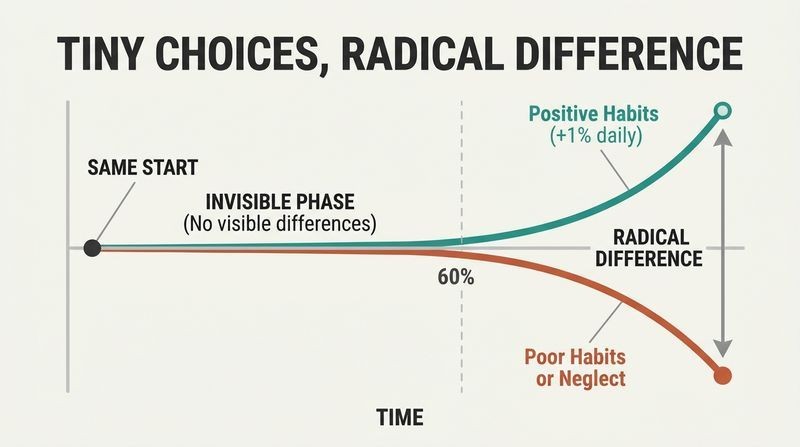
The core equation is deceptively small. Hardy defines the Compound Effect as reaping massive rewards from a chain of small, smart choices repeated consistently over time. His formula: small choices plus consistency plus time equals radical difference. The catch is that early results feel invisible, which is why most people abandon the process.
The magic penny proves it. Given a choice between $3 million cash today or a penny that doubles daily for 31 days, the doubling penny wins. On day 20, the penny is worth only about $5,000 while the cash holder enjoys millions. Not until day 30 does the penny pull ahead, finishing at over $10.7 million. Compounding stays hidden until the very end, then explodes.
The penny parable dramatizes exponential growth, but real life rarely offers clean doubling. Habit gains are noisy, nonlinear, and vulnerable to setbacks. What's valuable here is the psychological reframe: the reason people quit is precisely that the payoff curve is back-loaded. This connects to the economic idea of hyperbolic discounting, our tendency to overvalue immediate rewards. Hardy's insight overlaps with James Clear's later work on habits and Jeff Olson's The Slight Edge, which he cites. The honest caveat: compounding cuts both ways and requires the right inputs. Doubling a bad process just accelerates ruin. Direction matters as much as consistency.
Take 100 percent responsibility, expecting nothing back in return
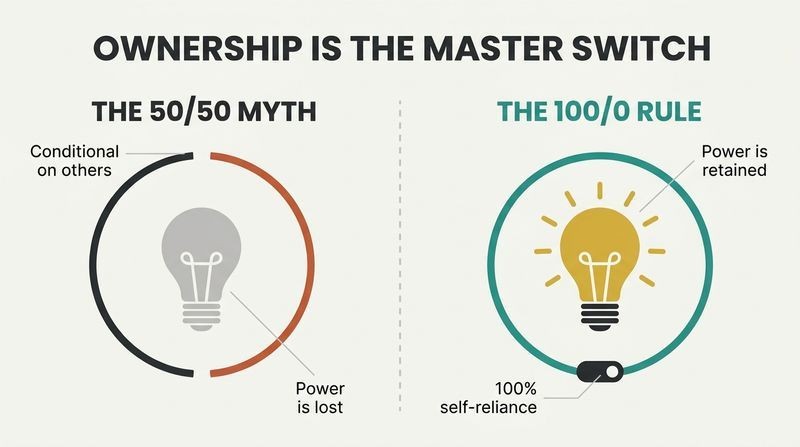
Ownership is the master switch. At eighteen, Hardy attended a seminar where a speaker asked what percentage of responsibility makes a relationship work. Students shouted fifty-fifty, then fifty-one/forty-nine. The instructor wrote 100/0: give everything with zero expectation of return. Hardy extended this to all of life. If you own every outcome, including how you respond to what happens to you, you hold the power.
He practiced what he preached. When a business partner squandered his investment and he lost more than $330,000, Hardy refused to sue. He blamed himself for skipping due diligence and ignoring red flags. The loss was his fault because he had abdicated responsibility. Blaming traffic, coworkers, or the economy, he argues, quietly surrenders the only leverage you actually have.
This echoes Stoic philosophy, particularly Epictetus, who distinguished what is in our control from what is not, and located freedom in the former. Julian Rotter's psychological concept of locus of control supports Hardy: people with an internal locus tend to achieve more and cope better. Yet the 100/0 framing has limits. Taken literally it can slide into self-blame for genuine injustice, structural disadvantage, or others' abuse. The steelman is that responsibility is not about fault but about agency: assigning blame elsewhere feels righteous but leaves you powerless. Used as an empowerment tool rather than a moral verdict, it is genuinely liberating.
Track any behavior you want to change, obsessively and daily
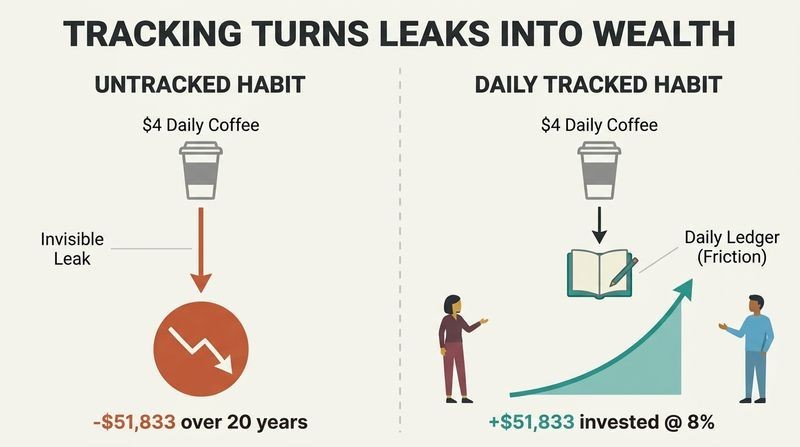
Awareness precedes control. Hardy learned tracking after his accountant informed him he owed over $100,000 in taxes and had no idea where the money went. The fix: write down every cent spent for 30 days, from a $1,000 suit to 50 cents of tire air. The friction of recording purchases made him spend less automatically. He now tracks food, exercise, calls, even affection toward his wife.
You cannot improve what you do not measure. Casinos track every table, Olympic trainers track every calorie, and elite golfers track every swing metric. Hardy asks readers to track one habit for three weeks minimum. A $4 daily coffee, he calculates, costs $51,833 over 20 years once you account for what that money could have earned invested at 8 percent.
Tracking works through what behavioral scientists call the measurement effect or reactivity: the mere act of monitoring a behavior changes it, usually in the desired direction. This underpins food journaling research, where dieters who log meals lose roughly twice as much weight. Hardy's coffee calculation is a vivid lesson in opportunity cost, though it assumes a consistent 8 percent return and ignores that small pleasures have real value. The deeper point stands: unconscious behavior is ungovernable. Modern self-tracking apps and wearables automate what Hardy did with a pocket notebook, but the manual friction he describes may actually be the active ingredient.
Willpower fails; only a burning why-power sustains hard change
Reasons beat discipline. Hardy argues willpower is like covering a picnic basket with a napkin to stop a grizzly bear. What actually powers persistence is why-power, a motivation rooted in your core values and deepest desires. Without a compelling reason, you revert to comfortable bad habits the moment things get uncomfortable.
The plank test makes it concrete. Walk a 30-foot plank on the ground for $20 and anyone would do it. Suspend that same plank between two skyscrapers and nobody moves. But if your child were trapped on the far rooftop in a fire, you would cross instantly. The plank and the danger are identical. Only the why changed. When the reason is big enough, Hardy says, you will figure out almost any how.
Contemporary research increasingly agrees that willpower as a depletable fuel tank (ego depletion) has failed to replicate reliably. Self-determination theory, developed by Deci and Ryan, supports Hardy's emphasis: intrinsic motivation tied to autonomy, competence, and values drives lasting behavior far better than gritted teeth. Interestingly, Hardy endorses negative fuel too, citing Anthony Hopkins channeling resentment and Pete Carroll fighting to prove doubters wrong. This aligns with research on defensive pessimism and approach-versus-avoidance motivation. One nuance worth flagging: revenge and spite can propel achievement but often leave the achiever hollow, a tension Hardy himself acknowledges through his distinction between achievement and fulfillment.
A one-degree course error lands you hundreds of miles off
Small deviations compound into disasters. A plane leaving Los Angeles for New York with its nose just one percent off course arrives in Albany or Delaware, roughly 150 miles adrift. A single bad habit works the same way, invisible in the moment yet devastating over distance. Habits, defined as behaviors that have become nearly involuntary, account for an estimated 95 percent of what we feel, think, and achieve.
The frog and the tree drive it home. Hardy retells the tortoise and hare, casting himself as the tortoise who wins through consistency, not talent. He points to Larry Bird, never the most gifted athlete, who shot 500 free throws every morning before school and became one of the NBA's most reliable shooters. Champions substitute disciplined habit for raw ability.
The 95 percent habit figure is a popularized approximation rather than a precise finding, but neuroscience broadly supports the direction: the basal ganglia automate repeated behaviors, freeing conscious attention. Charles Duhigg's cue-routine-reward loop and Wendy Wood's research showing roughly 43 percent of daily actions are habitual reinforce Hardy's core claim. The aviation metaphor is a memorable illustration of sensitivity to initial conditions, a concept borrowed from chaos theory. The Larry Bird example is a useful corrective to talent worship, echoing Anders Ericsson's deliberate practice research, though Ericsson would stress that Bird's practice was highly structured, not merely repetitive.
Kill bad habits by attacking their triggers and environment
Uproot the cue, not just the behavior. Hardy offers strategies for eliminating bad habits. First, identify triggers by finding the who, what, where, and when behind each behavior. Second, clean house: remove every physical enabler, from alcohol bottles to junk food. He also suggests swapping (replacing a 1,255-calorie banana split with two 50-calorie chocolate kisses) and either easing in gradually or jumping in cold turkey depending on your wiring.
Installing good habits needs a different toolkit. His techniques include setting yourself up to succeed, thinking addition not subtraction (Montel Williams focuses on what to add to his diet, not deprive), public accountability, a success buddy, friendly competition, and celebration. Research he cites suggests about 300 repetitions to cement a habit, with three weeks of focus dramatically improving your odds.
The trigger-focused approach anticipates what behavioral scientists call stimulus control, and Hardy's clean house tactic maps onto choice architecture: making bad options physically inconvenient beats relying on resolve. The addition framing (adding vegetables rather than banning burgers) is smart because prohibition triggers reactance, the psychological urge to reclaim a threatened freedom. The competition example is telling and honest: when Hardy's company ran a pedometer contest, steps soared, then collapsed 60 percent once it ended. Extrinsic motivators produce spikes, not durability. The lasting habits are the ones that migrate from external scaffolding to internal identity, a transition Hardy gestures at but does not fully theorize.
Momentum is the invisible force that makes success snowball
Big Mo rewards the persistent. Hardy personifies momentum as Big Mo, an enigmatic force that catapults you once you build it. Like a childhood merry-go-round, getting it moving demands grinding effort, but once spinning, a light push sustains it. A space shuttle burns more fuel in its first minutes escaping gravity than during the rest of its flight. The hard part is always launch.
Consistency is the fuel. Apple's iPod was a slow burn, with revenue growth swinging from negative 33 percent in 2001 to 68 percent by 2005 before dominating the market. Michael Phelps and coach Bob Bowman built such rigorous routines over twelve years that Phelps was allowed to end practice early only once. Bookend your days with fixed morning and evening routines, Hardy advises, because you can rarely control the middle.
Momentum in Hardy's sense parallels the flywheel concept Jim Collins developed in Good to Great: consistent pushes in one direction eventually generate self-reinforcing speed. Newton's first law is a fitting metaphor, though physical momentum and behavioral momentum differ, the latter being fragile and psychologically mediated. The genuinely useful practical claim is his water-pump analogy: stopping does not merely cost the missed reps, it drains the primed system so you must start from zero. This maps to research on habit disruption, where breaking a streak reduces the automaticity already built. Bookending days is sound: morning and evening are the moments least hijacked by external chaos.
You become the average of the five people around you
Your reference group shapes your ceiling. Citing Harvard's David McClelland, Hardy claims your reference group, the people you habitually associate with, determines up to 95 percent of your success or failure. Jim Rohn taught him we become the combined average of our five closest companions in health, attitude, and income. Their influence is not a shove but a gentle current, like drifting down a shoreline on an inner tube without noticing.
Sort your relationships into three tiers. Hardy recommends categorizing associations as dissociations (people to cut out entirely), limited associations (some are three-minute friends, not three-hour or three-day friends), and expanded associations (people whose success you want to absorb). He drove across the bay to eat at an upscale restaurant in Tiburon just to breathe wealthier air, and eventually bought the very cliffside house he had admired for years.
The social contagion literature strongly backs this. Christakis and Fowler's Framingham study found obesity, smoking cessation, and even happiness spread through social networks up to three degrees of separation. Emotions and behaviors are genuinely transmissible. The advice to prune relationships, though, carries an ethical edge worth naming: treating people as upgradeable inputs can curdle into transactional coldness, and abandoning struggling friends when they most need support is not obviously admirable. The stronger reading is about proportion and awareness, being intentional about influence rather than passively absorbing it. Hardy's three-minute/three-hour/three-day framing is a genuinely useful heuristic for calibrating exposure without total exile.
Guard your mind like your body: garbage in, garbage out
Input programs your expectations. Hardy compares the mind to an empty glass. Fill it with sensational news, tabloids, and talk-show rants and every idea you produce gets filtered through that dirty water. The brain evolved for survival, not happiness, so it is wired to fixate on threat, what Hardy calls lack and attack. Media exploits this, parading the day's most horrifying events while millions of good things go unreported.
Flush the glass and feed the mind. Americans average 4.7 hours of TV daily, nearly 30 percent of waking hours. Hardy cancels news, uses curated feeds to get relevant updates in 15 minutes, and turns his car into a rolling classroom. Brian Tracy taught him that instructional audio during a typical 12,000-mile driving year equals two semesters of college education.
The negativity bias Hardy describes is well documented: humans weight bad information more heavily than good, an adaptation that kept ancestors alive but distorts modern risk perception. Research on mean world syndrome, coined by George Gerbner, shows heavy news consumers systematically overestimate danger and violence. Hardy's remedy anticipates the digital minimalism movement Cal Newport later championed. The drive-time university idea is charming and partly valid, though passive audio learning without retrieval practice or application yields far less than a real semester. The deeper wisdom is treating attention as a finite resource with compounding consequences, since what you repeatedly consume becomes the raw material of your thoughts.
Push hardest at the wall where everyone else quits
Growth lives past the point of exhaustion. Hardy calls these moments of truth, the instant when effort becomes painful and your mind invents excuses to stop. Lance Armstrong, whom Hardy interviewed, described finding his real opponent (himself) in his most painful climbs. In weight training, the reps you grind out after hitting your max multiply your results far more than the comfortable earlier reps. Arnold Schwarzenegger's cheating principle squeezed five or six extra reps past failure for outsized gains.
Bad conditions are your advantage. Muhammad Ali beat George Foreman by absorbing punches on the ropes until Foreman hit his wall in the eighth round. Armstrong welcomed rain because rivals hated it. When conditions are easy, everyone performs. Difficulty is precisely where you separate from the pack, because most people crack.
This is the physiology of overload made motivational. Muscle hypertrophy genuinely requires training near failure to recruit high-threshold motor units, so Schwarzenegger's instinct had a biological basis, though modern sports science warns that chronic max-effort cheating raises injury risk. Psychologically, Hardy is describing the willingness to tolerate discomfort that Angela Duckworth calls grit. The Ali example is subtler than pure endurance: rope-a-dope was strategic patience, letting an opponent exhaust himself, which reframes suffering as tactics rather than machismo. The broadly true claim is that competitive advantage concentrates at the margins others avoid. The caveat: distinguishing productive discomfort from genuine warning signals is a skill, not a slogan.
Do more than expected, and multiply your results tenfold
Small extras produce exponential returns. Hardy notes the top-ranked golfer averages just 1.9 strokes better than the tenth-ranked player, a mere 2.7 percent edge, yet earns five times the prize money. A racehorse wins by a nose but takes ten times the purse. Slightly better performance yields disproportionately larger rewards, so the marginal extra effort is where the leverage lives.
Beat expectations, then do the unexpected. Oprah stunned her audience by giving everyone a car. Hardy proposed to his wife by memorizing a speech in Portuguese for her father and phoning all five of her brothers. He sends Thanksgiving cards instead of Christmas cards because nobody else does. When a friend refused to fly cross-country for a dream-job interview, ignoring Hardy's advice to show up in person, he lost the job to a weaker candidate.
The golf-prize disparity is a real-world illustration of what economists Sherwin Rosen called the economics of superstars: in winner-take-most markets, tiny quality differences translate into enormous income gaps because consumers and employers cluster around the perceived best. This is why the marginal one percent matters so disproportionately. Hardy's do-the-unexpected tactics amount to strategic differentiation and pattern interruption, standing out in an attention-scarce environment. The honest tension is survivorship bias: for every Portuguese proposal that charmed, unremarked stories exist of over-the-top gestures that backfired as desperate or manipulative. Still, the underlying principle, that reputation for exceeding expectations compounds like any other habit, is sound and underexploited by most people.
Analysis
The Compound Effect is a distillation, not an original theory. Darren Hardy, as publisher of SUCCESS magazine, positions himself as a curator who has filtered thousands of achievement ideas down to six fundamentals: choices, habits, momentum, influences, and acceleration, all governed by compounding. The book's intellectual lineage runs directly through Jim Rohn and Jeff Olson's The Slight Edge, and it shares DNA with later blockbusters like Atomic Habits. Its enduring value is not novelty but framing: the vivid penny parable, the one-degree flight metaphor, and the three-friends weight-gain story make exponential thinking viscerally memorable.
The book's greatest strength is honesty about the emotional problem at the heart of self-improvement: the results lag the effort, so people quit during the invisible phase. Hardy's remedies (tracking for awareness, why-power over willpower, environmental design, momentum through routine) map surprisingly well onto contemporary behavioral science, even though the book cites little peer-reviewed research and leans on round numbers like 95 percent and 300 repetitions that should be read as heuristics rather than data.
The weaknesses are those of the genre. The 100 percent responsibility doctrine, powerful as agency training, risks blaming individuals for structural realities. The prune-your-friends advice can curdle into instrumentalizing relationships. Survivorship bias runs throughout: Hardy became a millionaire by 24, and the examples are winners, rarely the equally consistent people whose bets did not pay off. Compounding, crucially, is direction-agnostic; disciplined effort in the wrong pursuit compounds waste.
Read correctly, though, the book is less a wealth manual than a philosophy of patience in an impatient culture. Its target is what Hardy calls microwave mentality, the expectation of instant results. Against the fantasy of overnight transformation, it offers something quietly radical: ordinary actions, unremarkable in isolation, are the only mechanism by which extraordinary outcomes are ever actually built. That message, delivered without mysticism, is why the book still resonates.
Review Summary
Readers praise The Compound Effect for its practical, actionable advice on achieving success through small, consistent actions. Many found it motivating and appreciated the real-life examples. Some critics felt it oversimplified complex issues or promoted an overly narrow definition of success. Overall, most readers found value in the core concept of compounding small efforts over time to create significant results.
People Also Read




FAQ
What's "The Compound Effect" about?
- Core Principle: "The Compound Effect" by Darren Hardy is about the principle of reaping huge rewards from a series of small, smart choices. It emphasizes that small, consistent actions over time lead to significant results.
- Focus on Habits: The book highlights the importance of habits and how they shape our lives, suggesting that success is not about big, dramatic changes but about the small, everyday decisions.
- Long-term Impact: It explains how the effects of these small actions compound over time, leading to exponential growth and success in various areas of life.
- Practical Guidance: Hardy provides practical advice and strategies to harness the power of the Compound Effect in personal and professional life.
Why should I read "The Compound Effect"?
- Achieve Success: The book offers a proven formula for achieving success by focusing on small, consistent actions rather than quick fixes.
- Personal Development: It provides insights into personal development, helping readers understand how to make better choices and develop positive habits.
- Motivation and Inspiration: With endorsements from successful figures like Anthony Robbins, the book is both motivational and inspirational, encouraging readers to take control of their lives.
- Actionable Strategies: Hardy provides actionable strategies and exercises to help readers implement the principles of the Compound Effect in their daily lives.
What are the key takeaways of "The Compound Effect"?
- Small Choices Matter: Small, everyday choices can lead to significant results over time when compounded.
- Consistency is Key: Consistent actions, even if small, are crucial for achieving long-term success.
- Habits Shape Success: Developing positive habits and eliminating negative ones are essential for personal and professional growth.
- Momentum and Influence: Building momentum and being mindful of influences (input, associations, environment) are vital for sustaining success.
How does Darren Hardy define the "Compound Effect"?
- Definition: The Compound Effect is the principle of reaping huge rewards from a series of small, smart choices.
- Incremental Growth: It emphasizes that small, seemingly insignificant actions, when done consistently over time, lead to significant results.
- Long-term Focus: The focus is on long-term growth and success rather than immediate gratification or quick fixes.
- Universal Application: The principle can be applied to various aspects of life, including health, finances, relationships, and personal development.
What are some practical strategies from "The Compound Effect"?
- Tracking Habits: Hardy suggests tracking your habits to become aware of your actions and make necessary changes.
- Routine Building: Establishing daily routines and sticking to them helps in maintaining consistency and building momentum.
- Goal Setting: Setting clear, specific goals and aligning daily actions with these goals is crucial for success.
- Influence Management: Being mindful of the influences around you, such as the people you associate with and the information you consume, is essential for maintaining a positive trajectory.
What is the "Magic Penny" example in "The Compound Effect"?
- Illustration of Compounding: The "Magic Penny" example illustrates how a penny that doubles in value every day for 31 days results in over $10 million, demonstrating the power of compounding.
- Choice Comparison: It compares choosing between $3 million in cash or a penny that doubles daily, showing the long-term benefits of compounding.
- Patience and Consistency: The example emphasizes the importance of patience and consistency, as the significant payoff only becomes apparent towards the end.
- Application to Life: It serves as a metaphor for how small, consistent actions can lead to substantial results over time in real life.
How does "The Compound Effect" address the concept of habits?
- Habit Formation: The book discusses how habits are formed and how they can be changed to support success.
- Positive vs. Negative Habits: It emphasizes the importance of developing positive habits and eliminating negative ones to achieve desired outcomes.
- Behavioral Change: Hardy provides strategies for changing behaviors, such as identifying triggers and replacing bad habits with good ones.
- Long-term Impact: The focus is on the long-term impact of habits, as they compound over time to produce significant results.
What role does "Momentum" play in "The Compound Effect"?
- Momentum Definition: Momentum, or "Big Mo," is described as a powerful force that propels you forward once you start taking consistent actions.
- Building Momentum: The book explains how to build momentum by establishing routines and sticking to them consistently.
- Sustaining Success: Momentum helps sustain success by making it easier to continue taking positive actions once you've started.
- Overcoming Inertia: It highlights the importance of overcoming initial inertia to get momentum working in your favor.
How does Darren Hardy suggest managing influences in "The Compound Effect"?
- Input Control: Hardy advises controlling the input you allow into your mind, such as media and information, to ensure it supports your goals.
- Associations: He emphasizes the importance of surrounding yourself with positive influences and limiting time with negative ones.
- Environment: Creating a supportive environment that aligns with your goals is crucial for maintaining focus and motivation.
- Proactive Management: Being proactive in managing these influences helps sustain the positive changes and momentum needed for success.
What are some of the best quotes from "The Compound Effect" and what do they mean?
- "You make your choices, and then your choices make you." This quote emphasizes the power of choices in shaping your life and outcomes.
- "The Compound Effect is the principle of reaping huge rewards from a series of small, smart choices." It highlights the core principle of the book, focusing on the impact of small, consistent actions.
- "Consistency is the key to achieving and maintaining momentum." This quote underscores the importance of consistency in building and sustaining success.
- "Your life will be the net result of each step you take." It reminds readers that every action contributes to the overall outcome of their lives.
How does "The Compound Effect" address goal setting?
- Importance of Goals: The book emphasizes the importance of setting clear, specific goals to guide your actions and decisions.
- Alignment with Values: Goals should align with your core values and long-term vision for your life.
- Actionable Steps: Hardy provides strategies for breaking down goals into actionable steps and integrating them into daily routines.
- Continuous Review: Regularly reviewing and adjusting goals ensures they remain relevant and aligned with your progress and changing circumstances.
What is the significance of "Acceleration" in "The Compound Effect"?
- Beyond Expectations: Acceleration involves going beyond what is expected to achieve extraordinary results.
- Extra Effort: It highlights the impact of putting in a little extra effort, which can multiply results significantly.
- Moments of Truth: The book discusses moments of truth where pushing through challenges can lead to breakthroughs and accelerated success.
- Exceeding Limits: Acceleration is about exceeding personal limits and expectations to achieve greater levels of success.
About the Author
Other books by Darren Hardy

Download PDF
Download EPUB
.epub digital book format is ideal for reading ebooks on phones, tablets, and e-readers.








































