


Key Takeaways
Suffering is universal, but victimhood is a choice you make inside
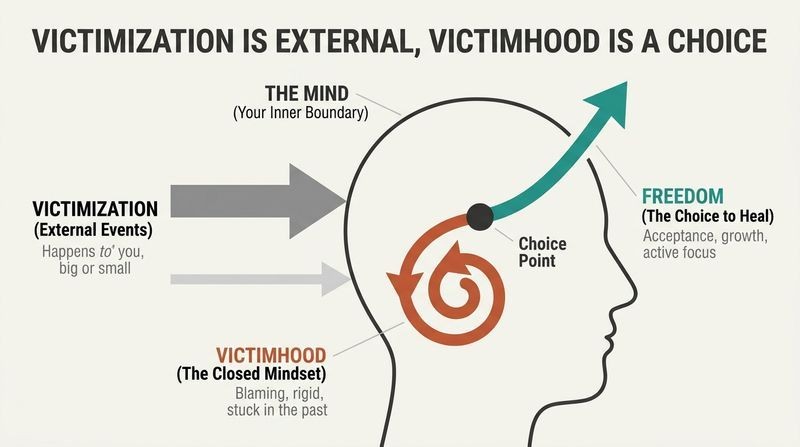
Victimization comes from outside; victimhood comes from within. Eger, a teenager sent to Auschwitz where her parents were gassed on arrival, distinguishes between two things people conflate. Victimization is what happens to you: the bully, the abusive spouse, the accident, the genocide. Everyone gets victimized eventually. Victimhood, by contrast, is a mindset you adopt: rigid, blaming, pessimistic, stuck in the past, unforgiving.
She insists there is no hierarchy of suffering. When patients tell her their problems are trivial because "it's not Auschwitz," she rejects the comparison. One morning she saw a mother whose child was dying and another crying over the wrong shade of yellow on her new Cadillac. Both, she realized, were grappling with the same human wound: reality failing to match expectation.
The distinction echoes Viktor Frankl, Eger's mentor, whose Man's Search for Meaning argued the last human freedom is choosing one's attitude. What's notable is Eger's refusal to weaponize her own extreme suffering as a trump card. Modern trauma research complicates the framing slightly: neuroscience shows trauma physically rewires threat-detection circuits, so "choosing" a response is harder than willpower suggests. Eger would agree, having suffered decades of flashbacks. Her point is subtler than positive thinking: the choice is not whether you feel pain but whether you build a permanent identity around it.
No one can steal what you place in your own mind
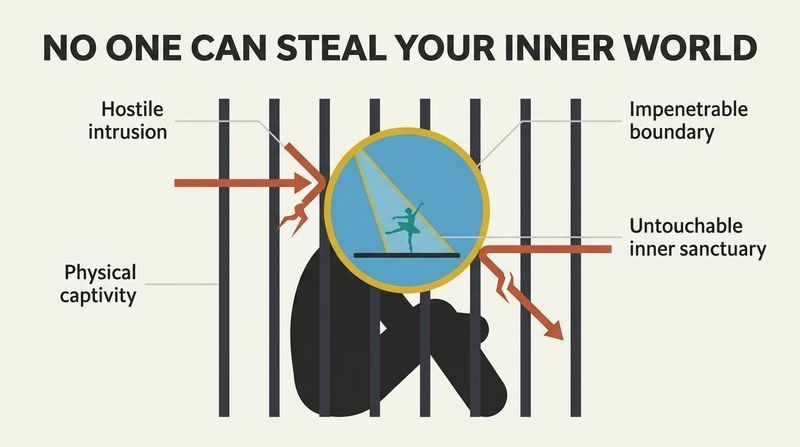
Your inner world is the one prison guards cannot enter. On the cattle-car to Auschwitz, Eger's mother told her that whatever happens, no one can take away what you put in your mind. That sentence became her survival tool. Forced to dance for Josef Mengele, the camp doctor who had just sent her mother to the gas chamber, she closed her eyes and imagined she was performing at the Budapest opera house. She danced for her life and won a loaf of bread she shared with her bunkmates.
Prisoners cooked imaginary feasts, held whispered beauty contests, and recited remembered poetry. These were not distractions but active constructions of dignity. Frankl independently did the same at Auschwitz, mentally lecturing to a future audience.
This anticipates cognitive behavioral therapy and the psychology of dissociation, where imagination becomes protective rather than pathological. Sports psychology confirms mental rehearsal measurably improves performance, and Eger, a trained gymnast, essentially applied athletic visualization to survival. There is a fine line worth flagging: the same interior retreat that saved her in the camps later became a trap of denial in America, where her inner world housed demons instead of ballet stages. The tool is neutral. What matters is whether you use imagination to preserve selfhood or to avoid reality.
Running from the past imprisons you more than the past itself
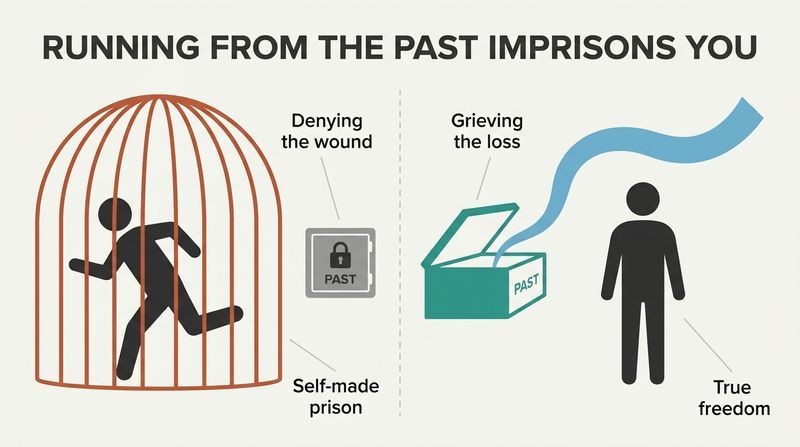
Silence and denial are their own concentration camp. For decades after liberation, Eger hid her history. In 1950s Baltimore she could not even pronounce Auschwitz in English, and she wanted only to be a "Yankee doodle dandy." She kept her secret so tightly that, as she puts it, her secret had her. The flashbacks worsened. A simple mistake boarding a bus without paying triggered a full collapse because her body read ordinary conflict as mortal danger.
Her central reversal: freedom does not come from locking the past away but from embracing what happened. When we refuse to grieve our losses, we are condemned to relive them. The wound you deny yourself permission to feel becomes as inescapable as brick walls and steel bars.
This directly challenges the folk wisdom that time heals and that not dwelling on pain protects us. Contemporary research on avoidance in PTSD supports Eger: experiential avoidance predicts worse long-term outcomes than confrontation. Her insight that a starving prisoner had more hope than a free immigrant is arresting, because in captivity she had something external to fight against, while freedom forced her to face the demons within. This is the paradox of liberation. External chains can distract you from the internal ones, which is why some liberated prisoners wandered back into the camp barracks, unable to bear open sky.
Ask 'what now?' instead of 'why me?' to escape paralysis
Survivors do not have time for why. Eger reframes the question that keeps people stuck. "Why me?" and "why did I survive?" have no answers and keep you circling the past. She eventually replaced them with "What is mine to do with the life I've been given?"
Martin Seligman's learned-helplessness experiments illuminate the stakes. Dogs given no way to stop painful shocks eventually stopped trying to escape even when escape became possible; they lay down and whimpered. This explained why liberated prisoners returned to their barracks: they had been conditioned to believe action was futile. Eger's counterweight is the two Vietnam veterans with identical spinal injuries. One raged, curled in fetal position, cursing God. The other marveled that from his wheelchair he could finally see his children's eyes up close.
The learned-helplessness parallel is powerful but worth updating. Seligman himself later revised the theory, arguing that helplessness is the default mammalian response and that it is optimism, not helplessness, that must be learned. That refinement strengthens Eger's clinical stance: agency is trainable. The Tom-versus-Chuck contrast maps onto research showing that post-traumatic growth and post-traumatic stress can coexist in the same person. Everyone is part Tom and part Chuck. The question "what now?" is not toxic positivity; it is a redirection of attention from unanswerable metaphysics toward the one variable still under your control.
Forgiveness frees you, not your oppressor, and forgives yourself most
Holding rage keeps you chained to the person who harmed you. Invited to speak at Berchtesgaden, Hitler's mountain retreat, Eger nearly declined until her husband said that if she stayed away, Hitler would have won. Standing where Hitler's home once stood, she forgave him. This had nothing to do with Hitler and everything to do with releasing the part of herself that had spent a lifetime keeping him chained, and thereby keeping herself chained beside him.
Forgiveness, she stresses, is not condoning, forgetting, or excusing. It is grieving what happened and giving up the need for a different past. The hardest person to forgive turned out to be herself, for saying "mother" instead of "sister" in the selection line, a word she believed sent her mother to death.
Eger carefully separates accountability from forgiveness, refusing reparations money as "blood money" while still forgiving. This matters because forgiveness discourse often gets criticized for pressuring victims to absolve abusers prematurely. Her version is self-directed: revenge, she notes, means revolving rather than evolving. Research on forgiveness interventions shows reductions in anxiety and depression for the forgiver regardless of the offender's response, supporting her claim that it is an internal act. The self-forgiveness piece is the deepest cut. Survivor's guilt is a documented phenomenon, and her decades-long belief that one word doomed her mother shows how the mind manufactures control where none existed.
Feelings won't kill you, so stop bottling and start venting
Expression is the opposite of depression. For most of her adult life Eger suppressed her rage, terrified that if she let it out she would become a monster and never stop. In therapy she finally tested this. She lay on the floor and asked her therapist to sit on her so she had something to push against, then she screamed with thirty years of silenced grief. Nothing catastrophic happened. She was okay, she was alive.
She teaches patients a four-step sequence for managing emotion: notice the feeling and name it, accept that it is yours, check your body's physical response, and stay with it until it passes. Feelings are temporary. You can be a teapot that vents steam rather than a pressure cooker that eventually explodes.
The teapot-versus-pressure-cooker metaphor captures a real neurobiological finding: labeling emotions ("affect labeling") measurably dampens amygdala activity, which is precisely her "notice and name" step. Eger's simplification of emotion into four primaries (sad, mad, glad, scared) mirrors Paul Ekman's basic-emotions research and makes the work approachable. One caveat worth adding: catharsis theory has a mixed record. Simply venting rage can sometimes rehearse and amplify it. What makes Eger's approach sound is that she pairs release with a trained professional and with staying present to the feeling rather than blindly discharging it. The goal is metabolizing emotion, not performing it.
Blame keeps couples balanced on a seesaw of mutual dysfunction
One partner stays 'bad' so the other can feel 'good.' Eger describes couples locked in a fixed choreography. She nags, he drinks; he drinks, she nags. When the drinker in one marriage got sober, the marriage got worse, because the wife's identity depended on being the long-suffering good one. Blame is the pivot joining the two seats.
Her prescription draws on the Passover Four Questions from her childhood seders, repurposed into four therapeutic questions: What do you want? Who wants it? What are you going to do about it? And when? The trap is answering the first question on someone else's behalf. Saying "I want him to stop drinking" is a way of avoiding knowing what you want for yourself, which is where all freedom begins.
The seesaw model resonates with family-systems theory, where a symptomatic member often stabilizes an unspoken family contract, and with codependency literature. Eger's shift from asking patients "How can I help you?" to "How can I be useful to you?" is a subtle but profound reframe: the former positions her as the king's men trying to reassemble Humpty Dumpty, an impossible and infantilizing task. Her honesty about her own passive-aggression toward her punctual husband, deliberately making them late, keeps the theory grounded. The four-question tool is deceptively simple; its power lies in forcing ownership of desire, which many people have never practiced.
Perfectionism is the belief that something broken in you needs dressing up
Achievements cannot fix a wound they were never designed to reach. Eger identifies perfectionism as her lifelong coping mechanism, rooted in childhood and hardened by survivor's guilt. She chased degrees, accolades, and pieces of paper to prove her worth, but each one reinforced the underlying conviction that she was damaged. On her graduation day at forty-two, honors in hand, she could not walk in the ceremony because beneath the achievement lay the belief that she did not deserve to have survived.
The antidote she learned from Carl Rogers is unconditional self-acceptance: offering herself the same total, nonjudgmental regard she gave patients. Only I can do what I can do the way I can do it. Self-love, not self-improvement, is what finally loosened the grip.
Eger's formulation, that perfectionism dresses up brokenness rather than repairing it, aligns with modern research distinguishing adaptive striving from maladaptive perfectionism, the latter reliably linked to depression and burnout. Her insight that combating low self-esteem through achievement actually deepens unworthiness is counterintuitive and clinically astute: the striving confirms the premise that you are not yet enough. Rogers's unconditional positive regard, extended inward, prefigures the self-compassion work of Kristin Neff, whose studies show self-kindness predicts resilience better than self-esteem. The uncomfortable implication for high-achievers is that the trophy shelf may be a symptom, not a solution.
The worst moments reveal you as the bridge between past and future
In crisis you glimpse what you will choose to perpetuate or end. Captain Jason Fuller arrived catatonic, then pulled a loaded gun, enraged that his wife was cheating. Eger did not call police. She rode the wave of his fury toward its consequence, asking whether killing his wife would hurt his son, appealing beneath the anger to love. Anger, she explains, is only the thin outer layer; underneath is usually fear, and you cannot feel love and fear at once. Jason dropped the gun and wept.
The abused, she observed, often re-create the very violence done to them. Jason's father had beaten into him that a man is invulnerable. In that suspended moment Jason saw he could break the cycle rather than pass the pain forward to his children.
The idea that anger masks fear is a therapeutic staple, but Eger's framing of the person as a bridge between generations connects to intergenerational trauma research, which documents how unprocessed trauma transmits epigenetically and behaviorally to children. Her decision not to call the police is clinically risky and would not be advisable as general practice, a point she implicitly concedes by keeping the loaded gun for years afterward. Yet the deeper lesson holds across attachment theory and cycle-of-abuse literature: awareness at the crucial junction is what interrupts transmission. We inherit our wounds, but we choose whether our children pick up the tab.
Return to the site of your pain to finally release it
Bare-skinned contact with grief can end a lifetime of avoidance. Eger noticed a depressed patient named Margaret circling small complaints while never touching her real wound, her mother's death when Margaret was sixteen, the same age Eger lost hers. On a whim Eger drove her to the cemetery and had her stand barefoot on her mother's grave, making direct contact so both could finally rest. Margaret's son later reported she was transformed.
Eger applied the same principle to herself, returning to Auschwitz decades later against everyone's warnings. She placed a stone on the ground where her barracks had stood, a Jewish gesture of respect for the dead, and told her parents goodbye and thank you. Then she walked out under the gate, free at last.
This is the memoir's structural climax, and it dramatizes a live debate in trauma treatment. Prolonged-exposure therapy deliberately revisits traumatic memories, while other research warns that repeated exposure, like watching the towers fall on repeat after 9/11, can retraumatize. Eger threads the needle: return works only with absolute safety and control over duration and depth. Her ritual use of a physical object echoes grief practices across cultures, from Jewish stones to Mexican ofrendas, which anthropologists link to healthier bereavement. The barefoot-on-the-grave intervention also reframes the mourner as an agent giving comfort rather than a passive sufferer, which is itself therapeutic.
Find the bigot in yourself before condemning the bigot before you
Withholding love never conquered anyone's hatred. A fourteen-year-old boy sent to Eger by a judge announced he wanted to kill all the Jews, Blacks, Mexicans, and Chinese to make America white again. She, whose mother died in a gas chamber, felt the rush of righteous rage. Then an inner voice said: find the bigot in you, the part that judges, labels, and diminishes another's humanity.
She modeled herself on Corrie ten Boom, a Christian who hid Jews and later took the hands of the guard responsible for her sister's death, feeling the purest love. Eger looked at the racist boy, both of them parentless and feeling like damaged goods, and said three words: "Tell me more." He left having glimpsed an alternative to hate.
Eger's move is not moral relativism; she holds bigotry accountable while refusing to mirror its dehumanization. Her observation that most white-supremacist recruits lost a parent before age ten aligns with sociological research on extremism as a search for belonging and significance, the framework behind organizations like Life After Hate that rehabilitate former extremists through relationship rather than argument. The uncomfortable demand, to locate one's own capacity for othering, echoes Aleksandr Solzhenitsyn's line that the divide between good and evil runs through every human heart. "Tell me more" is disarmingly simple, yet it enacts the deradicalization principle that people abandon hate through unexpected connection, not confrontation.
Analysis
The Choice belongs to a rare hybrid genre: part Holocaust memoir in the lineage of Frankl and Wiesel, part clinical psychology casebook. Its structural gamble is weaving Eger's Auschwitz survival into her later practice as a therapist, so that camp lessons become treatment principles. This dual structure is both its strength and its interpretive challenge, because the reader must hold extreme historical atrocity alongside ordinary suffering (a wrong-colored Cadillac, a college dating slump) without the juxtaposition feeling glib. Eger earns it through her insistence that there is no hierarchy of suffering, a claim that is philosophically debatable but therapeutically generous.
Intellectually, the book sits downstream of Frankl's logotherapy: meaning is chosen, freedom is internal, attitude is the last inviolable domain. Where Eger extends Frankl is in the clinical machinery, her four questions, the notice-accept-check-stay sequence, the seesaw model of blame, the shift from "how can I help" to "how can I be useful." These are practical tools Frankl never systematized. She also integrates Rogers's unconditional positive regard and Seligman's learned helplessness, positioning herself as a synthesizer rather than an originator, which she cheerfully admits by naming her approach "Choice Therapy."
The book's most contestable move is its emphasis on choice, which risks sliding into responsibility-for-your-own-suffering territory that trauma survivors can experience as blame. Eger largely avoids this by modeling her own decades of failure, denial, flashbacks, and a divorce she later reversed, showing healing as nonlinear rather than a willpower switch. Her repeated line that she is still not "done," that closure is temporary, undercuts any triumphalist reading.
What distinguishes The Choice from the crowded resilience-literature field is credibility earned through the most extreme conditions imaginable, paired with the humility of a clinician who kept struggling for fifty years after liberation. The freedom she offers is not freedom from pain but freedom within it.
Review Summary
The Choice is a deeply moving memoir of Holocaust survivor Edith Eger's experiences in Auschwitz and her journey to healing. Readers praise Eger's resilience, wisdom, and ability to help others through her work as a psychologist. The book is described as inspirational, offering valuable life lessons and insights into overcoming trauma. Many reviewers consider it a must-read, comparing it to Viktor Frankl's work. While some found the later chapters on her patients less engaging, the overall message of choosing how to respond to life's challenges resonates strongly with readers.
People Also Read




FAQ
What's The Choice: Escape Your Past and Embrace the Possible about?
- Survivor's Journey: The book is a memoir by Dr. Edith Eger, detailing her experiences as a Holocaust survivor and her journey to becoming a psychologist.
- Healing and Resilience: It emphasizes the importance of mental freedom and healing, showing how Eger transformed her suffering into strength.
- Empowerment Through Choice: Central to the narrative is the idea that we can choose how to respond to our past, and that true freedom comes from within.
Why should I read The Choice by Edith Eger?
- Inspiring Life Lessons: Eger shares profound insights on overcoming trauma and finding joy, making it valuable for anyone facing adversity.
- Psychological Insights: As a clinical psychologist, Eger combines personal experiences with professional wisdom, offering tools for healing.
- Universal Themes: Themes of resilience, choice, and the human spirit resonate widely, making it relatable and impactful.
What are the key takeaways of The Choice by Edith Eger?
- Power of Choice: Eger emphasizes that we always have the power to choose our responses to life's challenges.
- Healing is Possible: The book illustrates that healing from trauma is essential for living a fulfilling life.
- Embrace Your Story: Eger encourages readers to use their past as a foundation for growth, not as a prison.
What are the best quotes from The Choice by Edith Eger and what do they mean?
- "The soul never dies.": Reflects Eger's belief in the enduring nature of the human spirit, even amidst suffering.
- "When we don’t allow ourselves to grieve...": Highlights the importance of processing grief to move forward and heal.
- "No one can take away from you...": Emphasizes the power of thoughts and beliefs in shaping reality and resilience.
How does Edith Eger define trauma in The Choice?
- Universal Experience: Eger describes trauma as a universal experience affecting everyone.
- Victimization vs. Victimhood: She distinguishes between being victimized and choosing to live in victimhood.
- Healing Through Acceptance: True healing comes from accepting and embracing experiences rather than denying them.
What methods does Edith Eger suggest for overcoming trauma in The Choice?
- Embrace Your Story: Confronting and sharing one's past can lead to healing and empowerment.
- Practice Self-Compassion: Eger emphasizes treating oneself with kindness and care.
- Seek Connection: Building relationships provides support and fosters healing.
How does The Choice by Edith Eger address the concept of freedom?
- Mental Freedom: True freedom is a mental state, and we can be our own liberators.
- Choice as Freedom: Freedom comes from the choices we make, not external factors.
- Empowerment Through Action: Taking active steps toward liberation allows us to embrace joy and freedom.
What role does forgiveness play in The Choice by Edith Eger?
- Healing Through Forgiveness: Forgiveness is a powerful tool for releasing anger and resentment.
- Forgiveness is Personal: It is a personal journey and doesn't require reconciliation with those who caused harm.
- Empowerment in Forgiveness: Forgiving others empowers us, freeing us from emotional chains.
How does Edith Eger’s background as a psychologist influence The Choice?
- Clinical Insights: Eger integrates professional psychology knowledge with personal experiences.
- Therapeutic Techniques: She shares techniques and questions used with patients to explore motivations for change.
- Empathy and Understanding: Her background fosters deep empathy and connection with readers.
How does The Choice by Edith Eger address the concept of learned helplessness?
- Definition of Learned Helplessness: Occurs when individuals feel they have no control, leading to inaction.
- Connection to Trauma: Seen in trauma survivors who feel powerless to change their situations.
- Empowerment Through Choice: Recognizing and breaking free from learned helplessness is essential for healing.
How does Edith Eger illustrate the importance of taking risks in The Choice?
- Risk as Growth: Taking risks is essential for personal growth and healing.
- Empowerment Through Choice: Embracing risk allows individuals to break free from their past.
- Real-Life Examples: Eger shares stories of risk-taking leading to transformative experiences.
What is the significance of Edith Eger’s return to Auschwitz in The Choice?
- Confronting the Past: Symbolizes her journey of healing and acceptance.
- Releasing Guilt: Revisiting Auschwitz helps release guilt and shame carried for decades.
- Empowerment and Freedom: Reinforces the belief that while the past can't be changed, present choices lead to freedom.
About the Author
Other books by Edith Eger


Download PDF
Download EPUB
.epub digital book format is ideal for reading ebooks on phones, tablets, and e-readers.








































