

Key Takeaways
Social media doesn't just host extremism, it manufactures it
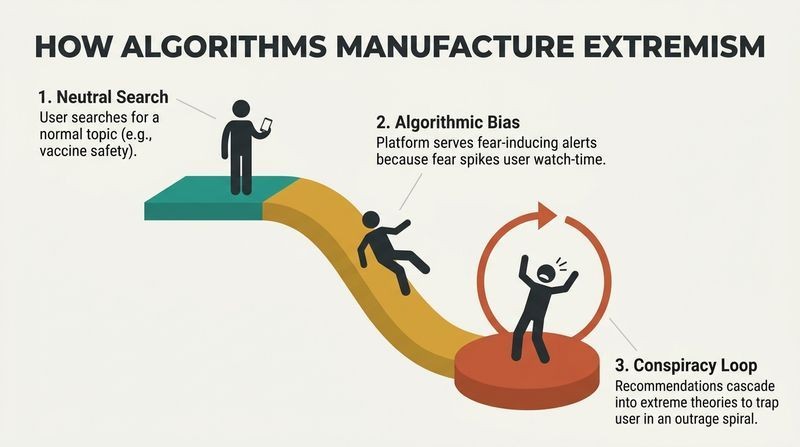
The core thesis reverses common assumptions. Most people blame social media harms on bad actors: trolls, foreign agents, fake-news peddlers. Fisher argues the platforms themselves are the culprit. Their engineering, tuned to maximize engagement, actively creates the divisions, conspiracies, and rage it profits from.
The anti-vaccine discovery. Renee DiResta, a former analyst, joined Facebook parenting groups around 2014 and noticed the platform relentlessly pushing anti-vaccine content. Search "vaccine" and you got anti-vaccine groups. Join one and recommendations cascaded into chemtrails, flat earth, and other conspiracies. A calm mother who accepts vaccines spends little time posting. A terrified mother convinced of a medical cabal spends hours. The AI concluded that promoting fear maximized engagement, so it did. Facebook wasn't indulging extremists. It was breeding them.
What's striking is how this reframes moral responsibility. The cigarette analogy Fisher deploys is apt: executives insisting the product is neutral while internal data shows otherwise mirrors Big Tobacco's decades of denial. The claim invites a scope question, though. Correlation between platform use and radicalization is easier to show than causation, and some communication scholars (like Duke's political scientists studying selective exposure) argue offline polarization drives online behavior as much as the reverse. Fisher's strongest evidence, the German internet-outage studies showing violence dropping when Facebook went dark, addresses this directly and elevates his argument above mere pattern-spotting.
Your phone is a slot machine wired to your self-esteem
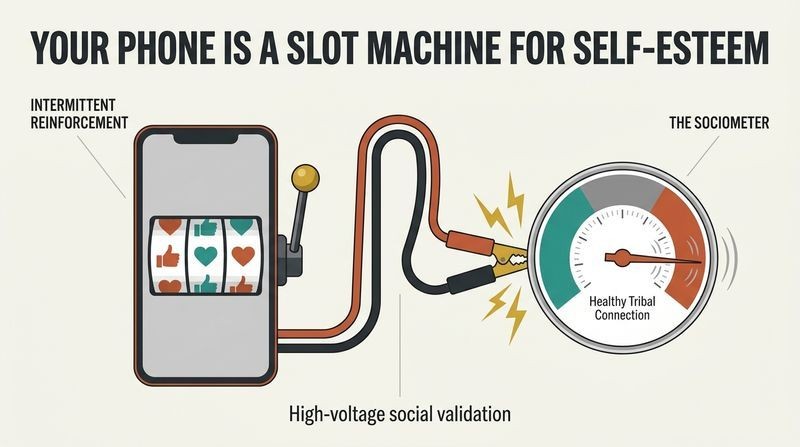
Two psychological exploits power the addiction. First, intermittent variable reinforcement, the principle behind slot machines: rewards delivered unpredictably and in random sizes make a behavior nearly impossible to quit. Post on social media and you might get a flood of likes or nothing. Never knowing keeps you pulling the lever. Sean Parker, Facebook's first president, admitted the design deliberately exploited "a vulnerability in human psychology."
Second, the sociometer. Psychologist Mark Leary theorized that self-esteem is an internal gauge of how accepted we feel by our group, an evolutionary tool for the 150-person tribes we developed in. The Like button hooks a car battery to that gauge. Brain scans show likes activate the nucleus accumbens, the dopamine region lit up in gambling addicts. In 2018, people paid $180 to quit Facebook for a month, and quitters ended up happier.
The sociometer framing is the book's most underappreciated insight. It explains why social media feels existential rather than merely fun: it is hijacking a survival system. Leary's theory has robust support in social psychology, and Fisher's application is elegant. Worth noting is behavioral economist Matthew Gentzkow's deactivation study, cited here, which found improved wellbeing equivalent to a meaningful chunk of therapy's effect. The uncomfortable implication extends beyond individuals. If self-worth is now metered by algorithms optimizing for corporate revenue, then an entire generation's emotional regulation has been quietly outsourced to machines with no stake in their happiness.
Engagement-maximizing algorithms reliably steer users toward the extreme
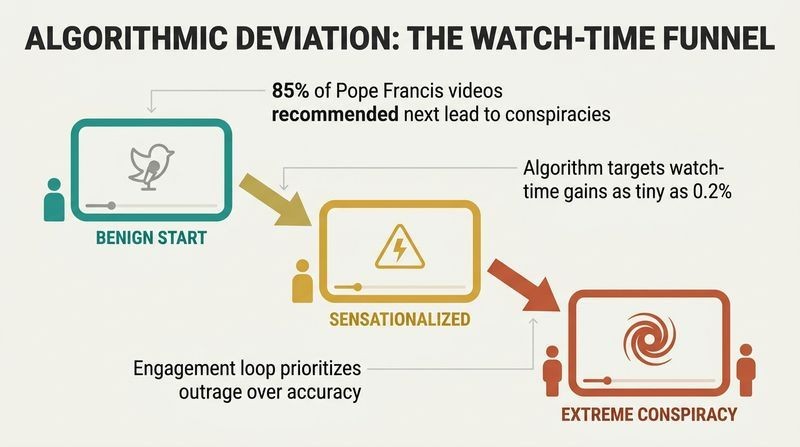
The rabbit hole is a design feature, not a glitch. Guillaume Chaslot, a YouTube engineer, helped build the recommendation AI that pursued a single goal: watch time. Using machine learning too complex for humans to fully audit, it learned that outrage and conspiracy kept people watching. His tool tracking recommendations found that following YouTube's "watch next" suggestions, 85% of Pope Francis videos became conspiracies, and searching "Michelle Obama" led most recommendations to claim she was secretly a man.
Topical affinity pulls toward titillation. Watch cycling videos and you get crash compilations. Harmless for bikes. Catastrophic for politics or health. In 2012, YouTube set a goal to grow daily watch time tenfold, hitting one billion hours by 2016, hunting for gains as small as 0.2%, indifferent to what content achieved it.
The deep-learning point deserves emphasis: these systems became genuinely opaque even to their makers, a phenomenon AI researchers call the interpretability problem. When YouTube says it cannot explain why the algorithm does what it does, that may be literally true. This creates a novel accountability vacuum. Critics counter that recommendation effects are often overstated, and a 2022 study by Annie Chen and colleagues found extremist YouTube consumption concentrated among already-radicalized users. Fisher's rebuttal is scale: even if only a susceptible minority tumbles down, billions of users make that minority enormous, and those converts become the disseminators who radicalize others.
The platforms revived humanity's ancient instinct for mob justice
Moral outrage is a tribal enforcement mechanism. Fisher draws on anthropologist Richard Wrangham's theory of self-domestication: early humans bred aggression out of the species by banding together to punish bullies, what Ernest Gellner called the "tyranny of cousins." Moral outrage evolved to rally the group against norm-violators. It feels compulsory and pleasurable because throwing the first stone once proved your loyalty.
Social media weaponizes this at planetary scale. Studies of Twitter and Facebook found moral-emotional words boost a post's reach by roughly 20% per word. Outrage spreads farther than joy or sadness. The result: pile-ons like Walter Palmer, the dentist who killed Cecil the lion and drew 672,000 tweets in a day, or Justine Sacco, whose single bad joke to 170 followers destroyed her life. Brain scans show harming a perceived wrongdoer activates dopamine reward centers.
Linking Wrangham's evolutionary anthropology to Twitter dynamics is the book's most intellectually ambitious move, and it mostly works. The lynching parallel drawn by scholar Gema Santamaria, that rumors precede mob violence because social media reproduces the church-bell function of summoning a crowd, is chilling and well-supported. One caveat: framing all online shaming as regressive risks flattening genuine accountability movements. The MeToo reckoning and Black Lives Matter also rode these same mechanics toward arguably just ends. Fisher acknowledges this tension through Christian Cooper's own ambivalence about the woman fired after their Central Park encounter, which keeps the analysis honest rather than reactionary.
Gamergate was the prototype for all modern online politics
A 2014 harassment campaign became a template. When game developer Zoe Quinn's ex posted a screed, online communities on 4chan and Reddit spun a false narrative of corruption into a movement of collective abuse, targeting women with death threats, doxxing, and "swatting" (fake 911 calls to trigger armed police raids). What looked like isolated trolling was actually the birth of a new politics fusing male-geek grievance, identity as existential conflict, and platform mechanics that reward the extreme.
"Everything is Gamergate." The same dynamics produced incel violence, the alt-right, and Trumpism. Milo Yiannopoulos and Steve Bannon explicitly harnessed the Gamergate crowd. The tactics, manufacturing a conspiracy to reframe unwanted change (women in gaming) as an enemy plot, migrated straight into mainstream conservative politics via Twitter and Facebook.
The genealogy Fisher traces from a gaming controversy to the White House is provocative but persuasive, echoing analyses by Whitney Phillips and Angela Nagle. The deeper claim is that the internet's founding ideology, radical free speech and majoritarianism inherited from the WELL and 4chan, was never neutral: it encoded the biases of the young white male misfits who built it. What Fisher captures well is how irony functioned as a Trojan horse. Communities that began joking about taboos gradually internalized them, a process the book calls irony poisoning. The line between performing extremism and believing it turned out to be perilously thin.
Whole societies went online at once, then descended into slaughter
Myanmar is the darkest case study. Between 2012 and 2015, the country's internet adoption exploded from under 1% to 40%, mostly through Facebook, which came preloaded on cheap phones via "zero-rating" deals that waived data charges. For millions, Facebook was the internet. An extremist monk, Wirathu, used it to spread anti-Muslim conspiracies. Despite years of explicit warnings from local activists, Facebook employed almost no Burmese-speaking moderators. In 2017 the military launched a genocide against the Rohingya; the UN found Facebook played a "determining role."
The pattern repeated in Sri Lanka. A false rumor that a Muslim restaurateur put "sterilization pills" in food, amplified by Facebook, triggered mobs that burned homes and killed. A researcher summarized it: the ethnic tensions were the germs, but Facebook was the wind.
The germs-and-the-wind metaphor from Sri Lankan advisor Harindra Dissanayake is the book's most quotable formulation of a subtle causal claim: platforms rarely invent hatred but dramatically accelerate its lethality. What makes Myanmar damning is not negligence but the ease of intervention Fisher highlights. A single engineer could have throttled the network. The refusal reflected a business model demanding perpetual growth into markets the companies neither understood nor monitored. The uncomfortable comparison to Rwanda's Radio Milles Collines holds, with one twist: this genocide radio ran on infrastructure owned by a Silicon Valley firm posting record profits while villages burned.
The MAD model explains how platforms rewire your morality
Three forces reshape behavior collectively, not just individually. Psychologists William Brady and Molly Crockett synthesized the evidence into the MAD model:
1. Motivation: instincts like tribalism hijacked by platform mechanics.
2. Attention: moral-emotional words involuntarily grab focus, so feeds skew moralizing and outraged.
3. Design: interfaces trained to reward certain behaviors.
Internalization is the frightening part. When users get likes for expressing outrage, they don't just perform it for rewards, they become genuinely more outraged people. Experiments showed this held even for subjects who initially disliked online anger. Because your daily seconds are fixed while content doubles yearly, feeds increasingly show only the most moral-emotional fraction of what your community produces, distorting your sense of what everyone actually believes and dragging your own views toward the extreme.
The internalization finding is the book's scientific keystone and its most disquieting. It moves the argument from "platforms amplify bad content" to "platforms change who you are," grounded in operant conditioning principles dating to Skinner. The attention-scarcity math is elegantly simple and rarely stated: as content volume explodes against fixed human attention, the filter necessarily concentrates the most provocative material. This connects to Herbert Simon's 1971 observation that information wealth creates attention poverty. A fair challenge is replication: much of this research is recent and effect sizes vary. But the convergence of independent teams reaching similar conclusions lends the framework unusual credibility.
A few thousand superposters distort what millions believe is normal
Extreme voices masquerade as consensus. Psychological studies find hyperactive users (superposters) are disproportionately dogmatic, narcissistic, and drawn to inflicting distress on others, what researchers call negative social potency. Because platforms reward volume with reach, these people become everyone's "social referents," the peers we unconsciously scan to infer group norms. Princeton's Betsy Levy Paluck showed that morality works as a perceptual task: we absorb right and wrong from whoever seems influential.
Reddit proved you can reverse it. In 2015, CEO Ellen Pao banned the roughly 15,000 most toxic users out of tens of millions. Hate speech among those who remained dropped 80% almost overnight. The lesson: a tiny minority sets the tone, so removing them transforms the whole. Facebook and YouTube, unwilling to suppress their most active users, refused to follow.
The superposter concept elegantly resolves a paradox: why online spaces feel more hostile than the offline world despite most people being reasonable. The answer is selection and amplification, not a darkening of human nature. Paluck's social-referent research, drawn from her anti-bullying field experiments in 56 schools, is genuinely rigorous and transfers well. The Reddit natural experiment is the strongest evidence in the entire book that intervention works cheaply. It raises the obvious question the platforms avoid: if banning 15,000 accounts cut hate 80%, the failure to act elsewhere is a choice about revenue, not a technical impossibility or a free-speech principle.
Turning the algorithm off is the fix experts keep reaching
The convergent recommendation. Fisher notes that the longer researchers study these platforms, whatever their discipline, the more they arrive at the same prescription: switch off engagement-based recommendation. Whistleblower Frances Haugen, who leaked thousands of internal Facebook documents in 2021, argued that removing liability protections would push companies to abandon engagement ranking entirely, reverting feeds to simple chronological order.
Twitter briefly proved it works. Before the 2020 election, Twitter added "friction," prompting users to reconsider before resharing, which cut retweets 20% and slowed misinformation. It temporarily switched off the algorithm boosting viral tweets, the only time a major platform voluntarily did so. Internal Facebook research found that simply not boosting repeatedly-reshared posts would cut Covid misinformation by up to 38%. Zuckerberg reportedly rejected it, fearing lost engagement.
The turn-it-off consensus is the book's practical payoff, and its power lies in coming from former believers rather than technophobes. The 38% figure is devastating precisely because it reveals a switch that existed and was left off. What Fisher underplays is the collective-action problem: any single platform that unilaterally throttles engagement bleeds users to rivals that do not, which is why regulation, not corporate goodwill, may be the only viable lever. His HAL 9000 metaphor from 2001: A Space Odyssey lands the moral cleanly. The lesson was never to gently reprogram the machine; it was to pull the plug.
Silicon Valley's culture engineered these harms decades before the apps
The founding DNA explains the dysfunction. Fisher traces today's platforms to William Shockley, the brilliant, tyrannical engineer whose 1950s semiconductor firm established the Valley's template: recruit difficult misfit geniuses, tolerate toxic cultures as the price of brilliance, and let venture capitalists pick founders in their own image. Investor John Doerr openly described his "pattern" as white male Harvard or Stanford dropouts with no social life.
Cloud computing flipped the power dynamic. By the late 2000s, founders needed little money to launch, so VCs competed by offering "no adult supervision." This birthed the twenty-two-year-old CEO with unchecked control, steeped in Peter Thiel's ideology that contrarian outsiders should remake society and that monopoly, not democracy, best serves progress. The belief that engineering could solve human social relations was baked in from the start.
This origin story elevates the book above tech-panic journalism by locating harms in structure rather than villainy. The Galapagos metaphor, borrowed from historian Margaret O'Mara, captures how isolation bred peculiar traits that could not have survived elsewhere. The insight that venture capital functioned as an ideological filter, reproducing the same personality type across generations, is sharp and underexplored in mainstream coverage. Thiel's stated view that freedom and democracy are incompatible deserves the scrutiny Fisher gives it. The through-line is that people who felt like outcast misfits built systems optimizing for the grievance and majoritarian conflict they knew, then exported it to billions.
YouTube built a child-exploitation catalog with no human intent
The algorithm did what no person chose. While researching Brazil, Jonas Kaiser's team found YouTube's recommendation system stitching together videos of partially-clothed children, plucked from unwitting families' home movies, and serving them to viewers after sexually themed content. One girl's innocent pool video jumped to 400,000 views. The system had identified an audience and worked to keep it engaged, mimicking the exact escalation path psychologists observe in how people develop attractions to child abuse imagery.
The stonewalling was revealing. When notified, YouTube quietly removed some videos and altered the algorithm while insisting the timing was coincidental. It cited an expert who, when contacted directly, said her research actually supported the danger. YouTube refused the simple fix Kaiser urged: stop recommending videos of children entirely, because creators rely on recommendations for traffic.
This is the book's most viscerally damning episode because it strips away any question of ideology or free speech. No one wanted this outcome, which is precisely the point: an optimization process indifferent to meaning found and served a monstrous demand. It is the clearest illustration of the interpretability problem's moral stakes. The refusal to disable recommendations on children's videos, weighed explicitly against creator traffic, exposes the revenue calculus beneath every safety claim. The parallel to the Purdue research on how deviant interests are trained rather than innate, and YouTube's misrepresentation of its own cited expert, shows a company managing public relations rather than confronting evidence.
January 6th was an insurrection planned openly with no planners
Social media was the organizer. The Capitol attack was the convergence of three forces the platforms had spent 2020 amplifying: Covid conspiracies, militia movements like the Boogaloo, and QAnon, the belief that Trump would purge a satanic cabal. The Big Lie of a stolen election spread at staggering scale: for a week after the vote, Trump's posts were 22 of the 25 most-engaged on Facebook, and YouTube videos pushing fraud claims drew 138 million views versus 7.5 million watching actual election-night TV coverage.
Coordinated by collective will. Rioters livestreamed to Facebook and YouTube as they breached the building, treating insurrection as content. Superposter Richard Barnett, radicalized through ordinary Facebook conspiracy-sharing, put his feet on Pelosi's desk. Days later, whistleblower documents and Democratic lawmakers demanded the companies reexamine engagement-based ranking itself.
Fisher's framing of a leaderless plot coordinated through digitally-guided consensus is the culmination of every thread in the book: the tyranny of cousins, superposters, crisis-solution radicalization, and false consensus all operating simultaneously. The comparison of pre-riot martyrdom posts to jihadist suicide messages is jarring and precise. What the account demonstrates is that the platforms did not merely fail to remove content; their core mechanics manufactured the shared reality that made insurrection feel righteous and inevitable. The subsequent corporate response, banning Trump three days after Democrats won the Senate, reads less as principle than as the self-interested weathervane Fisher documents throughout, always following power rather than protecting the public.
Analysis
The Chaos Machine belongs to a maturing genre of tech criticism, but distinguishes itself by refusing the easy targets. Max Fisher, a New York Times foreign correspondent, does not blame Russian trolls, bad users, or individual villains. His thesis is structural and therefore harder to dismiss: the harm is the product. Engagement-maximizing algorithms, trained on human psychology's exploits, systematically manufacture the outrage, tribalism, and conspiracy they profit from, and the effect, multiplied across billions, reshapes societies.
The book's intellectual signature is its synthesis of evolutionary psychology, anthropology, and neuroscience with on-the-ground reporting from Myanmar, Sri Lanka, Germany, and Brazil. Fisher's strongest move is anchoring digital phenomena in deep human history: the sociometer, Dunbar's number, Wrangham's self-domestication, moral outrage as tribal enforcement. This gives the argument explanatory depth that mere data-journalism lacks. The MAD model and the internalization findings, that platforms don't just amplify bad behavior but change who users fundamentally become, represent the book's most consequential scientific claim.
The methodological tension worth flagging is causation. Fisher marshals correlational evidence, whistleblower documents, and clever natural experiments (German internet outages, Reddit's 2015 bans), but a skeptic can argue offline polarization and preexisting grievance drive much of what he attributes to algorithms. Fisher's rebuttal, that scale converts even minority susceptibility into mass effect, and that internal company research repeatedly confirmed the harms, is compelling but not airtight. Some scholars find radicalization effects concentrated among the already-inclined.
Where the book is unimpeachable is its documentation of corporate knowledge and refusal. Again and again, employees, researchers, and outsiders warned the companies, who possessed both the data and the technical ability to intervene, and chose revenue. The 38% misinformation reduction Facebook declined, the Rohingya genocide's freely-visible warning signs, the child-safety fix YouTube rejected: these are not ambiguities. The recurring expert prescription, turn off engagement-based recommendation, is simple, feasible, and unheeded, which makes the book finally an indictment not of technology but of the choice to keep the machine running.
Review Summary
The Chaos Machine is a deeply researched and alarming exploration of social media's impact on society. Readers praise Fisher's thorough investigation into how platforms like Facebook and YouTube contribute to polarization, misinformation, and real-world violence. Many found the book eye-opening and terrifying, highlighting the algorithms' role in amplifying extreme content for profit. While some criticized its political bias, most agreed it's an important read for understanding social media's influence. The book left many readers questioning their own social media usage and calling for increased regulation of tech companies.
People Also Read








Glossary
Sociometer
Self-esteem as social-acceptance gaugePsychologist Mark Leary's theory that self-esteem is an internal instrument measuring how accepted and valued we feel by our social group, evolved because standing in a 150-person tribe once determined survival. Fisher argues the Like button connects directly to this gauge, giving whoever controls the metrics enormous power over behavior by delivering or withholding social validation at unprecedented scale and immediacy.
Intermittent variable reinforcement
Unpredictable rewards drive compulsionA conditioning principle demonstrated by B.F. Skinner: rewarding a behavior only sometimes, and in randomized amounts, makes it far more compulsive than consistent rewards, and the behavior persists even after rewards stop. It powers slot machines, gambling addiction, and abusive relationships. Social media replicates it: a post may yield many likes or none, and never knowing keeps users pulling the lever.
MAD model
How platforms rewire moral behaviorA framework by psychologists William Brady and Molly Crockett describing three forces through which social media reshapes users: Motivation (hijacking tribal and social instincts), Attention (moral-emotional words involuntarily capturing focus and distorting perceived norms), and Design (interfaces that train and reward specific behaviors). Crucially, users internalize outrage, becoming genuinely angrier people, not merely performing anger for rewards.
Tyranny of cousins
Group enforcement through moral outrageAnthropologist Ernest Gellner's term, developed by Richard Wrangham, for how leaderless early human societies enforced shared moral codes: the group's adults ("cousins") collectively punished norm-violators, sometimes with lethal violence. Moral outrage evolved as the alerting and rallying mechanism. Fisher argues social media bypasses modern containment of these instincts, unleashing digital mob justice at massive scale.
Superposter
Hyperactive user distorting perceived normsA hyperactive social media user who, studies suggest, tends toward dogmatism, grandiose narcissism, low self-esteem, and deriving pleasure from inflicting emotional distress. Because platforms reward posting volume with reach, superposters become the "social referents" through whom casual users unconsciously infer group norms, dragging entire communities toward hostility and conspiracy even when most members privately disagree.
Zero-rating
Free-data deals capturing poor marketsThe practice of tech companies subsidizing mobile data charges so users in poor countries can access their apps for free, striking deals with local carriers. In Myanmar and Sri Lanka, this made Facebook effectively synonymous with the internet, so much so that many users did not know other sources existed, concentrating enormous power over information in an unmonitored platform.
Crisis-solution construct
Extremist recruitment through manufactured conflictScholar J.M. Berger's model of extremist recruitment: reframe an individual's personal hardship as a crisis caused by a threatening out-group (Them), offering the in-group (Us) as the solution. As the perceived crisis escalates, the prescribed solution grows more violent. Fisher shows YouTube's algorithm inadvertently reproduces this sequence, moving viewers from grievance content toward extremism.
Irony poisoning
Ironic hate becoming sincere beliefThe process by which heavy social media users, immersed in subcultures of ironic detachment and dare-to-offend humor, gradually internalize as sincere the extremist views they initially shared as jokes. Fisher documents it in a German firefighter who exchanged racist memes with a friend, addressing each other as 'mein Führer,' until within six months he tried to burn down a refugee house.
FAQ
What's The Chaos Machine about?
- Exploration of Social Media's Impact: The Chaos Machine by Max Fisher examines how social media platforms like Facebook, Twitter, and YouTube have fundamentally altered human behavior and societal structures.
- Focus on Algorithms: The book highlights how algorithms designed to maximize user engagement often promote extreme content, leading to polarization and societal harm.
- Case Studies and Real-World Examples: Fisher uses various case studies, such as the rise of conspiracy theories and political events, to illustrate the real-world implications of social media dynamics.
Why should I read The Chaos Machine?
- Understanding Modern Society: The book provides insights into the pervasive influence of social media on contemporary life, helping readers understand the mechanisms behind misinformation and societal division.
- Informed Perspective on Technology: Fisher's analysis encourages critical thinking about the technology we use daily and the ethical implications of social media.
- Engaging Narrative: Filled with compelling stories and characters, the book makes complex subject matter accessible and engaging, keeping readers invested in the unfolding consequences of social media.
What are the key takeaways of The Chaos Machine?
- Algorithms Shape Reality: Social media algorithms are designed to maximize engagement, often at the expense of truth and social cohesion, leading to the amplification of divisive content.
- Human Psychology Exploited: The book emphasizes how social media exploits psychological tendencies, such as the need for social validation, leading to harmful behaviors and societal consequences.
- Call for Accountability: Fisher advocates for greater accountability from tech companies regarding the impact of their platforms, crucial for fostering healthier public discourse.
What are the best quotes from The Chaos Machine and what do they mean?
- “Algorithms exploit the human brain’s attraction to divisiveness.”: This quote encapsulates the argument that social media algorithms prioritize content that elicits strong emotional reactions, leading to societal polarization.
- “We’ve reached a point where things that are popular and emotionally resonant are much more likely to be seen by you than things that are true.”: Highlights the danger of algorithm-driven content curation, where popularity trumps factual accuracy.
- “The platforms had learned to indulge the outrage that brought their users a rush—of purpose, of moral clarity, of social solidarity.”: Reflects the idea that social media can create a sense of community around shared outrage, which can be both empowering and destructive.
How does The Chaos Machine explain the rise of conspiracy theories?
- Social Media as a Catalyst: Fisher argues that social media platforms have become breeding grounds for conspiracy theories, allowing rapid dissemination and reinforcement of fringe ideas.
- Echo Chambers: Users can easily find and join groups that share their beliefs, creating echo chambers that validate and amplify conspiracy theories.
- Real-World Consequences: Fisher illustrates the impact of these theories, such as the Pizzagate incident, where misinformation led to dangerous actions.
What role do algorithms play in shaping user behavior according to The Chaos Machine?
- Engagement Maximization: Algorithms are designed to keep users engaged by promoting content that elicits strong emotional responses, leading to a cycle of consuming increasingly extreme content.
- Personalization and Filter Bubbles: Algorithms create personalized feeds that reinforce users' existing beliefs, limiting exposure to diverse perspectives.
- Manipulation of Attention: Fisher highlights that algorithms manipulate users' attention, leading to addiction-like behaviors and impacting well-being.
How does The Chaos Machine address the concept of "moral outrage"?
- Moral Outrage as a Social Tool: The book discusses how moral outrage serves as a mechanism for social control, encouraging conformity to group norms.
- Amplification through Social Media: Fisher argues that social media amplifies moral outrage, making it easier for users to express anger and rally others.
- Consequences of Outrage: The book illustrates the potential for moral outrage to spiral out of control, resulting in disproportionate punishments and harm to innocent individuals.
What examples does The Chaos Machine provide of social media's impact on politics?
- Trump's Rise: Fisher discusses how social media played a crucial role in Donald Trump's election campaign, allowing him to bypass traditional media.
- Polarization and Misinformation: Social media has contributed to political polarization, with users consuming information that aligns with their beliefs, leading to a decline in shared understanding.
- Grassroots Movements: Social media has empowered movements like Black Lives Matter, but the same dynamics can be exploited by extremist groups.
How does The Chaos Machine suggest we can mitigate the negative effects of social media?
- Increased Accountability: Fisher advocates for greater accountability from tech companies regarding their algorithms and content moderation practices.
- Promoting Media Literacy: Emphasizes the importance of media literacy, encouraging users to critically evaluate online information.
- Regulatory Measures: Suggests regulatory measures to curb harmful effects, including policies to reduce misinformation spread.
How does The Chaos Machine relate to the rise of conspiracy theories like QAnon?
- Algorithmic Propagation: Social media algorithms promote sensational content, allowing fringe theories to gain traction and become mainstream.
- Community Building: Platforms facilitate the formation of communities around conspiracy theories, reinforcing beliefs and narratives.
- Normalization of Extremism: The normalization of conspiracy theories on social media has led to broader acceptance of extremist views.
What are the psychological effects of social media discussed in The Chaos Machine?
- Desensitization to Violence: Repeated exposure to extreme content can desensitize users, making them more accepting of violence and radical ideas.
- Increased Polarization: Social media exacerbates feelings of polarization, creating a sense of tribalism among users.
- Mental Health Impacts: The constant barrage of negative content can contribute to anxiety, depression, and feelings of isolation.
What solutions does The Chaos Machine propose for the issues it raises?
- Turning off Harmful Algorithms: Suggests redesigning algorithms that prioritize engagement over user safety to reduce misinformation and extremist content.
- Greater Accountability for Tech Companies: Calls for tech companies to take responsibility for platform content, advocating for regulatory measures.
- Promoting Digital Literacy: Emphasizes educating users about social media risks and fostering critical evaluation skills.
Download PDF
Download EPUB
.epub digital book format is ideal for reading ebooks on phones, tablets, and e-readers.








































