

Key Takeaways
If you can spot greatness in others, you already carry it
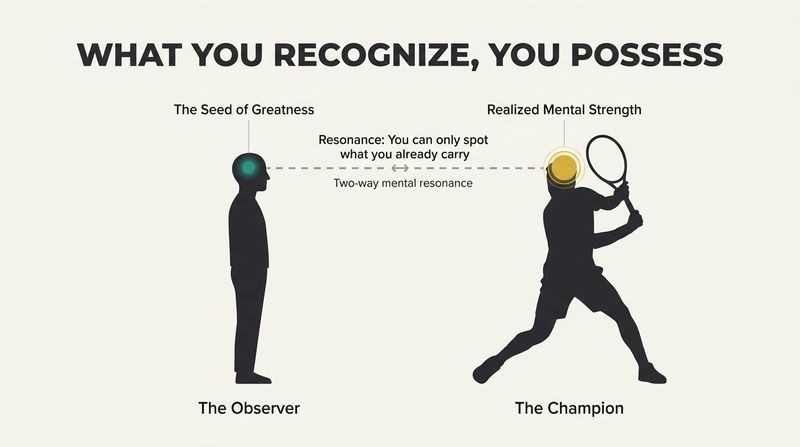
Afremow opens with a mirror trick: the very qualities you admire in elite athletes (Djokovic's poise under pressure, Tiger's Sunday calm) can only be recognized by someone who already possesses seeds of them. Envy and awe make others seem superhuman, but they aren't. Novak Djokovic notes that among the top 100 tennis players, physical difference is tiny; what separates winners is the mental ability to perform at the right moments.
The thesis follows: sport is overwhelmingly mental. Kareem called the mind the thing that makes everything else work. Naturally gifted athletes still log thousands of unglamorous hours. The gap between pedestrian and peak performance begins and ends in the head, and mental strength, like muscle, is trainable through repetition and reinforcement.
The "spot it, got it" claim is motivationally clever but psychologically loose. Recognizing excellence requires only conceptual understanding, not latent capacity (a critic can spot a masterpiece without being able to paint). Still, the deeper point aligns with Anders Ericsson's deliberate practice research and Carol Dweck's growth mindset: elite performance is built, not bestowed. What's striking is how Afremow reframes admiration, usually a passive emotion, into an active diagnostic tool. The risk is overselling mind over matter; genetics and biomechanics matter enormously in elite sport. The honest read: mentality is the largest controllable variable, not the only variable.
Win the day: excellence is a daily deposit, not a rare event
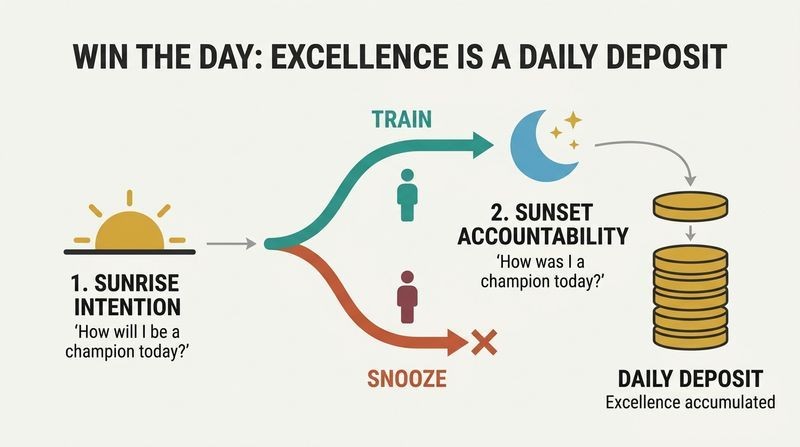
The U.S. Olympic Committee motto captures it: it's not every four years, it's every day. Afremow borrows Chip Kelly's Oregon mantra "Win the day," meaning today is the only arena where talent can actually be expressed. Mark Spitz, who won seven golds in 1972, focused on doing his best today rather than obsessing over tomorrow.
Two gut-check questions anchor the practice:
1. At sunrise: How will I be a champion today? (intention)
2. At sunset: How was I a champion today? (accountability)
Discipline isn't required every second, only at key decision forks: hitting snooze versus training, junk food versus the nutrition plan. Anson Dorrance's note to a young Mia Hamm defined a champion as someone drenched in sweat when nobody is watching.
This echoes James Clear's systems-over-goals argument and BJ Fogg's behavior design: outcomes are lagging indicators of daily process. The neuroscience of habit formation supports the "key moments" framing, willpower is a limited resource best spent at decision points rather than sustained all day. The Dorrance-Hamm anecdote is powerful precisely because it locates virtue in unobserved effort, a private-integrity standard. One caution: relentless daily maximizing can tip into overtraining and burnout, a tension Afremow addresses elsewhere. The daily-deposit metaphor works best when paired with strategic rest, otherwise "win the day" becomes a recipe for depletion.
Feed the good wolf: challenge negative self-talk, don't just endure it
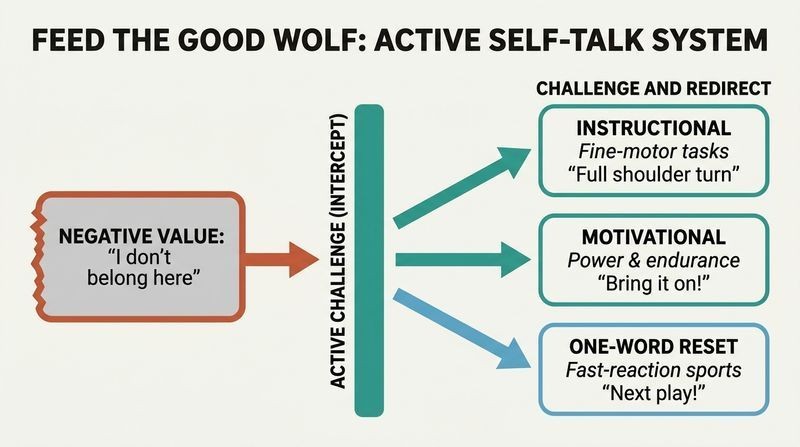
A Cherokee legend frames the mental battle: two wolves fight inside us, one destructive, one constructive, and the one that wins is the one you feed. Afremow turns this into a two-step drill: first identify self-defeating thoughts ("I don't belong here"), then actively replace them with useful ones ("Bring it on").
The research is specific. A 2011 meta-analysis of 32 studies by Hatzigeorgiadis found self-talk measurably improves performance, but type matters:
1. Instructional self-talk ("full shoulder turn") works best for fine-motor tasks like golf.
2. Motivational self-talk ("I'm the best") works best for strength and endurance tasks like sprinting.
In fast-reaction sports, a one-word reset like "Next play!" flushes mistakes before they compound.
The matching of self-talk type to task type is the genuinely useful, evidence-based nugget here, and it's underappreciated in pop sports psychology, which tends to prescribe generic positivity. It connects to cognitive load theory: telling a golfer "I'm awesome" adds nothing actionable, while a technical cue directs attention productively. There's a subtlety worth flagging: research by Ethan Kross shows distanced self-talk (using your own name or "you") outperforms first-person "I" statements for emotional regulation. Afremow's framework would be even sharper with that distinction. The wolf metaphor risks implying thoughts are binary; in practice, cognitive defusion (observing thoughts without fighting them) often beats replacement.
Visualize in first person, feeling it, not watching yourself like film
Mental imagery is rehearsal, not daydreaming, and it works because the brain often can't distinguish vividly imagined action from real action (a nightmare produces real racing heart and sweat). A 2008 MRI study by Hap Davis found athletes reliving success showed heightened activity in the right premotor cortex, the brain's action-planning region, compared to those reliving failure.
Afremow's prescription is precise: visualize through your own eyes (first-person), not as a spectator, and engage every sense using the SFE formula, See it, Feel it, Enjoy it. Javelin champion Steve Backley, injured before the 1996 Olympics, did nearly all his final preparation through visualization instead of physical training and produced one of his best-ever performances, a silver he cherished above gold. Practice two to three times weekly, 10 to 15 minutes.
The functional-equivalence hypothesis (imagery activates similar neural pathways as execution) is well supported, though Afremow slightly overstates it; the brain does distinguish real from imagined, just imperfectly. The first-person versus third-person distinction maps onto real research: internal (kinesthetic) imagery tends to help skill execution, while external imagery can help form. What's often missed is that imagery amplifies whatever it rehearses, so poorly controlled imagery of failure is actively harmful, which is why Afremow insists on repeating until the mental rep is clean. This is essentially neural priming, the same principle behind surgeons and musicians mentally rehearsing before high-stakes performance.
Reframe butterflies as fuel: get them flying in formation
Anxiety before competition is not a malfunction; it's evidence you care. Afremow's guidance flips the instinct to eliminate nerves. Instead, ally with the anxiety and reinterpret physical arousal (pounding heart, sweaty palms) as the body arming itself: "My body is preparing to perform." Panic, he explains, is just an exaggerated false alarm that always eventually subsides.
Key moves include preparation (the more ready you are, the less you fear), even deep breathing (prolonging the exhale triggers the relaxation response), and staying present rather than "futurizing." A related lever is intensity control: every athlete has an optimal arousal zone. Golfers may need to throttle down for a putt; weightlifters throttle up for a max lift. FEAR is reframed as Face Everything And Respond.
This is textbook cognitive reappraisal, and it's backed by strong research. Harvard's Alison Wood Brooks showed that saying "I am excited" before a stressful task beats "I am calm," because anxiety and excitement share the same physiological signature; reappraisal is easier than suppression. The optimal-arousal idea is the century-old Yerkes-Dodson law: performance peaks at moderate arousal and collapses when too low or too high. Afremow's practical contribution is task-specificity, recognizing that the ideal zone differs between a precision putt and an explosive lift. The weakness: reappraisal is harder for people with clinical anxiety, where "just reframe it" can feel dismissive.
Play to win, not to avoid losing; they feel identical but aren't
Some athletes chase something positive; others just run from mistakes. Afremow argues playing not-to-lose is rooted in fear, keeps you on your heels, creates muscle tension, and puts you in a no-win trap. Playing to win is rooted in confidence, keeps you on your toes, and frees you to perform within yourself.
He names two inner opponents: fear of failing and fear of winning (some athletes feel unworthy of the spotlight or shun big victories). Dan O'Brien scored zero in the pole vault at the 1992 Olympic trials, failed to qualify, then used it as a stepping-stone to break the world record and win gold in 1996. The prescription: give yourself permission to win unapologetically and to "fall forward" when you don't.
The distinction maps directly onto regulatory focus theory (Higgins): promotion focus (pursuing gains) versus prevention focus (avoiding losses) produce measurably different strategies, emotions, and even physical postures. Interestingly, the research is more nuanced than Afremow allows; prevention focus can outperform in tasks requiring vigilance and accuracy, while promotion focus wins in creative, risk-tolerant domains. So a defensive lineman and a free-throw shooter may benefit from different orientations. The "fear of winning" concept is underrated and real, tied to impostor phenomenon and self-handicapping. The core insight holds: fear-driven tension is biomechanically costly, tightening the very muscles that need to flow.
Chase the process; let the score find you instead of chasing it
A recurring theme: focus on execution, not outcome. Afremow contrasts two athlete types. The ego-oriented athlete craves awards and external validation, suffers high anxiety, and feels empty even after winning ("what next?"). The mastery-oriented athlete is driven by love of the craft and the pursuit of growth; rewards are icing. Paradoxically, mastery athletes often attract better outcomes.
Curt Tomasevicz's 2010 gold-medal bobsled team, holding a huge lead before the final run, refused to think "don't blow it" and instead approached run four exactly like the previous thousand runs of their careers, trusting talent rather than protecting a result. The zen story of the archer with "one eye on the goal, one eye on the path" reinforces it: fixating on where you want to end up steals attention from what gets you there.
This is the athletic expression of what Mihaly Csikszentmihalyi called flow (autotelic, intrinsically motivated absorption) and what self-determination theory (Deci and Ryan) identifies as intrinsic versus extrinsic motivation. Decades of evidence show intrinsic motivation predicts persistence and well-being better than trophy-chasing, and that dangling external rewards can actually undermine intrinsic drive (the overjustification effect). The "paradox" Afremow notes, that not chasing outcomes produces better outcomes, is real: outcome anxiety consumes working memory and disrupts automaticity. The caveat is that elite sport is ruthlessly outcome-measured, so pure process orientation is aspirational; the skill is compartmentalizing outcome focus to preparation and process focus to performance.
Adopt "always a student": talent grows, it isn't a fixed trait
Afremow leans on Carol Dweck's Stanford research distinguishing a growth mindset (abilities can be developed through dedication) from a fixed mindset (talent is a static trait). Champions embrace the zen idea that even a master can improve at what she already does well.
Edwin Moses is the case study: he won 400-meter hurdles gold in 1976 and 1984 and reeled off 107 consecutive finals wins over a decade. He credited success not to superior physical gifts but to outsmarting, out-thinking, and out-preparing rivals who were more talented. The corollary lessons: seek help from specialists without shame (asking is strength, not weakness), stay coachable (empty your cup, as the zen tea master tells the overfull professor), and treat failure as a teacher, Michael Jordan missed over 9,000 shots and credits that for his success.
Dweck's mindset framework has faced replication scrutiny; some large-scale studies find growth-mindset interventions produce small effects, strongest for struggling and disadvantaged students. That doesn't invalidate the concept but tempers the miracle framing common in motivational books. The stronger evidence sits with Ericsson's deliberate practice: what matters is not just believing you can improve but structuring effortful, feedback-rich practice at the edge of ability. Afremow's "empty your cup" and "seek specialists" advice is the practical bridge, coachability is the behavioral expression of a growth mindset. The Moses example is compelling because it foregrounds preparation intelligence over raw talent, a healthy corrective to genetic determinism.
Delay gratification like the marshmallow kids who scored higher later
Afremow recruits Walter Mischel's 1972 Stanford marshmallow experiment: children offered one marshmallow now or two if they waited about 15 minutes. Roughly a third held out. Follow-ups years later found the waiters had higher SAT scores and were rated more competent as young adults. Self-control, he argues, is a secret of champions who tolerate short-term frustration for larger rewards.
The practical translation: build personal delay tactics for your own marshmallow tests, distraction, deep breathing, or a shouted cue like "Go for the gold!" when tempted to cut a workout short or stray from a nutrition plan. He pairs this with the Asch conformity study (75% of subjects agreed with an obviously wrong group answer at least once) to warn against groupthink: don't let peers drag your standards down.
Honesty requires noting that the marshmallow test has aged poorly under replication. A 2018 study (Watts, Duncan, Quan) found the predictive power largely vanished after controlling for family income and background, suggesting the test partly measured affluence and environmental stability rather than innate willpower. Poorer children rationally grab the sure thing because promises are less reliable in their world. So "just delay gratification" can moralize what is often circumstance. That said, the core skill (self-regulation via attention deployment, exactly what Mischel's successful kids did by looking away or distracting themselves) remains trainable and valuable. The Asch pairing is apt: conformity pressure is a real, documented threat to individual standards.
Your body wins when your mind refuses to quit: brain over pain
Afremow distinguishes noninjury discomfort (the price of growth) from genuine injury pain (a stop signal). Endurance sport is largely a "suffer-fest," and champions learn to move through the wall (runners) or the bonk (cyclists). Ann Trason observed that pain hurts up to a point and then plateaus. Techniques include shifting attention to what feels good (one elite runner focuses on his eyelids, the only part that doesn't hurt), metaphorical imagery (a swimmer leaving pain in her wake), and Dave Scott's mantra "do what I can do in this moment."
Crucially, this pairs with regeneration. Vince Lombardi warned that fatigue makes cowards of us all. A 2006 study found a 10-minute nap most recuperative for the sleep-deprived, beating 20 or 30 minute naps. Relax the body so you can tax the body.
The pain-plateau intuition matches current exercise physiology: the brain, not the muscles, is often the limiter. Tim Noakes's "central governor" model proposes the brain regulates effort to protect the body, meaning perceived exertion can be modulated by attention, expectation, and mood, which is exactly why attentional strategies work. The nap finding reflects sleep-cycle architecture: naps under about 20 minutes avoid slow-wave sleep and its groggy sleep inertia. The essential ethical guardrail Afremow includes is real, distinguishing productive discomfort from injury signals, since "push through everything" culture drives overuse injuries and, in cases like concussions, catastrophic harm. Toughness without discernment is recklessness.
Rehab is your new sport: master the injury before it masters you
Injuries are near-universal in athletics, and Afremow reframes recovery as a competitive event in itself, bringing the champion's mindset to the training room. He maps the five stages of loss (shock/denial, anger, bargaining, depression, acceptance) so athletes recognize the emotional terrain, and stresses talking about feelings rather than isolating.
Diver Laura Wilkinson broke three bones in her foot before the 2000 Olympic trials, couldn't dive for two months, and visualized ripping her dives daily; she won gold in Sydney with a still-unhealed foot. The prescription: be patient but persistent (underdoing prolongs recovery, overdoing risks reinjury), fire up imagination to picture the injured area healing, and spin a negative into a positive by training the uninjured half of the body. Every setback is framed as an opportunity for a comeback.
The Kubler-Ross five stages, borrowed from grief research, is a useful heuristic but was never empirically validated as a fixed sequence; people cycle, skip, and repeat stages unpredictably, so athletes shouldn't feel abnormal for not "progressing" tidily. The genuinely evidence-based element is imagery for rehab: motor imagery and observation activate overlapping neural circuits and can slow strength loss in immobilized limbs, a phenomenon documented in neurophysiology. Wilkinson's story illustrates this vividly. The social-support emphasis is also well founded; research links strong support networks to faster rehabilitation adherence and better psychological outcomes. Reframing rehab as a sport is smart because it preserves athletic identity, whose loss often drives injury-related depression.
Sustained obsession, not talent, separates the durable champions
Longevity at the top is by choice, not chance. Rower Brad Alan Lewis, 1984 Olympic gold medalist, coined "sustained obsession": the obsession is easy, keeping it sustained is the hard part. He broke his training into one-day battles against local rivals who "deserve most of my medal." The chicken-and-pig fable clarifies the standard: opening a ham-and-eggs restaurant, the chicken is merely involved, the pig is fully committed. Pat Riley put it bluntly, you're either in or out, no life in between.
Afremow catalogs staying power: Jerry Rice sprinting uphill while others quit, Bob Tewksbury pitching 11 years despite two arm surgeries through resilience and appreciation, Roger Federer protecting longevity by refusing to overplay. Age is often no barrier, Satchel Paige pitched in the majors at 59, and Sybil Newall won Olympic archery gold at 53.
"Sustained obsession" is the folk version of what researchers call grit (Angela Duckworth: passion plus perseverance toward long-term goals), which predicts achievement across domains, though its predictive edge over conscientiousness is debated. Lewis's one-day-segment method is psychologically shrewd; it converts an overwhelming multi-year goal into tractable daily contests, mirroring proximal-goal research showing near-term subgoals sustain motivation better than distant ones. The tension in this chapter, total obsession versus Federer-style regeneration, is the crux: the durable champions aren't the ones who train hardest but the ones who balance obsession with strategic recovery. Pure all-in commitment without rest predicts burnout, the very fate that ends most promising careers early.
Analysis
The Champion's Mind sits in a crowded genre (applied sport psychology for lay athletes) but distinguishes itself through density and voice. Afremow, a practicing sport psychologist, structures the book less as a linear argument than as a curated "peak-performance jar," hundreds of short, drawable lessons stitched together with Olympic anecdotes, zen parables, and cited studies. This is both its strength and its summarizing challenge: there is no single load-bearing framework like Atomic Habits' Four Laws, but rather a mosaic of interlocking mental skills (imagery, self-talk, arousal control, focus, confidence) unified by one thesis, that the trainable mind is the largest controllable variable in performance.
What elevates the book above motivational filler is Afremow's discipline in grounding claims in named research: Hatzigeorgiadis on self-talk typing, Davis's fMRI imagery work, Mischel's marshmallow test, Asch on conformity, Strack's pen-in-teeth facial-feedback study. Some of these have since weakened under the replication crisis (marshmallow, facial feedback, and arguably mindset interventions), which a careful modern reader should note. The book predates that reckoning, so it presents findings with more certainty than current evidence warrants. This is the main scholarly vulnerability.
The deeper intellectual through-line, largely implicit, is a stoic-buddhist synthesis: control the controllables, detach from outcomes, stay present, treat adversity as material. Afremow essentially operationalizes Epictetus and zen practice into locker-room technique. That fusion is the book's most transferable contribution beyond sport; the same tools serve any high-stakes performer.
The audience is genuinely broad (recreational to Olympic), and the writing is deliberately skimmable, designed for consumption in fragments before practice. The cost is repetition and occasional over-claiming ("90 percent mental"). But the practical value is high: unlike many mindset books, Afremow gives concrete drills, breathing counts, imagery protocols, journaling prompts, rather than vague exhortation. It is a reference manual disguised as inspiration.
Review Summary
The Champion's Mind receives mostly positive reviews, with readers praising its practical advice on mental training for athletes and its applicability to everyday life. Many find the book motivational and insightful, appreciating the blend of psychological techniques, athlete anecdotes, and Eastern wisdom. Some critics note repetitiveness and a lack of depth in certain areas. Overall, readers value the book's focus on developing a champion's mindset, goal-setting, visualization, and mental toughness, with many finding it useful for both sports and personal development.
People Also Read






FAQ
What's The Champion's Mind about?
- Focus on Mental Skills: The Champion's Mind by Jim Afremow emphasizes the importance of mental skills and strategies for enhancing athletic performance. It explores how a champion's mindset can lead to success in sports and life.
- Practical Techniques: The book offers practical techniques for athletes at all levels to develop mental toughness, focus, and resilience. These strategies are designed to be actionable and immediately applicable.
- Holistic Approach: Afremow discusses the significance of physical fitness, nutrition, and recovery alongside mental training, ensuring a well-rounded preparation for athletes.
Why should I read The Champion's Mind?
- Expert Insights: The book is filled with insights from Olympic champions and sports psychologists, making it a credible resource for improving the mental game.
- Applicable to All: While targeted at athletes, the principles are applicable to anyone striving for excellence in any field, including academic and professional pursuits.
- Motivational Content: Motivational quotes and stories inspire readers to push through challenges and strive for their personal best, encouraging a mindset of growth and resilience.
What are the key takeaways of The Champion's Mind?
- Mental Training is Essential: Mental training is as crucial as physical training for athletes, significantly impacting performance outcomes.
- Goal Setting and Visualization: Setting clear goals and using visualization techniques are highlighted as methods to enhance performance and mental preparation.
- Resilience and Adaptability: The ability to bounce back from setbacks and adapt to challenges is crucial for success, with strategies provided for managing pressure and maintaining focus.
What are the best quotes from The Champion's Mind and what do they mean?
- “The mind is a powerful thing.”: This quote underscores the significance of mental strength in achieving athletic success, suggesting that belief in oneself can lead to improved performance.
- “Don’t envy the champion—be the champion.”: Encourages readers to take action towards their goals rather than merely admiring others' successes, promoting a proactive approach to personal development.
- “Success is peace of mind.”: Reflects the idea that true success comes from knowing you have put in the effort to achieve your goals, emphasizing self-satisfaction over external validation.
How does The Champion's Mind define mental toughness?
- Resilience Under Pressure: Mental toughness involves remaining positive and proactive in adverse situations, maintaining focus and composure during high-pressure moments.
- Commitment to Improvement: Built through consistent effort and a commitment to self-improvement, athletes must push through discomfort and challenges to develop this trait.
- Self-Belief and Confidence: Closely linked to self-belief and confidence, athletes must trust their training and abilities to perform at their best.
What specific techniques does The Champion's Mind recommend for goal setting?
- SMART Goals Framework: Afremow suggests using the SMART criteria (Specific, Measurable, Achievable, Relevant, Time-bound) to set effective goals, helping athletes clarify objectives and track progress.
- Visualization of Goals: Encourages athletes to visualize their goals to enhance motivation and focus, creating a mental blueprint for achieving desired outcomes.
- Regular Review and Adjustment: Athletes are advised to regularly review and adjust their goals, ensuring alignment with evolving aspirations and circumstances.
How can athletes manage anxiety according to The Champion's Mind?
- Reframe Anxiety as Excitement: Viewing anxiety as a natural response that can be channeled into positive energy helps athletes perform better under pressure.
- Breathing Techniques: Emphasizes deep breathing to calm nerves and maintain focus, reducing physical symptoms of anxiety and promoting relaxation.
- Preparation and Practice: Being well-prepared for competitions can significantly reduce anxiety levels, as confidence in training leads to less anxiety during performance.
What role does nutrition play in The Champion's Mind?
- Fuel for Performance: Proper nutrition is essential for optimal athletic performance, providing necessary energy and nutrients to support training and recovery.
- Mindful Eating: Encourages athletes to practice mindful eating, enhancing their relationship with food and improving overall well-being.
- Hydration and Recovery: Highlights the importance of staying hydrated and focusing on recovery nutrition, aiding in performance and reducing injury risk.
How does The Champion's Mind suggest athletes deal with injuries?
- Mental Resilience: Emphasizes maintaining a positive mindset during recovery, focusing on controllable aspects and staying committed to rehabilitation.
- Consulting Professionals: Advises seeking guidance from medical professionals and sports trainers for effective injury management, ensuring safe and efficient recovery.
- Setting Recovery Goals: Encourages setting specific goals for the recovery process, maintaining motivation and providing a clear path to returning to peak performance.
What is the significance of self-talk in The Champion's Mind?
- Positive Reinforcement: Self-talk can significantly influence performance, with positive self-talk boosting confidence and helping athletes overcome challenges.
- Feeding the Good Wolf: Uses the metaphor of the "two wolves" to illustrate nurturing positive thoughts, encouraging athletes to focus on constructive self-statements.
- Managing Negative Thoughts: Athletes are taught to recognize and challenge negative self-talk, reframing these thoughts into positive affirmations to enhance mental resilience.
How can I develop a champion's mindset according to The Champion's Mind?
- Set Clear Goals: Establish both short-term and long-term goals to provide direction and motivation, helping athletes stay focused on progress and achievements.
- Practice Visualization: Use mental imagery to visualize successful performances and outcomes, enhancing confidence and preparing the mind for competition.
- Maintain Positive Self-Talk: Replace negative thoughts with positive affirmations to build confidence and resilience, staying focused and motivated during challenges.
What role does relaxation play in athletic performance as discussed in The Champion's Mind?
- Essential for Recovery: Relaxation techniques are crucial for physical and mental recovery after intense training or competition, reducing stress and preventing burnout.
- Improves Focus: Regular relaxation practices enhance concentration and mental clarity, allowing athletes to perform better under pressure.
- Balance Training and Recovery: Emphasizes balancing hard training with adequate relaxation, key to sustaining long-term performance and avoiding injuries.
Download PDF
Download EPUB
.epub digital book format is ideal for reading ebooks on phones, tablets, and e-readers.








































