
Key Takeaways
A hidden DC current system wraps every nerve and controls healing
“The DNA-RNA apparatus isn't the whole secret of life, but a sort of computer program by which the real secret, the control system, expresses its pattern in terms of living cells.”
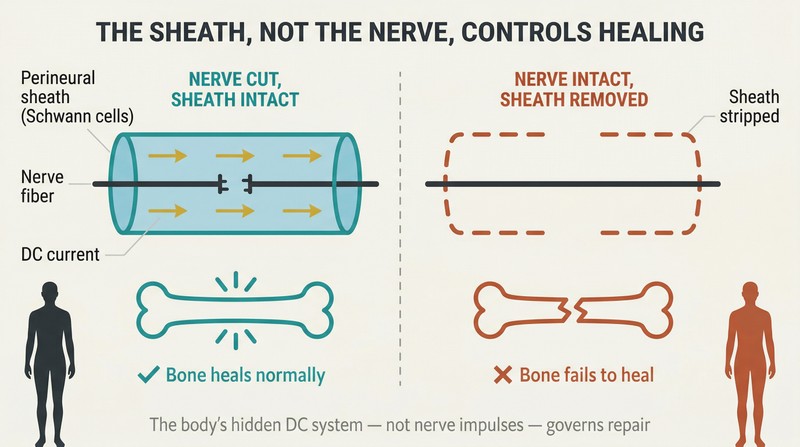
Every nerve wears a cellular sleeve. Becker discovered that perineural cells — Schwann cells sheathing peripheral nerves, glia surrounding brain neurons, and ependyma lining the spinal canal — carry semiconducting direct currents throughout the body. This analog system predates nerve impulses evolutionarily and operates alongside them like a background operating system beneath a faster digital network.
The evidence was decisive. In rat experiments, cutting nerve fibers but leaving Schwann cell sheaths intact preserved normal fracture healing. Intact nerves without their sheaths could not heal bone. The system's voltages rise during wakefulness, fall during rest, and reverse under anesthesia — tracking consciousness itself. Becker proposed this perineural DC system as the body's master integrator of growth, pain, and biological rhythms.
Salamanders regrow limbs because their wound current goes negative
“It's as if a pile of bricks were to spontaneously rearrange itself into a building, becoming not only walls but windows, light sockets, steel beams, and furniture in the process.”
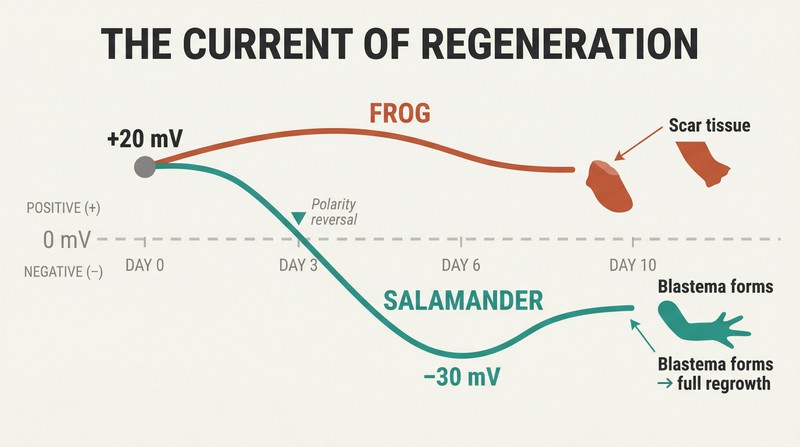
Becker's first experiment was disarmingly simple. He amputated the right forelegs of fourteen salamanders and fourteen frogs, then measured voltage at each stump daily. Both species initially showed a positive current of about 20 millivolts. Then the readings diverged dramatically. Frog voltages stayed positive and slowly declined as stumps scarred over. Salamander voltages dropped to zero by day three, then reversed to over 30 millivolts negative by days six through ten — precisely when the blastema appeared.
The blastema is regeneration's engine. This mass of primitive, dedifferentiated cells forms beneath the wound epidermis like a miniature embryo. Its cells then redifferentiate into every tissue needed — bone, cartilage, muscle, blood vessels, and nerves — all in perfect anatomical position. The negative polarity seemed to summon these cells into action.
A trillionth of an ampere can rewind a mature cell to embryonic state
“The potential repertoire of living cells is absolutely enormous, far greater than the healing powers normally manifested by most animals or even those dreamed of by doctors.”
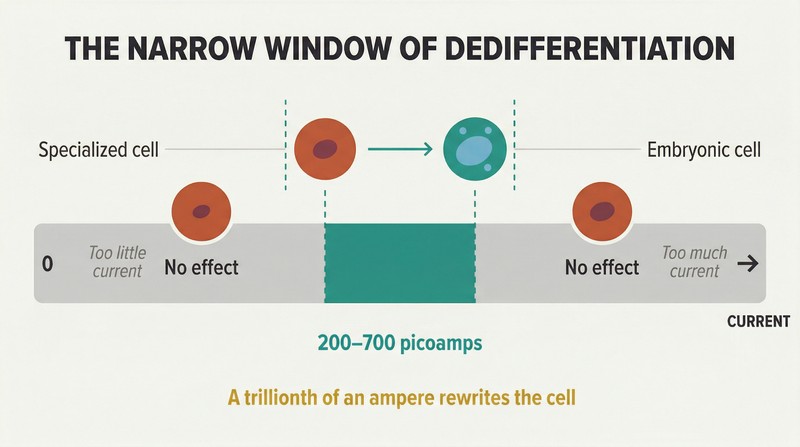
Dedifferentiation was scientific heresy. For decades, biology insisted that once a cell specialized — into muscle, blood, or bone — it could never revert. Becker proved otherwise by passing 200 to 700 picoamps through frog red blood cells in plastic chambers. Within hours, cells lost their hemoglobin, reactivated their shrunken nuclei, assembled new ribosomes and mitochondria, and became primitive cells indistinguishable from embryonic tissue.
The effective window was astonishingly narrow — too much or too little current did nothing. When the antibiotic puromycin was added to block protein synthesis, the genetic unlock still occurred but couldn't be expressed. Washing out the puromycin then allowed full transformation without any current, proving the electrical signal acted directly on DNA activation rather than merely degrading cells.
Bone is a living semiconductor that directs its own remodeling
“This was the first time that a complete circuit diagram of a growth process could be made.”
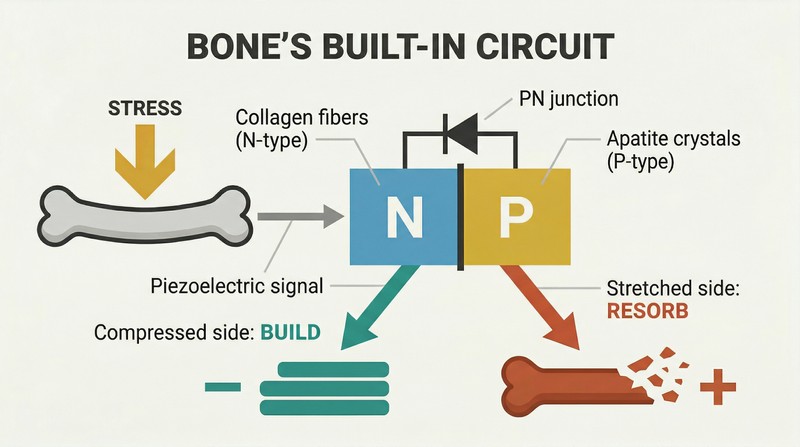
Bone's inner electronics are astonishing. Becker and physicist Charlie Bachman discovered that bone's collagen fibers are N-type semiconductors while its apatite crystals are P-type. Their interface forms a natural PN junction diode — the same component in a transistor radio. When bone bends under stress, collagen generates a piezoelectric signal. The diode rectifies it, filtering the positive rebound and leaving a negative growth signal on the compressed side.
This decoded Wolff's law electronically. The negative signal tells periosteal cells to build more bone where stress demands it; the positive signal on the stretched side triggers resorption. They even found that trace copper atoms form atomic pegs at the PN junction, holding apatite crystals to collagen fibers — a discovery that may eventually explain osteoporosis.
Electrically driven silver ions kill every bacteria type and grow tissue
“We may only have scratched the surface of positive silver's medical brilliance.”
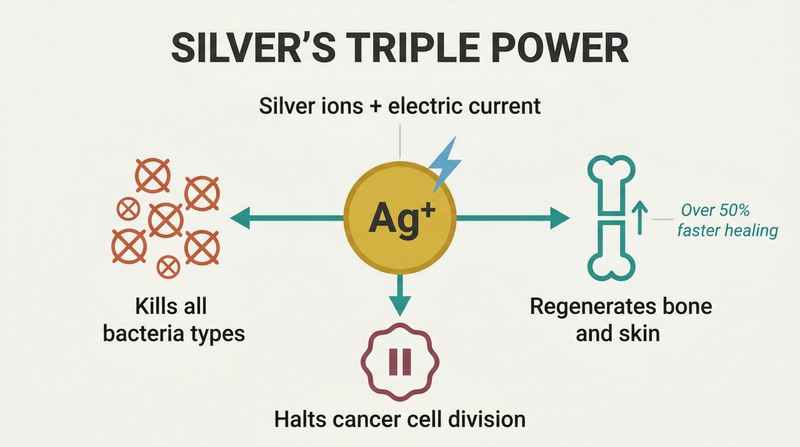
John the muskrat trapper was about to lose his leg. After three years of infected, nonhealing fractures, his shin was an open wound harboring five different bacteria — no antibiotic could fight them all. Becker laid silver-coated nylon carrying a small positive current over the wound. Within a week, all five bacterial types were dead. Unexpectedly, bone started growing under the positive electrode, which should only have inhibited growth.
Silver's triple power stunned the researchers. Further experiments revealed that electrically driven silver ions dedifferentiated fibroblasts into primitive cells resembling young bone marrow. In pig studies, silver nylon accelerated skin wound healing by over 50 percent. In human cancer cell cultures, silver ions suspended runaway mitosis without harming normal cells — opening a potential pathway to tumor control.
Children regrow severed fingertips — standard surgery prevents it
“Whatever we achieve pales before the self-healing power latent in all organisms.”
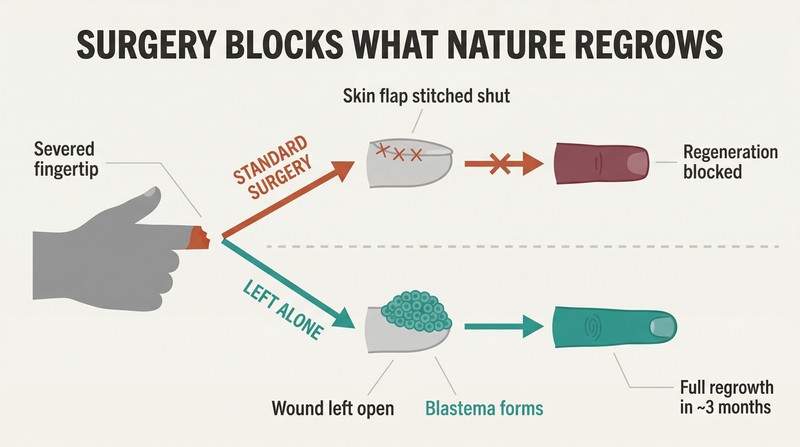
A clerical mix-up changed medicine. At Sheffield Children's Hospital in the 1970s, a surgeon's referral was lost. When the error was discovered, surgeon Cynthia Illingworth noticed the child's amputated fingertip was regenerating on its own. She documented several hundred cases: children under eleven who lost fingertips beyond the outermost joint crease consistently regrew bone, nail, skin, nerves, and fingerprints in about three months.
A blastema forms, just as in salamanders. This is true multitissue regeneration, triggered by a negative current of injury leaving the stump. But the standard surgical treatment — stitching a skin flap over the wound — blocks it entirely. Pediatric surgeon Michael Bleicher laments that most colleagues still choose stitches over nature, dismissing the evidence as hogwash.
Cancer may be regeneration without the control signal
“In our war on cancer we've stampeded ourselves into a sort of Vietnam syndrome: To destroy our foes, we're killing our friends.”
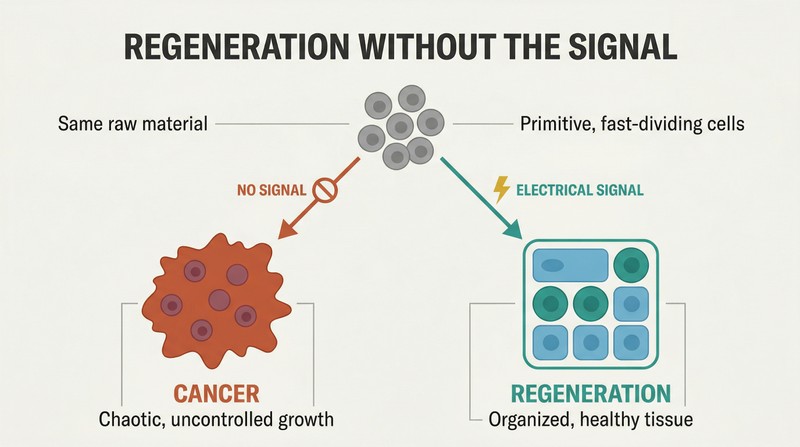
Animals that regenerate best get the least cancer. Salamanders are nearly immune to malignancy; frogs, which barely regenerate, get several types. When Meryl Rose transplanted frog tumor cells into a salamander limb and then amputated through the cancer, the regenerative electrical environment normalized the cancer cells. They dedifferentiated and then re-specialized as healthy muscle and cartilage alongside the blastema.
Even metastatic cancer could be reversed. Seilern-Aspang induced skin cancer in salamanders with carcinogens, then amputated a nearby tail. Regeneration eliminated both the primary tumor and all distant metastases, as though by remote control. Cancer cells share all the hallmarks of embryonic cells — they're primitive, fast-dividing, and metabolically dominant — but lack the electrical guidance that regeneration provides.
Earth's 10-Hz electromagnetic pulse synchronizes all biological clocks
“The most powerful shaper of our development may turn out to be the subtlest, a force that's completely invisible to us.”
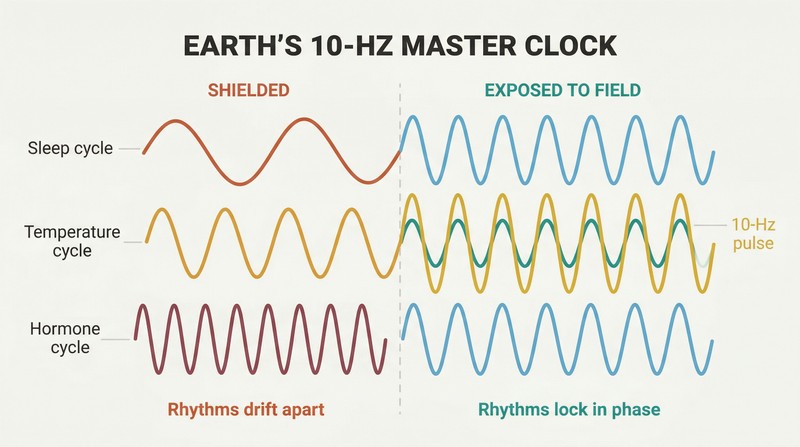
In underground bunkers near Munich, physicist Rutger Wever isolated hundreds of volunteers from all time cues for up to two months. Those still exposed to earth's electromagnetic field maintained near-24-hour rhythms. Those in magnetically shielded rooms became thoroughly desynchronized — sleep, temperature, and hormone cycles drifted apart. Only one intervention restored order: an electric field of just 0.025 volts per centimeter pulsing at 10 hertz.
That frequency is life's master clock. It matches earth's dominant micropulsation, the alpha rhythm in every animal's brain, and possibly the resonant frequency of the Precambrian atmosphere where life originated. The pineal gland, producer of melatonin and serotonin, responds directly to magnetic fields of half a gauss or less. A 1980 study found that a weak 60-Hz field canceled rats' normal nightly melatonin rise.
Power line fields doubled childhood leukemia in the first large study
“All life pulsates in time to the earth, and our artificial fields cause abnormal reactions in all organisms.”
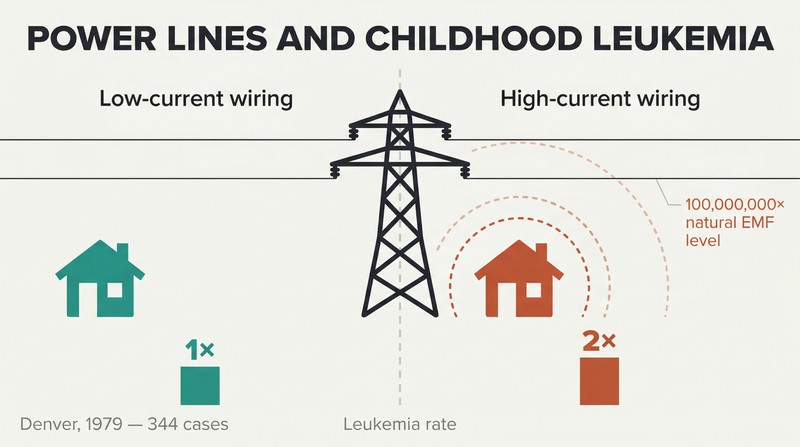
Radio-wave density around us is 100 million times the natural level from the sun. In 1979, Wertheimer and Leeper studied 344 childhood cancer deaths in Denver, mapping each address against power line wiring. The leukemia death rate in homes with high-current wiring was more than double the rate in low-current homes. Stockholm researchers confirmed the finding. Milham found elevated leukemia in adult electrical workers.
The mechanism runs through biological timing. ELF fields at 30 to 100 hertz — the frequencies nearest natural micropulsations — disrupt cell-cycle timing, trigger chronic stress hormones, and impair immune function, all documented in lab animals at power densities well below U.S. safety standards. Becker's team also found suicide rates 40 percent higher in areas with the strongest magnetic fields. Soviet researchers discovered that bacteria became more antibiotic-resistant in electric fields barely above earth's background.
Becker's lab was defunded for testifying about power line dangers
“These energies are too dangerous to be entrusted forever to politicians, military leaders, and their lapdog researchers.”

After testifying at New York State hearings that power line fields posed documented health risks, and after helping write the suppressed Navy report on Project Sanguine — an ELF submarine antenna — Becker's NIH grants were canceled, his VA funding blocked, and his laboratory disbanded in 1980. The NAS committee assigned to review Sanguine included three scientists who had just testified for the power companies at the same hearings.
The pattern is systemic. When colleague Andy Marino was denied funding, the anonymous reviewer turned out to be a rival who had publicly accused Becker of fraud. Marino was offered a job as night administrative officer. Peer review, Becker argues, has become a self-perpetuating priesthood that rewards conformity and punishes discovery — especially when discovery threatens the military-industrial interests that fund two thirds of American research.
Analysis
The Body Electric is a rare artifact in science writing: a book ahead of its time in 1985 that remains ahead of mainstream medicine four decades later. Becker's central claim — that the body possesses a semiconducting DC electrical system controlling growth, healing, and consciousness — has been partially vindicated by subsequent bioelectricity research. His bone-healing electrodes evolved into FDA-approved devices used on tens of thousands of patients. His observations about dedifferentiation anticipated the induced pluripotent stem cell revolution by decades — Shinya Yamanaka won the 2012 Nobel Prize for chemically achieving what Becker demonstrated electrically in the 1960s.
Yet the book also serves as an institutional autopsy. Becker documents how peer review became a mechanism for enforcing orthodoxy, how military-industrial interests corrupted safety standards, and how inconvenient scientists were systematically defunded. The patterns he identified — regulatory capture, suppression of environmental health data, career destruction of whistleblowers — have only intensified since publication.
The electropollution chapters deserve the most careful contemporary reading. While some speculative claims (the Soviet 'woodpecker' as a bioweapon, ESP via biofields) remain unsubstantiated, Becker's core warning — that chronic artificial electromagnetic exposure disrupts biological timing and growth control — now has considerably more epidemiological support. The WHO classified ELF magnetic fields as 'possibly carcinogenic' in 2002, citing precisely the evidence Becker championed.
Where the book shows its age is in passages on the origin of life and parapsychology, which lack the experimental rigor characterizing Becker's best work. These sections arguably weakened credibility among the skeptical audience it most needed to reach. The enduring power of The Body Electric lies in its insistence that reductionism, while useful, is insufficient. The body is not merely a bag of chemicals to be titrated — it is an electromagnetic organism whose deepest healing capacities remain untapped and whose vulnerability to our electromagnetic environment remains largely unacknowledged.
Review Summary
The Body Electric is praised as a groundbreaking work exploring the role of electricity in biological processes. Readers appreciate Becker's innovative research on regeneration and healing, as well as his insights into the potential harmful effects of electromagnetic fields. Many find the book fascinating and life-changing, though some note its technical complexity. Reviewers commend Becker's integrity in challenging scientific orthodoxy and exposing political interference in research. The book is seen as both scientifically rigorous and accessible, offering valuable perspectives on health, biology, and the nature of scientific progress.
Glossary
Blastema
Mass of primitive regenerating cellsA mound of dedifferentiated, unspecialized cells that forms at the site of a wound in animals capable of regeneration, such as salamanders. The blastema functions like a miniature embryo, containing totipotent cells that redifferentiate into all tissue types—bone, muscle, nerve, blood vessel—needed to rebuild the missing part. Its formation is triggered by electrical signals from the neuroepidermal junction.
Dedifferentiation
Cells reverting to primitive stateThe process by which a mature, specialized cell reverts to a primitive, embryonic state by reactivating previously repressed genes. Long considered impossible by mainstream biology, Becker demonstrated it could be triggered by extremely small DC currents in the range of 200 to 700 picoamps. Dedifferentiated cells can then re-specialize into entirely different cell types through redifferentiation.
Neuroepidermal junction (NEJ)
Nerve-skin regeneration triggerA microscopic connection formed when nerve fiber tips grow into the thickened epidermis at the site of an amputation wound. Each nerve fiber forms a tiny synapse-like bulb against an epidermal cell. The NEJ generates the specific electrical current—initially positive, then reversing to negative—that triggers dedifferentiation and blastema formation. Charles Thornton proved in 1954 that this junction is the one pivotal step before regeneration can begin.
Current of injury
Wound's electrical signalAn electrical current emanating from any wound in a living organism, first discovered by Galvani in 1794 and confirmed by Matteucci in the 1830s. Long dismissed as a trivial side effect of dying cells leaking ions, Becker showed it persists for days or weeks, varies proportionally with the amount of nerve tissue present, and differs in polarity between regenerating animals (which reverse to negative) and non-regenerating ones (which stay positive).
Perineural DC system
Body's analog electrical networkBecker's proposed system of semiconducting direct currents carried throughout the body by perineural cells—Schwann cells surrounding peripheral nerves, glial cells in the brain, and ependymal cells lining the spinal canal. This system operates alongside nerve impulses as an analog information channel, controlling healing, pain perception, biological rhythms, and levels of consciousness. Its existence was confirmed by Hall effect measurements, nerve-freezing experiments, and the finding that Schwann cell sheaths carry the healing signal even after nerve fibers are destroyed.
Wolff's law
Bone reshapes to match stressThe principle, discovered by nineteenth-century surgeon J. Wolff, that bone grows into whatever shape best meets the mechanical demands placed on it. Becker and Bachman decoded the electrical mechanism: piezoelectric signals from bent collagen fibers are rectified by a natural PN junction diode formed at the collagen-apatite interface, producing a negative growth signal on the compressed side and a positive resorption signal on the stretched side.
PN junction diode
Semiconductor rectifier in boneA device formed where a P-type semiconductor (apatite, in bone) meets an N-type semiconductor (collagen). It passes current in one direction only, filtering out unwanted signals. In bone, the PN junction rectifies the biphasic piezoelectric signal generated by mechanical stress, removing the positive rebound pulse and leaving only the negative growth-stimulating signal. Becker and Bachman were the first to identify this electronic component in living tissue.
Polezhaev principle
Bigger injury triggers better regrowthThe observation, derived from Russian biologist Lev Polezhaev's work, that increasing injury severity can paradoxically improve regeneration. Polezhaev showed that pricking frog limb stumps daily with needles induced partial regrowth. The principle reached its extreme in Becker's discovery that newt hearts regenerated perfectly only when 30 to 50 percent was destroyed—small wounds healed slowly and incompletely. Something about massive damage activates the body's full regenerative capacity.
L-field
Burr's electromagnetic life fieldA term coined by Yale physiologist Harold Saxton Burr for the electromagnetic field he measured around all living organisms. Burr proposed this 'field of life' held the organism's shape like a mold and that faults in the field could reveal latent illness. While Burr's measurements were valid and his work pioneered bioelectric measurement, his theoretical framework was too simplistic to account for the complexity of biological structures. His later writings veered into questionable applications.
FAQ
What's The Body Electric about?
- Exploration of Electromagnetism: The book investigates the role of electromagnetism in biological processes, focusing on how electrical currents influence healing and regeneration.
- Regeneration Research: It highlights the author's research on regeneration, particularly in salamanders, and explores potential applications in human medicine.
- Critique of Modern Medicine: Becker critiques the reductionist approach of modern medicine, advocating for the consideration of the body's innate healing abilities and the importance of electrical signals.
Why should I read The Body Electric?
- Innovative Insights: The book offers groundbreaking ideas about the relationship between electricity and biological processes, potentially reshaping our understanding of healing.
- Interdisciplinary Approach: It combines biology, medicine, and physics, appealing to readers interested in the intersection of these fields.
- Practical Applications: Becker discusses potential medical applications, particularly in treating nonunions and infections, which could benefit healthcare professionals.
What are the key takeaways of The Body Electric?
- Electrical Currents and Healing: Electrical currents are crucial in the healing process, as demonstrated by limb regeneration in salamanders.
- Dedifferentiation and Regrowth: The concept of dedifferentiation is introduced, where specialized cells revert to a primitive state to aid regeneration.
- Human Application Potential: The findings suggest that similar techniques could be applied to humans, especially in treating fractures and infections.
How does Becker connect electricity to healing in The Body Electric?
- Current of Injury: Becker describes the "current of injury," an electrical signal at a wound site that initiates healing.
- Electrical Potentials: Different electrical potentials in tissues correlate with healing stages, particularly in bone and soft tissue.
- Practical Applications: Understanding these signals could lead to new treatments for enhancing human healing.
What is dedifferentiation as described in The Body Electric?
- Definition of Dedifferentiation: It is the process where specialized cells revert to a more primitive state, allowing them to proliferate and differentiate into various cell types.
- Role in Regeneration: Essential for regeneration, particularly in amphibians like salamanders, where red blood cells dedifferentiate to form new tissues.
- Experimental Evidence: Electrical stimulation can induce dedifferentiation in frog red blood cells, leading to blastema formation.
What are the implications of Becker's research for modern medicine?
- Revolutionizing Treatment Approaches: Findings could lead to new methods for treating fractures and infections, shifting from chemical treatments to electrical stimulation.
- Holistic Understanding of Healing: Encourages a holistic view of medicine that incorporates natural healing processes and electrical activity.
- Potential for Regeneration: Opens the possibility of inducing regeneration in humans, previously considered impossible.
How does Becker address the concept of electropollution in The Body Electric?
- Definition of Electropollution: Discusses the negative effects of artificial electromagnetic fields on biological systems, disrupting natural electrical processes.
- Health Implications: Warns that exposure to electropollution can interfere with natural healing abilities and contribute to health issues.
- Call for Awareness: Advocates for greater awareness and research into electromagnetic fields' effects on health, urging a balance between technology and biological integrity.
What is the significance of electrical currents in regeneration as discussed in The Body Electric?
- Role of Ependymal Cells: Ependymal cells are crucial for regeneration, creating pathways for nerve fibers to regrow.
- Polarity and Healing: The electrical environment, particularly current polarity, can inhibit or promote cellular activity and healing.
- Experimental Evidence: Manipulating electrical currents can lead to successful regeneration in animal models, suggesting potential human applications.
How does Becker relate cancer to regeneration in The Body Electric?
- Cancer as Dedifferentiation: Cancer cells may represent dedifferentiation, where mature cells revert to a primitive state, similar to regeneration cells.
- Regenerative Abilities and Cancer Resistance: Animals with strong regenerative capabilities, like salamanders, tend to have lower cancer incidences, suggesting a link.
- Potential for Controlling Cancer: Understanding regeneration mechanisms could lead to new cancer treatment approaches, focusing on restoring normal cellular functions.
What are the dangers of electromagnetic fields discussed in The Body Electric?
- Health Risks: Exposure to artificial electromagnetic fields can lead to health issues, including stress responses and increased cancer risk.
- Subliminal Stress: Low-level electromagnetic fields can activate stress responses without conscious awareness, leading to long-term health consequences.
- Call for Regulation: Advocates for stricter regulations on electromagnetic exposure, emphasizing the need for research to understand these fields' full impact on health.
How does Becker’s work challenge traditional views in medicine?
- Critique of Reductionism: Argues against the reductionist approach in medicine, advocating for a holistic understanding that includes bioelectricity.
- Integration of Mind and Body: Emphasizes the connection between psychological states and physical health, suggesting mental and emotional factors in healing.
- Encouragement of Innovative Research: Highlights the need for open-mindedness in scientific inquiry, encouraging exploration of unconventional ideas for medical advancements.
What future research directions does Becker suggest in The Body Electric?
- Exploring Regeneration in Humans: Emphasizes the need for research into applying electrical stimulation to human tissues for healing and regeneration.
- Understanding Cellular Mechanisms: Calls for studies to uncover dedifferentiation and regeneration mechanisms, particularly in mammals.
- Investigating Electromagnetic Effects: Suggests research on electromagnetic fields' effects on health and healing, especially in modern technology and electropollution contexts.
Download PDF
Download EPUB
.epub digital book format is ideal for reading ebooks on phones, tablets, and e-readers.








































