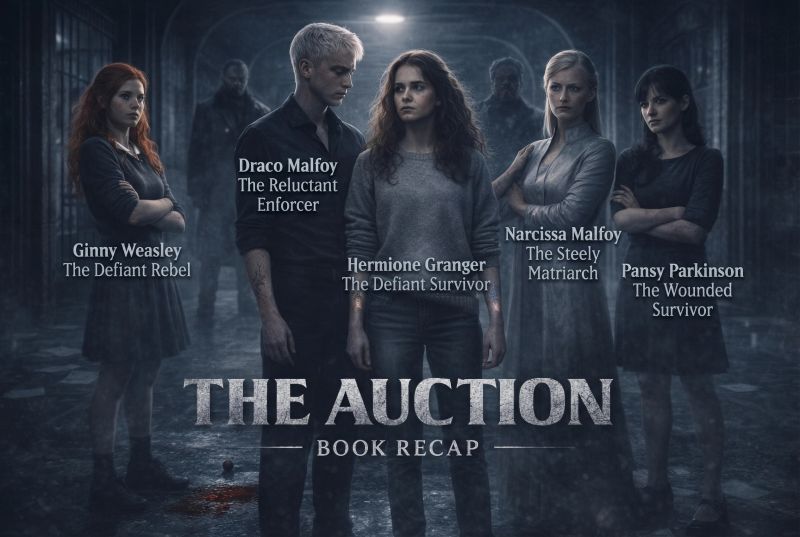

Plot Summary
Sold at the Palace
Voldemort12 wins the Battle of Hogwarts. Harry Potter is dead. Hermione1 is stunned while tracking Narcissa Malfoy3 through the castle corridors and wakes four days later in a Ministry holding cell with fifty captive girls. Pansy Parkinson,6 a pure-blood inexplicably among them, reveals they will be auctioned as slaves.
Hermione1 leads a failed escape attempt that costs two lives and her voice — Yaxley silences her with a spell. At a commandeered Muggle theatre, she is paraded in a gold dress as the final Lot before a thousand screaming Death Eaters. Antonin Dolohov8 bids against a lone masked figure in the fourth row. When the gavel falls at sixty-five thousand Galleons, Dolohov8 has won. But the masked bidder's seat is already empty.
The Gilded Cage Opens
Hermione's1 tattoo burns and rearranges: not Dolohov's8 initials, but D.M. Draco Malfoy2 has struck a private deal. A house-elf named Mippy delivers Hermione1 to Malfoy Manor — not to a dungeon but to a lavish suite with a private bath, a wardrobe of clothes in her exact size, and bookshelves stocked with Muggle and wizarding fiction.
Narcissa3 restores Hermione's1 stolen voice, serves her tea, and declares that she is now under the protection of Narcissa Malfoy.3 Lucius4 is colder — he confiscates a styling comb she pocketed as a weapon and warns her to show gratitude.
That night, Hermione1 burns the gold auction dress in the fireplace. The bed accepts her weight as if it has been waiting for her. She drinks a Dreamless Sleep potion and sleeps through the night.
Voldemort Reads Her Heart
Draco2 dresses Hermione1 in a negligée and takes her to Hogwarts, now Voldemort's12 throne room built on bones. Before the Dark Lord,12 Draco2 plays the cruel master — boasting about anticipation as the sweetest torture. Voldemort12 forces Legilimency on Hermione.1
He slashes through her mind, dredging up memories she cannot hide: watching Draco2 across classrooms, dancing with him at the Yule Ball, the skip of her heartbeat whenever he entered a room. The Dark Lord12 discovers that Hermione1 fancies her captor. He cackles with delight.
Then he searches Draco's2 mind and finds nothing reciprocated. His verdict: Draco2 can torture her for years without lifting a wand. On the walk home, Draco2 heals the cut his ring left on her lip and asks desperately what Voldemort12 found. She refuses to tell him.
Venom Drawn by Lips
Bellatrix Lestrange13 slips past the Manor's wards and attacks Hermione1 in bed, carving possessive marks into her arm with a poisoned goblin blade. Draco2 arrives in his trunks and socks, having heard her scream through the wall connecting their bedrooms. He wraps himself around her, presses his mouth to the wound, and sucks viper venom from her blood — spitting dark smoke and red onto the cream carpet.
He heals the gash and resets the blood boundary wards to bar his aunt13 forever. Days later, during an argument at the gazebo, Hermione's1 magic explodes — slamming Draco2 against a stone pillar and shattering his newly healed ribs. The discovery shocks them both. The Malfoys have not suppressed her magic. They never intended to.
Edinburgh's Friday Revels
Draco2 takes Hermione1 to Edinburgh Castle for the weekly revels hosted by the Carrow twins. She wears a slip dress and a gold collar marking her as a Death Eater's property. Dinner with the Slytherin boys is a grotesque pageant: girls serve wine, sit in laps, are groped openly.
In the Lounge below, sex acts occur in public view while gamblers trade war secrets over cards. But Charlotte,10 a silver-collared Carrow Girl with unusual freedom of movement, offers Hermione1 a grape — the same symbol Hermione1 once used to spell Not Alone on Ministry floors for fifty terrified girls.
Across the room, Cho Chang9 presses a grape between her painted lips and meets Hermione's1 eyes. A revolution is being stitched together beneath the silk, one collar at a time.
The Performance for Voldemort
The Dark Lord12 arrives at the Manor unannounced. Draco,2 knowing Voldemort12 expects him to be raping Hermione,1 stages a violent simulation — pinning her to the wall, grinding against her, ejaculating on her chest while she trembles beneath him.
He pinches her skin instead of penetrating, planting enough sensory memory to satisfy a Legilimens. Voldemort12 reads Hermione's1 mind and is satisfied. But he also extracts something she did not intend to give — her knowledge of Horcruxes, Harry's shared dreams with the snake, and the suspicion that Harry himself carried a piece of Voldemort's12 soul.
Hermione's1 Occlumency is still too weak to protect what matters most. The Dark Lord12 departs in cold calculation. Her room lies in smoking ruins, her magic having erupted unbidden.
The One O'Clock Gun
The strawberry-blonde Carrow Girl — a Muggle who once grabbed Hermione's1 hand under a glass-strewn table, who kissed her in a bathroom to slip a scrap of paper beneath her collar — is dragged before Edinburgh's courtyard with her teenage brother. Amycus Carrow wheels out the castle's old war cannon.
Draco2 presses against Hermione's1 back, whispering Occlumency instructions as the cannon fires twice and the crowd cheers. Charlotte10 slips the note from Hermione's1 collar later. In Ginny Weasley's5 handwriting, scrawled in red lipstick: How do I kill him? Hermione1 agonizes for days before writing two words on stolen parchment, small enough to hide beneath gold metal: Snake first.
Three Minutes with Cho
Draco2 arranges a paid encounter with Mulciber to borrow Cho Chang9 for a private booth. He gives Hermione1 two minutes alone. Cho9 — who has survived a year of sexual slavery by becoming a weapon — embraces Hermione1 instantly. The instruction is minimal: Fiendfyre, Basilisk Venom, Sword of Gryffindor. Cho9 nods and promises Charlotte10 will deliver it to Ginny5 within weeks.
She presses a green suicide pill into Hermione's1 dress seam — a last resort if their minds are read. When Draco2 knocks, Cho9 has undressed them both to sell the scene. Hermione1 stumbles out red-faced and dizzy. But the intelligence is in transit, moving through Charlotte's10 network toward the one person close enough to Voldemort12 to act on it.
Pansy's Ink-Dark Secret
Pansy Parkinson6 arrives at the Manor by Floo to fix Hermione's1 hair and wardrobe. Between scolding her about moisturizer and replacing her entire underwear drawer, Pansy6 reveals a crucial detail: the slave tattoos were not spells cast on the skin. They were ingested as an ink-flavored potion, then activated when the owner signed parchment in blood. This changes everything.
Hermione1 has been chasing a counter-curse for months; what she needs is an antidote. She pivots her research entirely. Pansy6 also divulges why she ended up at the Auction: she had tried to steal Hermione1 from Yaxley for Draco,2 and her own father turned her over as punishment. Pansy's6 eyes are ice as she tells Hermione1 it was always for Draco.2 Never for her.
The Kiss Against the Wall
Their practice sessions — dinners where Hermione1 sits in Draco's2 lap, learning to kiss his neck so Edinburgh looks convincing — have been escalating for weeks. Draco2 keeps pushing her off his lap to hide his arousal. When he destroys the suicide pill Cho9 gave her, they fight savagely. He pins her wrists to the wall. She lifts her chin.
And he kisses her — desperate, consuming, his tongue in her mouth and his knee slipping between her thighs. He pulls away in horror, apologizing. She tells him it was not a mistake. Their practice sessions resume with new honesty, each evening pushing physical boundaries further, building a language of touch that Edinburgh demands and their hearts can no longer contain.
The Ritual at Two A.M.
Dolohov8 is coming in the morning with mediwitches to inspect and sterilize the remaining Lots. The virginity detection spell will prove Draco2 has never touched Hermione,1 exposing every Malfoy deception.
Draco2 has ransacked the library for a solution: a Germanic ritual requiring two parents, a blade, and candlelight. At two in the morning, Lucius4 arrives through the Floo. Narcissa3 cleanses Hermione1 with water and whispered German; Lucius4 cuts a thin line across her heart.
Her virginity separates from her body as a ball of white light, sealed in a glass jar. The detection spell now reads nothing. When Dolohov8 arrives at dawn and the mediwitch moves to sterilize her remaining ovary, Narcissa3 blasts him unconscious. They Obliviate everyone present.
The Letters Vanish
After months translating seventeenth-century Scourer journals — American slaveholders whose coded runes inspired the Death Eaters' tattoo magic — Hermione1 recreates the potion and brews its antidote. She tests it on mice in the Malfoy potions laboratory using Narcissa's3 wand.
Every mouse crosses the blood boundary unharmed. She uncaps the vial, sips, and watches D.M. dissolve from her arm like smoke. She steps past the property line into open air. Nothing. She is free. But Draco2 cannot come with her, and leaving would sentence his family to death.
So she re-inks her arm, signs the blood parchment in her own handwriting, and watches the letters reappear on her skin. She stays — not because she is captive, but because leaving him is the one freedom she cannot bear.
Cho's Sword, Charlotte's Pill
The True Order attacks Edinburgh Castle with enchanted Portkeys that penetrate its wards. Angelina Johnson — one-armed and ferocious — slices tattoo arms off Lots and Portkeys them to safety. Cho Chang9 impales Mulciber through the back with a decorative sword.
Draco2 drags Hermione1 through collapsing corridors and werewolf-infested grounds as the castle crumbles around them. Charlotte10 is captured for interrogation. Dolohov8 corners Cho,9 who swallows her suicide pill before her memories can be read — dying with foam on her lips and fire in her eyes.
Draco2 returns to Edinburgh to save Charlotte,10 extracting her memories instead of killing her and Obliviating every Carrow Girl in the dungeons. Lucius4 arrives to help clean the evidence. Hermione1 waits in his bedroom and weeps.
Lucius's Hidden Pensieve
Hermione1 discovers that Lucius's4 study — once warded against her — opens at her touch. Inside a locked ebony cabinet, she finds a Pensieve holding carefully curated memories. She plunges in.
Lucius's memories reveal that Goyle Senior was possessed by a fragment of Voldemort's12 soul — the same Horcrux that lived inside Harry, released when Harry died in the Forbidden Forest. Voldemort12 extracted it and sealed it inside the Sorting Hat, hidden in a Malfoy property deep inside Romania's Moldoveanu Peak.
Harry died believing his sacrifice would destroy the Horcrux inside him. It had not. When Hermione1 surfaces, she collapses on Draco's2 bedroom floor. He finds her there and asks a single question: what is a Horcrux? She tells him everything. He asks how they destroy it.
Romania's Last Horcrux
On the night of a Hogwarts Anniversary Celebration, Blaise7 covers for Draco2 via Polyjuice Potion while Hermione1 testifies about Horcruxes to a sealed court. They retrieve a basilisk fang from the Chamber of Secrets and Portkey to Romania.
Inside the mountain, they navigate infinite looping staircases, a lethal forgetfulness charm, and the specter of Tom Riddle rising from the Sorting Hat. Riddle tempts Draco:2 swear loyalty and Hermione1 will never be a slave again — she will be Lady Malfoy.
Draco2 pretends to comply, then hurls the basilisk fang through Riddle's chest and into the Hat. It screams and dies. On the Wooden Bridge leaving Hogwarts, Bellatrix13 catches them. She promises to kill Hermione.1 Draco2 kills his aunt13 with a curse to the back.
The Marble in His Palm
The tattoo antidote has been distributed through Edinburgh's champagne — every Lot's magic floods back. Ginny Weasley5 kills Avery with a stolen blade, passes the Sword of Gryffindor to Neville17 who slays Nagini, then kills Voldemort12 herself with the Elder Wand.
Ron11 and Ginny5 storm Malfoy Manor and find Hermione1 in Draco's2 bed. Ron11 attacks Draco,2 pinning him at wandpoint. Hermione1 races to his nightstand drawer, grabs a clouded marble wrapped in a handkerchief — a Portkey Draco2 once hid there for her escape — and throws it across the room.
Their eyes meet in the half-second before his fingers close. He vanishes. Ron11 stares at the empty air. Hermione1 has freed the man she loves by weaponizing his own gift against the people who came to save her.
Mint Robes and Still Waters
Hermione1 wakes in St. Mungo's Janus Thickey Ward — the mental health floor — her magic suppressed, her door locked. Bill Weasley has authorized her care. Healers test for mind-altering magic, find nothing, but refuse to release her.
Oliver Wood,19 also confined, tells her the truth: they are considered damaged, unfit to make their own decisions. She finds Neville17 recovering on a lower floor, tells him about the Malfoys, and together they arrange a newspaper interview.
The headline — the youngest member of the European Advisory Council — forces the Healers' hand. Ginny5 retrieves her with a borrowed wand and a letter that reads: I believe you about the Malfoys. I have since the morning you left, when George told me about your tattoo antidote potion.
Lucius's Final Gambit
Lucius Malfoy4 surrenders to the True Order. At his trial, Hermione1 arrives prepared to defend him — but Lucius4 deliberately goads the crowd, mocking how slowly he killed Charlie Weasley. George Weasley fires a Killing Curse from the gallery.
The mob Apparates to the Manor to kill Narcissa.3 But the wards have sealed: only Hermione1 can pass the gates. She sprints to find Narcissa3 hidden in the house-elves' quarters. Days later, goblins from Gringotts arrive and reveal the final piece: the midnight virginity ritual from nearly a year ago had registered Hermione1 as Lucius's4 adopted daughter in magical law.
He filed paperwork naming her eldest heir. The Manor, the vaults, the fortune — all of it belongs to Hermione Granger.1 His last chess move, executed from beyond the grave.
I Love Him Still
Hermione1 hires the brilliant American lawyer Alan Shrapley, successfully defends Blaise Zabini7 at trial, and takes the stand at Draco's2 trial in absentia. She testifies for days — the tattoo antidote, the Horcrux, Bellatrix's13 death, every sacrifice and act of protection.
General Pierre, the French Prosecutor, deploys his final weapon: Stockholm Syndrome. He argues that Draco2 confessed love only as the regime collapsed. Hermione1 lifts her chin and tells the court she loved Draco Malfoy2 for years before he ever saved her, and that she loves him still.
The courtroom erupts. The sentence is two years in Azkaban — Shrapley expects reduction on appeal. The headline the next morning prints the words she spoke under oath across every front page in Europe.
The Gainsworth Book
Months pass. Hermione1 works at a small bookshop in Diagon Alley, studying law between customers and fighting for justice one case at a time. The bell above the door chimes at closing time. Draco2 stands on the mat in a Muggle coat, his hair longer, his eyes the same grey.
He asks if she has the newest Gainsworth novel — the series whose collector's editions she once burned in a magical outburst, the same author who inscribed a first draft for her birthday at Draco's2 request. He mentions needing reading material for about fourteen to sixteen months.
He tells her he is not leaving yet. Tomorrow sounds nice. His hand extends across the counter. Her fingers close around his, filling the spaces that have been empty since she threw a marble across a moonlit room and watched him disappear.
Analysis
The Auction interrogates the politics of survival under totalitarianism by refusing to let any character remain morally clean. Its central question — whether kindness within a corrupt system constitutes resistance or complicity — resists easy answers. Hermione1 receives tea and libraries and a lover while Ginny5 is publicly brutalized; the disparity is never resolved, only acknowledged. This asymmetry is the story's most uncomfortable and most honest feature.
The narrative subverts the captivity romance by making Hermione1 an active agent throughout. She researches, brews, strategizes, and communicates with the resistance — all from within her gilded cage. Her choice to remain after breaking the tattoo is not submission but calculation: she stays because leaving would kill the people who freed her to stay. The story thus reframes captivity not as a love story's setting but as a political condition that requires political solutions.
The Scourers — American magical slaveholders whose tattoo magic the Death Eaters borrowed — explicitly connect wizarding enslavement to real-world chattel slavery. This is deliberate and uncomfortable: the Lots are sterilized, branded, stripped of names, and sold at auction. By grounding its fantasy in historical atrocity, the story demands that readers confront the mechanics of dehumanization rather than aestheticizing them.
Post-war, the narrative refuses a triumphant resolution. The True Order commits its own abuses — involuntary institutionalization, mob justice, suppression of evidence. Hermione's1 fight for due process and fair trials mirrors her wartime resistance: both require her to defend people the world has decided are irredeemable. The story's deepest argument is that justice cannot be achieved through vengeance, that the systems we build to punish evil must themselves be just, or the cycle merely continues under different banners. Draco's2 return — quiet, tentative, arriving at a bookshop counter — earns its emotional weight precisely because nothing about it is triumphant. It is simply a man choosing to face consequences, and a woman who fought to ensure those consequences would be fair.
Review Summary
The Auction is a highly rated Dramione fanfiction with over 21,000 reviews. Readers praise its complex plot, character development, and emotional depth. Many compare it favorably to other popular Dramione fics like Manacled. The slow-burn romance and spicy scenes are highlights for fans. Some criticize its length and pacing, particularly in the final chapters. Despite mixed opinions on the ending, most reviewers consider it a must-read for Dramione enthusiasts, lauding the author's writing skills and world-building within the Harry Potter universe.
Characters
Hermione Granger
Captive scholar turned rebelHermione's brilliance has always been her greatest weapon and her deepest vulnerability. Stripped of wand, freedom, and friends, she channels obsessive intelligence into the only resources available — books, potions ingredients, and her own relentless mind. She is driven by a fierce moral compass that refuses to categorize people as simply good or evil, even when the world demands it. Her psychological depth emerges in the tension between logic and love: she can Occlude her mind into crystal-clear discipline yet cannot suppress the feelings she has harbored since adolescence. She carries immense guilt for surviving in comfort while her friends suffer, which fuels her determination to weaponize her captivity. Her arc traces a journey from helplessness to agency — from a girl who spelled 'not alone' with grapes on a cell floor to a woman who reshapes the legal architecture of post-war justice.
Draco Malfoy
Captor hiding a secret heartDraco is a man built from contradictions — pure-blood arrogance layered over deep insecurity, emotional walls fortified by years of Occlumency, and a capacity for love so fierce it terrifies him. He purchased Hermione1 at the Auction not out of cruelty but from feelings he has carried since fourth year, hidden beneath sneers and distance. His psychological architecture is defined by compartmentalization: he can perform monstrous acts in public while privately shielding the woman in his care with a gentleness that confuses even him. His relationship with his father4 is one of desperate aspiration and quiet rebellion. He craves approval yet consistently chooses paths Lucius4 would consider weakness. His deepest fear is not death but becoming someone who causes Hermione1 to look at him the way she looked at the other Death Eaters. Every kindness costs him something — a piece of his cover, a fragment of his safety — and he pays without hesitation.
Narcissa Malfoy
The matriarch who bends steelNarcissa operates with the quiet devastation of someone who has learned to wield grace as a blade. She is fiercely maternal, extending her protection to Hermione1 with a warmth that borders on adoption — sharing tea, lending wands, teaching Legilimency through platinum threads of consciousness. Her power lies in what she refuses to say aloud: she never directly acknowledges what Hermione1 is doing in the library or the potions lab, yet she enables every step. A Legilimens from the Black-Rosier line, she can deceive even skilled interrogators while appearing transparently honest. Her marriage to Lucius4 is complex — genuine love tangled with political pragmatism — and her primary allegiance is always to her son2. She embodies the principle that survival and moral courage are not mutually exclusive, that pragmatism can coexist with compassion.
Lucius Malfoy
The strategic patriarchLucius is the consummate chess player — coldly pragmatic, devastatingly articulate, and always ten moves ahead. He radiates aristocratic disdain while quietly preparing for every possible outcome. His relationship with Hermione1 oscillates between patronizing contempt and grudging respect; he mocks her Muggle jeans yet trusts her enough to leave his study unlocked. His morality is situational: he will kill on command but draws the line at weapons of mass destruction; he will serve Voldemort12 faithfully but curate memories of his complicity for potential leverage. His love for Narcissa3 and Draco2 is the one unshakeable constant in his calculated existence. Everything he does — from his assignments abroad to his most audacious secrets — serves the goal of ensuring his family survives regardless of which side wins the war.
Ginny Weasley
The fire that survived captivityGinny endures the most harrowing captivity of any character — sold to Avery, repeatedly brutalized, publicly disciplined, and paraded as Voldemort's12 favorite pet. Yet beneath the aristocratic drawl she adopts to survive, the fire that defined her at Hogwarts still burns. She is tactically brilliant, transforming intimate knowledge of her captors into the intelligence that ultimately enables Voldemort's12 defeat. Her relationship with Hermione1 is fractured by circumstance: she cannot reconcile her friend's apparent comfort at Malfoy Manor with her own suffering, and the cognitive dissonance manifests as wary distance. She carries the weight of her family's decimation — parents, brothers, Harry — with a stoicism that borders on dissociation. Her handwriting on a scrap of paper, asking how to kill a god, reveals the volcanic determination buried beneath layers of trauma.
Pansy Parkinson
Armored ally in Slytherin silkPansy weaponizes vanity and cruelty as survival mechanisms, deflecting vulnerability with cutting remarks and immaculate presentation. Sold at the Auction by her own father after attempting to steal Hermione1 for Draco2, she carries deep wounds beneath her polished exterior. Her loyalty to Draco2 is absolute and pre-dates any romantic relationship — it is the loyalty of someone who recognizes a kindred soul trapped in an impossible role. She provides crucial intelligence about the tattoo potion's nature and later risks her freedom by attending Edinburgh in Hermione's1 body via Polyjuice. Her refusal to accept pity or charity masks a profound loneliness, and her relationship with Hermione1 evolves from contempt to grudging respect.
Blaise Zabini
Draco's loyal shadow operativeBlaise operates with casual elegance that conceals razor-sharp instincts. He is Draco's2 closest friend and most reliable co-conspirator, willing to risk his life for schemes he openly mocks. His humor functions as deflection — he maintains an air of amused detachment even as the world burns around him. He shelters Pansy6, Daphne Greengrass, and the Italian minister's niece Giuliana at Grimmauld Place, playing reluctant caretaker to a household of traumatized women. His willingness to impersonate Draco2 via Polyjuice at Hogwarts demonstrates a loyalty that transcends self-preservation. He faces his own trial with the same sardonic grace, joking about prison bread while agreeing to withhold evidence that could free him in order to protect Draco's2 defense.
Antonin Dolohov
Hermione's predatory shadowDolohov is the embodiment of the threat Hermione1 escaped. He watched her shower in the Ministry cells, groped her while she was petrified, and made graphic promises about what he would do once she was his property. His obsession with her is possessive and dehumanizing — she represents a conquest denied. He dogs her at Edinburgh, threatens Draco's2 position, and ultimately attempts to assault her in a private room. His presence functions as a constant reminder of the fate Hermione1 avoided and her friends did not, making every moment of safety at the Manor feel borrowed.
Cho Chang
Warrior in a silver collarCho transforms from the shy, grief-stricken girl Hermione1 knew at Hogwarts into something forged in fire — a resistance operative who can kiss a man's neck while memorizing his secrets. Enslaved by Mulciber, she weaponizes the intimacy forced upon her, gathering intelligence and passing messages through Charlotte's10 network. Her willingness to take her own life rather than allow her mind to be read demonstrates the extremity of her commitment. She carries a suicide pill in her dress seam and offers one to Hermione1 with the clinical calm of a soldier issuing equipment.
Charlotte Selwyn
Edinburgh's invisible spymasterCharlotte moves through Edinburgh Castle's rooms with a tray of champagne and a network of secrets. As the Carrow Girl with the most freedom, she serves as the hub connecting enslaved girls to each other and to the outside resistance. She receives Hermione's1 intelligence about Horcruxes and delivers it to Ginny5 via intermediaries no one can trace. Her smile is painted on, her warmth strategic, and her courage quiet and absolute. When the castle falls, her body is found in the rubble — a wand forced into her hand by Imperious Curse, killed fighting a war she had been winning from the inside.
Ron Weasley
The love she left behindRon exists in Hermione's1 story primarily as an absence that aches — a heavy, earthy book on her Occlumency shelf that she cannot open without losing her composure. Captured and tortured at the Lestrange estate, he remains alive but unreachable for most of the narrative. His eventual reappearance carries the weight of everything Hermione1 sacrificed. He cannot comprehend her feelings for Draco2, and his hurt manifests as cold withdrawal. His honest admission that he needs time reveals a maturity forged by his own year of suffering.
Voldemort
The architect of sufferingVoldemort in victory is not the raging monster of battle but something worse — a calm, amused god playing with insects. He uses Hermione's1 feelings as entertainment, reads minds with casual violence, and treats his followers' loyalty as a renewable resource. His greatest vulnerability is arrogance: he cannot imagine that the slaves and servants around him might be conspiring, nor that a Malfoy2 would sacrifice everything for a Muggle-born.
Bellatrix Lestrange
Madness with a bladeBellatrix functions as the dark mirror to Narcissa3 — both Black sisters, both fiercely loyal, but to opposite ends. She sees Draco's2 attachment to Hermione1 as contamination, a weakness threatening the Black bloodline. Her visits to the Manor carry the weight of nightmares: she carves, poisons, and cackles with the glee of someone who has replaced all human connection with devotion to power. Her manipulation of Draco2 in Switzerland — forcing him to torture and kill — reveals her belief that love is weakness that must be burned away.
Theo Nott
Slytherin with a hidden heartTheo oscillates between pompous rivalry with Draco2 and genuine vulnerability. His father designed the slave tattoos, and Theo risks his life to give Hermione1 the key to deciphering them — not for ideology, but because he loves Oliver Wood19 and needs him freed.
Marcus Flint
Edinburgh's cruel ringmasterFlint presides over the Edinburgh dinner parties with predatory charm and perfect new teeth. He creates the lust potion used on enslaved girls, pushes Draco2 to share Hermione1, and serves as the constant pressure testing their facade.
Luna Lovegood
The girl who chose the skyLuna's death — jumping from a rooftop on Draco's2 advice that death was better than what awaited her — haunts Hermione1 throughout the story. Her gentle smile and bloodied teeth in the Ministry corridors become a symbol of impossible choices.
Neville Longbottom
Harry's chosen successorNeville endures brutal captivity under the Rookwoods, losing fingers and nearly his life. Yet he is the first person at St. Mungo's to believe Hermione1 unconditionally, and helps her fight for release. Harry told him to kill the snake — and when the moment comes, he does.
Viktor Krum
Undercover at the revelsViktor infiltrates Edinburgh as a Bulgarian government official, working secretly for the True Order. He attempts to extract Hermione1 during the castle attack and later testifies at Draco's2 trial that Draco2 lowered his wand.
Oliver Wood
Theo's broken belovedOliver is Theo Nott's14 enslaved Lot and, eventually, his lover. Beaten, limping, and silently devoted, Oliver represents the human cost of the slavery system and the complicated bonds formed within it.
Hestia Jones
Post-war pragmatist generalHestia serves as Hermione's1 primary ally in the post-war government — pragmatic, sharp, and honest about the limits of her own power. She recruits Hermione1 to the European Advisory Council and mentors her through the political minefield of the Edinburgh Trials.
Plot Devices
The Slave Tattoo and Antidote
Chains and keys to freedomThe magical tattoo — inked initials that bind a person to a property through a combination of ingested potion and blood-signed parchment — is the story's central mechanism of control. It shocks the bearer who crosses a property boundary, tracks ownership transfers, and functions as a visible brand of subjugation. Hermione's1 year-long research to decode its seventeenth-century American origins and brew an antidote forms the backbone of her contribution to the resistance. The antidote, once distributed through Edinburgh's champagne by Charlotte's10 network, simultaneously frees every enslaved person and restores their suppressed magic — enabling the night Voldemort12 falls. The tattoo also serves as an emotional symbol: Hermione1 voluntarily re-inks herself after proving she can leave, choosing captivity over abandoning Draco2.
Occlumency as Mental Library
Hermione's psychological armorHermione1 teaches herself Occlumency by visualizing her mind as a library — bookshelves of memories that can be opened, closed, locked, or hidden. A lake with still waters serves as her meditative anchor. This device operates on multiple levels: practically, it protects her secrets from Voldemort's12 Legilimency and allows her to survive Edinburgh's horrors without breaking; emotionally, it becomes a metaphor for how trauma is processed, stored, and occasionally permitted to surface. Narcissa3 assists her with platinum threads of Legilimency, weaving specific memories into a curated volume for Bellatrix13 to find. The device's limitation — that deep emotional disturbance can topple the shelves — creates tension whenever her composure is threatened, making every moment of vulnerability genuinely dangerous.
The Portkey Marble
Escape route becomes sacrificeA clouded marble wrapped in a handkerchief, hidden in Draco's2 nightstand drawer alongside chocolates and trinkets. Draco2 placed it there as an emergency escape for Hermione1 — paired with a knife charmed to sever and cauterize, in case she needed to cut off her tattooed arm. It represents his willingness to let her go even as he loves her. Hermione1 discovers it early but never uses it for herself. When the True Order storms the Manor and Ron11 attacks Draco2, she grabs the marble and throws it to Draco2 instead — weaponizing his own gift against her rescuers to save him. Its trajectory across the room, from her fingers to his palm, inverts every power dynamic the story has established.
The Grape Symbol
Revolution's secret handshakeIn the Ministry holding cells, silenced and powerless, Hermione1 spells 'Not Alone' with grapes on the marble floor — her only way to communicate hope to fifty terrified girls. The grape becomes a recurring symbol of quiet resistance. At Edinburgh, Charlotte10 offers her one from a tray with pointed significance. Cho9 presses a grape between her painted lips and locks eyes with Hermione1 across the Lounge. The symbol connects the women across impossible distances, affirming that even in a system designed to isolate them, solidarity persists. It carries no magical power; its strength is entirely human — the shared understanding that someone remembers and someone is fighting.
Lucius's Pensieve Memories
Insurance becomes revelationLucius Malfoy4 secretly maintains a Pensieve in his locked study, curating memories as insurance should the Great Order fall. The black-tinted vials contain his most dangerous secrets: discovering Goyle Senior's possession by Voldemort's12 soul fragment, guiding Voldemort12 to Romania to create a new Horcrux, and the crucial moment at Dover Beach where he lowered his wand and let Andromeda Tonks and baby Teddy Lupin escape. When Hermione1 discovers the Pensieve, these memories transform from Lucius's4 self-preservation tool into the key that enables the destruction of Voldemort's12 final Horcrux. They also serve as evidence at the trials, demonstrating that Lucius4 — for all his crimes — strategically positioned information that would be crucial to Voldemort's12 defeat.
FAQ
Synopsis & Basic Details
What is The Auction about?
- Voldemort's victory reshapes the world: The Auction is a dark Harry Potter Alternate Universe fanfiction set after Voldemort wins the Battle of Hogwarts. The story follows Hermione Granger, captured and stripped of her freedom, as she is forced into a system of magical slavery.
- Sold to the highest bidder: Hermione is entered into a horrific auction of captured Order members and sympathizers, where she is purchased by Draco Malfoy. This unexpected turn thrusts her into the heart of the Death Eater elite's world, forcing her to navigate a dangerous new reality under his ownership.
- Survival, secrets, and unexpected alliances: Held at Malfoy Manor, Hermione must grapple with the trauma of her captivity while attempting to understand the complex and often contradictory treatment she receives from Draco and his mother, Narcissa. Her fight for survival evolves into a quest for freedom, uncovering dark secrets about the new regime and the magic binding the enslaved.
Why should I read The Auction?
- Deep exploration of dark themes: The story unflinchingly tackles mature and difficult subjects like magical slavery, trauma, and the psychological toll of war, offering a raw and emotional narrative that pushes the boundaries of the Harry Potter universe.
- Complex and evolving character dynamics: The central relationship between Hermione and Draco is a masterclass in navigating power imbalances, distrust, and the slow, painful development of a bond forged in the crucible of a brutal new world.
- Intricate plot and world-building: Beyond the central relationship, the fic builds a detailed post-Voldemort society, complete with its own political structures, social hierarchies, and dark magical underpinnings, creating a compelling backdrop for a story of resistance and survival.
What is the background of The Auction?
- Voldemort Wins Alternate Universe: The core premise is a deviation from canon where Voldemort defeats Harry Potter at the Battle of Hogwarts, leading to the subjugation of the Wizarding world under Death Eater rule. This establishes a brutal, oppressive regime where blood purity dictates status and the conquered are enslaved.
- System of Magical Slavery: The story introduces a formalized system of magical slavery, where captured individuals are branded with binding tattoos that link them to their owners. This system is central to the plot, driving the initial conflict and Hermione's quest for freedom.
- Post-War Political Landscape: The narrative explores the political structure of Voldemort's new world, including the roles of prominent Death Eaters, the subjugation of the Ministry of Magic, and the emergence of a fragmented resistance movement (the True Order) operating in the shadows and from abroad.
What are the most memorable quotes in The Auction?
- "Not alone.": This phrase, first spelled out by Hermione with grapes in the Ministry holding cells (Chapter 3) and later echoed by Ginny (Chapter 5), becomes a powerful motif representing the enduring connection and shared struggle among the enslaved women, a quiet promise of solidarity and resistance in the face of dehumanization.
- "It's the right thing to do.": Uttered by Draco when Hermione asks why he bought her (Chapter 11), and later by Hermione when explaining why she must stay at the Manor (Chapter 30), this phrase encapsulates the complex moral choices characters face and the often-unseen motivations behind their actions, highlighting the story's central theme of finding morality in a morally bankrupt world.
- "I love you.": Draco's confession to Hermione (Chapter 38) is a pivotal emotional turning point, revealing the depth of his feelings and the culmination of their fraught relationship. Its raw simplicity underscores the profound connection they've forged amidst trauma and darkness, redefining their dynamic beyond that of captor and captive.
What writing style, narrative choices, and literary techniques does LovesBitca8 use?
- Intense, visceral internal monologue: The narrative is primarily told from Hermione's first-person perspective, offering deep access to her psychological state, trauma responses, and evolving emotions. This creates an intimate, often claustrophobic feel, immersing the reader in her subjective experience of captivity and survival.
- Strategic use of sensory detail and motif: LovesBitca8 employs recurring sensory details (e.g., smells, textures, sounds) and motifs (e.g., specific colors, objects like grapes or mirrors, locations like the library or the gazebo) to symbolize character states, foreshadow events, and add thematic depth beyond explicit plot points.
- Controlled pacing and narrative misdirection: The story balances moments of intense action and horror (the Auction, battles, torture) with slower periods of character development and research. The author strategically withholds information and uses subtle foreshadowing to build suspense and reveal plot twists, often challenging reader assumptions about character motivations and allegiances.
Hidden Details & Subtle Connections
What are some minor details that add significant meaning?
- The specific locations of scars and tattoos: Hermione's "Mudblood" scar from Bellatrix (Chapter 3) and Yaxley's signature tattoo placed just above it (Chapter 3) are not random; they physically mark her subjugation and the layers of trauma inflicted upon her body, highlighting how the new regime literally brands its victims over their past identities.
- The significance of specific books and literary allusions: The repeated mention of A Tale of Two Cities (Chapter 6) and Jane Eyre (Chapter 10) in Hermione's suite and the library, alongside discussions of Brontë (Chapter 7), Hugo (Chapter 7), and Dickens (Chapter 6), subtly connect Hermione's experiences to themes of revolution, identity, and confinement found in classic literature, suggesting her story is part of a larger, timeless struggle.
- The subtle differences in Malfoy family magic: Lucius's ability to create a blood boundary only Malfoys can cross (Chapter 32), Narcissa's Legilimency and unique ritual magic (Chapter 21), and Draco's specific wandless magic capabilities (Chapter 2) hint at inherited magical traits and family secrets that play a role in their survival and interactions, suggesting their power extends beyond their political standing.
What are some subtle foreshadowing and callbacks?
- Pansy's early knowledge of the Auction and its details: Pansy Parkinson's seemingly throwaway lines about the Auction and the price of virgins in the Ministry holding cells (Chapter 2) are not just cynical remarks; they foreshadow the reality of the event and hint at her prior knowledge or connections to the Death Eater elite, subtly setting up her later role and complex relationship with the Malfoys.
- Draco's reaction to Hermione's Amortentia scent: Hermione's memory of smelling honey in Amortentia in Slughorn's class (Chapter 3) and glancing at Draco, who was glaring at Ron, is a subtle callback to their shared history and Hermione's long-held, unrequited feelings, foreshadowing the complex emotional undercurrents that will later define their relationship in the darkest of circumstances.
- The recurring motif of mirrors and reflections: Mirrors appear at key moments (Hermione's reflection in the Ministry showers, Chapter 3; the cracked mirror backstage, Chapter 5; her reflection in Draco's bedroom, Chapter 20), often reflecting a distorted or fragmented image of Hermione, subtly foreshadowing shifts in her identity, self-perception, and the blurring lines between who she was and who she is forced to become.
What are some unexpected character connections?
- Pansy Parkinson's deep connection to the Malfoys and her father: Pansy's confession to Hermione in the Ministry holding cells (Chapter 4) reveals her long-standing, complex relationship with Draco and her father's harsh expectations, providing unexpected depth to her character and explaining her presence among the captives despite her pure-blood status. Her later rescue orchestrated by Blaise and her father's subsequent actions (Chapter 25) highlight the twisted family dynamics at play.
- Charlotte Selwyn's role as a key resistance operative: Charlotte, initially appearing as a Carrow Girl serving drinks (Chapter 15), is later revealed to be a vital link in the True Order's communication network (Chapter 28). Her seemingly subservient role hides a dangerous mission, creating an unexpected connection between the enslaved women and the broader resistance movement.
- Lucius Malfoy's unexpected connection to Andromeda Tonks and Teddy Lupin: Lucius's hesitation at Dover Beach (Chapter 31) when faced with Andromeda and Teddy, ultimately lowering his wand, reveals a surprising connection to his disowned sister-in-law's family. This moment of unexpected mercy hints at a deeper humanity beneath his cruel exterior and suggests complex family ties still hold some sway over him.
Who are the most significant supporting characters?
- Narcissa Malfoy: Beyond her role as Draco's mother, Narcissa becomes a crucial, albeit quiet, ally to Hermione. Her acts of kindness, lending her wand (Chapter 4), providing access to the library (Chapter 7), and ultimately defying Death Eaters to protect Hermione (Chapter 21), reveal her as a complex figure whose maternal love drives her to subtle acts of rebellion against the regime she is ostensibly a part of.
- Pansy Parkinson: Initially presented as a typical Slytherin bully, Pansy's character is given significant depth. Her survival story, complex relationship with her father and Draco, and later role in assisting Hermione and Blaise (Chapter 34) position her as a key supporting character whose journey highlights themes of resilience and unexpected alliances in a broken world.
- Charlotte Selwyn: Though her time in the narrative is limited, Charlotte's role as a central figure in the enslaved women's communication network (Chapter 28) and her ultimate sacrifice make her a profoundly significant supporting character. She embodies the quiet resistance and bravery found among the enslaved, demonstrating that even seemingly minor characters can play vital roles in the fight for freedom.
Psychological, Emotional, & Relational Analysis
What are some unspoken motivations of the characters?
- Draco's need for control stemming from powerlessness: While Draco claims his purchase of Hermione was "the right thing to do" (Chapter 11), his actions throughout the story suggest an unspoken motivation rooted in his own trauma and powerlessness during the war. His need to control Hermione's environment and protect her (Chapter 6, 11) can be interpreted as a way to reclaim agency in a world where he felt he had none, projecting his desire for safety onto her.
- Narcissa's quiet defiance as a form of self-preservation: Narcissa's acts of kindness towards Hermione and her later defiance of Death Eaters (Chapter 21) are driven by her fierce maternal love, but also by an unspoken motivation to protect herself and her son. By aiding Hermione, she is subtly positioning her family for a potential future where the True Order might rise, ensuring their survival by demonstrating a hidden opposition to the Great Order.
- Hermione's drive for justice as a way to process guilt: Hermione's relentless pursuit of justice for the enslaved and her determination to expose the truth about the Great Order (Chapter 39) are fueled by her inherent morality, but also by an unspoken motivation to process her survivor's guilt. By fighting for others, she is perhaps seeking to atone for surviving when so many of her friends did not, channeling her trauma into a powerful force for change.
What psychological complexities do the characters exhibit?
- Hermione's trauma and dissociation: Hermione exhibits complex psychological responses to trauma, including dissociation (Chapter 1, 3), difficulty processing emotions (Chapter 4), and a drive to regain control through intellectual pursuits (Chapter 7). Her journey involves navigating these responses, learning to integrate her trauma, and finding healthy coping mechanisms beyond burying her feelings.
- Draco's struggle with inherited darkness and personal choice: Draco is a psychologically complex character grappling with the legacy of his family and the choices he made during the war. His internal conflict between the darkness he was raised in and his burgeoning feelings for Hermione (Chapter 6, 11) creates a deep psychological tension, revealing a character wrestling with his identity and the possibility of redemption.
- The psychological toll of magical slavery: The story portrays the devastating psychological impact of magical slavery on its victims. Characters like Ginny (Chapter 5), Oliver (Chapter 34), and the Carrow Girls (Chapter 28) exhibit varying degrees of trauma, from outward rage to dissociation and brokenness, highlighting the profound psychological damage inflicted by the system.
What are the major emotional turning points?
- Hermione's realization of the Auction's reality: Pansy Parkinson's blunt explanation of the Auction (Chapter 2) serves as a major emotional turning point for Hermione, shattering any lingering hope and forcing her to confront the horrifying reality of her situation. This moment marks the beginning of her psychological adaptation to captivity and the shift from resistance to strategic survival.
- Draco's confession of love: Draco's declaration of love for Hermione (Chapter 38) is a pivotal emotional turning point, transforming their relationship from one of complex alliance and attraction to explicit romantic connection. This moment redefines their bond and sets the stage for their shared future, despite the external chaos.
- Hermione's decision to stay at Malfoy Manor: Hermione's choice to remain at the Manor and work with Draco to break the tattoos, rather than escape alone (Chapter 30), is a significant emotional turning point. It signifies her growing trust in him and her commitment to a shared goal, prioritizing their alliance and the potential for collective freedom over her immediate personal escape.
How do relationship dynamics evolve?
- Hermione and Draco: From captor/captive to allies and lovers: The central relationship undergoes a dramatic evolution. Beginning with fear and distrust (Chapter 2, 3), it shifts to a fragile alliance based on shared secrets and mutual benefit (Chapter 4, 7). This slowly deepens into a complex bond of care and attraction (Chapter 11, 20), culminating in a romantic relationship (Chapter 29, 30) that defies the circumstances of their initial connection.
- Hermione and Narcissa: From wary distance to mutual respect and affection: Initially, Hermione views Narcissa with suspicion (Chapter 3), but Narcissa's subtle acts of kindness and protection (Chapter 4, 7) gradually build a foundation of wary respect. This evolves into a relationship of genuine affection and mutual support (Chapter 21, 36), highlighting the possibility of connection across seemingly insurmountable divides.
- Hermione and her friends: Strained by trauma and differing experiences: Hermione's relationships with her friends, particularly Ginny and Ron, are deeply impacted by their differing experiences of the war and captivity. While love and loyalty remain (Chapter 5, 37), trauma creates distance and misunderstanding, requiring painful conversations and a slow process of rebuilding trust and connection in the aftermath of shared suffering.
Interpretation & Debate
Which parts of the story remain ambiguous or open-ended?
- The full extent of Lucius Malfoy's motivations and plans: While Lucius's decision to leave the Manor to Hermione is revealed (Chapter 39), the full depth of his long-term planning and whether he truly anticipated the specific outcomes of the war and his death remain somewhat ambiguous. His complex motivations, blending self-preservation, family loyalty, and perhaps a subtle opposition to Voldemort, are open to interpretation.
- The long-term psychological impact on the enslaved survivors: While the immediate trauma responses of characters like Ginny, Oliver, and the Carrow Girls are depicted, the story leaves open the question of their long-term psychological recovery and how they will integrate back into a 'normal' world after enduring such horrors.
- The future of the Wizarding world under the new government: The story concludes with the True Order in power and the establishment of the International Magical Military Tribunal, but the long-term stability and fairness of this new government remain open-ended. The challenges of rebuilding, addressing past injustices, and navigating international relations suggest an uncertain future for the Wizarding world.
What are some debatable, controversial scenes or moments in The Auction?
- The depiction of magical slavery and sexual violence: The story's central premise and explicit tags involving magical slavery, sexual assault, and non-consensual elements are inherently controversial and can be deeply disturbing for readers. The unflinching portrayal of these themes is a significant point of debate regarding the story's content and its impact.
- The development of a romantic relationship between Hermione and Draco: The evolution of Hermione's relationship with Draco, her former captor, is a highly debated aspect of the story. Readers often grapple with the ethics and psychological implications of a romance developing from a power imbalance rooted in captivity and trauma.
- Lucius Malfoy's final act and its interpretation: Lucius's decision to leave his entire estate to Hermione (Chapter 39) is a controversial moment. It sparks debate about whether this act is a genuine attempt at redemption, a final manipulative power play, or a combination of complex motivations, challenging readers to interpret his character beyond simple villainy.
The Auction Ending Explained: How It Ends & What It Means
- The Horcrux is destroyed, but the fight continues: Hermione and Draco successfully destroy the final Horcrux in Romania (Chapter 35), reducing Voldemort to a mortal state and enabling Ginny to kill him (Chapter 36). This marks the end of Voldemort's reign and the collapse of the Great Order, but it is not a clean victory.
- Justice is imperfect, and the past casts a long shadow: The True Order takes power, but their methods are often flawed and brutal, as seen in the swift, sometimes unjust trials (Chapter 38, 40). Hermione fights for due process and the exoneration of those who helped her, particularly Draco and Blaise, navigating a political landscape still scarred by the war and personal vendettas.
- A new beginning, marked by loss and hope: Lucius Malfoy is killed during his trial (Chapter 38), but leaves his entire estate to Hermione (Chapter 39), making her the unexpected Heir of Malfoy Manor. Draco is sentenced to a short term in Azkaban (Chapter 41) but is expected to be released early. The story ends with Hermione finding her place in the new world, working in a bookshop and fighting for justice, while waiting for Draco's return, suggesting a future built on love, resilience, and the slow work of healing.
Download PDF
Download EPUB
.epub digital book format is ideal for reading ebooks on phones, tablets, and e-readers.








































