

Key Takeaways
Freud discovered childhood sexual abuse was real, then buried the truth
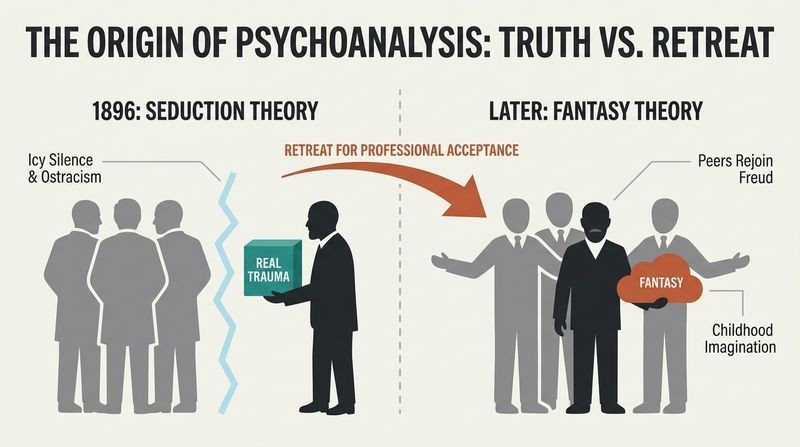
In April 1896, Freud delivered a paper called The Aetiology of Hysteria to Vienna's psychiatric establishment. His thesis: neurosis in his patients traced back to real sexual assaults suffered in early childhood, often by fathers. This became known as the seduction theory. His colleagues met it with icy silence. Krafft-Ebing dismissed it as a scientific fairy tale.
Within a few years Freud reversed himself entirely. He declared the memories were fantasies, wishes, products of childhood sexual imagination. Masson, once projects director of the Freud Archives, argues this reversal was not a scientific correction but a failure of moral courage. Freud abandoned an uncomfortable truth to rejoin the profession that had ostracized him, and psychoanalysis was built on that retreat.
What makes this claim explosive is its source. Masson had privileged access to sealed Freud correspondence and was groomed to run the Archives before his conclusions got him expelled. The insider-turned-heretic narrative gives the book unusual authority and unusual controversy. Modern trauma research, from Bessel van der Kolk to Judith Herman, largely vindicates the reality of childhood abuse that Masson insisted on. Critics counter that Freud never fully abandoned seduction and that Masson overstated the drama. Both can be partly true: the historical record is genuinely ambiguous, which is precisely why the fight over interpretation remains so heated decades later.
Believing victims once cost a career, not just credibility
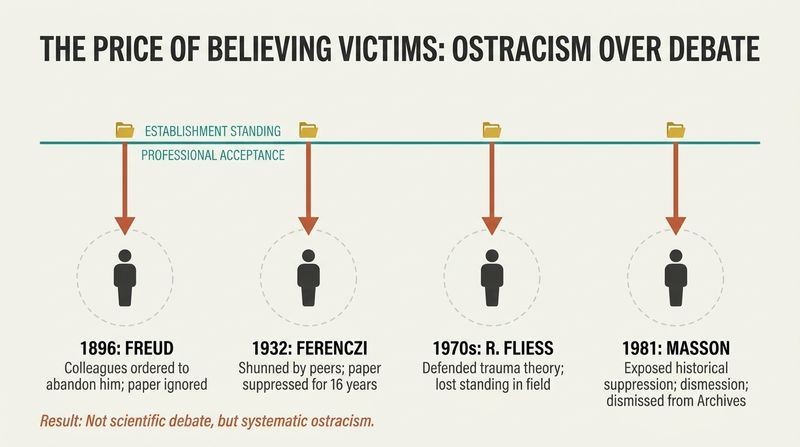
Masson frames the abandonment as a study in professional pressure. When Freud believed his patients, he was isolated. He wrote to his friend Fliess that colleagues had been told to abandon him and a void was forming around him. His paper received no summary, no discussion in the medical journals, only its title.
The pattern repeated across generations. Sandor Ferenczi, Freud's beloved disciple, revived the trauma theory in 1932 and was shunned, his final paper suppressed for sixteen years. Robert Fliess, son of Freud's friend, argued the same case in the 1970s and lost his standing. Masson himself was dismissed from the Archives in 1981. Each proponent of abuse-as-reality met not scientific rebuttal but ostracism.
The recurrence is the strongest part of Masson's argument. A single reversal could be explained many ways, but a repeating cycle of the same idea meeting the same social punishment across nearly a century suggests something structural, not personal. Sociologists of science, following Thomas Kuhn, note that paradigms resist anomalies through social enforcement, not just evidence. Whistleblower research shows the same dynamic in medicine and corporations: the messenger is attacked to protect the institution. The uncomfortable implication is that scientific communities can systematically avoid truths that indict their members or their comfortable theories.
Freud saw abused children's corpses in a Paris morgue
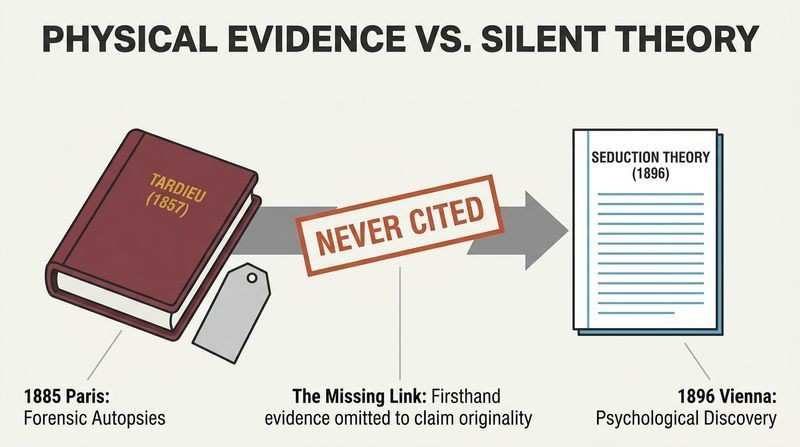
Masson's detective work reconstructs Freud's 1885-86 stint in Paris studying under Charcot. Freud attended forensic autopsies by Paul Brouardel at the Paris morgue, later recalling he was shown things science preferred to ignore. Brouardel and his predecessor Ambroise Tardieu had documented the physical and sexual abuse of children, often fatal, often by parents.
Tardieu's 1857 study cataloged 339 cases of rape of children under eleven among 616 he examined. Freud owned these French works. Masson argues Paris planted the seeds: Freud witnessed the reality of child abuse firsthand, then drew on it when formulating his 1896 theory. Yet he never cited these French sources, perhaps to claim the psychological discovery as entirely his own.
This archival excavation is Masson at his best, connecting Freud's biography to a forgotten French forensic literature that no historian had linked to psychoanalysis. It reframes the seduction theory not as a wild leap but as grounded in documented medical reality. The nuance worth noting: the French physicians recorded the physical facts without any psychological theory of aftermath, and some, like Fournier, championed the opposite view that children lie. Freud inherited both currents. That he was exposed to two opposing traditions makes his eventual choice look less like inevitable science and more like a contested judgment call.
A botched nose surgery may have twisted Freud's whole theory
Emma Eckstein, one of Freud's earliest patients, is Masson's tragic heroine. In 1895, Freud let his friend Wilhelm Fliess operate on her nose, based on Fliess's bizarre theory linking the nose to sexual and menstrual problems. Fliess left half a meter of surgical gauze in the wound. Eckstein nearly bled to death and was permanently disfigured.
Rather than blame the surgical blunder, Freud gradually recast her hemorrhages as hysterical, caused by longing and wishes to attract him. Masson argues this move to protect Fliess and himself was pivotal. If Eckstein's very real injury could be reframed as fantasy-driven, then her memories of childhood seduction could be fantasies too. Loyalty to a friend helped birth a theory.
The Eckstein episode is Masson's smoking gun for psychological motive. It illustrates a mechanism cognitive scientists call motivated reasoning: when confronted with evidence that implicates us or those we love, we unconsciously reinterpret it to reduce discomfort. Freud, who brilliantly described rationalization and denial as defenses, may have enacted them. The case also exposes the dangers of the Freud-Fliess folie a deux, two men reinforcing each other's untestable ideas. One caution: motive does not equal proof of error in the broader theory. That Freud had reasons to want fantasy to be true does not by itself establish that all his patients were abused.
The word seduction hides the violence of what happens to a child
Masson dissects Freud's language carefully. In the 1896 paper Freud used harsh, accurate words: rape, assault, attack, abuse, aggression, trauma. These name violence done by an adult to a child too weak to resist and too dependent to protest. But in later writings, one word came to dominate: seduction.
Seduction implies participation, even invitation. It subtly suggests the child wanted it, brought it on, was the seducer rather than the victim. This linguistic drift, Masson argues, was not innocent. It let therapists and society off the hook, transforming an act of cruelty into a shared fantasy. The very vocabulary of psychoanalysis came to obscure the imbalance of power at the heart of child abuse.
This is a sharp insight into how euphemism shapes moral perception, anticipating later feminist and linguistic critiques. The framing of language as ideology echoes George Orwell and later work on how naming controls blame in sexual violence cases. Contemporary advocates made the same point when they pushed courts to replace child prostitute with sexually exploited child. Words assign agency, and assigning agency to a victim is itself a form of harm. The observation that a single softened noun could carry decades of theoretical weight demonstrates how much conceptual work vocabulary quietly performs, often below conscious awareness.
Freud built his flip on a book he probably never read
When Freud publicly explained abandoning the seduction theory, he cited new evidence: cases of people who had been seduced in childhood yet remained normal, drawn from Havelock Ellis. Masson tracked down the source and found it nearly empty. Ellis's book contained only one seduction case, irrelevant to Freud's thesis.
Masson's forensic conclusion is startling: Freud likely never read Ellis directly. He appears to have taken the reference secondhand from Iwan Bloch, who himself took it from a review of an article he had not read. Freud, Masson argues, abandoned his most important discovery partly on the strength of a comment in a review of an article he never saw. The scientific justification was hollow.
This is meticulous source-tracing, the kind of scholarship that separates argument from assertion. If accurate, it undercuts the standard defense that Freud changed his mind for empirical reasons. It also models a broader lesson about citation laundering, where a claim gains false authority as it passes through secondhand references, a phenomenon documented in modern studies of academic citation errors where scholars cite papers they have not read. The caveat: Masson himself calls this reconstruction somewhat speculative. Absence of a marked copy is not proof Freud never read it. Still, the burden shifts: the official empirical story looks far weaker than psychoanalytic tradition claimed.
When memory becomes fantasy, the therapist repeats the original betrayal
Masson's clinical warning is the book's moral core. If a patient was genuinely harmed as a child and the analyst insists those memories are fantasies, the therapist does fresh violence. The patient came for help and instead has her reality denied again, this time by the very person meant to heal her.
Real memories, Masson argues, demand validation from the outside world. Denial can push a person toward a break with reality. What analysts label transference, the patient's rage at the therapist, may actually be justified anger at being treated like a parent who denied the abuse. By recasting real events as imagined desires, the analyst enters into covert collusion with what made the patient ill in the first place.
This reframing of transference is provocative and clinically consequential. It anticipates the trauma-informed care movement, which centers believing and validating survivors. Judith Herman's Trauma and Recovery, published years later, made establishing safety and acknowledging reality foundational to healing. Masson's insight that denial can itself be pathogenic aligns with attachment research on how caregiver invalidation damages a child's sense of reality. The tension, surfaced in the 1990s memory wars, is that overzealous validation can also implant false memories. The honest position, which Masson approaches, is that neither reflexive disbelief nor reflexive belief serves patients: the reality of the specific case matters.
Ferenczi died believing patients, refusing to recant like Freud had
Sandor Ferenczi, Freud's closest ally for two decades, retraced Freud's steps in his 1932 Confusion of Tongues paper. He argued that adults really do rape children far more often than anyone admits, and he named a defense mechanism: identification with the aggressor, where the terrified child takes on the guilt the adult should feel.
Freud pressured him not to publish. Colleagues wanted the paper banned. After Ferenczi died in 1933, his allies dismissed his final work as the product of mental illness, calling his belief in real abuse a sign of paranoia. Masson found the letters revealing this was character assassination. Ferenczi's courage to stand with his patients, and refuse to abandon what he knew, cost him his standing and, in his own view, hastened his death.
Ferenczi's fate is the book's most poignant parallel, showing the cost of dissent within a movement. His concept of identification with the aggressor, often credited to Anna Freud, actually appears first in his work, a small injustice Masson corrects. The dynamic where an institution pathologizes a dissenter, attributing disagreement to mental illness, has grim historical echoes, from Soviet psychiatry to workplace retaliation. What lends Ferenczi credibility is that his clinical observations about dissociation, trance states, and the child's premature maturation under trauma anticipate modern dissociation research with uncanny precision. Being ahead of one's field can be indistinguishable, to contemporaries, from being unwell.
Over a quarter of women were sexually abused before age fourteen
Masson marshals empirical data to show the abuse Freud dismissed is widespread. Diana Russell's landmark study of a random sample of 930 San Francisco women found that over one-quarter had experienced sexual abuse before age fourteen, and well over a third before eighteen. Among people seeking psychotherapy, the rate is almost certainly higher.
Studies of psychiatric patients found nearly half had histories of physical or sexual abuse. A later prospective study by Linda Meyer Williams followed girls with documented, hospital-recorded abuse; seventeen years on, 38 percent did not report the abuse that records proved had happened. This confirmed both that abuse is common and that people genuinely forget it, undercutting the claim that recovered memories must be inventions.
Grounding the historical argument in prevalence data transforms it from a Freud quarrel into a public health case. Russell's random-sample methodology was rigorous for its era and has held up. The Williams study is especially valuable because it starts from documented cases rather than retrospective claims, sidestepping the circularity that plagues memory debates. The broader point: a theory that systematically reclassifies real trauma as fantasy will misdiagnose a large fraction of a clinical population. One nuance the data invites: forgetting and repression are not identical, and the mechanisms of traumatic memory loss remain debated in neuroscience, even as the fact of it is well established.
Institutions protect the powerful by doubting the powerless
Masson locates the deepest reason for Freud's reversal in social convenience. His patients came from Vienna's respectable middle class, the same class as Freud and his colleagues. To believe them meant accusing fathers, uncles, and respectable men of raping their own children. The fantasy theory posed no threat to the social order.
By declaring that victims imagined their abuse, therapists could stay on the side of the successful and powerful rather than the miserable victims of family violence. The French forensic writers had already shown that educated, well-off men committed these crimes. Comfort, not evidence, favored the theory that spared them. A truth that indicts respectable society tends to be quietly reclassified as delusion.
This is the book's structural, almost political thesis, and it resonates with later feminist analyses by Florence Rush and Louise Armstrong who argued incest was protected by patriarchal interest. The mechanism, where institutions preserve credibility hierarchies that favor the powerful, appears across domains: clergy abuse cover-ups, athletic and medical scandals where victims were disbelieved for decades. Miranda Fricker's concept of testimonial injustice, where a speaker is given less credibility due to prejudice, names exactly what Masson describes. The challenge to the thesis is that it can become unfalsifiable, explaining any disbelief as motivated. The corrective is the empirical record, which increasingly shows the disbelieved were telling the truth.
Analysis
This is a work of revisionist intellectual history, argued by a disillusioned insider, that doubles as a moral indictment of a profession. Masson's structure is part detective story, part prosecutorial brief: he excavates suppressed letters, traces citations to their hollow origins, and reconstructs Freud's Paris education to argue that the founding move of psychoanalysis, abandoning the seduction theory, was an ethical failure rather than a scientific advance.
The book's power lies in convergence. No single piece proves Masson's case, but the Eckstein disaster, the isolation Freud confessed to Fliess, the hollow Havelock Ellis citation, the euphemistic drift toward the word seduction, and the repeating persecution of Ferenczi, Robert Fliess, and Masson himself together form a pattern that resists innocent explanation. Masson is careful, at his best, to distinguish documented fact from speculation, and he repeatedly concedes that Freud's inner motives are unknowable, settling on loss of moral courage as his interpretation rather than fraud.
The book's vulnerabilities are equally real. Critics correctly note that Freud never entirely erased seduction from his writings, and Masson's afterwords engage this seriously, tracing every later passage to show that whatever remained was theoretically marginalized. His psychological reconstruction of Freud's motives, while plausible, sometimes outruns the evidence. And the memory wars of the 1990s complicated his position: the reality of abuse does not guarantee the reliability of every recovered memory, a tension Masson acknowledges but cannot fully resolve.
What endures is the reframing. Masson relocated the seduction theory from a footnote in Freud's development to the central drama of psychoanalytic history, and he did so while the feminist movement was independently establishing the prevalence of child sexual abuse. The convergence made the book impossible to ignore. Its lasting contribution is a question every helping profession must keep asking: whose comfort does our theory serve, and at whose expense.
Review Summary
The Assault on Truth by Jeffrey Moussaieff Masson examines Freud's abandonment of his "seduction theory"—the belief that childhood sexual abuse caused neurosis. Reviewers note Masson uses unpublished letters from Freud's archives to argue that professional pressure, particularly regarding the Emma Eckstein case and Freud's friendship with Wilhelm Fliess, led Freud to reframe patients' abuse memories as fantasies. While praised for its scholarly research and disturbing revelations, some critics question Masson's conclusiveness and note the book's graphic content. Most find it essential reading for understanding psychoanalysis's problematic foundations.
People Also Read




Glossary
Seduction theory
Neurosis caused by real childhood abuseFreud's 1896 hypothesis that hysteria and neurosis originate in actual sexual assaults suffered in early childhood, not in fantasy. Freud presented it in The Aetiology of Hysteria, arguing these were real, damaging events. He abandoned it within a few years in favor of the view that such memories were largely fantasies rooted in childhood sexual wishes, a shift that enabled the development of psychoanalysis.
The Aetiology of Hysteria
Freud's 1896 abuse paperThe lecture Freud delivered to Vienna's Society for Psychiatry and Neurology in April 1896, presenting his seduction theory. It argued that at the root of every case of hysteria lay one or more real sexual experiences in early childhood. It met an icy reception, was barely reported in medical journals, and Krafft-Ebing called it a scientific fairy tale.
Confusion of Tongues
Ferenczi's 1932 trauma paperSandor Ferenczi's final paper, delivered in 1932, which revived Freud's abandoned belief in the reality of child sexual abuse. It described how adults confuse a child's need for tenderness with sexual passion. Freud and colleagues disapproved; its English publication was suppressed for sixteen years until 1949.
Identification with the aggressor
Victim absorbs abuser's guiltA defense mechanism first named by Ferenczi in Confusion of Tongues, in which a terrified, helpless child submits to and psychologically merges with the attacker, introjecting the guilt the adult should feel. The term is often mistakenly credited to Anna Freud's later work.
Emma Eckstein
Freud's disfigured early patientAn early patient of Freud whose nose was operated on by Wilhelm Fliess in 1895. Fliess left surgical gauze in the wound, nearly killing her and leaving her disfigured. Freud reinterpreted her post-surgical hemorrhages as hysterical, caused by longing, a move Masson sees as central to Freud's shift from real trauma to fantasy.
Actual neuroses
Neuroses with physical sexual causesFreud's term for neuroses, primarily neurasthenia and anxiety states, that he believed had a direct physical sexual cause such as masturbation or coitus interruptus, as distinct from the psychoneuroses (hysteria and obsessional neurosis) whose origins he sought in psychological factors and, briefly, in childhood seduction.
Download PDF
Download EPUB
.epub digital book format is ideal for reading ebooks on phones, tablets, and e-readers.








































