

Key Takeaways
The arts build minds, they aren't decoration for smart kids
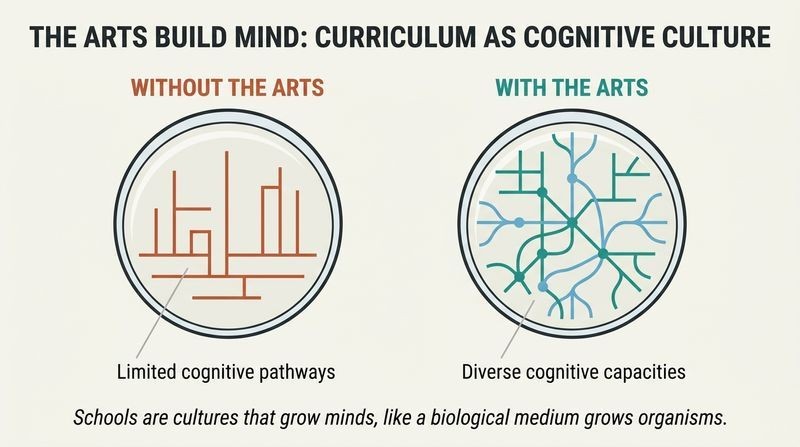
Perception is a cognitive event. Eisner's central claim overturns the school hierarchy that treats math and reading as the tough, brainy subjects while filing art under emotional relief. He argues the opposite: composing a watercolor, interpreting a mask, or shaping a sculpture demands some of the most complex thinking humans do. His famous line captures it: what we see is not simply what we take from the world, but what we make of it.
The stakes are educational, not decorative. Schools are cultures in two senses: a shared way of life, and a medium for growing minds, like a biological culture grows organisms. What a curriculum includes literally shapes which forms of thinking children develop. Sidelining the arts starves specific cognitive capacities.
Eisner wrote before neuroscience confirmed that perception is active construction, not passive reception. His argument now aligns with predictive-processing models of the brain, where seeing is hypothesis-testing. The framing also anticipates Howard Gardner's multiple intelligences and Nelson Goodman's work on symbol systems. What's bracing is the political edge: Eisner isn't asking for art's inclusion out of fairness but insisting that excluding it produces measurably narrower minds. The weakness is empirical vagueness, since he concedes hard evidence for broad cognitive transfer is thin. But his stronger move is defining thinking itself broadly enough that artistic reasoning qualifies by definition rather than by borrowed prestige.
Your tools decide what you notice, so choose them deliberately
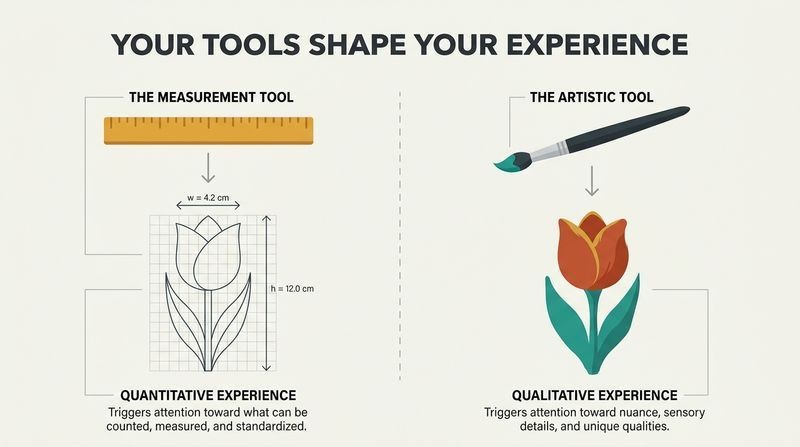
The form of representation shapes experience. Eisner uses a camera analogy: load black-and-white film and you hunt for shadow and contrast; load color film and you chase hue. The instrument in your hands steers your attention before you even shoot. If your only tool is a yardstick, you look for what can be measured. Measuring tools lead to quantification; artistic tools lead to qualification.
This has sharp curricular consequences. Learning to work in a medium is learning to think and perceive in a particular way, because people seek what they are able to represent. A curriculum that offers only words and numbers trains students to notice only what words and numbers capture. Choosing which symbolic systems students master is therefore a decision about which slices of reality they will ever experience.
This echoes the Sapir-Whorf hypothesis (language shapes thought) but extends it beyond words to paint, sound, and movement. It also prefigures Marshall McLuhan's medium-is-the-message and Andy Clark's extended-mind thesis, where cognition offloads into tools. The insight has practical teeth in an era of standardized testing: if assessment measures only the quantifiable, schools implicitly teach students to ignore the unquantifiable. One caution: Eisner risks overstating determinism. Skilled thinkers translate fluidly across media and often perceive richly before acquiring a representational vocabulary. Tools bias attention powerfully, but they do not fully imprison it. Still, the design principle stands: diversify the media, diversify the mind.
Surprise is the reward, so hold your goals loosely
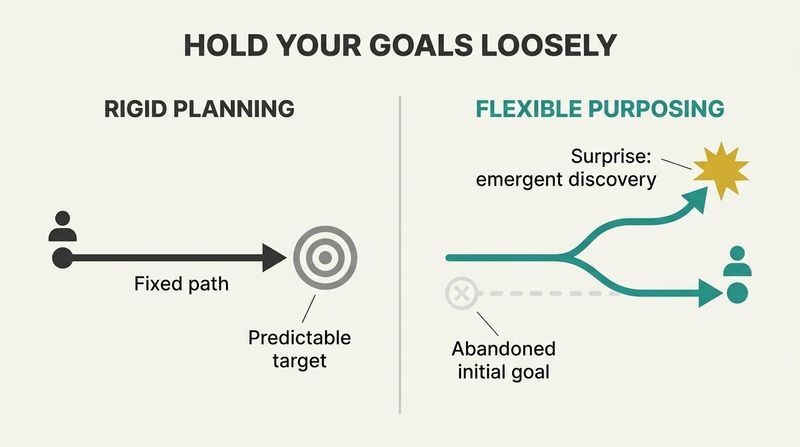
Flexible purposing beats rigid planning. Eisner borrows John Dewey's term for the improvisational intelligence artists use. The standard model of rationality says: fix your ends, then engineer means to hit them. Art works differently. The painter starts with an embarkation point, not a blueprint, and the work itself begins to speak back, revealing options the maker never envisioned. Jazz improvisation is the vivid case: musicians know the theme but discover the actual music in performance.
The practical payoff is surprise, which Eisner calls a fundamental reward of creative work and the richest source of learning. Pursuing surprise means abandoning familiar routines and accepting an uncertain path. The temptation, especially after past success, is to repeat old victories. Good teaching encourages students to redefine their aims mid-process when better possibilities emerge.
This maps neatly onto research in organizational strategy (emergent versus deliberate strategy, per Henry Mintzberg) and onto design thinking's iterative prototyping. It also resonates with Donald Schon's reflective practitioner, who converses with the materials of a situation. The deeper point challenges the entire objectives-based logic of modern schooling and management: predefined outcomes can foreclose the best discoveries. There is a tension worth naming. Flexible purposing requires enough skill and security to improvise well; novices who abandon goals may just flounder. Surprise rewards the prepared. Eisner acknowledges this implicitly through his insistence on technique, but the balance between structure and openness is genuinely hard to strike.
Judgment without rules: trust the gut feeling of rightness
Somatic knowledge guides qualitative work. When an artist decides a color is too bold or an edge needs softening, no formula supplies the answer. Eisner calls this somatic or embodied knowledge: a felt, visceral sense of whether the parts cohere, whether there is what philosopher Nelson Goodman called rightness of fit. The body is engaged; the information is felt, not calculated.
Watercolor is his teaching example. It is unforgiving: pigment on wet paper bleeds unpredictably, dark covers light, timing is everything, and mistakes cannot be hidden. The painter must judge the weight of the brush tip, the dampness of the paper, the order of application, all while sensing whether the emerging image lives or dies on arrival. This is judgment in the absence of rules, and it exercises an intelligence that multiple-choice scoring machines, which need no judgment at all, entirely lack.
Eisner's somatic knowledge anticipates embodied cognition (Lakoff and Johnson) and Antonio Damasio's somatic-marker hypothesis, where bodily emotional signals guide decisions that pure logic cannot resolve. It also parallels Michael Polanyi's tacit knowing, we know more than we can tell. The claim quietly rebukes the fantasy that all competence can be codified into rubrics and algorithms. What's valuable for readers beyond art: expertise in cooking, medicine, negotiation, and writing all rely on this unteachable-by-rule feel. The limitation is that somatic judgment resists quality control and can rationalize mere preference. Eisner would counter that criteria, applied flexibly, discipline the feel without reducing it to measurement.
Making the private public: create, edit, discover, then share
Representation performs four cognitive jobs. Eisner breaks down what happens when a fleeting idea becomes a poem, painting, or score. Ideas are slippery, here now and gone in a blink. Representation does four things:
1. Inscription: it stabilizes the evanescent image in durable material.
2. Editing: concreteness lets you refine, harmonize, and remove rough edges.
3. Communication: it transforms private consciousness into public form others can read.
4. Discovery: working the material generates ends you never planned, producing surprise.
The process is a conversation, not dictation into a recorder. The maker speaks to the work and the work speaks back. This is why Eisner insists art is genuinely a form of inquiry: the finished piece is not the download of a fixed mental picture but the site where new meaning gets found.
This is one of Eisner's most portable frameworks, applicable far past the studio. Writers know the phenomenon: you don't know what you think until you see what you wrote. Cognitive scientists call this epistemic action, manipulating the world to think better rather than just to achieve a goal. The editing stage in particular deserves emphasis in a culture that romanticizes spontaneous genius; Tolstoy's attention to the tiny adjustment is where quality actually lives. The framework also reframes communication as necessarily lossy and transformative, never an exact transfer, which connects to information theory and to hermeneutics. The reader always reconstructs rather than receives.
There is no single right way to teach art
Aims are chosen, not given by the subject. Eisner catalogs at least six competing visions, each legitimate, each shaped by its historical moment. Discipline-based art education (making, art history, criticism, aesthetics) arose after Sputnik's push for rigor. The visual-culture approach treats images as political texts to decode. The German Bauhaus tradition trained creative problem-solvers for design. Lowenfeld and Read's creative self-expression movement, born amid World War II, saw art as therapeutic protection of individuality against totalitarian conformity. Others justify art by workplace skills, cognitive development, or academic score boosts.
His point: a field's aims come not from its content alone but from human judgment responsive to context, community values, and the times. A nation as diverse as the United States needs no single sacrosanct curriculum. Intelligent planning weighs these options rather than pretending one is inevitable.
Eisner models intellectual honesty rare in advocacy writing: he lays out rival positions, including ones he distrusts, before staking his own. The historical framing (each vision congenial to its era) is essentially a sociology-of-knowledge move, showing that even educational aims are socially constructed. This resists the perennial temptation to declare one approach scientifically correct. The risk is relativism, if all aims are legitimate, how does a teacher choose? Eisner's answer is contextual judgment, which demands professionalism rather than compliance. For readers in any field facing competing philosophies (management, medicine, design), the lesson generalizes: clarify which game you are playing before optimizing your moves.
Not everything that matters can be measured
Measurement, testing, and grading are not evaluation. Eisner untangles concepts schools routinely conflate. You can measure without evaluating (a painting is three feet by four feet says nothing about its worth) and evaluate without measuring (calling it a fine work assigns no number). Assessment appraises individuals; evaluation appraises programs. Neither requires tests, and neither must end in a grade.
He champions clinical assessment over broad standardized testing. Standardized tests, he warns, predict mainly other test scores and confront students with tasks they will never meet outside school, roughly like the motor vehicle department. What we truly care about is what students do when they have a choice, not what they can do under exam conditions. His Nebraska line lands the point: you cannot fatten cattle by weighing them. Look at three features in student work: technical quality, inventiveness, and expressive power.
The distinction between can-do and will-do is Eisner's most underrated contribution to assessment theory. Dispositions, what students voluntarily pursue, are the real educational yield, yet they are nearly invisible to timed tests. This connects to self-determination theory (Deci and Ryan), where intrinsic motivation predicts sustained behavior far better than extrinsic pressure. His concept of educational connoisseurship and criticism, borrowing the art critic's trained perception to describe classroom life, offers a qualitative alternative to reductive metrics. The obvious objection is scalability: connoisseurship is labor-intensive and hard to standardize across accountability systems. Eisner concedes this, which is precisely why he calls for inventing new evaluation methods rather than defaulting to the scale.
Standards can become soul-mates of standardization
Rigor literally means stiff, and stiff things break. Eisner mounts a careful critique of the standards movement. The word standard carries at least four meanings (a banner to rally around, an average, a unit of measure, a level of attainment), and the movement blurs them. The paradox is fatal: to be useful for evaluation, standards must be specific; but the more specific, the more numerous. He cites the McRel Laboratory recommending roughly 75 standards and 2,250 benchmarks for grades 1 to 12, and since each benchmark carried four proficiency levels, teachers faced some 9,000 descriptors.
He traces the pattern historically to the efficiency movement of 1913 to 1930, when superintendents applied Frederick Taylor's stopwatch-driven scientific management to classrooms, even pricing a recitation in Greek against one in French. Following Dewey, Eisner prefers criteria, which prompt inquiry into a unique work, over standards, which impose an external ruler.
Eisner's genealogy is devastating precisely because it shows standards-based reform as a recurring cycle, not an innovation: efficiency movement, behavioral objectives banks of the 1960s, then 1990s standards, each collapsing under its own proliferation. This resonates with James Scott's Seeing Like a State, where imposing legible uniformity on complex human systems produces brittle failure. The criteria-versus-standards distinction is philosophically sharp: criteria open judgment, standards close it. A fair rebuttal is that equity arguments for common standards are real, uniform expectations can protect disadvantaged students from being taught less. Eisner's answer favors local professional judgment, which assumes a trustworthy, well-supported teaching workforce that reform advocates precisely doubt.
Children draw what they know, see, imagine, and feel
Development runs from inside out and outside in. Eisner surveys the theories of children's art and refuses the false either-or. Some scholars say children draw what they know (a hand has five fingers, so five fingers appear, even in schematic form); others say they draw what they see (young perception is global and undifferentiated). Eisner reconciles them: seeing itself is a way of knowing, so the two are one coin. But children also draw what they imagine (winged horses, purple cats) and what they feel (the important object gets exaggerated and enlarged).
The developmental arc moves from action-pleasure scribbles, to closed shapes, to schematic figures with a baseline and sky, toward the culturally prized mastery of illusion around ages ten to twelve. This progression is not automatic maturation. It reflects learning, promoted by teachers who design the right challenges within the child's reach.
Eisner threads between Piagetian stage theory and Vygotsky's social constructivism, landing closer to Vygotsky's zone of proximal development, the sweet spot where a task is too hard alone but achievable with help. His refusal to romanticize unassisted development is pointed: he calls pedagogy-by-neglect morally irresponsible, a direct shot at the Lowenfeld-Read hands-off tradition. This aligns with contemporary evidence that even preschoolers benefit from guided participation (Barbara Rogoff) and from programs like Reggio Emilia. One nuance he honors: Jessica Davis's U-curve finding, that preschoolers and adolescents show high aesthetic interest while middle-childhood realism dips, complicates any simple upward-progress story and warns against equating illusion-mastery with artistic growth.
Slow down perception; efficiency is a virtue for chores
The arts teach savoring, and savoring generalizes. Eisner notes we rush most seeing: perception stops the instant we slap a label on something (that's a stop sign, that's Uncle Harry) and never explore its qualities. Dewey called this recognition rather than perception. Efficiency dominates because we see in order to use and classify, then hurry on. But few of us want to eat a great meal efficiently, hold a wonderful conversation efficiently, or make love efficiently. What we enjoy, we linger over.
The classroom case: teacher Mr. Harsh pours cream into clear coffee and delights in the cloudlike burst, distinguishing the practical act from the aesthetic one. His students then transform swirling red ink in water into literary writing. The larger claim is that learning to attend slowly, to relish qualities, is a transferable capacity that enriches science, history, and daily life.
This is Eisner at his most quietly countercultural, indicting a civilization optimized for speed, three-second commercial cuts, stand-up lunches. His argument prefigures the slow movement and mindfulness research showing that sustained attention deepens both enjoyment and comprehension. It connects to Mihaly Csikszentmihalyi's flow, the timeless absorption Eisner describes as occupying a spaceless, timeless universe. The philosophical core, that experience is made, not merely taken, positions attention as an active craft. A skeptic might note that not all savoring is educationally productive and that efficiency genuinely serves many worthy ends. Eisner grants this: efficiency is a virtue for tasks we dislike. The claim is about protecting space for the other mode.
Every classroom teaches four lessons at once
What surrounds the task teaches too. Eisner identifies four interacting forces that shape what students actually learn, most of them invisible on any lesson plan:
1. Constraints and affordances of the materials (watercolor demands different thinking than clay).
2. Teacher prompts and scaffolding (the cues that help without taking over the student's project).
3. Classroom norms (whether looking at a neighbor's work counts as copying or as learning).
4. The classroom milieu, the overall ambiance and sense of community.
Beyond these, he names the implicit curriculum (hidden values conveyed by grading, seating, and tone) and the null curriculum, what is never taught at all. The null curriculum matters as much as the explicit one: when the arts are absent or taught so poorly they might as well be, students pay a price. Acts of omission are as consequential as acts of commission.
The null curriculum is Eisner's signature coinage and arguably his most quietly radical idea: absence is a form of content. What a school refuses to teach shapes minds by leaving whole domains of experience unavailable, a point with obvious relevance to debates over which histories, languages, and art forms get cut first under budget pressure. The four forces anticipate situated-learning theory (Lave and Wenger) and communities of practice, where learning is inseparable from social context. The insight that the teacher teaches herself, her evident love or indifference toward ideas, echoes research on emotional contagion and modeling. The framework's strength is holism; its challenge is that these forces are hard to engineer deliberately without becoming heavy-handed.
Education is learning to invent and reinvent yourself
Brains are given; minds are made. Eisner's culminating thesis: we are born with brains but grow minds through interaction with culture. The two are inseparable, biology and culture defining each other, but the crucial claim is that schools participate in the very invention of mind. Parents send children to school, in effect, to have their minds made. The curriculum is a mind-altering device, and it should be one.
The arts are premier tools of this self-creation. Making art is a process that culminates in a new form, and that form is a re-creation of the person. Recreation, Eisner puns, is re-creation. The disposition to keep learning throughout life may be schooling's most important gift, because growth need not cease at any age; it terminates only when life does. His closing image insists there is more beauty in a single rock than one could exhaust in a lifetime, if only we learn to look.
Eisner ends where philosophy of education meets existentialism: the self is not discovered but constructed, and art is a primary workshop for that construction. This resonates with Nietzsche's imperative to become who you are and with contemporary narrative-identity research (Dan McAdams), where people literally author selfhood. The claim that mind is a cultural invention, not a biological given, is bold and mostly vindicated by developmental neuroscience on experience-dependent plasticity, kittens deprived of visual stimulation lose sight permanently. The lifelong-growth emphasis reframes education's success metric from test scores to sustained appetite. The vulnerability is that self-invention through art is hard to defend to a policymaker demanding measurable returns, which is exactly the battle Eisner spent his career fighting.
Analysis
Elliot Eisner's The Arts and the Creation of Mind (2002) is a thesis-driven work of educational philosophy by a Stanford scholar who was simultaneously a trained painter, art teacher, and curriculum theorist. That triple vantage explains the book's core move: to dismantle the entrenched hierarchy that treats the arts as emotional garnish while crowning math and reading as the seat of intellect. Eisner's counterthesis, grounded in Dewey, Goodman, Langer, and Arnheim, is that the arts are rigorous cognitive activities and, more provocatively, that they model what all good education should be.
The book's intellectual spine is a redefinition of cognition itself. By defining thinking as any process through which we become aware of the world, Eisner folds perception, feeling, and qualitative judgment into the cognitive fold, so the arts qualify as intelligence by definition rather than by borrowed prestige. From this flow his most durable ideas: representation as a four-stage inquiry, flexible purposing, somatic knowledge, the medium shaping perception, and the trio of explicit, implicit, and null curricula.
What makes the book hard to summarize is its refusal of the self-help register. Eisner offers few tidy prescriptions; he offers a sensibility and a vocabulary. His prose dances between concrete studio detail (watercolor's unforgiving timing, cream blooming in clear coffee) and abstract epistemology.
The polemical heart is his critique of standardization. Writing amid the accountability wave that produced No Child Left Behind, Eisner historicizes standards as a recurring efficiency fantasy dating to Taylorist school superintendents pricing Greek recitations. His preference for criteria over standards, connoisseurship over measurement, and dispositions over test scores remains a coherent, if institutionally marginal, alternative.
The book's limitation is candor about evidence: Eisner repeatedly concedes that transfer claims (art boosts math scores) lack solid support, and he refuses to lean on them, insisting instead that art's justification lies in what only art provides. This intellectual honesty is admirable but leaves advocates without the empirical ammunition politics demands. Two decades on, the book endures less as a policy manual than as the most eloquent available argument that a mind starved of aesthetic experience is a narrower mind, and that schools, in what they omit, quietly decide who their students become.
Review Summary
The Arts and the Creation of Mind receives mostly positive reviews, with readers praising its insights on art education and its impact on cognition. Many consider it essential for educators, highlighting its compelling arguments for including arts in curricula. Some readers found it particularly useful for research and teaching. However, a few critics noted that the book focuses more on school arts education than expected and lacks empirical support for some claims. Overall, reviewers appreciate Eisner's defense of arts in education and its potential to shape thinking.
People Also Read




Glossary
Null curriculum
What schools never teachEisner's term for the subjects, skills, and modes of thought that a school never offers, whose absence shapes students as powerfully as what is taught. When the arts are omitted or taught poorly, students lose access to entire forms of meaning-making. Acts of omission, he argues, are as consequential as acts of commission in shaping what minds can and cannot do.
Flexible purposing
Improvising goals mid-processBorrowed from John Dewey, this is the improvisational intelligence of shifting or redefining one's aims when better possibilities emerge during the work itself. It contrasts with rigid rational planning where ends are fixed and only means vary. Jazz improvisation is the model: the theme is known, but the actual music is discovered in performance.
Somatic knowledge
Embodied felt judgmentAlso called embodied knowledge, this is the visceral, bodily sense of whether qualitative relationships cohere, whether a work has rightness of fit. Artists rely on it to make choices no formula can dictate: is this color too bold, this edge too sharp? The information is felt in the gut, eye, or body rather than calculated by rule.
Representation (four functions)
Making private consciousness publicEisner's account of transforming inner ideas into public material form. It performs four cognitive jobs: inscription (stabilizing fleeting images in durable material), editing (refining the concrete form), communication (sharing with others), and discovery (generating unforeseen ends that produce surprise). It is a conversation between maker and material, not a one-way download of a fixed mental picture.
Educational connoisseurship and criticism
Trained perception of teachingEisner's qualitative alternative to standardized assessment. Connoisseurship is the private art of appreciation, noticing what others miss. Criticism makes that perception public through description, interpretation, evaluation, and thematics. Applied to classrooms, it renders fine-grained accounts of teaching and learning that test scores cannot capture, drawing on the art critic's trained eye rather than reductive metrics.
Criteria versus standards
Open inquiry versus fixed rulerFollowing Dewey, Eisner distinguishes criteria, which are features one looks for to prompt deeper inquiry into a unique work (technical quality, inventiveness, expressive power), from standards, which apply a fixed external ruler for comparison. Criteria open judgment and respect individuality; standards close it and tend toward standardization, making them ill-suited to fields that prize originality and surprise.
Implicit (hidden) curriculum
Values taught tacitlyThe unstated lessons conveyed not through official content but through grading practices, classroom norms, seating, tone, and the teacher's own evident attitudes toward ideas. Eisner notes it is barely hidden from students, who read it well and adapt. It often endures longer and teaches more powerfully than the explicit, formally planned curriculum.
FAQ
What's The Arts and the Creation of Mind about?
- Role of Arts in Education: The book explores how the arts contribute to cognitive development and argues for their central role in educational curricula.
- Cognitive and Cultural Impact: It emphasizes that engaging with the arts enhances complex thinking and personal growth, allowing individuals to express their identities.
- Educational Framework: Eisner presents a framework for integrating arts into education, highlighting their importance in shaping societal values and individual consciousness.
Why should I read The Arts and the Creation of Mind?
- Insightful Educational Perspective: The book challenges traditional educational priorities, advocating for the inclusion of the arts to enhance learning.
- Practical Applications: It offers practical insights for educators and policymakers on integrating arts into curricula effectively.
- Cultural Relevance: Understanding the role of the arts is increasingly important in a society where creativity drives innovation.
What are the key takeaways of The Arts and the Creation of Mind?
- Arts as Core Curriculum: Eisner argues for the arts as essential subjects that foster critical thinking and creativity.
- Transformative Power of Arts: Engaging with the arts transforms consciousness and enhances emotional and social navigation.
- Multiple Forms of Knowledge: The book highlights the importance of various forms of representation, such as visual and musical, in understanding complex ideas.
What are the best quotes from The Arts and the Creation of Mind and what do they mean?
- "Perception is, in the end, a cognitive event.": This underscores the link between perception and cognitive processes, enhanced by engaging with the arts.
- "The curriculum is a mind-altering device.": It suggests that education, particularly through the arts, shapes how individuals think and perceive the world.
- "Imagination is given license to fly.": This highlights the role of imagination in fostering creativity and the importance of allowing students to explore their imaginative capacities.
How do the arts contribute to cognitive development according to The Arts and the Creation of Mind?
- Enhancing Complex Thinking: Engaging with the arts fosters nuanced thinking and critical skills applicable across various domains.
- Refining Sensory Perception: The arts encourage attention to sensory details, crucial for cognitive development.
- Promoting Flexible Thinking: The arts teach adaptability and creativity, essential for navigating life's complexities.
What methods does Eisner suggest for teaching the arts effectively?
- Creating Engaging Environments: Design learning spaces that foster creativity and exploration.
- Encouraging Imaginative Exploration: Allow students to explore their imagination with guidance and support.
- Using Scaffolding Techniques: Provide prompts and support to help students succeed in their artistic endeavors.
How does The Arts and the Creation of Mind define the role of assessment in arts education?
- Assessment as a Learning Tool: Focus on understanding students' growth rather than just measuring outputs.
- Encouraging Reflection: Assessment should foster reflection on creative processes, enhancing learning and self-awareness.
- Holistic Evaluation: Consider both the artistic product and process for a comprehensive understanding of development.
What challenges does Eisner identify in integrating the arts into education?
- Cultural Ambivalence: There is often ambivalence about the arts' role, with many viewing them as secondary to "hard" subjects.
- Standardized Testing Pressures: Emphasis on testing can marginalize the arts, limiting creative opportunities.
- Lack of Resources: Many schools lack the resources needed for effective arts programs, hindering full engagement.
How does The Arts and the Creation of Mind address assessment in arts education?
- Critique of Traditional Assessment: Eisner critiques methods that prioritize standardized testing, which fail to capture artistic learning's complexity.
- Formative Assessment: Focus on learning processes rather than just final products to improve teaching and learning.
- Multiple Dimensions of Assessment: Consider technical quality, inventiveness, and expressive power in assessments.
How does The Arts and the Creation of Mind propose to improve arts education?
- Curriculum Development: Advocate for integrating arts with other subjects for a holistic educational approach.
- Teacher Training: Emphasize professional development to equip educators with skills to foster creativity and critical thinking.
- Community Engagement: Encourage collaboration between schools and communities to enrich arts education experiences.
What role does imagination play in The Arts and the Creation of Mind?
- Central to Artistic Process: Imagination allows envisioning possibilities beyond reality, crucial for creativity.
- Enhances Learning: Fostering imagination leads to deeper engagement and understanding across disciplines.
- Connection to Experience: Imagination is linked to sensory experience, emphasizing experiential learning's importance.
What research agenda does The Arts and the Creation of Mind suggest for arts education?
- Longitudinal Studies: Track the impact of arts education over time to understand long-term benefits.
- Qualitative Research: Use methods that capture the complexities of artistic learning and teaching processes.
- Demographic Studies: Assess the status of arts education in schools to inform policy and highlight improvement areas.
Download PDF
Download EPUB
.epub digital book format is ideal for reading ebooks on phones, tablets, and e-readers.








































