

Key Takeaways
Never run dry: nine plug-and-play responses answer almost anything
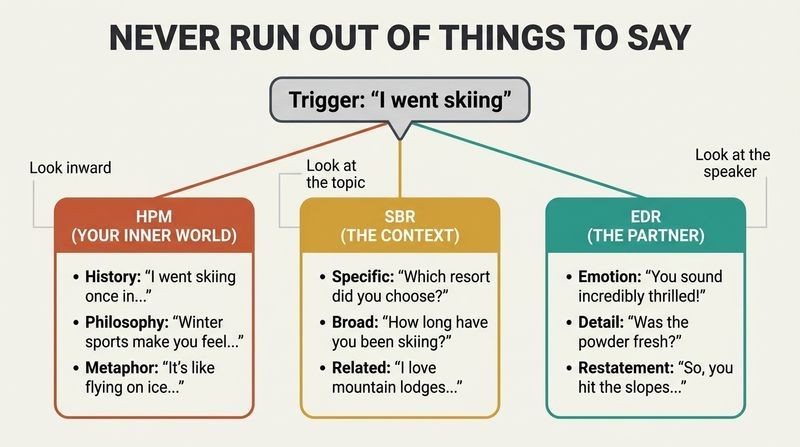
Three response families cover every topic. Patrick King collapses conversation into nine reflexive moves grouped as HPM, SBR, and EDR. HPM (History, Philosophy, Metaphor) draws on your inner world: a personal memory, an opinion, or what the topic reminds you of. SBR (Specific, Broad, Related) works with what's in front of you: drilling into details, asking background questions, or branching to adjacent subjects. EDR (Emotion, Detail, Restatement) centers the other person: naming their feeling, mining the five Ws, or echoing their exact words back.
When someone says they went skiing, you can recall your own trip (History), ask what slopes they hit (Specific), or say 'You sound thrilled' (Emotion). Chain these together like cue cards and awkward silence has nowhere to hide.
What's clever here is treating conversation as a finite decision tree rather than a mysterious gift. This echoes improv theater's rule of 'yes, and' and cognitive load theory: when the brain has a menu, it stops freezing. The risk King flags himself is imbalance. Lean too hard on HPM and you become the conversational narcissist redirecting everything to yourself; lean only on EDR and you vanish, offering no substance of your own. The real skill is proportion. Research on conversational reciprocity by Harvard's Karen Huang shows question-askers are rated more likable, validating the EDR bias toward the other person's world.
Absolute questions kill conversations; add qualifiers to set people free
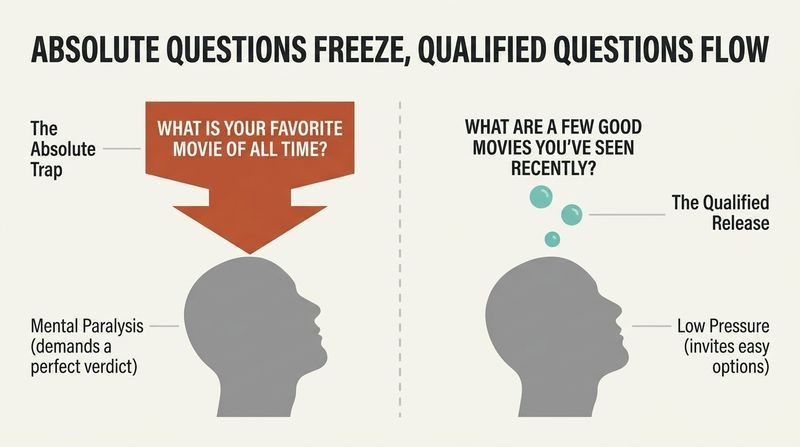
'Favorite' forces a painful verdict. Asking someone their number-one movie of all time hands them an impossible homework assignment. Most stall with 'let me think about that' and never recover. King argues that maybe 1% of people carry definitive answers ready to fire; everyone else feels ambushed and judged. The absolute answer also exposes the speaker: declare one film the greatest and you invite an argument about your taste.
Loosen the frame and watch them relax. Swap 'What's your favorite?' for 'What are a few good movies you've seen recently?' Qualifiers based on number or time (some, recently, a couple) remove the pressure to commit. Saying you saw a decent film lately invites agreement or friendly disagreement instead of a verdict on your character.
This maps neatly onto behavioral economics and choice architecture. Barry Schwartz's paradox of choice shows unbounded options paralyze; a bounded prompt is a smaller, answerable menu. The mechanism is also social face-saving: an absolute answer is falsifiable and defendable, so it triggers self-protective hedging. King's fix quietly lowers the stakes of being wrong. One nuance worth adding: absolutes can occasionally spark delightful debate among people who already trust each other. The tactic is less about banning superlatives and more about reading whether your listener wants a playground or a witness stand.
React slightly slower and match their exact emotion
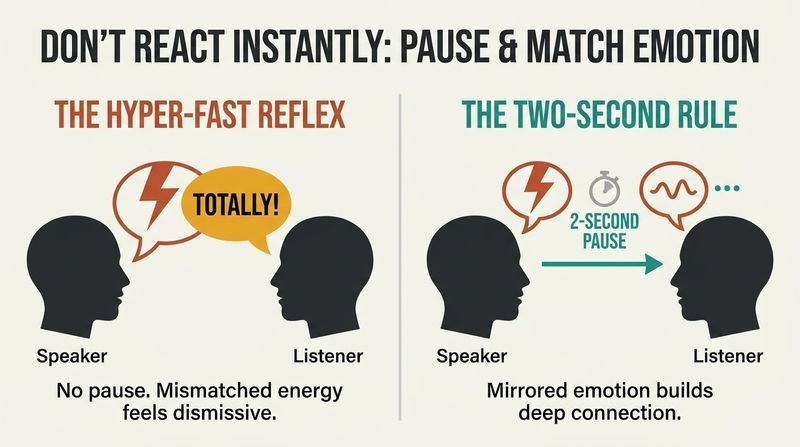
A conversation without reactions feels like a wall. King recalls a networking chat with a lawyer whose face stayed desert-flat, no blink, no acknowledgment. It felt like talking to furniture. Reactions prove you are emotionally and intellectually present. But two failure modes exist: no reaction, and reaction that arrives too fast. Vigorous nodding and instant 'I know, totally!' signals you heard trigger words, not meaning, and it rushes the speaker into wrapping up.
Two fixes make reactions land. First, identify the primary emotion (joy, annoyance, anger, sadness, or humor) and mirror that one back. Second, deploy the two-second rule: pause briefly after they finish before responding, wearing a thoughtful face. That delay signals genuine processing rather than reflexive box-checking.
The counterintuitive gem is that over-eagerness reads as dismissal. This aligns with research on active listening and turn-taking: micro-pauses signal cognitive engagement, while premature backchanneling ('yeah, yeah') is decoded as impatience. Therapists call the deliberate pause 'holding space.' There is a cross-cultural caveat King does not raise: acceptable silence length varies by culture. In some Nordic and East Asian contexts a two-second gap is normal, while in rapid-fire New York exchanges it can read as disengagement. Emotional mirroring also connects to affective empathy and mirror-neuron literature, though matching the wrong emotion (anger at a funny story) breaks rapport instantly.
Free-associate five words off any topic to escape dead ends
Stuck conversations aren't anyone's fault. When someone gushes about cats and you know nothing about cats, panic sets in. King's escape hatch: stop treating the word as a trigger for your feelings and treat it as a pure concept. Silently blurt five associations. Cats yields kittens, lions, allergies, the musical, sushi. Suddenly you have five on-ramps back into the flow. Car racing yields NASCAR, tires, The Fast and the Furious, each a legitimate pivot.
Practice off the field first. Write five random words on paper. For 'napkin,' fire three associations (table, spoon, fine dining), then chain three off your last word, and repeat. Do this across a week and non-linear connection becomes reflex, so mid-conversation you feel unstuck rather than frozen.
King is essentially teaching divergent thinking, the same faculty measured in creativity's Alternate Uses Test. The instruction to strip emotion and treat words as abstract nodes resembles semantic network activation in cognitive psychology: every concept links to dozens of others, and practice strengthens retrieval speed. It also mirrors how improvisers train word-association games to kill hesitation. A subtle strength is decoupling contribution from expertise; you need not know cats to talk around cats. The limitation: pure association can feel scattershot or evasive if you never actually engage the person's original enthusiasm. Association is a bridge, not a destination.
Step outside the conversation and comment on it, positively
Break the fourth wall like Ferris Bueller. In theater the fourth wall is the invisible screen between actor and audience; breaking it means addressing the audience directly. In conversation, it means observing the exchange itself: 'This chat took a wonderfully weird turn, didn't it?' or 'Did you just reference a 90s boy band?' Done with curiosity, it signals self-awareness and flatters the other person by noticing something they were proud of.
Keep it positive or it becomes an attack. Commenting negatively ('Are you steering this back to yourself again?') reads as condescension. Two safe uses: naming what you're both silently thinking (an unspoken inside joke), and voicing an upbeat opinion on where things are heading ('No idea where this is going, but I like it').
This is conversational meta-cognition, and it signals high status precisely because it requires monitoring the interaction while participating in it. Sociologist Erving Goffman would call it a shift in 'footing,' stepping from performer to commentator. The move works because shared observation manufactures intimacy: you are now co-authors watching your own scene. The positivity constraint is well-judged. Meta-comments carry an implicit power to evaluate, and evaluation aimed at a person's behavior triggers defensiveness (Gottman's research on criticism). Aimed at the shared moment, it bonds. Overused, though, it can feel performative, like someone narrating their own cleverness rather than connecting.
Manufacture instant intimacy with an 'us against the world' aside
One whispered observation creates a two-person tribe. 'Can you believe how loud it is in there?' instantly forms an in-group: just the two of you, the only sane ones, sharing secret knowledge above the crowd. It is the feeling of locking eyes with a stranger over something absurd. King grounds this in evolutionary psychology: on the ancient savanna, an us-versus-world instinct helped you spot allies and avoid becoming a lion's lunch.
Aim at three targets. Comment on something noteworthy in the moment, a shared context ('everyone here is so aggressive'), or a probable shared emotion ('exhausting in there, isn't it?'). Miss the mark and you sound like you're stating the obvious. Hit it and you tap the deepest likability rule: people prefer people who seem similar to them.
The similarity-attraction effect is one of social psychology's most replicated findings (Byrne's work from the 1960s onward). King's twist is that similarity can be fabricated in real time through selective framing; you and the stranger aren't actually different from the crowd, but the comment invents a boundary. This is the same mechanism behind inside jokes, gang colors, and national anthems. The ethical edge worth flagging: in-groups define themselves against out-groups, so the technique subtly others everyone else in the room. Used warmly it bonds; used as constant snark it curdles into cliquish superiority that others can sense and resent.
Prep a conversation resume before social events, like a job interview
You rehearse for interviews but wing your social life. Before an interview you review accomplishments and prime stories so no question catches you flat-footed. King asks why we don't extend this to socializing, where first impressions matter just as much. A conversation resume is a pre-built inventory of your best material: unique experiences, recent interesting happenings, opinions on current events, funny childhood facts, embarrassing moments, and evidence supporting the persona you want to project.
Preparation buys confidence and identity control. Knowing you have five interesting weekend stories ready means an unexpected 'how was your weekend?' won't collapse into 'I just watched TV.' You choose the impression you make (outdoorsy, artsy, professional) rather than defaulting to a fumbling stutterer. Review it before events, then let it surface organically without hogging the spotlight.
This reframes charisma as preparation rather than innate spontaneity, which is both liberating and slightly paradoxical: banter feels magical precisely because it seems unrehearsed. Yet every great talk-show host and comedian works from prepared material delivered as if spontaneous. Performance scholars call this 'the rehearsed spontaneous.' The psychological payoff King identifies, confidence through predictability, tracks with anxiety research: unpredictability drives social anxiety, so a fallback inventory lowers physiological arousal. The danger is over-scripting into a walking highlight reel that never truly listens. The resume should function like a jazz musician's scales: internalized scaffolding for improvisation, not a setlist recited verbatim.
Announce a time limit upfront to lower a stranger's guard
People fear open-ended conversations, not you. King notes that grocery lines and elevators breed easy chatter precisely because everyone knows the built-in exit: reach the cashier, and it's over, no obligation. A café, by contrast, has no visible escape, so strangers stay guarded. The fix is to import that boundary artificially. Open with 'I have to run in ten minutes, but...' or 'quick question before I head out...'
A capped commitment feels safe to accept. The other person reasons that even a dreadful chat lasts only ten minutes, so why not. You get your foot in the door, and once they discover the conversation is actually enjoyable, they relax and continue. You can even name a soft continuation: 'let's pick this up later.' The boundary bypasses the instinct to avoid.
This is a sharp application of what negotiators know as lowering the perceived cost of a yes. It resembles the foot-in-the-door technique inverted: rather than escalating commitment, you shrink the initial ask to something almost costless. Behavioral research on 'ask' framing shows people agree far more readily when an exit is visible; uncertainty about duration is itself a deterrent. There is honesty tension worth naming: a fabricated deadline is a small deception, and if you then linger for an hour the pretext dissolves. King's version works best when the constraint is plausible and you genuinely honor the other person's freedom to leave.
Silence your ego: derail your own train of thought and listen
Two trains can't share one track. Picture both people barreling toward each other with competing topics: your boss complaint versus their weekend tale. Good conversationalists put their topic on hold, switch fully to listening, and circle back later. Bad ones refuse to yield, so each launches their own agenda the instant the other stops, acknowledging nothing. King's rule: you can't have two pitchers, someone must catch, and roles should swap often.
Talk-show hosts are the proof. Every host is a professional comedian who could outshine any guest, yet they park their egos and ride the guest's train, resisting the urge to interrupt with a funnier line. The result: guests look brilliant and likable. The nagging voice insisting your point is funnier may be right, but voicing it over them only repels.
This is emotional self-regulation dressed as conversational tactics. The basketball analogy King uses (benchwarmers who shoot the instant they touch the ball because they never know when they'll get another chance) is psychologically astute: scarcity of speaking time breeds hoarding. The implication is that a generous listener actually makes others listen better, reducing their anxiety about getting a turn. This connects to research on conversational turn-taking and 'floor apportionment.' The deeper point echoes Dale Carnegie: being interested beats being interesting. One caveat: chronic self-derailing can tip into self-erasure, where you never share and become a therapist rather than a friend. Balance, again, is everything.
Frame taboo questions as a 'thought experiment' to unlock honesty
People clam up to avoid judgment. Ask a provocative question and many retreat: 'I can't even think about that.' King's workaround is to explicitly announce a thought experiment, then stack restrictions that absolve the person of responsibility for their answer. Would you kill a home intruder? Now suppose it's pure self-defense, he's terminally ill anyway, and no jury would ever convict you. Each added condition strips away a moral objection and makes the real question answerable.
Put the spotlight on the hypothetical, never the person. By labeling it an experiment, you signal 'this isn't about you, we're just exploring.' It works like handing someone an intellectual costume to wear. But construct it carelessly and it becomes an inquisition; the instant their answer seems to reveal their character, the fun curdles into feeling judged.
This exploits a genuine feature of moral cognition: people reason more freely about dilemmas when framed as abstract puzzles rather than personal confessions, the same design logic behind the trolley problem and Rawls's veil of ignorance. Psychological distance (construal level theory) makes hard topics tractable. The stacked stipulations also resemble how philosophers isolate variables. The manipulation risk is real: layering conditions until someone 'must' say yes can railroad them into endorsing something they'd reject, then feel tricked. King's insistence on keeping the spotlight off the person is the crucial safeguard. Handled well it produces genuine intimacy; handled poorly it feels like entrapment.
Compliment choices people made, not genes they were handed
Praise effort, not luck. King recalls a substitute teacher who complimented his hair and eyes every single time she saw him until it felt hollow and manipulative. The lesson: not all compliments are equal, and volume backfires. The most impactful ones target what a person actively chose and controls: their clothing, hairstyle, decor, opinions, worldview, or a physique they clearly built in the gym. These reflect identity and taste.
Inherited traits are cheap to praise. Complimenting someone's eye color or height amounts to 'nice job winning the genetic lottery.' They've heard it a thousand times and you could say it to fifty strangers today, so it carries no ownership. A Hawaiian-shirt devotee complimented on the shirt feels genuinely seen, because the choice broadcasts who they've decided to be.
This distinction between praising fixed traits and controllable effort rhymes powerfully with Carol Dweck's growth-mindset research, where effort-praise builds motivation and trait-praise breeds fragility. King imports that logic into social bonding: effort-based compliments validate agency and identity, the parts of self people feel authorship over. There's also a scarcity dimension; a compliment only lands when it feels rare and specific to the target. The reciprocity engine he cites (kindness triggers return kindness) is Cialdini's most robust principle. One refinement: even choice-based compliments fail if they feel strategic. Sincerity is detectable, and a transparently instrumental compliment reads as flattery, which erodes rather than builds trust.
Disarm insults by agreeing and amplifying them to absurdity
Wit is spontaneous creativity, delivered cool. King, a self-described formerly chubby kid, survived taunts by weaponizing agreement. Told his shirt was huge, he'd note it doubled as a parachute. The move takes the insult's power away by embracing it and exaggerating past the point of sense. He offers four comeback types:
1. Pick apart their words (reinterpret 'slow as a glacier' as 'strong and cool under pressure')
2. Agree and amplify (pile onto the insult about yourself absurdly)
3. Reverse and amplify (turn it back: you're even worse at this)
4. Outlandish comparison (I should've used the eggs as hockey pucks)
Delivery decides everything. Aim for 50% indifference, a James Bond calm. Never look wounded, never fire comebacks in rapid succession, and never use tired lines like 'so is your mom.' The goal is likability, not winning.
The judo metaphor King uses is apt: agreement redirects an opponent's momentum rather than opposing it, denying them the emotional payoff of a rise. This is the core mechanic of paradoxical intention in therapy and of self-deprecating humor's status paradox, where publicly owning a flaw signals such security that it reads as high status. The 50% indifference rule matters because comebacks delivered with heat expose the very insecurity they aim to mask. Research on humor styles (Martin) distinguishes affiliative and aggressive humor; King steers hard toward affiliative even in defense. The restraint clause, don't machine-gun retorts, is wise: relentless cleverness broadcasts insecurity louder than silence would.
Analysis
Patrick King's slim 2016 manual belongs to a crowded self-help subgenre (conversational charisma) but distinguishes itself through a single organizing conviction: wit is not a gift bestowed at birth but a mechanical skill decomposable into drillable patterns. The book opens with a childhood spent studying David Letterman's Teflon smoothness and closes with the admission that King never became Letterman, a framing that honestly positions the work as engineering rather than magic.
Structurally the book is an anthology of eighteen discrete tactics, which is both its strength and weakness. There is no cumulative argument, so chapters can be sampled in any order, but the absence of a unifying model means techniques occasionally collide (the ego-suppressing 'derail your train' chapter sits uneasily beside the self-promotional 'conversation resume'). The connective tissue, stated repeatedly, is that the goal of conversation is mutual comfort, not victory. Nearly every tactic reduces to lowering the other person's psychological guard: absolute questions raise it, boundary statements lower it, thought experiments dissolve it.
Intellectually, King is a pragmatic behaviorist. He rarely cites research, relying instead on introspection and plausible mechanism, which leaves claims untested but rings experientially true. Much of the material would be endorsed by academic social psychology: similarity-attraction, reciprocity, the likability of question-askers, and effort-versus-trait praise all have empirical backing he does not invoke.
The ethical tension running throughout deserves scrutiny. Several techniques (manufactured time limits, fabricated in-groups, restriction-stacked hypotheticals) are mild manipulations. King's defense is that they serve mutual enjoyment, and he repeatedly warns against weaponizing wit to feel superior. Read charitably, the book teaches social generosity through structure. Read cynically, it risks producing calculated performers. The honest reader will treat these as scaffolding to internalize and then discard, arriving at genuine curiosity by way of technique.
Review Summary
The Art of Witty Banter receives mixed reviews, with many readers finding it disappointing and misleading. Critics argue it lacks genuine wit and focuses more on basic conversation skills. Some praise its accessible advice on improving social interactions, while others view it as inauthentic and potentially harmful. Positive reviews highlight tips on preparing for conversations and building rapport. However, numerous readers criticize the book's examples as cringe-worthy, sexist, and inappropriate. Overall, the book's reception is polarized, with some finding value in its conversational techniques and others dismissing it as superficial.
People Also Read




FAQ
What's "The Art of Witty Banter" about?
- Overview: "The Art of Witty Banter" by Patrick King is a guide to mastering the art of engaging and clever conversation. It provides techniques to be quick, interesting, and captivating in social interactions.
- Purpose: The book aims to help readers develop skills to make people comfortable, connect easily, and never run out of things to say, enhancing their social presence.
- Content Structure: It includes practical exercises, frameworks, and strategies to improve conversational skills, such as HPM, SBR, and EDR, which are different response techniques.
- Author's Background: Patrick King is a social interaction specialist, bringing his expertise to help readers improve their social skills and build better relationships.
Why should I read "The Art of Witty Banter"?
- Improve Social Skills: The book offers actionable advice to enhance your ability to engage in witty and meaningful conversations, which can be beneficial in both personal and professional settings.
- Build Confidence: By learning the techniques in the book, you can gain confidence in social situations, making interactions more enjoyable and less stressful.
- Practical Techniques: It provides specific methods and exercises that can be practiced to develop conversational skills, making it a practical guide rather than just theoretical.
- Versatile Application: The skills learned can be applied in various contexts, from casual chats to networking events, making it a valuable resource for anyone looking to improve their social interactions.
What are the key takeaways of "The Art of Witty Banter"?
- Frameworks for Conversation: The book introduces frameworks like HPM (History, Philosophy, Metaphor), SBR (Specific, Broad, Related), and EDR (Emotion, Detail, Restate) to guide responses in conversations.
- Avoid Absolutes: It advises against speaking in absolutes, as they can make conversations difficult and lead to judgment, suggesting more open-ended questions instead.
- React Appropriately: Emphasizes the importance of reacting with the appropriate emotion and timing to show engagement and understanding in conversations.
- Use of Humor: Encourages using humor and wit to make interactions more enjoyable, while being mindful of delivery and context to avoid misunderstandings.
How does the HPM, SBR, and EDR framework work in conversations?
- HPM Framework: Stands for History, Philosophy, and Metaphor, encouraging responses that draw on personal experiences, opinions, or metaphors to add depth to conversations.
- SBR Framework: Involves Specific, Broad, and Related responses, allowing you to ask targeted questions, provide context, or relate topics to keep the conversation flowing.
- EDR Framework: Focuses on Emotion, Detail, and Restatements, helping you engage by acknowledging emotions, asking for details, or summarizing what the other person said.
- Purpose: These frameworks provide a structured approach to responding in conversations, ensuring you have diverse and engaging ways to interact.
What is the "Us Against the World" technique?
- Concept: This technique involves creating a sense of camaraderie by highlighting a shared experience or perspective that sets you and the other person apart from others.
- In-Group Feeling: It taps into the universal desire to belong, making the other person feel like they are part of an exclusive group with you.
- Application: You can use this technique by making observations or comments that emphasize a commonality or shared understanding between you and the other person.
- Effect: It fosters a sense of closeness and rapport, making the conversation more engaging and enjoyable for both parties.
How can I use "Fallback Stories" in conversations?
- Definition: Fallback stories are pre-prepared anecdotes or topics that you can introduce into a conversation to keep it flowing or revive it when it stalls.
- Components: A good fallback story includes a bridging sentence, the story itself, your opinion on it, and questions to engage the other person.
- Purpose: They provide a safety net in conversations, ensuring you always have something interesting to say and can steer the discussion in a new direction.
- Relatability: Choose stories with universal themes or dilemmas that others can easily relate to and have opinions about, encouraging further discussion.
What is the "Thought Experiment" technique?
- Purpose: This technique is used to engage people in hypothetical scenarios, allowing them to explore ideas and express opinions without fear of judgment.
- Setup: Announce the thought experiment and set boundaries or restrictions to make it clear that the discussion is hypothetical and separate from personal beliefs.
- Engagement: It encourages deeper conversation by removing social and moral obligations, making it easier for people to share honest and interesting responses.
- Application: Use it to explore complex topics or moral dilemmas, providing a safe space for open and thought-provoking dialogue.
How can I make the other person feel like an expert in a conversation?
- Role Reversal: Encourage the other person to take on the role of a teacher or expert by showing genuine curiosity and asking them to share their knowledge.
- Validation: This approach validates their experiences and opinions, making them feel valued and respected in the conversation.
- Questions: Ask open-ended questions that allow them to elaborate on their expertise, showing that you are interested in learning from them.
- Effect: It boosts their confidence and comfort level, leading to a more engaging and positive interaction.
How can I effectively use compliments in conversations?
- Focus on Choices: Compliment people on things they have control over, such as their style, manners, or achievements, rather than innate traits like eye color.
- Genuine and Specific: Ensure compliments are genuine and specific to the person, reflecting their unique choices and efforts.
- Impact: Well-placed compliments can create a positive atmosphere, making the other person feel appreciated and more open to conversation.
- Avoid Overuse: Use compliments sparingly to maintain their impact and avoid coming across as insincere or overly flattering.
What are "Double Explanations" and how do they enhance conversations?
- Concept: Double explanations involve providing a simple, engaging answer to a common question, followed by a more detailed explanation if the other person shows interest.
- Layman's Explanation: Start with a layman's explanation that is unexpected and draws people in, making you appear interesting and approachable.
- Expert Explanation: If prompted, offer a more in-depth explanation that provides additional context and detail, satisfying the other person's curiosity.
- Purpose: This approach keeps conversations dynamic and allows you to engage at different levels, depending on the other person's interest.
How can I use "Witty, Good-Natured Teasing" effectively?
- Delivery: Use a deadpan delivery initially, followed by a clear indication that you are joking, such as a smile or laugh, to ensure the teasing is taken in stride.
- Safe Topics: Focus on superficial choices or acknowledged weaknesses, avoiding deeply personal or sensitive topics that could offend.
- Purpose: Teasing can create a playful and relaxed atmosphere, showcasing your sense of humor and making interactions more enjoyable.
- Balance: Ensure the teasing is lighthearted and not hurtful, maintaining the overall goal of mutual comfort and rapport.
How can I initiate witty banter by going beyond the literal?
- Avoid Literal Responses: When someone makes a statement, avoid taking it at face value and instead look for opportunities to engage in humor or playfulness.
- Misinterpretation: Purposefully misinterpret statements in a humorous way to initiate a joke or playful exchange.
- Stay in the Joke: Once a joke is initiated, stay in character and continue the playful banter, adding to the humor and keeping the conversation lively.
- Practice: Develop the mindset of looking beyond the literal to create opportunities for witty banter and engaging interactions.
About the Author
Other books by Patrick King


Download PDF
Download EPUB
.epub digital book format is ideal for reading ebooks on phones, tablets, and e-readers.








































