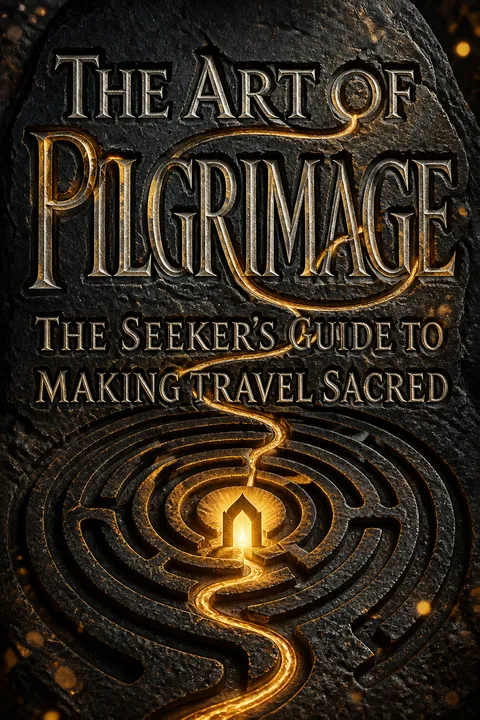
Key Takeaways
1. Pilgrimage transforms ordinary travel into a sacred quest for meaning
At the heart of this book is the belief that virtually every traveler can transform any journey into pilgrimage with a commitment to finding something personally sacred along the road.
Mindful versus mindless travel. The fundamental difference between a tourist and a pilgrim lies in their intention and perception. While tourism seeks comfort, distraction, and entertainment, pilgrimage demands a conscious engagement with the world. It is an active shift from being a passive onlooker to an active witness of the sacred.
The sacred is everywhere. Sacred travel does not require visiting ancient temples or remote shrines; it can occur in a local park, a museum, or an ancestral home. The key is to approach the destination with reverence and a desire for transformation.
- Reimagining the way we see the world
- Moving from distraction to deep attention
- Seeking personal answers to ultimate questions
A commitment to depth. By choosing to travel with a deep purpose, we elevate our experiences from mere sightseeing to soul-renewing rituals. This transformation requires us to slow down, linger, and absorb each stage of the journey, allowing the outer landscape to mirror our inner growth.
2. The journey begins with a deep, soulful longing for the unknown
Uncover what you long for and you will discover who you are.
The holy longing. Every sacred journey begins with a profound sense of restlessness, a feeling that something vital is missing from our daily lives. This internal hunger is what Goethe called the "holy longing," an irresistible pull toward the unknown that cannot be satisfied by material comforts.
A spiritual hunger. This longing is not merely wanderlust; it is the spirit's compass pointing toward completion and clarity. It is a call to break away from stultifying habits and rediscover our true selves.
- Recognizing the gap between our current state and our potential
- Honoring the quiet voice of our creative desires
- Treating melancholy as a signal to seek deeper meaning
The search for authenticity. When we acknowledge this deep-seated hunger, we begin the process of self-discovery. The longing itself acts as a catalyst, urging us to step out of our comfort zones and embark on a path of risk and renewal.
3. Answering the call requires listening to signs, dreams, and synchronicities
And so, the real treasure, the treasure that brings our wretchedness and our ordeals to an end, is never far away.
The wake-up call. The call to adventure often arrives in moments of crisis, disruption, or unexpected synchronicity. It may manifest as a recurring dream, a sudden inspiration, or a chance encounter with a stranger who points the way.
The art of listening. To hear the call, we must cultivate stillness and pay close attention to the subtle signals of our lives. This requires us to step back from the noise of modern existence and listen to our dreams and intuitions.
- Paying attention to recurring themes and symbols in our lives
- Embracing moments of synchronicity as guiding forces
- Practicing solitude to hear our inner voice
A leap of faith. Answering the call is a courageous act that demands we trust the unseen path. By responding to these subtle invitations, we begin to align our daily actions with our deeper destiny, turning our drifting into a consecrated quest.
4. Mindful preparation and packing light set the stage for spiritual transition
The day on which one starts out is not the time to start one's preparations.
The power of preparation. True pilgrimage requires careful mental, spiritual, and physical preparation long before we cross our front door. This involves studying the history, myths, and sacred texts of our destination to prime our minds for the encounters ahead.
Simplifying the burden. Packing light is a physical manifestation of our desire for spiritual simplicity. By shedding unnecessary material possessions, we free ourselves to focus on the essential experiences of the road.
- Carrying only what is truly necessary and meaningful
- Creating a personal "Book of Hours" with inspiring texts
- Bringing talismans that ground and connect us to our purpose
Priming the imagination. When we prepare our minds, we become alert to the subtle details and synchronicities of our journey. This deliberate preparation ensures that we do not merely consume a place, but actively engage with its living spirit.
5. Crossing the threshold demands embracing vulnerability and leaving room for serendipity
How will the gods ever find her when she has done everything in her power to make sure that they never will?!
The threshold guardian. Leaving the familiar behind always evokes a sense of fear and resistance, symbolized by the mythological threshold guardian. To cross this boundary, we must confront our anxieties and make a conscious commitment to the unknown.
Embracing the unexpected. A rigid itinerary leaves no room for the divine to enter our travels. We must allow space for serendipity, recognizing that the most transformative moments often arise from unexpected delays, detours, and disruptions.
- Letting go of rigid expectations and planned outcomes
- Viewing obstacles as opportunities for growth and learning
- Carrying peace offerings and gifts for the strangers we meet
The courage to lose our way. The true adventure begins when we lose our bearings and are forced to rely on our intuition and the kindness of strangers. By embracing this vulnerability, we open ourselves to the magical possibilities of the road.
6. The pilgrim's way is an active practice of deep attention and walking
The difference between pilgrim and tourist is the intention of attention, the quality of the curiosity.
The art of seeing. To travel soulfully, we must unlearn our habitual ways of looking and learn to see with the "eyes of the heart." This requires a deep, focused curiosity that seeks out the extraordinary in the ordinary.
Solvitur ambulando. Walking is the ultimate spiritual practice for the traveler, a physical act that slows us down and connects us directly to the earth. It is through the rhythm of our footsteps that we quiet our minds and become fully present.
- Focusing on small, beautiful details rather than overwhelming sights
- Recording our impressions through writing, sketching, or photography
- Using a walking stick to maintain physical and spiritual balance
A continuous meditation. By treating each step as a prayer, we transform the physical act of movement into a continuous meditation. This practice of deep attention ensures that we do not merely pass through a landscape, but allow it to pass through us.
7. Navigating the labyrinth of travel's trials reveals inner resilience
A labyrinth is a defense, sometimes a magical defense, built to guard a center, a treasure, a meaning.
The winding path. Few journeys are linear; instead, they twist, turn, and double back, mirroring the ancient symbol of the labyrinth. The trials we encounter—confusion, disappointment, and loss—are essential components of the sacred path.
The shadow side. Facing the shadow side of travel, such as confronting historical tragedies or personal grief, is a powerful rite of initiation. These difficult experiences strip away our illusions and force us to find our inner strength.
- Trusting our intuition as our guiding thread (Ariadne's clew)
- Practicing patience and silence during moments of frustration
- Finding "drops of honey" even in the darkest situations
An initiation to clarity. By enduring and overcoming these difficulties, we emerge from the labyrinth with a renewed sense of purpose. The trials do not break us; instead, they stretch our souls and prepare us for the sacred center.
8. True arrival is an oracular encounter that demands presence over consumption
This is a great moment, when you see, however distant, the goal of your wandering.
The sacred center. Reaching our destination is more than a physical arrival; it is an encounter with the numinous, a place where the walls of the temporal world dissolve. At this sacred center, we must resist the urge to consume the site through mindless photography or souvenir hunting.
An oracular experience. Like the ancient pilgrims at Delphi, we must approach the shrine with a deep question in our hearts. The site itself acts as an oracle, reflecting our deepest desires and offering insights into our soul's journey.
- Practicing silence and stillness upon arrival
- Making a ritual offering to express our gratitude
- Engaging with the site's history and myths through reading or prayer
A moment of transcendence. True arrival is a state of grace where we feel a profound connection to all the pilgrims who have gone before us. In this still point, we experience a deep healing and a restoration of our faith in life.
9. Bringing back the boon means sharing hard-won wisdom to serve others
The ultimate aim of the quest, if one is to return, must be neither release nor ecstasy for oneself, but the wisdom and the power to serve others.
The return journey. The sacred circle of pilgrimage is not complete until we return home and integrate our experiences into our daily lives. The true value of our journey is not the personal ecstasy we felt, but the "boon" we bring back to our community.
Sharing the gift. This boon is the hard-won wisdom, compassion, and self-knowledge we gathered on the road. We must share these gifts with others, acting as a bridge for those who are about to set out on their own journeys.
- Telling our travel stories with humility and depth
- Creating physical reminders, like altars or memory boxes, at home
- Using our renewed energy to serve and heal our communities
A legacy of grace. By passing on the wisdom we received, we keep the spirit of our pilgrimage alive. The stories we bring back become a source of inspiration, helping others to find their own sacred paths.
10. The ultimate destination of any sacred journey is a transformed everyday life
The path around our home is also the ground of awakening.
The final integration. The true test of a pilgrimage is how it changes our relationship with our ordinary, everyday existence. Upon our return, we must apply the mindfulness and reverence we practiced on the road to our daily routines.
Seeing home anew. Having traveled to the ends of the earth, we return to our starting point and see it for the first time. The sacred is no longer a distant destination; it is present in our homes, our work, and our relationships.
- Treating daily walks as miniature pilgrimages
- Approaching everyday challenges with the patience of a traveler
- Cultivating a continuous sense of gratitude and wonder
The ongoing quest. Our journey does not end when we cross our threshold; it simply shifts inward. By living each day with the intention and attention of a pilgrim, we turn our entire lives into a sacred, ongoing quest.








































