
Key Takeaways
People skills, not talent, drive 85% of career success
“The reason 90% of people fail in life is a failure to deal successfully with people.”
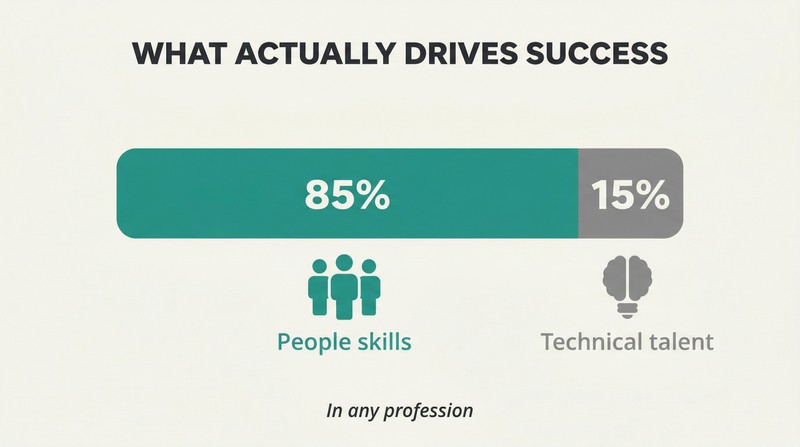
Brains aren't the bottleneck. Giblin cites studies showing that learning to deal with people accounts for 85% of success in any profession and roughly 99% of personal happiness. The most successful people you know likely aren't the smartest — they simply have "a way" with others.
Both the shy and the bossy fail. The shy person thinks their problem is personality when it's really a people-skills deficit. The bossy person forces compliance but can never force the one thing they crave most: genuine liking. Whether you're retreating from people or bulldozing them, the result is the same. Giblin's central premise: human relations is the skill of getting what you want without trampling others' egos in the process.
Difficult people are ego-starved, not ego-inflated
“You have to lower yourself to be petty.”
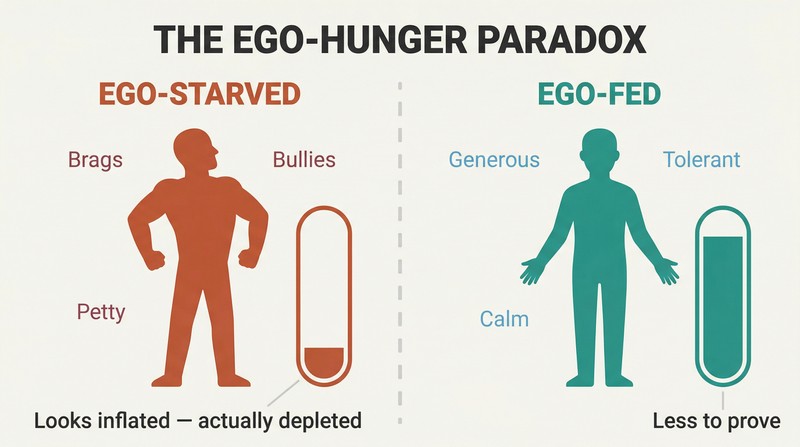
A starved ego is a mean ego. Giblin compares ego-hunger to physical hunger: skip two meals and you become critical, irritable, and impossible to please. The same happens with self-esteem. The braggart, the bully, and the show-off aren't suffering from too much self-regard — they're desperately overcompensating for too little.
Feed the ego, tame the lion. When self-esteem runs high, people are generous, tolerant, and willing to hear criticism. When it's depleted, even an innocent remark feels like an attack. In World War I, a private barked at General Pershing to put out a match. Pershing's calm reply: "Just be glad that I'm not a second Lieutenant." The higher the self-esteem, the less need for pettiness.
Pay five daily compliments — praise the act, not the person
“Everyone is a millionaire in human relations…the great tragedy is that too many of us hoard our wealth.”
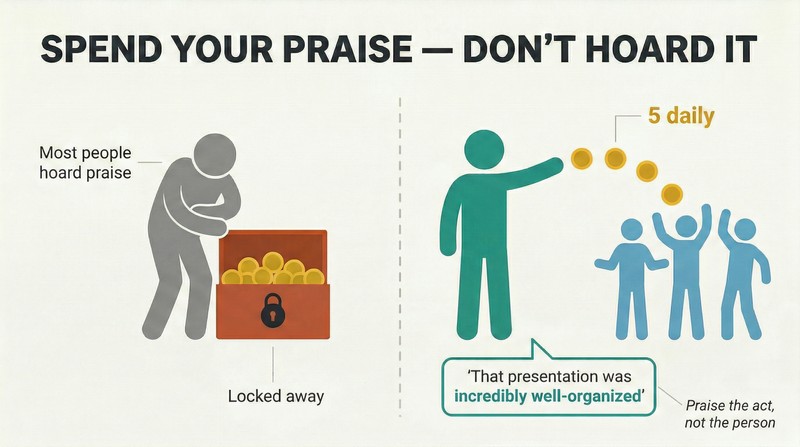
Praise releases real energy. Giblin argues the lift from sincere praise isn't imagined — it releases physical energy and enables people to perform better. But most of us hoard this free currency, saving it only for big occasions or forgetting to spend it at all.
Technique matters. Praise the act or attribute, not the person: "That presentation was incredibly well-organized" lands better than a vague "You're great." Six rules for effective thanks:
1. Say it sincerely, not off-hand
2. Speak up — don't mumble
3. Use the person's name
4. Make eye contact
5. Thank people when they least expect it
6. Consciously look for things worth praising
Project the attitude you want returned — others mirror you exactly
“Enthusiasm is more catching than a cold; and so are indifference and lack of enthusiasm.”
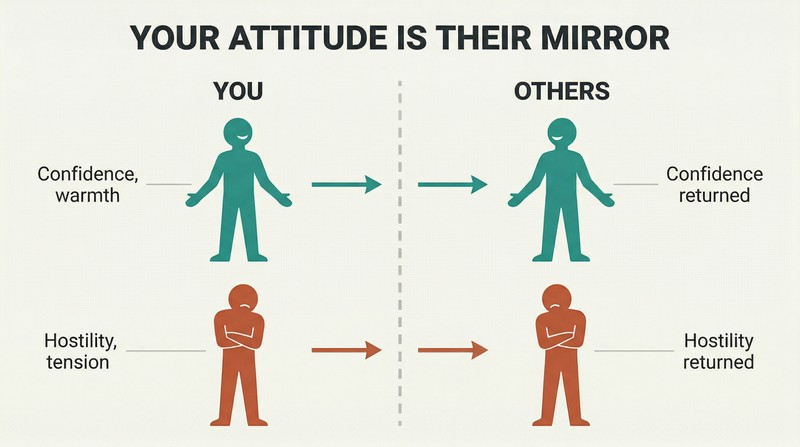
Emotions are contagious. When you smile, others smile back. When you shout, they shout back. Giblin compares every interaction to standing before a mirror — your attitude reflects directly in the other person's behavior. In explosive situations, lowering your voice literally forces others to lower theirs; anger can't sustain itself at a whisper.
Confidence is self-fulfilling. Napoleon, escaping exile, walked directly toward the army sent to capture him — acting as if they would follow his orders. They did. John D. Rockefeller, when asked to pay debts, would calmly offer Standard Oil stock instead of cash. His composure was so absolute that nearly every creditor chose the stock — and none regretted it.
Open every encounter on the note you want it to end on
“If you set the stage for comedy, don't be serious…if you set the stage for tragedy, don't expect others to be frivolous.”
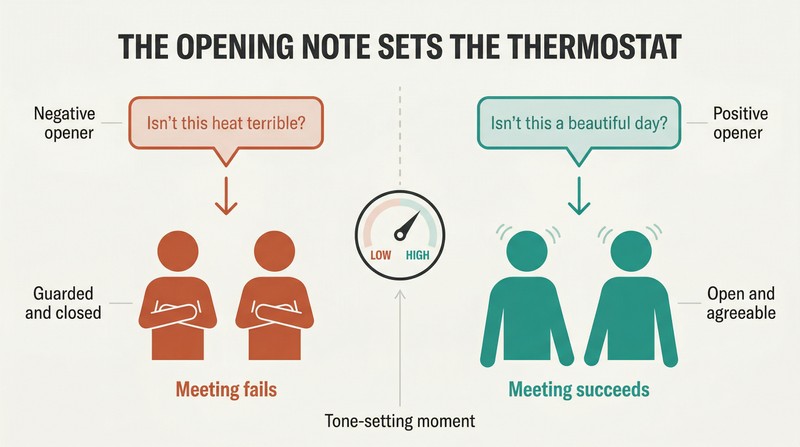
Your first words set the thermostat. Want a business-like meeting? Start business-like. Want informality? Begin casually. Others unconsciously match the tone you establish in the first moments. When a meeting "just didn't come off," Giblin says it almost always failed because someone struck the wrong opening note.
Create a "yes" atmosphere. Prime agreement early by asking preliminary questions that invite yes responses — "Isn't this a beautiful color?" or "Don't you agree this is fine workmanship?" — before asking the big question. Nod affirmatively as you speak. Avoid negative openers ("Isn't this heat terrible?") that put people in a cautious, pessimistic frame. Cheerful, optimistic people are more generous and willing to take chances.
Stop trying to impress — let others know they impress you
“Compete with them, and they will be firmly convinced that you are a fool who doesn't know his way around.”
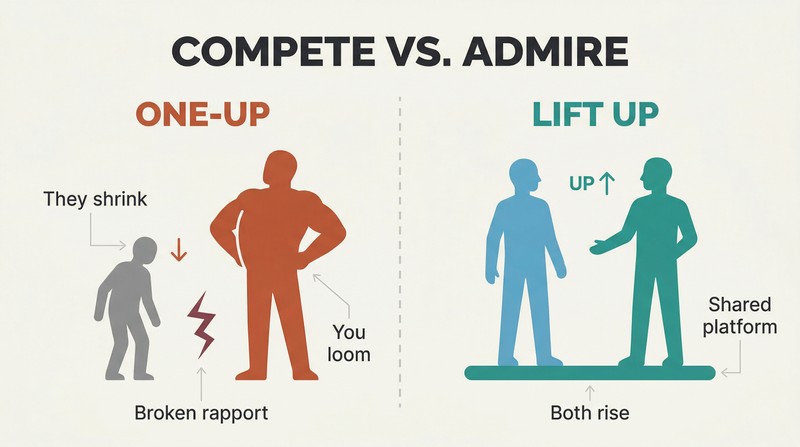
One-upmanship backfires every time. If someone tells you about a great feat, and you immediately counter with something even greater, you've shrunk them to enlarge yourself. The temptation is universal — but it destroys rapport. Consciously or unconsciously, the drive to impress makes you diminish others, and they resent you for it.
The counterintuitive move. The most effective way to make a good impression is to let others know that you are impressed by them. Show genuine admiration for what someone has done, and they won't think less of you — they'll rate you as one of the smartest, most personable people they've met. Don't compete for importance. Let others shine, and you glow by association.
Accept people as they are to earn the power to change them
“A critical, fault-finding person…is never going to be stampeded by those hoping to become close friends.”
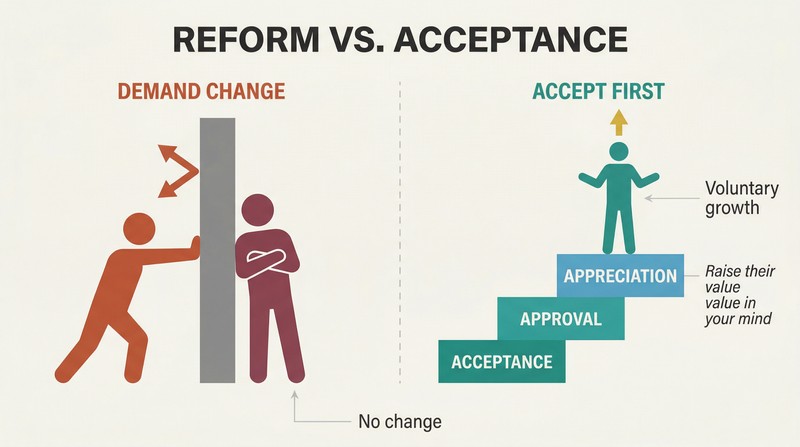
The Triple-A Formula. Giblin outlines three hungers every person carries:
1. Acceptance — let people be themselves without requiring perfection
2. Approval — go beyond tolerating faults to actively finding things you can praise
3. Appreciation — literally means "to raise in value"; emphasize others' worth in your mind, then show it
Reform never works; acceptance does. No one has the power to "reform" another person. But accepting them as they are gives them the psychological safety to change themselves. Don't fashion a moral straightjacket and demand people wear it to earn your friendship. When others taste your approval, they begin adjusting their behavior to earn more of it — voluntarily.
Great conversationalists ask questions, not tell stories
“Anything about you or your past that is similar to others will help them to like you.”
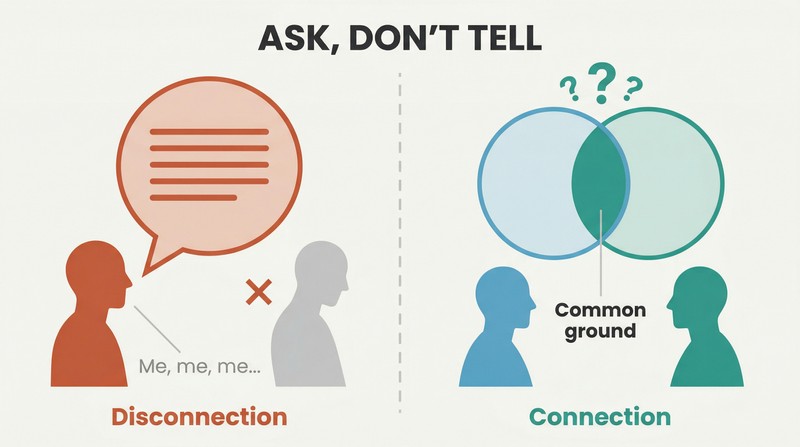
Small talk is the warm-up, not the weakness. Giblin says most people freeze in conversations because they're afraid of saying something "too trivial." But small talk is necessary to get the wheels turning. Stop trying to be clever, and you'll paradoxically say cleverer things because the pressure is gone.
The me-too technique. When you can't think of what to say, ask where someone is from, what they do, or about their family. Then find similarities between their experiences and yours. Sharing common ground ("I grew up on a farm too") isn't stealing the spotlight — it tells the other person, "I'm like you. I agree with you." We instinctively like people who resemble us. Seek agreement, and disagreements resolve themselves.
Listening reveals what people need while hiding your hand
“…if you can't touch them, you can't move them.”
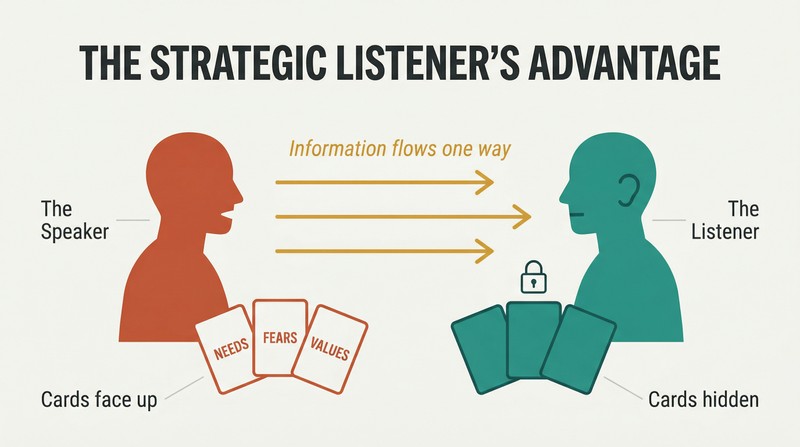
Listening is strategic, not passive. You can't influence someone if you don't know what they want, fear, or value. Listening is the fastest way to discover others' true positions — and the safest way to conceal your own. Successful people encourage others to keep talking while keeping their own mouths shut. Talk enough, and you'll inevitably reveal your hand.
Listening also cures self-consciousness. When all your attention flows outward — to the speaker's words, tone, and inflection — there's no bandwidth left for anxious self-monitoring. Practical tips: look at the speaker, lean toward them, ask follow-up questions, never interrupt, and use the speaker's own words to introduce your ideas ("As you pointed out…"). This proves you listened and lets your points land without resistance.
Slip ideas past the ego guard — force triggers immunity
“Friends don't come at us hammer and tongs, so we just close our ears to ideas dressed up like enemies.”
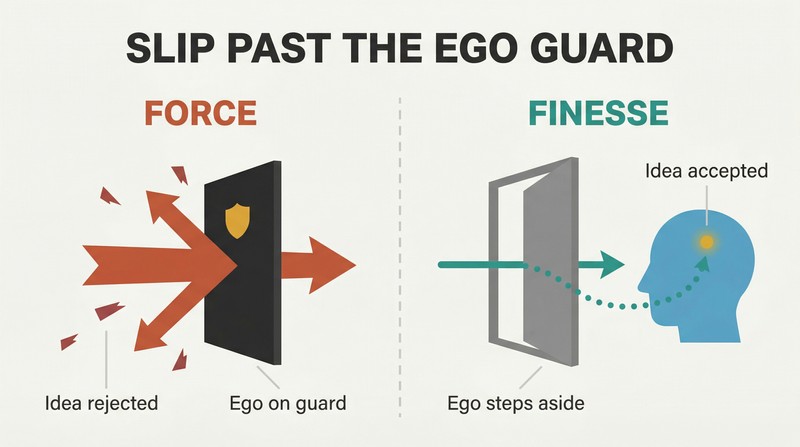
The ego is a bouncer. No idea is truly accepted until it reaches the subconscious mind — and the ego stands guard at the entrance. Ridicule someone's position, and the ego slams the door. Threaten them, and they immunize themselves against everything you say, no matter how logical.
Low-pressure persuasion changes minds. Giblin's rules:
1. Let others state their full case first — they can't hear you until they've been heard
2. Pause before responding to show you took their point seriously
3. Concede minor points willingly so they'll yield on the major one
4. State your case calmly — exaggeration kills credibility
5. Let them save face: "I felt the same way until I saw this new information"
Criticize the act in private, once, and supply the fix
“Even if you have pure motives and the right spirit, it's how they feel about it that counts.”
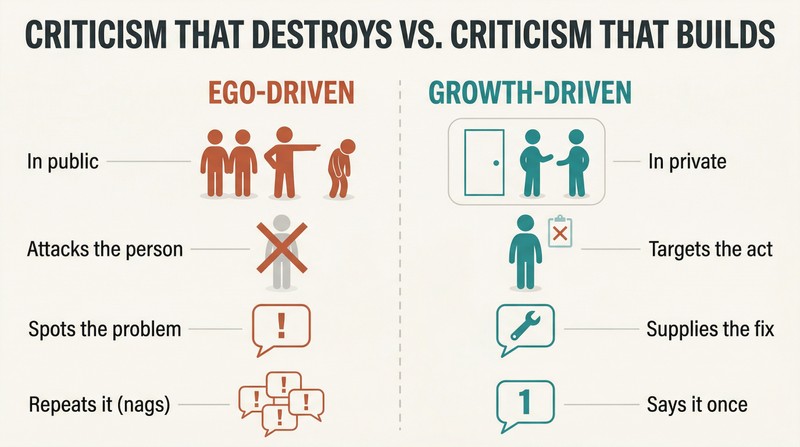
Most criticism serves the critic's ego, not the recipient's growth. When someone says "I'm telling you this for your own good," Giblin argues they're usually bolstering their own self-worth at others' expense. Whether you criticize privately is the clearest test of your real motives — do you only critique when there's an audience?
Seven rules for criticism that works:
1. Always in absolute privacy
2. Preface with a genuine compliment to lower defenses
3. Criticize the behavior, not the person
4. Tell them how to do it right — don't just spotlight the mistake
5. Ask for cooperation rather than demanding it
6. One criticism per offense — repeating is nagging
7. End on a friendly note: "I know I can count on you"
Analysis
Giblin's mid-century classic distills interpersonal dynamics into a single operating principle: every human interaction is an ego transaction. Where Carnegie offered a catalog of techniques, Giblin offers a unified theory — people's behavior is ultimately driven by their hunger for self-esteem, and your success depends on how well you feed that hunger without starving your own.
The book's most enduring insight — that difficult people suffer from too little self-esteem, not too much — anticipated what clinical psychology later confirmed through research on narcissistic fragility. Roy Baumeister's sociometer hypothesis, developed decades after Giblin wrote, argues that self-esteem functions as an internal gauge of social acceptance — precisely the mechanism Giblin describes with his ego-hunger metaphor. The prescription (feed the starving ego rather than attacking it) remains empirically sound.
Giblin's framework has a notable blind spot: it risks conflating empathy with instrumentalism. 'Feed their ego so they give you what you want' can slide from genuine generosity into calculated manipulation. Modern readers steeped in authenticity culture may bristle at the transactional framing. Yet the underlying principle — that recognition costs nothing and creates reciprocity — aligns with Adam Grant's later research showing that organizational 'givers' outperform 'takers' over time.
What keeps the book remarkably current is its specificity. The five-compliments-a-day rule, the one-criticism-per-offense limit, the ego-guard metaphor for persuasion — these are implementable protocols, not abstract philosophy. Giblin's insight that listening strategically reveals others' positions while concealing your own reads like a negotiation manual drafted decades before Fisher and Ury's Getting to Yes or Voss's Never Split the Difference. In an era of escalating digital conflict and declining face-to-face interaction, Giblin's core thesis — that people skills are not soft skills but the hardest, most consequential skills you can develop — may be more urgent than when he first wrote it.
Review Summary
"The Art of Dealing With People" receives high praise for its concise, practical advice on improving interpersonal skills. Readers appreciate its straightforward approach, real-life examples, and timeless insights. The book covers topics like understanding human ego, effective communication, and handling criticism. Many find it a valuable resource for both personal and professional settings. Some reviewers note similarities to other self-help books but still find unique value in Giblin's presentation. Overall, it's considered a quick, impactful read for anyone seeking to enhance their people skills.
People Also Read





Glossary
Ego-hunger
Universal craving for self-esteemGiblin's term for the innate human need for respect, approval, and a sense of accomplishment—analogous to physical hunger for food. Just as a starving person becomes irritable and self-focused, a person whose ego-hunger goes unsatisfied becomes critical, defensive, and difficult. Ego-hunger must be partially fed before someone can turn attention outward to others.
Triple-A Formula
Acceptance, Approval, and AppreciationGiblin's three-part framework for developing an attractive personality. Acceptance means allowing people to be themselves without requiring perfection. Approval goes further by actively finding things to like about others. Appreciation—literally meaning 'to raise in value'—involves emphasizing others' worth in your mind and demonstrating it through actions like thanking them, acknowledging their presence, and treating them as special.
First Law of Human Relations
People act to enhance egosGiblin's foundational principle stating that people act—or fail to act—largely to enhance their own egos. When logic and reasoning fail to persuade someone, giving them a personal reason tied to their self-importance is the most effective motivator. Giblin illustrates this with a story of getting a hotel room during a sold-out convention by telling the clerk, 'If anyone can find a solution, it's you.'
Me-too technique
Bond through shared similaritiesA conversational strategy where you bring yourself into the discussion by sharing something about your own life that mirrors what the other person said. Rather than one-upping ('I own 500 acres in Texas'), you create connection ('I grew up on a farm too'). This communicates agreement and similarity, building rapport because people instinctively trust and like those who resemble them.
Happy talk
Keep conversations positive, not complainingGiblin's term for the practice of keeping conversations optimistic rather than airing personal problems, ailments, or complaints in social or professional settings. Instead of burdening others with negativity, Giblin recommends writing yourself a letter detailing how you've been wronged, then burning it. The letter serves as a private emotional outlet, eliminating the compulsion to dump negativity on others.
Download PDF
Download EPUB
.epub digital book format is ideal for reading ebooks on phones, tablets, and e-readers.








































