
Plot Summary
Desert Nightfall: Silent Town
In the cold Arizona night, two Army officers, Shawn and Crane, approach the tiny town of Piedmont to recover a downed satellite. The town is eerily silent, its buildings dark, and buzzards circle overhead. As the men enter, they discover bodies strewn everywhere, frozen in peaceful yet unnatural poses. Their radio transmissions grow increasingly panicked as they witness a robed figure walking among the corpses. Suddenly, their communication ends in terror and violence. This chilling opening sets the stage for a crisis that is both scientific and existential, as the ordinary collides with the unknown, and the first hints of an unprecedented biological disaster emerge.
Vanished Lives, Grim Discovery
At Vandenberg Air Force Base, the disappearance of Shawn and Crane triggers alarm. Major Manchek, a methodical and cautious officer, initiates emergency protocols. Aerial reconnaissance confirms the worst: Piedmont's population is dead, bodies scattered indoors and out, with only a single figure moving among them. The military's response is swift but uncertain, as they struggle to comprehend the scale and nature of the catastrophe. The chilling efficiency of the deaths, the lack of visible trauma, and the presence of a lone survivor raise more questions than answers. The crisis is no longer local—it is a national emergency, demanding the mobilization of the country's most advanced scientific resources.
Emergency Protocols Initiated
Recognizing the potential for an extraterrestrial biological threat, Major Manchek triggers the top-secret Wildfire Alert. This protocol, years in the making, is designed to assemble a team of elite scientists and provide them with an underground laboratory built for absolute containment. The process is automatic and relentless, summoning experts from across the country. The narrative shifts to the personal: scientists are pulled from their lives, families, and routines, thrust into a crisis that tests their expertise and their humanity. The machinery of national defense and scientific inquiry grinds into motion, setting the stage for a confrontation with the unknown.
Wildfire Team Assembled
The Wildfire team—Stone, Leavitt, Burton, and Hall—are introduced, each bringing unique skills and psychological baggage. Stone, the Nobel laureate and project architect, is driven and impatient. Leavitt, the clinical microbiologist, is imaginative but plagued by hidden epilepsy. Burton, the pathologist, is brilliant but anxious. Hall, the surgeon, is the "Odd Man," chosen for his unmarried status and decisive temperament. Their selection is not just about expertise but about psychological profiles, as the project's self-destruct mechanism can only be disarmed by the Odd Man. The team's dynamics—rivalries, doubts, and flashes of insight—will shape their response to the crisis.
Descent Into Containment
The team enters the Wildfire facility, a marvel of engineering and paranoia. Each level is more sterile than the last, and the scientists undergo exhaustive decontamination, physical exams, and psychological stress. The process is both physically and mentally taxing, stripping away their identities and routines. The facility itself is a character—cold, color-coded, and automated, designed to isolate not just pathogens but also the people within. The descent is a metaphor for the narrowing focus of their mission: from the world above to the microscopic world below, from the general to the specific, from the familiar to the alien.
Piedmont's Deadly Secret
Stone and Burton, clad in protective suits, enter Piedmont. They find not just mass death but a pattern: people died instantly, clutching their chests, with blood clotted solid in their veins. Some committed bizarre suicides, suggesting madness as well as physical destruction. The satellite is found in the doctor's office, crudely opened. Two survivors are discovered: a screaming infant and an old man, Peter Jackson, who is gravely ill. The town is a puzzle, its clues scattered among the dead and the living. The scientists' emotions—horror, curiosity, and urgency—drive them to collect every possible sample and survivor.
Survivors: Infant and Old Man
The infant and Jackson are transported to Wildfire, becoming the team's most valuable assets. Their survival is inexplicable, given the lethality of the outbreak. Hall, tasked with their care, begins to search for commonalities. Jackson's history of ulcers, aspirin, and Sterno (methanol) abuse, and the infant's constant crying, suggest physiological states that might confer protection. The survivors embody hope and mystery, forcing the team to look beyond the obvious and question their assumptions about infection, immunity, and the nature of the threat.
The Alien Organism Unveiled
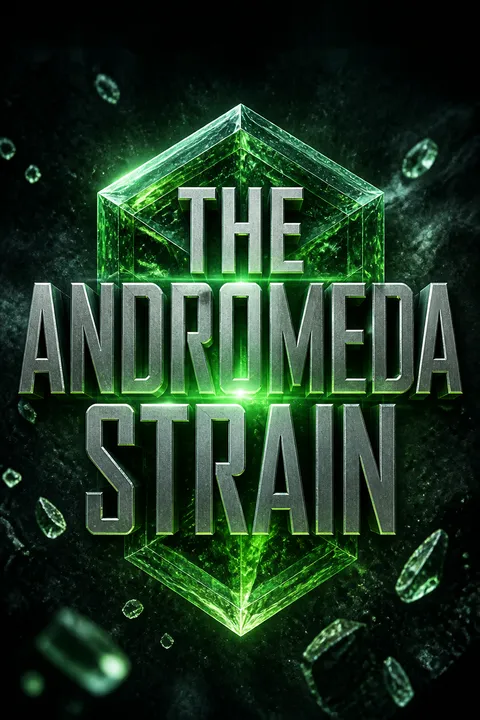
In the lab, the team isolates the causative agent: a green, hexagonal, crystalline organism unlike anything on Earth. It contains no proteins or amino acids, defying all known biology. It grows rapidly in the presence of carbon dioxide and ultraviolet light, with no waste products. Electron microscopy and X-ray crystallography reveal a structure more like a self-replicating crystal than a cell. The organism's simplicity and efficiency are terrifying—it is perfectly adapted to survive and multiply in space, and its potential for mutation is vast. The scientists are awed and unsettled, realizing they face not just a disease but a new form of life.
Scientific Race Against Time
As the team experiments, they learn that Andromeda kills by causing instant, total blood clotting. It is airborne, but only infectious in a narrow pH range. Attempts to treat or neutralize it with antibiotics or anticoagulants fail. The organism mutates rapidly, and a military jet that flies over the contaminated zone crashes when its plastic components are destroyed—evidence that Andromeda has changed its mode of attack. The team's focus shifts from containment to survival, as the threat evolves faster than their understanding. The pressure mounts, and mistakes—both human and mechanical—compound the danger.
Mutation and Catastrophe Loom
A seal in the lab fails, exposing Burton to the organism. Simultaneously, Leavitt suffers a seizure triggered by flashing lights, incapacitating him at a critical moment. The lab's automated systems initiate a countdown to nuclear self-destruction, designed to prevent the organism's escape. Hall, the Odd Man, is the only one who can disarm the bomb, but he is trapped by the facility's own defenses. The narrative becomes a race against time, as Hall must navigate lethal obstacles, fight off paralysis from tranquilizer darts, and reach the control panel before detonation.
The Bomb and the Seal
Hall's desperate crawl through the central core, dodging automated defenses and fighting the effects of curare, is the story's climax. He reaches the self-destruct panel with seconds to spare, using his unique key and physiological profile to abort the explosion. The tension is visceral, the outcome uncertain until the last moment. The resolution is both a triumph of individual will and a critique of systems designed to be foolproof but vulnerable to human error and unforeseen events. The team survives, but only barely, and only because of a series of lucky breaks and last-minute insights.
Hall's Desperate Gamble
In the aftermath, Hall realizes that the survivors—Jackson, the infant, and a diabetic police officer—shared one trait: their blood pH was outside the narrow range in which Andromeda could multiply. Rapid breathing (alkalosis), acidosis from disease or drugs, or metabolic imbalance protected them. The organism's mutation into a form that digests plastics, rather than human tissue, is both a reprieve and a warning. The crisis is over, but only because the threat has changed, not because it has been eliminated. The team's relief is tempered by the knowledge that Andromeda could mutate again.
The Aftermath and Understanding
The immediate danger passes as Andromeda drifts into the upper atmosphere, apparently harmless for now. The government covers up the true nature of the crisis, attributing related disasters to mechanical failure. The Wildfire team is left to reflect on their ordeal: the limits of human knowledge, the unpredictability of science, and the thin line between safety and catastrophe. The story ends with a sense of uneasy resolution—Andromeda is not defeated, only dormant, and the world remains vulnerable to the unknown. The lessons are sobering: vigilance, humility, and the need for systems that can adapt as quickly as the threats they are designed to contain.
Analysis
A cautionary tale of science, systems, and the unknownThe Andromeda Strain is a masterclass in techno-thriller storytelling, blending scientific realism with existential dread. At its core, the novel is a meditation on the limits of human knowledge and the dangers of overconfidence in technology and systems. Crichton's narrative exposes the fragility of even the most advanced safeguards, showing how small errors—mechanical, psychological, or procedural—can cascade into catastrophe. The story's emotional arc moves from awe and terror to relief and humility, as the characters confront an alien life form that defies their assumptions and nearly destroys them. The lessons are clear: vigilance, adaptability, and humility are essential in the face of the unknown. The novel also critiques the compartmentalization of expertise and the dangers of bureaucratic inertia, suggesting that true safety lies not in rigid protocols but in the capacity to question, adapt, and collaborate. In an age of emerging biological threats and technological complexity, The Andromeda Strain remains a prescient and unsettling exploration of what happens when humanity meets the truly alien.
Review Summary
Reviews of The Andromeda Strain are largely positive, averaging 3.91/5. Readers appreciate Crichton's meticulous scientific detail and realistic, report-style narrative, which creates authentic tension. Many find it a gripping techno-thriller, praising its prescient themes around pandemics and extraterrestrial organisms. Common criticisms include dry, overly technical passages, underdeveloped characters, and an anticlimactic ending. Several note the book's dated lack of diversity, with an all-white male cast. Despite its age, many consider it a foundational sci-fi work that holds up remarkably well, particularly given its eerie relevance to modern pandemic experiences.
People Also Read


Characters
Jeremy Stone
Stone is the architect of the Wildfire Project, a Nobel Prize-winning bacteriologist whose intellect and ambition are matched by impatience and a sometimes abrasive manner. He is the team's anchor, pushing for thoroughness and discipline, but his confidence can border on arrogance. Stone's legal training and political connections make him adept at navigating bureaucracy, but his focus on systems and protocols sometimes blinds him to human factors. Psychologically, Stone is both a rationalist and a worrier, haunted by the possibility of failure and the limits of human control. His development is marked by moments of humility, as he confronts the unpredictability of both the organism and his own team.
Peter Leavitt
Leavitt is a clinical microbiologist with a gift for creative thinking and a penchant for challenging assumptions. He is the team's "idea man," often proposing wild theories that stretch the boundaries of conventional science. However, Leavitt harbors a secret: he suffers from epilepsy, which he hides out of fear for his career. This vulnerability becomes critical when a seizure incapacitates him at a crucial moment. Leavitt's psychological complexity—his pessimism, self-doubt, and flashes of brilliance—make him both indispensable and unpredictable. His journey is one of self-acceptance and the recognition that even the most brilliant minds have limits.
Charles Burton
Burton is a pathologist whose expertise in tissue analysis and disease mechanisms is vital to the team's investigation. He is meticulous and thorough, but his anxiety and self-doubt sometimes lead to mistakes—most notably, overlooking key autopsies that could have provided earlier answers. Burton's psychological profile is marked by a fear of failure and a tendency to second-guess himself. His development is a study in the dangers of tunnel vision and the importance of collaboration. Burton's survival, both literal and professional, depends on his ability to adapt and trust his colleagues.
Mark Hall
Hall is a surgeon chosen for his unmarried status and psychological profile, making him the only one able to disarm the lab's self-destruct mechanism. He is practical, quick-thinking, and sometimes irreverent, providing a counterbalance to the more theoretical members of the team. Hall's outsider status gives him a unique perspective, allowing him to see connections others miss—most importantly, the link between blood pH and survival. Psychologically, Hall is resilient and adaptable, able to function under extreme pressure. His journey is one of reluctant heroism, as he moves from skepticism to decisive action.
Peter Jackson
Jackson is an elderly Piedmont resident whose survival is initially inexplicable. His history of ulcers, aspirin, and methanol abuse creates a physiological state—acidosis—that protects him from Andromeda. Jackson is cantankerous, stubborn, and deeply human, embodying both the randomness of survival and the importance of individual variation. His interactions with Hall provide crucial clues, and his presence serves as a reminder that science must account for the messiness of real life.
The Infant (Jamie Ritter)
The unnamed infant is the other survivor of Piedmont, protected by the physiological effects of constant crying (respiratory alkalosis). The baby is a symbol of vulnerability and resilience, forcing the scientists to consider factors beyond the obvious. The infant's survival challenges assumptions about immunity and adaptation, highlighting the role of chance and the limits of scientific prediction.
Major Arthur Manchek
Manchek is the duty officer who recognizes the crisis and initiates the Wildfire Alert. He is methodical, cautious, and sometimes slow to act, but his adherence to protocol is crucial in the early stages. Manchek represents the intersection of military discipline and scientific uncertainty, and his decisions shape the trajectory of the response. Psychologically, he is a study in the burdens of command and the difficulty of acting under uncertainty.
The Andromeda Organism
Though not a character in the traditional sense, Andromeda is the story's true antagonist. It is a crystalline, self-replicating organism with no proteins or enzymes, capable of rapid mutation and adaptation. Its simplicity and efficiency make it both fascinating and terrifying. Andromeda's behavior forces the characters to confront the limits of their knowledge and the unpredictability of evolution. It is a symbol of the unknown, a reminder that life—and danger—can take forms beyond human imagination.
Allison Stone
Allison appears briefly but serves as a touchstone for Stone's humanity. Her confusion and fear at his sudden departure highlight the personal costs of scientific crisis. She represents the world outside the lab, the lives disrupted by events beyond their control.
Karen Anson
Karen assists Hall in the care of the survivors, embodying the competence and compassion of the support staff. Her presence underscores the collaborative nature of scientific work and the importance of empathy in the midst of crisis.
Plot Devices
Scientific Realism and Procedural Detail
The novel's structure is built around the step-by-step investigation of the outbreak, mirroring real-world scientific inquiry. Detailed descriptions of laboratory procedures, decontamination, and data analysis create a sense of authenticity and immersion. This realism grounds the story, making the extraordinary events plausible and the stakes tangible. The procedural approach also serves as a narrative engine, driving the plot through a series of discoveries, setbacks, and breakthroughs.
The "Odd Man" Hypothesis
The self-destruct mechanism can only be disarmed by the "Odd Man"—an unmarried male with a specific psychological profile, statistically more likely to make correct life-or-death decisions. This device adds tension and personalizes the crisis, making Hall's survival and actions central to the resolution. It also raises questions about the intersection of psychology, bureaucracy, and technology in high-stakes environments.
Foreshadowing and Red Herrings
The narrative is rich with foreshadowing: the birds at Piedmont, the survivors' physiological states, the mutation of the organism, and the malfunctioning teleprinter all hint at future developments. Red herrings—such as the initial focus on blood clotting and the threat of nuclear detonation—keep the characters (and readers) guessing, heightening the sense of uncertainty and danger.
Mutation as Escalation
Andromeda's ability to mutate—shifting from killing humans to dissolving plastics—escalates the crisis and forces the team to adapt. This device underscores the unpredictability of biological threats and the limitations of static defenses. It also serves as a metaphor for the broader challenges of science and society: the need to anticipate and respond to change.
Closed-System Tension
The Wildfire facility is both fortress and prison, designed to contain threats but also to trap its occupants. The automated systems, color-coded levels, and relentless protocols create a claustrophobic atmosphere. The countdown to self-destruction, triggered by a containment breach, transforms the lab from a place of safety to a site of existential peril. This device heightens suspense and forces the characters to confront their own limitations.
The Andromeda Strain Series Series

About the Author
Other books by Michael Crichton




Download PDF
Download EPUB
.epub digital book format is ideal for reading ebooks on phones, tablets, and e-readers.








































