

Key Takeaways
Health beats brains: the last untapped competitive advantage is organizational
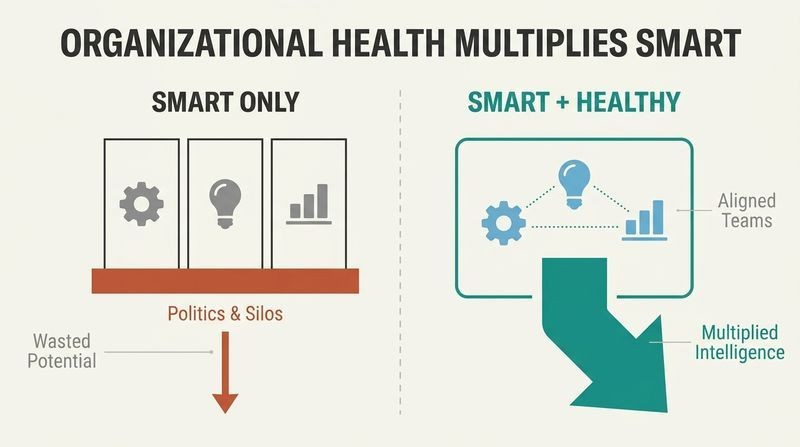
Smart is only half the equation. Lencioni splits every organization into two halves. Being smart means mastering the decision sciences: strategy, finance, marketing, and technology. Being healthy means minimal politics, low confusion, high morale, and low turnover among good people. Nearly all executives pour their energy into the smart half because that is where the light is better, more measurable, more comfortable.
Health multiplies intelligence. He argues health is the greater advantage because it lets an organization use the brains it already has. In twenty years of consulting he never met a leadership team too dumb to succeed, but he met plenty too dysfunctional to tap their intelligence. Journalists blame failures on bad strategy, missing that politics and misalignment made those dumb decisions possible.
The smart-versus-healthy dichotomy echoes Jim Collins and the resource-based view of strategy: sustainable advantage comes from hard-to-copy internal capabilities, not knowledge that leaks across an industry in nanoseconds. Lencioni's claim that health is the true multiplier finds support in organizational psychology, where psychological safety (Amy Edmondson's research at Google's Project Aristotle) predicts team performance more than individual talent. The weakness is measurement. Lencioni concedes health resists quantification, which invites survivorship bias in his case examples. A skeptic could ask whether healthy firms simply had better luck or markets. Still, the reframing is powerful precisely because it points leaders toward the neglected variable.
Overcome the three biases that make leaders dismiss health as beneath them
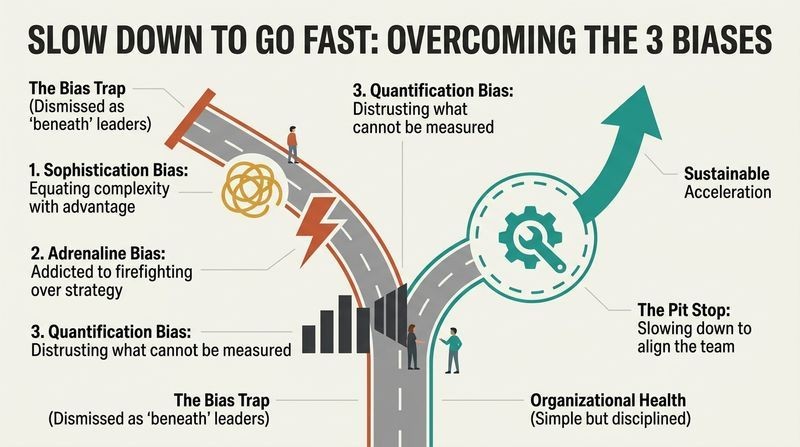
Leaders think health is beneath them. Lencioni traces his career-long question to a CEO who explained why rivals never copied his wildly healthy company: they believed it was beneath them. Three quiet biases produce this blindness.
1. Sophistication bias: health is so simple it seems unworthy of clever, well-educated executives who equate advantage with complexity.
2. Adrenaline bias: leaders are addicted to firefighting and cannot slow down for work that is important but not urgent.
3. Quantification bias: because health's financial impact resists precise measurement, analytical leaders distrust it.
Simple is not the same as easy. Health demands not intelligence but discipline, courage, persistence, and common sense. The old race-car axiom applies: sometimes you must slow down to go fast.
These biases map neatly onto behavioral economics. The adrenaline bias is present bias and the urgency trap that Eisenhower diagnosed decades ago: the urgent crowds out the important. The quantification bias resembles the McNamara fallacy, where what cannot be measured gets treated as unimportant. What is astute here is naming the ego dimension. Sophisticated leaders resist simple solutions partly because embracing them feels like an admission that their expensive training is not the differentiator. This connects to Philip Tetlock's work showing that credentialed experts often underperform simple rules. The humility Lencioni demands is genuinely countercultural in status-driven executive suites.
Build vulnerability-based trust by having the leader admit weakness first
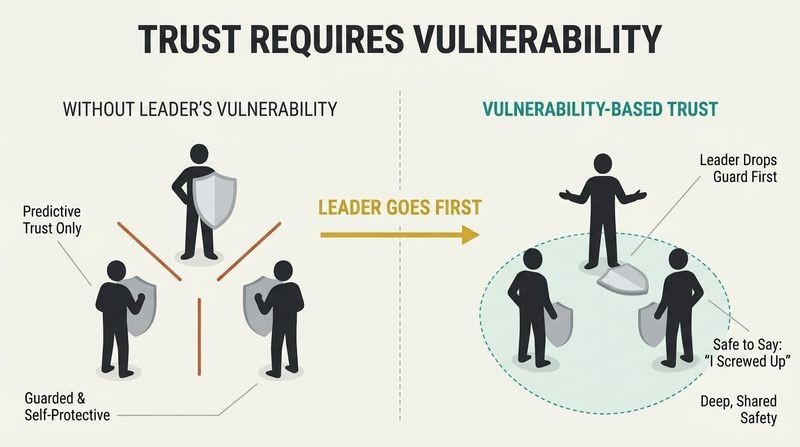
The right kind of trust is vulnerability-based. Most people think trust is predictive: knowing someone will follow through. Lencioni means something rawer. Vulnerability-based trust exists when teammates comfortably say I screwed up, I need help, your idea is better than mine, and I am sorry, without fearing the admission will be used against them.
Start small, then go deep. He builds it with a fifteen-minute personal histories exercise (where were you born, siblings, hardest childhood challenge) and behavioral profiling like Myers-Briggs. One CFO revealed he grew up without indoor plumbing, instantly reframing his tightness with money for a frustrated team. This combats the fundamental attribution error, our habit of blaming others' behavior on character while excusing our own as circumstance. Crucially, the leader must get naked first, or no one else will.
The fundamental attribution error is one of social psychology's most robust findings, and applying it to team trust is a genuinely useful move. The insight that leaders must model vulnerability aligns with Brene Brown's research on shame and courage, and with the finding that leader self-disclosure increases follower openness. One caution: vulnerability rituals can misfire in low-trust or high-turnover environments, becoming performative or even weaponized, a risk Lencioni acknowledges only lightly. Cross-culturally, the personal-histories approach may land differently in high-context or hierarchical cultures where public self-disclosure feels inappropriate. The core principle survives, but the specific exercises deserve local adaptation rather than universal deployment.
Mine for conflict; artificial harmony is more dangerous than argument
Fear of conflict signals dysfunction. Lencioni prizes productive ideological conflict: passionate debate about ideas, never attacks on people. Teams sit on a continuum from artificial harmony (fake smiles, disingenuous agreement) to destructive personal warfare. Most cluster near artificial harmony, terrified that any disagreement leads to Armageddon. The ideal point sits just short of the line where constructive turns destructive.
Silence festers into resentment. When people withhold opinions, disagreement about an issue curdles into frustration with a person, producing eye-rolls and quiet contempt. He recounts a CEO who stood up and walked out saying I do not have time for this, killing conflict for years and enabling a product decision that cost hundreds of jobs. Tools to break the freeze: mining for buried disagreement and real-time permission, where a leader interrupts a budding argument to praise it.
This inverts the conventional workplace preference for niceness, and the distinction between nice and kind is sharp. It resonates with Kim Scott's Radical Candor, where ruinous empathy (caring without challenging) does more damage than honest confrontation. The conflict continuum also parallels the Tuckman storming stage that many teams try to skip. A nuance worth adding: research on conflict distinguishes task conflict (productive) from relationship conflict (corrosive), and the two are empirically hard to separate. Task disagreements often bleed into personal friction. Lencioni's remedy, grounding conflict in prior vulnerability-based trust, is precisely the mechanism studies suggest keeps task conflict from metastasizing into the relationship kind.
Disagree and commit: buy-in requires weigh-in, not consensus
Weigh in to buy in. People commit to decisions they helped shape through debate, even ones they disagreed with. Lencioni borrows Intel's disagree-and-commit philosophy: leave the room unambiguously aligned even without agreement. This avoids the consensus trap, where waiting for unanimity produces late, watered-down decisions that mildly disappoint everyone.
Passive agreement is the real danger. In real life, thwarted executives do not sabotage plans dramatically. They nod, return to their offices, and quietly do nothing, waiting to say I never liked that idea. A pharmaceutical company banned business-class travel; half the executives enforced it, half told staff to ignore it, and the credibility damage dwarfed the airfare. The fix: leaders must break ties after everyone speaks, then have the team restate exact commitments so no one leaves with a different understanding.
Disagree-and-commit has since become Silicon Valley gospel, echoed in Jeff Bezos's shareholder letters and Andy Grove's High Output Management, where the concept originated. It solves a real coordination failure that game theory illuminates: partial compliance is often worse than universal compliance or universal defection, because inconsistency destroys the predictability that lets organizations function. The business-class example captures how norm violation is contagious. One extension: neuroscience of buy-in suggests people accept unfavorable outcomes when they perceive procedural fairness, being heard, even more than favorable outcomes reached unfairly. Lencioni's weigh-in principle is essentially a procedural justice mechanism, which explains why it produces commitment beyond mere logic.
Peer accountability beats boss accountability, and behavior matters before numbers
Peers, not the boss, drive accountability. In 12,000 teams assessed by Lencioni's firm, 65% scored worst on accountability, the lowest of all five behaviors. When people run to the leader to report a straying peer, they breed politics and resentment. Cohesive teammates confront each other directly, which only works when everyone knows commitment was genuine.
Confront behavior before results slip. Most leaders can tell someone they missed a number, an objective, emotion-free act. Far harder, and more important, is confronting behavior, because behavioral problems (sloppy prep, dropped discipline) always precede measurable declines. Lencioni calls the reluctance the wuss factor and reframes accountability as an act of love: caring enough to risk someone's resentment. His team effectiveness exercise has members name each person's single biggest strength and one behavior that hurts the team.
The reframing of accountability as love rather than punishment is unusually humane for a management book and aligns with self-determination theory, where growth-oriented feedback satisfies the need for competence more than evaluative judgment. The behavior-precedes-results insight anticipates the leading-versus-lagging-indicators distinction now central to OKRs and balanced scorecards. What is candid is Lencioni's admission that he himself struggles with accountability, and his observation that a conflict-avoidant leader trains subordinates to avoid it too. A useful challenge: peer accountability can degrade into peer surveillance or mobbing without strong trust and clear norms. The exercise's power depends entirely on the trust foundation built earlier, which is why sequence matters.
Answer six questions so there is zero daylight at the top
Alignment means eliminating daylight. Clarity is the second discipline. Lencioni argues subtle gaps between leaders become blinding chaos two levels down, the vortex effect, dooming empowerment. Leaders must align, without jargon, on six questions:
1. Why do we exist? (core purpose)
2. How do we behave? (core values)
3. What do we do? (business definition)
4. How will we succeed? (strategy)
5. What is most important right now? (thematic goal)
6. Who must do what? (roles)
There are no perfect answers, only aligned ones. He warns against perfection paralysis, citing a CEO who spent nine months refusing to declare a direction while competitors outflanked the company, eventually committing only to a three-word rhyming slogan. A directionally correct answer everyone commits to beats a perfect answer that arrives too late.
The six questions function as a shared mental model, and the emphasis on eliminating small gaps at the top reflects a systems-theory truth: variance amplifies as it propagates downstream, much like tolerance stacking in engineering. The rejection of the traditional mission statement (skewered via the fictional Dunder Mifflin spoof) is well aimed at corporate boilerplate that signals nothing. The perfection-paralysis warning connects to Herbert Simon's satisficing and to Patton's dictum that a good plan executed now beats a perfect one next week. The main limitation: in genuinely volatile markets, premature commitment can lock in wrong bets, so the discipline needs pairing with fast feedback loops.
Define purpose idealistically and keep only two or three real core values
Purpose must be idealistic and true. Ask why repeatedly until you reach something just short of make the world a better place. Southwest exists to democratize air travel, which is why it defends low prices as sacred. A paving company founder realized his real purpose was helping first-generation Americans buy homes, not paving driveways.
Distinguish four kinds of values. Core values (only two or three, inherent, unchanging) must be separated from aspirational (qualities you are trying to build), permission-to-play (baseline decency like honesty), and accidental (unintended, like hiring only one demographic). A true core value invites being punished for it: an airline whose CEO answered a customer complaining about a joking flight attendant with a three-word note, we will miss you. Nine generic values plastered on posters make decisions impossible.
The four-category taxonomy is the sharpest practical contribution here, cutting through the values-statement inflation that Built to Last inadvertently unleashed. The test that a real core value invites punishment (forfeiting revenue or customers to honor it) is a costly-signaling criterion straight out of evolutionary biology: only signals that are expensive to fake are credible. The accidental-values warning deserves emphasis in the diversity era, since unexamined culture-fit hiring quietly reproduces homogeneity, a phenomenon labor economists call homophily in hiring. One tension: Lencioni insists core values cannot be manufactured, yet organizations do evolve. His answer, treat desired traits as aspirational rather than pretending they are core, is intellectually honest and avoids the cynicism that fake values breed.
Pick one thematic goal: if everything is important, nothing is
One rallying cry, not seven priorities. The fifth question, what is most important right now, cures organizational ADD and silos. Lencioni studied why firefighters, ER staff, and soldiers never fight turf wars and found the answer: a shared crisis creates a single, unarguable focus. He calls the peacetime equivalent a thematic goal, a rallying cry that is singular, qualitative, temporary (three to twelve months), and shared across the whole leadership team.
Support it with defining objectives. Beneath the thematic goal sit four to six defining objectives (the categories of work needed) and ongoing standard operating objectives (the day-job metrics). A freight company drowning in demand chose solve the capacity problem as its goal. An IT department rallied around shedding its bad reputation and sustained the turnaround eight years. All of it fits on one page.
The emergency-responder insight is genuinely illuminating: crisis dissolves silos because it imposes a superordinate goal, exactly the mechanism Muzafer Sherif's classic Robbers Cave experiments used to unite warring boy-scout groups. Making the thematic goal qualitative rather than numeric is counterintuitive in a KPI-obsessed culture but wise, since premature metrics narrow behavior and invite gaming (Goodhart's Law). The shared-ownership requirement, where the goal belongs to the whole team regardless of function, directly attacks the accountability diffusion that plagues matrixed organizations. A fair critique: some organizations genuinely juggle multiple existential priorities, and forcing artificial singularity could starve a second critical fire. The three-to-twelve-month window is the practical safety valve.
Become Chief Reminding Officer: employees need to hear it seven times
Repetition is the job, not a failure of it. The third discipline is overcommunicating clarity. Lencioni cites the claim that employees do not believe a message until they have heard it about seven times. Leaders resist repeating themselves because it feels inefficient, patronizing, or boring, but messaging is emotional, not intellectual: people are gauging whether leaders are serious, not learning new facts.
Cascade live, not by email. The most powerful tool is cascading communication: within twenty-four hours of a meeting, every leader tells their team the same key messages in their own words, face to face. When an Australian HR head and her German counterpart discovered their bosses had said identical things, they believed in alignment more than any glossy newsletter could achieve. First, though, leaders must clarify at meeting's end what was actually decided, or they cascade contradictions.
The seven-exposures claim mirrors the marketing rule of seven and the mere-exposure effect in psychology, where repetition breeds both familiarity and trust. The framing of leader as Chief Reminding Officer reframes what many executives consider beneath them into a core function, consistent with research showing that strategy execution fails far more often from communication gaps than from flawed strategy. The insistence on live over digital cascading is well grounded: media-richness theory holds that ambiguous, emotionally weighty messages require high-bandwidth channels where tone and questions are possible. In the remote-work era this tension sharpens, and Lencioni's concession that video suffices for dispersed teams is a reasonable accommodation.
Institutionalize culture through simple human systems, never bureaucracy
Reinforce clarity when leaders are not in the room. The fourth discipline embeds the six answers into every people process: hiring, orientation, performance management, compensation, recognition, and firing. The trick is to institutionalize culture without bureaucratizing it. A one-page performance review that managers actually use beats a seven-page one designed by a consultant. Leaders must design these systems themselves, not delegate them wholesale to HR or legal, who optimize for standardization and lawsuit-avoidance instead of focus.
Fire for values, reward with recognition. Keeping a talented performer who violates core values tells everyone the values are fake. Recognition beats cash: employees treat money as a satisfier, not a driver. One consultant literally summoned a junior employee mid-meeting so executives could thank her, ensuring she would champion the values. A departing consultant asked what would have kept him answered simply, anything.
The satisfier-versus-driver distinction restates Herzberg's two-factor theory, where hygiene factors like pay prevent dissatisfaction but only intrinsic factors like recognition and growth motivate. Decades of research on the overjustification effect support the caution against over-relying on financial incentives, which can crowd out intrinsic motivation. The insistence that leaders design human systems rather than outsourcing them to HR is a pointed critique of how compliance logic hollows out culture, echoing complaints in Reinventing Organizations and Netflix's no-rules-rules philosophy. The firing-for-values principle is the enforcement mechanism that makes core values credible: without it, values are decoration. The genuine risk is subjectivity in cultural-fit firing, which can mask bias, a tension the framework underweights.
Run four distinct meetings; stop drowning strategy in tactical stew
Meeting stew is the culprit. Lencioni says if he could watch just one thing to judge an organization's health, it would be a leadership meeting. Bad meetings cram administrative updates, tactical decisions, and strategic debate into one pot, and the brain cannot digest such disparate topics. The counterintuitive fix is more meetings, each with a single purpose:
1. Daily check-in: ten standing minutes, pure information exchange.
2. Tactical staff meeting: weekly, with a real-time agenda set only after reviewing the scorecard.
3. Topical strategic meeting: ad hoc, hours long, one big issue at a time.
4. Quarterly off-site review: step back on team, strategy, and people.
Kill the pre-set agenda. Like a counselor who cannot plan a session before meeting the couple, teams should build agendas live. All four meetings total roughly 13% of a 50-hour week.
Separating tactical from strategic conversation reflects Daniel Kahneman's fast-versus-slow thinking: operational fires demand quick System 1 responses, while strategy needs slow, deliberate System 2 attention, and mixing them shortchanges both. The real-time agenda idea challenges the productivity orthodoxy that every meeting needs a pre-circulated agenda, arguing sensibly that priorities cannot be known until the team assesses current reality together. The color-coded scorecard is a lightweight visual-management tool akin to lean manufacturing's andon boards. The daily check-in resembles the agile daily standup, which independently validated Lencioni's instinct. The main friction is calendar load in already meeting-saturated cultures, though his rebuttal, that good meetings eliminate the reactive email churn between them, is empirically plausible.
Analysis
The Advantage is Lencioni's attempt to unify eight prior business fables into one integrated, non-fiction operating system for leaders. Where those books dramatized single problems through story, this one strips away the narrative scaffolding and presents a comprehensive, checklist-driven model. That is both its strength and its vulnerability. The strength is coherence: the four disciplines (cohesive team, clarity, overcommunication, reinforcement) build sequentially, and the reader leaves with a genuine playbook rather than a single memorable metaphor. The vulnerability is evidentiary. Lencioni openly admits he is not a quantitative researcher and rests his conclusions on twenty years of consulting observation, invoking Jim Collins for permission. This makes the book susceptible to survivorship bias and post-hoc storytelling, the very sins he accuses journalists of committing when they attribute failure to bad strategy.
What elevates the work above typical management fare is its psychological honesty. The insistence on vulnerability-based trust, the reframing of accountability as love, and the confession that Lencioni himself struggles with the wuss factor lend credibility that data alone would not. He is essentially importing clinical and social psychology (the fundamental attribution error, the difference between nice and kind) into the boardroom, and doing so accessibly.
The deepest idea, that health multiplies intelligence, is also the least falsifiable, and readers should hold it as a productive hypothesis rather than proven law. In an era of remote and hybrid work, the emphasis on live, face-to-face cascading communication and daily standing check-ins faces real logistical strain, though the underlying principles survive translation to video. The book's enduring value lies less in any single technique than in its central reframe: that the softest-seeming variable, how people at the top behave toward one another, is the hardest-to-copy and most decisive source of competitive advantage. That claim, whether or not it can be regressed against revenue, reorients where serious leaders spend their attention.
Review Summary
The Advantage is a practical guide to organizational health that emphasizes building cohesive leadership teams, creating clarity, and reinforcing company values. Readers appreciate Lencioni's straightforward approach and actionable advice, though some find it repetitive or overly simplistic. The book's focus on trust, communication, and alignment resonates with many leaders. While some criticize the writing style, most agree that the principles are valuable for improving organizational effectiveness. Overall, it's considered a useful resource for managers and executives seeking to enhance their company's culture and performance.
People Also Read

FAQ
What's "The Advantage: Why Organizational Health Trumps Everything Else In Business" about?
- Focus on Organizational Health: The book emphasizes that the greatest advantage any company can achieve is organizational health, which is often overlooked despite being simple and accessible.
- Four Disciplines Model: It introduces a model consisting of four disciplines: building a cohesive leadership team, creating clarity, overcommunicating clarity, and reinforcing clarity.
- Practical Guide: Unlike Lencioni's other books, this is not a fable but a comprehensive guide using real-world examples and client stories to illustrate the concepts.
- Integration of Concepts: The book integrates ideas from Lencioni's previous works, focusing on practical approaches to improving organizational health.
Why should I read "The Advantage: Why Organizational Health Trumps Everything Else In Business"?
- Competitive Advantage: Understanding and implementing organizational health can provide a significant competitive edge over others who focus solely on traditional business metrics.
- Practical Application: The book offers actionable steps and real-world examples, making it easier to apply the concepts in various organizational settings.
- Comprehensive Framework: It provides a structured approach to addressing common organizational dysfunctions, making it a valuable resource for leaders.
- Improved Work Environment: By focusing on health, organizations can reduce politics and confusion, leading to higher morale and productivity.
What are the key takeaways of "The Advantage: Why Organizational Health Trumps Everything Else In Business"?
- Organizational Health is Key: The book argues that organizational health is the most significant advantage a company can have, surpassing traditional metrics like strategy and finance.
- Four Disciplines: The four disciplines—building a cohesive leadership team, creating clarity, overcommunicating clarity, and reinforcing clarity—are essential for achieving organizational health.
- Leadership's Role: The leader's active involvement is crucial in driving organizational health, from building trust to reinforcing clarity.
- Practical Implementation: The book provides a step-by-step guide to implementing these disciplines, emphasizing the importance of communication and alignment.
What are the best quotes from "The Advantage: Why Organizational Health Trumps Everything Else In Business" and what do they mean?
- "The single greatest advantage any company can achieve is organizational health." This quote underscores the book's central thesis that health is more critical than traditional business metrics.
- "If everything is important, nothing is." This highlights the need for focus and prioritization within an organization to avoid being overwhelmed by competing objectives.
- "A good plan violently executed today is better than a perfect plan executed next week." This emphasizes the importance of decisiveness and action over waiting for the perfect solution.
- "Trust is the foundation of real teamwork." This quote reflects the importance of vulnerability-based trust as the cornerstone of a cohesive leadership team.
What is the Four Disciplines Model in "The Advantage"?
- Discipline 1: Build a Cohesive Leadership Team: Focuses on building trust, mastering conflict, achieving commitment, embracing accountability, and focusing on results.
- Discipline 2: Create Clarity: Involves answering six critical questions to ensure alignment and eliminate confusion within the organization.
- Discipline 3: Overcommunicate Clarity: Emphasizes the need for leaders to repeatedly communicate the organization's clarity to ensure understanding and alignment.
- Discipline 4: Reinforce Clarity: Involves embedding clarity into the organization's processes, from hiring to performance management, to sustain health over time.
How does Patrick Lencioni define organizational health in "The Advantage"?
- Integrity and Consistency: Organizational health is about integrity, meaning the organization is whole, consistent, and complete in its management, operations, strategy, and culture.
- Smart vs. Healthy: While being smart involves traditional business metrics like strategy and finance, being healthy involves minimal politics, high morale, and low turnover.
- Multiplier Effect: A healthy organization can better leverage its intelligence, leading to improved decision-making and performance.
- Cultural Impact: Health impacts not just the organization but also its employees, leading to a more fulfilling work environment.
What are the six critical questions for creating clarity in "The Advantage"?
- Why do we exist? This question helps define the organization's core purpose and reason for being.
- How do we behave? Focuses on identifying core values that guide employee behavior and decision-making.
- What do we do? A straightforward description of the organization's business activities.
- How will we succeed? Involves identifying strategic anchors that guide decision-making and differentiate the organization.
- What is most important, right now? Helps prioritize the organization's focus to avoid being overwhelmed by competing objectives.
- Who must do what? Clarifies roles and responsibilities to ensure alignment and accountability.
How does "The Advantage" suggest building a cohesive leadership team?
- Trust Building: Encourages vulnerability-based trust where team members are open and honest about their weaknesses and mistakes.
- Mastering Conflict: Promotes productive ideological conflict to ensure the best ideas are considered and debated.
- Achieving Commitment: Ensures that all team members are committed to decisions, even if they initially disagreed.
- Embracing Accountability: Encourages peer-to-peer accountability to maintain focus and adherence to commitments.
- Focusing on Results: Emphasizes the importance of collective goals and measuring success based on organizational achievements.
What role does communication play in "The Advantage"?
- Overcommunication is Key: Leaders must repeatedly communicate the organization's clarity to ensure understanding and alignment.
- Cascading Communication: Involves leaders communicating key messages to their direct reports, who then pass them down the organization.
- Consistency and Authenticity: Messages should be consistent and authentic to build trust and credibility with employees.
- Multiple Channels: Effective communication requires using various channels, including face-to-face interactions, to reinforce key messages.
How does "The Advantage" address the issue of meetings?
- Meeting Stew: Warns against combining different types of discussions into one meeting, which leads to confusion and inefficiency.
- Four Types of Meetings: Recommends daily check-ins, tactical staff meetings, adhoc topical meetings, and quarterly off-site reviews to address different needs.
- Real-Time Agendas: Suggests creating agendas during meetings based on current priorities rather than pre-set topics.
- Focus on Resolution: Emphasizes the importance of driving issues to closure and making decisions during meetings to avoid unnecessary follow-ups.
What is the significance of the thematic goal in "The Advantage"?
- Singular Focus: The thematic goal provides a single top priority for the organization, ensuring focus and alignment.
- Temporary and Shared: It is a temporary goal, usually lasting 3 to 12 months, and is shared across the leadership team.
- Defining Objectives: Thematic goals are supported by defining objectives that outline the activities needed to achieve the goal.
- Avoiding Silos: By focusing on a single goal, organizations can reduce silos and ensure that all departments work towards the same objective.
How does "The Advantage" suggest reinforcing clarity within an organization?
- Human Systems: Embedding clarity into processes like hiring, performance management, and compensation to sustain organizational health.
- Non-Generic Processes: Customizing systems to reflect the organization's unique culture and values rather than adopting generic solutions.
- Leadership Involvement: Leaders must actively participate in designing and reinforcing these systems to ensure alignment with organizational clarity.
- Simplicity and Relevance: Systems should be simple and relevant, focusing on reinforcing the organization's clarity rather than adding bureaucracy.
About the Author
Other books by Patrick Lencioni


Download PDF
Download EPUB
.epub digital book format is ideal for reading ebooks on phones, tablets, and e-readers.








































