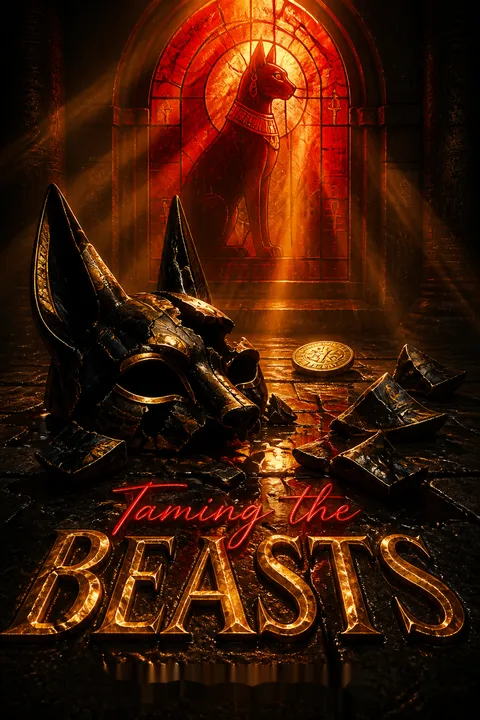

Plot Summary
Shadows of the Past
Zoey's life is a patchwork of trauma and resilience, shaped by a scandalous past and a present filled with supernatural revelations. Once grounded in reality, she's now entangled with werecats and vampires, her heart split between five enigmatic men. The scars of betrayal and public shame have made her fiercely protective of her new happiness, but also wary of trust. As she navigates the complexities of loving multiple cursed men, Zoey's determination to save them becomes her anchor. The story opens with her clutching a mysterious coin, the supposed cure for her lovers' monstrous afflictions, and plotting a daring heist with her best friend Emma. Their bond is tested by secrets, jealousy, and the looming threat of supernatural forces, setting the stage for a tale of love, danger, and redemption.
The Heist and the Cure
Zoey, Emma, and the enigmatic Kebe break into the bank owned by Zoey's boyfriends, seeking the ancient coin rumored to cure both vampirism and the werecat curse. The heist is a blend of adrenaline and anxiety, with Zoey's confidence masking her underlying fear of what the cure might change—not just for her lovers, but for herself. The coin's power is palpable, but doubts swirl as Kebe questions its true nature. The trio's alliance is fragile, strained by mistrust and conflicting motives. When the men discover the break-in, the lines between punishment and pleasure blur, revealing the tangled web of desire and loyalty that binds them all. The coin, once a symbol of hope, becomes a catalyst for deeper secrets and shifting allegiances.
Secrets, Lies, and Desire
The aftermath of the heist exposes cracks in every relationship. Zoey's confession about her camming past and the theft tests the men's trust, especially Titan's, whose anger simmers beneath the surface. The group's dynamic is a volatile mix of jealousy, possessiveness, and longing, with Zoey caught between her need for acceptance and her fear of losing the delicate balance she's found. Kebe's presence is increasingly disruptive, her flirtations and cryptic warnings sowing discord. As the lovers grapple with their own insecurities, the question of whether the cure will unite or divide them looms large. The emotional stakes rise, with every touch and whispered promise shadowed by the threat of betrayal.
Kebe's True Colors
Kebe's role shifts from quirky outsider to potential saboteur. Her knowledge of the coin and the supernatural world is unsettlingly precise, yet her motives remain opaque. Emma and Zoey's suspicions grow as Kebe evades questions and withholds the coin, her actions hinting at a hidden agenda. The men, too, sense something amiss, their instincts sharpened by years of living with danger. Kebe's manipulation is subtle but effective, exploiting the group's vulnerabilities and deepening the rift between trust and suspicion. The coin, once a beacon of hope, now feels like a ticking time bomb, its true purpose obscured by layers of deceit.
Tangled Loyalties
The bonds between Zoey, Emma, and their lovers are strained to breaking. Emma's engagement to Callum, the vampire desperate for humanity, is overshadowed by her fear of what the cure might cost. Zoey's polyamorous relationship is threatened by the possibility that the men will no longer need to share her once cured. Kebe's provocations force everyone to confront uncomfortable truths about desire, jealousy, and the nature of love. As secrets multiply, so do the dangers, both supernatural and emotional. The group's unity is fragile, held together by shared trauma and the hope that love can survive even the darkest revelations.
Dangerous Games
The story's erotic undercurrents intensify as Zoey and her lovers navigate the blurred lines between punishment and pleasure. Their intimacy is both a refuge and a battleground, where trust is tested and boundaries are pushed. Titan's resistance gives way to longing, his anger masking a deep need for connection. The group's sexual chemistry is explosive, but always shadowed by the threat of violence and loss of control. Kebe's presence is a constant reminder that not all games are safe, and that desire can be as dangerous as any curse. The stakes are raised, with every encounter carrying the risk of heartbreak or worse.
The Sinister Shift
The atmosphere in Crooked Point grows tense as supernatural forces converge. Otto and the others sense a shift in the air, an omen of impending danger. Kebe's arrival coincides with this unease, her aura unsettling even the most stoic of the group. Rumors of a new vampire, Elias, and the mysterious disappearances of Bennett's friends in Egypt add to the sense of foreboding. The town itself becomes a character, its quiet streets hiding secrets and threats. As the group scrambles to uncover the truth about the coin and Kebe's intentions, the line between friend and foe blurs, and the cost of trust becomes painfully clear.
Unraveling Trust
The group's unity is shattered by revelations about Kebe's true nature and the coin's origins. Bennett's contacts vanish under suspicious circumstances, and suspicion falls on Kebe, whose explanations grow increasingly implausible. Zoey's desperation to protect her lovers leads her to risky decisions, including seeking help from her enigmatic online client, King. The men's faith in Zoey is tested, as is her faith in them. The threat of violence hangs over every interaction, and the possibility that the cure is a trap becomes impossible to ignore. The group is forced to confront the reality that not everyone can be saved, and that some betrayals cut too deep to heal.
The Vampire's Bargain
As the truth about Kebe and the coin comes to light, the group is forced into an uneasy alliance with her. Kebe's confession that she is not a vampire but something older and more powerful—Anubis's daughter, the goddess Kebechet—shocks everyone. Her motives, shaped by millennia of loyalty to her father and disdain for werecats, are revealed to be both personal and cosmic. The coin, far from being a cure, is a weapon designed to create vampires and eradicate werecats. The group must decide whether to trust Kebe's offer of a new cure, knowing that her allegiance could shift at any moment. The stakes are higher than ever, with the fate of the town—and their own hearts—hanging in the balance.
The Coin's Curse
The wedding of Emma and Callum, meant to be a celebration of love and hope, becomes a nightmare as Kebe activates the coin. Instead of curing, it unleashes a fog that transforms the townspeople into vampires, turning the ceremony into a bloodbath. Zoey and Emma's desperate attempts to escape are mirrored by the men's struggle to protect them. The coin's true power is revealed: it is not a cure, but a curse, designed to create chaos and destruction. Kebe's betrayal is complete, and the group is forced to confront the reality that their trust has been weaponized against them. The line between victim and monster blurs, and survival becomes the only goal.
Blood and Betrayal
The aftermath of the wedding massacre is a tableau of loss and devastation. Zoey's boyfriends, in their werecat forms, are gravely wounded, outnumbered by the newly created vampires. Emma and Zoey, covered in blood and stripped of hope, seek refuge in the bank's vault, pursued by a remorseful but still dangerous Kebe. The town is in chaos, its people either dead or transformed. The group's faith in each other is all that remains, but even that is fragile. The cost of betrayal is measured in blood, and the possibility of redemption seems distant. Yet, in the darkness, the faintest glimmer of hope persists.
The Wedding Catastrophe
The wedding, once a symbol of new beginnings, becomes the epicenter of tragedy. Callum's struggle to control his vampiric urges is mirrored by the chaos unfolding around him. Zoey's desperate attempts to save her lovers are met with violence and heartbreak. The town square, once filled with laughter and music, is now a battlefield. The group's unity is tested as never before, with each member forced to confront their deepest fears and regrets. The line between love and loss is razor-thin, and the future is uncertain. Yet, even in the midst of horror, the bonds of love endure, offering a fragile lifeline.
Monsters Unleashed
Kebe's identity as the goddess of embalming and serpents is fully revealed, along with her role in the massacre. Her allegiance to Anubis and her disdain for werecats have driven her to unleash the coin's curse, but witnessing the carnage forces her to question her own motives. The group, battered and broken, must decide whether to trust her offer of a new cure—a relic of Baset, the cat goddess. The sistrum, a musical instrument, becomes their last hope. As they race against time to save what remains of their world, the true nature of monstrosity is laid bare: it is not in the curse, but in the choices they make.
The Goddess Revealed
Kebe's transformation from antagonist to reluctant ally is marked by guilt and a desire for redemption. Her confession about the coin's true purpose and her father's machinations forces the group to reevaluate everything they thought they knew. The sistrum, Baset's relic, is their only hope, but its power is uncertain. Kebe's knowledge of the supernatural world is both a blessing and a curse, her insights tinged with centuries of prejudice and pain. The group's willingness to trust her, even after all she has done, is a testament to their resilience—and their desperation. The possibility of salvation rests on a knife's edge.
The Last Hope
Armed with the sistrum, Zoey, Emma, and Kebe risk everything to reach the town square and broadcast its music. The journey is fraught with danger, as vampires prowl the streets and the memory of loss hangs heavy. The sistrum's song, when finally played, is both beautiful and haunting, its power rippling through the town. The cure works, but not as expected: only those who can hear it are saved. Zoey's boyfriends, their ears damaged in the battle, remain trapped in their werecat forms, their fate uncertain. The cost of victory is measured in scars, both physical and emotional, but hope is rekindled.
The Sistrum's Song
The aftermath of the cure is bittersweet. The town is saved, but the memory of the massacre lingers. Zoey's boyfriends, slowly healing, are a testament to the resilience of love and the power of second chances. Kebe, now an uneasy friend, works to atone for her actions, her relationship with Grudge a symbol of unexpected redemption. Emma and Callum, finally united as mortals, begin their new life together, their love stronger for having survived the darkness. The group's unity, once forged in fire, is now tempered by forgiveness and the promise of a brighter future.
Aftermath and Awakening
In the weeks that follow, the group works to rebuild their lives and their town. The scars of the past are ever-present, but so is the determination to move forward. Zoey's love for her five men is undiminished, their bond stronger for having survived the worst. The town's collective amnesia is a blessing, allowing them to start anew without the weight of memory. Kebe and Grudge's unlikely romance is a reminder that even the most broken can find healing. The group's laughter and love are a balm, proof that even in the aftermath of horror, joy is possible.
New Beginnings
One year later, the group gathers for Thanksgiving, a celebration of survival and togetherness. Zoey, now engaged to all five of her lovers, reflects on the journey from shame and secrecy to acceptance and joy. The table is crowded with friends, family, and the promise of new life. Emma's pregnancy is a symbol of hope, and the group's laughter is a testament to the power of love to heal even the deepest wounds. The past is not forgotten, but it no longer defines them. In taming their beasts, they have found their true selves—and each other.
Analysis
A modern myth of love, trauma, and transformationTaming the Beasts is a bold reimagining of the paranormal romance, blending eroticism, myth, and psychological realism into a story that is as much about healing as it is about desire. At its core, the novel is a meditation on the nature of monstrosity—both literal and metaphorical—and the possibility of redemption. The use of ancient Egyptian mythology grounds the supernatural elements in a rich symbolic context, while the polyamorous dynamic challenges conventional notions of love and fidelity. The story's emotional arc is driven by the characters' willingness to confront their own darkness, to forgive themselves and each other, and to believe in the possibility of a better future. The lessons are clear: love is messy, trust is risky, and healing is a journey, not a destination. In the end, Taming the Beasts is a celebration of resilience, the power of chosen family, and the belief that even the most broken can be made whole.
Review Summary
Taming the Beasts receives overwhelmingly positive reviews as the thrilling conclusion to the Crooked Point trilogy, averaging 4.37 out of 5 stars. Readers praise its perfect blend of humor, spice, mystery, and supernatural elements featuring vampires, werecats, and ancient Egyptian mythology. Fans adore the dynamic between protagonists Emma and Zoey and their respective love interests, particularly the slow-burn tension with Titan. The character Grudge is highlighted as a standout addition. Most reviewers agree the series delivers a satisfying, emotionally resonant ending with plenty of twists.
People Also Read
Characters
Zoey
Zoey is the emotional heart of the story, a woman scarred by public humiliation and personal loss, yet fiercely determined to carve out happiness on her own terms. Her relationships with her five lovers are complex, blending passion, vulnerability, and a desperate need for belonging. Zoey's journey is one of self-acceptance, as she learns to trust not only her lovers but herself. Her loyalty is unwavering, and her willingness to risk everything for those she loves is both her greatest strength and her deepest vulnerability. Zoey's psychological arc is defined by her struggle to reconcile her past with her present, and her ultimate triumph is in embracing love without fear.
Emma
Emma is Zoey's anchor, a best friend whose own journey mirrors and contrasts with Zoey's. Her love for Callum is marked by patience and sacrifice, her willingness to risk everything for a chance at a shared future. Emma's psychoanalysis reveals a woman torn between fear and hope, her engagement to a vampire a metaphor for the risks inherent in love. Her loyalty to Zoey is unwavering, and her courage in the face of supernatural danger is quietly heroic. Emma's development is a testament to the power of friendship and the belief that love can conquer even the darkest curses.
Bennett
Bennett is the de facto leader of the werecats, his calm exterior masking a deep well of guilt and responsibility. His relationship with Zoey is marked by a need for control, both in and out of the bedroom, but also by a profound tenderness. Bennett's psychological complexity lies in his struggle to balance his protective instincts with his fear of losing those he loves. His journey is one of learning to trust—not just Zoey, but his own capacity for happiness. Bennett's arc is defined by his willingness to sacrifice for others, and his ultimate acceptance of vulnerability as strength.
Otto
Otto is the most nurturing of the werecats, his humor and warmth a balm for Zoey's wounds. Beneath his easygoing exterior lies a fierce loyalty and a capacity for violence when those he loves are threatened. Otto's relationship with Zoey is marked by a deep emotional intimacy, his love expressed through acts of service and quiet devotion. His psychological development centers on his struggle to forgive himself for past mistakes and to believe that he is worthy of love. Otto's journey is one of healing, both for himself and for those around him.
Huxley
Huxley is the artistic heart of the group, his flair for design and aesthetics matched by his playful approach to love and sex. His relationship with Zoey is marked by a joyful exploration of boundaries, his willingness to share her a testament to his confidence and security. Huxley's psychological complexity lies in his need for acceptance, both from his lovers and from himself. His arc is one of embracing vulnerability and finding strength in connection. Huxley's development is a reminder that joy and creativity can be powerful tools for survival.
Ace
Ace is Huxley's mirror and complement, his steadiness balancing his brother's exuberance. His love for Zoey is quiet but profound, his willingness to share her a reflection of his deep trust. Ace's psychological journey is one of learning to assert his own needs while supporting those he loves. His relationship with Huxley is a model of sibling loyalty, and his bond with Zoey is marked by a gentle protectiveness. Ace's development is a testament to the power of quiet strength and the importance of being seen.
Titan
Titan is the most enigmatic of the werecats, his anger and distance masking a deep well of longing and pain. His relationship with Zoey is marked by resistance and eventual surrender, his need for control giving way to vulnerability. Titan's psychological complexity lies in his struggle to trust, both himself and others. His arc is one of transformation, as he learns to accept love and to believe that he is worthy of happiness. Titan's journey is a reminder that even the most wounded can be healed by love.
Callum
Callum is Emma's vampire fiancé, his centuries of loneliness and regret shaping every decision. His love for Emma is both a salvation and a torment, his desire for a normal life driving the search for a cure. Callum's psychological arc is defined by his struggle to control his monstrous urges and to believe in the possibility of redemption. His journey is one of self-forgiveness, as he learns that love can be both a curse and a cure. Callum's development is a meditation on the nature of monstrosity and the power of hope.
Kebe (Kebechet)
Kebe is the story's wild card, her identity as the daughter of Anubis and the goddess of embalming and serpents revealed only after a series of betrayals. Her motives are shaped by millennia of loyalty to her father and a deep-seated disdain for werecats. Kebe's psychological complexity lies in her struggle to reconcile her inherited prejudices with her growing affection for the group. Her arc is one of reluctant redemption, as she moves from antagonist to uneasy ally. Kebe's development is a reminder that even the most ancient wounds can be healed, and that change is always possible.
Grudge
Grudge is Zoey's online confidant, his irreverence and humor masking a deep loyalty. His role as both voyeur and participant blurs the lines between fantasy and reality, his crush on Kebe adding a layer of complexity to his character. Grudge's psychological journey is one of self-discovery, as he moves from outsider to integral member of the group. His development is a testament to the power of friendship and the importance of laughter in the face of darkness.
Plot Devices
The Coin and the Sistrum
The narrative is driven by the search for and use of two powerful Egyptian artifacts: the Anubis coin and Baset's sistrum. The coin, believed to be a cure, is revealed as a curse, its activation unleashing chaos and transforming the town into vampires. The sistrum, a musical instrument, becomes the true cure, its song restoring humanity to the afflicted. These relics serve as both MacGuffins and metaphors, their power reflecting the characters' hopes and fears. The use of ancient artifacts grounds the supernatural elements in a rich mythological context, while their ambiguous nature mirrors the uncertainty and complexity of love and trust.
Polyamory and Shared Trauma
The story's emotional core is the polyamorous relationship between Zoey and her five lovers, a dynamic marked by jealousy, desire, and the constant threat of loss. Their shared trauma—both personal and supernatural—binds them together, but also threatens to tear them apart. The narrative structure alternates between moments of intense intimacy and scenes of violence and betrayal, using the group's relationship as a lens through which to explore themes of trust, forgiveness, and the possibility of redemption. The polyamorous dynamic is both a source of strength and a site of conflict, its evolution mirroring the characters' psychological growth.
Unreliable Allies and Shifting Allegiances
The story is marked by a series of shifting allegiances, with characters forced to rely on those they cannot fully trust. Kebe's role as both antagonist and ally exemplifies this, her motives and loyalties constantly in flux. The use of unreliable narrators and ambiguous motives creates a sense of suspense and uncertainty, keeping both characters and readers off balance. Foreshadowing is used to heighten tension, with early hints about Kebe's true nature and the coin's power paying off in dramatic fashion. The narrative's structure, with its alternating perspectives and timelines, reinforces the theme that trust is both necessary and dangerous.
Redemption and Forgiveness
The story's resolution is grounded in the characters' willingness to forgive—not just each other, but themselves. The aftermath of the massacre is marked by acts of redemption, with Kebe working to atone for her actions and the group choosing to move forward together. The use of amnesia as a plot device allows the town to heal, while the group's decision to embrace their new beginning is a testament to the power of love to overcome even the deepest wounds. The narrative's cyclical structure, ending with a celebration of togetherness, reinforces the idea that healing is always possible.
About the Author


Download PDF
Download EPUB
.epub digital book format is ideal for reading ebooks on phones, tablets, and e-readers.








































