Key Takeaways
Every conversation is thousands of micro-decisions — and most of us wing it
“Even though we do it all the time, conversation is surprisingly tricky and high stakes.”
Conversation is a coordination game. Every time you speak, you're making simultaneous choices — what to say, how to say it, when to pause — while guessing what your partner wants, feels, and expects. Harvard professor Alison Wood Brooks spent a decade recording and analyzing thousands of real conversations (speed dates, negotiations, doctor visits, family dinners) and discovered that most of us massively underestimate this complexity.
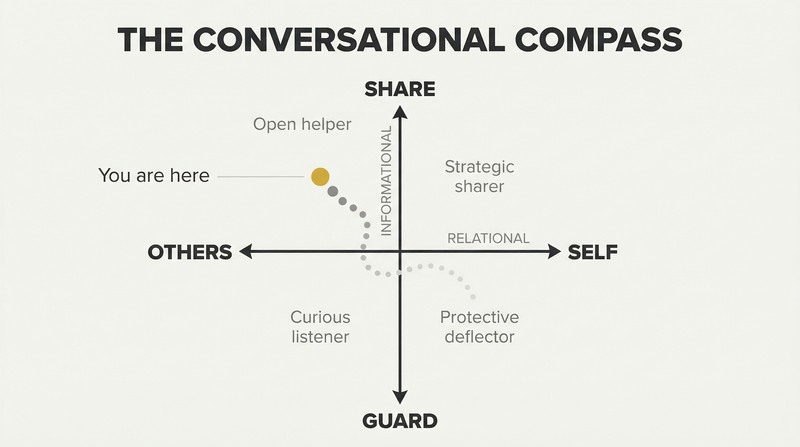
Her framework, the TALK maxims — Topics, Asking, Levity, Kindness — provides four reminders to navigate the game. Meanwhile, the conversational compass maps your goals along two axes: informational (sharing vs. guarding information) and relational (serving others vs. yourself). Your compass resets constantly — a friend's whispered revelation can instantly transform a casual catch-up into an urgent information hunt. Understanding the game is the first step to playing it well.
Thirty seconds of topic prep transforms any conversation
“While smoothness and excitement can happen spontaneously, they are actually more likely to happen with deliberation and forethought.”
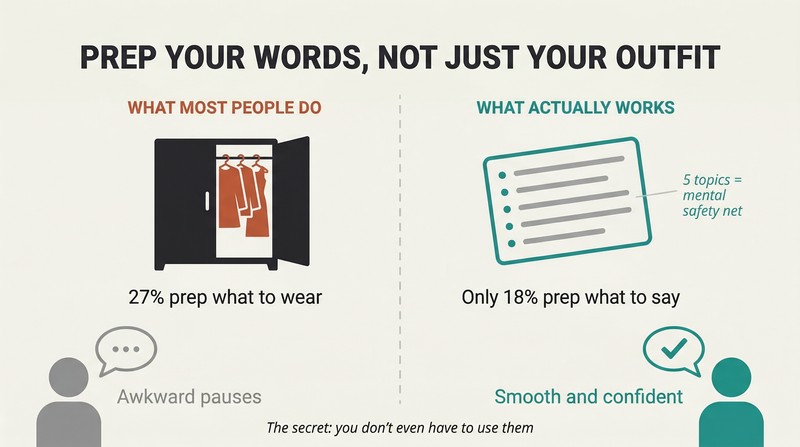
We prep our outfits, not our words. Brooks found that 27% of people spend five-plus minutes deciding what to wear before a social event, while only 18% think about what they'll talk about. Over half believe topic prep is unnecessary. This is the Myth of Naturalness — watching skilled conversationalists and assuming their ease is effortless, that it should be effortless for us, too.
In reality, brainstorming five possible topics before a conversation triggers cognitive offloading — freeing mental bandwidth so you listen better, pause less, and transition between subjects more smoothly. In Brooks's Chat Circle exercise, students who prepped topics rated their conversations as far more enjoyable than those who improvised. By semester's end, over 90% listed topic prep as a top-three course takeaway. The secret: you don't have to raise your prepped topics. Just knowing they're there makes you more confident.
Switch topics more often than feels polite
“Most people are generally too cautious about topic-switching, for lovely but misguided reasons.”
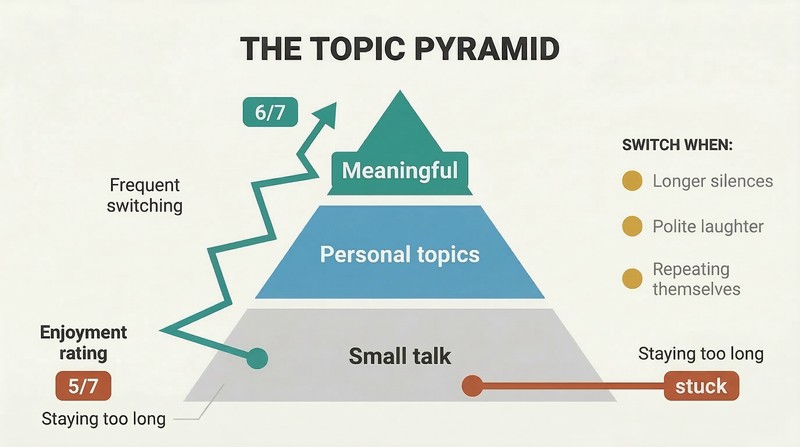
Small talk is a doorway, not a destination. Brooks organizes topics on a topic pyramid: broadly relatable small talk at the base, tailored personal topics in the middle, and deeply meaningful exchange at the peak. The goal isn't to skip small talk — it's to use it as a stepping-stone and move upward before the conversation stagnates.
In controlled studies, people instructed to switch topics frequently rated conversations 6 out of 7 for enjoyment, while natural-pace talkers rated theirs only 5 out of 7. Crucially, more breadth didn't sacrifice depth — deft switchers found treasure quickly and moved on. Three signs a topic has run out of juice:
1. Longer mutual silences
2. More frequent polite laughter
3. Redundancies — people repeating themselves
When you spot one, switch confidently.
Ask one more follow-up question per conversation
“The key to good conversation isn't knowing, but learning.”
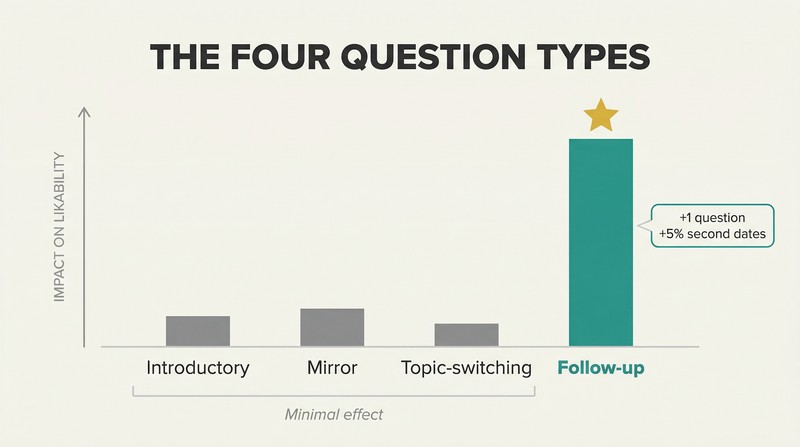
Follow-ups are the superhero of question types. Brooks identified four question types — introductory, mirror, topic-switching, and follow-up — and found the likability boost from asking more questions was driven almost entirely by follow-ups. On speed dates, asking just one additional question per date yielded a 5% greater chance of a second date. Yet we drastically overestimate how many questions we ask: negotiators guessed 50%+ of their speaking turns contained a question; the real number was under 10%.
Avoid boomerasking — posing a question just to answer it yourself and steer attention back to you. Instead, channel curiosity. Brooks's Never-Ending Follow-Ups exercise challenges students to respond only with follow-up questions. Partners rarely notice the technique, and the conversation deepens naturally. Even a bland follow-up keeps the coordination game alive and may uncover unexpected treasure.
Sensitive questions are far less dangerous than you fear
“Asking itself is a form of caring — an acknowledgment of your partner's unique mind.”
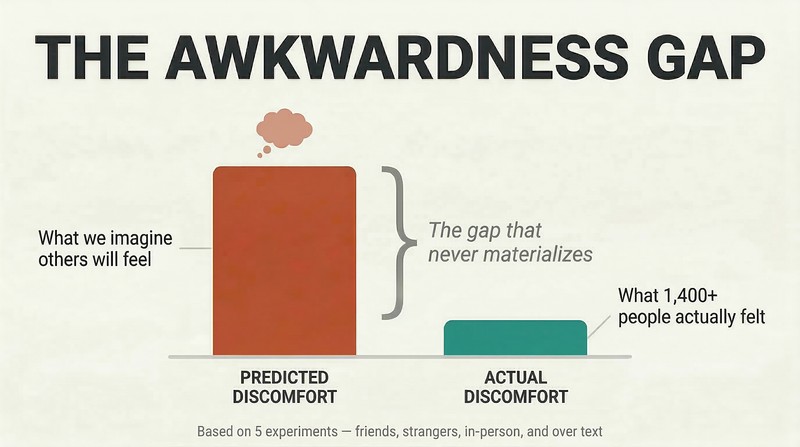
Our predictions about awkwardness are wildly wrong. Researchers asked people to predict how uncomfortable co-workers would feel answering sensitive questions like "How much is your salary?" or "Have you ever had an affair?" Then they tested it. Across five experiments with over 1,400 people, they found zero evidence that sensitive questions caused more harm than benign ones — not between friends, not between strangers, not in person, not over text.
Ascending the topic pyramid toward meaningful exchange requires getting personal, which means accepting some vulnerability. Context does matter — broken trust, power differentials, and large audiences raise the stakes. But in most everyday conversations, the greater danger is silence. One bold question can crack open the doorway from polite chatter to genuine connection. The discomfort we imagine rarely materializes.
Find the fun — you don't need to be funny to create levity
“The incremental risk that one-off jokes will flop is much smaller than the aggregated risk of a lifetime of boring, disengaged conversation that leaves you (and those around you) miserable.”
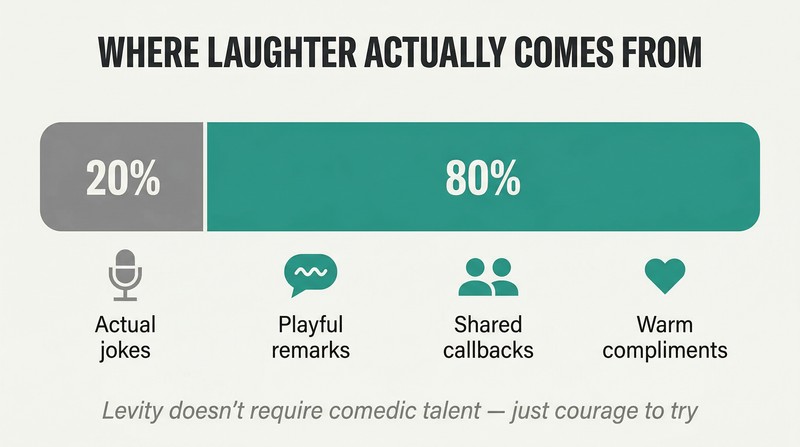
Only 20% of laughter responds to actual jokes. Researcher Robert Provine found most laughter follows banal remarks like "Look, it's Andre!" or "It was nice meeting you, too." Levity — any warm, playful, or unexpected conversational move that infuses positive energy — doesn't require comedic talent. It requires courage to try.
Levity also builds psychological safety. In one study, people in whimsical environments were 1.9 times more likely to reveal personal information, including Social Security numbers. Call-backs to past shared moments trigger authentic laughter. Compliments work even when recipients suspect insincerity — marketing scholars found flattering messages boosted sales despite obviously ulterior motives. Psychologist Jennifer Aaker found that when people on their deathbeds were asked about regrets, the most common answer was wishing they'd spent more time laughing with loved ones.
Prove you're listening with your words, not just your nods
“Nonverbal signals like smiling and nodding give the impression that you're listening…they are also easy to fake.”

Responsive listening beats active listening. Active listening relies on nonverbal cues — smiling, nodding, eye contact — that can be performed on autopilot while your mind drifts. Responsive listening uses verbal cues that require genuine attention: follow-up questions, paraphrasing, call-backs to earlier points, and back-channel feedback like "Yeah," "Really?" and "No way!" Research shows people listen attentively only about 76% of the time — and that's self-reported.
A landmark study of 36,000 police officer utterances from Oakland body camera footage revealed that respectful language makes people feel:
1. Seen and known (using their name or preferred title)
2. Good to be with (positive emotional tone)
3. Worthy of care (gratitude, reassurance, apologies)
Even on-topic interruptions — excited interjections, finishing sentences — signal engaged co-narration rather than rudeness.
In disagreements, aim to learn — not to persuade
“Receptiveness begets receptiveness.”
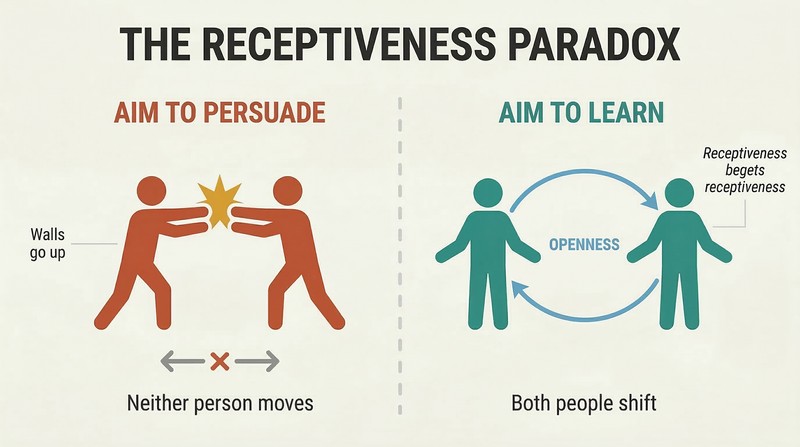
The receptiveness recipe turns conflict into connection. Across hundreds of thousands of conversations, researchers identified concrete linguistic tactics that prevent disagreements from escalating. The core ingredients:
1. Acknowledge what your partner said
2. Affirm their reasoning ("Good point")
3. Flag points of agreement amid disagreement
4. Hedge your claims ("maybe," "possibly")
5. Share personal stories instead of reciting facts
The mindset matters as much as the words. People who adopted a learning goal — trying to understand the other person's perspective rather than change it — were ironically more persuasive. In Brooks's classroom, 40% of students rated the disagreement exercise as their favorite of twenty-plus activities. The key discovery: people systematically underestimate how much others are willing to learn. When you assume your partner won't budge, you treat them worse — a self-fulfilling prophecy.
In groups, the highest-status person's job is to lift others up
“To put it bluntly, having more status makes you less kind.”
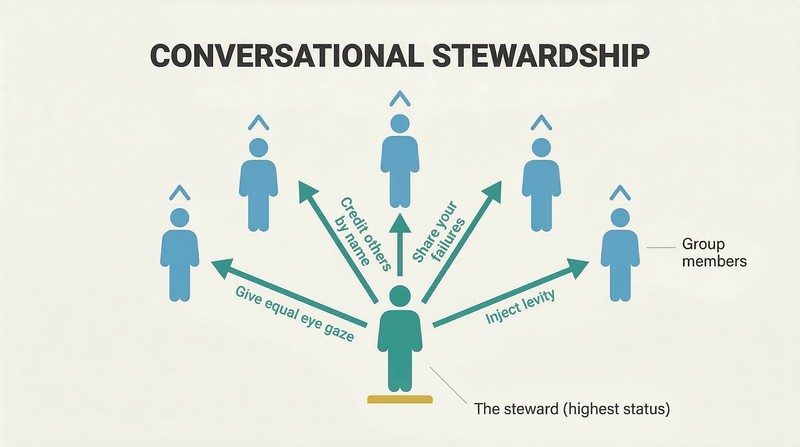
Status hierarchies silently dictate every group conversation. Even at a casual Thanksgiving bar outing, invisible rankings determine who speaks, who stays quiet, and whose ideas get credited. As group size grows, coordination problems scale exponentially — four people means six unique relationships; eight people means twenty-eight. Research shows women speak significantly less than men even in the U.S. Senate, partly from justified fear of backlash.
High-status members can counter these dynamics through what Brooks calls conversational stewardship — deliberately structuring and guiding the group. Concrete moves include giving equitable eye gaze (not just looking at whoever's talking), crediting quieter members by name, sharing your own failures to reduce others' fear of speaking, and injecting levity when low-status members go silent. A conversational steward can partition large groups into pairs or centralize attention strategically — alternating formats keeps conversations from stagnating.
Promise to change — it's the most powerful part of any apology
“People are more likely to sue others not for being wrong but for being cruel.”
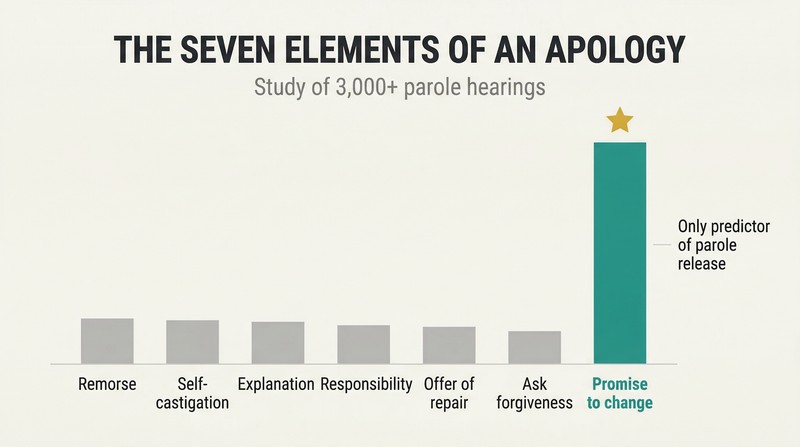
Even superfluous apologies build trust. When a researcher told strangers "I'm sorry about the rain" — clearly not his fault — before asking to borrow their phone, compliance jumped from 9% to 47%. Analysis of over 3,000 parole hearings revealed that among seven apology elements (remorse, self-castigation, explanation, etc.), only one strongly predicted release: a concrete promise to change future behavior.
BP CEO Tony Hayward's infamous oil spill apology — "There's no one who wants this thing over more than I do. I'd like my life back" — failed because it centered himself instead of the victims. Effective apologies focus squarely on the recipient's experience, resist the urge to request forgiveness in the same breath, and arrive quickly — recipients perceive faster apologies as more sincere. Not a single study has found that withholding an apology beats offering one.
Analysis
Alison Wood Brooks occupies a genuinely novel position in the communication literature. While predecessors like Dale Carnegie offered prescriptive etiquette and negotiation scholars like William Ury focused on high-stakes dealmaking, Brooks applies experimental behavioral science to the full spectrum of conversation — from pillow talk to parole hearings. Her methodological innovation is significant: using natural language processing to quantify spoken words as data, she can make claims about conversational behavior at a scale that Erving Goffman's eavesdropping or traditional conversation analysis never could.
The TALK framework's elegance lies in its dual function as both mnemonic and diagnostic tool. When a conversation fails, you can almost always trace the failure to one or more maxim violations — a stale topic nobody switched away from, a question nobody asked, levity nobody attempted, kindness nobody showed. This makes the framework genuinely useful rather than merely decorative.
The book's most counterintuitive contributions center on miscalibration: we overestimate how many questions we ask (by a factor of five), underestimate how much others want to be asked sensitive questions, underrate the power of topic preparation, and systematically assume our conversational skills are worse than they actually are. These are not platitudes but experimentally validated asymmetries that, once recognized, can be corrected.
A legitimate critique is cultural scope — the research skews heavily Western and American. Question-asking norms, self-deprecating humor, and direct sensitive questioning may not transfer cleanly across cultures with different expectations around hierarchy, indirectness, or silence. Brooks acknowledges this gap honestly but cannot fill it.
Perhaps most profoundly, Brooks reframes conversation itself: not as a performance to be judged, but as a coordination game to be played together. This shift from evaluation to collaboration may be her most lasting contribution. It gives anxious conversationalists permission to be imperfect while offering concrete tools to be incrementally better — which, compounded across thousands of daily interactions, is transformative.
Review Summary
Talk receives largely positive reviews, with readers praising its insights on improving conversation skills. Many find the TALK framework (Topics, Asking, Levity, Kindness) helpful and practical. Reviewers appreciate the blend of scientific research and real-world examples. Some note that while certain points seem intuitive, having them explicitly stated is valuable. A few criticize the corporate tone and occasional lack of nuance. Overall, readers find the book engaging and useful for enhancing both personal and professional communication.
People Also Read




 Immersive
Glossary
TALK maxims
Four reminders for better conversationA framework developed by Alison Wood Brooks consisting of four conversational reminders: Topics (choose and manage what you discuss), Asking (use questions to steer and deepen), Levity (infuse positive energy and fun), and Kindness (prioritize your partner's needs through respectful language and responsive listening). Not rigid rules but prompts to counteract common conversational failures.
Conversational compass
Maps competing conversational goalsA two-axis framework for plotting conversational purposes. The informational axis (north–south) captures how much you aim to exchange accurate information. The relational axis (east–west) captures how much you serve the collective versus yourself. The four quadrants—Connect, Savor, Protect, and Advance—represent different legitimate conversational motives. Every participant has their own compass, and goals shift constantly during conversation.
Topic pyramid
Hierarchy from small talk to deep talkA visual model organizing conversation topics by depth and personalization. At the broad base sits small talk (weather, current events)—universally relatable but impersonal. The middle holds tailored talk (personal interests, shared experiences). The peak contains deep talk—topics uniquely suited to the specific combination of people, relationship, and moment. The goal is to climb upward, using small talk as a stepping-stone rather than a destination.
Myth of Naturalness
False belief that skill means effortlessnessThe mistaken assumption that good conversationalists are naturally talented and don't need preparation. When someone displays conversational skill, it appears effortless, leading observers to believe it is effortless—and that it should be effortless for them too. This myth fuels resistance to topic preparation, question planning, and other deliberate conversational strategies that research shows improve performance.
Boomerasking
Asking a question to answer it yourselfA counterproductive conversational pattern in which someone poses a question to a partner not out of genuine curiosity, but as a setup to share their own information. Named after the self-returning arc of a boomerang. Example: asking 'How was your weekend?' only to quickly pivot to bragging about your own plans. Research shows boomeraskers are perceived as uncurious and insincere; directly sharing information is more effective than disguising it as a question.
Receptiveness recipe
Linguistic toolkit for productive disagreementA set of evidence-based linguistic tactics identified by researchers Julia Minson, Mike Yeomans, and Hanne Collins that characterize productive disagreement. Key ingredients include: acknowledging your partner's statements, affirming their reasoning, flagging points of agreement, hedging claims with words like 'maybe' or 'possibly,' sharing personal stories, using positive framing, and avoiding explanation words like 'therefore' or 'always.' People who use receptive language are less likely to provoke hostility and more likely to persuade.
Responsive listening
Proving attention through verbal cuesBrooks's distinction from conventional 'active listening.' While active listening emphasizes nonverbal signals (nodding, eye contact, smiling) that can be faked, responsive listening requires verbal evidence of attention: follow-up questions, paraphrasing, call-backs to earlier topics, back-channel feedback ('Yeah,' 'No way!'), and on-topic interruptions. These verbal cues can only be produced by someone genuinely processing what their partner said, making them more reliable signals of care.
Conversational stewardship
Deliberately guiding a group's conversationA concept borrowed from meeting expert Elise Keith, referring to the practice of actively supervising or managing a group conversation. A steward plans for differences among group members, gives forethought to goals and topics, structures turn-taking, and monitors the emotional temperature. Tools include partitioning (dividing into subgroups) and centralizing (focusing all attention on one thread), alternated strategically to keep conversation productive and inclusive.
ZQ (Zero Questions)
People who ask zero questionsA term coined by professional matchmaker Rachel Greenwald for conversation partners who fail to ask a single question during an interaction. ZQs talk endlessly about themselves without inquiring about the other person. Research shows that even in contexts designed for information exchange—meetings, dates, interviews—people frequently ask very few questions, and the absence of questions dramatically reduces likability and connection.
FAQ
What's Talk: The Science of Conversation and the Art of Being Ourselves about?
- Exploration of Conversation: The book examines the complexities of conversation, viewing it as a "coordination game" where participants navigate topics and emotions.
- TALK Framework: Introduces the TALK framework—Topics, Asking, Levity, and Kindness—as essential components for effective communication.
- Real-Life Applications: Offers insights from research and teaching to help readers improve conversational skills in both personal and professional settings.
Why should I read Talk: The Science of Conversation and the Art of Being Ourselves?
- Enhance Communication Skills: Provides practical strategies to make interactions more enjoyable and effective.
- Scientific Insights: Combines scientific research with anecdotes to show how conversations shape relationships and experiences.
- Broaden Understanding: Helps readers understand conversation dynamics, including navigating difficult topics and fostering connections.
What are the key takeaways of Talk: The Science of Conversation and the Art of Being Ourselves?
- Coordination Game Concept: Conversation is a coordination game requiring constant adjustments based on context and partner dynamics.
- TALK Maxims: Topics, Asking, Levity, and Kindness are guiding principles for engaging conversations.
- Importance of Kindness: Prioritizing kindness fosters respect and understanding, enhancing interaction quality.
What are the best quotes from Talk: The Science of Conversation and the Art of Being Ourselves and what do they mean?
- Micro-Decisions in Conversation: “In every conversation, we make thousands of fleeting micro-decisions about what to say, how to say it, and when.” This highlights the complexity and decision-making involved in effective communication.
- Quality Beyond Topics: “Good conversation doesn’t always require that we choose good topics.” Suggests that connection and engagement matter more than the topics themselves.
- Role of Levity: “Levity is any conversational move—playful, funny, unexpected, warm—that infuses positive energy.” Emphasizes humor's role in keeping conversations engaging.
What is the TALK framework in Talk: The Science of Conversation and the Art of Being Ourselves?
- Topics: Focuses on choosing engaging and relevant topics to steer conversations productively.
- Asking: Involves using questions to navigate topics and deepen discussions, fostering interactive dialogue.
- Levity: Encourages humor and playfulness to maintain engagement and enjoyment.
- Kindness: Prioritizes the needs and feelings of partners, creating a respectful environment.
How does Talk: The Science of Conversation and the Art of Being Ourselves define effective conversation?
- Complex Coordination: Effective conversation is a coordination game requiring participants to read cues and adjust responses.
- Micro-Decisions: Participants make numerous micro-decisions impacting conversation flow and outcome.
- Mutual Engagement: Successful conversations require mutual engagement, where both parties feel heard and valued.
How does Talk: The Science of Conversation and the Art of Being Ourselves address difficult conversations?
- Understanding Emotions: Emphasizes managing emotions for effective communication, providing strategies for recognizing and addressing emotional responses.
- Receptiveness Recipe: Introduces acknowledging, affirming, and validating perspectives to create a safe dialogue space.
- Apologies and Responsibility: Discusses the importance of apologies in repairing relationships and restoring trust.
What role does psychological safety play in conversations according to Talk: The Science of Conversation and the Art of Being Ourselves?
- Foundation for Open Dialogue: Psychological safety is the belief that one won't be punished for speaking up, essential for honest conversations.
- Encourages Participation: When individuals feel safe, they share thoughts without fear, leading to richer discussions.
- Mitigates Status Hierarchies: Helps level the playing field in group settings, encouraging contributions from all members.
How can I improve my questioning skills as suggested in Talk: The Science of Conversation and the Art of Being Ourselves?
- Ask More Questions: Emphasizes asking more questions to enhance information exchange and likability.
- Use Follow-Up Questions: Crucial for deepening discussions and showing genuine interest in responses.
- Avoid Closed Questions: Open-ended questions encourage elaborate responses and engaging dialogue.
What are some common conversational pitfalls discussed in Talk: The Science of Conversation and the Art of Being Ourselves?
- Boomerasking: Asking a question only to answer it oneself, which can seem self-centered.
- ZQs (Zero Questions): Individuals who ask no questions, leading to one-sided dialogues.
- Gotcha Questions: Designed to catch someone off guard, creating defensiveness and hindering communication.
How can I apply the principles from Talk: The Science of Conversation and the Art of Being Ourselves in group conversations?
- Airtime Sharing: Be mindful of airtime in group settings, ensuring everyone can contribute.
- Encourage Participation: Use topic-switching questions to invite quieter members into the conversation.
- Monitor Engagement: Pay attention to dynamics and be ready to switch topics or introduce levity to keep engagement high.
How does Talk: The Science of Conversation and the Art of Being Ourselves suggest improving listening skills?
- Active Listening: Involves fully engaging with the speaker and showing attentiveness through cues.
- Back-Channel Feedback: Use nodding or verbal affirmations to signal listening and engagement.
- Paraphrasing: Practice paraphrasing to ensure understanding and validate the speaker's perspective.
Download PDF
Download EPUB
.epub digital book format is ideal for reading ebooks on phones, tablets, and e-readers.








































