

Key Takeaways
For the word-poisoned mind, language devours reality before the body can taste it
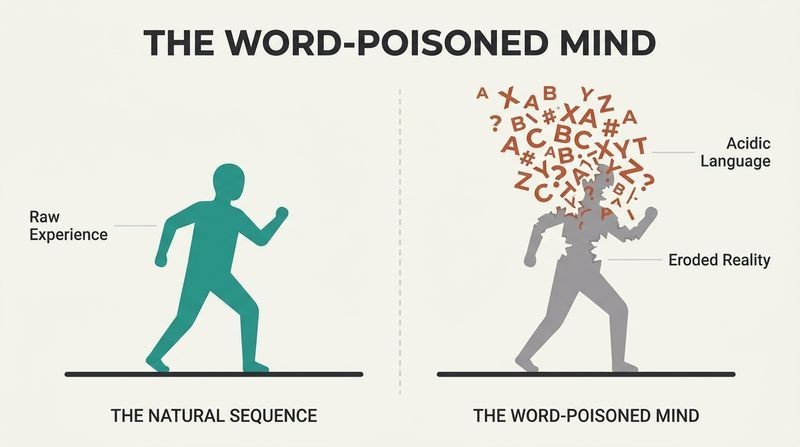
Words arrived before the flesh. Mishima confesses a reversal of the normal human sequence. Most people know their bodies before they know language. For him, words came first, and the body arrived late, already half eaten away. He compares this to a wooden pillar attacked by white ants, except that in his case the ants were feeding before the pillar had even formed.
Language corrodes what it touches. Any art built from words relies on their acidic function, the way etching depends on nitric acid biting into copper. But words reduce reality to abstraction, and in corroding the world they risk corroding themselves, like stomach fluids digesting the stomach that produces them. This left him craving a realm where words held no power at all: the body, action, and reality itself.
This opening diagnosis anticipates a century of thought about how language mediates and alienates experience. Lacan argued the subject is constituted, and split, by entering the symbolic order of language. Mishima intuited something similar from the inside, describing himself as a boy who lived at his desk rather than in his skin. What is striking is his refusal to treat this as neutral. He frames literacy as a wound. Contemporary somatic psychology echoes the worry: over-verbalizing an experience can flatten its felt intensity, a phenomenon researchers call verbal overshadowing. The reader need not share his extremity to recognize the danger of living entirely in description rather than sensation.
Cultivate the neglected orchard of your body with sunlight and steel
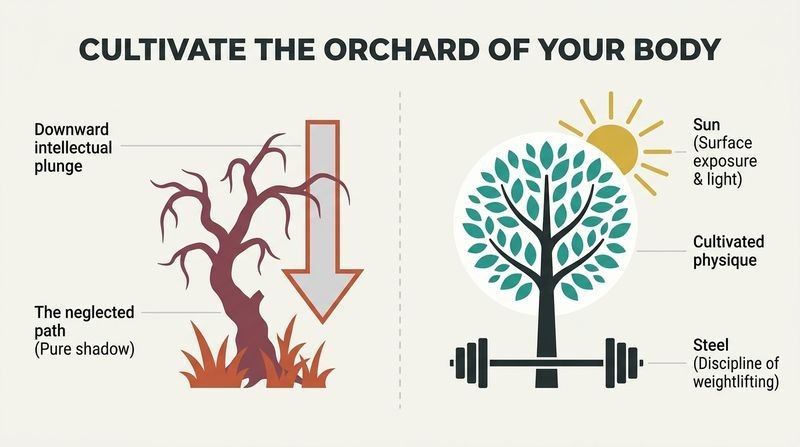
The self is a dwelling, the body its orchard. Mishima frames his physique as land he could either cultivate or abandon to weeds. Many people call that neglected orchard destiny. He chose to farm it deliberately, using two tools: sun (sunlight, tanning, exposure) and steel (barbells, the discipline of weightlifting sustained across ten years).
Reconciling with the sun meant defying the intellectual herd. As a boy he worshipped night, shadow, and introspection, writing poems that shunned the sun. Postwar literary fashion prized dark, cloying night thoughts, and their authors had lusterless skin and sagging stomachs. He came to suspect his hatred of the sun was itself herd behavior. On a 1952 voyage abroad he shook hands with the sun. Why, he asks, must thought only plunge downward into depths, never climb toward the surface and the muscled skin?
The orchard metaphor reframes fitness not as vanity but as stewardship, a refusal to let the given body rot by default. This resonates with virtue ethics, where character is cultivated like a garden through repeated practice rather than declared. His attack on the pallid intellectual anticipates modern research linking exercise to cognition and mood. Yet there is a tension worth naming. Mishima presents surface and depth as rivals, championing the skin over the abyss. Most traditions insist on both. The steelman: he is correcting a genuine imbalance in a culture that had exiled the body to make room for the mind, not denying that depth exists.
Muscle is the anti-word: it universalizes you instead of isolating you
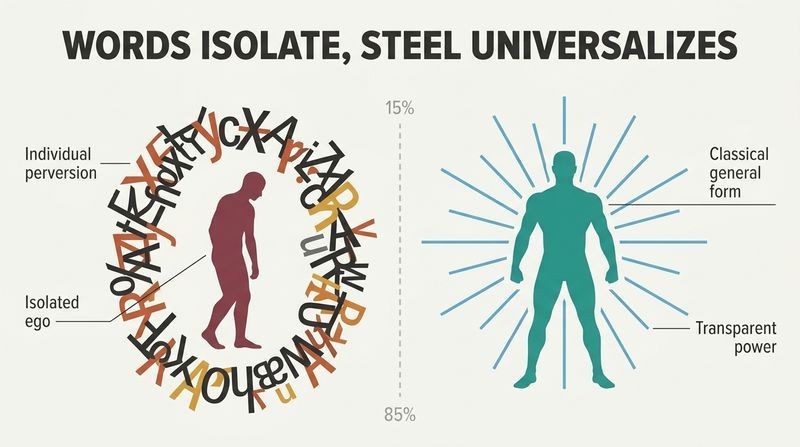
Words individualize, steel universalizes. Language began as common currency, shared by a whole people to communicate ordinary needs. Literature perverts this by prizing individual style, which is why every signed work is, in Mishima's phrase, a beautiful perversion of words. Muscle works in reverse. The relentless pressure of the barbell strips away the idiosyncratic, degenerate features of a body and drives it toward a classical, general form in which individual difference dissolves.
Strength becomes transparent power. Mishima describes cooling his heated muscles at a window and suddenly losing the sense of their existence entirely, feeling only a pure, objectless power like light. He maps physical traits to moral ones: flabby muscles to feeble emotion, a sagging stomach to sentimentality, a taut body to intrepid spirit. The correspondence, he admits, is a personal creed, not a universal law.
The claim that bodybuilding erases individuality, rather than expressing it, is counterintuitive and provocative. It inverts the modern gym culture of self-branding. Mishima is closer to the classical Greek ideal, where the athlete's body approached an impersonal canon of proportion, the kanon of Polykleitos. His muscle-to-morality mapping is where a careful reader should push back. He concedes it himself, noting timid minds housed in bulging muscles. Physiognomy, reading character from the body, has a long discredited history. The honest reading is that Mishima is constructing a private symbolic system, a way to make abstract virtues visible on his own flesh, not asserting a science of others.
Real tragedy needs an ordinary body briefly ennobled by physical courage
The riddle of the shrine bearers. As a child, Mishima puzzled over the faces of young men carrying a heavy portable shrine through festival streets, their eyes turned to the sky in ecstatic abandon. Decades later, having built his body, he shouldered a shrine himself and solved it. They were seeing nothing mystical, only the blue autumn sky, swaying between clarity and madness. The vision was not private genius but a shared group perception, available only through common physical strain.
His definition of the tragic. Tragic pathos is born when a perfectly average sensibility momentarily seizes a privileged nobility that keeps others at a distance, grounded in bodily courage. It is not the special soul flaunting its specialness. The consequence stings writers: one who deals in words can create tragedy but can never participate in it.
This is a genuinely original theory of tragedy, distinct from Aristotle's emphasis on the fall of an elevated figure. Mishima locates the tragic in a democratic, communal, physical instant, the moment an unremarkable person is lifted into distinction by shared bodily effort. It resembles what sociologists studying collective effervescence, following Durkheim, describe: ritual synchrony dissolving the individual into a charged group. His painful corollary, that the writer is exiled from the tragedy he depicts, doubling as spectator forever outside the arena, drives the entire book. It also quietly critiques the artist's condition. To witness and record is to be structurally barred from the thing witnessed.
Seek the opponent, the one reality that stares back and cannot be abstracted
Combat introduces the thing that gazes back. Through boxing and fencing, Mishima chased what lurks just beyond the flashing fist and the tip of the bamboo sword. He calls it, in plain language, the opponent. Unlike an idea, which you can stare at without it ever returning your gaze, the opponent looks back. You see him, he sees you, both dwelling in the same world of being seen and acting.
Expression requires standing outside; combat forbids it. To put something into words, you must step outside the world and take your leisure to observe it. But in a realm where your gaze is constantly returned, there is no time to form sentences. Ideas flit behind the semi-transparent fictions they produce. Behind action, the opponent flits, and behind the opponent stands the ultimate reality that never yields: death.
The idea that things gaze back while ideas do not anticipates a strand of twentieth-century phenomenology. Sartre made the returned gaze of the Other central to self-consciousness, the shame of being seen. Mishima weaponizes it: the sparring partner is a mirror that cannot be edited. His insight that expression requires temporal distance, the luxury of standing apart, is a sharp description of why writing feels safe and combat does not. The nuance a reader might add: many contemplative traditions insist reality gazes back everywhere, in a face, a landscape, not only across a fist. Mishima needed the extremity of violence to feel it, which says as much about him as about reality.
Pain is the only proof that consciousness truly lives inside the flesh
Suffering witnesses the mind in the body. Mishima concluded that physical pain might be the sole physical expression of consciousness, the surest evidence that awareness persists inside the flesh rather than floating free in the study. As his body gained muscle, he developed a positive appetite for suffering, insisting this came directly through the sun and steel, not through imagination.
Physical courage reverses the usual roles. We assume consciousness is passive and the body is bold. In the drama of courage the reverse holds. The flesh instinctively retreats into self-defense, while it is clear-eyed consciousness that decides to hurl the body into self-abandonment. Therefore only physical courage makes a true awareness of death possible. However long a sheltered philosopher broods on death, divorced from bodily courage, he cannot even begin to grasp it.
Pain as the guarantor of presence has deep resonance. Elaine Scarry argued pain is the most certain of interior states to the sufferer and the most doubted by others, which is why Mishima treats it as private proof. Initiation rites across cultures use ordeal precisely to fuse conviction to the body, ceremonies of death and rebirth he explicitly invokes. The challenge: neuroscience shows chronic pain often dulls rather than sharpens consciousness, and trauma can fragment the self. Mishima idealizes the acute, chosen pang of the athlete, the counterblow that confirms strength, not the grinding suffering of illness. His courage-reverses-roles claim, though, is a genuine correction to armchair fatalism.
Wield pen and sword together: hold the wilting flower and the artificial one at once
Art and action are opposite flowers. Action perishes with its blossom, glorious and gone, like a duelist's stroke. Literature is an imperishable flower, and an imperishable flower is an artificial one, life held in reserve and treated with preservatives. Mishima wanted both at once, reviving the old Japanese ideal uniting letters and the martial arts.
Living the contradiction as alternating current. Rather than resolve the tension, he installed two mutually hostile elements in himself, flowing in opposite directions, creating a balance that is constantly destroyed and reborn. His strategy: defend the citadel within art, but take the offensive in fields outside it. Combining the two forces each to see through the other's ultimate dream. The man of action learns his eternal flower is fake; the artist learns his art buys no favor from death. The duality offers no salvation by dreams.
The wilting flower against the artificial flower is one of the book's most portable images, a compact philosophy of why we are torn between doing and describing. It maps onto a familiar modern anxiety: the creator who films the sunset instead of watching it, trading presence for a permanent record. Mishima refuses the usual advice to integrate the two smoothly. He prefers productive collision, an oscillation rather than a synthesis, closer to Nietzsche's Apollonian and Dionysian tension than to any tidy balance. The unsettling honesty here is his conclusion that the dual path strips away consolation. Each ideal exposes the other's lie, leaving no dream to hide inside.
You cannot both see yourself and fully exist, unless a blade splits you open
The apple that cannot see its own core. Mishima's central image for the crisis of self-awareness is an apple. A healthy apple simply exists, its red skin opaque, its core hidden in darkness. The core longs for proof that it is a perfect apple, but it cannot see itself. The only way for the core to be seen in the same light as the skin is for a knife to plunge in and split the fruit open. At that instant existence shatters. The core sacrifices being for the sake of being seen.
Muscle demands the same fate. His euphoric sense of existence could be endorsed only by muscle, yet merely seeing muscle in a mirror was not enough to touch the roots of being. Self-endorsement therefore drives toward self-destruction: the blade cutting flesh, blood flowing, seeing and existing finally closing their gap. That is death.
The apple is Mishima's answer to a paradox philosophers call the elusiveness of the self: the eye cannot see itself seeing, the knower cannot fully become its own object. His solution is terrifyingly literal. Where mystics dissolve the seer-seen divide through meditation, and where Sartre left it an irresolvable lack, Mishima proposes the knife. Read as psychology, this is the logic of the person who can only feel real through crisis, injury, or spectacle, needing an external wound to confirm an inner existence. It is a profound and dangerous idea. The reader should hold it as diagnosis rather than prescription, a window into how self-consciousness can curdle into a hunger for its own violent ending.
Only shared bodily suffering, never words, can dissolve you into a group
The group speaks a language words cannot carry. Mishima realized that individual writing, however anguished, can never create a community of shared pain. A lonely writer's sorrow may billow toward the stars, but suffering is transmissible only between bodies placed under the same conditions. Pleasure spreads through ideas; only co-located flesh shares agony. The group is a concept of uncommunicable shared suffering that finally rejects words.
Running as one, seeking death and glory. Stripped to the waist in freezing dawn air, a red-sun towel around his forehead, running in formation, Mishima felt the tragic quality emerge like sweat, a flame of nobility. Self-awareness receded to a distant rumor. He belonged to them and they to him, forming an unmistakable us. To belong, he asks, what more intense mode of existence could there be? The group became a bridge that, once crossed, offered no return.
This is the social counterweight to the book's intense solitude, and it lands on genuine science. Synchronized physical movement, marching, rowing, chanting, measurably raises pain thresholds and bonding, what researchers studying military drill and ritual call muscular bonding. Durkheim's collective effervescence and modern work on behavioral synchrony both confirm that moving together in hardship forges belonging language cannot. Mishima's insight that shared pleasure is easy while shared suffering is rare and binding rings true across armies, sports teams, and disaster survivors. The shadow: a community defined by openness to death, a community of warriors, is also the psychology that makes political extremism and self-sacrifice feel like transcendence. Belonging this total can annihilate judgment.
Push body and spirit to their extremes and opposites fuse like a snake eating its tail
Live at the edges, not the depths. Mishima declares he cares only for the outermost surfaces of body and spirit, dismissing the depths as shallow and commonplace. Body and spirit had never blended for him. Physical action never gave the icy thrill of intellectual adventure, and thought never delivered the hot darkness of exertion. Somewhere, he reasoned, a higher principle must reconcile them, and that principle is death.
The flight of the F104. Riding a supersonic fighter to 45,000 feet, subjected to G-force and denitrification, he finally sees his vision: a vast snake of white cloud circling the globe and swallowing its own tail. Opposites carried to extremes come to resemble each other. At those rarefied heights, where motion becomes stillness and the closed cockpit mirrors his midnight study, inner and outer worlds invade and become interchangeable. Body and spirit at last join.
The ouroboros, the tail-devouring snake, is an ancient alchemical symbol of unity and eternal return, and Mishima earns it through an unusually modern vehicle, a jet fighter. His claim that extremes converge echoes the coincidentia oppositorum of mystics like Nicholas of Cusa, where at infinity a circle and a straight line become one. The closing Icarus poem reframes the whole book: the yearning to ascend toward the sun that both lures and destroys, the unanswerable question of whether one belongs to heaven or earth. It is a fitting, unresolved end. The book is less a program to follow than a rare, lucid map of a mind organizing itself toward transcendence and, unmistakably, toward its own beautiful destruction.
Analysis
Sun and Steel resists summary because it is neither memoir nor treatise but what Mishima calls confidential criticism, a twilight genre suspended between confession and analysis. Its argument advances by image and paradox rather than proposition. Read as philosophy, it is a sustained attack on the Cartesian and modern literary settlement that exiled the body from serious thought, and an attempt to build, from muscle and sunlight, an epistemology of the flesh. Mishima's wager is that certain truths, tragedy, courage, belonging, death, are simply inaccessible to the disembodied intellect and can be reached only through cultivated physical strength. This makes him an unlikely ally of contemporary embodied cognition and of thinkers from Nietzsche to Merleau-Ponty who insist meaning is rooted in the lived body. What separates Mishima is his aestheticism. He does not merely want the body to think; he wants it to die beautifully, at its peak, before decay. The book's engine is the writer's tragic exclusion. Having defined tragedy as the ordinary sensibility briefly ennobled by physical courage, he concludes that the man of words can compose tragedy but never enter it, and Sun and Steel is his desperate, decade-long campaign to earn entry through the body he lacked. The apple metaphor exposes the fatal logic: a self-awareness that can only confirm its existence by being seen, and can only be fully seen when a blade splits it open. Written two years before his ritual suicide in 1970, the essay reads in retrospect as a philosophical rehearsal, which is both its power and its warning. Readers should extract its genuine gifts, the orchard of the neglected body, the discipline of surfaces over depths, the science of shared suffering, and the wilting flower against the artificial one, while recognizing that its terminus, self-endorsement through self-destruction, is a diagnosis of a mind in extremis, not a template for living.
Review Summary
Sun and Steel receives mixed reviews, with an average rating of 3.76/5. Readers appreciate Mishima's philosophical exploration of the mind-body connection and his pursuit of physical strength. Many find the writing beautiful and thought-provoking, praising its insights on self-improvement and facing mortality. However, some criticize the book as overly abstract, fascist-leaning, or pretentious. The work's autobiographical nature and its connection to Mishima's eventual suicide add complexity to readers' interpretations.
People Also Read

Glossary
Sun and Steel
Sunlight and weightlifting as self-cultivationMishima's twin tools for cultivating the body he neglected in youth. Sun means sunlight and tanning, exposure to the physical world; steel means barbells and weightlifting sustained over roughly ten years. Together they form the husbandry by which he reclaimed reality, action, and physical courage from a self he felt had been built entirely out of words.
Confidential criticism
Hybrid of confession and analysisMishima's name for the essay's own genre, a mode between the night of personal confession and the daylight of objective criticism. The I it explores is not his autobiographical self but the residue that remains after all his other words have drained away, essentially a language of the body attempting self-analysis.
The opponent
Reality that gazes backWhat Mishima found lurking beyond the fist in boxing and the tip of the sword in fencing. Unlike an idea, which can be stared at without ever returning the gaze, the opponent looks back, forcing both fighters into a shared world of being seen and acting. Behind the opponent stands the ultimate reality that never yields: death.
Tragic pathos
Average sensibility briefly ennobled physicallyMishima's definition of tragedy. It arises when a perfectly ordinary, average sensibility momentarily seizes a privileged nobility that sets it apart, grounded specifically in physical courage rather than special genius. The corollary is that a person who works only in words can create tragedy but can never participate in it.
The apple metaphor
Seeing versus existing paradoxMishima's image for the conflict between self-awareness and existence. A healthy apple exists but its hidden core cannot see itself. The only way the core can be seen in full light is for a knife to split the fruit, which destroys its existence. So too, confirming one's existence through the seen body ultimately demands self-destruction, that is, death.
The snake (ouroboros)
Tail-eating ring uniting oppositesThe vision Mishima sees during his supersonic F104 flight: a vast snake of white cloud encircling the earth and swallowing its own tail. It symbolizes his conclusion that opposites carried to extremes come to resemble one another, and that at the outermost edges body and spirit, inner and outer, finally fuse into one.
Language of the flesh
Wordless bodily knowledge and expressionThe second language Mishima learned through sun and steel, a form of knowledge and expression belonging to the body rather than words. It includes sweat, pain, shared suffering, and the group's speech, and it reaches truths, especially about courage and death, that verbal art cannot capture or transmit.
FAQ
What is "Sun and Steel" by Yukio Mishima about?
- Personal Testament: "Sun and Steel" is Mishima’s philosophical memoir exploring the relationship between the body and the mind, art and action, and the pursuit of an ideal existence.
- Body vs. Words: The book contrasts the world of words (literature, intellect) with the world of the body (physicality, action), reflecting Mishima’s own journey from a life dominated by literature to one focused on physical cultivation.
- Themes of Death and Beauty: Mishima delves into the aesthetics of death, the tragic, and the pursuit of beauty through both art and physical discipline.
- Hybrid Genre: The work is a blend of confession, criticism, and philosophical essay, offering a unique insight into Mishima’s psyche and worldview.
Why should I read "Sun and Steel" by Yukio Mishima?
- Unique Perspective: The book provides a rare, introspective look at Mishima’s personal philosophy and the tensions between intellect and physicality.
- Cultural Insight: It offers a window into postwar Japanese thought, masculinity, and the samurai ethos, as interpreted by one of Japan’s most controversial writers.
- Literary and Philosophical Value: Readers interested in existentialism, aesthetics, or the limits of language will find Mishima’s arguments provocative and original.
- Influence and Legacy: "Sun and Steel" is essential for understanding Mishima’s later works and his dramatic life and death, making it valuable for students of literature and Japanese culture.
What are the key takeaways from "Sun and Steel" by Yukio Mishima?
- Words Corrode Reality: Mishima argues that language abstracts and distances us from direct experience, leading to a longing for unmediated reality.
- Body as Truth: He posits that the body, through discipline and suffering, can access truths and experiences that words cannot convey.
- Tragedy and Group Identity: The book explores the idea that true tragedy and nobility are found in shared, physical experiences, especially those involving risk and death.
- Duality and Reconciliation: Mishima ultimately seeks a reconciliation between art and action, intellect and flesh, suggesting that only in death do these opposites unite.
How does Yukio Mishima define the relationship between words and the body in "Sun and Steel"?
- Words Precede Flesh: Mishima describes his own development as one where words and intellect came before bodily awareness, leading to a sense of alienation from physical reality.
- Corrosive Power of Language: He likens words to a corrosive force that can erode the purity of both reality and the self.
- Body as Redemption: Through physical training (sun and steel), Mishima seeks to reclaim a sense of reality and authenticity that words alone cannot provide.
- Fetishization of Both: He admits to a kind of fetishism for both words and the body, ultimately striving to balance and reconcile the two.
What is the significance of "sun" and "steel" in Mishima's philosophy?
- Sun as Vitality: The sun represents life, energy, and the surface of things—contrasted with the introspective, nocturnal world of the intellect.
- Steel as Discipline: Steel refers to the implements of physical training (weights, swords), symbolizing discipline, strength, and the transformation of the body.
- Means of Cultivation: Together, sun and steel are the tools Mishima uses to cultivate his body, seeking to achieve an ideal form and a new kind of knowledge.
- Metaphor for Transformation: They embody the process of moving from a life of words to one of action, and from abstraction to concrete experience.
How does "Sun and Steel" by Yukio Mishima address the concept of death and the tragic?
- Death as Ultimate Reality: Mishima sees death, especially violent or heroic death, as the ultimate unification of body and spirit, and the only true endorsement of existence.
- Tragedy as Group Experience: He argues that tragedy is born when ordinary people, through shared physical ordeal, attain a momentary nobility and closeness to the divine.
- Aesthetic of Death: The book explores the idea that beauty and honor are most fully realized in the moment of death, particularly when the body is at its peak.
- Rejection of Abstract Death: Mishima criticizes intellectual or imagined death, insisting that only physical courage and suffering can bring true awareness of mortality.
What role does physical training and suffering play in "Sun and Steel" by Yukio Mishima?
- Path to Knowledge: Mishima claims that physical training and the acceptance of pain provide a form of knowledge and consciousness inaccessible through words.
- Discipline and Transformation: The cultivation of muscle and endurance is both an aesthetic and moral discipline, transforming the self and enabling a new relationship with reality.
- Proof of Existence: Suffering and physical challenge serve as proof of consciousness and existence, bridging the gap between seeing and being.
- Preparation for Death: Training is also preparation for death, aligning the body with the ideals of courage, honor, and the tragic.
How does Yukio Mishima critique modern intellectualism and literature in "Sun and Steel"?
- Alienation from Reality: Mishima argues that modern intellectuals and writers are disconnected from the body and real experience, living in a world of abstractions.
- Imagination as Escape: He criticizes the tendency to use imagination and words to avoid the pains and risks of physical existence.
- Art as False Immortality: Literature, for Mishima, preserves life artificially, creating "imperishable flowers" that are ultimately less authentic than the fleeting glory of action.
- Need for Balance: He calls for a union of art and action, suggesting that true greatness requires both intellectual and physical cultivation.
What is the "language of the flesh" and how does it differ from the language of words in "Sun and Steel"?
- Nonverbal Communication: The "language of the flesh" refers to the direct, unmediated expression of the body—through action, suffering, and shared experience.
- Universality: Unlike words, which are individual and abstract, the language of the flesh is universal, accessible to all who undergo the same physical ordeal.
- Beyond Expression: Mishima suggests that some realities—especially those involving pain, courage, and death—cannot be adequately expressed in words, only lived.
- Source of Tragedy: This language is the foundation of group identity and tragedy, as it enables a shared sense of existence and meaning.
How does "Sun and Steel" by Yukio Mishima explore the idea of group identity and shared suffering?
- Group as Principle of Flesh: Mishima sees the group as embodying the principle of the body, where individuality dissolves in shared physical experience.
- Shared Suffering: Only through collective suffering—sweat, fatigue, and risk—can individuals attain a higher existence and glimpse the divine.
- Language of the Group: The language of the group is physical, not verbal; it is enacted through rituals, training, and communal action.
- Tragic Affirmation: The group enables the affirmation of identity and nobility through tragedy, culminating in the possibility of heroic death.
What are the most important quotes from "Sun and Steel" by Yukio Mishima and what do they mean?
- "Words are a medium that reduces reality to abstraction for transmission to our reason, and in their power to corrode reality inevitably lurks the danger that the words themselves will be corroded too."
- Mishima warns that language distances us from direct experience and can ultimately undermine itself.
- "The muscles that I thus created were at one and the same time simple existence and works of art; they even, paradoxically, possessed a certain abstract nature."
- He sees the cultivated body as both a physical reality and an aesthetic achievement, blurring the line between art and life.
- "To embrace suffering is the constant role of physical courage; and physical courage is, as it were, the source of that taste for understanding and appreciating death..."
- Mishima links courage, suffering, and the awareness of mortality as essential to a meaningful existence.
- "The group is a concept of uncommunicable shared suffering, a concept that ultimately rejects the agency of words."
- He emphasizes that true community and tragedy are rooted in shared physical ordeal, not in language.
How does the epilogue and the poem "Icarus" encapsulate the message of "Sun and Steel" by Yukio Mishima?
- Unity of Opposites: The epilogue’s image of the snake biting its tail symbolizes the reconciliation of body and spirit, action and intellect, life and death.
- Limits of Human Aspiration: The "Icarus" poem reflects the tension between the desire to transcend (fly) and the inevitability of return to earth (fall), mirroring Mishima’s own struggles.
- Tragic Yearning: Both the prose and poem express a longing for the absolute, knowing that fulfillment is fleeting and often destructive.
- Acceptance of Fate: Mishima ultimately accepts the impossibility of fully uniting opposites in life, suggesting that only in death—or in moments of extreme experience—can such unity be glimpsed.
About the Author


Download PDF
Download EPUB
.epub digital book format is ideal for reading ebooks on phones, tablets, and e-readers.








































