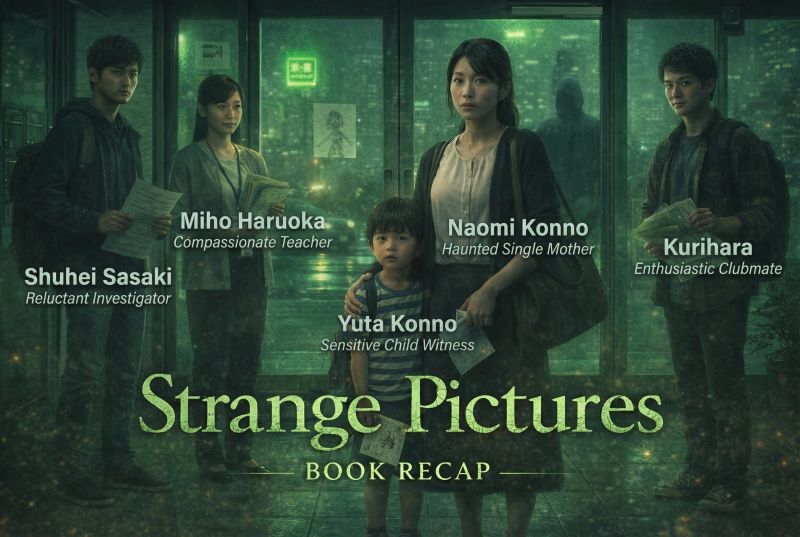
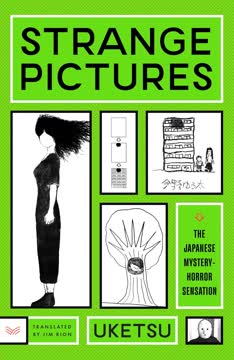

Plot Summary
Prologue
A psychology professor presents her students with a drawing by Little A, a girl arrested at eleven for killing her mother. She reads the image diagnostically: a smudged mouth betraying forced smiles under abuse, a doorless house signaling a craving for refuge, sharp thorns on a tree suggesting aggression.
But in the trunk of that thorny tree sits a small bird, safe in a hollow. This, the professor11 declares, reveals a powerful nurturing instinct — a desire to shelter the weak. With proper exposure to animals and small children, the girl's aggression could be softened. Her recommendation proved successful: Little A, she tells her class, is now living happily as a mother.
The Blog Called Raku
College student Sasaki,9 tipped off by his Paranormal Club friend Kurihara,8 opens a defunct blog at midnight. Written under the pen name Raku, it chronicles a man's life with his illustrator wife Yuki5 — their wedding anniversary, her pregnancy discovered on Christmas Day, months of anticipation shadowed by a breech baby that refuses to turn.
Days before the due date, Yuki5 draws five numbered pictures imagining the baby's future at different ages, each with a mysterious circled number she won't explain.
After a silence, Raku4 announces the baby was saved by emergency caesarean but Yuki5 died on the table. Then nothing for three years — until a final entry addressing the one he loves most, referencing the secret of three drawings, an unforgivable sin, and enduring love. Sasaki9 reads it repeatedly, unable to decode its meaning.
Three Drawings, One Death
Kurihara8 reveals what Sasaki9 missed: deleted entries spanning three years, a hidden third person Raku4 never named, medically reckless advice to deliver a breech baby naturally. The real horror lives in the illustrations. As a professional, Yuki5 used layer composition — numbered circles indicating each drawing's original scale.
Kurihara8 resizes drawings one through three, aligns the circles, and stacks them. The combined image: a woman's corpse sliced open, a baby pulled from a bloody abdominal wound, an old woman in white scrubs performing the extraction.
Yuki5 drew the scene of her own death by caesarean before it happened. Alone afterward, Sasaki9 layers the remaining two pictures. They form a father and child walking hand in hand — Yuki's5 quiet vision of the family continuing without her. He runs to tell Kurihara8 but cannot find him anywhere.
Yuta's Forbidden Pilgrimage
Almost six, Yuta Konno7 lives with his mama Naomi1 in a sixth-floor Tokyo apartment, his father Haruto4 three years dead. When the nursery class draws pictures of their mothers, Yuta7 produces their apartment building with his own unit smothered in grey.
His teacher Ms Haruoka10 investigates and discovers the scribble came first — drawn beneath the apartments to disguise something else. Yuta's7 classmate Miu13 recalls he started with a rectangle containing a small triangle. Ms Haruoka10 calls Naomi1 with an abuse theory, describing the shapes.
Naomi1 erupts in rage, but the description hands her the real answer: those shapes are the first strokes of a gravestone's kanji. The next morning, Yuta7 vanishes. Naomi1 finds him at a cemetery searching for a grave marked Yuki Konno5 — his birth mother, who died delivering him. Naomi1 is sixty-four: his grandmother, not his mother.
Naomi Opens the Door
For days, a car has trailed Naomi1 and Yuta7 through dark streets. A hooded figure in a grey coat has appeared outside their building, followed them up the stairwell, heard Yuta7 name their floor. Naomi1 has her own reasons for avoiding police.
The night after finding Yuta7 at the cemetery, the doorbell rings at ten. Through the peephole: the grey coat. She locks Yuta's7 bedroom, takes a knife from the kitchen, and calls out in false cheer. When the man steps inside, she drives the blade into his abdomen.
He barely resists, crumpling to the floor with one hand pressed to the wound. His hood falls back to reveal the wrinkled face of an old man — someone Naomi1 recognizes from decades ago but cannot place. Blood pools on the hallway linoleum. The chapter pivots from desperate self-defense to something far older.
An Art Teacher's Final Sketch
In 1995, nineteen-year-old Iwata3 works in newspaper administration despite longing to report. His boss Kumai,2 a former journalist sidelined by cancer, once led coverage of the case Iwata3 cares about most: the 1992 murder of art teacher Miura,6 his mentor who secretly sustained Iwata's3 impoverished family with daily bento lunches.
Miura6 was found on Mt K — with over two hundred injuries. His resentful friend Toyokawa12 was suspected but never arrested. Among the evidence: a crude mountain drawing on a receipt, its paper creased with fold lines.
Kumai2 shares the case files. Iwata3 visits his old school and meets Yuki Kameido,5 Miura's6 former student. A canvas pierced with guide-holes for a blind student triggers a breakthrough: the fold lines were not drawing guides but tactile landmarks for drawing without seeing one's hands.
Sunset Proves the Trick
On the anniversary, Iwata3 recreates Miura's6 hike with the same lunch from the same supermarket. He reaches the eighth station at five o'clock. When he faces west toward the mountains Miura6 drew so faithfully, he sees only a black silhouette — the setting sun backlights the entire range, erasing every detail.
Miura6 could not have seen what he sketched. The truth crystallizes overnight: Miura6 was killed at dawn, not dusk. The murderer force-fed him a fresh Hanayagi Bento to manipulate the stomach-content analysis.
The body was battered over two hundred times not from hatred but to destroy every alternate dating method — rigor mortis, blood settling, corneal opacity. The stolen sleeping bag hid evidence of an overnight stay. Every brutal detail was calibrated misdirection, and the drawing was Miura's6 proof that he survived until morning.
Iwata's Last Drawing
That night, Iwata's3 revised timeline clears both Toyokawa12 and Miura's wife,1 who had morning alibis. Only Yuki Kameido5 lacks one. But when he wakes in darkness, bound inside his sleeping bag by ropes, the voice sitting on his chest is wrong — older, harder than the young woman he suspects.
She mentions her husband's death and speaks the name Haruto:4 Miura's6 son. This is Miura's wife.1 She force-feeds Iwata3 blended bento through his pinched nose, then takes up a stone.
Before the end, Iwata3 teases a receipt and pencil from his pocket and draws mountains by touch, mimicking his mentor's method — leaving his own dying message. Days later, Toyokawa12 is found dead in a distant prefecture with a typed confession to both murders. Police close both cases.
The Grey Coat Unmasked
The old man bleeding on Naomi's1 hallway floor identifies himself as Kumai2 — the reporter who covered her husband Miura's6 murder over twenty years ago. He addresses her as Naomi Miura, her married name, then corrects himself: Konno, her maiden name.
He mentions Iwata,3 the young man under his mentorship who climbed that mountain and never came back. Before she can respond, a detective pushes through the doorway. Naomi Konno1 is arrested for attempted murder, with investigations reopening into cold cases.
The revelation cascades across every chapter: Raku the blogger's4 devoted mother, the grandmother raising Yuta7 in a sixth-floor apartment, the voice that killed Iwata3 in his sleeping bag, Miura's6 widow — all one woman whose three decades of violence share a single, consuming origin.
A Girl and Her Finch
In detention, Naomi's1 past unspools. A gentle father and an emotionally hollow mother. After her father's suicide from depression, her mother shattered into cruelty. Beatings began. Naomi's1 sole comfort was Cheepy, a pet finch her father had bought for her tenth birthday.
She cleaned house, forced smiles, endured — anything to survive. Then one afternoon, her mother seized Cheepy and began crushing him in her fist. Naomi1 begged on her knees, offered her own body for punishment. When the grip only tightened, something broke. She stomped on her mother's neck. A quiet crack.
Naomi1 sat cradling the surviving bird beside the corpse, weeping with relief. Six years in reformatory followed, where the psychologist from the prologue11 analyzed her drawing — the thorny tree sheltering a bird — and declared her fit for rehabilitation. Cheepy lived out his days in the facility, cared for by Naomi1 until the end.
Why Miura Drew Mountains
After reformatory, Naomi1 became a midwife, married art teacher Miura,6 and had a son named Haruto.4 The withdrawn boy became the target of his father's blunt discipline — forced outdoor trips, slaps for disobedience. The protective fury that saved Cheepy returned.
One September night in 1992, Naomi1 bound her sleeping husband in his bag, force-fed him bento to corrupt the autopsy timeline, and battered him beyond recognition. Miura's6 dying act confounded her: he drew the mountain view not to condemn his wife but to create a misleading timeline that would shield her.
He understood that if Naomi1 were caught, Haruto4 would have no parent. His friend Toyokawa,12 who witnessed the murder from the shadows, leveraged it into years of sexual blackmail. When reporter Iwata3 later reopened the case, Naomi1 killed him on the same mountain, then staged Toyokawa's12 suicide with a typed confession.
Fifteen Grams of Salt
Naomi1 fled to Tokyo with Haruto.4 Years later, the grown Haruto4 reunited by chance with Yuki Kameido5 — his father's former student, the woman he would marry and chronicle as Yuki in his blog. When Yuki5 became pregnant, a dark craving stirred in Naomi:1 not to recede into grandmotherhood but to be a mother again, central and needed.
Each morning she handed Yuki5 three capsules she called prenatal supplements. They contained only salt — fifteen grams daily, tripling the safe limit for a woman with high blood pressure.
As the senior midwife at Yuki's5 clinic, Naomi1 falsified her daughter-in-law's medical charts. During delivery, Yuki's5 blood pressure surged catastrophically. A vessel burst in her brain. The emergency caesarean saved baby Yuta.7 Yuki5 did not survive. Naomi1 resigned from the clinic and became, at last, the mother she ached to be.
Raku Signs Off
Yuki5 had known. About a week before the due date, she broke down sobbing for hours — likely the moment she grasped what Naomi1 was doing. But the method was too subtle to prove, and accusing her mother-in-law would mean exile from the only family she had.
So she hid her testament in art: five numbered drawings that, layered correctly, depicted an old woman in surgical scrubs pulling a baby from a sliced-open corpse. The old woman was Naomi.1 Three years after Yuki's5 death, Haruto4 cracked the code.
His final blog post addressed the one he loved most, naming an unforgivable sin and undying love in the same breath. The contradiction between these truths destroyed him. Unable to condemn his mother, unable to forgive her, Haruto4 hanged himself. Naomi1 found his body at dawn.
Kumai's Calculated Sacrifice
Kumai2 spent a decade pursuing the truth after Iwata's3 death. His crucial insight: both Miura6 and Iwata3 could have drawn the mountain view from memory in total darkness, meaning the murders could have happened at night — when only Naomi1 lacked an alibi.
The drawings left at both scenes benefited her alone, a woman with morning alibis who wanted investigators fixated on dawn. Diagnosed again with cancer at sixty-five, Kumai2 enlisted a detective friend and designed a trap. He stalked Naomi1 and Yuta7 for four days, counting on her protective violence to surface.
He deliberately removed the vest his partner demanded. Dr. Hagio,11 the psychologist from the prologue, saw the arrest on the news and re-examined her decades-old analysis with horror. Those thorns sheltering the bird in Naomi's childhood drawing had not existed despite the nurturing instinct. They were its instrument.
Noodles at the Barbecue
Recovering in his hospital bed, Kumai2 discovered his roommate — a young man with a broken leg — knew far more about the case than any civilian should. The college student had spent a year dissecting the blog after a clubmate's8 tip, and recognized Kumai's2 name from the news.
He offered a deal: the blog proving Naomi1 also killed her daughter-in-law, in exchange for Kumai's2 promise to undergo cancer surgery. He disclosed the pen name's secret — HARUTO KONNO4 rearranged into OH NO NOT RAKU. Kumai2 agreed. He began adopting Yuta.7
On a June afternoon, he brought the boy to a barbecue at the home of Yuta's7 nursery friend Miu.13 Her father,14 sensing Yuta7 did not care for meat, set a plate over the coals and stir-fried noodles instead. Yuta7 and Miu13 stood watching, expectant, the summer light warm on their faces.
Analysis
Strange Pictures operates as a literary nesting doll: each chapter's mystery — a blog, a child's drawing, a murder investigation — turns out to be a facet of one woman's pathological motherhood. Uketsu's structural innovation lies in making readers solve puzzles alongside characters, then retroactively recontextualizing every solution. The blog reader thinks he is decoding a ghost story. The nursery teacher thinks she is investigating abuse. The young reporter thinks he has caught a jealous friend. Each is wrong in ways that illuminate how perspective shapes — and distorts — understanding.
At its psychological core, the novel asks whether protective love can become indistinguishable from predation. Naomi1 kills her mother to save a finch, her husband to save her son, and her daughter-in-law to save her own identity as a mother. The motivation shifts from desperate defense to narcissistic possession, but Naomi1 herself cannot perceive the boundary. Dr. Hagio's11 misreading in the prologue — interpreting the thorns and the bird as separable qualities — becomes the book's deepest irony. They were never separate. Nurturing and destruction grew from the same root system.
The motif of drawings-as-testimony unifies the narrative. Yuki's layered death portrait, Miura's mountain sketch, Iwata's3 traced copy, Yuta's7 hidden gravestone, the prologue's diagnostic sketch — in each case, pictures communicate what words cannot, because the artist is dying, or a child, or trapped in a relationship where spoken truth is impossible. Uketsu suggests that visual expression operates below the threshold of conscious deception, revealing what the artist may not know they are revealing.
Most unsettling is the institutional critique. Every system Naomi1 navigates — juvenile justice, healthcare, law enforcement, prefectural police coordination — was designed to identify someone like her and failed. Her crimes succeed not because she evades these systems but because her violence is structurally identical to devotion. The barbecue ending offers warmth but no absolution: Yuta7 may grow up loved, but the cost was five lives and a generational inheritance of violence dressed as care.
Review Summary
Strange Pictures is a uniquely structured mystery novel combining text and illustrations. Readers praise its innovative format, intricate plot, and unexpected twists, comparing it to puzzle-solving. Many enjoy the psychological aspects and interconnected stories. Critics note simple prose and repetitive explanations, possibly due to translation. The book polarizes readers, with some finding it brilliant and others boring. Overall, it's seen as an entertaining, quick read that challenges readers to piece together clues and unravel a complex mystery.
Characters
Naomi Konno
Grandmother posing as mamaA sixty-four-year-old woman raising her grandson Yuta7 in a cramped Tokyo apartment, presenting herself as his mother. Naomi's childhood was forged in extremes: her father's suicide left her trapped with an abusive mother, shaping a psyche that equates love with protection at any cost. She carries her mother's beauty—pale skin, dark hair—and her own dread of inheriting that cruelty. A trained midwife, she understands birth and death as twin forces. Her relationship with motherhood is total: she needs the role the way lungs need air. Beneath warmth and domestic competence lies a mind that sorts the world into those who must be sheltered and those who threaten that shelter. Every decision she makes flows from one question: what would a mother do to keep her child safe?
Isamu Kumai
Tenacious retired reporterA sixty-five-year-old former reporter for a regional newspaper, reassigned to administration after cancer derailed his career. Kumai's identity was built on relentless pursuit—he earned the nickname The Fixer for extracting scoops from active investigations. Being forced off a story was the defining wound of his professional life, and guilt over what happened to his protégé3 deepened it into obsession. Lonely, unmarried, and childless, he has little reason to preserve himself beyond the work. His moral framework is transactional: information is currency, justice is measured in outcomes. Yet beneath the pragmatism lies genuine care for those damaged by the crimes he investigates—a care he struggles to express in any language other than action.
Shunsuke Iwata
Orphaned reporter with a debtA nineteen-year-old newspaper employee whose mentor, art teacher Miura6, secretly sustained him and his grandfather through poverty by bringing extra bento boxes every day. Orphaned by illness—his mother at eleven, his father at fifteen—Iwata channeled grief into a single ambition: becoming a reporter to investigate Miura's6 unsolved murder. He possesses sharp analytical instincts but is, as Kumai2 observes, too soft—his empathy and deference to social hierarchies make him hesitate where a seasoned reporter would push. His recreation of Miura's6 final day on the mountain is both memorial pilgrimage and investigative breakthrough. Iwata represents the idealist who believes truth-seeking is inherently redemptive, not yet understanding that the people guarding secrets can be as dangerous as the secrets themselves.
Haruto Konno
Son who never cut the cordNaomi's1 son and the blogger behind Oh No, not Raku—an anagram of his full name. Raised by a mother whose love was absolute and a father whose love was physical and demanding, Haruto grew into a withdrawn, gentle man who defers to Naomi1 in all things. Even as an adult, he does as his mother says—a loyalty so deep it resembles dependency more than devotion. His blog entries reveal warmth, humor, and genuine joy in domestic life with his wife Yuki5, documenting their pregnancy with infectious enthusiasm while currents move beneath the surface. The central tension of his character is the gap between the man Yuki's5 love is making him and the child Naomi's1 love has always kept him.
Yuki Kameido
Artist who sees too muchA talented illustrator who first appeared as Miura's6 devoted student, carrying complicated feelings into adulthood. After years of professional struggle and family estrangement, she reunites with Haruto4 and finds genuine love. Perceptive and resourceful, Yuki channels her artistic gift into the only form of communication available when words become impossible—coded pictures that tell truths she cannot speak aloud.
Yoshiharu Miura
Blunt teacher, hidden heartA high school art teacher universally disliked for his strictness yet quietly devoted to his students' welfare. He feeds an impoverished student's family with daily bento lunches and spends hours counseling troubled teenagers. His love for his son Haruto4 is genuine but expressed through discipline that puts him at odds with Naomi1. His artistic expertise and deep familiarity with the mountain landscape prove significant well beyond his lifetime.
Yuta Konno
A boy between two mothersAlmost six years old, Yuta is sensitive and artistic, quietly processing more than the adults around him realize. He carries a buried memory of visiting a grave with his father4 and an instruction never to mention his birth mother5. His discovery of his family name in kanji unlocks that memory and propels him on a journey no child should take alone. His emotional intelligence exceeds his years—he hides what he knows to protect the people he loves.
Kurihara
Puzzle-solving club analystSasaki's9 younger clubmate in the college Paranormal Club, Kurihara is deceptively sharp—he prints the entire blog, dissects its inconsistencies during his commute, and masters illustration layer composition to crack the drawing puzzle. His quiet obsession with the blog's mysteries outlasts his initial conversation with Sasaki9 and extends well beyond their time together.
Sasaki
Reader who enters the mazeA college senior consumed by job hunting who discovers the blog through Kurihara's8 tip. He serves as the audience's entry point into the mystery, experiencing the same dawning horror alongside the reader.
Miho Haruoka
Nursery teacher detectiveYuta's7 dedicated nursery teacher who notices his strange drawing and investigates with patience and intelligence. She switches between warmth and firmness as her class demands and cares deeply about each child. Her wrong conclusion about abuse reflects not incompetence but the limits of reading a child's inner world from outside—a theme the book explores repeatedly.
Dr. Tomiko Hagio
Psychologist who misreadA now-famous professor who analyzed young Naomi's1 drawing decades ago and declared her redeemable. Her initial assessment frames the book's central question about whether maternal love can ever be separated from the capacity for violence.
Nobuo Toyokawa
Jealous friend turned threatMiura's6 more talented art school classmate who resented needing help from a less gifted man. His envy and spite make him dangerous in ways that extend well beyond artistic rivalry, and his presence in the story links Miura's6 past to Naomi's1 escalating crimes.
Miu Yonezawa
Yuta's watchful classmateA precocious nursery school girl who monitors Yuta7 constantly and provides crucial eyewitness testimony about his drawing process. Her directness and emotional maturity exceed her years.
Mr. Yonezawa
The warm-hearted barbecue dadMiu's13 jovial father who stays upbeat despite his wife's cancer. He hosts the final barbecue, showing children that joy persists even alongside grief.
Plot Devices
Yuki's Five Layered Drawings
Coded death in layered artFive illustrations ostensibly depicting an unborn baby at different life stages, each numbered with a circled digit. They function on two levels: innocently, as a mother's hopeful imaginings; covertly, as a puzzle requiring professional illustration technique to decode. Using layer composition, drawings one through three combine into a single image when resized by matching their numbered circles and stacked: an old woman in surgical white extracting a baby from a dead mother's sliced-open body. Drawings four and five, layered separately, form a father and child walking hand in hand. The drawings drive the blog mystery, trigger one character's4 devastating discovery years later, and ultimately serve as evidence of a crime disguised as natural death.
Mountain Drawings on Receipts
Dying messages proving timeBoth murder victims on Mt K— drew the mountain scenery on supermarket receipts using paper folds as tactile guides, their hands working blind inside sleeping bags. The drawings initially appear to prove the victims survived until dawn—when the mountains are visible—contradicting the falsified time of death. The killer intentionally left the drawings at both scenes because they supported a dawn-murder theory that ironically cleared her, since she had morning alibis. The deeper truth, uncovered after a decade: both artists could draw the view from memory even in darkness, meaning the drawings prove nothing about when the murders occurred. The second victim's3 drawing, mimicking the first's6, is his own coded message: the real killer is whoever benefits from the pictures being left behind.
The Hanayagi Bento
Stomach-content time forgeryA signature lunch box from a station-front supermarket that serves as both a symbol of generosity and an instrument of concealment. The victim ate one daily and shared extras with an impoverished student3. The killer exploited this routine: by force-feeding a fresh bento to the already-captured victim, she manipulated the stomach-content analysis pathologists use to estimate time of death. The partially digested bento placed death roughly twelve hours before it actually occurred. The trick only worked because the body was so thoroughly destroyed that stomach contents became the sole viable dating method. The bento appears across three timelines: as an act of daily kindness, as forensic evidence in the investigation, and as a weapon during both killings.
Sleeping Bag Binding
Sleeping bag as weaponTying ropes around a sleeping bag while the victim sleeps immobilizes their arms and legs while leaving their hands free to move inside. This method allowed a small-framed killer to subdue adult men without a physical struggle. The paradox is central to the mystery: the victims were helpless yet able to retrieve pen and paper from their pockets and draw by touch alone. The technique explains both how the murders were physically possible and how the dying messages were created—connecting the method of killing to the method of testimony. Its discovery by the second victim3 becomes the moment he understands exactly who is killing him.
Naomi's Tree Drawing
Diagnosis that backfiresThe drawing analyzed in the prologue—a thorny tree protecting a small bird in its hollow—represents the killer's psyche as interpreted by a psychologist11. Initially read as evidence of dual nature (aggression plus nurturing love that could be separated and cultivated), it becomes the book's organizing metaphor. The final revelation inverts the reading entirely: the thorns exist specifically to protect the bird. The capacity for extreme violence is not opposed to maternal love—it is generated by it. Every killing springs from the same root as every tender act of care. The drawing appears at the beginning as hope and returns at the end as horror, the identical image meaning opposite things depending on what the viewer knows.
FAQ
Synopsis & Basic Details
What is Strange Pictures about?
- A Web of Secrets: Strange Pictures is a psychological mystery that unravels through seemingly disparate narratives, including a college student's investigation into a cryptic blog, a mother's desperate search for her missing son, and a reporter's quest to solve a cold case murder. At its heart, it explores how hidden truths and unspoken traumas manifest through art and shape the lives of multiple generations.
- Art as a Mirror: The story uses drawings and visual clues as central plot devices, from a psychologist's analysis of a child's aggressive yet nurturing artwork to layered narratives and hidden messages concealing a premonition of death, and a dying man's coded sketch. These "strange pictures" serve as both evidence and metaphor, reflecting the characters' deepest fears, desires, and hidden motives.
- The Cycle of Protection: Beneath the surface of its intricate puzzles, the novel delves into the complex and often destructive nature of maternal love. It examines how the fierce instinct to protect loved ones can twist into possessiveness, manipulation, and even murder, perpetuating a cycle of harm across families and generations.
Why should I read Strange Pictures?
- Intricate Puzzle Box Narrative: Readers who enjoy unraveling complex mysteries will be captivated by the novel's layered structure, where seemingly minor details and subtle artistic clues are meticulously placed to reveal shocking truths. The story constantly challenges the reader to interpret and connect the dots alongside the characters.
- Deep Psychological Exploration: Beyond the thrilling plot, Strange Pictures offers a profound look into the human psyche, particularly the dark corners of love, trauma, and obsession. It forces readers to confront uncomfortable questions about morality, the nature of evil, and the lengths to which people will go for those they cherish.
- Unique Blend of Horror and Mystery: Uketsu masterfully blends elements of psychological horror with a compelling detective narrative, creating an atmosphere of creeping dread and intellectual intrigue. The "sketch mystery" format is innovative, making the act of reading an interactive experience as you try to decipher the hidden meanings yourself.
What is the background of Strange Pictures?
- Japanese Cultural Context: The story is deeply embedded in contemporary Japanese society, touching on themes like the pressure of job hunting for college students, the challenges of single parenthood, and the cultural nuances of family dynamics and social expectations. The setting of a Tokyo apartment and a regional mountain provides a grounded backdrop for the unfolding mysteries.
- Psychological Theories of Art: The narrative draws heavily on the idea that art is a "mirror of the soul," referencing drawing tests used in psychology to analyze mental states. Dr. Hagio's initial analysis of "Little A's" drawing introduces the concept that even seemingly innocent artistic choices can reveal profound inner turmoil or hidden desires, setting a thematic precedent for the entire book.
- Evolution of Digital Communication: The blog "Oh No, not Raku!" serves as a crucial plot device, highlighting the early 21st-century phenomenon of personal online diaries. Kurihara's observation that "blogs... now almost seemed quaint" (Chapter One) grounds the story in a specific technological era, while also emphasizing how digital footprints can preserve secrets for years.
What are the most memorable quotes in Strange Pictures?
- "Painting is a mirror of the soul.": This quote from Dr. Hagio in the Prologue establishes the foundational premise of the entire novel, underscoring how visual art, even simple drawings, can offer profound insights into a person's mental state and hidden truths, driving the core mystery of Strange Pictures.
- "I cannot forgive you. But even so, I will always love you.": Haruto's final blog entry (Chapter One, and later The Final Chapter) encapsulates the agonizing conflict at the heart of his character and his relationship with Naomi. It reveals the devastating paradox of love intertwined with unforgivable betrayal, leading to his tragic end.
- "We've all got our skeletons in the closet.": Miu Yonezawa's surprisingly mature observation (Chapter Two) serves as a thematic anchor, acknowledging the universal presence of hidden pasts and unspoken burdens within families. It subtly foreshadows the deep, dark secrets that Naomi Konno has meticulously concealed throughout her life.
What writing style, narrative choices, and literary techniques does Uketsu use?
- Fragmented, Interlocking Narratives: Uketsu employs a non-linear, fragmented narrative structure, presenting different timelines and perspectives (Sasaki's blog investigation, Naomi's present-day struggles, Iwata's cold case review, Kumai's redemption arc). These seemingly disconnected threads gradually interlock, revealing a single, overarching story of crime and consequence, enhancing the mystery's complexity.
- "Sketch Mystery" Format: The author's signature technique involves integrating visual clues—drawings, diagrams, and their interpretations—directly into the narrative. This unique approach transforms the act of reading into an interactive puzzle, inviting readers to analyze the "strange pictures" alongside the characters and piece together the hidden meanings themselves.
- Subtle Foreshadowing and Psychological Realism: Uketsu excels at planting subtle hints and "throwaway lines" that gain immense significance later, such as Kurihara's observation about deleted blog entries or the specific details of Miura's Hanayagi Bento. This meticulous attention to detail, combined with a focus on characters' internal monologues and emotional states, creates a chilling sense of psychological realism and dread.
Hidden Details & Subtle Connections
What are some minor details that add significant meaning?
- The Seven-Piece Cake Anomaly: Kurihara's astute observation about the wedding anniversary cake (Chapter One) — Raku ate two, Yuki one, four left, totaling seven pieces from what should be an eight-piece cake — subtly introduces the concept of an "unseen third person" in their lives. This seemingly trivial detail foreshadows Naomi's pervasive, hidden influence on Haruto and Yuki, even before her direct involvement in their lives is revealed, hinting at a deeper, more insidious presence.
- Yuta's Stencil Ruler and Diamond: The detail of Yuta's favorite stencil ruler with its various shapes, particularly the diamond/rhombus (Chapter Two), connects directly to Ms. Haruoka's developmental psychology lecture about children drawing "ideas" rather than reality. Yuta's initial attempt to draw a gravestone, mistaken for a triangle, and his subsequent "erasure" with white crayon, symbolizes his subconscious processing of his birth mother's death and his father's secret, revealing a child's unique way of expressing profound trauma.
- The Hanayagi Bento's Daily Ritual: Miura's habit of buying the Hanayagi Bento daily and sharing it with Iwata (Chapter Three) is more than just a character quirk; it becomes a critical element in the murder plot. This specific detail allows the killer to convincingly fake the time of death by force-feeding Miura the familiar meal, highlighting how intimate knowledge of a victim's routine can be weaponized, and connecting Miura's kindness to Iwata with his ultimate demise.
What are some subtle foreshadowing and callbacks?
- "Little A" as Naomi's Echo: The Prologue's "Little A," an eleven-year-old girl who murdered her mother, is a direct, albeit initially unconfirmed, foreshadowing of Naomi Konno's past. Dr. Hagio's analysis of Little A's drawing — the thorny tree protecting a bird — is a powerful callback in the Final Chapter, where Hagio re-evaluates her diagnosis, realizing the "protection" could manifest as extreme aggression, directly linking Naomi's childhood trauma to her adult serial murders.
- The "Oh No, not Raku!" Anagram: The blog title itself, "Oh No, not Raku!" (Chapter One), is a clever anagram of "Haruto Konno," revealed by Kumai's hospital roommate (The Final Chapter). This subtle linguistic puzzle foreshadows Haruto's deep internal conflict and his ultimate self-destruction. It implies a hidden cry of despair within his very identity, a secret message from Haruto to himself about his inability to escape his mother's influence.
- Miura's "Self-Satisfied" Love: Miura's wife's description of him as "so self-satisfied. All 'I'm a good dad, devoted to my family'" (Chapter Three) subtly foreshadows Naomi's motive for his murder. This seemingly critical but not malicious observation highlights Miura's well-intentioned but overbearing parenting style, which Naomi perceives as a threat to Haruto, ultimately leading her to believe she must eliminate him to protect her son.
What are some unexpected character connections?
- Yuki Kameido's Dual Identity: The revelation that Yuki Kameido, Miura's art student and later Haruto's wife, is the same person (Chapter Three and The Final Chapter) creates a profound and tragic connection across the timelines. This unexpected link means that Naomi's second victim, Yuki, was not a stranger but a woman who had once admired Naomi's husband and later became her daughter-in-law, intensifying the personal betrayal and the cycle of violence.
- Kumai and Iwata's Shared Mentor: The bond between veteran reporter Kumai and young Shunsuke Iwata (Chapter Three) is deeper than a simple boss-employee relationship. Iwata's admiration for Miura, his former teacher, mirrors Kumai's own journalistic drive. Iwata's death, a direct consequence of his investigation into Miura's murder, fuels Kumai's guilt and transforms his professional pursuit into a personal quest for redemption, creating a powerful, tragic mentorship.
- Dr. Hagio's Unwitting Role: Dr. Tomiko Hagio, the psychologist from the Prologue, is revealed to have been Naomi's counselor at the juvenile reformatory (The Final Chapter). This connection is unexpected because Hagio's initial diagnosis of Naomi's "nurturing love" inadvertently set Naomi on a path to midwifery, a profession she later exploited to commit murder. Hagio's misjudgment highlights the profound and unforeseen consequences of early psychological assessments.
Who are the most significant supporting characters?
- Kurihara, the Catalyst for Discovery: Shuhei Sasaki's younger clubmate, Kurihara (Chapter One), is crucial as the initial source of the "Oh No, not Raku!" blog. His keen analytical skills and insistence on the blog's deeper strangeness ("There's something off about the whole story") push Sasaki to investigate further, ultimately leading to the deciphering of Yuki's layered drawings and the first major breakthrough in the overarching mystery.
- Ms. Haruoka, the Empathetic Observer: Yuta's nursery school teacher, Miho Haruoka (Chapter Two), plays a vital role in understanding Yuta's emotional state through his drawing. Her knowledge of child psychology and her empathetic questioning of Miu allow her to deduce Yuta's attempt to draw a gravestone, directly leading Naomi to find her son and revealing the existence of Yuki's grave.
- Keizo Kurata, the Trustworthy Ally: Detective Keizo Kurata (The Final Chapter) is essential to Kumai's plan to apprehend Naomi. Despite the coldness of the cases and Kumai's unorthodox request, Kurata's long-standing relationship with Kumai and his personal integrity lead him to agree to the dangerous sting operation, providing the necessary official support to finally bring Naomi to justice.
Psychological, Emotional, & Relational Analysis
What are some unspoken motivations of the characters?
- Naomi's Quest for "True" Motherhood: Beyond simply protecting Haruto, Naomi's deepest unspoken motivation is a desperate, almost pathological, need to validate her own identity as a "good mother" (The Final Chapter). Having been unloved by her own mother, she seeks to prove herself superior, leading her to eliminate anyone (Miura, Yuki) who she perceives as threatening her singular, idealized role in her son's life, or later, her grandson's.
- Haruto's Unbreakable Umbilical Cord: Haruto's "love" for Naomi, even after discovering her crimes, stems from an unspoken, deeply ingrained dependence. Naomi's suffocating care had prevented his emotional independence, leaving him unable to truly resent or break free from her (The Final Chapter). His suicide is not just despair, but a tragic inability to reconcile his mother's monstrous acts with the only source of unconditional love he had ever known.
- Yuki's Silent Acceptance of Fate: Yuki's decision to leave a coded message rather than directly confront Naomi about her murderous intent (The Final Chapter) suggests an unspoken resignation. Perhaps she understood the futility of confronting someone as manipulative and deeply entrenched in their self-justifications as Naomi, or perhaps she felt a sense of powerlessness due to her own "sin" (as Raku's blog implies), choosing to protect Haruto through a posthumous warning rather than a direct, potentially futile, confrontation.
What psychological complexities do the characters exhibit?
- Naomi's Justified Violence: Naomi exhibits a complex psychological profile where her violent acts are consistently rationalized as righteous "protection" (The Final Chapter). From killing her abusive mother to save her bird, to murdering her husband for Haruto, and Yuki for Yuta, she operates under a distorted moral compass where her love justifies any atrocity, demonstrating a profound lack of remorse for actions she deems necessary.
- Haruto's Cognitive Dissonance: Haruto's internal struggle, expressed in his final blog post ("I cannot forgive you. But even so, I will always love you"), showcases severe cognitive dissonance. He is unable to reconcile the image of his loving mother with the reality of her being a murderer, leading to an unbearable psychological conflict that ultimately drives him to suicide, highlighting the devastating impact of parental betrayal on a deeply dependent child.
- Kumai's Redemptive Obsession: Kumai's decision to risk his life to catch Naomi, despite his terminal cancer, reveals a complex mix of guilt, professional pride, and a desire for a meaningful end (The Final Chapter). His obsession with solving the case is not purely altruistic; it's a psychological quest for redemption, a need to surpass Iwata's legacy and prove his own worth as a journalist before his death, transforming his final act into a form of self-sacrifice.
What are the major emotional turning points?
- Naomi's Mother's Cruelty: The pivotal emotional turning point for young Naomi is witnessing her mother crush Cheepy, her beloved finch, while muttering, "That's what I'm hoping!" (The Final Chapter). This moment shatters Naomi's illusion of a happy family and her mother's love, triggering her first act of violence and cementing her belief that extreme measures are necessary to protect the vulnerable, setting her on a lifelong path of justified murder.
- Haruto Deciphers Yuki's Drawings: Haruto's emotional world collapses when he finally deciphers the "secret of those three drawings" (Chapter One, The Final Chapter), revealing Yuki's murder. This realization is the catalyst for his profound despair and suicide, as it forces him to confront the horrific truth about his mother and the woman he loved, creating an unbearable emotional chasm between his two most significant relationships.
- Kumai's Cancer Diagnosis and Iwata's Legacy: Kumai's terminal oesophageal cancer diagnosis (The Final Chapter) serves as a profound emotional turning point, shifting his perspective from professional obligation to a desperate, personal mission. His guilt over Iwata's death, combined with his own mortality, ignites a fierce determination to catch Naomi, transforming his final days into a quest for justice and personal redemption.
How do relationship dynamics evolve?
- Naomi and Haruto: From Nurturing to Suffocating: The relationship between Naomi and Haruto evolves from a deeply nurturing bond, where Naomi pours all her love into her son to escape her own trauma, into a suffocating dependency (The Final Chapter). Naomi's overprotective nature prevents Haruto's independence, leading him to remain emotionally tethered to her even as an adult, ultimately contributing to his inability to cope with her betrayal and his tragic suicide.
- Miura and Toyokawa: From Mentor/Apprentice to Bitter Rivalry: The dynamic between Yoshiharu Miura and Nobuo Toyokawa shifts dramatically from a master-apprentice relationship in art school to one of bitter resentment and rivalry (Chapter Three). Toyokawa's initial admiration curdles into hatred as he struggles professionally while Miura, whom he once tutored, thrives. This evolution of their relationship provides a strong, albeit initially hidden, motive for Toyokawa's desire to harm Miura.
- Kumai and the Police: From Adversarial to Collaborative: Kumai's relationship with the police, particularly Detective Kurata, evolves from the typical adversarial dynamic between a reporter and law enforcement to one of reluctant collaboration (The Final Chapter). His willingness to sacrifice himself to provoke Naomi into an attack, combined with Kurata's trust and empathy, allows them to bridge their professional divide and work together to achieve justice, highlighting the power of personal connection in a rigid system.
Interpretation & Debate
Which parts of the story remain ambiguous or open-ended?
- The Nature of Yuki's "Sin": Raku's final blog post mentions "whatever sin you committed" (Chapter One), implying Yuki had a dark past. While her connection to Miura as his student and her unrequited love are revealed, the specific "sin" that Raku refers to is never explicitly detailed or confirmed. This ambiguity leaves readers to debate whether it was a genuine transgression, a misinterpretation by Raku, or a narrative red herring designed to deepen the mystery around her character.
- **The Extent of Naomi
Download PDF
Download EPUB
.epub digital book format is ideal for reading ebooks on phones, tablets, and e-readers.








































