

Key Takeaways
Literary talent is common; the power to tell story is rare
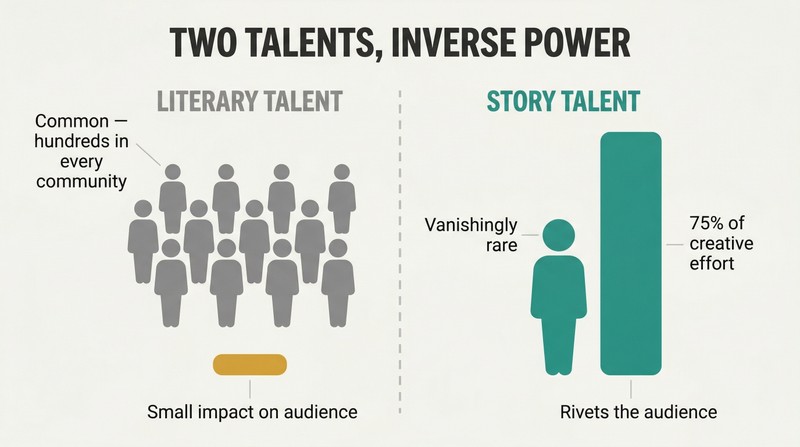
McKee separates two independent gifts. Literary talent — converting ordinary language into vivid, expressive prose — is relatively common. In every literate community, hundreds of people write beautifully. Story talent — the ability to transform life itself into a more powerful, meaningful experience through the design of events — is vanishingly rare. The two have no necessary connection.
Story design consumes 75% of creative effort. Who are these characters? What do they want? What stops them? What are the consequences? A script analyst never writes "Great story, terrible dialogue — pass." But they routinely pass on scripts with gorgeous language and anorexic plots. Helen at the coffee machine, spinning the story of getting her kids on the bus, rivets her coworkers. Her colleague tells of his mother's death and bores them senseless. The difference is story craft, not vocabulary.
Story lives in the gap between what characters expect and what happens
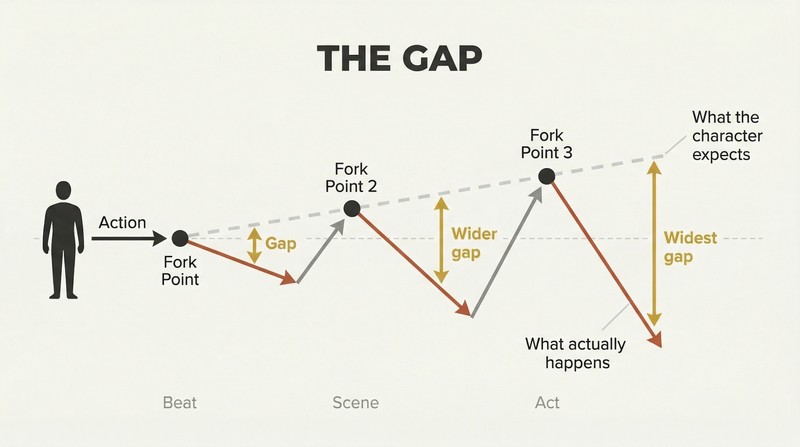
The Gap is McKee's central concept. When a character takes an action expecting a useful reaction from the world, the world instead reacts differently or more powerfully than anticipated. This breach between subjective expectation and objective result is where all narrative energy originates. A man calls a friend for a phone number — the friend screams and hangs up. Suddenly, life is interesting.
The gap recurs at every level of structure. The character, now at greater risk, must summon more willpower for a harder second action — which again provokes antagonism, opening another gap. This progression of expectation-shattering moments builds from beat to scene to sequence to act, generating the forward momentum that carries an audience through two hours without noticing time pass. Without the gap, there is activity but no drama.
Reveal character through choices under pressure, not description
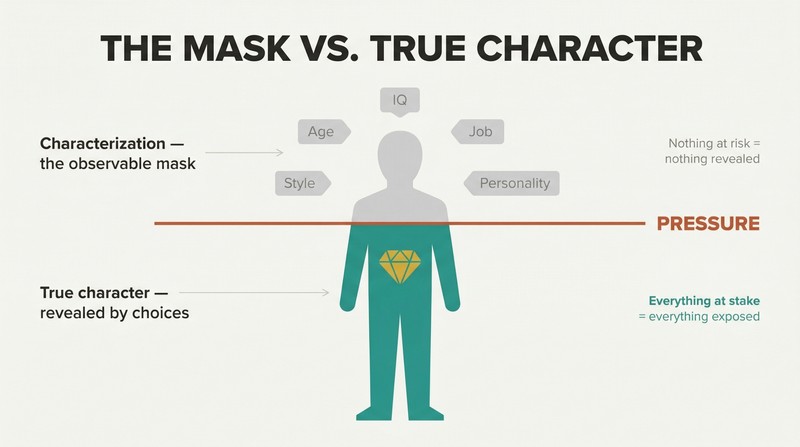
Characterization is the mask; true character hides behind it. Characterization includes everything observable — age, occupation, style, personality — the traits that make each person unique. But none of this reveals who someone truly is. A man who tells the truth when lying costs nothing reveals nothing. A man who insists on truth when a lie would save his life reveals everything.
Consider two drivers approaching a burning school bus. One is a shy, undocumented housekeeper; the other a wealthy neurosurgeon. Their characterizations couldn't be more different. But the fire strips away every surface distinction. Who stops? Who runs in? Who, with seconds left, reaches for which child? These choices under extreme pressure expose the deep humanity — or prejudice — beneath the mask, regardless of background, income, or education.
To fix a flat character, rewrite your plot — they're the same thing
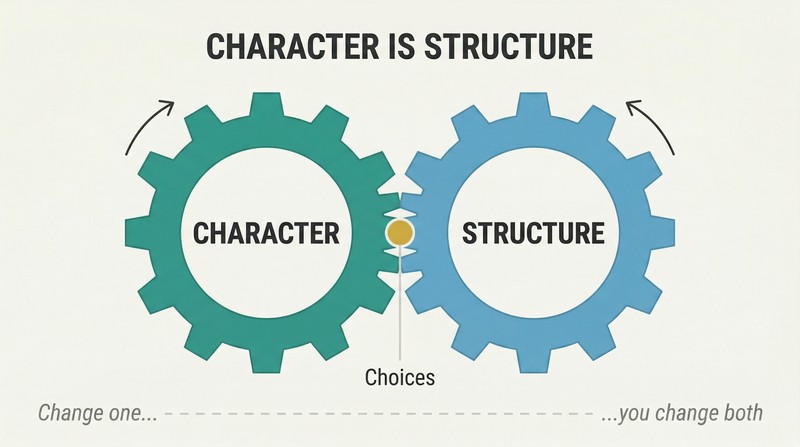
This is not a metaphor — it's a mechanical reality. If you change your event design so that in one draft the protagonist tells the truth but in the rewrite she lies, you have created a wholly different person, even though her job, wardrobe, and personality stay identical. Conversely, if you reimagine your protagonist from honest to deceptive, the entire plot must be rebuilt because a changed nature demands different choices, which demand different events.
The phrase "character-driven story" is redundant. All stories are character-driven, because events emerge from choices and choices reveal character. Writers who tinker with a protagonist's quirks — adding a fear of heights or a fondness for jazz — without reshaping the plot are decorating a mask, not constructing a human being. Change one, and you necessarily change the other.
Push antagonism past simple evil to make your protagonist grow
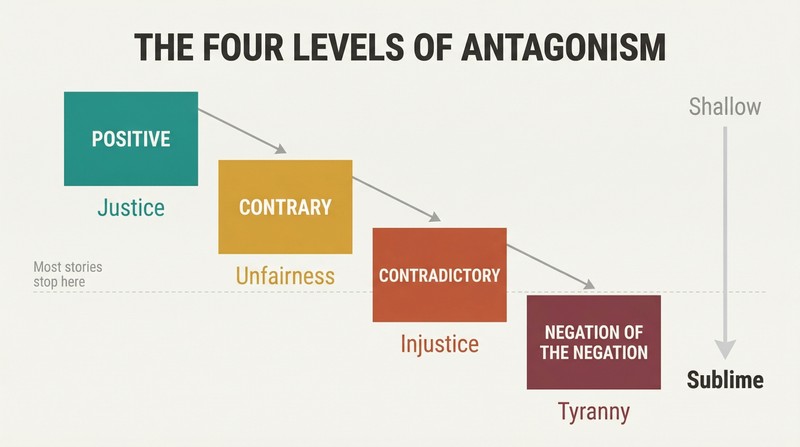
McKee calls this the Principle of Antagonism — the most important and least understood precept in story design. A protagonist facing weak opposition stays shallow. When antagonistic forces appear to outweigh the hero's capacity, the character must dig deeper.
Go beyond simple opposites with four gradations. McKee maps negativity through the positive value, its contrary (somewhat negative), its contradictory (fully opposite), and the Negation of the Negation — a compound negative that is qualitatively worse. Justice doesn't just face injustice (criminals breaking the law); at the end of the line it faces tyranny, where those who make the law commit crimes with impunity. In Chinatown, the sexual horror isn't incest — it's incest with the offspring of your own incest. Stories stopping at the contradictory feel adequate. Those reaching the Negation of the Negation become sublime.
Delete every scene where the value charge doesn't flip
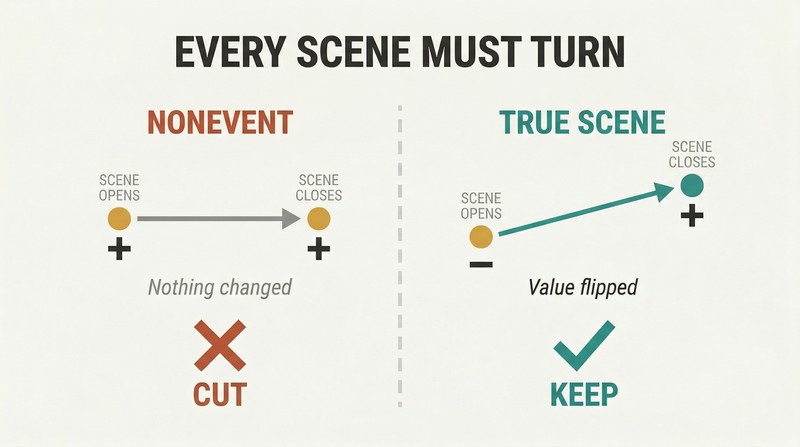
Test every scene ruthlessly. At the opening, note the value at stake — love, truth, freedom, safety — and its charge (positive or negative). At the scene's close, note it again. If the two are identical, the scene is a nonevent: characters talked and moved, but nothing changed. Its only justification is exposition. A disciplined writer trashes it and weaves the information elsewhere.
This principle applies across all genres. In Die Hard, values like freedom and justice flip through explosive action. In The Remains of the Day, interior values like self-awareness shift through the subtlest gestures. A scene where lovers argue from bedroom to kitchen to highway is one scene — not four — because the value only flips when one partner slams the car door and declares it over. Activity is not action. Action is change.
A smaller story world gives you more creative choices, not fewer
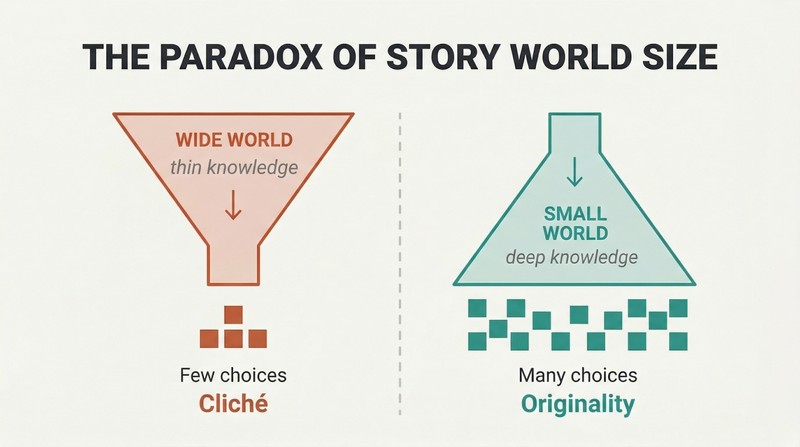
Constraint breeds originality. Dr. Strangelove uses three sets and eight characters to stage planetary nuclear annihilation. Crime and Punishment is microscopic. McKee argues the world of a story must be small enough for one mind to know it in godlike depth — every eating habit, September weather pattern, and social ritual.
This counterintuitive math is the weapon against cliché. When writers choose a vast canvas — "my setting is America" — knowledge thins, choices narrow, and they borrow from other films. A narrow canvas forces invention. A divorce in Louisiana, on Park Avenue, and on an Idaho potato farm are three entirely different movies. There is no such thing as a portable story. McKee adds: if you have writer's block, go to the library. Talent doesn't abandon you — ignorance starves it into a coma.
Force characters into dilemmas between irreconcilable goods
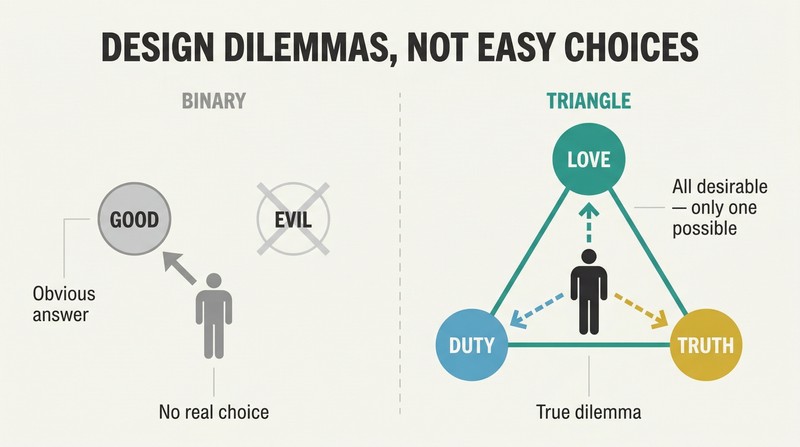
True choice is dilemma. From any character's subjective viewpoint, they always pick what they believe is right — even Attila the Hun. So good-versus-evil decisions are dramatically trivial. Genuine dilemma forces a choice between two desirable things you can't have simultaneously, or between two terrible options where you must accept one. These choices define character absolutely.
Design in triangles, not binaries. A two-sided conflict — she loves me, she loves me not — is repetitious and has no real ending. Add a third element (a rival, a competing desire, an impossible obligation) and you generate over twenty relationship variations, enough to progress without repetition. More importantly, triangular design brings closure: when the protagonist sacrifices one corner to claim another, the audience feels a true, irreversible choice has been made.
What characters say and do must hide what they actually think
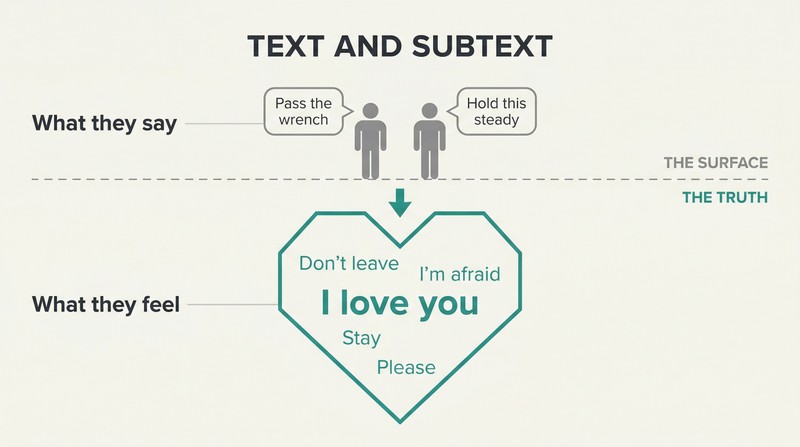
Every scene has a text and a subtext. The text is the sensory surface — what's said and done. The subtext is the life underneath — thoughts and feelings both known and unknown, hidden by behavior. McKee insists this isn't cynicism; it's the fundamental architecture of human interaction. We all wear public masks. If we said exactly what we were thinking, we'd be clinically insane.
Write the subtext, not the surface. Instead of a candlelit dinner where lovers say "I love you" and mean it — which is unactable because there's nothing for the actor to play — write two people changing a tire. Let all dialogue concern jacks and lug nuts. The actors bring the romance to life from within, and the audience sees through the surface to the truth. That discovery is the pleasure of storytelling.
Your climax needs a revolution in meaning, not an explosion
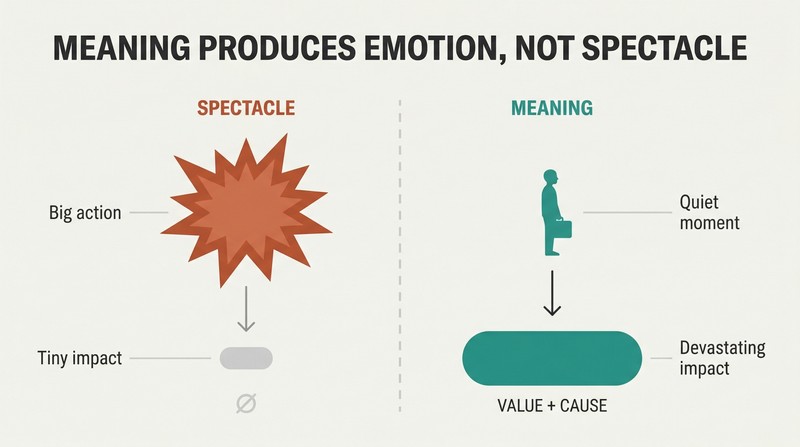
The Story Climax is your ultimate creative task. It must deliver a revolution in values — a swing from positive to negative or vice versa that is absolute and irreversible. In Ordinary People, the climax is a woman packing a suitcase and walking out a door — devastating because of the values that shatter behind her. The power comes from what changes, not how loudly it detonates.
Distill meaning with the Controlling Idea, a single sentence combining Value (the positive or negative charge at climax) plus Cause (why that value changed). Dirty Harry: "Justice triumphs because the protagonist is more violent than the criminals." Chinatown: "Evil triumphs because it's part of human nature." This sentence then guides every creative choice backward through the screenplay, ensuring unity from opening image to final frame.
Spend months on index cards before writing a line of dialogue
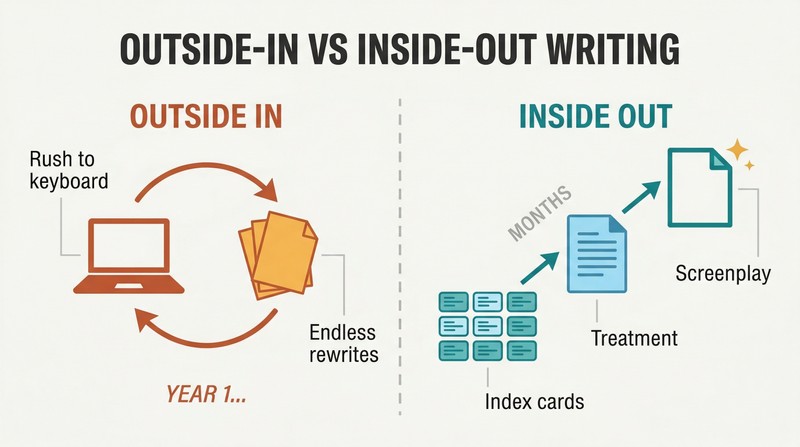
Successful writers work from the inside out. McKee contrasts two methods: writing from the outside in (rushing to the keyboard, clinging to favorite scenes through endless drafts) versus writing from the inside out (building a step-outline on three-by-five cards, expanding to treatment, then writing the screenplay). The outside-in writer often spends a year spinning wheels. The inside-out writer knows within weeks whether a story works.
The pitch test is ruthless and simple. Tell your story from your cards in ten minutes. Watch the listener's eyes. If they're hooked, curious, and moved at the end, proceed to a full scene-by-scene treatment of sixty to ninety pages before touching dialogue. Characters who've had tape over their mouths for months will produce dialogue that crackles with character-specific voice and subtext.
Analysis
Robert McKee's Story occupies a singular position in creative writing pedagogy: it is simultaneously a practical screenwriting manual, a work of narrative philosophy, and an implicit argument about the relationship between artistic form and human cognition. Published in 1997 but drawing on decades of teaching, the book derives principles of storytelling not from industry convention but from the deep structure of human perception and desire.
The book's most enduring contribution is the concept of 'the Gap '— the breach between a character's subjective expectation and objective reality — which McKee positions as both the substance and the energy of narrative. This is not merely a plotting technique; it is an epistemological claim about how humans process experience. We construct models of reality, act on them, and are shocked when reality refuses to cooperate. Story, in McKee's formulation, strips away the 99% of daily life where expectations meet results and concentrates on the 1% where they collide. This makes storytelling not an escape from reality but an intensified engagement with it.
The 'Negation of the Negation 'framework deserves particular attention as perhaps the book's most practical diagnostic tool. By mapping values through four gradations — positive, contrary, contradictory, and the double negative — McKee gives writers an instrument for identifying why stories feel adequate but never brilliant. It's the difference between a crime story ending with a criminal caught and one ending with the justice system itself revealed as criminal.
What makes Story controversial in some circles — its perceived prescriptivism — is precisely what makes it durable. McKee does not prescribe formulas; he articulates why certain narrative structures resonate across millennia and cultures, grounded in the architecture of consciousness itself. The book's greatest limitation is its near-exclusive focus on film, sometimes at the expense of acknowledging how digital, interactive, and serialized storytelling have since expanded the territory. Still, its core principles — pressure reveals character, constraint breeds originality, meaning produces emotion — remain as relevant to a podcast narrative or video game script as to a feature film.
Review Summary
Story receives mostly positive reviews for its comprehensive insights into storytelling principles, though some find it overly formulaic or verbose. Many praise McKee's analysis of story structure, character development, and screenwriting techniques as valuable for writers across mediums. The book is lauded for its practical advice and examples from films. However, a few reviewers criticize McKee's tone as arrogant or his approach as too prescriptive. Overall, it's considered an essential resource for aspiring writers, especially screenwriters.
People Also Read

Glossary
The Gap
Breach between expectation and resultThe fundamental mechanism of storytelling in McKee's framework. It is the split that opens between what a character subjectively expects to happen when they take an action and what objectively results. When the world reacts differently or more powerfully than anticipated, the gap creates surprise, curiosity, and emotional energy. It operates at every level of structure—within beats, scenes, sequences, and acts—and is what McKee identifies as both the substance and the energy of story.
Controlling Idea
Story's irreducible meaning sentenceA single sentence expressing a story's ultimate meaning through two components: Value (the positive or negative charge of life at the story's climax) plus Cause (the chief reason that value reached its final state). For example, 'Justice triumphs because the protagonist is more violent than the criminals.' McKee prefers this term over 'theme' because it implies a functional role—guiding the writer's strategic choices toward what is appropriate or inappropriate throughout the work.
Negation of the Negation
Compound negative beyond simple oppositesThe extreme limit of negative human experience in a story's value system, going qualitatively beyond the contradictory (the direct opposite of a positive value). If the positive value is justice, the contradictory is injustice (criminality), but the Negation of the Negation is tyranny—where those who make the law commit crimes with impunity. McKee argues that stories reaching this depth achieve greatness, while those stopping at the contradictory remain merely adequate. The concept applies across all values: love, truth, freedom, courage.
Archplot
Classical story design formMcKee's term for Classical Design, the dominant storytelling form across cultures and millennia. Features an active protagonist pursuing desire through primarily external conflict, in continuous time, within a causally connected reality, building to a closed ending of absolute, irreversible change. Positioned at the top of McKee's Story Triangle, it represents the narrative model that mirrors how most human beings perceive their own existence. Examples span from Casablanca to The Seven Samurai to Shine.
Miniplot
Minimalist reduction of classical designA set of story design variations that reduce or compress elements of Classical Design. Characteristics may include open endings, emphasis on internal rather than external conflict, passive or multiple protagonists, and subtler turning points. Miniplot does not mean 'no plot'—it requires equally careful craft. It strives for simplicity and economy while retaining enough classical structure to satisfy the audience. Examples include Tender Mercies, Paris Texas, and Pelle the Conqueror.
Antiplot
Contradicts classical story formsA set of story design variations that actively reverse Classical Design, contradicting traditional forms to exploit or ridicule formal principles. Features may include nonlinear time, coincidence replacing causality, and inconsistent realities where story rules are made to be broken. Positioned at the right corner of McKee's Story Triangle, Antiplot emerged primarily in post-World War II European cinema. Unlike Miniplot which shrinks the Archplot, Antiplot contradicts it. Examples include Weekend and After Hours.
Spine
Story's unifying desire-lineAlso called the Through-line or Super-objective, the Spine is the protagonist's deep desire to restore the balance of life disrupted by the Inciting Incident. It serves as the primary unifying force holding all story elements together—every scene, image, and word ultimately relates to this core of desire and action. If the protagonist has an unconscious desire, that deeper need becomes the Spine because it is always more powerful and durable than the conscious objective.
Inciting Incident
Event launching the protagonist's questThe first major event of the telling that radically upsets the balance of forces in the protagonist's life, swinging values sharply positive or negative. It arouses conscious desire (and sometimes unconscious desire) to restore balance, launches the Quest, raises the Major Dramatic Question in the audience's mind, and projects an image of the Obligatory Scene. It must occur onscreen for the Central Plot and typically falls within the first quarter of the telling. Example: the shark attack in Jaws.
Story Values
Polarized qualities driving story changeUniversal qualities of human experience that may shift from positive to negative or vice versa from one moment to the next. Examples: alive/dead, love/hate, freedom/slavery, truth/lie, courage/cowardice. These are not moralistic 'family values' but the broadest binary charges of experience. Every meaningful story event must be expressed and experienced in terms of a value changing its charge. They are what McKee calls 'the soul of storytelling'—the medium through which change becomes meaningful to an audience.
Image System
Subliminal recurring motif strategyA category of imagery embedded in a film that repeats in sight and sound from beginning to end with persistence and great variation, but with crucial subtlety, operating as subliminal communication to deepen aesthetic emotion. Must remain invisible to the conscious mind; the moment an audience recognizes a symbol as symbolic, its power is destroyed. Can use External Imagery (symbols carrying pre-existing cultural meaning) or Internal Imagery (symbols given entirely new meaning within the specific film). Example: water imagery in Les Diaboliques.
FAQ
What’s Story by Robert McKee about?
- Focus on Storytelling Principles: Story explores the art and craft of storytelling, with a particular emphasis on screenwriting. It highlights the importance of story structure, character development, and the emotional impact of narratives.
- Universal Themes: The book discusses how stories reflect universal human experiences and emotions, making them relatable across cultures and time periods. McKee argues that storytelling serves as a means to explore deeper truths about life.
- Crafting Compelling Narratives: McKee provides practical advice on creating engaging stories that resonate with audiences, focusing on principles rather than rigid formulas.
Why should I read Story by Robert McKee?
- Master Storytelling Techniques: The book equips writers with essential techniques to craft compelling narratives that captivate audiences. McKee's insights are invaluable for improving storytelling skills.
- Understanding Audience Expectations: It helps writers understand what audiences seek in stories, allowing them to create narratives that fulfill and surprise expectations, crucial for commercial success.
- Timeless Wisdom: McKee's principles are grounded in the history of storytelling, making them relevant for contemporary writers. His exploration of archetypes and universal themes provides a solid foundation for any aspiring storyteller.
What are the key takeaways of Story by Robert McKee?
- Principles Over Rules: McKee emphasizes that storytelling is about principles, not rules, encouraging creativity within a framework that has stood the test of time.
- Character and Structure Interconnection: The book highlights the inseparable relationship between character and structure, asserting that “structure is character; character is structure.”
- Importance of Conflict: Conflict is essential to storytelling, driving character development and plot progression. McKee notes that a story must build to a final action beyond which the audience cannot imagine another.
What is McKee's definition of story in Story?
- Story as a Sequence of Events: McKee defines story as a selection of events from a character's life composed into a strategic sequence to evoke specific emotions.
- Character-Centric: Events must be meaningful and directly related to the character's desires and conflicts, ensuring audience engagement.
- Emotional Resonance: A well-crafted story resonates emotionally with the audience, allowing them to connect with the characters and their experiences.
What are the main elements of story structure according to Story by Robert McKee?
- Events and Scenes: McKee breaks down story structure into events and scenes, where each scene must turn the value at stake in a character's life.
- Acts and Sequences: Scenes build into sequences, which then form acts, culminating in a story climax. Each act must create a significant change in the character's life.
- Character Arcs: Emphasizes the importance of character arcs, where characters undergo significant transformation throughout the story.
What is the significance of the Inciting Incident in Story by Robert McKee?
- Catalyst for Change: The inciting incident sets the story in motion, disrupting the protagonist's ordinary world and creating the story problem.
- Establishes Stakes: It establishes the stakes for the protagonist, making it clear what they stand to gain or lose, essential for audience engagement.
- Drives Conflict: Introduces the central conflict that will unfold throughout the story, shaping the character's decisions and actions.
How does McKee define conflict in Story?
- Three Levels of Conflict: McKee identifies inner conflict, personal conflict, and extra-personal conflict as essential for narrative progression.
- Conflict as a Driving Force: He emphasizes that nothing moves forward in a story except through conflict, underscoring its necessity.
- Creating Tension: Effective storytelling requires escalating conflict, which keeps the audience engaged and invested in the characters' journeys.
What is the Principle of Antagonism in Story by Robert McKee?
- Definition: The Principle of Antagonism states that a protagonist and their story can only be as compelling as the forces of antagonism make them.
- Character Depth: Complex antagonistic forces create multidimensional protagonists, essential for relatable characters.
- Conflict as a Driver: McKee argues that conflict is the engine of storytelling, and without significant antagonism, stories lack emotional resonance.
How does Story by Robert McKee address character development?
- True Character vs. Characterization: McKee distinguishes between observable traits and true character, revealed through choices under pressure.
- Desire as a Driving Force: Understanding a character's desires is crucial for development, as it drives the story forward.
- Conflict and Choice: Character development occurs through conflict and choices, revealing true nature and engaging the audience emotionally.
How does McKee suggest handling exposition in Story?
- Dramatize Exposition: Convert exposition into action, allowing characters to reveal necessary information through interactions.
- Pacing and Timing: Reveal key information at critical moments to maintain interest and build tension.
- Avoiding "California Scenes": Use natural, organic conversations to reveal character and backstory over time.
What are some best quotes from Story by Robert McKee and what do they mean?
- “Stories are equipment for living.”: Highlights the role stories play in helping individuals navigate life, providing frameworks for understanding experiences.
- “A story is about principles, not rules.”: Emphasizes that storytelling is guided by universal principles, encouraging writers to explore their unique voices.
- “Character is structure; structure is character.”: Underscores the interconnectedness of character and story structure, with well-developed characters driving the narrative.
About the Author
Download PDF
Download EPUB
.epub digital book format is ideal for reading ebooks on phones, tablets, and e-readers.








































