

Plot Summary
Undress First, Serpent King
Tem1 is a twenty-year-old chicken farmer's daughter in a village protected from basilisks by a mirrored wall. Every generation, girls born the same year as the prince enter the basilisks' caves to be sexually trained; one will become the prince's wife.
Tem's1 rival Vera4 mocks her inexperience relentlessly, but on the night of the training, Tem1 is the first girl brave enough to step forward. Instinct draws her to the farthest cave, where she meets Caspen2 — the legendary Serpent King, whose students are always chosen.
When he orders her to undress, she demands he go first. Astonished, he complies. They pleasure themselves in front of each other, finishing together. From his essence, he forges a smooth claw and slides it inside her — a tether that pulses whenever he thinks of her.
Ranked Last, Kissed First
At the castle, Tem1 meets Prince Leo3 over whiskey in his study. He's sharp-tongued and entitled, with gold-sheathed fangs and gray eyes that linger too long on the green silk dress Caspen2 sent her. When Leo3 holds a surprise elimination, he ranks girls on podiums by attractiveness and places Tem1 dead last. She storms after him and demands to know why.
He admits she was the most beautiful girl in the room — he ranked her last to punish her for refusing his compliment. Their adversarial chemistry intensifies through weeks of escalating encounters. At the next elimination, Leo3 kisses each remaining girl. Tem1 seizes him by the face and kisses him so fiercely the crowd falls silent. Leo3 places her on the first podium. The reversal is total.
The Serpent King Yields
Night after night, Caspen2 teaches Tem:1 anatomy, touch, how to stroke him, how to take him in her mouth. He shows her herself through his own eyes using their mental bond — extraordinary, wanted, flawless.
Yet he refuses to have sex with her, even as every other girl's basilisk has already crossed that line. When Tem1 confronts him, Caspen2 admits he's terrified of losing control — his true form craves her pain as much as his human form craves her pleasure. She tells him to try.
They consummate on his silk sheets, again and again, until her body gives out. Caspen2 bites her lip hard enough to draw blood, revealing the razor-thin margin between ecstasy and destruction. He forges a new claw from their combined fluids — something iridescent, binding them deeper.
Jonathan Turns to Stone
After Vera's4 ex-boyfriend Jonathan13 and his friend assault Tem1 in the forest — tearing her dress, grabbing her body — she knees Jonathan13 and flees to the caves. Caspen2 heals her bruises, takes her to his private chambers for the first time, and vows retaliation. Tem1 begs him to show mercy. He refuses.
The next night, two stone statues appear in the town square — Jonathan13 and his friend frozen in terrified postures, ringed by dried blood. Only Tem1 knows the truth. The petrification violates the centuries-old truce between basilisks and humans, and the villagers erupt in fury, chanting for the snakes to be driven from their caves. Tem1 realizes Caspen's2 possessive rage carries consequences far beyond settling a personal score.
Two Letters on a Tree
After a volatile Passing of the Crown ceremony — where Maximus7 hesitates before placing the golden crown on Leo's3 head and villagers riot onstage — Leo3 shows up at Tem's1 cottage. She asks him to take her somewhere impressive. He leads her to a graveyard bench beneath a willow tree carved with two initials: E and L. Evelyn14 and Leo.3
She was a fisherman's niece who talked to him rather than at him, the first person to listen. His father disapproved. They planned to run away together, but Evelyn14 never appeared. Leo3 still visits the bench most mornings, waiting. The confession cracks something open between them. Beneath the arrogance and the gold teeth, Tem1 sees a boy who lost someone — and never stopped looking.
The Necklace Was a Proposal
In his chambers, Caspen2 confesses that the golden claw necklace he gave Tem1 was not a gift — it was a marriage proposal, forged from his own blood transmuted into gold. Tem1 accepts immediately. But Caspen2 warns his quiver must approve, and the condition is a ritual: she must have sex with his father, Bastian,6 the true Serpent King, on an altar before the entire Drakon quiver.
It is the ancient way basilisks test whether a human deserves one of their own. Tem1 is horrified. Caspen2 is ashamed, insisting he would never demand it of her. But Tem1 understands the alternative: without the ritual, she will be dismissed as Caspen's2 pet — never his equal, never his queen. Slowly, her resolve begins to harden.
Gold Forged from Blood
Caspen2 leads Tem1 deep beneath the mountain to a towering memorial carved with hundreds of names — basilisks who vanished after the war. He reveals that the royals capture basilisks and bleed them through a process that transmutes their blood into gold. Every crown, every cuff, every gilded fork in the castle was purchased in agony.
The mysterious voice Tem1 has heard crying for help in the castle belongs to one of these prisoners. Caspen2 also explains the crest — a way basilisks extract power from humans through forced orgasm, binding them permanently. He confesses he crested a rival basilisk on his father's orders, killing the creature and paving the way for Bastian's6 rule. That creature was Rowe's8 father. Rowe8 wants revenge.
Kora's Hands Hold Everything
The auditorium houses an enormous statue of Kora, goddess of fertility. Tem1 mounts Bastian6 on the goddess's outstretched palms while hundreds of basilisks watch. She makes the king finish — a triumph that silences the room.
Then Caspen2 takes his place, and they perform together as proof of their bond. Afterward, they must have sex publicly in a suite until midnight. Hours in, Caspen2 begins transitioning involuntarily, his body scaling and ridging beyond what Tem's1 human frame can withstand. Her pelvis shatters.
She blacks out. When she wakes, Caspen2 has healed her body, but the memory is seared into them both — her broken screams, his helpless roar. Bastian6 grants his blessing. Tem1 has earned a place among the basilisks, the cost written invisibly on her bones.
Half Snake, Half Girl
Caspen2 rewrites Tem's1 entire life with a single confession. Her freckled palms — twelve on each hand, a pattern she has carried since birth — are a basilisk trait inherited from her father, Kronos,12 a basilisk imprisoned in the castle dungeon.
Tem1 is a hybreed: half human, half basilisk. It explains why she can communicate telepathically with Caspen,2 why she physically cannot lie, why roosters have always grated against her cells. Her mother11 fled the Seneca quiver when they refused to accept a human mate.
Now Bastian6 knows what Tem1 is, and he has plans: hybreeds can crest entire groups simultaneously without physical contact. He wants Tem1 to crest the royal family at Leo's3 wedding, transferring all their power to the basilisks in a single devastating act.
Caspen Screams Through Her Skull
Leo3 stays the night at Tem's1 cottage after drinking together at the village bar. They undress, touch each other intimately, and the instant Leo's3 body is about to join hers, Tem's1 mind detonates.
Caspen's2 consciousness crashes through their mental bond — not words but raw anguish, a montage of every intimate moment he and Tem1 have shared, weaponized into psychic agony so severe she screams and curls into herself. Leo3 holds her as she sobs, powerless to understand what just happened.
She tells him the truth: Caspen2 occupies her mind, always. Leo3 absorbs this with devastating calm and whispers that he will take whatever portion of her she can spare. They sleep tangled together, her cheek against his chest, the invisible line between her two worlds sharper than ever.
Tem Sheds Her Human Skin
Caspen2 takes Tem1 to a cavern lake deep beneath the mountain — a place where Kora herself is said to have bathed. He teaches her to transition by making love to her simultaneously, guiding her consciousness toward its hidden frequency.
She tries and fails, slamming against shackles of self-doubt. Then she lets go. Both halves of her fuse — human vulnerability and basilisk power combining into something neither species has witnessed in generations. For the first time, she sees Caspen2 in his true form: black scales refracting light like shattered prisms, ancient and magnificent.
They exchange pulses of staggering intensity, each climax feeding the other in an infinite loop. When they return to human form on the lakeshore, Tem1 understands she can never go back to who she was.
The Council Kneels
At the basilisk council meeting, Bastian6 proposes that Tem1 crest the royals at Leo's3 wedding. Caspen2 draws power from Tem's1 body in front of the council, their sexual connection dominating the room. The vote passes. Tem's1 conditions: Leo3 and his sister Lilly9 must be spared. Each council member honors her with a ritual kiss between her legs.
Rowe's8 kiss crosses a line — Caspen2 forces him to continue, then finish himself, as public humiliation. Days later, Caspen2 discovers Rowe8 ambushed Tem1 in a tunnel and tried to crest her. His retaliation is permanent: he rips off Rowe's8 cock, stripping the basilisk of the one currency his people value most. The act guarantees Rowe8 as a mortal enemy with nothing left to lose.
Adelaide's Quiet Verdict
Tem's1 telepathic connection with Caspen2 has been deteriorating for days — his voice fading, the corridor between their minds closing. She can lie now, easily, for the first time in her life. Terrified, she seeks out Adelaide,10 a basilisk who possesses rare knowledge of hybreeds.
Adelaide's10 diagnosis is devastating: when Caspen2 crested Tem,1 the crest bypassed her human half and targeted her basilisk half instead, which is now dying. Because their engagement is sealed by a blood bond — their lives literally linked — Caspen2 is dying too.
Tem1 has less than a week. If she can gain enough power through cresting others, she might heal herself and save them both. But she cannot tell Caspen.2 The guilt of knowing he caused this would destroy him before the bond does.
Leo Sees the Dungeons
Tem1 leads Leo3 down the castle stairs to the dungeon. He sees basilisks shackled to stone, golden wires fused to their fingers, their blood transmuted into the wealth his family wears on their wrists and in their mouths. At the final cell, she introduces her father Kronos12 — gaunt, chained, barely conscious.
She tells Leo3 everything: she is a hybreed, her mother11 loved a basilisk, the voice she heard crying through the castle walls was her own father. Leo3 goes pale. He touches his golden teeth. But instead of recoiling from Tem,1 he kisses her and vows to end the bloodletting. They return to his room and make love for the first time — tender and desperate and achingly human, a consummation earned through trust rather than seduction.
Basilisk Meets Prince
Tem1 arranges the impossible: she brings Leo3 to the caves to face Caspen.2 The two princes size each other up in the firelight — one who lives in gold stolen from the other's people. Caspen2 snarls that humans are easily satisfied. Leo3 fires back. Tem1 steps between them. Leo3 offers to cease bloodletting the moment he is crowned, in exchange for one thing: Tem,1 for however long his human life lasts.
Caspen2 does not consider Leo3 a threat — only a nuisance. He defers the choice to Tem.1 She looks at them both and says the only honest thing she can: she loves them both. The triangle crystallizes into an alliance. Leo3 proposes with his dead mother's silver ring. Tem1 accepts. The fragile arrangement holds.
The King Eats His Father
Before the harvest-moon ceremony, Bastian6 corners Tem1 and reveals his true design: after she crests the royals, he will crest her — killing her basilisk half and, through the blood bond, killing Caspen.2 He values power above his own son's life. The wedding proceeds.
Leo3 is crowned king. Then the basilisks attack. Bastian6 transitions mid-reception and drives his fangs into Tem's1 shoulder, shattering her collarbone and sternum, trying to weaken her human side to force the crest.
Caspen2 unleashes a fury beyond anything Tem1 has witnessed — he transitions and tears into his father's6 chest, consuming him alive in front of the screaming crowd. Bastian's6 mangled body hits the aisle. The remaining basilisks flee into the maze. The wedding is ruined. The war has begun and ended in one night.
Tem Sets the Prince Free
Tem1 is bleeding out on the stage, her basilisk half nearly extinguished. In desperation, she discovers she can crest herself — drawing power from her human side to heal her basilisk side, an act no one predicted a hybreed could perform.
Her bones knit; her power surges. But her human side weakens. Caspen2 begs her to crest Leo.3 She resists until Leo3 insists, offering himself willingly. The crest bonds him to her, his energy healing the last of her wounds.
Then Tem1 does the one thing worthy of such power: she orders Leo3 to find Evelyn14 and choose his own future. He smiles — peaceful, resigned, luminous — presses a final kiss to her temple, and walks into the night. Caspen2 and Tem1 remain. She places a golden claw around his neck, completing their bond.
Epilogue
Leo3 frees every imprisoned basilisk from the castle dungeon, personally reuniting Tem's parents1 — her father Kronos12 and her mother Daphne11 — after years of forced separation. He locks Maximus7 in the cell Kronos12 occupied and demands to know where Evelyn14 is.
His father admits he paid her to leave; she lives just one village over. Leo3 rides through the night, the ache in his chest sharpening with each mile between him and Tem.1 At dawn, he finds a girl beside a river, feeding the ducks, honey-blond hair catching the light exactly as he remembered. She looks up. She says his name.
Analysis
Kiss of the Basilisk interrogates the architecture of systems that claim ownership over women's bodies while disguising that ownership as honor, tradition, or love. Tem1 exists at the intersection of every power structure in her world — basilisk and human, prince and pauper, predator and prey — and the novel's central argument is that she should not have to choose between them. The hybreed is not a compromise between species; it is a refusal of the binary altogether.
The book's most incisive critique targets the way patriarchal power replicates itself across supposedly opposing cultures. Bastian6 and Maximus7 are mirror images: both demand obedience from their sons, both weaponize tradition to maintain control, both view women as instruments of ambition. The ritual and the bloodletting are structural twins — ceremonies that extract value from bodies deemed lesser. That both kingdoms practice their own version of bodily exploitation reveals that the war between species was never about difference but about who gets to extract and who must endure.
Tem's1 arc from village pariah to dual queen subverts the chosen-one narrative by centering agency above destiny. She does not fulfill a prophecy; she rewrites the terms of engagement entirely. Her most radical act is not the crest or the transition but the repeated insistence on consent — demanding Caspen2 ask before altering her emotions, refusing to undress on command, choosing Leo3 only when she is ready. In a world where sex is currency, power, and weapon, Tem's1 revolutionary contribution is treating it as something that must be freely given.
The love triangle functions as a thesis on holding contradictions. Caspen2 offers depth, danger, and spiritual completion; Leo3 offers candor, vulnerability, and human warmth. Tem's1 refusal to abandon either mirrors the hybreed's biological reality: she is not half of two things but fully both. The novel's ultimate lesson is that love need not be singular to be real, and that the bravest act is not choosing a side but insisting that sides need not exist.
Review Summary
Split or Swallow received polarizing reviews, with ratings ranging from 1 to 5 stars. Many readers found it addictive, praising its spicy content and unique premise involving basilisk shifters. Critics cited issues with pacing, character development, and repetitive scenes. Some appreciated the unhinged nature of the story, while others found it too long and lacking in plot. The main character, Tem, and her relationships with Caspen and Leo were particularly divisive. Overall, the book was described as a wild, smutty ride that left a lasting impression on readers.
Characters
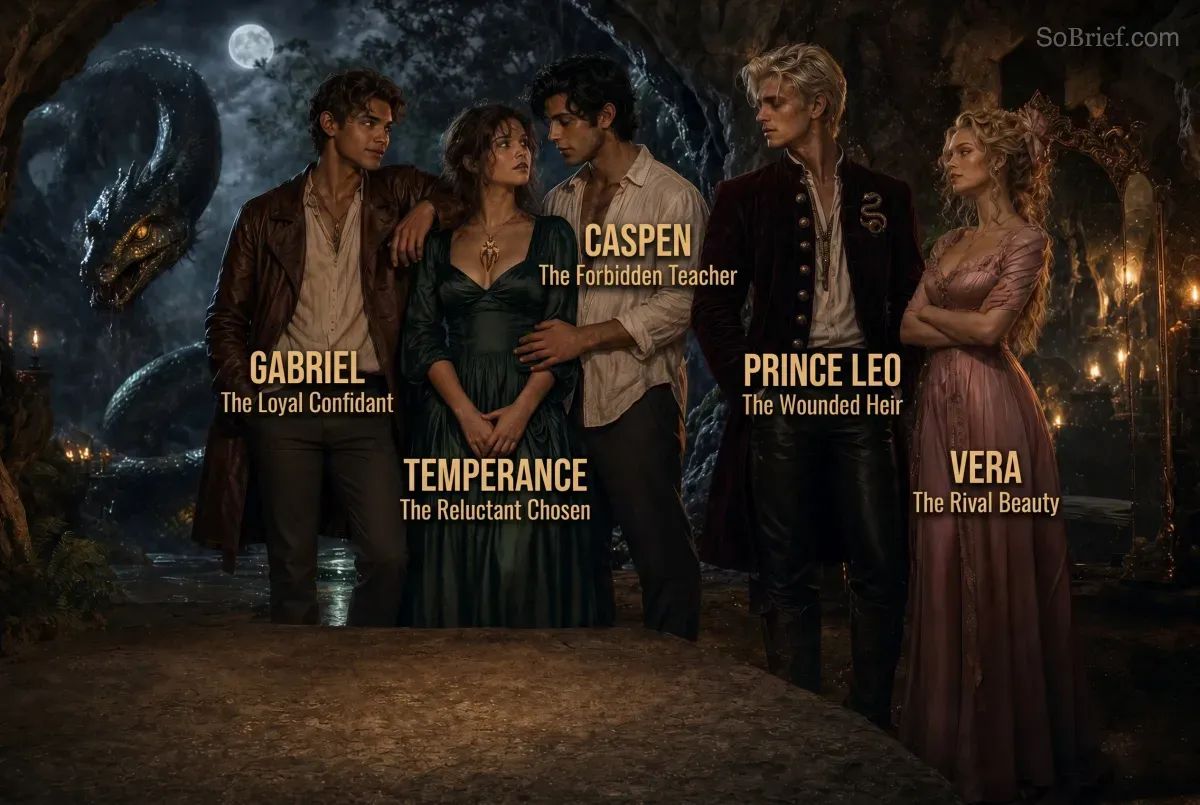
Tem
Chicken farmer's defiant daughterTemperance Verus is a twenty-year-old chicken farmer's daughter in a village where girls born the same year as the prince are trained by basilisks for a chance to become queen. Bullied mercilessly by peers for her poverty and fatherless upbringing, Tem carries profound insecurities about her worth—yet beneath them lies an iron stubbornness that refuses to yield. She is compulsively honest, headstrong, and governed by instinct rather than obedience. Her deepest need is to be perceived as extraordinary by someone who matters. Psychologically, her entire arc revolves around reclaiming agency in a world where every authority figure—teachers, kings, rivals—presumes to decide her fate. She refuses to be tamed, even by those she loves, and demands consent in every interaction as a form of quiet revolution.
Caspen
Basilisk prince and forbidden loverCaspenon Drakon is the basilisk assigned to train Tem1—a centuries-old creature whose students have been chosen by every generation's prince. Known among villagers as the Serpent King, he is devastatingly beautiful in human form and terrifyingly powerful in his true one. Caspen's psychology is defined by suppression: he wages constant internal war between the predator who craves Tem's1 pain and the man who only wants to protect her. He is secretive, possessive, and deeply afraid of vulnerability—traits born from a lifetime of obeying a ruthless father6. Behind his composed exterior lives someone who carries the guilt of past violence like a stone. His love for Tem1 is immediate, absolute, and ultimately the thing that makes him most dangerous—to her and to himself.
Leo
Human prince hiding a woundPrince Thelonius—Leo—is the twenty-year-old heir to the human throne, raised in suffocating privilege by a father7 he despises. With gold-sheathed incisors, sharp cheekbones, and a whiskey glass perpetually in hand, Leo masks genuine vulnerability behind relentless flirtation and cutting humor. He is shaped entirely by loss: his mother died giving birth to him, and his first love14 vanished without explanation. He craves what he cannot have—not from entitlement but from genuine need. Leo's defining trait is radical candor; unlike Caspen2, he never hides how he feels, weaponizing honesty the way others weaponize secrets. He always says the devastatingly right thing at the devastatingly right moment. His deepest fear is that loving Tem1 will end the same way loving Evelyn14 did.
Vera
Village bully and rivalVera is a baker's daughter whose pink ribbons and surgical cruelty have made her the village's unofficial queen of gossip. She torments Tem1 with precision, targeting her poverty and inexperience. Yet beneath her confidence lies insecurity—she clings to boyfriends, competes ferociously for the prince, and crumbles when control slips from her manicured fingers. She functions as Tem's1 dark mirror: everything society rewards and Tem1 refuses to become.
Gabriel
Tem's loyal best friendGabriel is Tem's1 closest friend—six chaotic feet of leather jackets, broken serving platters, and unshakeable loyalty. Gay and unapologetic, he works as a castle dishwasher with unlimited access to stable boys. Gabriel provides Tem's1 only true sanctuary: humor without judgment, affection without conditions. He protects her at personal risk and never once doubts she deserves everything she is fighting for.
Bastian
The true Serpent KingBastian is Caspen's2 father and ruler of the Drakon quiver—the actual Serpent King. An ancient basilisk of terrifying power, he views every relationship as transactional and every person as a tool for advancement. He demands absolute obedience from his family and punishes disloyalty with devastating precision. His charisma is a veneer over ruthless ambition, and he wields tradition and ritual as instruments of control rather than community.
Maximus
Leo's controlling father-kingKing Maximus is Leo's3 father—an imperious patriarch who measures worth exclusively by bloodline and obedience. He belittles Tem1 at every encounter and has systematically undermined Leo's3 attempts at independence throughout his life. His relationship with his son is defined by contempt disguised as duty. He presides over dark practices within the castle with cold pragmatism and considers any deviation from tradition a personal affront.
Rowe
Caspen's vengeful rival basiliskRowe Seneca is Vera's4 basilisk teacher and Caspen's2 most dangerous adversary. His father was killed at Bastian's6 command, and Rowe's hatred is personal, generational, and volcanic. He views Tem1 as an abomination and repeatedly attempts to use her as a weapon against Caspen2. Rowe represents the cycle of violence the basilisk world perpetuates—revenge begetting revenge, with no king merciful enough to break it.
Lilly
Leo's warmhearted older sisterPrincess Lilibet—Lilly—is the first royal Tem1 meets and the only one who greets her with genuine warmth. Champagne-sipping and refreshingly irreverent, Lilly sees through her brother's3 bravado immediately. Her casual observation that Leo3 always wants what he cannot have becomes the key to understanding his entire psychology.
Adelaide
Basilisk with hybreed knowledgeAdelaide is a female basilisk from the Seneca quiver whose family history includes rare knowledge of hybreeds. Beautiful and pragmatic, she provides crucial information about Tem's1 condition when no one else can.
Tem's mother
Secret-keeping chicken farmerTem's1 mother is a quietly resilient woman who raised her daughter alone on a farm surrounded by roosters—the one creature that can kill a basilisk. She carries a profound secret about Tem's1 origins for twenty years, sacrificing her own truth to shield her child from danger. Her relationship with Tem1 is defined by fierce love expressed through pragmatism rather than tenderness.
Kronos
Imprisoned basilisk fatherKronos is a basilisk imprisoned beneath the castle, weakened by years of bloodletting. His freckled palms carry a rare pattern, and his faint telepathic cries echo through the castle walls to anyone capable of hearing them.
Jonathan
Vera's boyfriend turned assailantJonathan is Vera's4 on-again-off-again boyfriend who assaults Tem1 in the forest, an act that triggers lethal retaliation and shatters the truce between species.
Evelyn
Leo's vanished first loveEvelyn is the fisherman's niece Leo3 fell in love with before the training began. Her unexplained disappearance haunts him daily and shapes his approach to every relationship that follows.
Plot Devices
The Claw
Intimate psychic tetherForged from Caspen's2 essence through basilisk magic, the claw sits inside Tem's1 body and connects them across any distance. When Caspen2 thinks of her, it pulses—sometimes gently, sometimes so intensely it brings her to climax in church pews, bakery counters, or her childhood bed. The device evolves: the first claw is made from Caspen2 alone; the second is forged from both their fluids, symbolizing their deepening union. Caspen2 can also speak directly into Tem's1 mind through it. The claw functions as both a romantic tether and a mechanism of control—Tem1 carries a piece of her lover inside her at all times, whether she wants to or not. Its presence or absence marks the state of their bond throughout the story.
The Mirrored Wall
False fortress of safetyA twelve-foot wooden wall encircles the entire village, sheathed on the outside in mirrors. Basilisks in their true form die upon seeing their own reflection, making the wall an effective barrier after the ancient war. However, basilisks in human form can pass through freely—rendering the wall psychologically reassuring but practically useless. The wall represents the false security the villagers maintain and the broader illusion that the centuries-old truce keeps them safe. It also quietly demonstrates a truth the humans refuse to acknowledge: the basilisks choose to remain outside the wall, not because they must, but because they honor an agreement the humans have already broken underground.
The Blood Bond
Engagement sealed by mortalityWhen Caspen2 forged the golden claw necklace from his own blood and placed it around Tem's1 neck, he did not merely propose—he bound their lives together permanently through ancient magic. If either dies, the other dies too. This transforms a romantic gesture into a mutual hostage situation, raising the stakes of every danger Tem1 faces. The bond becomes the central mechanism through which external threats can target Caspen2 indirectly: any force that harms Tem's1 fundamental nature ripples through their shared lifeline. It is both the deepest expression of Caspen's2 devotion and, potentially, the instrument of his destruction.
The Crest
Power through forced pleasureA basilisk ability that extracts power from humans by inducing involuntary orgasm through physical contact. The crested person is permanently bonded to the basilisk, compelled to obey and even sacrifice themselves for their master. For basilisks, being crested is fatal—it is an act forbidden among their own kind. Caspen's2 venom can protect against it. The crest serves as both weapon and currency in basilisk politics: it is how thrones are seized, rivals eliminated, and hierarchies enforced. It represents the book's central tension between pleasure and power, consent and coercion—the question of whether something that feels good can still be a violation.
Bloodletting
Gold harvested from captive basilisksThe royals' hidden source of wealth. Basilisks are imprisoned in the castle dungeon with metal wires fused to their fingers that transmute their blood into gold. Every golden object in the castle—Leo's3 tapered teeth, Maximus's7 cuff, the flecked marble floors, even the engagement jewelry of past queens—represents generations of basilisk suffering. The bloodletting functions as the story's original sin: the atrocity that makes genuine peace between species impossible and the discovery that ultimately forces Leo3 to choose between his inheritance and his conscience. It reframes every piece of royal opulence the reader has already encountered as evidence of a crime.
FAQ
Synopsis & Basic Details
What is Split or Swallow about?
- Synopsis focuses on Tem's journey: The story follows Temperance "Tem" Verus, a young woman in a world where humans and basilisks coexist uneasily, as she navigates the basilisk training to become the prince's wife, grappling with societal expectations, personal desires, and a growing connection with the enigmatic Serpent King, Caspen.
- Exploration of power dynamics: The novel explores the complex power dynamics between humans and basilisks, men and women, and individuals and society, as Tem challenges traditional roles and seeks to define her own destiny.
- Themes of identity and self-discovery: At its core, Split or Swallow is a coming-of-age story about Tem's journey of self-discovery, as she confronts her insecurities, embraces her sexuality, and learns to wield her own power in a world that seeks to control her.
Why should I read Split or Swallow?
- Unique blend of genres: The novel offers a fresh and unconventional reading experience, blending elements of fantasy, romance, and erotica with a feminist perspective, creating a story that is both thought-provoking and entertaining.
- Complex and compelling characters: The characters in Split or Swallow are richly developed and morally ambiguous, challenging readers to question their own assumptions and biases. Tem's journey is particularly compelling, as she grapples with her identity and desires in a world that seeks to define her.
- Exploration of relevant themes: The novel tackles important themes such as power, control, and self-acceptance, offering a nuanced perspective on the human condition and the challenges of navigating a complex world.
What is the background of Split or Swallow?
- Fantasy setting with historical echoes: The story is set in a fictional world with a history of conflict between humans and basilisks, drawing parallels to real-world historical and political tensions. The mirrored wall serves as a physical manifestation of the divide between the two groups, reflecting their mutual distrust and fear.
- Cultural context of arranged marriage: The basilisk training and the prince's selection of a wife reflect the cultural context of arranged marriage and the societal pressures on young women to conform to specific roles and expectations.
- Mythological and symbolic elements: The novel incorporates mythological elements, such as the basilisk, and symbolic imagery, such as the mirror, to enhance the story's themes and create a rich and immersive world.
What are the most memorable quotes in Split or Swallow?
- "You'll never guess what happened to me last night," Vera whispered. This quote, which opens the first chapter, immediately establishes the tone of gossip, secrets, and sexual tension that permeates the story. It foreshadows the importance of female relationships and the challenges Tem faces in navigating social expectations.
- "After all, who would want a girl who tastes like chicken shit?" This cruel insult, delivered by Vera, encapsulates Tem's deep-seated insecurities and the societal pressures she faces as a farm girl. It highlights the class divisions within the village and the ways in which women are often pitted against each other.
- "All journeys begin with a step, Tem." Caspen's words of encouragement, spoken during Tem's initial hesitation, serve as a recurring motif throughout the story, reminding her to embrace the unknown and trust in her own abilities. It encapsulates the theme of self-discovery and the importance of taking risks.
What writing style, narrative choices, and literary techniques does Lindsay Straube use?
- First-person perspective: The story is told from Tem's point of view, allowing readers to intimately experience her thoughts, feelings, and perceptions. This creates a strong sense of empathy for Tem and allows for a nuanced exploration of her internal conflicts.
- Descriptive and evocative language: Straube uses vivid and sensual language to create a rich and immersive world, particularly in her descriptions of the basilisk training and the physical interactions between characters. This enhances the reader's emotional experience and brings the story to life.
- Foreshadowing and symbolism: The novel employs subtle foreshadowing and symbolic imagery to create a sense of mystery and intrigue. Recurring motifs, such as the mirror and the color gold, add layers of meaning to the story and enhance its thematic resonance.
Hidden Details & Subtle Connections
What are some minor details that add significant meaning?
- Freckles as a connection: Tem's freckles, described as "holding the stars," are a recurring detail that connects her to her absent father and hints at a hidden destiny. This seemingly minor physical trait becomes a symbol of her unique heritage and potential.
- The ylang ylang and sandalwood oils: The specific choice of oils Tem's mother applies before the training is significant. Ylang ylang is associated with confidence and sensuality, while sandalwood is known for its grounding and calming properties. This combination reflects Tem's need for both courage and composure as she enters the unknown.
- The gold and black color scheme: The recurring use of gold and black, particularly in the castle, symbolizes the power dynamics and moral ambiguities of the world. Gold represents wealth, status, and the corrupting influence of power, while black represents the darkness, secrets, and hidden dangers that lurk beneath the surface.
What are some subtle foreshadowing and callbacks?
- The dream of fire: Tem's dream of being warmed by fire foreshadows her connection with Caspen, whose presence is often associated with warmth and heat. The dream also hints at her latent basilisk nature, as fire is a common symbol of transformation and power.
- Vera's under-the-bridge encounter: Vera's initial story about her encounter under the bridge foreshadows Tem's later sexual awakening and her own experiences with intimacy. It also highlights the contrast between Vera's performative sexuality and Tem's more genuine and introspective approach.
- The rooster and the snake: The royal insignia depicting a rooster dueling with a snake is a constant reminder of the historical conflict between humans and basilisks. It foreshadows the ongoing tensions and the potential for renewed violence, as well as the inherent power dynamics at play.
What are some unexpected character connections?
- Caspen and Kronos's relationship: The revelation that Caspen is the son of the Serpent King adds another layer of complexity to their relationship. It highlights the burden of legacy and the challenges of defying familial expectations.
- Tem and Evelyn's shared experience: The parallel between Tem and Evelyn, both women who captured the prince's heart but were ultimately deemed unsuitable by the royal family, underscores the societal pressures and limitations placed on women.
- Tem and Leo's connection through loss: The shared experience of losing a parent creates a subtle connection between Tem and Leo, despite their opposing allegiances. This connection highlights the humanizing aspects of grief and the potential for empathy even between enemies.
Who are the most significant supporting characters?
- Gabriel as confidant and protector: Gabriel serves as Tem's closest friend and confidant, offering unwavering support and a much-needed dose of humor. His loyalty and protectiveness toward Tem make him a valuable ally in a world that often feels hostile.
- Tem's mother as a figure of both support and constraint: Tem's mother, while loving and supportive, also represents the societal expectations and limitations that Tem is trying to overcome. Her past experiences and her desire for Tem to succeed create a complex dynamic that shapes Tem's decisions.
- Lilly as an unexpected ally: Princess Lilibet provides Tem with valuable insights into the royal family and the inner workings of the court. Her rebellious spirit and her willingness to defy expectations make her an unexpected ally in Tem's journey.
Psychological, Emotional, & Relational Analysis
What are some unspoken motivations of the characters?
- Caspen's desire for connection: Despite his stoic demeanor, Caspen is driven by a deep-seated desire for connection and acceptance. His willingness to defy societal norms and risk his own safety for Tem reveals his longing for a love that transcends the boundaries of his basilisk identity.
- Leo's need for validation: Leo's actions are often motivated by a need for validation and approval, particularly from his father. His pursuit of Tem is partly driven by a desire to rebel against his father's expectations and assert his own autonomy.
- Bastian's fear of losing power: Bastian's ruthlessness and his willingness to sacrifice his own son stem from a deep-seated fear of losing power and control. His actions are driven by a desire to maintain his position as the Serpent King and ensure the dominance of the basilisk society.
What psychological complexities do the characters exhibit?
- Tem's imposter syndrome: Tem struggles with feelings of inadequacy and self-doubt, constantly questioning her worthiness and her ability to succeed. This imposter syndrome stems from her low social standing and her lack of experience, creating a constant internal conflict.
- Caspen's internal conflict: Caspen grapples with the tension between his duty to his people and his love for Tem. His internal conflict is evident in his attempts to control his emotions and maintain a stoic facade, even as his actions reveal his deep affection for Tem.
- Leo's daddy issues: Leo's relationship with his father is fraught with tension and resentment. His desire to rebel against Maximus's expectations and assert his own autonomy drives many of his actions, creating a complex and often self-destructive pattern of behavior.
What are the major emotional turning points?
- Tem's first orgasm with Caspen: This experience marks a turning point in Tem's understanding of her own sexuality and her ability to experience pleasure. It empowers her and gives her a newfound sense of confidence.
- The revelation of Tem's Hybreed identity: This revelation shatters Tem's sense of self and forces her to confront the complexities of her identity. It is a moment of profound emotional upheaval that sets her on a new path of self-discovery.
- Caspen's confession of love: Caspen's declaration of love is a pivotal moment in their relationship, solidifying their bond and creating a sense of hope for a future together. However, it also comes with the realization of the sacrifices they must make to be together.
How do relationship dynamics evolve?
- Tem and Caspen's power shift: The power dynamic between Tem and Caspen shifts throughout the story, as Tem gradually asserts her autonomy and challenges his authority. Their relationship evolves from one of student and teacher to one of equals, marked by mutual respect and a shared desire for connection.
- Tem and Leo's push and pull: The relationship between Tem and Leo is characterized by a constant push and pull, as they grapple with their feelings for each other and the expectations placed upon them. Their connection is marked by both tenderness and conflict, as they navigate the complexities of their respective positions in society.
- Caspen and Bastian's strained relationship: The relationship between Caspen and Bastian is fraught with tension and resentment, stemming from their differing views on the future of the basilisk society and their conflicting desires for power. Their interactions are marked by subtle power plays and veiled threats, highlighting the deep-seated conflict between father and son.
Interpretation & Debate
Which parts of the story remain ambiguous or open-ended?
- The true nature of Kora: The role and influence of Kora, the goddess of fertility, remains ambiguous throughout the story. While the villagers pray to her and attribute the success of the training to her benevolence, her actual presence and power are never explicitly confirmed.
- The long-term consequences of the ending: The ending of the story, while hopeful, leaves the long-term consequences of Tem and Caspen's actions open to interpretation. It is unclear whether their union will truly bring lasting peace between humans and basilisks, or whether their actions will only lead to further conflict.
- The extent of Caspen's control: The extent of Caspen's control over Tem's mind and emotions is a recurring source of debate. While he claims to respect her autonomy, his actions often blur the lines between protection and manipulation, leaving readers to question the true nature of their relationship.
What are some debatable, controversial scenes or moments in Split or Swallow?
- The ritual scene: The ritual scene, in which Tem is subjected to a public display of sexuality and power, is likely to be controversial for its graphic content and its exploration of themes of submission and control. Some readers may find the scene empowering, while others may find it exploitative or disturbing.
- The cannibalism scene: The act of cannibalism, committed by Caspen against his own father, is a shocking and disturbing moment that raises questions about the morality of violence and the lengths to which individuals will go to protect those they love.
- The power dynamics between Tem and Caspen: The power dynamics between Tem and Caspen are complex and often unsettling, with Caspen wielding significant control over Tem's emotions and actions. Some readers may find this dynamic problematic, while others may interpret it as a reflection of the power imbalances that exist in many relationships.
Split or Swallow Ending Explained: How It Ends & What It Means
- Tem chooses love and connection: In the end, Tem chooses to embrace her love for both Caspen and Leo, forging a new path that defies societal expectations and challenges the rigid boundaries between humans and basilisks. Her decision to reject the traditional power structures and embrace her own agency is a testament to her growth and self-discovery.
- A new era of co-existence: The ending suggests the possibility of a new era of co-existence between humans and basilisks, one based on understanding, respect, and mutual desire. However, the path to peace is not without its challenges, and the future remains uncertain.
- The power of choice and self-acceptance: Ultimately, the ending of Split or Swallow emphasizes the importance of individual choice and self-acceptance. Tem's journey is a testament to the power of embracing one's true self and defying expectations, even in the face of overwhelming odds. The ending is a celebration of love, acceptance, and the courage to forge one's own path.
Download PDF
Download EPUB
.epub digital book format is ideal for reading ebooks on phones, tablets, and e-readers.








































