

Key Takeaways
Seduction beats coercion: attract others so you spend less on sticks and carrots
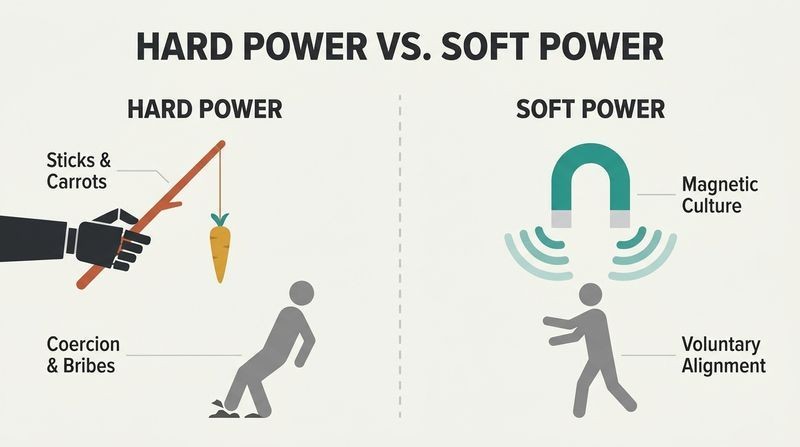
Soft power is getting what you want through appeal, not force. Nye, who coined the term in 1990, defines it as the ability to shape what others want through the attractiveness of your culture, political ideals, and policies. When people admire your values and aspire to your prosperity, they follow willingly, so you need fewer threats and bribes to move them.
Hard power rests on inducements (carrots) and threats (sticks). Soft power operates through a third channel: co-option rather than command. Think of Chinese students building a replica of the Statue of Liberty in Tiananmen Square, or Afghans in 2001 requesting copies of the Bill of Rights. Nobody paid or threatened them. As Nye puts it, when your objectives look legitimate, persuasion costs almost nothing.
What's striking is how Nye smuggles a marketing insight into geopolitics: the cheapest influence is the kind targets do not notice. This anticipates Robert Cialdini's work on liking and social proof, and echoes Antonio Gramsci's concept of cultural hegemony, where dominance feels like consent. A fair challenge: attraction is hard to convert into specific outcomes on demand. Admiring American jazz did not make the Kremlin sign treaties. Nye concedes soft power works better on diffuse, long-run goals than on immediate favors, which makes it powerful but frustratingly unbankable for leaders who need a vote next Tuesday.
Play world power like three-dimensional chess, not a single military board
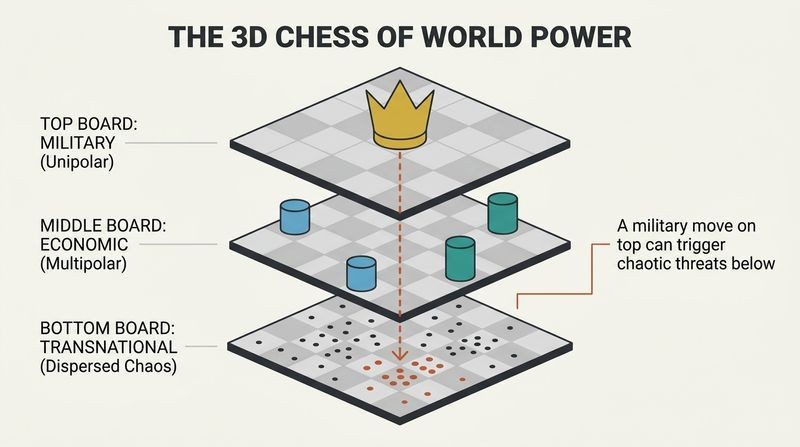
Power is not one game but three stacked boards. Nye argues analysts err by measuring only military might. On the top board, classic interstate military force, the United States is genuinely unipolar. On the middle board of economic issues, power is multipolar: Washington cannot dictate trade or financial rules without Europe, Japan, and China. On the bottom board of transnational problems (terrorism, pandemics, climate change, crime), power is chaotically dispersed among state and nonstate actors, and no country dominates.
Leaders who focus only on the top board are, in his phrase, one-dimensional players in a three-dimensional game. Winning requires playing horizontally and vertically, noticing how a military win on top (toppling Saddam) can hand Al Qaeda recruits on the bottom board.
The chessboard metaphor is Nye's most durable analytic gift, and it aged well. The 2008 financial crisis and COVID-19 both demonstrated the bottom board's autonomy from tanks. A useful extension comes from network theory: on the bottom board, influence flows to whoever sits at communication hubs, not whoever has the biggest arsenal. One critique: the boards are less separable than the model implies. Economic sanctions weaponize the middle board for top-board ends, and cyber operations blur all three. Still, as an antidote to the reflex of counting aircraft carriers, the framework remains clarifying.
America's soft power flows from culture, values lived at home, and legitimate policy
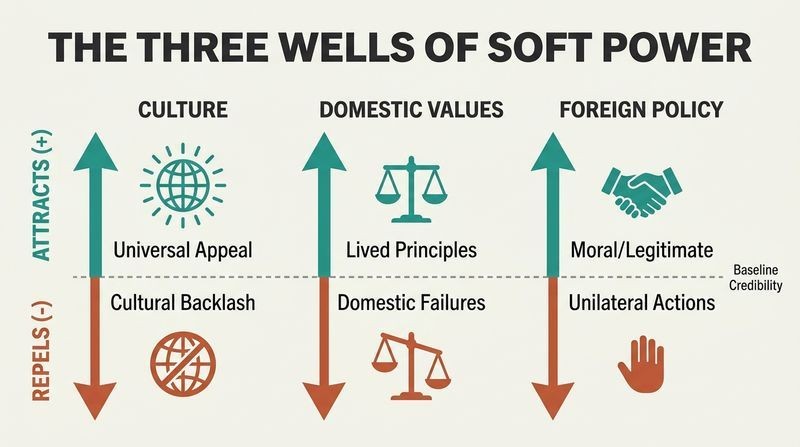
Three wells feed a nation's attractiveness. Nye identifies culture (when it holds universal appeal), political values (when a country actually lives up to them at home and abroad), and foreign policy (when it looks legitimate and morally grounded).
The catch is that all three can backfire. Racial segregation gutted American credibility in newly independent Africa during the 1950s. Capital punishment and weak gun laws repel Europeans today. Hollywood images that dazzle teenagers in Latin America can enrage clerics in Saudi Arabia. Crucially, much of this resource sits outside government control: Harvard, Microsoft, Michael Jordan, and half a million foreign students generate more attraction than any State Department program. Nye warns that narrow, parochial cultures produce little soft power, while universalist ones radiate widely.
The three-source model doubles as a diagnostic checklist for any nation branding itself. What's valuable is Nye's insistence that soft power is co-produced by civil society, which means governments can squander it but cannot manufacture it on command. This connects to Simon Anholt's later nation-brand research showing that a country's reputation tracks its actual behavior more than its advertising. The tension Nye flags (the same film attracts and repels different audiences) undercuts any universal strategy. Soft power is audience-relative, so a single message optimized for Berlin may actively damage standing in Riyadh.
Perceived hypocrisy is the fastest way to burn attractiveness built on values
Nothing corrodes soft power like the gap between preaching and practice. Because attraction rests on proclaimed ideals, a country that violates its own standards looks like a fraud, and fraud repels. Nye cites Guantanamo Bay detentions and the Abu Ghraib prison photos, which achieved iconic status worldwide and made American human rights advocacy sound hollow.
Other self-inflicted wounds: agricultural subsidies protecting wealthy farmers while lecturing poor nations on free markets, and gas-guzzling vehicles that signal indifference to climate change and to other countries. A Swedish diplomat told Nye the most criticized feature of American soft power packaging was its perceived double standards. When you scorn people as hypocrites, they become far less willing to help you achieve your goals.
This is the book's sharpest practical warning, and behavioral science backs it. Research on moral licensing and on the messenger effect shows audiences discount advice from sources they judge inconsistent. The insight travels beyond nations: brands, institutions, and leaders all leak credibility through the say-do gap. A subtle point worth adding is that hypocrisy charges are asymmetric. Powerful actors are held to the standards they themselves announce, so declaring lofty values raises the bar you can fall below. This creates a paradox: the very idealism that generates soft power also manufactures the yardstick by which you are condemned.
Rivals can gang up to deny your legitimacy without matching your firepower
Soft balancing is how the weak constrain the strong. Traditionally, threatened states form military alliances against a dominant power. But when one country's military lead is unmatchable, rivals switch tactics: they band together to strip the legitimacy from its actions, raising the cost of using hard power. Before the 2003 Iraq War, France, Russia, and China blocked a second UN Security Council resolution. They could not stop the invasion, but they made it far more expensive.
The bill was concrete. Nye estimates that resisting a UN role in reconstruction cost the United States over $100 billion, roughly $1,000 per household. In the 1991 Gulf War, allies covered 80 percent of costs; without a mandate in 2003, Washington had to pay countries like Poland and Honduras to participate.
Soft balancing became a hot debate in international relations theory, with skeptics like Stephen Brooks and William Wohlforth arguing that what looked like balancing was just ordinary diplomatic friction. Nye's version is more persuasive because he ties it to a mechanism: legitimacy lowers the price of cooperation, so denying it raises the price. The Internet accelerated this. Nye notes that 2003 antiwar protests mobilized 1.5 million Europeans in a single February weekend, whereas Vietnam-era organizing took four years to reach comparable scale. Legitimacy, in short, is a budget line, not a moral luxury.
American pop culture pierced the Berlin Wall before the hammers arrived
The Cold War was won by mixing hard containment with soft seepage. Nye argues military deterrence created a standoff, but attraction eroded the Soviet system from inside. Banned films, rock music, and blue jeans quietly invalidated official propaganda. Soviet audiences watching apolitical American movies noticed nobody stood in bread lines or shared communal apartments.
Concrete channels mattered. Between 1958 and 1988 roughly 50,000 Soviets visited the United States on exchanges. One KGB official later called these exchanges a Trojan Horse that infected people and eroded the system. Aleksandr Yakovlev, shaped by a 1958 year at Columbia, became a key liberalizing force behind Gorbachev. In Prague, a spontaneous John Lennon shrine became a rallying point, so that, as Nye puts it, Lennon trumped Lenin.
The claim that culture helped dissolve communism is contested but well-supported here, and it reframes the Cold War as partly a contest of consumer imagination. Economic historians note the Soviet bloc lost the legitimacy race once its citizens could compare living standards, which television made unavoidable. What Nye underplays is selection bias: exchange visitors were often already reform-curious. Still, the mechanism is sound and echoes James Scott's idea that regimes collapse when the private gap between official truth and lived reality becomes publicly sayable. Pop culture supplied the vocabulary of that private disbelief, decades before any wall came down.
Unipolar swagger provokes resentment; humility is a strategic asset, not weakness
Style, not just substance, moves the soft-power needle. Nye notes that candidate George W. Bush argued in 2000 that a humble America earns respect while an arrogant one breeds resentment, then documents how the administration's tone undercut that wisdom. A 2003 BBC poll across eleven countries found 65 percent called the United States arrogant, and a majority in every surveyed country, including Americans themselves, agreed.
The new unilateralism held that American intentions were good and hegemony benevolent, so consultation was optional and legitimacy would arrive after the fact through good outcomes. Nye counters that others assume Washington acts from self-interest like everyone else. Teddy Roosevelt's counsel, speak softly while carrying a big stick, captures the lesson: loud-hailer rhetoric squanders the very attraction that makes the stick unnecessary.
Nye's point aligns with negotiation research showing that perceived respect, not just favorable terms, determines whether deals stick. The deeper claim is about attribution: dominant actors are read uncharitably by default, so tone does disproportionate work. A steelman of the unilateralists: sometimes decisiveness itself attracts, and dithering in committees signals weakness that invites challenge. Nye grants that hard power can generate a myth of invincibility. The synthesis is that humility and resolve are not opposites. The skill lies in projecting strength without rubbing others' noses in it, a distinction leaders in every domain, from CEOs to coaches, routinely fumble.
Terrorists need soft power too: recruitment depends on attraction, not just explosives
The democratization of technology privatized war. Nye observes that instruments of mass destruction have grown smaller, cheaper, and more available, while the Internet makes global organizing nearly free. What once required a totalitarian state (killing on a mass scale) now lies within reach of loose networks like Al Qaeda, spread across some 60 countries.
Crucially, terrorism itself runs on soft power. Its victory depends on attracting supporters and recruits as much as on destroying targets. Bin Laden's videos were effective precisely because broadband delivered them efficiently to receptive audiences. After the Iraq War, polls in Indonesia, Jordan, Pakistan, and Morocco showed pluralities expressing confidence in bin Laden over Bush or Blair. The struggle, Nye stresses, is a civil war within Islam between moderates and extremists, winnable only if moderates win.
Reframing terrorism as a battle for attraction rather than attrition was ahead of its time and prefigured the ISIS propaganda machine a decade later. The insight cuts against the kinetic instinct to measure success in enemies killed. What Nye adds that counterterrorism doctrine often missed: heavy-handed force is not neutral, it actively manufactures the grievance that fuels recruitment, a feedback loop the top-board military win obscures. A limitation is that soft power tools work poorly on committed fanatics; they target the recruitable margin, the undecided pool. Winning that margin, not converting zealots, is the realistic aim.
In an age of information glut, credibility becomes the scarcest currency
Abundant information creates a paradox of plenty. When people drown in messages, attention becomes scarce, and whoever can sort valuable signal from clutter gains power. Nye argues politics shifts from whose army or economy wins to whose story wins. Editors, cue-givers, and credible voices become power brokers.
This makes propaganda self-defeating. Information that looks like manipulation not only gets scorned but poisons a country's reputation for reliability. Nye points to exaggerated pre-war claims about Iraqi weapons: they mobilized domestic support but, once exposed, dealt a lasting blow to Anglo-American credibility and weakened a channel (shared intelligence) that could have shaped other governments' policies. In this environment the soft sell outperforms the hard sell, and effective public diplomacy means listening as much as broadcasting.
The paradox of plenty, borrowed from Herbert Simon's insight that information consumes attention, has only intensified since 2004. Social media turned every citizen into a potential cue-giver and made credibility even more volatile. Nye's warning that propaganda is counterproductive is validated by research on the backfire effect and on source trust. A modern complication he could not foresee: in a fragmented media ecosystem, credibility is tribal, so a source distrusted by one audience is trusted precisely for that reason by another. This fractures the single global marketplace of ideas Nye imagined into rival echo chambers, each with its own currency of belief.
Public diplomacy works on three clocks: daily spin, yearly themes, lasting relationships
Attraction must be cultivated across three time horizons. Nye, drawing on practitioner Mark Leonard, breaks public diplomacy into layers:
1. Daily communications, explaining decisions and rapid-responding to false charges, aimed at the foreign press not just the domestic one.
2. Strategic campaigns, developing a handful of branding themes over a year, like an advertising push.
3. Long-term relationship-building through exchanges, scholarships, and training that mature over decades.
The third layer is the highest-yield and cheapest. Roughly 700,000 people have passed through American exchange programs, including leaders like Anwar Sadat and Margaret Thatcher; half the leaders in the counterterrorism coalition were once exchange visitors. Yet Nye notes the United States spends 400 times more on hard power than soft, and post-Cold-War cut exchanges from 45,000 to 29,000 annually.
The three-horizon model is genuinely portable to corporate communications and personal reputation alike: crisis response, campaign, and relationship equity operate on different clocks and cannot substitute for one another. Nye's most damning data point is the budget asymmetry, which reveals a structural bias: hard power has visible outputs and constituencies (defense contractors, bases), while soft power's payoffs are diffuse and delayed, so it perpetually loses budget fights. Public choice theory predicts exactly this underinvestment. The fix Nye implies (protecting exchange funding from short-term politics) mirrors how endowments shield long-horizon investments from quarterly pressures. Relationships compound like capital, but only if left to accrue.
Drop the empire metaphor: it flatters power America cannot actually exercise
Calling America an empire misdescribes the world and misguides strategy. Nye rejects the fashionable early-2000s framing, from both left and right, that the United States runs a global empire. Real empires meant direct political control: Britain ran Kenya's schools, taxes, laws, and elections. America in 2003 could not even get Mexico and Chile to vote its way in the Security Council. Its influence inside other countries is far shallower than Britain's was at its peak.
Worse, Nye diagnoses imperial understretch, not overstretch. The State Department gets 1 percent of the federal budget; the military gets 17 times more. The public shows little appetite for empire and consistently favors multilateralism. A force built to kick down doors and leave is ill-suited to the patient work of building democratic institutions.
Nye's terminological discipline (words matter, metaphors smuggle assumptions) is a model of clear thinking. The empire debate has since cooled, partly vindicating him: two decades of costly nation-building in Iraq and Afghanistan confirmed that American publics will not sustain occupation, exactly his understretch thesis. A sharper critique from world-systems theorists holds that informal economic empire (control through dollar dominance, institutions, and markets) is real even without colonial administration, so Nye may dismiss the metaphor too fast. Still, his core point stands: adopting imperial self-conception invites the resistance and legitimacy costs that make the underlying goals harder, not easier, to achieve.
Smart power is neither hard nor soft; it is the deliberate blend of both
The book's ultimate prescription is combination, not choice. Nye insists he is no soft-power romantic: as a former assistant secretary of defense, he affirms military strength is indispensable. The error is treating hard and soft as rivals. Smart power means knowing when to deploy carrots, sticks, or attraction, and how each affects the others.
The two interact both ways. Brutal actions destroy attraction, as when Soviet invasions of Hungary and Czechoslovakia gutted Moscow's appeal even as its arsenal grew. But hard power can also attract through a myth of strength; as bin Laden noted, people prefer the strong horse. Nye's containment example is the template: George Kennan's Cold War strategy paired military deterrence with cultural transformation from within, a decades-long marriage of both powers that ultimately prevailed.
Smart power became Nye's signature contribution to policy vocabulary, adopted by later secretaries of state. Its strength is also its vulnerability: as a prescription, balance both is nearly unfalsifiable, and critics note it offers little guidance on the exact ratio in a given crisis. The real value is diagnostic humility, forcing leaders to ask which instrument fits which board. The Kennan example is instructive because containment was patient in a way democracies find agonizing. Smart power's deepest obstacle is not intellectual but temporal: soft power pays out over decades, while electoral and news cycles reward the visible, immediate returns of force.
Analysis
Soft Power is best read as a corrective, not a manifesto. Nye, a founder of neoliberal institutionalism in international relations, wrote it during the 2003 Iraq War to rescue a concept he coined in 1990 from both trivialization (soft power as Coca-Cola and blue jeans) and dismissal (Rumsfeld's I don't know what it means). The book's intellectual move is to expand the definition of power itself: beyond command (coercion and payment) lies co-option, the ability to shape what others want. This is genuinely a contribution to power theory, extending Bachrach and Baratz's second face of power into international affairs.
The work's enduring strength is analytic clarity: the three-board chessboard and the three sources of soft power (culture, values, policy) are teaching tools that survive because they organize messy reality without oversimplifying it. Its enduring weakness is measurement. Nye leans heavily on Pew and Gallup polling to demonstrate attractiveness, but he candidly concedes the gap between soft-power resources and actual outcomes, a gap that makes the concept hard to operationalize and easy for skeptics to dismiss as mere popularity. Attraction is real but frustratingly unbankable.
Historically, the book is a period piece in the best sense: it captures the moment American primacy was maximal yet its legitimacy was cratering, and it correctly predicted that winning the peace would prove harder than winning the war. Read in the age of TikTok, disinformation, and Chinese soft-power spending, Soft Power looks prescient about the rising importance of credibility and networks, yet dated in its optimism that liberal, pluralist values sit closest to global norms. The fragmentation of the information ecosystem into tribal echo chambers challenges his premise of a single marketplace of ideas. Nye's synthesis, smart power, remains the sensible conclusion: power is a portfolio, and the recurring policy failure is not choosing wrongly between hard and soft, but neglecting the patient, unglamorous cultivation of attraction that compounds over decades.
Review Summary
Soft Power explores the concept of influencing others through attraction rather than coercion. Readers found the book insightful but repetitive, with some criticizing its American-centric perspective. Many appreciated Nye's analysis of cultural influence, public diplomacy, and the importance of balancing hard and soft power. Some felt the book could have been condensed, while others praised its relevance to modern international relations. Overall, reviewers considered it an important work for understanding global politics, despite its limitations and potential bias.
People Also Read

FAQ
What's "Soft Power: The Means to Success in World Politics" about?
- Concept of Soft Power: The book introduces and elaborates on the concept of "soft power," which is the ability to influence others through attraction and persuasion rather than coercion or payment.
- Changing Nature of Power: It discusses how power dynamics have shifted in the global information age, emphasizing the importance of cultural influence, political values, and foreign policies.
- Interplay of Hard and Soft Power: The book explores how soft power interacts with traditional hard power, such as military and economic might, in achieving national objectives.
- Global Context: It provides a comprehensive analysis of how different countries, including the United States, Europe, and nonstate actors, wield soft power in international relations.
Why should I read "Soft Power: The Means to Success in World Politics"?
- Understanding Modern Diplomacy: The book offers insights into how countries can achieve their foreign policy goals through non-coercive means, which is increasingly relevant in today's interconnected world.
- Strategic Insights: It provides strategic advice on how nations can enhance their global influence by leveraging cultural and ideological appeal.
- Historical Context: The book places current international relations within a historical framework, helping readers understand the evolution of power dynamics.
- Practical Applications: It is useful for policymakers, diplomats, and anyone interested in international relations, offering practical examples of soft power in action.
What are the key takeaways of "Soft Power: The Means to Success in World Politics"?
- Definition of Soft Power: Soft power is the ability to shape the preferences of others through appeal and attraction, rather than coercion or payment.
- Sources of Soft Power: Culture, political values, and foreign policies are primary sources of soft power.
- Limits and Challenges: While soft power is crucial, it has its limits and must be used in conjunction with hard power for effective international strategy.
- Global Influence: The book highlights how different countries, including the U.S., Europe, and nonstate actors, utilize soft power to achieve their goals.
How does Joseph S. Nye Jr. define "soft power"?
- Attraction Over Coercion: Soft power is defined as the ability to get what you want through attraction rather than coercion or payments.
- Cultural Influence: It arises from the attractiveness of a country's culture, political ideals, and policies.
- Legitimacy and Values: When a country's policies are seen as legitimate, its soft power is enhanced.
- Non-Tangible Resources: Soft power relies on intangible resources like culture and values, rather than military or economic might.
What are the sources of American soft power according to Joseph S. Nye Jr.?
- Cultural Appeal: American culture, including music, movies, and technology, is a significant source of soft power.
- Political Values: The U.S. is admired for its democratic values and political ideals.
- Foreign Policy: When U.S. foreign policies are perceived as legitimate and morally sound, they enhance its soft power.
- Educational Influence: The presence of international students in American universities contributes to the U.S.'s soft power.
How does "Soft Power: The Means to Success in World Politics" explain the interplay between hard and soft power?
- Complementary Forces: Hard and soft power are not mutually exclusive; they can complement each other in achieving national objectives.
- Strategic Balance: Effective foreign policy often requires a balance between coercive measures and attractive influence.
- Case Studies: The book provides examples, such as the Iraq War, to illustrate how hard and soft power interact in real-world scenarios.
- Myths of Invincibility: Sometimes, hard power can create myths of invincibility that enhance a country's soft power.
What are the limits of soft power as discussed in the book?
- Context-Dependent: The effectiveness of soft power is highly dependent on the cultural and political context of the target audience.
- Diffuse Influence: Soft power often has a more diffuse effect, creating general influence rather than specific actions.
- Need for Willing Interpreters: It requires willing interpreters and receivers to be effective, unlike hard power, which can be more direct.
- Not a Substitute for Hard Power: Soft power cannot replace hard power in situations requiring immediate and forceful action.
How does Joseph S. Nye Jr. suggest countries can enhance their soft power?
- Cultural Diplomacy: Investing in cultural exchanges and promoting cultural products can enhance a country's attractiveness.
- Consistent Policies: Aligning domestic and foreign policies with universally admired values can boost soft power.
- Public Diplomacy: Engaging in effective public diplomacy that listens and responds to foreign publics is crucial.
- Leveraging Nonstate Actors: Collaborating with NGOs and private sectors can amplify a country's soft power.
What role does public diplomacy play in wielding soft power?
- Building Relationships: Public diplomacy involves building long-term relationships with key individuals and organizations.
- Strategic Communication: It includes developing strategic themes and campaigns to promote a country's image.
- Crisis Management: Effective public diplomacy requires rapid response capabilities to manage crises and counter misinformation.
- Two-Way Communication: Successful public diplomacy involves listening to foreign audiences and adapting messages accordingly.
How does "Soft Power: The Means to Success in World Politics" address the challenges of soft power in the Middle East?
- Cultural Barriers: The book discusses the cultural differences that make soft power more challenging in the Middle East.
- Long-Term Strategy: It emphasizes the need for a long-term strategy involving cultural and educational exchanges.
- Policy Consistency: Aligning U.S. policies with the aspirations of Middle Eastern populations is crucial for effective soft power.
- Role of Nonstate Actors: The book highlights the importance of engaging nonstate actors to promote democracy and development.
What are some criticisms of the concept of soft power?
- Ephemeral Popularity: Critics argue that soft power is merely about popularity, which can be fleeting and unreliable.
- Lack of Control: Governments often have limited control over the cultural and ideological sources of soft power.
- Not Always Effective: Soft power may not always lead to desired policy outcomes, especially in authoritarian regimes.
- Overemphasis on Attraction: Some critics believe that focusing too much on attraction can undermine the necessary use of hard power.
What are the best quotes from "Soft Power: The Means to Success in World Politics" and what do they mean?
- "Soft power is not weakness." This quote emphasizes that soft power is a form of power, not a sign of weakness, and is crucial for effective foreign policy.
- "Seduction is always more effective than coercion." It highlights the idea that attracting others to your side is often more successful than forcing them.
- "Power comes in many guises." This underscores the multifaceted nature of power, including both hard and soft elements.
- "The real key is how many allies do I grow." This quote reflects the importance of building alliances and partnerships through soft power.
Download PDF
Download EPUB
.epub digital book format is ideal for reading ebooks on phones, tablets, and e-readers.








































