

Plot Summary
Prologue
Mia1 boards a plane at Heathrow, scrolling backward through years of photos on her phone, searching for one image of all her friends together. She moved to London six months ago; now she's flying to New York at the last minute. A chatty seatmate recites his tourist itinerary — the Statue of Liberty, Times Square, The Lion King — and announces that nobody's died, so there's no reason to be glum.
Mia1 looks at him and says that, actually, someone has. Before takeoff, she finds what she was looking for: all of them on a bright green lawn in Amagansett, a swimming pool sparkling behind them, bocce balls at their feet. She zooms in on each of their faces and waits for a relief that doesn't come.
Club Soda at Midnight
New Year's Eve, 2007. Mia1 is twenty-four, fighting a cold, dragged to a party on Orchard Street by her roommate Sasha.3 The apartment belongs to Richie Fournier,5 a flamboyant college classmate.
When Mia1 can't reach a bottle of Club Soda atop the refrigerator, a man with close-cropped hair and three freckles beneath his left eye retrieves it for her, then points out she contradicted herself by claiming there were no mixers. His name is Marco2 — Richie's5 new roommate, just back from a Fulbright in Bogotá. They recognize each other from a Penn psychology class called The Pursuit of Happiness.
He asks how hers is going. She tells him to check back in five years. Around them the party throbs — Sasha3 and their roommate Adam4 playing quarters, Richie5 disappearing to the bathroom — but Mia1 and Marco2 barely register anyone else.
The Bodega with Bad Ice
They're out of mixers and ice, so Marco2 volunteers for a bodega run. Mia1 stubs out her cigarette and joins him. They pass the first bodega — Marco2 declares its ice is bad, in a way he cannot describe. They keep walking.
Mia1 holds up her hand like a map of Michigan to show him where Lansing is. She tells him about her three much-older brothers and the wooden coat rack her father made for each of them but never built for her. Marco2 describes Bogotá with the precision of someone who loved a place and left it anyway.
They miss midnight inside a fourth bodega, watching the countdown on a television next to yesterday's newspapers. On the stoop of his building, Marco2 sets the bags of ice on the ground. He kisses her, and she tells him to stop talking and do it again.
Mia Stays Behind
Two years after Lehman Brothers implodes and wipes out Marco's2 banking career, he lands a position at the World Bank — in Washington. Over beers in their tiny Greenpoint studio, Mia's1 laptop open to hotels in Bogotá for a trip they'll never take, he tells her.
She leads with how proud she is, then asks what she's supposed to do. He suggests she come with him; she says she has a job, friends, a life. They both know she's scared — not of DC, but of tethering herself to one future at twenty-seven.
A hairdresser tells her she'd better get a ring first. Mia1 walks the city for hours, unable to picture either outcome. She never books the flights to Colombia. Marco2 moves alone, and what Mia1 thought was a deliberate choice reveals itself as paralysis.
Table Twelve in Cancun
June 2014. At Courtney Paulson's12 destination wedding, Mia1 is seated directly across from Marco2 and his girlfriend Emily7 — a colorectal surgery resident with a disarming sense of humor. Sasha3 is honeymooning with Theo6 in Hawaii.
Mitch Reynolds,11 a loud-mouthed finance bro from their college years, knocks an entire bottle of red wine across Mia's1 green dress. Emily7 approaches with a Tide pen and unexpected warmth — they bond briefly, until Emily7 mentions she and Marco2 are capping their own wedding at forty people. The ring is being resized.
Mia1 holds her smile a beat too long. Elsewhere, Richie5 turns vicious toward Nina Guzman,10 an old classmate, outing her past relationship with the bride. Adam4 tells Mia1 he's done with Richie5 for good. On the beach, fireworks misspell the groom's name. Mia1 cries so hard she can't stop.
The Precinct Bench
By his early thirties, Richie's5 drinking and drug use have made him a liability — whispered about at weddings, pitied behind his back. The bottom arrives on an ordinary morning: hungover on the subway, he snaps at a little girl in glasses, causing her to cry.
He buys two bottles of vodka, tells the clerk they're for an office party, and passes out on a bench at South Street Seaport. When he wakes in a police precinct, Adam4 is beside him. Adam4 squeezes his hand past the point of comfort and tells him that one day he's going to be happy, and promises to be there when it happens.
Richie5 enters recovery in California. At an AA meeting on Perry Street, a relentlessly cheerful man named Rami9 introduces himself and won't take no for breakfast. Richie's5 new life begins with weak coffee and earnest company.
Labor Day, Amagansett
Labor Day 2018. Adam4 books an Airbnb for Richie's5 birthday — a rambling grey house with a broken pool heater and dull knives. The full cast reconvenes: Mia1 brings Lev,8 her older journalist boyfriend from the New Yorker; Marco2 brings Emily7 and baby Ava; Sasha3 and Theo6 arrive with toddler Ethan, Theo6 still hollowed by the bankruptcy of his real estate firm.
Richie5 is sober now, accompanied by Rami.9 Mitch11 and Nina10 fill the remaining chairs. By afternoon, every fault line is exposed. Marco2 and Emily7 bicker about parenting in the pool.
Sasha3 has been secretly sleeping with Mitch,11 driven by a need to feel like someone other than a wife and mother. Lev8 condescends to everyone. The house creaks under the accumulated weight of who they've all become.
Whitney Houston in Three Syllables
After dinner they play Celebrity. When Marco2 draws a name, Mia1 guesses it before he finishes two syllables — Whitney Houston, Bilbo Baggins, Maya Angelou — sixteen points in a single electrifying round. Emily7 watches from across the room, perfectly still.
The connection between Mia1 and Marco2 is visible to everyone, especially Richie,5 who can barely concentrate because Rami's9 arm has settled around Adam's4 shoulder on the opposite couch. Later that night, Nina10 opens the wrong door looking for a bathroom and finds Sasha3 and Mitch11 tangled on a four-poster bed.
Mitch11 pushes past her; Sasha3 pulls the sheet over her legs and begs Nina10 to keep quiet. Nina10 promises — and is shocked to discover she feels happy. Sasha3 is confiding in her, and for once, someone has let her in. Alone in the observatory, Emily7 presses her knuckles to her eyes.
Ten Weeks, Then Nothing
Roughly six months before the Halloween party, Mia1 develops an aversion to eggs. A test confirms she's pregnant by Lev.8 She tells no one — not Adam,4 not Sasha3 — and gives herself weeks to decide, catching herself smiling on the subway, guarding her secret like something precious.
In the tenth week, she bleeds. A doctor confirms the pregnancy is over. That evening she tells Lev8 everything. He holds her hand and repeats that he loves her. Then he tells her that serious people don't have children.
The grief she feels is not for the pregnancy itself but for a possibility that was hers to choose until suddenly it wasn't. Months later, when Warner Brothers options her article about a climate activist, Lev8 belittles her success out of jealousy. She leaves him, moves back to Greenpoint, and finds herself thirty-nine and alone.
Tuna's Replacement
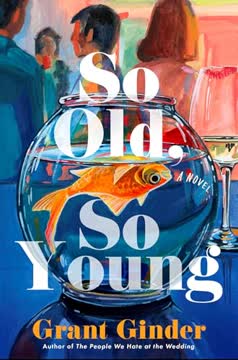
October 2022. Sasha's3 Montclair life runs on logistics — country club dues, Theo's6 Bruce Springsteen cover band, new friends who understand car seats and Peloton. The morning of her Halloween party, Ethan's goldfish Tuna is floating belly-up.
She drives to Petco with baby Prudence strapped to her chest, where an employee insists a replacement betta fish requires a thirty-gallon tank and special water drops. Sasha3 snaps. She tells him about eighty-five incoming guests, the titanium screws in her hand from a car wreck, the mammogram she can't schedule, and the three hours of sleep she's had in three nights.
She demands a goldfish in a bag. She gets it. Then she picks up Mia,1 Adam,4 and Richie5 at the train station, handing Mia1 the fish through the car window like a baton in a relay she's losing.
The Kitchen on Inwood Avenue
Sasha3 canceled their trip to Miami, blaming childcare problems. But Anoushka13 — Sasha's3 new suburban friend — innocently mentions the real reason: Sasha3 is going to DC to support Emily7 through her troubled marriage. Mia1 confronts her in the kitchen.
Sasha3 tells Mia1 to grow up — says she can't keep pretending they're living in their old apartment, that she has a mortgage and in-laws and children. Then Richie,5 who learned of Sasha's3 affair from Nina,10 turns to Theo6 and announces that Sasha3 slept with Mitch Reynolds.11 Theo's6 face drains white.
Sasha3 kicks them all out. On the curb, Richie5 turns on Adam4 — accusing him of decades of moral superiority, of treating everyone as a project to manage. Mia1 sides with Richie.5 Adam4 says he's done and walks away alone. Three friendships shatter in under ten minutes.
Galileo in Prospect Park
A week before Mia1 gets the call, she is sitting in a London pub, ignoring her ringing phone. Seven missed calls from Richie.5 She phones him back from a bench in Russell Square. He tells her Adam4 is dead.
Adam4 and his husband Rami9 were riding Citibikes home from an Indigo Girls concert through Prospect Park when Adam4 challenged Rami9 to a race. Rami9 let him ride ahead. The music in his shared AirPod sputtered and stopped. At the top of a hill, Rami9 found Adam4 on the ground, his bike across him, phone shattered.
Hypertrophic cardiomyopathy — thickened heart walls, undetectable without an ultrasound. The cruelest irony: when Adam4 and Rami9 screened for genetic conditions before having their daughter Lucy, Adam4 came back with zero. The condition that killed him was the one nobody thought to test for.
Take It Away
Richie5 is the only person at the bar before the memorial begins. He couldn't make it to the church — spent an hour on his closet floor, shaking. But he found the Nike shoebox Adam4 dropped off in December: inside Crime and Punishment, a flash drive loaded with seventeen years of photos none of them knew existed.
He printed them all. Now a triple bourbon sweats on the counter. He thinks of the last time he saw Adam4 — a freezing December sidewalk, coffee, a debate over Rita Ora versus Dua Lipa.
When they said goodbye, their mouths met in an accidental, suspended kiss. Neither pulled away for several seconds. The bartender leaves to change the kegs. The door opens and Mia1 walks in, saying something about Buckingham Palace. Richie5 looks at the glass and tells the bartender to take it away.
The Photos in Crime and Punishment
The bar fills with photos Richie5 printed from the flash drive — pictures Adam4 took across seventeen years that none of them knew existed. Mia1 and Sasha3 stand before a shot of themselves in the apartment on East 57th Street, young and holding overfull glasses of wine, cologne samples scattered on the floor.
Sasha's3 hand finds Mia's.1 Neither apologizes outright, but Sasha3 says they haven't changed all that much, and Mia,1 crying, agrees. Marco2 finds her outside the church and they walk toward the reception together — not as ex-lovers reuniting, but as two people who know each other's edges well enough to share a sidewalk in silence. At the bar, Richie5 tells Mia1 he loved Adam.4 She says she knows. Outside, April sun warms new leaves, and the city carries on around them.
Analysis
Grant Ginder's novel operates as a longitudinal study of friendship conducted through accumulation rather than crisis. Its central insight is that adult relationships are not destroyed by single catastrophic events but by the slow accretion of asymmetric change — the thousand divergences that occur when people who formed their identities together begin aging at different speeds and in incompatible directions. The non-linear structure mirrors this thesis: by toggling between five time periods spanning 2007 to 2024, Ginder shows how the same group can occupy radically different emotional positions depending on which year we observe them. Mia's1 fear of commitment at twenty-seven becomes Marco's2 emotional distance at thirty-four becomes Emily's7 resentment at forty. Personality traits don't evolve so much as metastasize, hardening into the very limitations they were designed to circumvent.
The most psychologically incisive element is the book's treatment of parenthood as a social sorting mechanism. Children don't merely change those who have them — they restructure the entire relational network, creating a hierarchy of legitimacy in which the childless are permanently relegated to the periphery. Mia's1 fury at Sasha3 isn't about Miami. It's about the recognition that her life choices have made her categorically less important in her best friend's calculus of obligation.
Ginder also anatomizes how grief has been colonized by performance. Marco's2 anxiety about not posting about Adam4 reflects a genuine modern confusion about whether private mourning constitutes caring at all. The novel's answer is embodied by Richie's untouched bourbon: caring means showing up, not broadcasting.
Adam's4 death from a genetic condition his own screening failed to detect is the book's cruelest irony and its most honest observation — you can prepare meticulously for the future and still be ambushed by the present. What survives isn't the friendship they had at twenty-four, but something smaller and harder-won: the willingness to hold someone's hand in a bar and admit you haven't changed all that much.
Review Summary
So Old, So Young follows six college friends across twenty years through five pivotal parties, exploring how time transforms relationships, identities, and dreams. Reviews praise the character-driven narrative and nostalgic millennial touchpoints, though readers note a large cast initially confuses. The stellar audiobook features full-cast narration. While most find characters realistically flawed and relatable, some critique them as unlikeable or privileged. The writing captures aging's emotional complexity—feeling simultaneously old and young. Several reviewers note rushed endings and occasional shallow plotting, yet many deeply connected to themes of friendship dissolution, parenthood's isolating effects, and accepting life's inevitable changes.
People Also Read










Characters
Mia Hoffmann
Restless writer, emotional centerThe novel's gravitational center—a sharp, self-deprecating journalist from Lansing, Michigan whose fear of commitment masks a deeper fear that her life is smaller than it should be. The youngest of four siblings by fourteen years, she carries the sense of being an afterthought, a late arrival in a story her family already finished writing. She uses humor as armor and self-criticism as a preemptive strike against others' judgment. Her defining tension is between wanting intensity and fearing the vulnerability it demands. Brilliant at reading other people's motives and weaknesses, she's terrible at reading herself. She collects accomplishments—the Times, a book deal, a television show—like evidence in a case she's building to prove she matters, but no verdict ever quite satisfies.
Marco Bernardi
Mia's enduring unfinished sentenceSon of working-class Los Angeles parents, Marco2 arrived at Penn feeling outclassed and responded by becoming relentlessly earnest—completing every reading, attending every office hour, taking his education more seriously than anyone thought was cool. His Fulbright in Bogotá gave him the intellectual confidence his college years couldn't. He's drawn to competence and directness, which makes his attraction to Mia1 both inevitable and maddening, since she performs indifference toward the things she wants most. His great flaw is a passive righteousness—he knows what he thinks of people but rarely says it plainly until frustration forces his hand. With Mia1, he's spent seventeen years orbiting the same unfinished sentence, circling back each time the distance closes just enough to remind him why he cared.
Sasha Karlsson-Lee
Social architect, restless wifeTall, beautiful, and wealthy enough that her friends can't complain about rent to her—a power dynamic she never asked for but always benefited from. Raised in an Atlanta suburb by an adopted Korean-American mother, she grew up embarrassed by how little had happened to her and moved to New York determined to become interesting. She's the group's social architect, the one who makes plans and drags everyone along. Beneath the confidence runs a compulsive need to inhabit someone other than who she's expected to be—which first manifests as crashing parties where she doesn't belong, and later as increasingly reckless attempts to recapture autonomy. She loves fiercely but struggles to admit when her own choices have left her lonely, and her pride makes apology feel like surrender.
Adam Parker
The group's quiet foundationOrphaned at four when his parents died on icy mountain roads, raised by a Lutheran aunt who hadn't wanted children, he developed a compulsion to be useful that became the architecture of his personality. He cleaned dishes no one asked him to clean, folded laundry that wasn't his, remembered birthdays and allergies and the precise pressure needed when squeezing someone's hand. Mia1 once compared him to a roll of Duct Tape—he counted it among the greatest compliments of his life. His goodness is genuine but not uncomplicated; it's rooted in a childhood fear that his existence is a burden, and that the only way to justify it is through constant, visible service. He loves with a quiet, stubborn permanence that the people around him have never learned to properly repay.
Richie Fournier
Charismatic wreck, unlikely survivorThe group's most magnetic member and its most destructive. He possesses extraordinary social charisma—he lights up rooms, charms strangers, launches legendary campus slip-and-slides—that coexists with an addiction slowly dismantling his life since college. Raised by a contemptuous stepfather in New Hampshire, he developed an appetite for obliteration that he mistakes for bravery. His relationship with substances follows a grimly predictable cycle: the fun, the darkness, the spectacular fall, the apology tour. What saves him from being merely cautionary is his self-awareness—he knows exactly what he's doing, even as he can't stop. His love for Adam4 is the one constant that addiction can't fully erase, though it does its relentless best to make that love unrecognizable to both of them.
Theo Wingate
Sasha's steadfast, shaken husbandSasha's3 husband—handsome, accommodating, and almost pathologically considerate. He had testicular cancer in college, lost his job when his real estate firm went bankrupt, and processes adversity by going emotionally numb. He joins a Bruce Springsteen cover band in Montclair and pours himself into it with an earnestness that both moves and embarrasses his wife. His decency is his greatest strength and the quality Sasha3 most takes for granted.
Emily
Marco's precise, exhausted wifeMarco's2 wife and a colorectal surgeon whose professional precision extends uncomfortably into parenting. She approaches motherhood as triage, micromanaging every diaper and feeding schedule, which makes Marco2 feel like an intern in his own family. Warm and self-deprecating with strangers—she bonds with Mia1 over a surgical pun at a wedding—she grows increasingly isolated by the distance between who she and Marco2 are becoming.
Lev Archaki
Mia's famous, condescending loverMia's1 older boyfriend, a celebrated New Yorker journalist who orders mojitos without asking and critiques her adjective use as foreplay. He represents the aspirational career and swagger that Mia1 thought she wanted. His intelligence is genuine, but his ego cannot accommodate anyone else's success. He sends a dick pic at a climate conference and somehow makes it charming. His condescension is the costume his insecurity wears, and it fits him best when the people he loves succeed.
Rami
Adam's husband, Richie's lifelineMet Richie5 at a 7:30 AM meeting on Perry Street and refused to let him be cold or eat breakfast alone. He works in marketing at Netflix, smiles more than seems possible in early sobriety, and possesses a stubborn warmth that eventually breaks through Richie's5 defenses. He later becomes Adam's4 husband, and together they have a daughter named Lucy through surrogacy.
Nina Guzman
The group's persistent outsiderEarnest to the point of painful, desperate for inclusion, and treated with casual cruelty by people she considers friends. She had a relationship with Courtney Paulson12 in college, pivoted from community gardening to e-cigarettes, and made enough money to buy a Sagaponack house she's often alone in. Her mother Carol is her closest confidante. Her defining wound is that she tries too hard and can never figure out why that makes people like her less.
Mitch Reynolds
Finance bro, convenient affairA former Goldman Sachs trader who treats every room as a stage for his own performance—laughing too loud, name-dropping sexual positions, buying orange Ducati motorcycles. He once kissed Mia1 at a bar in college; years later he fills a very different role in Sasha's3 life. He is aggressively, proudly, almost admirably shallow.
Courtney Paulson
Rich mean girl, serial brideDaughter of a Long Island car dealership baron. Her lavish Cancun wedding and subsequent divorce frame two of the novel's key gatherings. She later remarries a dentist and moves to Connecticut, where she makes brutally honest calculations about love and settling.
Anoushka Banik
Sasha's new suburban confidanteSasha's3 closest friend in Montclair, met at a book club over gougères. She treats suburban life with ironic detachment and inadvertently reveals the lie that detonates Sasha3 and Mia's1 friendship.
Alison Liu
Courtney's loyal maid of honorCourtney's12 best friend from college, known for her squeaky voice and a broken ankle from marathon training. She delivers a rambling wedding speech that makes the audience uncomfortable.
Plot Devices
The Flash Drive in Crime and Punishment
Memory vessel, reconciliation keyHidden inside a copy of Dostoevsky's novel, tucked into an old Nike shoebox that Adam4 returned to Richie5 months before his death, this flash drive contains seventeen years of photographs that none of the friends knew Adam4 was taking. The images span from the apartment on East 57th Street through weddings, parties, and quiet moments. Richie5 discovers it while sitting on his closet floor, unable to make it to the funeral. He prints the photos and pins them around the memorial bar, transforming a space of grief into an archive of shared life. The device functions as Adam's4 final act of caretaking—documenting the people he loved in moments they were too busy living to notice. It becomes the catalyst for Mia1 and Sasha's3 reconciliation.
Annie the Ghost
Cover story for secret selvesWhen Mia1 and Adam4 hear strange noises in their apartment on East 57th Street, Sasha3 invents a ghost named Annie to explain away the sounds of her sneaking out at night. Annie becomes a shared fiction—blamed for clogged dishwashers, mice, forgotten lightbulbs, and fire-escape cigarettes—that allows each roommate to deflect responsibility for things they can't otherwise explain. The ghost represents the secret selves all three maintain: Sasha's3 nighttime adventures crashing bar mitzvahs and fashion parties, Adam's4 still-closeted desires, Mia's1 anxieties about adulthood. Annie is ridiculous by design—no self-respecting ghost would haunt Midtown East—but the absurdity is precisely what makes her useful. She gives them permission not to examine things too closely.
The Bodega with Bad Ice
Love's founding mythologyOn New Year's Eve 2007, Marco2 volunteers to buy ice and mixers for the party. Mia1 joins him. They pass the first bodega and Marco2 declares—with a straight face—that its ice is bad, in a way he cannot describe. They walk past two more before finally entering a fourth. The transparent excuse extends their time together through the streets of the Lower East Side, allowing them to trade stories about Michigan and Bogotá while missing midnight entirely. The bad ice becomes shorthand for the willing self-deception that love requires at its beginning: the mutual agreement to believe a flimsy story because the alternative—going inside, going home, going back to the party—means the conversation ends. It establishes the mythology of their relationship.
The Goldfish Tuna
Last straw before the collapseEthan's pet goldfish dies the morning of Sasha's3 Halloween party. Her frantic attempt to replace it—driving to Petco with a baby strapped to her chest, threatening an employee who insists betta fish require thirty-gallon tanks—becomes a pressure gauge for every obligation she's been silently managing: the cupcakes, the dry ice, the animatronic witch, the mammogram she hasn't scheduled. Tuna is a small, simple thing that was supposed to be easy, and its transformation into an unsolvable problem mirrors the way Sasha's3 life has become a stack of small crises, each one manageable alone but collectively crushing. The dead fish in its bowl is the domestic equivalent of a cracked dam.
The Bourbon at the Memorial Bar
Sobriety's final testAt the bar where Adam's4 memorial reception will be held, Richie5 orders a triple bourbon and stares at it. He's missed the church service entirely, paralyzed by grief on his closet floor. The untouched glass becomes the novel's climactic image of choice: between self-destruction and presence, between the ease of old habits and the difficulty of staying conscious. When Mia1 walks through the door and Richie5 tells the bartender to take the glass away, the act represents not triumph over addiction—Richie5 has relapsed before and may again—but a single, specific decision to be here for one more day. It is the only way he can honor the man who once promised to be there when Richie5 was happy.








































