
Plot Summary
The Morning Everyone Drowned
Crosses line every shore from Gulf to northern sound. A year later, the country stumbles forward — jails emptied when guards vanished, banks became mausoleums, historically Black colleges reorganized into centers of governance.
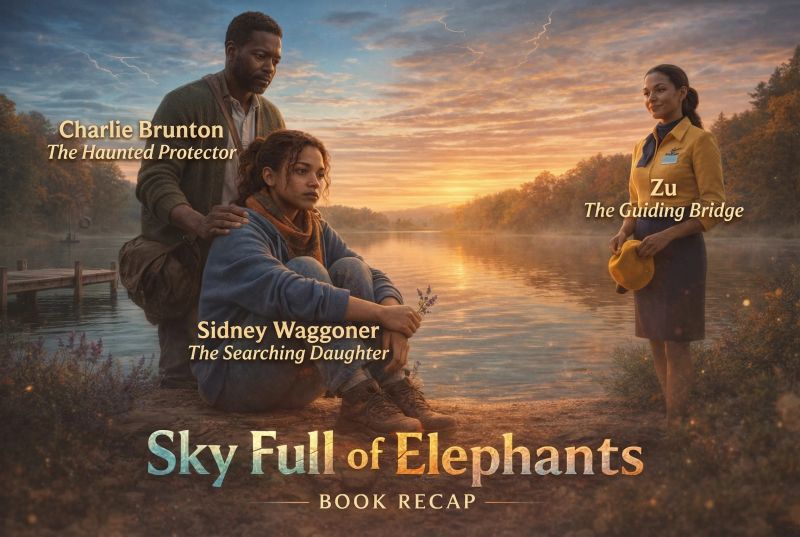
In D.C., Charlie Brunton1 teaches solar power at Howard University, living in a suburban house whose white family's photos he has finally boxed up. Before the event, he spent twenty years at Sussex State Prison — freed only because the guards marched into the sea with everyone else.
Charlie1 carries what he calls his conflict: the relief he felt at their absence shames him, a darkness he cannot reconcile with goodness. He drinks bourbon alone on his office floor, teetering between rising to meet this new world and putting a bullet in his head.
The Daughter in the Dark
His phone rings past midnight. A young woman's voice identifies herself as the daughter of Elizabeth14 — a name that hits Charlie1 like a phantom against his skin. He had not once considered that the child he fathered with a white woman might still be alive, spared by whatever kept her above the waterline. She lives outside Oshkosh, Wisconsin, alone since her family drowned.
She says everyone has left her, just like he did. She demands he take her south to Alabama, where she believes white survivors have formed a colony. She refuses to give her name, insists his blood does not make him her father, and hangs up. Charlie1 retrieves an old letter from his filing cabinet — still sealed in its prison evidence bag — and maps the route north.
Rifle at the Foyer Door
His Prius nearly dies crossing miles of scorched Indiana farmland — entire towns burned by an old woman named Ethel,11 who feeds him dinner and tells him to stop mourning the dead and decide who he will become.
Recharged, he presses on to the Waggoner estate in Oshkosh: a sprawling plantation-style house behind wrought-iron gates inscribed with the family name. His daughter2 buzzes him through, stretches a generator cord across the driveway, and when Charlie1 pushes the front door open, she greets him with a long rifle aimed at his face.
Nineteen years old, gold-black curls matted from a year of neglect, she handles the weapon with a steadiness that tells him she has used it before. She has not left this house since her family walked into the lake.
Between the Barrel and the Boy
A Black father and his young son wander through the open gate. Sidney2 raises her rifle. Charlie1 watches her settle into the scope — calm, decided — and steps into the barrel's line. He tells her no house is worth a child's life. The gun drops. The family flees. Sidney2 runs to the lakeshore where her mother14 and brothers walked into the water and never surfaced.
Sitting in damp red sand, she speaks her name: Sidney, after him — Sidney Charles Brunton. Her mother14 named her after the man she never let Sidney2 know. Charlie1 promises he will take her wherever she wants to go and will not leave until she says so. She shakes his hand, and his grip holds like the first rung on a long climb.
The Man in the White Hood
Kenosha is a ruin — every wall, tree, and sidewalk scrawled with white-painted Bible verses. They reach her aunt Agnes's10 ransacked house, where Charlie1 sees a face in the hallway photos that jolts his memory with fury: Thomas, the man who destroyed his life.
Before he can process it, Sidney2 is seized outside by a figure in a KKK uniform — a Black man calling himself Little,15 his mind fractured between feral rage and childlike terror. Charlie1 aims the rifle for the first time in his life and commands Little15 to release his daughter.2
The man crumples, then runs screaming threats. Sidney2 falls into Charlie's1 arms, trembling — the first time she has let him hold her. She reveals a cardboard note from her aunt claiming white survivors exist in Orange Beach, Alabama. They decide to fly south from Chicago.
Gate Sixteen's Last Pilot
O'Hare has been reinvented — one terminal, no airlines, free flights, color-coded staff in berets, and a concourse buzzing like a night market. Alabama is a no-fly zone; the state has a self-proclaimed king and planes lose navigation over it.
A desk representative directs them to gate sixteen, where a gruff ex-military pilot named Sailor6 works alongside his child Zu,7 a warmly androgynous flight attendant. Sailor6 recognizes Charlie's1 prison posture and shares his own story of years in a cell.
He will fly them near the Alabama border for one price: a stolen truck of jet fuel. Charlie1 agrees. Over two days, he fixes Sailor's6 malfunctioning navigation system, wins cash at spades, and watches Sidney2 laugh freely for the first time — with Zu,7 out exploring Chicago's still-glittering skyline.
Machetes at the Border
They fly to Mississippi, where ruined towns and shattered people line every road. In Jackson, crowds dressed in white practice what locals call walking — suicidal pilgrimages toward the sea, seeking to follow the dead into heaven. Along the Gulf Coast, crosses puncture sugar-white sand for miles.
Charlie1 teaches Sidney2 to drive on a cleared stretch of interstate. She screams with the joy and grief of acceleration, tears streaming as she pushes through everything pent up inside her.
Then armed teenagers materialize from the trees — Black boys carrying machetes and axes, no guns — and force them onto a silent electric school bus. Sailor,6 the only one armed, escapes into the woods. The brightest-eyed boy among the captors, a teenager named Fela,8 tells them with quiet authority that he is taking them to see the king.3
The Kingdom Nobody Expected
Mobile operates on a frequency Charlie1 has never encountered. People smile genuinely, picking fruit from trees lining the streets. Silent trolleys glide without cables. Tall black obelisks stand throughout the city. Colorful Creole town houses burst with music and balcony conversations.
King Hosea3 — stocky, fedora-wearing, with a general's bearing — greets them at a blue Victorian house alongside his family: intellectual eldest son Herald,12 hulking enforcer Tau,13 the bright young captor Fela,8 and radiant princess Nona.5
The queen, Vivian,4 a former civil rights activist who once rallied thousands, presides over a council of women beneath a sprawling oak. Sidney2 is directed to seek the queen's4 permission for passage to Orange Beach. Charlie1 is led to a dark house in Africatown, where the last American slave ship once docked.
The Machine That Broke the World
Inside the dark house, a conjure woman named Seraphin9 bathes Charlie1 in a candlelit ritual. Submerged, he visions his childhood — fixing a radio under his mother's tree, understanding himself as a frequency. Days later, Hosea3 reveals the truth.
In his garage sits a massive transmitter built from ancient African resonance science learned during five years in Haiti, fused with Tesla's wireless power theories. It taps into Black collective consciousness — four centuries of repressed grief, memory, and connection suspended in the atmosphere.
When Hosea3 turned it on, the signal surged uncontrollably and released that accumulated pain at once. That is what caused the event. He places headphones on Charlie1 connected to a weaker prototype. Even a fraction of the signal delivers an enormity that drops Charlie1 to his knees. Hosea3 holds his brother upright.
Nona Makes Sidney a Sister
The queen's4 council decides Sidney2 must remain until Mardi Gras. Nona5 declares Sidney2 her sister and orchestrates her transformation: women bathe and oil her, condition matted curls into a cascade of red-gold spirals.
Sidney2 gazes into Nona's5 vanity mirror and hardly recognizes the person looking back — no straightener needed, no apology required. At a working farm outside the city, she tills earth alongside people rehabilitating from lifelong trauma and talks honestly with a former actor who tells her nobody was ever really happy before.
At a street party on Dauphin Street, Nona5 pulls Sidney2 into the crowd. Sidney2 resists until the rhythm takes her — arms, shoulders, hips, knees — and she dances until grief shakes loose from her body. At dawn in the fields, she sees a vision of an enslaved ancestor who turns and meets her eyes.
The Lie That Took Twenty Years
Under the courtyard oak, Charlie1 tells Sidney2 everything. He loved her mother.14 Their secret three-night romance ended when Elizabeth's14 brother Thomas walked in, screamed rape, and shot him. Elizabeth14 confirmed the lie in court.
Charlie1 spent twenty years in prison for a crime born from the collision of love and racial division. He hands her the letter Elizabeth14 wrote him afterward and tells her his rage no longer defines him.
Sidney2 reads her mother's14 handwriting and discovers love drenched in blindness: Elizabeth14 never grasped the magnitude of what she sacrificed, never leveraged her power to undo it. The letter reads less like remorse than an oath her mother was born breathing. Sidney2 seizes a set of bus keys from inside the house and runs into the Mobile night.
Orange Beach Unmasked
Fela8 drives Sidney2 south to a colony where American flags fly over a functioning McDonald's and people jog with leashed dogs. At a beach revival, her aunt Agnes10 spots her from the stage. In a hospitality tent, Agnes10 reveals she survived because a grandmother down her line was Black — she had been passing her entire life.
Agnes10 left the cardboard note not from love but as recruitment: she wants Sidney2 to join the walkers and drown herself so the congregation might reach heaven. When Sidney2 refuses, Agnes's10 preacher-husband tells her the king's machine killed her family.
Fela8 cannot deny it. Sidney2 takes the truck keys and drives away alone — from Agnes's10 manufactured world, from the boy whose father's3 invention shattered hers. She carries her mother's letter west, driving until the road runs out.
Power Hiding in the Dark
Nona5 tells Charlie1 the decision to activate the machine again must be his. He works obsessively but cannot find a power source vast enough — until he falls asleep on a Mobile rooftop and wakes beneath a sky ablaze with constellations. The answer inverts every assumption: not daylight, but darkness.
Stars vibrate with infinite energy, and the resonant celebration of Black lives can amplify the signal into something he can channel through himself. That night, Seraphin9 performs an ancestors reading with tarot and possum bones.
One card falls: the hierophant, the conduit between the dead and the living. Through Seraphin,9 Charlie1 hears his mother's layered voice calling him out of hiding. At the center of his lifelong darkness he finds not conflict but buried brilliance. He will power the machine with starlight and deliver the message himself.
Trumpets Over Mardi Gras
Sidney2 has driven through Texas and the Arizona desert, past Indigenous dancers and columns of walkers, all the way to the Pacific shore. She wades into the black ocean at night until her body floats, releases her mother's letter to the current, and drifts between water and sky.
In Mobile, Mardi Gras erupts — buffalo floats, Choctaw dancers, Mexican krewes, the queen's4 coterie shaking the earth with choreographed fury. Charlie1 stands atop Forest Hill beside the relocated machine, Sailor6 and Zu7 and the king's3 sons assembled around him.
He flips the receiver, drawing power from vibrating stars. He flips the transmitter, channeling the signal through his own healed darkness — love, rage, heritage braided together. The signal ascends. Across the continent, Sidney2 feels the music of trumpets move through her like a message she has always carried.
Analysis
Sky Full of Elephants deploys its speculative premise — what if white people simply vanished? — not as thought experiment but as diagnostic instrument pressed against the chest of American identity. The novel's true subject is not the absence of whiteness but the unobstructed presence of blackness, and what that presence might become if the mirror distorting it as threat, deficiency, or commodity were finally shattered.
Campbell structures a dual bildungsroman. Charlie's1 arc moves inward — from self-hatred through anger to self-recognition — while Sidney's2 moves outward, from the sealed glass house of racial passing toward the terrifying openness of claiming every part of herself. Their journeys converge on the question every character must face: Who are you when the audience that defined you is gone?
The novel's most radical proposition is that Black collective trauma exists as literal frequency — measurable, transmittable, healable. Hosea's machine materializes the scientific reality that trauma alters gene expression across generations. By rendering this metaphorical truth as a functioning radio, Campbell argues that healing requires technology both ancient and futuristic: community ritual, ancestral connection, and the courage to feel what centuries of survival demanded be suppressed.
Mobile functions as the utopian thesis, but Campbell resists the trap of perfection. The kingdom still contains Tau's13 unresolved fury, walkers at its borders, and Orange Beach's stubborn regression. The argument is not that paradise is achievable but that betterment itself is the compass — a principle the queen4 voices and her city embodies through practice rather than doctrine.
Perhaps most subversively, the novel insists that darkness is not the absence of light but its hidden source. Charlie's1 climactic discovery that the stars hold infinite power inverts centuries of metaphor weaponized against his people. The darkness was generating light all along. The world had simply been conditioned never to look up.
Review Summary
Sky Full of Elephants receives mixed reviews, with ratings ranging from 1 to 5 stars. Many readers praise Campbell's ambitious premise and poetic writing style, while others criticize plot holes and underdeveloped characters. The novel explores themes of race, identity, and community in a speculative America where white people have vanished. Some find it thought-provoking and emotionally resonant, while others see it as problematic or dull. The book's portrayal of a post-white society and its handling of biracial identity are particularly divisive topics among reviewers.
People Also Read






Characters
Charlie Brunton
Father, fixer, reluctant heroA former prisoner turned solar power professor at Howard University, Charlie possesses extraordinary technical gifts buried beneath decades of internalized shame. As a child in Michigan, he could fix any machine—radios, engines, air conditioners—with an intuition his family called prodigious. But the world taught him to define his blackness through hostile eyes: as absence, as threat. Prison calcified this perception into something near self-hatred. Freed only when the guards walked into the sea, he teaches at Howard while drinking alone, unable to reconcile his relief at the event with his conscience. Beneath his quiet competence burns a protectiveness he has never had occasion to exercise. Charlie's core wound is not what happened to him but his belief that he deserved it—a belief the story slowly, painfully dismantles.
Sidney
Daughter caught between worldsA nineteen-year-old biracial woman raised in an entirely white Wisconsin family, Sidney has spent her life in a glass house of identity—visible to everyone, transparent to herself. She straightened her curly hair, wished away her nose and lips, and accepted her stepfather's word 'elegant' as an aspiration she could never quite reach. The event took her mother14, stepfather, and twin half-brothers into the lake while she stood helpless, unable to follow. What haunts her is not their deaths alone but her inability to die with them—proof, she believes, that she was never truly one of them. Armed, isolated, and clinging to a note from her aunt promising survivors exist in Alabama, Sidney's journey south becomes a journey inward, toward the half of herself she was taught to fear.
Hosea
King of Alabama, engineerThe self-proclaimed king of Alabama, Hosea is a stocky, fedora-wearing engineer and former trumpet player who married Vivian4 after watching her speak on a college courtyard. His mind operates at the intersection of science and spirit—material science from Tuskegee, jazz from every club between New Orleans and New York, and ancient resonance technologies learned during five years in Haiti. Hosea carries anger he refuses to suppress, believing the right to rage is essential to full humanity. He speaks in compressed, declarative bursts and views hesitation as moral failure. His love for Vivian4 and their four children anchors everything he constructs. A man who decided long ago that choosing his people's healing was the only decision worth making.
Vivian
Queen of Mobile, visionaryMobile's queen and Hosea's3 wife, Vivian is a former civil rights activist whose voice once rallied thousands across the American South. Her gift is intuition—she sees further and deeper than anyone around her. Exhausted by decades of fighting without change, she took her family to Haiti not to flee but to discover roots reaching to the center of the earth, then returned to build something unprecedented on American soil.
Nona
Princess, Sidney's chosen sisterThe princess of Mobile and Vivian's4 daughter, Nona radiates a gravitational self-assurance that pulls everyone into her orbit. Fierce and warm in equal measure, she claims Sidney2 as her sister on instinct and refuses to let her retreat into isolation. She is her mother's4 heir in presence and her father's3 heir in decisiveness—still young enough to be learning, already old enough to lead.
Sailor
Gruff pilot, fellow ex-prisonerA gruff ex-military pilot who spent years in prison for violence, Sailor works at Chicago's airport maintaining planes he was long forbidden to fly. His dream is unrestricted sky. Fiercely protective of his child Zu7, he disguises tenderness as irritation and dispenses wisdom between growled profanities. His bond with Charlie1 forms through the mutual recognition of caged men walking free.
Zu
Flight attendant, identity pioneerSailor's6 child and gate sixteen's flight attendant, Zu moves through the world in joyful androgyny that defies every category imposed upon them. Half-Mexican, raised by a widowed father, Zu once begged for a quinceañera and was denied by a dying mother who believed boys couldn't have one. Zu becomes Sidney's2 first real friend—effervescent, honest, and unapologetically themselves.
Fela
Youngest prince, Sidney's sparkHosea3 and Vivian's4 youngest son, Fela leads the armed teenagers who patrol Alabama's borders with machetes and easy grins. His eyes sparkle with a light Sidney2 cannot look away from. Impulsive and tender, he drives anything with an engine and falls for Sidney2 with the transparency of someone who has never been taught to hide what he feels.
Seraphin
Conjure woman, spiritual guideA manbo—conjure woman—in Mobile, Seraphin bridges the spiritual and physical worlds with an authority that feels less mystical than matter-of-fact. She bathes Charlie1 in ritual, reads his ancestors through tarot and bone, and becomes his lover. Her beauty exists in a space beyond simple description, functioning as a gateway to the transcendent.
Agnes
Sidney's aunt, Orange Beach survivorSidney's2 aunt by marriage, Agnes left a note on the Waggoner estate gate claiming white survivors thrive in Orange Beach, Alabama. Blond-haired and calculating, she built a comfortable life in Wisconsin and now presides over a church community on the Gulf Coast. Her survival in a world that should have taken her raises questions Sidney2 must eventually confront face to face.
Ethel
Wise woman of burned IndianaAn old woman living alone in a yellow house amid miles of Indiana she burned to ash. She feeds every traveler who arrives, dispenses maternal wisdom, and challenges Charlie1 to stop mourning the past and decide who he will become.
Herald
Lead scientist, dreamy eldest sonHosea's3 slender eldest son and Mobile's lead scientist. Herald built the city's power infrastructure and speaks of collective consciousness as a sky full of elephants—heavy, invisible, always overhead, waiting to be perceived.
Tau
Enforcer fueled by righteous rageHosea's3 hulking second son and Mobile's enforcer. Perpetually furious, Tau considers his rage a form of liberation—someone must feel the anger everyone else suppresses. Protective of his siblings to the point of menace, tender beneath layers of granite.
Elizabeth
Sidney's dead mother, Charlie's woundSidney's2 deceased mother and Charlie's1 former lover. A wealthy white woman from Wisconsin whose secret romance with Charlie1 produced their daughter. Her choices before and after Sidney's2 birth define both protagonists' deepest wounds.
Little
Fractured mind in Klan robesA Black man in Kenosha whose psyche shattered after the event, oscillating between wearing a KKK uniform and weeping like a child. He embodies the most extreme psychological devastation of internalized racism.
Plot Devices
Hosea's Machine
Transmits Black consciousnessA massive radio transmitter in Hosea's3 garage, built from ancient African resonance science and Tesla-inspired technology. It taps into the collective frequency of Black consciousness—centuries of repressed grief, memory, anger, and connection suspended in the atmosphere. When Hosea3 first activated it in Mobile, the uncontrolled signal release caused the event that killed every white person in America. The machine requires enormous power to reach full strength and cannot be calibrated to prevent collateral harm. It functions as both the novel's central mystery and its moral crucible: the power to heal Black people everywhere weighed against the risk of destroying anyone whose identity was built upon their subjugation. Charlie1 must decide whether to activate it again.
Elizabeth's Letter
Proof of Charlie's stolen lifeA letter written by Elizabeth14 to Charlie1 during his imprisonment, still sealed in its Sussex State Prison evidence bag when the story begins. Charlie1 read it once and never opened it again. The letter contains Elizabeth's14 acknowledgment that the accusation against Charlie1 was false—proof of a truth no court would hear. For years it rides as dead weight in Charlie's1 filing cabinet. When he gives it to Sidney2, it becomes her reckoning: evidence that her mother's14 love coexisted with a devastating moral blindness that assumed Charlie's1 freedom was expendable. Sidney2 eventually releases the letter into the Pacific, letting the current carry away the document that tethered both her parents to an irreversible past.
Agnes's Note
Drives Sidney's quest southA cardboard note taped to the Waggoner estate's entry gate, written in the unmistakable hand of Sidney's2 aunt Agnes10. It declares that not all white people died and directs any survivor to Orange Beach, Alabama. The note becomes Sidney's2 fixed star—proof that her old world persists somewhere reachable. It propels her to call Charlie1, endure the dangerous journey south, and resist every invitation to remain in Mobile. Its ultimate function proves bitterly ironic: what Sidney2 imagined as a lifeline is revealed to be a recruitment tool for the walkers, exposing that Agnes's10 survival depends on the same denial Sidney2 must ultimately overcome.
Sidney's Rifle
Measures Sidney's transformationA long rifle Sidney2 learned to shoot from her stepfather Rick, initially wielded as her sole means of control in a collapsed world. She aims it at Charlie1 in their first meeting, nearly fires on a Black child, and carries it through Kenosha. Charlie1 persuades her to abandon it before flying to Chicago. The rifle tracks Sidney's2 psychological state: when she holds it, she operates from fear and the reflexes of a world that trained her to see Black bodies as threats. Near the story's end, alone in a Walmart in Louisiana, she takes a new rifle off the wall, holds it, then places it back on the rack—a quiet, decisive gesture marking the distance she has traveled from the girl who answered every uncertainty with a trigger.
The Obelisks
Mobile's invisible power gridTall black spires installed throughout Mobile, coated in specialized solar cells. They draw energy into the ground until their frequency matches the earth's resonance, then shoot charged energy skyward into the ionosphere—making power and information accessible anywhere the sky can reach. Based on Tesla's Wardenclyffe Tower concept fused with ancient African technologies, the obelisks are Mobile's most visible technological achievement. Visitors feel their effect crossing the Alabama border as warmth or static electricity in the air. For Charlie1, they represent the answer to the puzzle he has been trying to solve his entire teaching career: a power system that is free, visible, and belongs to everyone equally.
FAQ
Synopsis & Basic Details
What is Sky Full of Elephants about?
- A post-apocalyptic reckoning: Sky Full of Elephants imagines a world where every white person in America has mysteriously drowned, leaving behind a Black and brown population to inherit a radically transformed society. The novel follows Charlie, a formerly incarcerated Black man, and Sidney, his biracial daughter, as they navigate this new reality, grappling with grief, identity, and the profound questions of inheritance and collective healing.
- Journey of self-discovery: The narrative unfolds as Charlie embarks on a journey to find Sidney, who is searching for a rumored white colony in Alabama, clinging to a past that no longer exists. Their individual quests for belonging and understanding intertwine with the larger societal effort to build a new world from the ashes of the old, free from the historical burdens of oppression.
- Reclaiming identity and power: At its core, the story explores the complex themes of Black consciousness, trauma, and liberation. It delves into how a community redefines itself, rebuilds infrastructure, and reclaims its spiritual and cultural heritage in the absence of its oppressors, while also confronting the internal conflicts and lingering pain of centuries of injustice.
Why should I read Sky Full of Elephants?
- Radical speculative premise: Readers seeking a truly unique and thought-provoking speculative fiction experience will find Sky Full of Elephants compelling. It offers a bold, unflinching exploration of race, power, and identity in a post-apocalyptic America, challenging conventional narratives of survival and utopia.
- Deep emotional resonance: The novel delves into profound psychological and emotional depths, particularly through Charlie and Sidney's complex relationship and their individual struggles with inherited trauma and self-acceptance. It offers a raw, honest portrayal of grief, anger, and the arduous path toward healing and self-forgiveness.
- Rich cultural tapestry: Cebo Campbell weaves a vibrant narrative rich with African and Caribbean cultural references, music, and spiritual traditions. The reimagined city of Mobile, Alabama, serves as a powerful vision of Black liberation and community, offering a hopeful counterpoint to the devastation of the past.
What is the background of Sky Full of Elephants?
- Post-Event America: The story is set approximately one year after "the event," a cataclysmic, unexplained phenomenon where all white people in America walked into bodies of water and drowned. This sudden absence has left the country's infrastructure in disarray, with cities either abandoned, struggling, or, in some cases, thriving under new Black leadership.
- Reimagined societal structures: The narrative explores the practical and philosophical implications of this societal shift. Traditional institutions like banks, police stations, and even the federal government have collapsed, replaced by localized, often community-led initiatives. Howard University, for instance, becomes a central hub for rebuilding and education, highlighting the historical resilience of Black institutions.
- Historical and cultural context: The novel is deeply steeped in the history of Black America, referencing slavery, the Civil Rights Movement, and figures like Medgar Evers and George Washington Carver. It posits that "the event" is a manifestation of centuries of repressed Black trauma and anger, and that true healing requires confronting this collective history, often through ancestral wisdom and cultural practices.
What are the most memorable quotes in Sky Full of Elephants?
- "Only a dark man could see such a horrible thing and feel what he felt. Too dark to be good. Too dark to be redeemed." (Charlie, Chapter 1): This quote encapsulates Charlie's profound internalized shame and self-hatred, a direct consequence of systemic racism and his wrongful imprisonment. It highlights the deep psychological scars that persist even after the external structures of oppression have vanished, setting the stage for his journey toward self-acceptance.
- "White ain't a people. White is a spell they put on themselves. Losing they minds in it too much is probably what killed'em. So there can't be a white colony, because white ain't an idea no more." (Sailor, Chapter 12): Sailor's blunt declaration offers a radical redefinition of "whiteness" not as a race, but as a constructed ideology. This quote is pivotal in challenging Sidney's ingrained perceptions and the very premise of her journey, suggesting that "the event" was a consequence of clinging to a destructive idea rather than a biological reality.
- "The signal heals you, Charles. It connects you back to everything we lost, and it heals you." (Hosea, Chapter 31): This quote from the King reveals the profound purpose of the consciousness machine, linking collective trauma to a tangible, healing frequency. It underscores the novel's central theme that true liberation comes from confronting and processing historical pain, transforming it into a source of connection and power for the Black community.
What writing style, narrative choices, and literary techniques does Cebo Campbell use?
- Lyrical and evocative prose: Campbell employs a rich, poetic writing style, often using sensory details and metaphorical language to create a deeply immersive experience. Descriptions of nature, music, and emotional states are particularly vivid, contributing to the novel's dreamlike yet grounded atmosphere.
- Dual perspective and shifting focus: The narrative primarily alternates between Charlie and Sidney's third-person limited perspectives, allowing readers intimate access to their internal struggles and growth. However, Campbell occasionally broadens the scope to include other characters' viewpoints or collective experiences, creating a panoramic view of the transformed world.
- Symbolic realism and magical realism: The novel blends elements of speculative fiction with a grounded realism, particularly in its portrayal of "the event" and the consciousness machine. Magical realism is subtly woven throughout, especially in the descriptions of the "signal," ancestral connections, and the heightened sensory experiences of the characters, blurring the lines between the tangible and the spiritual.
Hidden Details & Subtle Connections
What are some minor details that add significant meaning?
- The "Quarter-til" timekeeping: In Chapter 1, the detail that people now respond to time inquiries with "Quarter-til" because "gone was the appraiser of hours into wages" subtly highlights the profound shift in societal values. It signifies a liberation from the capitalist commodification of time, where minutes are no longer evaluated for their "resource ticking inside a body," reflecting a deeper, more human-centered existence.
- The abandoned Chihuahuas and cocker spaniels: The image of "Chihuahuas and cocker spaniels scavenged and begged in packs, their dog sweaters ragged, bedazzled collars dulled of sparkle" (Chapter 1) is a poignant, almost absurd detail. It symbolizes the complete collapse of the previous social order and the abandonment of its superficialities, as even pampered pets are reduced to their primal state, mirroring the larger human struggle for survival.
- The "Registry of Those Remaining": This online index (Chapter 3) is a seemingly bureaucratic detail, but its existence underscores the lingering need for order and accountability in a world without formal government. It also subtly hints at the scale of "the event" – a population so drastically reduced that a national registry of survivors is both necessary and feasible, emphasizing the profound emptiness left behind.
What are some subtle foreshadowing and callbacks?
- Charlie's "wavelength" self-perception: Early in Chapter 10, Charlie recalls imagining himself as a "wavelength, like a radio frequency, moving free but still attached." This seemingly innocent childhood thought subtly foreshadows his later role in understanding and channeling the "signal" of Black consciousness through the king's machine, which operates on principles of resonance and frequency. It suggests his innate connection to the very power that reshaped the world.
- Ethel's controlled burn: Ethel's admission that she "set fire to it" and "started what needed to be done" (Chapter 3) for miles around her home is a direct foreshadowing of the king's revelation about the machine. Her act of cleansing through fire, driven by the need to build a new life free from past cruelty, mirrors the king's more radical, collective act of "burning down to the bones of the world" to heal Black consciousness.
- The recurring scent of lavender: Lavender is first associated with Elizabeth (Chapter 1), then Sidney's mother's garden (Chapter 2), and later permeates the Waggoner estate (Chapter 7). This recurring scent acts as a powerful callback to Sidney's lost white family and her initial, painful connection to her past. It symbolizes the lingering presence of memory and grief, even as Sidney moves towards a new identity.
What are some unexpected character connections?
- Sailor and Zu's chosen family dynamic: While the summary mentions Zu is Sailor's child, the depth of their chosen family bond is subtly revealed through their interactions. Sailor's gruff protectiveness and Zu's unwavering loyalty, despite Sailor's past (prison, violence), highlight a profound connection forged through shared trauma and mutual support. Sailor's statement, "First thing was get my child. Then we both went to where we knew other black folks would be" (Chapter 15), emphasizes this immediate, instinctual bond in the new world.
- Charlie's unexpected kinship with Ethel: Ethel, the old woman who burned her land, serves as a surprising maternal figure for Charlie. Her wisdom and directness, particularly her ability to see through his shame ("It's okay to be two things at once" – Chapter 3), offer him a moment of profound comfort and a glimpse of the healing he desperately needs. She is a spiritual guide who helps him begin to reconcile his internal conflict, a connection he explicitly links to his deceased mother.
- Sidney's mirrored experience with Malcolm: Malcolm, the actor at Redemption Farm, shares a deep, unexpected connection with Sidney through their mutual suffering and feelings of being "lost" despite their different backgrounds. His honesty about his own "craziness" and the illusion of "normal" (Chapter 27) allows Sidney to articulate her own buried pain and suicidal ideation, creating a space for shared vulnerability and healing that transcends their initial roles as "rehabilitator" and "rehabilitated."
Who are the most significant supporting characters?
- Ethel, the wise elder: Beyond her role in Charlie's journey, Ethel embodies the deep wisdom and resilience of the Black community. Her act of burning the land is not just practical but symbolic of radical self-reclamation and the necessary destruction of old systems to build anew. She represents an ancient, grounded knowledge that predates and transcends "the event."
- Seraphin, the Manbo: Seraphin is crucial as Charlie's spiritual guide and a living embodiment of African diasporic traditions. Her role as a "conjure woman" and her ability to connect Charlie to his ancestors and the "signal" (Chapter 41) are central to his ultimate healing and understanding of the machine. She represents the spiritual dimension of Black consciousness and liberation.
- Malcolm, the empathetic actor: Malcolm, encountered at Redemption Farm, serves as a mirror for Sidney's internal struggles. His articulate reflections on the illusion of "normal" and the pervasive nature of suffering (Chapter 27) provide Sidney with a crucial moment of self-recognition and validation, helping her to process her own grief and fractured identity.
Psychological, Emotional, & Relational Analysis
What are some unspoken motivations of the characters?
- Charlie's pursuit of self-forgiveness: While Charlie explicitly seeks redemption, his deeper, unspoken motivation is to forgive himself for his past, particularly his perceived failures and the shame of his wrongful imprisonment. His desire to "fix" the machine and connect with Sidney is a subconscious attempt to mend his own fractured sense of self, believing that by helping others, he can finally absolve himself.
- Sidney's longing for validation: Beyond finding her aunt, Sidney's journey to Orange Beach is driven by an unspoken need for external validation of her identity. Having been an outsider in her white family and feeling "less" in the new Black world, she seeks a place where her biracial identity is understood and accepted, hoping to find a sense of belonging that has always eluded her.
- Hosea's burden of responsibility: The King's motivation to reactivate the machine, despite its destructive potential, stems from a profound, unspoken sense of responsibility to his people. He carries the weight of centuries of Black suffering and believes that only through this radical act of collective healing can his community truly be free and whole, even if it means risking further destruction.
What psychological complexities do the characters exhibit?
- Charlie's internalized oppression and "darkness": Charlie grapples with a deep-seated "darkness" – an internalized self-hatred and sense of unworthiness stemming from his experience as a Black man in America and his wrongful conviction. This complexity is evident in his initial relief at "the event" and his struggle to accept his new role as a respected teacher, constantly feeling like an imposter despite his capabilities. His journey is a psychological unraveling and re-integration of this "darkness" into a source of strength.
- Sidney's identity fragmentation and survivor's guilt: Sidney's biracial identity is a source of profound psychological complexity. She feels "half of two different worlds" and "never fully one" (Chapter 23), leading to a deep sense of alienation. Her survivor's guilt, stemming from her inability to drown with her family, manifests as self-punishment and a desperate clinging to the past, making her resistant to the new world's embrace.
- Tau's righteous anger as a coping mechanism: Tau's constant anger, while rooted in historical injustice, is a complex psychological defense. It serves as a protective shield, preventing him from fully processing the grief and vulnerability associated with the trauma of his ancestors. His inability to "laugh or smile" (Chapter 36) reflects a deep-seated pain that he channels into a fierce, almost performative, rage.
What are the major emotional turning points?
- Charlie's intervention at gunpoint: When Charlie physically shields the Black family from Sidney's rifle (Chapter 8), it marks a critical emotional turning point for him. This act of selfless protection, driven by a deep-seated empathy, begins to chip away at his internalized shame and allows him to embrace a nascent sense of fatherhood and community responsibility, moving beyond his personal conflict.
- Sidney's bath and self-reflection in Mobile: The ritual bath and subsequent self-reflection in Nona's mirror (Chapter 23) are profound emotional turning points for Sidney. The physical cleansing and Nona's unconditional acceptance allow her to shed layers of self-hatred and begin to see her own beauty and inherent worth, transforming her perception of her "different" features into sources of strength and identity.
- Charlie's experience with the prototype signal: When Charlie listens to the prototype of the king's machine (Chapter 31), the "enormity" of the signal breaks him apart, releasing years of repressed emotion. This overwhelming experience, described as "ferocious ecstasy" and "impossible clarity," is a cathartic emotional release that allows him to finally confront and integrate his "darkness," leading to a profound sense of wholeness and purpose.
How do relationship dynamics evolve?
- Charlie and Sidney: From estrangement to fragile connection: Their relationship begins with deep mistrust and resentment, fueled by Charlie's absence and Sidney's abandonment. Sidney's initial call is a demand, and their first meeting is at gunpoint. However, through shared vulnerability (Charlie's prison truth, Sidney's suicidal ideation) and Charlie's consistent protective actions, their dynamic slowly shifts towards a fragile, yet profound, father-daughter bond, culminating in Charlie's decision to activate the machine for her.
- Mobile's community: From fractured past to collective "us": The people of Mobile, initially presented as a thriving but somewhat mysterious collective, evolve into a deeply interconnected "us." Their relationships are built on shared values, mutual support, and a collective commitment to healing and progress. This is exemplified by the communal meals, the Mardi Gras celebration, and the willingness of characters like Nona and Fela to embrace Sidney as "sister," demonstrating a radical inclusivity.
- Charlie and Seraphin: From spiritual guide to intimate partner: Seraphin initially serves as Charlie's spiritual guide, helping him confront his inner turmoil. Their relationship deepens into an intimate, loving partnership, symbolizing the integration of Charlie's spiritual and emotional healing. Their connection is rooted in mutual understanding and a shared commitment to the larger purpose of collective liberation, highlighting how personal relationships can be integral to broader societal transformation.
Interpretation & Debate
Which parts of the story remain ambiguous or open-ended?
- The precise nature of "the event": While the king reveals his machine initiated "the event," the exact mechanism by which it caused all white people to drown remains somewhat ambiguous. It's described as a "signal" that "poured out" repressed Black trauma, but the scientific and metaphysical specifics of how this translated into a mass drowning are left open to interpretation, blurring the line between literal and symbolic causation.
- The fate of the rest of the world: The narrative primarily focuses on America, particularly the Black and brown communities. While there are mentions of other countries (Haiti, Cuba, Mexico, etc.) and the possibility of global connection, the full extent of "the event's" impact on non-American populations or other racial groups is not fully explored, leaving the global aftermath open-ended.
- The long-term implications of the machine's activation: Charlie's final act of activating the machine is presented as a moment of healing and connection, but the full consequences of this "uncalibrated" power are left to the reader's imagination. The queen's earlier warning that it could "hurt as much as help" and Agnes's fear that it would "break the world again" suggest a future that is not necessarily a perfect utopia, but one still fraught with potential challenges and unforeseen outcomes.
What are some debatable, controversial scenes or moments in Sky Full of Elephants?
- "The event" itself and its moral implications: The central premise—the mass drowning of all white people—is inherently controversial. Readers might debate the morality of such an "event," whether it constitutes a form of divine retribution, a necessary cleansing, or an act of extreme violence. The novel's portrayal of some Black characters feeling "relief" or "contented" (Chapter 1) further complicates this, challenging conventional notions of victimhood and justice.
- The king's decision to activate the machine: Hosea's deliberate choice to turn on the machine, knowing it would cause "the event," is a highly debatable moment. While he frames it as an act of healing and choosing "us" (Chapter 31), the immense loss of life raises questions about the ethics of collective punishment and whether any trauma justifies such a radical, destructive solution.
- The portrayal of Orange Beach and "walkers": The depiction of Orange Beach as a community of white people clinging to old illusions and the "walkers" who seek death as salvation (Chapter 35, 40) can be seen as controversial. It presents a stark, almost caricatured, contrast to Mobile's thriving Black society, potentially inviting debate about the novel's portrayal of white identity and its capacity for change or redemption.
Sky Full of Elephants Ending Explained: How It Ends & What It Means
- Charlie's ultimate choice and the machine's activation: The novel culminates with Charlie choosing to activate the king's consciousness machine, not as an act of vengeance, but as a deliberate act of healing and connection. He realizes the machine cannot be "calibrated" to a lesser power; its resonance "just is" and operates at full capacity. His decision is framed as a personal act of self-acceptance and a bequeathal of "freedom, connection, heritage, spirit, and a universe of ancestors" to his daughter and all Black people.
- The "Sky Full of Elephants" as collective consciousness: The title's meaning is revealed through Herald's metaphor: "It's up there, been up there, heavy too. All wisdom and memory… sorrow. A weight so heavy it would damn us all if it came down. But you can't see it'til you see it." (Chapter 29). The ending signifies that this "sky full of elephants"—the collective Black consciousness, laden with history, trauma, and resilience—is finally unleashed and made accessible. Charlie's act allows this powerful, healing energy to flow, transforming rage into creativity and despair into ingenuity.
- Sidney's journey to self-acceptance and connection: Sidney's journey ends on the Pacific coast, where she releases her mother's letter into the ocean, symbolizing her letting go of the past's burdens. She feels the "music of trumpets" (Chapter 42), a direct connection to the signal Charlie activated, signifying her integration into the collective "us." Her final realization that "Knowing him is knowing me" (Chapter 34) underscores her acceptance of her father, her Black heritage, and her own multifaceted identity, finding wholeness not in a specific place, but within herself and the vast, interconnected "us."
Download PDF
Download EPUB
.epub digital book format is ideal for reading ebooks on phones, tablets, and e-readers.








































