Key Takeaways
1. Mindfulness for Children: Cultivating Presence and Awareness
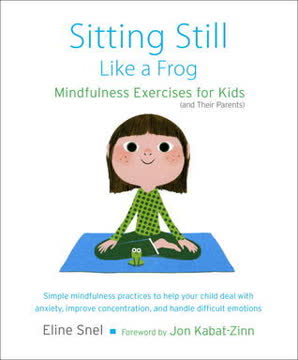
Sitting Still Like a Frog introduces the basics of mindfulness to children in an easy-to-understand and playful way.
Start young. Mindfulness, the practice of present-moment awareness with open and friendly willingness, is an essential life skill in our complex, fast-paced world. Introducing children to mindfulness early helps them cultivate presence of mind, heart, and body, capacities often overlooked but crucial for grounding oneself and making sense of their experiences. This foundational training supports their ability to learn, grow, and contribute uniquely to the world.
Holistic benefits. The book's approach, rooted in Eline Snel's "Mindfulness Matters" program, offers children practical tools to calm down, focus, manage anger, alleviate worry, and become more patient and aware. These exercises, often presented as playful games or adventures, help children develop emotional intelligence and overall well-being, fostering kindness towards themselves and others, and building self-confidence. The program has shown positive changes in school settings, including calmer classrooms and improved concentration.
Beyond cognition. Mindfulness is not just about the head; it's "heartfulness," engaging our entire being and multiple intelligences. Studies in medicine and neuroscience increasingly show that mindfulness training positively influences brain regions related to executive functioning, impulse control, decision-making, emotion regulation, and a sense of bodily connection. For children, whose brains are still developing, this training is vital for optimal learning and protecting against the negative effects of excessive stress.
2. Mindful Parenting: Embracing Presence, Understanding, and Acceptance
The best-known ingredients are friendliness, understanding, openness, and acceptance.
Break old patterns. Parents often react automatically to their children, driven by old patterns or unexamined emotions, leading to disproportionate responses. Mindful parenting encourages a pause, allowing parents to observe their irritation or impatience before reacting. This conscious choice prevents getting carried away by emotions, fostering milder and more understanding responses, and shifting the focus from the situation itself to one's reaction to it.
Surf the waves. Life inevitably brings challenges, or "waves," that cannot be stopped. Mindful parenting teaches parents to "surf" these waves by being truly present without suppressing or wishing away difficult situations. This allows for better-informed choices and actions. The "Pause Button" exercise is beneficial for both children and parents, providing a brief moment to prevent automatic reactions and respond with greater intention.
Core qualities. Three fundamental qualities—presence, understanding, and acceptance—are key to a relaxing and effective parenting approach.
- Presence: Being fully in contact with the current moment, feelings, and thoughts, without immediate judgment.
- Understanding: Relating to children by seeing things from their perspective, genuinely interested in their inner world.
- Acceptance: Recognizing and acknowledging your child's (and your own) thoughts and feelings without wanting to change or manipulate them, fostering a safe nest for self-confidence.
3. The Breath as an Anchor: Finding Calm in the Present Moment
By bringing mindful attention to your breath while you are breathing, you are present in this moment.
Always available. The breath is a powerful, ever-present anchor to the here and now, a constant companion that cannot be forgotten or left behind. By observing its movement, children and adults become more aware of their inner world, noticing if they are tense, calm, or restless. This simple act is the first step towards developing concentration and grounding oneself in the present.
The "Frog" exercise. The "Sitting Still Like a Frog" exercise is an accessible way for children to tune into their breathing. Like a frog that can make enormous leaps but also sit very still, children learn to observe what happens around and within them without immediate reaction, preserving energy. This practice helps them:
- Improve concentration.
- Reduce impulsivity.
- Gain a degree of control over their inner world.
Calm in crisis. Tuning into the breath is effective during both major and minor incidents, such as pre-exam jitters or intense physical pain. The story of Sara, who focused on her breathing after a severe injury, illustrates how this practice can help children stay calm and reduce panic, even when facing scary situations like hospital visits or injections. It teaches them that they need not be carried away by inevitable things.
4. Training Sensory Attention: Engaging with the World Without Judgment
The moment you can keep your jabbering mind at bay and use your senses without judgment, you will begin to experience the world quite differently.
Unmediated reality. Our senses—sight, sound, smell, touch, taste—are gateways to the present moment. We often filter these experiences through a "jabbering mind" that judges, comments, and interprets, often negatively. Learning to observe sensory input without this mental interference reveals a "wondrous thing": unmediated reality, allowing for deeper engagement and retention of information.
"I Am from Mars." The "I Am from Mars" exercise playfully demonstrates this by asking children to imagine they are aliens encountering familiar objects, like raisins, for the first time. By focusing purely on sensory details—shape, color, smell, sound, and taste—without preconceived notions, children discover new aspects of everyday items, like hearing a raisin "squeak." This exercise effectively cultivates open-minded, inquisitive, and nonjudgmental observation.
Mindful engagement. Training the "attention muscle" through sensory exercises enhances awareness and concentration.
- Mindful looking: Observing objects like a twig without judgment, noticing more details over time.
- Mindful listening: Identifying sounds without labeling them, discerning pitch, rhythm, and location, and practicing non-judgmental listening to others.
- Mindful eating: Taking a single bite and noticing all tastes, textures, and sensations without immediate judgment, leading to a deeper appreciation of food and earlier recognition of fullness.
5. Body Awareness: Listening to Your Inner Signals and Limits
Your body can tell you a great deal. Like a finely tuned instrument, it responds to emotions such as shock, tension, fear, and happiness, to cheerful thoughts or a head full of worries.
Body as barometer. The body constantly sends signals about our emotional state, physical needs, and limits—from stiff shoulders and heart palpitations to feelings of energy or fatigue. We often dismiss or deny these signals, leading to destructive habits like overworking or emotional suppression. Mindfulness teaches us to move "out of your head and into your body," acknowledging these signals without judgment.
Recognizing limits. By listening to the body, children learn about their physical and emotional limits. The "Stretching and Breathing" exercise, where children reach as high as possible while noticing their breath and muscle sensations, helps them experience "enough"—not too much, not too little, but just right. This awareness is crucial for understanding boundaries in eating, playing, or testing rules, fostering self-regulation.
Conscious relaxation. Some children struggle to sit still or relax. The "Spaghetti Test" audio exercise helps them consciously relax their bodies by imagining transforming stiff, uncooked spaghetti into soft, perfectly cooked strands. This practice helps them recognize calm and restlessness, offering a break and a chance "just to be." Regularly checking in with the body, through exercises or simple questions like "How do I feel?", builds a deeper connection to one's physical and emotional state.
6. Emotional Resilience: Weathering Your Inner Storms
By not wishing these feelings away or wishing they were different from what they are in the moment, you learn to notice the “weather” inside and to root yourself in what is really happening.
Inner climate. Our minds are like an ocean, capable of calm, sunny days or raging storms, reflecting our moods and intense emotions. Instead of resisting or wishing away these internal "weather patterns," mindfulness teaches us to notice them and root ourselves in the present reality of our feelings. This acceptance is crucial for developing emotional resilience.
"Your Personal Weather Report." This exercise helps children understand their interior world by asking them to identify their current "inner weather"—sunny, rainy, stormy, or overcast. The key is to simply observe this mood without trying to change it, just as one cannot change the external weather. This practice teaches children that moods are temporary, they blow over, and there's no need to take immediate action, offering a sense of relief.
Parental role. For parents, acknowledging a child's "storm" without resistance provides an opportunity to connect and offer support. The story of the grumpy son illustrates how a parent's mindful presence and acceptance can de-escalate intense emotions, allowing the child to express underlying distress. This approach teaches children that it's okay to have difficult feelings and that parents are there to support them, even during severe emotional conditions.
7. Handling Difficult Feelings: Acknowledging, Not Suppressing
Feelings are simply feelings, and it’s important that your child gets the message that “you are not your feelings; you have them.”
Feelings are temporary. Feelings—anger, sadness, fear, happiness—are natural responses felt in the body, often accompanied by thoughts. Children frequently attach judgments to these feelings or internalize others' opinions, leading to suppression or the belief that "negative" feelings are wrong. Mindfulness teaches that feelings are temporary and that "you are not your feelings; you have them," allowing for acceptance without being overwhelmed.
Three key lessons. To handle feelings effectively, children learn:
- To feel feelings in their body, stay with them, and notice their transient nature, without getting carried away or suppressing them.
- To understand they have feelings, rather than being their feelings (e.g., "I feel sad" instead of "I am a crybaby").
- That while all feelings are okay, not all behavior is; they can choose how to express emotions.
Mindful tools. The book offers audio exercises to help children navigate emotional maelstroms:
- "The Pause Button": Encourages stopping to note inner state before reacting.
- "First Aid for Unpleasant Feelings": Teaches noticing, experiencing, and admitting feelings.
- "A Safe Place": Guides children to an inner sanctuary where they can be completely themselves. These practices foster acceptance and reduce fear of intense emotions, showing that feelings pass.
8. Managing Worries: Observing Thoughts, Not Believing Them
Don’t believe all thoughts (the thought “I’ll never manage to get a good grade” is not true).
The "conveyor belt." Worrying arises from wanting things to be different from how they are, often fueled by a relentless stream of thoughts—a "conveyor belt" of ideas, opinions, doubts, and memories about the past, present, and future. We mistakenly believe worrying helps solve problems, but it often just creates more mental noise and distress.
Thoughts are not facts. Children can learn to influence their thoughts by understanding that:
- Thoughts are like little voices or storytellers in their heads, not necessarily truths.
- They are not their thoughts; they have them.
- They can choose to observe thoughts like passing clouds rather than engaging with or believing them, especially untrue ones like "I'll fail my exams."
Strategies for worries. Practical exercises help children manage worrying thoughts:
- "Observing Your Thoughts": A group exercise where participants identify thoughts in response to questions, revealing the mind's constant activity.
- "First Aid for Worries": Teaches shifting attention from the head to the calm, thought-free breath in the abdomen.
- "The Little Box of Worries": A tangible method for children to "deposit" their worries into a decorated box before bed, creating distance from them.
9. The Power of Kindness: Cultivating Compassion for Self and Others
Kindness is one of the most powerful qualities a person can possess. It is like a gentle rain that falls everywhere, without excluding a single place.
Unconditional warmth. Kindness is a nonjudgmental, inclusive quality that touches the heart, fostering trust, balance, and openness, even in difficult times. The story of the Surinamese cleaning woman in a hospital ward illustrates how genuine warmth and unconditional love can significantly aid healing and recovery, highlighting kindness as a potent, often overlooked, force.
Beyond retaliation. When faced with intimidation or bullying, the book suggests that while fighting back with aggression only escalates conflict, showing strength without venom is effective. The fable of the snake teaches that one can assert boundaries and command respect without causing harm. This approach empowers children like Sander, who learned to stand up for himself through judo and assertive responses, reducing his victimhood.
A skill to cultivate. Kindness is a skill that can be practiced and developed.
- "Compliment Ball": An exercise where children share sincere compliments with classmates, fostering a positive and supportive classroom environment, reducing cliques, and increasing mutual appreciation.
- "A Little Boost" & "The Secret of the Heart Chamber": Audio exercises that enhance awareness of enjoyable moments and encourage sending warm, loving feelings to others and oneself.
- "Noticing Your Unkindness": Using an elastic band bracelet to track moments of unkindness, raising awareness without self-reproach, and offering a choice to change behavior.
10. Patience, Trust, and Letting Go: Embracing Change and Inner Wisdom
If only we had the patience of a caterpillar in a cocoon, waiting to transform into a butterfly.
Navigating desires. We often wish for things to be different—better, safer, easier. While desires are healthy and can be a first step towards positive change, they can also trap us in what we don't have. The challenge lies in handling desires, especially those outside our control, without becoming consumed by them. This requires a shift in attitude, often aided by visualization.
Inner movie theater. Our minds constantly generate images, both scary "nightmare visions" and positive "dream visions." By deliberately tapping into this skill, children can become "film directors" of their inner world, creating beautiful and enjoyable pictures. Examples include a girl visualizing herself cycling effortlessly or a student picturing a confident presentation. These images reinforce existing potential, rather than manipulating reality.
The "Wishing Tree." This visualization technique introduces children to patience, trust, and letting go. They imagine a special tree where they entrust their deepest heart's desires to a dove, releasing it to fly away. This teaches them:
- Patience: Understanding that there is a time for everything.
- Trust: Believing that change will always come, even if not exactly as expected.
- Letting Go: Releasing the need to control or manipulate the outcome, realizing that change often occurs when one stops obsessing. This process is liberating, opening doors to new possibilities and fostering inner peace.
Review Summary
Reviews for Sitting Still Like a Frog are largely positive, averaging 4.17/5. Parents, teachers, and therapists praise its simple, accessible mindfulness exercises for children aged 5–12, noting improvements in focus, emotional regulation, and anxiety. The included CD of guided meditations is frequently highlighted as especially helpful. Some critics feel the anecdotes are overly optimistic, and one reviewer raised concerns about messaging around overeating. Many adults report benefiting from the exercises themselves, and several multilingual reviewers from diverse countries recommend it broadly.