
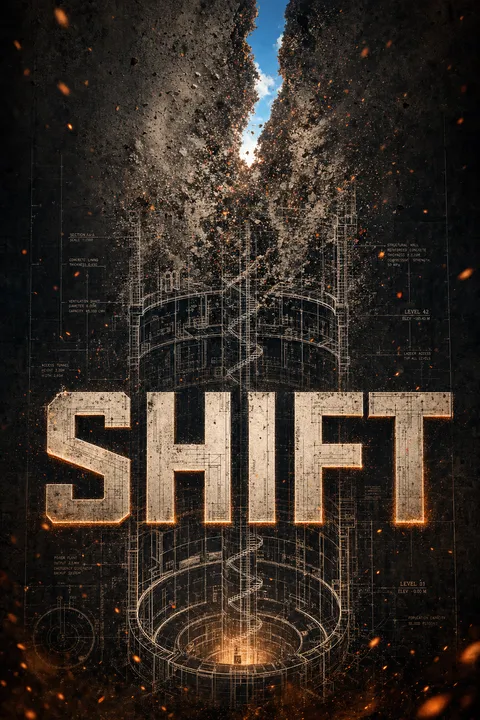


Plot Summary
Prologue
In 2110, beneath the hills of Georgia, a man named Troy1 wakes inside a frost-rimmed pod that feels like a tomb. Weak hands lift him from his coffin; strangers in white coax bitter pills and cold water down his throat. Memories rain down and dissolve almost as fast as they arrive, scenes from long nightmares slipping through his fingers.
He sobs into his palms while a sympathetic hand rests on his head, and the men who woke him let him grieve. It is a courtesy, the narration tells us, passed from one waking soul to the next: the right to weep before the drugs finish their work and the past is scrubbed away, until eventually he will forget he ever cried at all.
The opening fuses the book's twin engines: the technological (self-replicating nanobots, memory-erasing drugs) and the human (grief that resists chemistry). Howey stages resurrection as entombment, inverting hope into horror; to wake is to be buried alive in a stolen future. The unnamed courtesy of allowing tears before forgetting establishes the central ethical texture of Silo One, where cruelty is administered gently and complicity is systematized. That memory can be pharmaceutically deleted frames the entire trilogy's question: is a person who cannot remember still guilty, still human, still himself? Troy weeping over losses he can no longer name previews the protagonist's defining struggle against enforced amnesia.
A Senator's Buried Favor
In 2049 Washington, freshman Congressman Donald Keene1 answers a summons from Senator Paul Thurman2 of Georgia, a family friend who bounced him on his knee as a boy and bankrolled his election.
Thurman2 slides across a folder containing Donald's1 own forgotten college architecture drawing, a cylindrical tower, and asks him to redesign it, this time sunk underground beside a nuclear waste facility outside Atlanta. Trained as an architect before entering politics, Donald1 is flattered and uneasy. Thurman2 frames it as a just-in-case shelter, kept in-house because it must be like family.
Donald1 accepts, not grasping that he is being maneuvered rather than merely hired. A single odd instruction, that the building will need grow lights instead of sunlight, hints at something far stranger than an emergency bunker.
The inciting maneuver disguises itself as flattery. Howey seeds the trilogy's architecture of complicity here: evil requires skilled, decent people who believe they are doing ordinary work. Donald's professional pride becomes the hook, his gift for design weaponized against a future he cannot imagine. Thurman's insistence on family and trust reframes coercion as intimacy, a pattern that recurs whenever power grooms its instruments. The buried tower literalizes repression, a life-sustaining structure sunk out of sight, and the grow-lights detail plants dramatic irony: readers sense the underground purpose Donald cannot. The scene interrogates how monstrous projects get built, not by monsters, but by the competent and the loyal.
The Ex at the Desk
Anna Thurman,3 the senator's2 daughter and Donald's1 college girlfriend, appears unannounced in his office, wiring up a second monitor and volunteering as lead engineer on the shelter's mechanical spaces. Married to Helen6 back in Savannah, Donald1 feels old attraction stir and guilt chase it.
Helen,6 on the phone, remembers Anna3 flirting years earlier and warns Donald1 not to trust the people surrounding him. He insists their collaboration will stay purely digital, plans traded by email, and keeps careful distance.
His college friend Mick Webb7 handles logistics on the same secret Atlanta build. Donald1 pours himself into the work, rediscovering how much he loves designing, while the project's obsessive compartmentalization, nobody permitted to see the whole plan, gnaws at him more each week.
The domestic triangle is not filler; it is the mechanism by which Donald's fate will later be engineered. Howey braids private betrayal with civilizational betrayal, so that intimacy and conspiracy share the same grammar of secrecy and denial. Anna's easy invasion of Donald's space mirrors the state's invasion of every character's autonomy. Helen's intuition, dismissed as jealousy, proves the novel's recurring truth: those closest to power sense its rot first and are least believed. The compartmentalized blueprints dramatize how large evils are assembled from fragments no single worker fully sees, a bureaucratic diffusion of responsibility that lets everyone feel innocent of the whole they collectively construct.
The Order and the Invisible War
Summoned to a nanobath chamber in Boston, Thurman2 warns Donald1 that microscopic programmable weapons, keyed to a person's DNA, are being built by enemies abroad and will one day be released on everyone. He hands Donald1 a heavy book called the Order and instructs him to memorize it, then recruits Donald1 and Helen6 onto a vague alert team.
Shaken, Donald1 tries at home to explain to Helen6 that unstoppable invisible machines could end all life. She concludes he is having a breakdown and wants to call his sister's8 psychiatrist. To quiet his mounting dread, Donald1 begins taking pills filled under his sister Charlotte's8 name. He can no longer tell whether he is decoding a real conspiracy or simply losing his grip on reality.
Thurman's tutorial blurs truth and paranoia deliberately; his earlier lesson that denial mixes fact with lie until neither can be told apart now governs Donald's psyche. The nanobots literalize a modern terror: threats too small to see, too fast to stop, indistinguishable from the body's own processes. Crucially, Donald starts medicating to blunt fear, unknowingly enacting the exact suppression the silos will later automate. Helen's move toward psychiatry reframes prophetic dread as pathology, the age-old fate of Cassandras. Howey positions knowledge itself as the wound: to perceive the coming end is to be alone, unhinged, and chemically pressured back into comfortable forgetting.
Silo Twelve Goes Dark
The narrative jumps to 2110, where Troy1 serves a six-month shift overseeing all fifty underground silos from Silo One. Bitter blue pills numb his grief. From the comm room he watches Silo Twelve unravel: crowds trampling one another up a staircase, an airlock breached, a lone deputy pleading for orders.
Following the Order's script, Troy1 commands gas canisters fired and the facility sealed, then watches its residents die on the poisoned outer hills. Numb and trembling, he drags a red X across Silo Twelve on the master chart.
Investigating, he traces the collapse to a suicidal young IT shadow whose despair infected everyone above him. The horror fractures Troy's1 conditioning, and he begins secretly pocketing his pills, choosing to remember rather than forget.
This is the reader's first full immersion in the silo machinery, and Howey stages atrocity as procedure: buttons, scripts, forbidden vocabulary. The banality is the point. Troy's uncanny calm during mass death indicts the anesthetizing power of routine and pharmacology alike. His red X, a bureaucratic gesture, contains thousands of erased lives, echoing the novel's later Holocaust imagery of administrators processing extermination. The decision to stop taking pills is the story's true rebellion: to feel is to resist. Memory becomes moral agency. That grief must be smuggled, hidden in the cheek like contraband, reveals a regime that governs not through walls alone but through the chemistry of the interior self.
The Anthem and the Mushroom Clouds
In 2052 the finished silos, disguised as fairground bowls, host the National Convention. Donald's1 sister Charlotte,8 an Air Force drone pilot, arrives as a surprise guest. As a girl sings the anthem and jets scream overhead, mushroom clouds bloom over distant Atlanta.
Anna3 and Charlotte8 wrestle a stunned Donald1 down a concrete ramp into a silo while air-raid sirens wail. Too late, Donald1 understands: Thurman2 orchestrated the apocalypse, herding panicked crowds underground through staged bombs and invisible poison already seeded in the air.
Helen,6 cut off by a dead cell network, is funneled into a different silo entirely. Donald1 is swallowed by the earth he helped draw, losing his wife6 somewhere over a hill he will never be allowed to cross.
The convergence of the 2049 storyline lands with brutal irony: the anthem's rockets and bombs bursting in air become literal. Howey exploits patriotic ritual as the perfect cover for genocide, celebration and annihilation collapsing into one image. Donald's helplessness, separated from Helen by something as mundane as an overloaded network, universalizes the loss; catastrophe arrives not with clear enemies but with logistics and bad timing. The staged bombs are theater to trigger the herd instinct Thurman later names as humanity's fatal restlessness. This is the point of no return, the moment Donald's private guilt and the species' extinction fuse, binding him forever to the machine he unwittingly perfected.
The Man Named Troy Remembers
On Silo One's medical level, helping deep-freeze an old man who shrieks that his true name is Carlton, Troy1 drifts through rows of frozen women and children. He finds pods labeled Helen, then Helena, faces of strangers who chose familiar names for comfort. The truth crashes back: he is not Troy, he is Donald,1 and the sleeping woman he was drawn to is not his wife at all.
Overwhelmed by returning memory, he collapses into a seizure of grief and recognition among the coffins. The doctors, who retain their memories because they carry no regret about what was done, sedate him and return him to the deep freeze, tightening the drugs around everything his ruined mind cannot bear to hold.
Identity dissolves and reasserts in the same breath. The invented names, chosen as coded keepsakes, reveal a poignant human hunger to smuggle love past the censors of the mind. Carlton's cry, echoing later characters, dramatizes selfhood as the last thing surrendered. Howey's chilling detail, that those who administer the drugs are exempt because they feel no guilt, articulates the trilogy's moral thesis: conscience is what the system must chemically excise. Donald's recovered name is a triumph and a curse, restoring him only to unbearable pain. His forced re-freezing enacts the regime's method: not killing dissent but suspending it, filing the inconvenient conscience away like an overstocked body.
Anna in the War Room
Thawed again for a second shift, Donald1 is told a distant silo is failing. Deep in the armory he finds Anna,3 awake for nearly a year, living in a war room papered with silo schematics. Her father2 woke her because Silo Forty went dark, hacked its own systems, and the blackout is spreading to neighboring facilities.
Anna,3 an authority on wireless control, was pulled from the freeze to sever and remotely collapse the compromised silos. Worse: Victor,9 the psychiatrist who authored the Order and designed the entire psychological architecture, has shot himself at his desk, leaving Donald's1 old Silo Twelve report resting atop his notes. Anna3 presses Donald1 to help, insisting Victor9 believed his report held the key to saving another troubled silo, Eighteen.
Anna's reappearance reframes the trilogy as a chamber drama among the last conspirators, each entombed with their guilt. Victor's suicide, the death of the man who understood minds best, signals that the system's own architects cannot survive full knowledge of it, foreshadowing Donald's arc. The spreading darkness of Silo Forty introduces the plot's external threat: a rebellion the founders cannot see or stop, undermining their fantasy of total control. Howey contrasts Anna's cold operational competence, collapsing entire societies by radio, with Donald's raw grief, dramatizing two responses to atrocity: management versus mourning. The war room, buried among weapons, literalizes minds at war with their own consciences.
A Century Too Late
Combing the silo databases for his lost wife,6 Donald1 reasons she would honor their dog's name and finds her at last: Karma Brewer6 of Silo Two, a teacher who became a judge and lived to eighty-two. Her records list a husband, Rick Brewer,7 and the photographs confirm the unbearable: it was Mick,7 his closest friend. They raised two children and grandchildren together.
The discovery hollows him. A hundred years too late, Donald1 learns that the man who once toured him through the bunker and confessed loving him like a brother7 had claimed the ordinary domestic life Donald1 was robbed of. Grief hardens toward a rage without a target yet. Anna3 comforts him at night, and their old intimacy quietly reignites amid his guilt.
Howey weaponizes the database, a tool of surveillance, into an instrument of personal devastation, letting Donald watch a beloved life unfold entirely without him. The revelation reframes Mick's earlier cryptic sentimentality, seeding a betrayal whose full shape stays hidden. Grief here mutates into something combustible: Donald resents Helen for surviving, for not waiting through an impossibility, exposing the ugly selfishness love can breed. His drift toward Anna, even as loyalty to a dead woman torments him, portrays the erosion of principle under isolation and centuries of loss. The scene deepens the trilogy's meditation on time as the cruelest jailer, outliving everyone one is meant to protect.
The Porter and the Crow
Inside troubled Silo Eighteen, Mission Jones,4 a young porter born illegally and haunted that his mother was sent to clean the outside for bearing him, hauls loads up a silo splitting apart, where farmers torch crops and neighbors arm themselves.
Visiting his childhood teacher, the ancient Mrs. Crowe,11 whose schoolroom fills the upper Nest, he carries a coded note to his friend Rodny,12 sealed behind the steel doors of IT among humming servers. Rodny,12 gaunt and terrified, secretly presses a scrap into Mission's4 palm reading only, help me.
Explosions and fires erupt; armed young recruits in white overalls flood the stairwell. Mission's4 friend Cam is killed by a bomb meant to sow chaos, and the porter4 finds himself blamed and hunted through the levels.
The Silo Eighteen thread grounds the abstract genocide in a single, tender life. Mission's origin, a child whose birth cost his mother her life, embodies the silos' obscene arithmetic of population control, where a death must precede a birth. Howey uses the porter's climb, hauling burdens up an endless spiral, as a physical metaphor for inherited guilt and social gravity. Rodny's hidden plea plants the mystery that will link the silo's manufactured unrest to Silo One's unseen puppeteers. The gathering violence reveals how easily order becomes atrocity when trust erodes: everyone hoarding, everyone arming, a society engineering its own collapse under invisible encouragement from above.
The One Who Remembers
Donald1 finally decodes Victor's9 cryptic marks: the psychiatrist wrote around a paragraph, not over it, singling out a person in Silo Eighteen who remembers the vanished world15 and spreads the discontent fueling its endless revolts.
Searching the database for someone like himself, a medication refuser, a doubter, Donald1 and Thurman2 pinpoint the culprit15 and radio the silo. Rather than executing him, Thurman2 conducts a masterful Rite of Initiation over the airwaves, breaking down and rebuilding the frightened shadow,15 redirecting his rage into loyalty.
Watching the biometric waveforms flatten into steel resolve, Donald1 sees a rebellious boy transformed into a future silo head,15 indoctrinated to believe that sacrifice and cruelty toward one's own people are the price of protecting them.
The Rite is Howey's most disturbing set piece on ideological capture: rebellion is not crushed but reprogrammed, anger recycled into the enforcement of the very order that produced it. The shadow's conversion mirrors radicalization in reverse, a therapeutic-sounding dismantling of self toward obedience. Donald's detective work turns his own resistance into a diagnostic tool for identifying and neutralizing others like him, implicating him further in the machine. The scene interrogates how systems perpetuate themselves by absorbing dissent, turning the once-defiant into their fiercest guardians. Thurman's velvet coercion, tearing down then rebuilding, echoes the grooming that first captured Donald, revealing a self-replicating engine of manufactured consent.
A Birthday for Dying
Hunted through Silo Eighteen, Mission4 is smuggled upward inside a body bag by fellow porters Joel and Lyn, enduring the humiliation of being carried like the corpses he once hauled. He reunites with the Crow11 and friends Frankie and Allie,17 learning that his young half-brother Riley died in the fighting. Then Rodny12 arrives, transformed, in crisp white overalls, flanked by armed men.
He denounces Mrs. Crowe,11 charging that her tales of a beautiful lost world breed the very hatred driving each generation to revolt. He levels a pistol at the old woman.11 Mission4 lunges between them; the gun roars, killing both the porter and his teacher.11 On his seventeenth birthday, Mission4 dies in Allie's17 arms, whispering only that today he was born.
Mission's arc closes on the trilogy's cruelest irony: the reprogrammed rebel becomes the executioner of the woman who nurtured his imagination. Rodny's accusation contains a poisoned truth, that hope and memory of a better world do make the present unbearable, weaponizing the regime's own logic about the dangers of the wallscreen and the Legacy. The Crow embodies cultural memory itself, and her silencing dramatizes how authoritarian systems must murder the past to secure the future. Mission's death on his birthday, the deathday-birthday motif he carried throughout, completes a life defined by the silo's brutal exchange rate: one life always traded for another, sacrifice as the only inheritance.
The Run for Open Sky
Unable to bear another induced sleep, Donald1 smuggles himself into a drone lift and rides to the surface in a cleaning suit, determined to reach the hill above Helen's6 silo and die free beneath open clouds. He claws to the ridge and glimpses the concrete tower marking her resting place before Thurman2 and the others tackle him in the toxic wind and drag him back down.
Sedated, tears freezing pale blue on his cheeks, Donald1 surrenders to darkness hoping it will finally be permanent. Erskine's10 remembered words haunt the moment, that the world might be better with men like Donald1 in charge, spoken as the needle bites. He goes under believing he has failed even at the small mercy of dying.
Donald's suicidal pilgrimage recasts the forbidden Outside as the only space of freedom, inverting the silo's terror of the surface into a longing for release. The gesture is both despair and defiance: choosing his own death is the one autonomy left. That the founders drag him back, denying him even death, exposes the regime's total claim over life and its ending. Erskine's line, planted as an ironic epitaph, will ripen into prophecy. Howey frames the toxic wind and failing suit as the boundary of the founders' engineered world, foreshadowing later revelations. Donald's blue tears, colored by the machines in his blood, literalize a body no longer entirely his own.
Waking as the Shepherd
Third shift, 2345. Donald1 is roused yet again, but now everyone calls him Thurman, his boots and badge bearing another man's2 name, a switch engineered while he slept. Groggy in loose overalls, he learns a cleaner13 walked out of Silo Eighteen and, against all precedent, crested the hill without dying. The awed staff, who dub him the Shepherd,1 defer to his every word.
Donald1 plays the role, ordering restraint instead of a strike. Studying the anomaly, he recognizes a chilling echo from the collapse of Silo Seventeen decades earlier: the same blackout signature as the hacked Silo Forty. He begins to suspect Seventeen was never truly destroyed and that the wandering cleaner13 might stumble upon survivors hidden inside its dark shell.
The identity switch deepens the trilogy's theme that names are arbitrary in a place designed to sever people from their pasts; anyone can become anyone, and authority is a costume. Donald inheriting the mantle of the very man he loathes stages the prisoner-guard experiment he will later cite: systems, not individuals, generate power and cruelty. The cleaner who survives the hill reactivates the dangerous hope introduced by Donald's own surface run. Meanwhile his pattern recognition, linking Seventeen to Forty, positions him as investigator of a cover-up within the cover-up, a puppet slowly grasping the strings, driven by the same relentless compulsion to know that has defined and doomed him.
The Boy Who Became Solo
The story of Silo Seventeen unspools. In 2312, sixteen-year-old Jimmy Parker5 is pulled from class by his mother as the silo revolts and an airlock opens early. His IT father hides him in a secret warren beneath the servers, entrusts him with the silo's key and a code, twelve-eighteen, then leaves to rescue Jimmy's5 mother.
Both parents are killed at the great steel door while Jimmy,5 unable to make himself open it, listens in helpless terror. Alone, he survives on canned food, marks the passing days by scratching a server, and shoots intruders who guess the code. Slowly he loses himself, renames himself Solo,5 adopts a stray black cat he calls Shadow,16 and endures decades of crushing isolation as floodwaters climb the levels below.
Solo's chapters are the trilogy's raw study of solitude as slow annihilation of self. Jimmy's inability to open the door, condemning his parents, becomes an unhealable wound that fractures his identity into a third-person survivor, Solo, a psychological defense against unbearable guilt. Howey renders time as an antagonist, measured in scratches and rust, where the greatest threat is not violence but the erosion of language, sanity, and the will to persist. The cat restores a sliver of tenderness and speech, dramatizing how relationship, even with an animal, reconstitutes personhood. The rising flood externalizes engulfment: a human being drowning by degrees in his own preserved, purposeless survival.
Blue Sky Beyond the Ash
As the Shepherd,1 Donald1 secretly thaws his sister Charlotte,8 a former drone pilot, wanting one ally he can trust. Together they wrestle a drone into the launch lift and fly it out, straight across the dead landscape and past the ring of silos. The machine's sensors degrade exactly as cleaning suits are engineered to fail at a set distance, an invisible force chewing it apart.
But in its final seconds, before the camera dies, the drone punches through into color: blue skies, green grass, a living world just beyond the poisoned zone. Donald1 weeps with vindication. The devastation is precise and local, a deliberate quarantine rather than a dead planet, and the hope this ignites becomes almost too much to carry.
The drone flight is the trilogy's revelatory hinge: the apocalypse is bounded, engineered, and survivable elsewhere, transforming the founders' ruined-world justification into a lie of containment. Charlotte's reawakening gives Donald his first uncorrupted bond in centuries, kinship as the antidote to the system's atomizing loneliness. Howey turns a weapon of war, the drone, into an instrument of discovery, its dying camera bequeathing hope. The precisely failing technology confirms the surface poison is a designed leash, not nature's verdict. That green world beyond the browns reframes every silo as an unnecessary prison, and Donald's tears mark the collision of vindication with horror at the deliberateness of the deception.
The Suicide Pact Unmasked
Donald1 uncovers the founders' true bargain in a yellowed memo: the silos are not lifeboats but a culling. Only a single silo will ever be freed; all the rest, and everyone in Silo One, are meant to die so that the knowledge of world-ending weapons dies with them.
Realizing Anna3 engineered his entire life, switching him with Mick7 to keep him from Helen,6 Donald1 wakes her, then quietly poisons her drink and holds her as she slips away. He then thaws Thurman2 himself, binds his wrists, and forces the old man to confess that no one can be permitted to remember. Donald1 shoots his mentor2 in his pod and, the reluctant architect turned executioner, seizes the helm as the silo's grim new shepherd.
The revelation reframes the entire enterprise: not salvation but a self-destructing quarantine of dangerous knowledge, humanity thinned to a single ignorant remnant. Donald's twin killings complete his transformation from puppet to agent, though Howey refuses clean catharsis; the murders are acts of grief and rage as much as justice. Anna's death answers the personal betrayal, Thurman's the civilizational one, collapsing the private and political arcs into one reckoning. The prisoner-guard motif culminates: Donald becomes the jailer he despised, proving his own thesis that the system, not the man, corrupts. His seizing of power reads less as triumph than as the assumption of a curse, knowledge as both weapon and wound.
Epilogue
Alone in Silo One's comm room, Donald1 places a call to Silo Eighteen and reaches not its head but the defiant former cleaner turned mayor, Juliette,13 the woman who walked the hill and survived. He warns her, half threat and half plea, to be careful where she digs.
She answers coolly that she is sitting in a room full of the truth, that she has seen the forbidden books, and that she intends to unearth everything the founders buried. When he cautions her again, she tells him she would hate for him to hear them coming. The line holds two adversaries who are, in different ways, both prisoners hunting the same buried truth.
The epilogue pivots the trilogy from origin toward consequence, handing the torch from Donald's reluctant power to Juliette's active defiance. Their exchange stages a standoff between two truth-seekers on opposite sides of the same lie, mirror images of the compulsion to know. Juliette's promise to dig, and her threat that he will not hear them coming, transforms the buried culling into the seed of open revolt, inverting the founders' logic of silence and containment. Howey ends not on resolution but on ignition: the very hope the silos were built to suppress now speaks back through the wires. Knowledge, so long weaponized against the many, becomes their tunnel toward the surface.
Analysis
Shift is a prequel obsessed with complicity, arguing that apocalypse arrives not through cartoon villains but through competent, loyal, frightened people doing compartmentalized jobs. Howey's recurring image, drawn from Donald's1 dread at the Holocaust museum, is the draftsman coerced into inking the blueprints of his own extermination, or the bulldozer driver with the serene face; horror is administered, filed, scripted. Donald,1 an architect who literally drew the silos, is the reader's proxy for the guilt of participation, forever asking whether a good man inside an evil system remains good, or becomes its most useful part. The prisoner-guard motif he cites answers grimly: systems, not souls, generate cruelty, and any hand can hold the gun. Memory is the book's moral organ. The regime governs not merely through concrete walls but through the chemistry of forgetting; to remember is to resist, and grief becomes contraband hidden in the cheek. Against enforced amnesia Howey sets hope, embodied in the wallscreen and the Legacy, which the founders fear precisely because the human compulsion to see over the next hill cannot be fully extinguished. The trilogy's deepest cruelty is its inversion of salvation: the silos are lifeboats designed to sink, a suicide pact meant to bury dangerous knowledge along with almost everyone who carries it. Yet the drone's final image, blue sky beyond the ash, insists the devastation is engineered and bounded, a lie of containment rather than nature's verdict. Through three interlocking lives, the doomed porter Mission,4 the shattered survivor Solo,5 and the reawakening Donald,1 Howey studies how individuals endure engineered despair: through loyalty, through a cat,16 through the stubborn refusal to forget. The ending withholds catharsis, handing power to a reluctant executioner1 and igniting rebellion in a defiant cleaner,13 suggesting that truth, once weaponized against the many, can become their tunnel upward.
Review Summary
Shift received mixed reviews from readers. Many praised the backstory and world-building, finding it a compelling prequel that answered questions from Wool. However, some felt it lacked the excitement and strong characters of the first book. The pacing was criticized as slow by some, while others found it addictive and hard to put down. Donald, the main character, was divisive - some readers connected with him, while others found him frustrating. Overall, most fans of Wool enjoyed the additional context Shift provided, despite some flaws.
People Also Read




Characters
Donald Keene
Reluctant architect of doomA freshman congressman trained as an architect, pulled into a secret project by a mentor he trusts like family2. Married to Helen6, unsettled by his ex Anna3, Donald is curious, guilt-ridden, and prone to anxiety, yet stubbornly resistant to the enforced forgetting others accept. His defining trait is a compulsion to know, to peel back comforting lies even when the truth destroys him. Across the centuries he serves shifts underground under names not his own, waking and grieving and burying, forever the outsider steering a machine he never wished to build. Psychologically he is a man drowning in complicity, seeking either redemption or oblivion, unable to decide whether he is a good man trapped in an evil system or its willing instrument. His loyalty to the dead outlasts his loyalty to the living.
Senator Paul Thurman
Ageless mastermind and mentorA decorated war veteran turned powerful senator from Georgia, kept youthful by nanobath treatments, who has known Donald1 since childhood. Thurman speaks in riddles about denial, aliens, and invisible weapons, blending truth and lie until neither can be told apart. Commanding, patriarchal, and utterly certain, he treats catastrophic decisions as battlefield triage, killing few to save many, or so he insists. He grooms loyal instruments with the language of family and trust. Beneath the iron calm lies a man who has decided he alone must bear the weight of unthinkable choices, a self-appointed savior whose certainty makes him monstrous. He is the novel's study of how conviction, competence, and control curdle into tyranny dressed as duty.
Anna Thurman
Brilliant engineer, old flameThe senator's2 daughter, an MIT-trained specialist in wireless systems, and Donald's1 college girlfriend. Confident, sensual, and coolly capable, Anna moves through the world as if entitled to bend it toward her wishes. She works alongside Donald1 on the buried facility and, later, on containing rebellious silos from a war room. Warm and comforting one moment, coldly operational the next, she embodies the seductive danger of intimacy entangled with power. Psychologically she is driven by a fierce refusal of loneliness and a willingness to reshape others' lives to secure her own companionship, a possessiveness that wears the mask of love. Her competence is matched only by her capacity to rationalize what she takes.
Mission Jones
Burdened young porterA seventeen-year-old porter in Silo Eighteen, born illegally, haunted that his mother was sent to clean the outside for bearing him. Mission hauls heavy loads up an endless spiral staircase through a silo sliding toward violence. Angry, tender, and quietly self-destructive, he carries both physical burdens and inherited guilt, resenting the family and farms he fled while aching to belong. He runs messages and dark thoughts alike between the levels. His arc explores how a society's cruel arithmetic of birth and death shapes a boy who cannot see his own worth, and how loyalty to friends becomes the only meaning he trusts. He marks his birthday as a deathday, forever measuring his life against the mother it cost.
Jimmy Parker (Solo)
Boy alone in a dead siloA sixteen-year-old hidden by his IT father beneath the servers of Silo Seventeen as it collapses, entrusted with the silo's key and a secret code. After losing his parents at the great steel door, Jimmy survives alone for decades, gradually renaming himself Solo and speaking of himself in fractured ways. Resourceful, obsessive, and increasingly unmoored, he becomes an unwilling expert in how things rust, rot, and break down. A stray cat named Shadow16 restores a fragile thread of tenderness and speech. His story is the trilogy's meditation on solitude as slow psychic erosion, guilt that splits identity, and the stubborn animal persistence of a human being refusing, day by scratched day, to fully disappear.
Helen
Donald's grounded wifeDonald's1 wife back in Savannah, warm, perceptive, and wary of the powerful people her husband works for. She senses the rot around Thurman2 and Anna3 before Donald1 will admit it, and worries his ambition is changing him. Dismissed at times as merely jealous, her intuition proves painfully sound. She represents the ordinary domestic life Donald1 sacrifices, and her memory anchors his grief across the centuries, the human tether he can neither reach nor release.
Mick Webb
Charismatic college friendDonald's1 tall, charming college buddy and fellow congressman, working logistics on the same secret Atlanta project. Easygoing and confident, quick with a joke and a shoulder squeeze, Mick teases Donald1 about his domestic life while harboring his own quiet sentiments. His cryptic tour of the finished bunker, and his talk of giving up a coveted assignment, hint at loyalties and sacrifices deeper and stranger than Donald1 grasps at the time.
Charlotte Keene
Donald's soldier sisterDonald's1 younger sister, an Air Force drone pilot hardened by remotely killing targets overseas and diagnosed with battle fatigue. Fierce, honest, and frozen in Donald's1 memory as the teenager who enlisted, she refuses the medications that dull fear, insisting the fear keeps her human. Practical and steady, she becomes the rare person Donald1 can trust completely, a bond of kinship set against a world engineered to isolate everyone from everyone.
Victor (Vincent DiMarco)
Architect of the psychologyThe gray-haired psychiatrist who authored the Order and designed the silos' entire system of psychological control. Brilliant at reading minds yet poor at communicating, Victor understood human nature better than anyone and used it to engineer obedience through medication, routine, and managed fear. Composed and enigmatic, he privately wrestles with whether humanity was ever worth saving, a doubt that gnaws beneath his certainty and shadows every calm decision he makes.
Erskine
Discoverer of the threatA wiry, bespectacled British scientist who once built microscopic medical machines and first detected the enemy nanobots that justified the whole scheme. Thoughtful and mournful, Erskine coordinates the shifts and takes a paternal liking to Donald1. He explains the founders' reasoning with the weary conviction of a man who argued against it, lost, and now tends the consequences, believing perhaps that better men than himself should be in charge.
Mrs. Crowe (the Crow)
Ancient beloved teacherThe impossibly old schoolteacher of Silo Eighteen, perched for generations in the Nest, teaching children with songs and stories of a beautiful lost world of blue skies and green fields. Beloved, sly, and fiercely devoted to her students, she is a living repository of forbidden memory and hope. Her tales inspire dreams and discontent alike, making her both a cherished mother figure and, to some, a dangerous keeper of the past.
Rodny
Mission's trapped friendMission's4 childhood friend, sharp-tongued and once fearless, now shadowing in Silo Eighteen's IT department behind heavy steel doors among the servers. Gaunt and frightened when Mission4 finds him, Rodny secretly begs for help, caught at the terrifying center of the silo's secrets. His journey traces how knowledge and pressure can reforge a rebellious spirit into something colder and unrecognizable to those who loved him.
Juliette
Defiant cleaner turned mayorA former mechanic and briefly sheriff of Silo Eighteen, sent to clean the outside but who walked over the hill and survived. Stubborn, fearless, and hungry for truth, she becomes a leader determined to expose everything the founders buried, an emerging threat to the entire hidden order.
Eren
Loyal operations headThe bearded, vigorous head of operations in Silo One during Donald's1 final shift, who defers to the Shepherd1 and briefs him on crises. Decent, capable, and quietly weary, Eren embodies the ordinary functionary keeping an atrocity running smoothly, unaware of the deepest truths beneath his diligent work.
Lukas Kyle
Silo Eighteen's new shadowA young IT worker in Silo Eighteen, chosen as the next silo head, who studies the Legacy and gazes at the stars rather than dreaming of escape. Earnest and thoughtful, he undergoes the Rite of Initiation and learns the origin of his buried world.
Shadow
Solo's stray companionA black stray cat Jimmy5 rescues from the flooded lower levels of Silo Seventeen. Skittish then devoted, Shadow becomes Solo's5 only companion through years of solitude, drawing him toward food, trouble, and the fragile warmth of talking to another living creature.
Allie
Mission's farm-girl sweetheartA freckled farmer and Mission's4 first, brief romance, still fond of him and eager to care for him. Warm and rooted to the soil he fled, she represents the settled, loving life Mission4 fears he is unworthy of.
Plot Devices
Memory suppression medication
Chemically enforces forgettingBitter blue capsules, and secretly the water itself, dull grief, fear, and traumatic memory across the silos and Silo One's shifts. Founders discovered that a simple drug could erase the pain of any horror, and they use it to keep both silo populations and their own workers docile and unquestioning. The twist is that resistance is not chemical rebellion but its cause: those who begin to remember stop swallowing the pills, developing telltale sores and charcoal-colored urine. Donald's1 rare immunity, later traced to a PTSD drug taken under his sister's8 name, makes him dangerous precisely because he cannot forget. The device dramatizes the trilogy's core: memory is conscience, and forgetting is the machinery of complicity and control.
Cryopods and shifts
Suspends time and identityIn Silo One, workers serve six-month shifts spanning centuries, freezing between them in coffin-like pods that keep them alive for hundreds of years. Waking is disorienting, memory-fogged, and grief-heavy; the process is governed by codes, doctors, and rigid protocol. Women and children are kept frozen indefinitely as leverage over the men who work. The pods let Howey braid a pre-apocalypse origin story with events centuries later through a single consciousness, and they render the founders godlike, outliving whole civilizations they administer. They also enable the trilogy's cruelest intimacies and betrayals: waking a loved one, or refusing to, and the interchangeability of identities suggested by the pods' anonymous, invented names.
The Legacy and the Order
Curates and controls truthTwo book systems govern silo life. The Order is a rulebook, a recipe for managing every human contingency, dictating scripts, forbidden words, and responses to unrest, memorized by those in power. The Legacy is a vast, carefully edited archive of the old world's knowledge, shown to inductees during their initiation. Together they define permitted truth: what may be remembered and what must vanish. Donald1 is handed the Order early and made to memorize it; the Legacy later becomes both comfort and torment to the isolated Jimmy5. The books literalize the trilogy's meditation on how regimes weaponize history, revealing curated facts while burying the ability to destroy, so that knowledge becomes leash rather than liberation.
The wallscreen view
Displays a false ruined worldEach silo's cafeteria shows a live feed of the barren, toxic hills outside, a constant reminder that the world is dead and escape means death. Thurman2 explains its true purpose to Donald1: it exists to keep people in, to suppress the human compulsion to roam past every horizon. Cleaners sent outside die on those hills, seeming to confirm the lie. Yet the view is a boundary, not the whole truth, as Donald's1 drone flight and a surviving cleaner13 reveal. The wallscreen embodies the trilogy's central deception: hope, the desire to see over the rise, is the one thing the founders most fear and most ruthlessly manage, staging death to manufacture obedience.
The Pact
Hidden culling agreementA yellowed founders' memo reveals that the fifty silos are not arks meant to repopulate the earth together but a deliberate winnowing. Only one silo will ever be permitted to survive to freedom; all the others, plus everyone in Silo One, are meant to be extinguished so that the knowledge of self-annihilating weapons dies with them. Ranked lists secretly rate the silos, deciding who lives. This suicide pact among the founders reframes every act of the trilogy: the resets, the crossed-out silos, the frozen families are all stages of a planned genocide disguised as salvation. Its discovery is the moral detonation that turns Donald1 from complicit instrument into a reckoning force against the men who made him.
FAQ
Synopsis & Basic Details
What is Shift about?
- A multi-layered narrative: Shift tells the story of the world before the events of Wool, focusing on the origins of the silos and the people who built them. It explores the political intrigue and technological advancements that led to humanity's underground existence.
- Two timelines converge: The narrative alternates between the 21st century, where the silos are being constructed, and the 22nd century, where the consequences of those actions are being felt. This structure reveals the complex web of decisions and deceptions that shaped the future.
- Focus on characters: The story follows the journeys of key characters like Donald Keene and Troy, who grapple with their roles in the creation and maintenance of the silos, and the moral implications of their actions.
Why should I read Shift?
- Expands the Silo universe: Shift provides crucial backstory and context to the world of Wool, enriching the reader's understanding of the series' overarching themes and mysteries. It answers many questions about the origins of the silos.
- Explores complex themes: The novel delves into themes of control, memory, and the human spirit's resilience, offering a thought-provoking exploration of power, deception, and the consequences of our choices.
- Intriguing characters: The characters are complex and flawed, each grappling with their own internal conflicts and moral dilemmas. Their journeys are compelling and emotionally resonant, drawing the reader into their struggles.
What is the background of Shift?
- Technological advancements: The story is set against a backdrop of advanced technology, including nanotechnology and cryogenics, which are used to both control and preserve humanity. These technologies are central to the plot and raise questions about their ethical implications.
- Political intrigue: The narrative is deeply rooted in political intrigue, with powerful figures like Senator Thurman manipulating events to achieve their own goals. This political backdrop highlights the dangers of unchecked power and the importance of individual agency.
- Post-apocalyptic setting: While not explicitly post-apocalyptic, the story is set in a world on the brink of collapse, where the threat of global annihilation looms large. This setting creates a sense of urgency and highlights the stakes involved in the characters' actions.
What are the most memorable quotes in Shift?
- "Denial is the secret sauce in this town. It's the flavor that holds all the other ingredients together.": This quote from Senator Thurman encapsulates the pervasive deception and manipulation that drive the political narrative, highlighting the importance of denial in maintaining control.
- "Your job is to make sure nothing goes wrong.": This line, spoken to Troy, reveals the immense pressure and responsibility placed on those in charge of the silos, emphasizing the impossible task of preventing the inevitable.
- "It's just the bad stuff that slips away. All the unimportant things, we remember well.": This observation by Hal, a fellow silo dweller, speaks to the selective nature of memory and the psychological toll of the pills, highlighting the emotional cost of forgetting the past.
What writing style, narrative choices, and literary techniques does Hugh Howey use?
- Alternating perspectives: Howey employs a dual narrative structure, alternating between the perspectives of Donald Keene in the 21st century and Troy in the 22nd century. This technique creates suspense and allows the reader to piece together the full story.
- Foreshadowing and callbacks: The novel is filled with subtle foreshadowing and callbacks, creating a sense of interconnectedness between the two timelines. These literary devices enhance the reader's understanding of the plot and themes.
- Character-driven narrative: Howey focuses on the internal struggles and motivations of his characters, using their experiences to explore the broader themes of the story. This approach creates a deeply personal and emotionally resonant reading experience.
Hidden Details & Subtle Connections
What are some minor details that add significant meaning?
- The use of "Donny": Senator Thurman's use of "Donny" for Donald, a childhood nickname, highlights the power dynamic and the Senator's long-standing influence over Donald's life, even as a Congressman. It underscores the manipulation at play.
- The old books in Thurman's office: The presence of old, leather-bound books in Thurman's office, especially the French novel, hints at a deeper, more cultured past that has been lost or suppressed. It suggests a world beyond the silos.
- The recurring mention of dust: The recurring motif of dust, especially in Donald's office, symbolizes the decay and neglect of the world outside the silos, as well as the potential for the past to be forgotten. It also foreshadows the eventual collapse of the silos.
What are some subtle foreshadowing and callbacks?
- The mention of cryo-companies: Senator Thurman's past investment in cryo-companies foreshadows the use of cryogenic sleep in the silos, hinting at the technological advancements that led to humanity's underground existence.
- The recurring image of the ""view"": The view of the outside world on the wallscreen in the cafeteria, initially a source of comfort for Troy, becomes a symbol of the world's destruction and the characters' isolation. This image is a callback to the view in Wool.
- The mention of the "Order": The recurring mention of the "Order" as a guiding document foreshadows the rigid structure and control that govern life in the silos, highlighting the dangers of blind obedience and the suppression of individual thought.
What are some unexpected character connections?
- Donald and Anna's past relationship: The revelation that Donald and Anna were once romantically involved adds a layer of complexity to their working relationship, creating tension and highlighting the personal stakes involved in the project.
- Mick and Donald's shared history: The close friendship between Mick and Donald, and their shared history as college roommates, underscores the importance of personal connections in a world of political intrigue and deception.
- Senator Thurman and Charlotte's connection: The Senator's concern for Charlotte, and his offer to speak with her, reveals a deeper connection between the two families, highlighting the personal cost of war and the importance of human relationships.
Who are the most significant supporting characters?
- Margaret, Donald's secretary: Margaret's conspiratorial nature and her awareness of the political intrigue in Washington, D.C., provide a subtle commentary on the hidden agendas at play. She is a voice of caution and experience.
- Victor, the psych officer: Victor's role in the psychological manipulation of the silo dwellers, and his eventual suicide, highlights the ethical dilemmas of control and the psychological toll of the silo's system.
- Jones, the mechanic: Jones's expertise and his ability to fix anything make him a valuable asset to Troy, highlighting the importance of practical skills and knowledge in a world of technological complexity.
Psychological, Emotional, & Relational Analysis
What are some unspoken motivations of the characters?
- Senator Thurman's fear of chaos: Beneath his calculated exterior, Senator Thurman is driven by a deep-seated fear of chaos and the potential for humanity to destroy itself. This fear motivates his actions and his desire to control the future.
- Anna's desire for connection: Despite her intelligence and technical expertise, Anna is driven by a desire for connection and belonging. Her interactions with Donald reveal a longing for a relationship that transcends the boundaries of their professional lives.
- Troy's yearning for meaning: Troy's struggle with fading memories and his hollow existence reveals a deep yearning for meaning and purpose. He seeks to understand his role in the silo and to find a way to connect with his past.
What psychological complexities do the characters exhibit?
- Donald's guilt and self-doubt: Donald is plagued by guilt and self-doubt, questioning his own abilities and the choices he has made. He struggles with the moral implications of his actions and the weight of his responsibilities.
- Troy's emotional detachment: Troy's emotional detachment, a result of the pills he takes to suppress his memories, highlights the psychological toll of the silo's system and the loss of individual identity.
- Anna's internal conflict: Anna's internal conflict between her loyalty to her father and her own moral compass creates a complex and nuanced character. She is torn between her desire to follow her father's plan and her own sense of right and wrong.
What are the major emotional turning points?
- Troy's first awakening: Troy's awakening from cryogenic sleep is a major emotional turning point, as he is confronted with the loss of his past and the disorienting reality of his new life.
- Donald's discovery of the silos' true purpose: Donald's discovery of the silos' true purpose is a major emotional turning point, as he realizes the extent of the manipulation and control exerted by those who came before him.
- Mission's loss of his friend: Mission's loss of his friend Cam is a major emotional turning point, as he is forced to confront the harsh realities of his world and the fragility of life.
How do relationship dynamics evolve?
- Donald and Anna's complex relationship: The relationship between Donald and Anna evolves from a professional collaboration to a complex mix of attraction, guilt, and shared responsibility. Their past history adds a layer of tension and uncertainty to their interactions.
- Troy and Merriman's mentorship: The brief interaction between Troy and Merriman, his predecessor, highlights the cyclical nature of life in the silos and the importance of mentorship in navigating the challenges of leadership.
- Mission and his father's strained relationship: The strained relationship between Mission and his father underscores the generational divide and the conflict between tradition and individual ambition.
Interpretation & Debate
Which parts of the story remain ambiguous or open-ended?
- The true nature of the outside world: The true nature of the world outside the silos remains ambiguous, leaving the reader to wonder if it is truly as toxic as the characters believe. This ambiguity fuels the characters' desire to explore and discover the truth.
- The long-term effects of the pills: The long-term effects of the pills used to suppress memories are left open-ended, raising questions about the psychological toll of forgetting the past and the potential for the past to resurface.
- The ultimate fate of humanity: The ultimate fate of humanity is left ambiguous, with the possibility of both hope and despair. The story suggests that the future is not predetermined and that the choices made by the characters will shape the world to come.
What are some debatable, controversial scenes or moments in Shift?
- Thurman's decision to kill Hannigan: Senator Thurman's decision to kill his injured corporal in the war is a controversial moment that raises questions about the ethics of sacrifice and the value of individual lives.
- The use of cryogenic sleep: The use of cryogenic sleep as a tool for control and manipulation is a controversial aspect of the story, raising questions about the ethics of erasing memories and identities.
- The planned destruction of the silos: The planned destruction of all but one silo is a controversial element of the story, highlighting the moral implications of sacrificing countless lives for the sake of a perceived greater good.
Shift Ending Explained: How It Ends & What It Means
- Donald's act of defiance: Donald's decision to wake his sister and to take control of the drone, despite the risks, represents a rejection of the predetermined path laid out by Thurman and a commitment to forging a new future.
- The possibility of a new beginning: The glimpse of blue skies and green grass on the drone's camera feed offers a glimmer of hope for a world beyond the silos, suggesting that humanity may have a chance to rebuild and rediscover itself.
- The cyclical nature of history: The story ends with a sense of cautious optimism, but also with a recognition of the cyclical nature of history and the potential for humanity to repeat past mistakes. The characters' journeys highlight the importance of learning from the past and making conscious choices to shape a better future.
Silo Series
About the Author

Download PDF
Download EPUB
.epub digital book format is ideal for reading ebooks on phones, tablets, and e-readers.








































