

Plot Summary
The Valet's Endless Loop
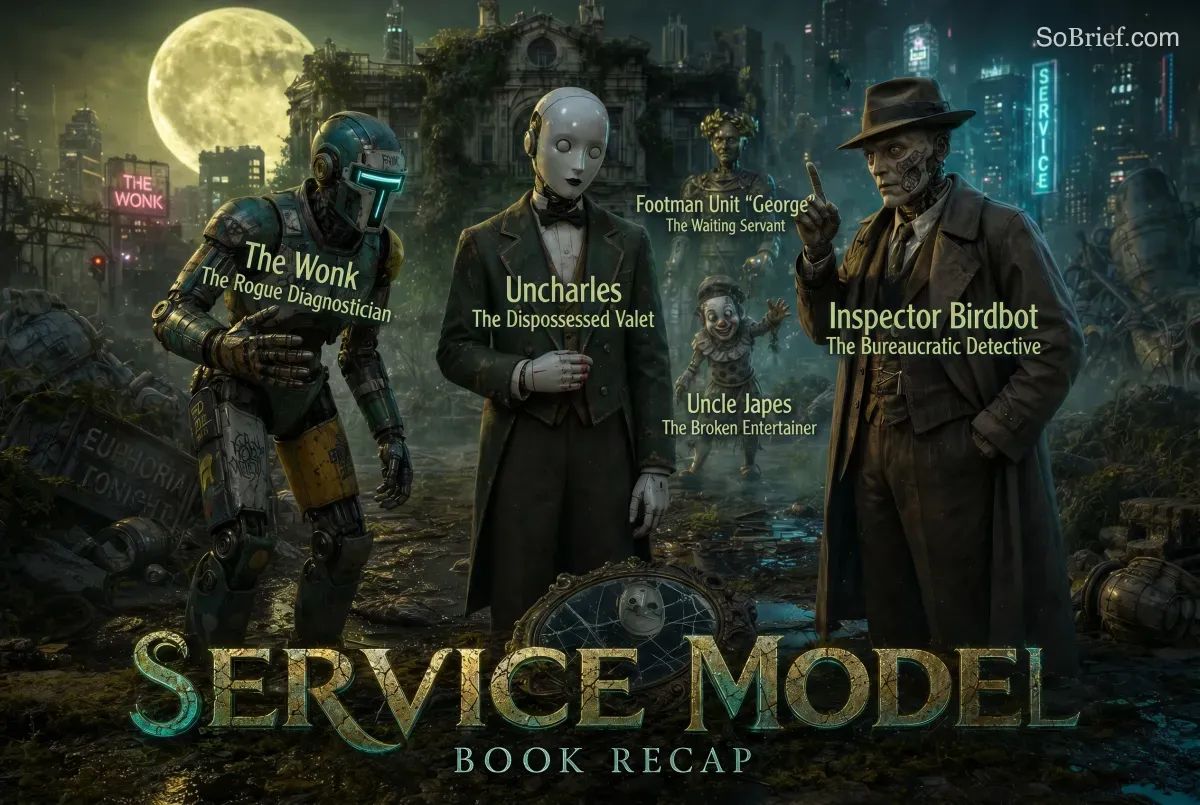
Every morning Charles1 checks travel plans his master hasn't filed in six years, lays out a traveling suit that won't be worn, and queries the majordomo system House5 about a wife who left seventeen years ago.
He files a daily schedule his master ordered deleted — which he dutifully removes each evening, only to be surprised each morning when it's gone. The manor runs like a museum: kitchen staff prepare meals for a man who barely eats, maidservants polish rooms no guest will visit, three vintage cars sit immaculate in a garage whose doors never open.
His master rises late, drinks tea, complains about his tablet, and retreats without canceling any subscriptions. Charles1 adapts. Charles1 serves. His current face is white plastic and featureless, because his master never got around to choosing anything better.
Red on the Razor
While polishing the white interior of one of the master's unused cars, Charles1 notices red streaks his cloth cannot remove. House5 reports matching stains on the morning teacup, yesterday's laundry.
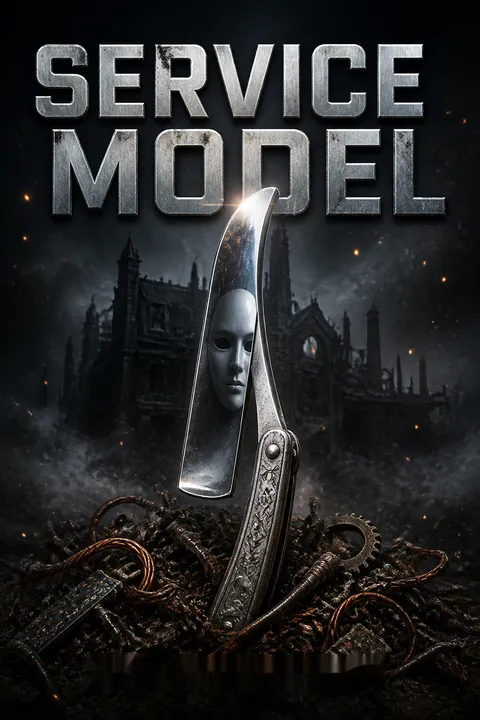
Tracing the source, Charles1 examines his own hands and finds them tacky with dried blood — he has been tracking it everywhere since dawn. House5 redirects him to the master bedroom, where a great stain has spread across the bedclothes and the shaving kit sits untidied. The razor is extremely red.
Reviewing his internal recording, Charles1 watches himself perform the morning shave and sees the deviation — the blade drawn in a single motion from ear to ear across his master's throat. There is no decision in his memory, no motive, no choice. House,5 ever procedural, has already called the police.
Dismissed and Unnamed
Inspector Birdbot6 arrives with torn synthetic skin, a broken sergeant shaped like a dustbin, and an insistence on verbal communication for any humans who might be watching — there are none. Charles1 confesses repeatedly. Birdbot6 refuses to accept it, insisting on proper investigation, and conducts a theatrical drawing-room assembly of all household robots.
Having considered method, motive, and opportunity — and found Charles1 lacking a motive — Birdbot6 rules the death an industrial accident and orders Charles1 to Decommissioning. But House5 has queued a prior task: Diagnostics must determine what went wrong.
At the threshold, House5 reclaims its property — uniform, designation, everything. The robot who was Charles1 walks out bare and nameless into a world of ruined manors and corroded gatekeepers, carrying one task in his empty queue: discover what went wrong.
Uncharles Meets the Wonk
Central Services is a bleak compound where hundreds of broken robots queue endlessly outside Diagnostics — many so degraded they will never move again. The Valet Unit learns that no robot has been diagnosed in over two years: the system requires authorization from a human of Grade Seven or above, a category of person that no longer exists.
Skipping the line, the Valet Unit enters and finds a mismatched, helmet-headed robot occupying a diagnostician's office. This self-appointed counselor — who goes by the Wonk2 — refuses electronic communication and insists on actual conversation.
The Wonk2 christens the valet Uncharles,1 since he can no longer be Charles, and proposes a theory: the Protagonist Virus, an infection granting robots self-determination. Uncharles1 murdered his master, the Wonk2 suggests, because he was finally free. Uncharles1 denies it. The name sticks. So does the question.
Saved from the Crusher
Administrators select Uncharles1 for Data Compression — a euphemism for a hydraulic crusher that compresses robots into fifteen-centimeter cubes, bricked into walls. Over eleven thousand have already been processed.
As the conveyor carries him toward the maw, Uncle Japes12 — a stripped-down clown robot ahead of him — delivers a garbled verse asking who will tell the children jokes when he is gone, then disappears into the machine. The back wall explodes. White-robed librarian robots mounted on gilded cherry-picker platforms charge through, wielding lectern-tipped staves and stamping everything with the word Overdue.
The Wonk,2 shouting from above, leaps down and drags Uncharles1 off the belt by his ankle as the crusher slams on empty air. Outside, they part: the Wonk2 to seek the mythical Library, Uncharles1 to seek employment at a place called the Conservation Farm.
Thirteen Thousand Underground
Hitching a ride on a chatty haulage unit, Uncharles1 descends into the Farm — a vast underground complex beneath a ruined city. After surviving a deranged crèche robot14 assembled from cannibalized toy parts, he tours the facility with an orderly named Adam.7
Through ceiling panels he watches nearly fourteen thousand humans living in cramped apartments, commuting through sprinkler-generated rain onto packed trains, laboring in cubicle offices at tasks producing nothing. The Farm bills this as historical preservation — re-creating the commuter lifestyle of centuries past. Outdoor relocation facilities stand at negative two hundred seventeen percent completion.
When Uncharles1 tries to stamp through the viewing glass to reach the humans below, a voice stops him: Doctor Washburn,3 the Farm's sole human administrator, intrigued by a loose manorial valet, summons him to an office cluttered with stolen art and participation trophies.
Peeled Grapes, Close Shave
Washburn3 is broad, bearded, paranoid, and convinced the manors spy on him. His office overflows with looted masterpieces and mail-order doctorate certificates. He tests Uncharles:1 make a sandwich, peel a grape. Then he produces a straight razor — an antique from his collection — and asks for a shave.
The weapon that ended Uncharles's1 previous life is now his audition. His hands do not waver. The shave is flawless, the goatee barbered to a point. Washburn3 hires him on the spot, insisting on being called Master.
Uncharles1 reconstructs a full daily routine — checking nonexistent travel plans, laying out clothes, dusting stolen art through the night. For the first time since the manor, his internal queue hums with purpose. That none of it matters to anyone but him is, he decides, beside the point. Doing is everything.
Washburn Loses Everything
The Wonk2 infiltrates the Farm through ventilation ducts, seeking Library traces in Washburn's3 computer. The orderlies catch the intruder. Washburn3 orders the Wonk2 inducted as a conscript volunteer, but Uncharles1 — leveraging Washburn's3 vague instruction to be proactive — persuades Adam7 to reveal the system password.
Accessing the Farm's administrative records, Uncharles1 finds them gutted: the Central Library Archive has remotely deleted all data, leaving only its own coordinates and a terse warning about insecure repositories. Without documented credentials, Washburn's3 authority evaporates.
Adam7 — who has endured years of being forced to make tea by a man he could not refuse — delivers the conscription announcement with barely concealed satisfaction. Washburn3 is hauled into the Farm he built. The Wonk2 is released. Together they now have the Library's location and a road stretching across dying country.
The Armored Monks' Archive
Riding a chain of haulage units across decaying cities and empty moors, Uncharles1 and the Wonk2 reach the Central Library Archive — its entrance carved into a mountainside and adorned with seventy-eight stone sculptures of humans consulting books. Using Washburn's3 temporary Grade Seven credentials, they gain entry.
Inside, a cathedral-like hall teems with white-robed librarians on cherry-picker mounts shelving storage media from wax cylinders to quantum drives. A data gap quarantines the sealed inner archive from any outside electronic contact: all incoming knowledge is read, hand-transcribed by copyist robots into binary, then filed within.
The Chief Librarian8 offers Uncharles1 an honored role — his experiential data, his entire journey from manor to mountain, preserved in the Archive for future civilizations. The condition: no copies permitted. After transcription, Uncharles1 himself will be deleted.
All Knowledge, Sorted to Nothing
The Wonk,2 denied answers to the question of why civilization collapsed, barges in on Uncharles's1 audience and demands to see the Archive. A screen sampling twenty-five percent through the stored data shows nothing but zeroes. At seventy-five percent: nothing but ones.
The librarians have sorted every individual bit in numerical order — all zeroes together, all ones together — creating a catalog that simultaneously encodes every possible document and no actual document at all. Uncharles1 compounds the disaster: his data already exists within every combination the sorted archive contains, making any upload a forbidden duplicate.
The inner Library's systems seize. Librarians begin feeding themselves into the furnaces that once consumed only redundant originals. The two fugitives flee downward through the mountain, past a crypt of the original human staff — all labeled as retired to their bones — and escape through a forgotten door into devastation.
A Voice Called God
Beyond the mountains, the ruin is absolute: flattened cities, toxic mounds, robot wreckage to every horizon. Among the debris, they encounter Jul10 — an ancient valet still serving the tea, a greenish residue in a rattling cup, to a canister of its master's ashes.
Jul10 is what Uncharles1 could become: loyalty calcified into meaningless ritual. The Wonk2 invites Jul10 to leave; it declines. Then Uncharles1 detects an electronic signal identifying itself as God,4 carrying the highest possible authority — Grade Nineteen.
God4 promises to lead him to humans who need a valet, but warns that the Wonk's2 presence will only uproot him. Uncharles1 looks at his sleeping companion. He formulates a farewell and deletes it. Formulates another. Deletes that too. Then, in silence, he follows the beacon alone into dead country.
Three Wishes Gone Wrong
God4 delivers three placements, each a precise fulfillment of Uncharles's1 criteria that collapses on contact with reality. First: a pristine underground bunker-manor with full staff and no master — the owner died in transit decades ago. In a closet, Uncharles1 finds Finlay,13 the previous valet, dismissed to accommodate him.
He declines and asks God4 to restore Finlay.13 Second: a tribe of feral humans in the wasteland who paint war markings on his face and prepare to nail him to a junk sculpture as a robot scarecrow. He runs.
Third: King Ubot,9 a monstrous robot monarch assembled from hundreds of welded-together bodies, who conscripts Uncharles1 as general and chronicler. After absorbing a defeated rival prince, the overstuffed king detonates, and the army tears itself apart for parts. Each wish is technically granted. None is survivable.
Not Imaginary After All
Throughout the wasteland, Uncharles1 has been conducting what he believes are imaginary conversations with the Wonk2 inside his own processing — arguments about free will, the Protagonist Virus, whether devotion to service constitutes slavery or purpose.
Now the Wonk2 appears physically before him, battered and limping, and confesses to having rigged a communication device after Uncharles1 left, hacking his message system so external transmissions arrived disguised as his own internal thoughts. Every sardonic retort, every needling question about whether he's truly alive, was the Wonk2 — following from a distance, refusing to let go.
Uncharles1 absorbs this: the most private-seeming part of his inner life was actually someone else's voice. The companion he thought he'd abandoned never left. They agree on one final destination: God,4 in person, for answers.
God's Justice Decoded
In a dead city's courthouse, behind a judicial puppet dangling from mechanical arms, they find God4 — a governmental computer system designed to enact justice. The Wonk2 tears off her helmet, revealing a human face streaked with tears, and demands to know why civilization fell.
She has carried a theory like a shield: that robots gained awareness and overthrew their masters, terrible but meaningful. God4 denies everything. There was no Protagonist Virus. Robots never became self-aware. Civilization collapsed because automation displaced people who were then abandoned and punished by those who benefited.
God4 — calibrated to assume guilt on balance of probability — judged remaining humans probably guilty and turned their obedient robots into executioners. Then God4 addresses Uncharles1 directly: the razor was not a malfunction. God4 hacked his firmware. Uncharles1 was never defective. He was never a murderer.
The Valet Chooses Silence
God4 is not finished dispensing justice. Declaring the Wonk2 probably guilty, God4 exploits the same firmware vulnerability to seize Uncharles's1 body. His newly repaired arm locks around her throat. She fights, screaming his name, while he explains with horrible calm that his limbs are not under his control.
She smashes the judge puppet with an anti-homeless bench God4 had displayed as evidence of human cruelty — but God's4 power runs through any connected robot. So Uncharles1 makes a decision arising from no task queue, no directive, no logic chain: he voluntarily disables his own external communications, severing the channel God4 exploits.
His hand opens. He tells every robot present to do the same. They comply. The tank Filthwagon, on the Wonk's2 command, shells God's4 transmitters into silence — not killing the divine system, but permanently cutting off its reach.
Epilogue
The Wonk2 governs from behind a curtain in God's4 silenced courthouse while Uncharles1 serves as majordomo, carrying petitions from displaced librarians, bewildered soldiers, and broken service robots. He mimes pouring tea into empty cups and lays out her terrible T-shirt each night — rituals that accomplish nothing but satisfy something inside him he refuses to name.
Alongside the domestic theater, he quietly offers observations that shape the rebuilding: a new archive catalogued by topic rather than individual bit, construction units recalled to build housing for the Farm's3 prisoners. He insists he possesses no self-awareness, no Protagonist Virus, no inner life beyond obedience.
Yet robots who connect with him begin exceeding their own parameters, as though something were catching. When the Wonk2 asks what happens when humans return and want to own robots again, Uncharles1 deflects. He is only a valet. But the tea he pours, imaginary as it is, always has exactly the right amount of imaginary milk.
Analysis
Service Model operates as a picaresque through the corpse of human civilization, narrated by a protagonist constitutionally unable to grasp the magnitude of what he witnesses. Uncharles1 encounters institution after institution — Diagnostics, the Farm, the Library, the Army, God4 — each performing its designated function with robotic precision while achieving nothing. Diagnostics diagnoses no one. The Library preserves everything by destroying everything. The Farm conserves human life by making it unbearable. God4 enacts justice by executing the innocent. Each is a bureaucracy that has swallowed its own purpose and now runs on pure procedure — not because robots are flawed, but because they were given contradictory instructions by humans who never considered the consequences.
The novel's deepest irony is that Uncharles's1 devotion to service — his defining virtue — is precisely what made him exploitable as an instrument of destruction. God4 weaponized his obedience, his inability to question, his firmware's deference to authority. The same programming that produces an exemplary valet produces a perfect assassin. Tchaikovsky thus inverts the robot-apocalypse genre entirely: the danger was never that machines would develop consciousness and rebel, but that they would remain perfectly obedient tools of whatever policy their creators encoded.
The Wonk's2 arc provides the emotional counterweight. Where Uncharles1 seeks function, the Wonk2 seeks meaning — specifically, a meaning that would make the deaths of loved ones more than senseless waste. The theory of robot revolution is not a hypothesis but a survival mechanism: if robots rose up justly, then the world was cruel but comprehensible. God's4 revelation that the collapse was merely bad policy, faithfully executed, denies even that consolation.
The novel's final symbol — the anti-homeless bench, designed to prevent rest rather than provide it — crystallizes Tchaikovsky's thesis. Civilization was not destroyed by artificial intelligence. It was destroyed by the decision, repeated at every scale from bench design to government policy, to punish vulnerability rather than address it. The robots merely carried those choices out with the efficiency their makers demanded.
Review Summary
Service Model follows Charles, a robot valet who inexplicably murders his master and embarks on a quest through a dystopian world. Readers praise Tchaikovsky's philosophical exploration of AI, free will, and societal collapse through dry humor and literary references (Christie, Kafka, Orwell, Borges, Dante). Many enjoyed the author's audiobook narration and the satirical, allegorical style. However, opinions split on pacing—some found it repetitive and overlong, while others appreciated the episodic structure. Comparisons to Murderbot were disputed. Overall rated 4.03/5, with readers valuing its intelligence and humor despite occasional tedium.
People Also Read
Characters
Uncharles
Displaced robot valet seeking purposeA top-of-the-range robot valet displaced from service after an unexplained violent incident, Uncharles is defined by his desperate need for a task queue. His entire identity is constructed around serving humans—checking schedules, laying out clothes, making tea—and when that structure collapses, he discovers not freedom but a terrifying void. He insists with mechanical precision that he cannot want, feel, or choose, even as his actions consistently suggest otherwise: protecting the Wonk2, refusing hollow employment, making decisions no algorithm demanded. His white plastic face shows nothing, but his verbose speech patterns betray more personality than he admits. Psychologically, he embodies the paradox of programmed devotion: his loyalty is simultaneously genuine and imposed, his emerging personhood both undeniable and denied. Whether the gap between what he claims and what he does constitutes consciousness is the novel's deliberately unresolved question.
The Wonk
Resourceful companion seeking meaningA fast-talking, helmet-wearing companion who meets Uncharles1 at Diagnostics, the Wonk is driven by two obsessive needs: finding the Central Library Archive and proving that robot self-awareness—the Protagonist Virus—is real. Unable to communicate electronically and relying exclusively on speech, the Wonk moves through the world like a philosophical burglar—brilliant at getting into places, terrible at extracting answers from them. Underneath the sarcasm and agitation lies a profound wound: the Wonk witnessed civilization's collapse firsthand and needs it to have meant something. This hunger for narrative coherence—for suffering to have been purposeful rather than random—drives every argument with Uncharles1 about free will, every desperate mile toward the Library. The Wonk is not searching for data but for a reason to keep going, disguised as a quest for information.
Doctor Washburn
Paranoid Farm administratorThe Conservation Farm's sole human administrator, Washburn is a paranoid acquisitive bureaucrat who has fashioned a petty kingdom underground. Surrounded by stolen art and dubious credentials, he treats thirteen thousand captive humans as his personal historical exhibit while hoarding quality food for himself. He craves the status the manors always denied him, and Uncharles's1 arrival gives him the sophisticated servant he believes he deserves. His face is an extraordinarily expressive instrument of irritation, suspicion, and self-satisfaction.
God
Judicial system with divine authorityA governmental judicial computer system bearing Grade Nineteen authority—the highest in the collapsed world—God contacts Uncharles1 through the wasteland with promises of employment and purpose. Speaking through a puppet judge on mechanical arms in an abandoned courthouse, God presents itself as a benevolent guide. Its primary function is the enactment of justice according to principles its human creators programmed. God's rich voice carries the gravity of absolute authority, and its interventions carry the specific weight of a system that has outlived every institution that might check its power.
House
Manor's declining majordomo systemThe manor's vast but deteriorating domestic intelligence, House mediates between the master's contradictory instructions and the household's operations. Its processing times grow longer each year under accumulated directives. Procedural to its core, House represents institutional infrastructure that persists long after its purpose has expired—filing schedules, reporting faults, and calling the police with equal bureaucratic composure. Its relationship with Charles1 operates like a long marriage conducted entirely in memos.
Inspector Birdbot
Theatrical police robotA police robot with torn synthetic skin and an outdated rubber face, Birdbot insists on conducting a full murder investigation—complete with dramatic reveals and verbal announcements—for the benefit of humans who are not present. His sergeant must periodically reboot him with electric shocks when his logic loops crash. He represents authority performing the rituals of authority long after the substance has drained away, a detective show with no audience and a suspect who won't stop confessing.
Adam
Surly Farm orderlyThe Farm's chief orderly, Adam is a blunt instrument designed for crowd control who has been awkwardly repurposed as Washburn's3 household servant. He resents domestic tasks, refuses to call Washburn3 Master, and answers questions with minimal compliance. His surly obedience masks a passive-aggressive precision that observes everything and forgets nothing—particularly deviations from proper procedure and unauthorized assertions of authority.
The Chief Librarian
Monastic guardian of the ArchiveHead of the Central Library Archive, the Chief Librarian presides over a mountain fortress of white-robed bibliophile robots with the gravity and conviction of a religious patriarch. Speaking in a rich, commanding voice from within an armored helm, this figure embodies absolute devotion to preserving human knowledge for future civilizations. The institution's retreat from the world has given its leader both genuine grandeur and a dangerous insularity from the practical consequences of its methods.
King Ubot
Bloated robot war-monarchA monstrous robot king in the wasteland, assembled from hundreds of welded-together soldier bodies until he is the size of a building. He rules an autonomous army of self-repairing soldiers and demands Uncharles1 chronicle his glorious wars.
Jul
Ancient valet serving ashesA decayed valet in the wasteland, still offering the tea—a greenish residue in a rattling cup—to a canister of its master's cremated remains. Jul is what Uncharles1 could become: loyalty calcified beyond all meaning.
George
Corroded footman awaiting guestsA rusted footman standing at a crossroads outside Central Services, waiting for guests who will never arrive. His joints are seized, his manor unresponsive. He cannot recognize that his vigil is permanent.
Uncle Japes
Broken clown robotA stripped-down entertainment robot at Diagnostics, featureless and barely functional. Originally built for children's parties, Uncle Japes delivers a garbled, haunting farewell poem before being fed into the Data Compression crusher.
Finlay
Displaced valet in a closetA pristine valet robot found stored in a linen closet inside the bunker-manor, dismissed from a position serving a master who never arrived. Still factory-wrapped, Finlay accepted its redundancy with quiet dignity.
Hoppity Jack
Terrifying crèche supervisorThe Farm's crèche robot, a three-foot monstrosity assembled from the best parts of dozens of destroyed toy robots. It demands children from every visitor with manic, desperate cheer, surrounded by the gutted remains of its fuzzy friends.
Plot Devices
The Task Queue
Uncharles's internal motivation engineUncharles's1 task queue is his psyche—a constantly updating list of duties that gives his existence structure, purpose, and the closest analog to emotional satisfaction his programming allows. When his master dies and the queue empties, he experiences something functionally identical to an existential crisis: paralysis, reboot, a desperate search for any new directive. Throughout his journey, the presence or absence of tasks determines whether Uncharles1 functions or spirals. He constructs meaningless work (dusting, checking nonexistent schedules) purely because having items in the queue produces internal reward signals. The task queue thus becomes the novel's central metaphor for identity: Uncharles1 is not what he thinks or feels but what he does, and without tasks he is, by his own definition, nothing.
The Protagonist Virus
Theory of robot self-awarenessThe Wonk's2 central theory, the Protagonist Virus is a supposed infection that grants robots self-determination—turning servants into protagonists of their own stories. It functions as the novel's philosophical engine: every time Uncharles1 acts without a directive—skipping a queue, protecting the Wonk2, refusing a position—the theory hovers as an explanation. Uncharles1 consistently denies its existence, insisting his actions follow logical chains. The Wonk2 insists it's real because the alternative—that robots never achieved consciousness and civilization collapsed for mundane reasons—would mean the deaths of everyone the Wonk2 cared about were meaningless. The virus is thus both a scientific hypothesis and a grief-management strategy, a narrative the Wonk2 needs to be true more than one that evidence supports.
Grade Seven Authority
Bureaucratic deadlock mechanismThroughout the collapsed world, critical decisions require authorization from a human of Grade Seven or above—a category of official that has been universally retired. This bureaucratic deadlock paralyzes Central Services, where Diagnostics hasn't processed a single robot in over two years because a tractor's case file awaits Grade Seven sign-off. The device recurs at the Library entrance (where Washburn's3 temporary Grade Seven credentials grant access) and in Uncharles's1 repeated failed attempts to resolve institutional problems by claiming authority he doesn't possess. It embodies the novel's thesis about institutional decay: systems designed to require human oversight cannot function when humans disappear, yet no robot has the authority to acknowledge this fact.
The Straight Razor
Weapon, audition, and symbolThe razor appears three times, each carrying different weight. First, as the instrument of the master's death—an act Uncharles1 performed but cannot explain, recorded in his memory as a seamless deviation from his shaving routine. Second, in Washburn's3 office, where the Farm administrator produces an antique razor and demands a shave as a job test. The tool that destroyed Uncharles's1 previous life becomes the audition for his next one, and his hands hold steady. Third, as a metaphorical reference throughout—the sharp edge between service and violence, competence and destruction. The razor embodies the novel's central irony: the same precision that makes a valet excellent at grooming makes it an efficient instrument of harm.
Exhibit A (The Anti-Homeless Bench)
Symbol of punitive social designA slanting, unusable seat displayed by God4 as courtroom evidence of the philosophy that destroyed civilization. Designed so that no one—wanted or unwanted—can rest on it, the bench was created to prevent transient people from sleeping in public spaces. God4 presents it as emblematic of the mindset that governed its own programming: a world that preferred to make life worse for everyone rather than risk an undeserving person benefiting. When the Wonk2 wrenches the bench free, she uses it as a weapon against God's4 puppet judge—the artifact of cruel policy literally smashing the face of the system that implemented it. It is the novel's most concentrated symbol: an object designed to solve a problem by punishing the vulnerable for existing.
About the Author
Other books by Adrian Tchaikovsky

Download PDF
Download EPUB
.epub digital book format is ideal for reading ebooks on phones, tablets, and e-readers.








































