
Key Takeaways
1. True victory comes through surrender to the divine
Remember Jesus of Nazareth, staggering on broken feet out of the tomb toward the resurrection, bearing on his body the proud insignia of the defeat that is victory, the magnificent defeat of the human soul at the hands of God.
The Jacob struggle. Buechner uses the Genesis story of Jacob wrestling with a mysterious stranger at the river Jabbok as a metaphor for our relationship with God. Jacob, the ultimate "go-getter" who succeeded through cunning and deceit, is brought to his knees, crippled, and forced to beg for a blessing. This ancient, jagged-edged story shows that our deepest spiritual encounters often feel like a violent struggle with an adversary who is actually our greatest lover.
Surrender as victory. This "magnificent defeat" represents the moment we realize our self-sufficiency is an illusion. True peace, love, and joy cannot be seized by force or intellect; they can only be received as gifts when we surrender our wills to God. When we are defeated by God, we are finally made whole, trading our cheap worldly happiness for a deep, undergirding joy.
The proud insignia. Like Jacob limping into the dawn, or Jesus rising with wounds, our spiritual triumphs are marked by our vulnerability.
- We fight God to protect our ego and control.
- God defeats us not to destroy us, but to bless us.
- The limp we carry is the mark of our transformation.
2. God is found in the ordinary, messy realities of human life
If holiness and the awful power and majesty of God were present in this least auspicious of all events, this birth of a peasant’s child, then there is no place or time so lowly and earthbound but that holiness can be present there too.
The scandal of incarnation. The central mystery of Christmas is "Emmanuel"—God with us. Buechner strips away the sanitized, sentimentalized versions of the nativity to reveal a raw, earthbound event filled with the smell of hay, the heavy breathing of a woman in labor, and the crying of a newborn. This is not a fairy tale, but a historical intrusion of the infinite into the finite, splitting time itself into B.C. and A.D.
Lowly places. Because God chose to enter the world in a stable, there is no corner of human existence too dark or mundane for the sacred to dwell. Holiness is not reserved for pristine sanctuaries; it is present in the muck, the noise, and the ordinary struggles of daily life. This means we are never safe from God's power to break in and recreate our hearts in the most unexpected places.
Vulnerability of love. By becoming flesh, God put Himself at our mercy, choosing to suffer with us.
- God comes to us in the hungry, the lonely, and the desperate.
- We are free to turn our backs or to welcome Him.
- True love is inseparable from the willingness to suffer.
3. Faith is not absolute certainty, but a persistent hope in the dark
And that no-man’s-land between the Yes and the No, that everyman’s land, is where faith stands and has always stood.
The tension of belief. Faith is not a static set of dogmas or a state of intellectual certainty. Instead, it is a dynamic, often fragile movement that exists in the tension between belief and doubt, constantly wrestling with the silence of God. It is the "nevertheless" of the human spirit, holding fast to a hope that cannot be scientifically proven but is deeply felt.
Whistling in the dark. Buechner compares faith to whistling in the dark—an act of courage that doesn't deny the darkness but insists that the dark is not all there is. It is a homesickness for a land we have only glimpsed from afar, a hunch that our lives have an ultimate destination. This faith is a gift of grace, not an achievement of the intellect.
The active wait. Faith is characterized by waiting and watching for the subtle ways God breaks through our blindness.
- It is a "nevertheless" spoken against despair.
- It is a willingness to press on despite unanswered prayers.
- It is the eye of the heart seeing beneath the surface of things.
4. Vocation is where your deep gladness meets the world's deep hunger
I believe that if it is a thing that makes us truly glad, then it is a good thing and it is our thing and it is the calling voice that we were made to answer with our lives.
The calling voice. Vocation is not merely a career choice or a means to acquire status and salary. It is a response to a voice that calls us from both inside and outside, summoning us to spend our lives doing what we were uniquely made to do. Our lives are full of clamorous voices, but the truest voice speaks to our deepest identity.
Gladness and service. Buechner rejects the Puritan notion that work must be a joyless penance. Instead, he argues that our own deep gladness is a crucial guide, and when aligned with the world's deep needs, it becomes a powerful force for healing. We must go with our lives where we most need to go and where we are most needed.
Listening for the summons. We must tune out the blaring voice of mass culture to hear our true calling.
- Vocation is where our unique gifts are fully utilized.
- The world needs our youth, our passion, and our joy.
- To ignore this call is to risk living a life of empty success.
5. We must become good stewards of our pain rather than burying it
What’s lost is nothing to what’s found, and all the death that ever was, set next to life, would scarcely fill a cup.
The danger of burying. When painful things happen, our natural instinct is often to bury them deep inside, hiding them from others and ourselves. However, the "buried life" leads to spiritual stagnation, isolation, and a slow withering of our capacity for joy. Playing it safe by ignoring our wounds is a way of not really living at all.
Stewardship of sorrow. Being a good steward of pain means holding it to the light, acknowledging its reality, and allowing it to connect us to the suffering of others. Pain, when shared and traded, becomes the raw material for compassion and deep human meeting. It is through our vulnerability that we become truly human and open to grace.
Gold from straw. Like the servants in the parable of the talents, we are called to "trade" with what we have been given, including our wounds.
- Burying pain creates an inner darkness of weeping and gnashing of teeth.
- Sharing pain breaks down the barriers of isolation.
- Our wounds can become a source of healing for others.
6. The church is a community of flawed humans called to heal one another
The reason he made his church out of human beings is that human beings were all there was to make it out of.
A family of misfits. The church was not founded as a club for the righteous, but as a gathering of ordinary, flawed individuals. From the original twelve disciples—who doubted, competed, and fled—to the modern congregation, the church is made of "lost sheep." It is a human institution with all the accompanying cowardice, stupidity, and grace.
The work of healing. The true mission of the church is to be a place of mutual healing, where we cast out demons of anxiety and raise each other from the deaths of loneliness and despair. It is a family where we belong to each other, bound by a love that transcends our differences. We are called to be the hands, feet, and heart of Christ to one another.
Stripping away the excess. If a historical wave washed away the buildings, budgets, and programs, we would still have the essence of the church: Christ and each other.
- We are called to be Christs to one another in practical ways.
- Healing and being healed go hand in hand.
- The church is defined by acts of love, not institutional success.
7. The Kingdom of God is a present, transfiguring reality of joy
The Kingdom of Heaven is only twenty minutes down the road, for Christ’s sake.
A present reality. The Kingdom of God is not just a far-off future event, but a reality that is "at hand," buried within the ordinary moments of our lives. It is a state of wild rejoicing and transfiguration that we can glimpse if we only have the eyes to see. It is as close as breathing, crying out to be born within us.
Glimpses of glory. Buechner describes running into this holiness head-on—in the bustling, beautiful traffic of New York City, in the play of a child, or in the majestic leap of killer whales. These moments of "the great dance" remind us that joy is our true home, and that we have God's joy in our blood.
Repent and believe. To enter the Kingdom, we must "repent"—which means to turn around 180 degrees—and believe the good news that we are loved.
- The Kingdom is found in the everydayness of our lives.
- It is characterized by compassion, tolerance, and justice.
- Living in the Kingdom means acting as if it is already here.
8. Our personal stories are deeply intertwined with the divine narrative
To cleave the truth of our own lives, to live and look beneath our own stories, is to see glimmers at least of his life, of his life struggling to come alive in our lives, his story whispering like a song through the babble and drone of ours.
The overlapping stories. Buechner asserts that there are ultimately only two stories—our own story and Jesus's story—and in the end, they are the same story. The events of Christ's life (baptism, temptation, ministry, crucifixion, resurrection) are mirrored in our own struggles and triumphs. Our stories are a parody of His, yet they meet in moments of grace.
The power of parables. Jesus taught in stories because truth is not a static doctrine but a living, breathing reality. By looking beneath the surface of our own narratives, we discover the "word of life" whispering through our personal histories. Stories capture the complexity, sadness, and joy of being human in a way that abstract theology never can.
Living the narrative. We are called to let Christ's story come true in us, becoming "the fragrance of Christ" in the world.
- Our baptisms are the moments we step into a new future.
- Our crucifixions are our griefs and self-surrenders.
- Our resurrections are our survival and capacity to hope.
9. To find the sacred, we must learn to pay attention to our own lives
The name of the room is Remember—the room where with patience, with charity, with quietness of heart, we remember consciously to remember the lives we have lived.
The room called Remember. In a fast-paced world, we are master escape artists, avoiding the long thoughts and deep memories. Buechner invites us to enter the quiet room of remembrance, where we deliberately look back over our journeys to find the hidden presence of God. This slow, grave remembering is a form of prayer.
The evidence of grace. When we remember our lives deeply, we see that we are survivors. We realize that a strength beyond our strength, a wisdom beyond our wisdom, and a love beyond our love have pulled us through our darkest valleys. We see that we were never truly alone, and this memory becomes the foundation of our hope for the future.
Listening to life. God speaks to us not in giant headlines in the stars, but in the humdrum, helter-skelter events of each day.
- Paying attention is the ultimate spiritual discipline.
- The unexpected phone call, the dream, the coincidence are clues.
- To remember the past is to build a solid foundation for hope.
Review Summary
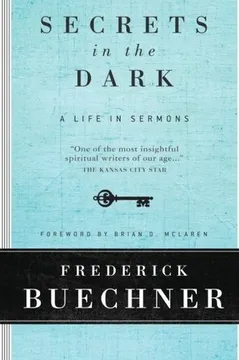
Secrets in the Dark receives an overall rating of 4.39 out of 5, with most readers praising Buechner's poetic, lyrical prose and his ability to weave personal storytelling with theological reflection. Many highlight his honest treatment of doubt, faith, and human imperfection as particularly refreshing. Some critics note inconsistencies between earlier and later sermons, with a few finding his later work too progressive or insufficiently grounded in Scripture. Nevertheless, the majority consider it a spiritually enriching collection, recommending it especially for pastors, seekers, and fans of literary religious writing.








































