

Key Takeaways
Shared fictions — not tools or muscles — made Sapiens the dominant species
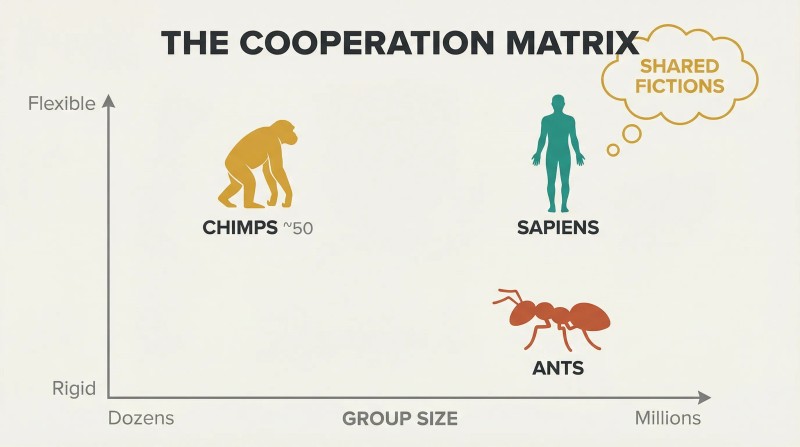
About 70,000 years ago, a genetic mutation sparked what Harari calls the Cognitive Revolution, giving Sapiens something unprecedented: fictive language — the ability to discuss things that don't physically exist. Ants cooperate in huge numbers but only rigidly. Chimps cooperate flexibly but only in groups of about 50. Sapiens alone do both — cooperating flexibly with unlimited strangers — because they can rally around shared myths.
Gossip bonds groups of roughly 150 people, the natural limit of intimate acquaintance. Beyond that threshold, shared fictions become the glue. Two Catholics who've never met can go on crusade together. Two strangers can trade across continents. The secret isn't bigger brains or better tools — it's the ability to collectively believe in things that exist nowhere except in our shared imagination.
Gods, nations, money, and human rights exist only in collective imagination
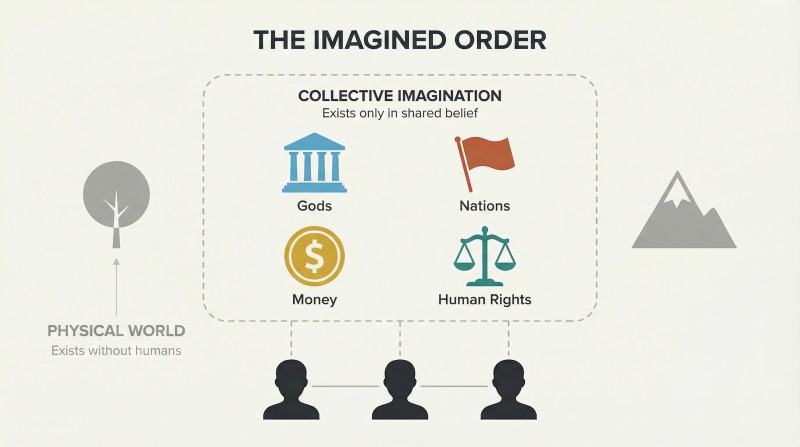
Harari calls society's shared beliefs imagined orders — constructs that millions treat as objective reality. Consider Peugeot: destroy every car, fire every employee, demolish every factory — the company still exists as a legal entity. Only a court order can kill it, because Peugeot lives in legal imagination, not the physical world. The same logic applies to nations, corporations, and the dollar.
An imagined order isn't a lie. A lie is deliberate deception; an imagined order is something everyone sincerely believes. Most millionaires genuinely believe in money. Most activists genuinely believe in human rights. Since the Cognitive Revolution, Sapiens have lived in a dual reality: the objective world of rivers and trees, and an imagined world of gods, nations, and corporations that has grown ever more powerful.
Farming gave us more food but worse lives — wheat domesticated us
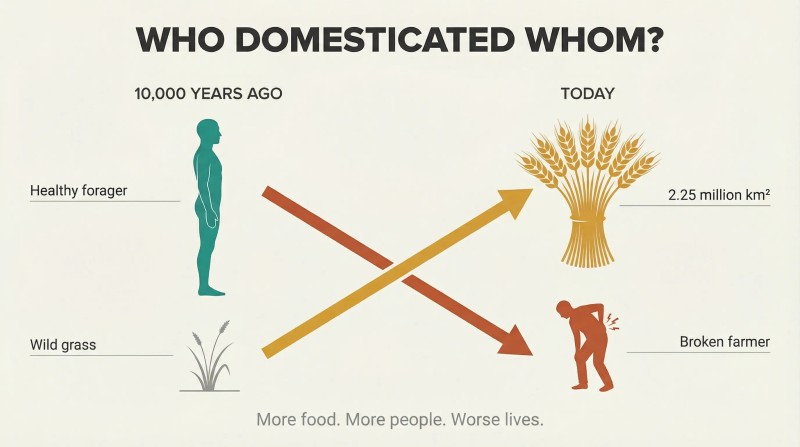
Around 10,000 years ago, Sapiens traded varied foraging for backbreaking labor. Harari calls the Agricultural Revolution "history's biggest fraud": farming demanded cleared rocks, irrigation, and constant pest control. Human spines, knees, and necks paid the price — ancient skeletons show spikes in arthritis, hernias, and slipped discs. Diet narrowed dramatically: a typical Chinese peasant ate rice for breakfast, lunch, and dinner.
The real beneficiary was wheat itself. Ten thousand years ago it was a wild grass confined to the Middle East; today it covers 2.25 million square kilometers. But extra food didn't improve individual lives — it fueled population growth. A village growing from 100 to 110 couldn't send 10 people back to foraging. The trap snapped shut generation after generation, and nobody remembered the alternative.
Watch for the luxury trap — the pattern that enslaved ancient farmers
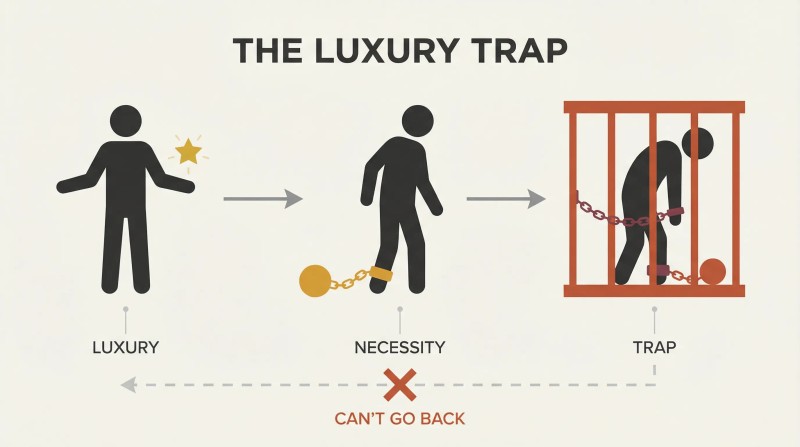
The luxury trap describes how small improvements become inescapable burdens. Ancient farmers thought hoeing fields instead of scattering seeds would prevent hunger. It worked — but more food meant more children, weaker immune systems from settled living, and vulnerability to single-crop failure. Nobody could go back because population growth burned the boats behind them.
The same pattern recurs relentlessly. Email was supposed to save time; now we manage dozens daily, all expecting immediate replies. Young professionals take demanding jobs planning to retire at 35, only to find mortgages and school fees make quitting impossible. Harari argues this is humanity's recurring blind spot: each generation makes small rational choices that accumulate into irreversible transformations nobody planned or wanted.
Money united the world where gods and kings could not
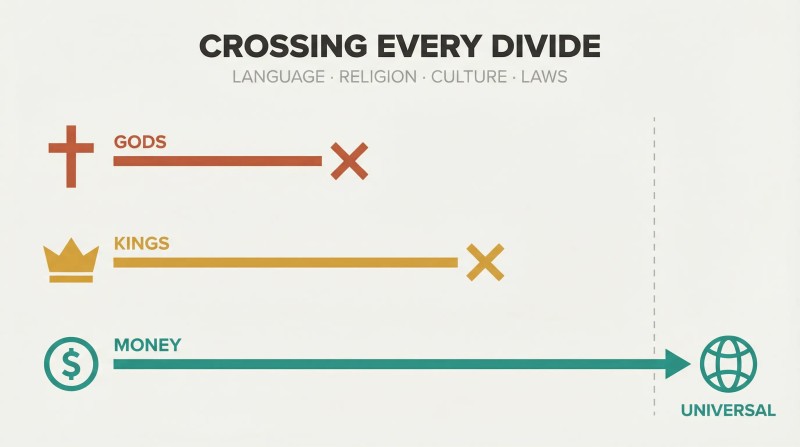
Money is a mutual trust system, not a material reality. Cowry shells, gold coins, and digital dollars share one feature: people accept them because they trust others will too. Christians and Muslims who killed each other over theology happily used each other's coins — twelfth-century millares struck by Christian conquerors bore Arabic inscriptions praising Allah. Today over 90% of the world's roughly $60 trillion exists only as electronic data.
Money's genius is universal convertibility: land becomes loyalty, health becomes justice, brawn becomes brain. But this corrodes communities — when everything has a price, honor, loyalty, and love get absorbed into market logic. People rely on money to cooperate with strangers, yet fear it will corrupt the bonds that can't be bought.
History reveals race, caste, and class as accidents hardened into 'nature'
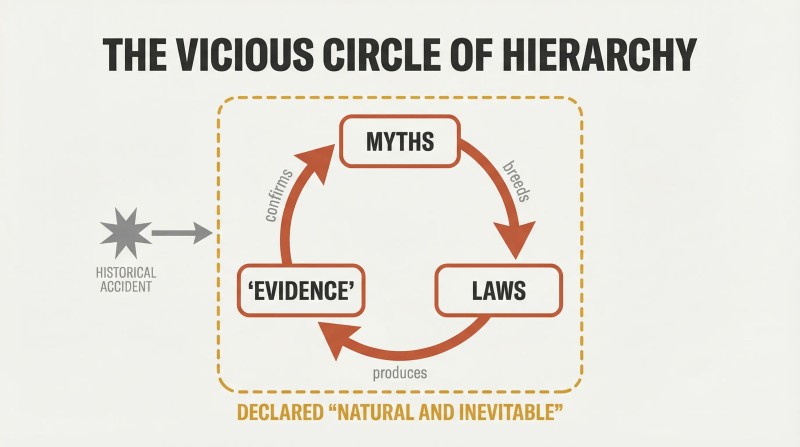
Hierarchies crystallize from accidents. American racial hierarchy began from circumstantial factors: Africa was geographically close, its slave trade already existed, and Africans had partial genetic immunity to tropical malaria. These practical advantages bred racist myths, which bred discriminatory laws, which produced "evidence" of black inferiority — because discrimination blocked advancement, confirming the prejudice. Harari calls this a vicious circle.
The same logic explains India's caste system (born from a 3,000-year-old invasion) and gender hierarchies worldwide. Both the Code of Hammurabi (declaring people divided into superiors, commoners, and slaves) and the American Declaration of Independence (declaring all men equal) claimed universal, eternal principles. Both were imagined orders — and recognizing this pattern is the first step toward questioning hierarchies that feel natural today.
Before any wheel or weapon, Sapiens halved Earth's large animals
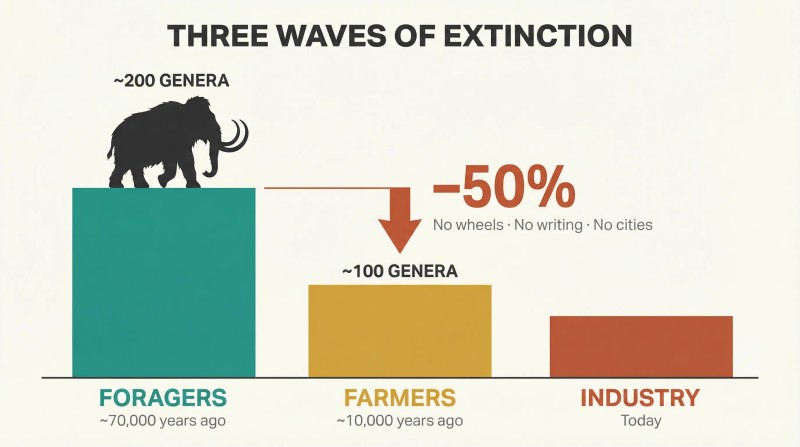
Wherever Sapiens arrived, megafauna vanished. Within a few thousand years of humans reaching Australia (~45,000 years ago), 23 of 24 large animal species went extinct. In the Americas, arrival roughly 14,000 years ago coincided with the loss of 34 of 47 large mammal genera in North America and 50 of 60 in South America — sabre-tooth cats, giant ground sloths, native horses, all gone.
Harari identifies three waves of extinction: the First Wave accompanied foragers colonizing new lands, the Second Wave followed the spread of farmers, and the Third Wave — industrial pollution and overuse — continues today. At the time of the Cognitive Revolution, about 200 genera of large terrestrial mammals existed. By the Agricultural Revolution, only about 100 remained. We were ecological serial killers long before fossil fuels.
Modern science launched when humanity first admitted 'we don't know'
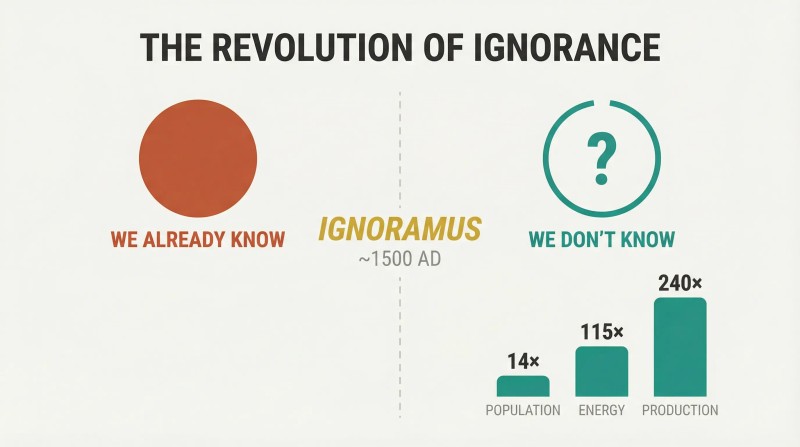
Before ~1500 AD, every knowledge tradition assumed important answers were already known. If a medieval peasant wanted to understand human origins, he asked a priest. Spider research was pointless — if God considered it important, He'd have mentioned it in Scripture. The prophet Muhammad began by condemning ignorance, then quickly claimed complete truth.
Modern science broke this pattern with a Latin admission: ignoramus — 'we do not know.' No theory became sacred. Darwin never claimed to be 'the Seal of Biologists.' This willingness to admit ignorance, gather observations, and connect them through mathematics made science uniquely dynamic. The payoff: since 1500, human population grew fourteenfold, production 240-fold, and energy consumption 115-fold — all because humanity stopped pretending it had all the answers.
Science, empire, and capital formed history's most powerful feedback loop
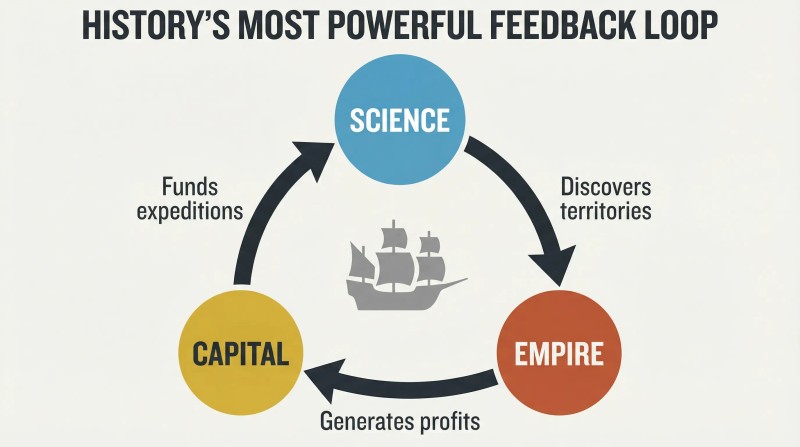
The loop worked like this: credit financed expeditions; expeditions yielded colonies; colonies generated profits; profits built trust; trust unlocked more credit. The Dutch defeated Spain not through military might but by repaying loans on time and maintaining independent courts. The VOC (Dutch East India Company), chartered in 1602, used shareholder funds to hire mercenaries and conquer Indonesia — a private corporation ruling an archipelago for nearly 200 years.
Captain Cook's 1768 voyage captured this marriage perfectly. The Royal Society funded scientists to observe Venus while the Royal Navy provided the ship and claimed territory. Cook discovered a scurvy cure that saved countless sailors — and simultaneously laid the foundation for British colonial dominance over the southwestern Pacific.
Happiness tracks your expectations, not your actual circumstances
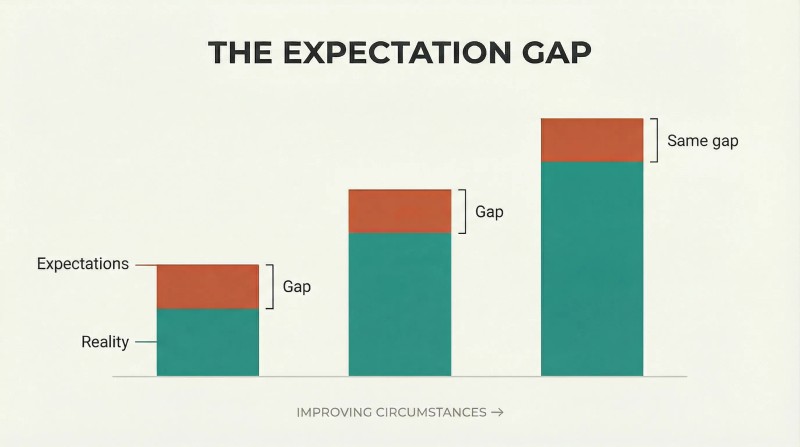
Money helps happiness only up to a point. Beyond basic needs, a lottery win produces roughly the same long-term emotional shift as a debilitating car accident — both fade within months. Family and community matter far more, but the most important variable is the gap between reality and expectations. A medieval peasant content in his unwashed shirt wasn't suffering from poor hygiene — he had no expectation of daily showers.
Mass media constantly inflates expectations. An eighteen-year-old no longer compares herself to fifty village peers but to celebrities and influencers. Biologists suggest our biochemistry functions like an air-conditioning system with a genetic set point: events temporarily shift the temperature, but the system always returns to baseline. Even the French Revolution didn't permanently change French serotonin levels.
The real question isn't what to become — but what we want to want
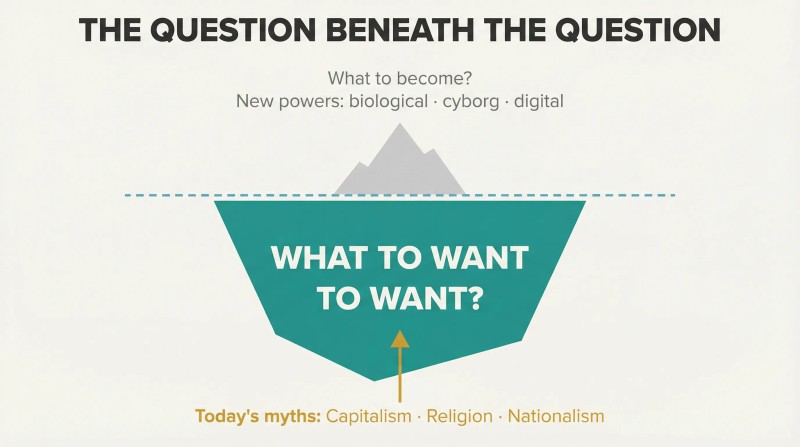
For 4 billion years, life evolved by natural selection alone. Now three technologies threaten to replace it: biological engineering (a fluorescent green rabbit named Alba already exists, created with jellyfish DNA), cyborg engineering (thought-controlled bionic arms, brain-computer interfaces), and inorganic life engineering (self-evolving computer programs). Harari calls the quest for immortality the Gilgamesh Project — science's true flagship endeavor.
Genetic engineers have already extended worm lifespans sixfold and created mice with enhanced memory. If we can soon engineer desires and emotions — not just bodies — then asking 'What do we want to become?' is obsolete. The deeper question is what we want to want, because the first generation of post-human beings will be shaped by our current cultural myths: capitalism, religion, nationalism. After them, all bets are off.
Analysis
Sapiens performs a remarkable intellectual maneuver: it applies the lens of 'fiction' uniformly across money, nations, religion, human rights, and corporations, then asks readers to sit with the discomfort. This move is essentially post-structuralist — Derrida and Foucault for airport bookshops — but Harari's genius lies in making the argument feel empirical rather than theoretical, grounding abstraction in evolutionary biology and archaeological evidence.
The book's central tension, however, goes largely unaddressed: if all human orders are imagined, what normative framework allows us to evaluate one fiction against another? Harari notes that both Hammurabi's hierarchy and Jefferson's equality are myths, then essentially shrugs. This even-handedness is intellectually honest but morally disorienting — it risks implying that liberal democracy and feudal theocracy are equally arbitrary, differing only in their capacity to coordinate populations.
The Agricultural Revolution chapter represents the book's most provocative contribution to popular thought. By reframing wheat's spread as a success for wheat's DNA rather than human welfare, Harari introduces what might be called 'gene's-eye history' — applying Dawkins's selfish gene logic to civilizational analysis. This yields the startling claim that evolutionary success (more DNA copies) correlates inversely with individual well-being, a framework that extends powerfully to industrial livestock and perhaps to modern workers trapped in cubicle farms.
The happiness chapter reveals a deeper philosophical commitment. Harari is ultimately closer to Buddhism than to Western humanism. His argument that feelings are 'fleeting vibrations' and that the pursuit of pleasant experience is the root of suffering imports Eastern metaphysics into what presents itself as secular history. This is the book's most personal and least defended claim, revealing that even Harari's objective survey is shaped by an imagined order of its own.
What makes Sapiens endure is not any single argument but the vertigo it induces — the sensation of seeing your own civilization as one more experiment in a 70,000-year laboratory.
Review Summary
Sapiens: A Brief History of Humankind receives mixed reviews. Many praise its engaging writing style, broad scope, and thought-provoking ideas about human history and development. Readers appreciate Harari's unique perspectives on topics like agriculture, religion, and technology. However, some criticize the book for oversimplification, bias, and lack of depth in certain areas. Despite these critiques, many find the book enlightening and recommend it as an accessible introduction to human history, sparking discussions about our past, present, and future.
People Also Read









Glossary
Cognitive Revolution
Sapiens gain fictive language abilityThe transformation approximately 70,000 years ago when Homo sapiens developed new ways of thinking and communicating, likely triggered by genetic mutations in brain wiring. It enabled fictive language—the ability to discuss abstract and imaginary concepts—which allowed Sapiens to cooperate flexibly in large numbers, outcompete other human species, and begin shaping cultures through shared myths rather than genetic evolution.
Imagined order
Myth-based system governing societyA social system sustained by shared beliefs that exist only in collective human imagination—not in objective reality or individual fantasy. Examples include nations, corporations, legal systems, religions, and human rights. Imagined orders are not lies (participants sincerely believe in them) and are not weak (they exert enormous real-world power). They are the only mechanism enabling large-scale cooperation among strangers.
Inter-subjective
Shared belief across many mindsA phenomenon that exists within the communication network linking the subjective consciousness of many individuals. Unlike objective phenomena (radioactivity exists regardless of belief) or subjective phenomena (an imaginary friend exists for one person), inter-subjective phenomena like money, nations, and human rights persist as long as the community of believers sustains them. If a single individual stops believing, nothing changes; if millions stop, the phenomenon can vanish.
Luxury trap
Improvements become inescapable obligationsA recurring historical pattern in which small changes intended to make life easier gradually accumulate into irreversible burdens. First identified in the transition from foraging to agriculture: each improvement (permanent settlement, irrigation, larger harvests) increased food production but also increased population, making it impossible to return to the previous lifestyle. Harari extends this pattern to modern phenomena like email and career escalation.
Gilgamesh Project
Science's quest to defeat deathHarari's term for the modern scientific endeavor to overcome death itself, named after the ancient Sumerian king who sought immortality. It represents the growing conviction that death is a technical problem—caused by heart attacks, cancer, infections—rather than an inevitable metaphysical fate. Harari argues this project is science's true flagship, and that nearly all biomedical research ultimately serves it, even when framed as curing specific diseases.
Fictive language
Communication about nonexistent thingsThe uniquely human capacity to transmit information about things that do not exist in physical reality—gods, nations, legal entities, future scenarios, abstract concepts. Emerging during the Cognitive Revolution approximately 70,000 years ago, Harari identifies it as the single most important trait distinguishing Homo sapiens from all other species, because it enables the creation of shared myths that coordinate mass cooperation among strangers.
FAQ
What's "Sapiens: A Brief History of Humankind" about?
- Comprehensive history: "Sapiens" by Yuval Noah Harari explores the history of humankind from the emergence of Homo sapiens in the Stone Age to the present day. It examines how our species came to dominate the planet and the impact of our actions on the world.
- Key revolutions: The book is structured around major revolutions: the Cognitive Revolution, the Agricultural Revolution, and the Scientific Revolution. Each revolution significantly altered the course of human history and shaped the modern world.
- Interdisciplinary approach: Harari combines insights from history, biology, anthropology, and economics to provide a broad understanding of human development and the forces that have shaped our societies.
Why should I read "Sapiens" by Yuval Noah Harari?
- Broad perspective: "Sapiens" offers a sweeping overview of human history, providing context for understanding current global issues and the trajectory of human development.
- Thought-provoking insights: The book challenges readers to reconsider commonly held beliefs about human progress, happiness, and the future of our species.
- Engaging narrative: Harari's writing is accessible and engaging, making complex historical and scientific concepts understandable and interesting to a wide audience.
What are the key takeaways of "Sapiens"?
- Human impact: Homo sapiens have had a profound impact on the planet, often at the expense of other species and ecosystems. Our ability to cooperate flexibly in large groups has been a key factor in our success.
- Role of fiction: The ability to create and believe in shared myths and stories has been crucial in uniting large groups of people and enabling complex societies to function.
- Future challenges: As we continue to advance technologically, we face ethical and existential questions about the future of our species and the planet.
How does "Sapiens" describe the Cognitive Revolution?
- Emergence of language: The Cognitive Revolution, occurring around 70,000 years ago, marked the development of complex language, allowing humans to share information and cooperate in unprecedented ways.
- Shared myths: This revolution enabled the creation of shared myths and beliefs, which became the foundation for large-scale social structures and cooperation.
- Cultural evolution: The Cognitive Revolution set the stage for cultural evolution, allowing humans to adapt and thrive in diverse environments through shared knowledge and innovation.
What role does the Agricultural Revolution play in "Sapiens"?
- Transition to farming: The Agricultural Revolution, beginning around 12,000 years ago, saw humans transition from foraging to farming, leading to the establishment of permanent settlements and the rise of civilizations.
- Impact on society: This shift allowed for population growth and the development of complex societies but also led to social hierarchies, increased labor, and a decline in individual well-being.
- Environmental consequences: The Agricultural Revolution had significant environmental impacts, including deforestation, soil depletion, and the domestication of plants and animals.
How does "Sapiens" view the Scientific Revolution?
- Knowledge and power: The Scientific Revolution, beginning around 500 years ago, marked a shift towards empirical observation and experimentation, leading to unprecedented advancements in knowledge and technology.
- Impact on society: This revolution transformed societies, enabling industrialization, globalization, and the rise of modern science and technology.
- Ongoing influence: Harari argues that the Scientific Revolution continues to shape our world, driving technological progress and raising new ethical and existential questions.
What role do imagined orders play in "Sapiens"?
- Foundation of societies: Imagined orders, such as religions, nations, and legal systems, are central to human cooperation and the formation of large societies. They are shared beliefs that exist only in the collective imagination.
- Stability and control: These orders provide stability and control by creating social hierarchies and norms that guide behavior. They enable strangers to cooperate and form complex social structures.
- Flexibility and change: While powerful, imagined orders are not fixed and can change over time. Harari emphasizes that understanding these constructs is key to understanding human history and potential future changes.
How does "Sapiens" address the concept of human happiness?
- Subjective well-being: Harari explores the idea that happiness is subjective and often influenced by expectations rather than objective conditions like wealth or health.
- Historical perspective: The book questions whether historical progress has led to increased happiness, suggesting that modern humans may not be significantly happier than their ancestors.
- Biological factors: Harari discusses the role of biology in happiness, noting that our biochemical systems may limit our capacity for sustained happiness.
What are some of the best quotes from "Sapiens" and what do they mean?
- "The Agricultural Revolution was history’s biggest fraud." This quote highlights Harari's argument that the shift to agriculture led to more work and less satisfaction for individuals, despite increasing the human population.
- "Ever since the Cognitive Revolution, Sapiens have been living in a dual reality." Harari refers to the coexistence of objective reality and imagined realities, such as religions and nations, which shape human societies.
- "There is no way out of the imagined order." This quote underscores the pervasive influence of shared myths and constructs in human societies, suggesting that they are essential for large-scale cooperation.
How does "Sapiens" explore the future of humankind?
- Technological advancements: Harari discusses the potential for genetic engineering, artificial intelligence, and other technologies to fundamentally alter human nature and society.
- Ethical dilemmas: The book raises questions about the ethical implications of these advancements, including issues of inequality, identity, and the definition of what it means to be human.
- Uncertain future: Harari emphasizes the uncertainty of the future, urging readers to consider the long-term consequences of our actions and the kind of world we want to create.
How does "Sapiens" challenge traditional narratives of history?
- Interdisciplinary approach: Harari combines insights from various disciplines to provide a more nuanced understanding of human history.
- Questioning progress: The book challenges the notion that human history is a linear progression towards improvement and highlights the complexities of societal change.
- Reevaluation of myths: Harari encourages readers to reevaluate the myths and narratives that have shaped human societies and consider their impact on the present and future.
About the Author
Other books by Yuval Noah Harari






Download PDF
Download EPUB
.epub digital book format is ideal for reading ebooks on phones, tablets, and e-readers.








































